“Greece is the witness to this because it was set aflame with a desire for eloquence and has surpassed in it and exceeded other places But Greece also has greater antiquity in all arts which it not only discovered but perfected because the power and abundance of speaking was developed by the Greeks. When I consider Greece, Atticus, your Athens occurs to me especially and shines out like a lighthouse. It is here that an orator first showed himself and here that oratory began to be entrusted to monuments and writings.”
vii. Testis est Graecia, quae cum eloquentiae studio sit incensa iamdiuque excellat in ea praestetque ceteris, tamen omnis artis vetustiores habet et multo ante non inventas solum sed etiam perfectas, quam haec est a Graecis elaborata dicendi vis atque copia. In quam cum intueor, maxime mihi occurrunt, Attice, et quasi lucent Athenae tuae, qua in urbe primum se orator extulit primumque etiam monumentis et litteris oratio est coepta mandari.
Inspired by the essay “Just a Girl: Being Briseis“, I have been reading through more passages about Briseis. In the Iliad, she performs a memorable lament for Patroklos. The much later Posthomerica similarly instrumentalizes her grief and uses her character as a way to amplify the loss of Achilles. Note, however, the really terrible observation of this passage that for a woman in war it can always get worse.
Quintus, Posthomerica 3.551-573
“Of all the women, Briseis felt the most terrible grief
in her heart within, the companion of warring Achilles.
She turned over his corpse and tore at her fine skin
With both hands and from her delicate chest
Bloody bruises rose up from the force of her blows—
You might even say it was like blood poured over milk.
Yet she still shined even as she mourned in pain
And her whole form exuded grace.
This is the kind of speech she made while mourning:
“Oh what endless horror I have suffered.
Nothing that happened to me before this was so great
Not the death of my brothers nor the loss of my country,
Nothing exceeds your death. You were my sacred day
And the light of the sun and the gentle life,
My hope for good and tireless defense against pain—
You were better by far than any gift, than my parents even—
You were everything alone for me even though I was enslaved.
You took me as your bedmate and seized me from a slave’s labor.
But now? Some other Achaean will take me away in his ships
To fertile Sparta or dry and thirsty Argos
Where I will again suffer terrible things working away,
Apart from you and miserable. I only wish that
The earth had covered over me before I saw your death.”
“I wish you’d think about one thing also. I am hearing that Appius is building a gateway at Eleusis. Would we be fools if we made one at the Academia too? “I think so” you will answer. But, still, then—write this to me. I really do love Athens itself. I want there to be some memento in the city and I hate lying inscriptions on other’s statues. But do what pleases you. And let me know what day the Roman mysteries indicate and how the winter has been. Take care of yourself.”
Unum etiam velim cogites. audio Appium πρόπυλον Eleusine facere; num inepti fuerimus si nos quoque Aca<de>miae fecerimus? ‘puto’ inquies. ergo id ipsum scribes ad me. equidem valde ipsas Athenas amo; volo esse aliquod monumentum, odi falsas inscriptiones statuarum alienarum, sed ut tibi placebit, faciesque me in quem diem Romana incidant mysteria certiorem et quo modo hiemaris. cura ut valeas.
This selection from the Iliad begins with Agamemnon, ends with Achilles, and has at its center Briseis, a woman captured in war and warred over by the Achaean heroes.
Iliad 1.318-350
Agamemnon did not threaten Achilles
and leave it at that. No, he told his able servants,
the heralds Talthybius and Eurybates:
“Go to Achilles’ hut, take Briseis by the arm,
and bring her here. If he won’t give her up,
well, I’ll go with more men and take her myself—
and all the worse for him.”
With that harsh instruction, he sent them on their way.
Reluctant, they walked the shore of the barren sea
to the Myrmidon encampment. And there they found him,
Achilles, idling by his hut and black ship,
not glad to see them. Frightened, awestruck,
they stood before the king saying nothing,
asking nothing. But, in his heart he knew.
He spoke: “Greetings, heralds. Messengers of Zeus and men,
come closer. You’re not to blame; Agamemnon is.
He’s the one who sent you for the girl, Briseis.
Come then, Zeus-born Patroclus, bring the girl out.
Give her to them to take away . . .”
And so Patroclus obeyed his dear comrade:
he brought Briseis from the hut and gave her over
to be led away. The men went back the way they came,
along the Achaean ships. The woman, reluctant,
went with them. Achilles was in tears.
He left his comrades, sat down on the grey sea’s shore,
and looked out on the boundless waters.
I want to highlight a word which occurs twice in the passage: ἀέκων, which I translate “reluctant.” Homer uses it to describe the heralds as they go to collect Briseis from Achilles. Some lines later he uses it to describe Briseis as the heralds return with her to Agamemnon.
What to make of this symmetry? Does it make sense to suggest the heralds and Briseis are in the same boat? The heralds seem to be reluctant because they fear Achilles. But Briseis is unconsenting in a more fundamental way: she’s a sex slave; all that’s happening is against her will. In other words, there’s reluctance, and then there’s reluctance. Homer, I suspect, is neither so monstrous nor so obtuse as to elide the difference.
So try this: in the passage above, reluctance isn’t a disposition of minds, but a disposition of bodies. Whether it’s the heralds or Briseis we’re talking about, the phenomenology of reluctantly going someplace would be largely the same: dragging feet; nervous glancing; head down; unsmiling expression, etc.
That’s one way to justify the symmetry suggested by ἀέκων (“reluctant”), but is that satisfying? I can’t resolve the matter. But what I’m sure of is that conundrums of this sort contribute to the Iliad’s claim on our attention.
“You don’t know, dear Heortius, the number or the severity of the sicknesses which are assailing me nor how long this has plagued me. For you would not disregard sympathy and criticize me if you did. But ignorance is harmful to human beings everywhere and it has force you to accuse instead of console. I will not call you out for not knowing about my suffering.
But someone of those who easily criticize you might still say that you were ignorant because you failed to inquire and that you did not inquire because of antipathy, and by attracting a suspicion of arrogance to yourself you risk greater accusations. But I will not do this because I don’t think it is right to ruin a strong friendship through nonsense. But whenever something like this happens, once I search around or a likely cause for events, I make a defense to myself on others’ behalf.”
“Still now—I hope your father Peleus lives every year he can
And that Pyrrhus come to the same good luck in weapons as you
But just notice worried Briseis, brave Achilles,
And don’t torture the miserable with painful delay.
If your desire for me has turned to boredom,
Force me to die rather than live without you.
You’re forcing it as you act now—my body and complexion are ruined;
This bit of breath that keeps me upright is only hope in you.
If that leaves me? I’ll meet my brothers and husband
And it won’t be glory for you to order a woman to die.
Why bother to tell me to? Strike at my body with bared steel.
There’s blood here to pour once my chest is opened.
Let that sword of yours find me, the very one the goddess stopped
From entering the breast of Atreus’ son.”
Nunc quoque—sic omnes Peleus pater inpleat annos,
sic eat auspiciis Pyrrhus ad arma tuis! —
respice sollicitam Briseida, fortis Achille,
nec miseram lenta ferreus ure mora!
aut, si versus amor tuus est in taedia nostri,
quam sine te cogis vivere, coge mori!
utque facis, coges. abiit corpusque colorque;
sustinet hoc animae spes tamen una tui.
qua si destituor, repetam fratresque virumque—
nec tibi magnificum femina iussa mori.
cur autem iubeas? stricto pete corpora ferro;
est mihi qui fosso pectore sanguis eat.
me petat ille tuus, qui, si dea passa fuisset,
ensis in Atridae pectus iturus erat!
Léon Cogniet, Briséis rendue à Achille découvre dans sa tente le corps de Patrocle, 1815, Orléans, musée des Beaux-Arts
For more on the Iliad from Briseis’ point of view, see the extraordinary anonymous essay, Just a Girl: Being Briseis
D Scholia to the Iliad:
“The Poet seems to use their patronymic names and not their personal ones, for other ancient accounts notes that [Chryseis] was named Astynomê and [Briseis] was named Hippodameia.”
“Then when Briseis, like golden Aphrodite herself,
Saw Patroklos run through with sharp bronze,
Poured herself over him while she wailed and ripped
At her chest, tender neck, and pretty face with her hands.
And while mourning the woman spoke like one of the goddesses:
“Patroklos, you were the dearest to wretched me and
I left you alive when I went from your dwelling.
And now I find you here dead, leader of the armies,
When I return. Troubles are always wresting me from troubles.
The husband my father and mother gave me to
I watched run through with sharp bronze in front of the city,
And then the three brothers my mother bore,
Dear siblings, all met their fate on that day.
But you would not ever let me weep when swift Achilles
Was killing my husband and when he sacked the city of divine Munêtos—
No, you used to promise to make me the wedded wife
Of divine Achilles, someone he would lead home in his ships to Phthia,
where you would light the marriage torches among the Myrmidons.
So now I weep for you, dead and gentle forever.”
So she spoke, while weeping….
“This is the mortal condition—we are born to face these chance occurrences and others like them so that we ought not even trust death when it comes to a human. We find, among other examples, so soul of Hermotimos the Clazomenian which was in the habit of wandering with his body left behind and after a long journey to announce what they could not know unless they were present. Meanwhile, the body remained half-alive until it was cremated by some enemies called the Cantharidae who, ultimately, stole from the returning body as if taking away a sheath.
We also know of Aristeas of Procennesus whose soul was seen alighting from his mouth in the image of a crow—along with the excessive fiction that accompanies this tale. I also approach the story of Epimenides of Knossos in a similar way: when he was a boy and tired out by heat and a journey he went to sleep in a cave and slumbered for 57 years. Upon waking, he wondering and the shape of things and the change as if it were just the next day. Even though old age overcame him in the same number of days as years slept, he still lived to 157 years old.
The gender of women seems to be especially susceptible to this ill because of the disruption of the womb—which, if corrected can restore proper breathing. That work famous among the Greeks of Heraclides pertains to this subject as well—he tells the story of a woman returned to life after being dead for seven days.”
haec est conditio mortalium: ad has et eiusmodi occasiones fortunae gignimur, ut de homine ne morti quidem debeat credi. reperimus inter exempla Hermotimi Clazomenii animam relicto corpore errare solitam vagamque e longinquo multa adnuntiare quae nisi a praesente nosci non possent, corpore interim semianimi, donec cremato eo inimici qui Cantharidae vocabantur remeanti animae veluti vaginam ademerint; Aristeae etiam visam evolantem ex ore in Proconneso corvi effigie, cum magna quae sequitur hanc fabulositate. quam equidem et in Gnosio Epimenide simili modo accipio, puerum aestu et itinere fessum in specu septem et quinquaginta dormisse annis, rerum faciem mutationemque mirantem velut postero die experrectum, hinc pari numero dierum senio ingruente, ut tamen in septimum et quinquagesimum atque centesimum vitae duraret annum. feminarum sexus huic malo videtur maxime opportunus conversione volvae, quae si corrigatur, spiritus restituitur. huc pertinet nobile illud apud Graecos volumen Hexaclidis septem diebus feminae exanimis ad vitam revocatae.
“Periander was ruling Korinth as a tyrant. For the Korinthians claim (and the Lesbians agree with them) that the most wonderful thing happened in his life: Arion of Methymna was carried to Tainaron on a dolphin. He was a kithara player second to none at that time and the first man we know of who composed, named and taught the dithyramb at Corinth.
They say that this Arion spent much time at Periander’s palace but desired to sail to Italy and Sicily. After he made a lot of money there, he wanted to return to Korinth again. He left from Tarentum and hired a ship of Korinthian men because he trusted no one more than Korinthians. But once on the sea, they conspired to throw Arion out to keep his money. After he learned this, he was begging, offering money to them, trying to bargain for his life. But he was not able to persuade him—the sailors commanded him either to do himself in, so that he might have a burial on ground, or to leap into the sea as soon as possible.
When Arion realized he was at the end, he asked, since it might seem right to them, that he appear in full dress standing on the benches singing. And he promised to kill himself after singing. This came as a delight to them if they could hear the best mortal singer at work. They retreated to the middle of the ship from the stern and he donned all his equipment and took up the kithara. While standing on the benches he sang the entire Orthian nome. When he was done with it, he threw himself into the sea in full costume.
They sailed back to Korinth but people claim a dolphin picked him up and took him to Tainaros. Once he got to land, he went to Koronth with all his stuff and when he got there told the whole story. Since Periander distrusted him, he held Arion under guard, separated from everyone. He waited for the sailors. When they were present, they were asked if they could say anything about Arion. When they were claiming that they left him safe somewhere in Italy and he was doing well in Tarentum, he appeared to them looking just like he did when he leaped out of the boat. The sailors were shocked and were not able to deny it since they had been completely refuted. The Korinthians and Lesbians say these things. And there is a bronze dedication of Arion in Tarentum, not very large: a man riding a dolphin.”
Note: This essay was sent to me to be published anonymously. It is a powerful reminder that who you are fundamentally changes what the Iliad means and that the loudest voices are often the abusive ones.
CW: Sexual Assault
You hadn’t heard of Agamemnon when you started college. You didn’t know about the embassy to Achilles or Briseis or the wrath of the gods. You did know that you really liked this guy, let’s call him Carl, and you’d been hanging out with him for a while and you were excited to go to a party at his frat house.
If you had read the Iliad, you might have noticed that Briseis and Chryseis play an awfully big role for people who barely even speak. You might have thought it was weird that Agamemnon insists that he prefers Chryseis to Clytemnestra, but he would part with her if it’s for the best (εἰ τό γ᾽ ἄμεινον), because he’s so worried about the λαός—the people, but really the men. Turns out that sometimes men are only concerned about the well-being of men. But you didn’t see that on a first read anyway, and Homer couldn’t have really helped you navigate the men or the lions.
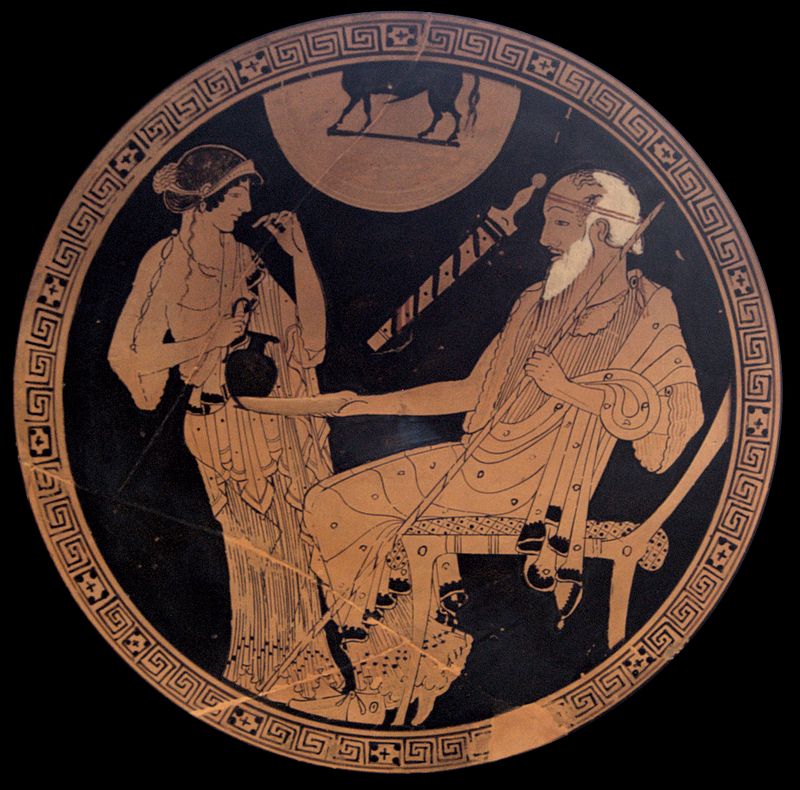
Briseis and Phoenix, red-figure kylix, c. 490 BCE, Louvre (G 152)[1]There’s a lot you don’t know about that party, but you do know that you had a lot to drink, and he took you down to his room and left you there. You might have fallen asleep, you may as well have. When you woke up, there was a stranger on top of you. “Stranger” is a bit strong – it was his ‘big brother,’ a relationship that apparently means quite a lot in a fraternity.
Agamemnon doesn’t want to part with Chryseis, but he will for a price. Or, more precisely, he will if he’s given a prize, a γέρας. Achilles and Agamemnon mention this all-important γέρας thirteen times in Book 1, and Agamemnon makes it very clear that he will not be prize-less (ἀγέραστος). We get another fourteen mentions of honor or dishonor (ἀτιμάω, τιμή, etc.), all of which have to do with the men involved. That’s a lot more than we hear about the women, the girls, whose feelings are inconsequential when men have their honor to worry about. The only feelings we hear anything about are the men—men cry, while women are bartered by men whose feelings are hurt.
Years later, you’d start to realize that words like assault and rape fit what happened to you that night, but that was after years of your pain being used as a punch line and a bargaining token among the brothers at this fraternity. Years of this being a story about how you were a slut and you shouldn’t have gotten so drunk. Years of ‘jokes’ about how you were ‘given’ to that man as a present, from little brother to big brother.
Briseis seated Red Figure Vase, London, British Museum 1843,1103.92 Cat. Vases E 76
And really, the important thing is that Briseis doesn’t end up ruining the Greek army’s chance to win the war. Eventually, the men realize that it’s not worth getting upset over something as meaningless as a girl. As Achilles spits out the words ‘I will not fight with you for the sake of a girl’ (1.298), you feel it in your gut. Ajax says this to Achilles later too – you’re doing this over only a girl (9.637). What a senseless reason to disrupt the unity of the men. Bros before hoes has a longer history than you realized.
Over the next several years, you would remain friends with everyone at the fraternity. You were a liberated college student and not someone who would make a big deal about whatever happened to you. You’re not that kind of girl, and what did it matter that something happened to you that night, that something was taken from you, but you would never – still don’t – know what?
If you look through the Iliad to see what we actually hear about Briseis, you see that she mostly shows up in Book 1 and Book 9, which makes sense. But she gets mentioned in Book 24 in passing. Or, it would be in passing until you start to look for her, and you see that Briseis is sleeping near Achilles, after Priam’s visit. Until you read Silence of the Girls, you didn’t really give this much thought. You fell into the same trap that the Greek men do, you only thought that the men mattered. You don’t like that women are seen as objects, but it is what it is and, anyway, it was a long time ago. But what must it have been like for Briseis to sleep next to this man every night? The man who gave her to Agamemnon – did it matter that Achilles was mad about it? He still handed her over –and now possessed her again. What must it be like to lay next to him every night?
Briseis taken away from Achilles – Pompeii (VI 8 5) – Napoli MAN 9105
As it happens, you were such a cool girl who would never get hung up on silly things that happen at parties – honestly, what a funny mistake it all was! You were so cool about it that you kept coming back to Carl over the following years. Agonized over how he just wasn’t sure you two could date, because seeing you being assaulted was hard for him. You see, he felt like you’d betrayed him, and you were so sorry that you’d caused so much trouble. You kept seeing him, sleeping with him, understanding why he couldn’t date you, because this was really your fault anyway, and maybe you could show him that you could be trusted.
Now you teach students, and while you’ve always warned students about triggering content, you never really knew what that experience was actually like, to have old trauma wash over you with no warning. Not until Christine Blasey Ford testified about Brett Kavanaugh, and women in your life started holding each other tight to withstand the onslaught of stories about sexual assault and how boys will be boys. Something about the volume of women who were reliving their abuse at the same time was too much, and your body couldn’t hold it. A decade of grief poured out in gasping, shuddering tears that you didn’t know were being held in.
Briseis and the other enslaved women mourn for Patroclus, but Homer tells us that they’re also mourning their own pain. Like they needed something else to center their grief on, and once Patroclus was a vessel from grief, their own unexpressed grief poured out. You know that your students can’t prop you up if all this grief comes out in class, and you make it through the end of the class session, but your distance from this text is gone. You’ve fallen out of your own story and into this one. It’s safer not to talk about Briseis’ trauma in class anymore.
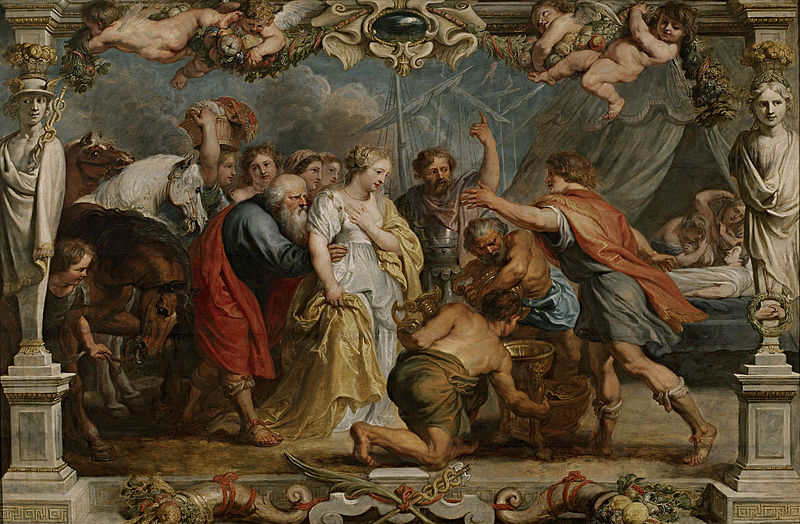
Briseis restored to Achilles, Peter Paul Reubens, 16th/17th Century
There’s no amount of philological rigor that can talk a body down that’s feeling dredged up trauma. You know that you aren’t enslaved and your family hasn’t been killed. You know that almost nothing about the Iliad is a particularly good fit for that night, but it’s not clear if you can separate the two stories anymore. You haven’t taught the Iliad since that day, but presumably you will have to again one day, and the thought is terrifying. Your body still holds the grief and the rage that you like to think your brain has processed, and what kind of a classicist can’t teach Homer anymore?
The academic part of your brain knows that no text is about one thing. The Iliad is about a million things, but for you, right now, it’s really just a story about how women have to pay terrible prices for what men want. How women have to suffer physical and psychological violence because men don’t want to be told no. For gold or glory or honor or because the gods were mad – what does it actually matter why? In the end, every woman in (or even just near) Troy is going to suffer because Paris and Agamemnon and Achilles want to take things that aren’t theirs. And how do you pull yourself out of that story enough to actually teach it?
If you or someone you know is a survivor of sexual assault and would like to talk to someone, there are a range of resources available from RAINN.org. (or call 1-800-656-HOPE) or NSVRC or helping survivors.org
Eurybates and Talthybios Lead Briseis to Agamemmon – Giovanni Battista Tiepolo (1696–1770)




#/media/File:Arch_of_Hadrian_Athens.jpg)
