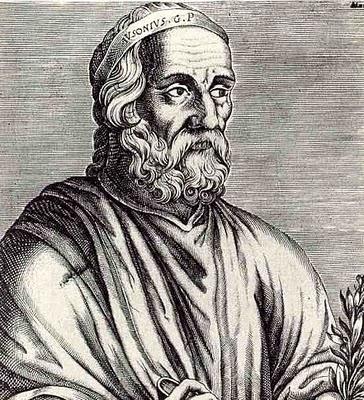
“A young man who had run on a rough road developed pain in his heel, especially close to the bottom. The area did not permit any draining of liquid because it was still producing moisture. On the fourth day, after his run, the whole area started turning dark right up to the joint of the ankle and below to the arch of the foot. It did not break out completely, instead he died first. He lived twenty full days after his run.”
Not long ago I sent round to the library to see what they had by Ausonius. The slave returned with a wheelbarrow full of books. Ausonius must be read to be believed! As poet, no subject is too trivial for him; as courtier, no flattery too excessive. He did write one passable nature poem on the Moselle, but I’m not keen on rivers. The rest of his work is quite marvellous in its tedium. Particularly those verses he wrote at Valentinian’s request. Among the subjects chosen by the Emperor were the source of the Danube (Ausonius did not locate it but he made a good try), Easter, and (best of all) four odes to the Emperor’s four favourite horses. I had one of these equine odes copied out and Hippia reads it to me whenever I am depressed. It begins “Oh raven steed, whose fortune it is to spread the golden thighs and Mars-like firm convexities of divine Augustus…” I don’t know when I have enjoyed a poem so much. I’ll enclose a copy. Anyway, I suggest you see Ausonius as soon as possible. And of course you will remember to express admiration for his work! In a good cause hypocrisy becomes virtue.
“A life commingled with virtue is like an eternal spring: it is clean, untroubled, drinkable and sweet, communal and wealthy, without harm and indestructible”
“Examine in yourself whether you desire to be wealthy or lucky. If you want wealth, know that it is neither good nor wholly yours. If you desire to be happy understand that it is good and under your power. One is the timely gift of chance, the other is a choice.”
“Child of Zeus, son of Laertes, savvy Odysseus,
I need to speak with total frankness, and say
exactly what I think and how this will go.
That should stop your stereophonic badgering.
As ghastly to me as Hades’ gates is the man
who hides one thing in his heart and says another.
I instead will say what I think is best:
“I don’t foresee the son of Atreus, Agamemnon,
or any other Danaan, bringing me around.
It was thankless work, endless warring against determined men:
there was equal share for shirker and fierce fighter;
the same respect for coward and brave;
and, a common death for the shiftless and the doer.
There was no reward for what my heart suffered
in always risking life and limb for war.”
Aesop: The Monkey and the Fisherman: ΑΛΙΕΥΣ ΚΑΙ ΠΙΘΗΞ
“Some fisherman was setting is net for fish along the seashore. A monkey was watching him and wanted to copy what he was doing. When the man went into some cave to take a nap and left his net on the beach, the monkey came down, and was trying to fish in the same way. Ignorant of the skill, he was using the net poorly and just wrapped it all around himself. He immediately fell into the sea and drowned. When the fisherman found him already drowning, he said, “fool, your ignorance and bad planning ruined you.”
The moral of the story is that people who try to imitate acts beyond their ability bring disaster upon themselves.”
The Greeks for a time travelled into Egypt, but they translated no books from the Egyptian language; and when the Macedonians had overthrown the empire of Persia, the countries that became subject to Grecian dominion studied only the Grecian literature. The books of the conquered nations, if they had any among them, sunk into oblivion; Greece considered herself as the mistress, if not as the parent of arts, her language contained all that was supposed to be known, and, except the sacred writings of the Old Testament, I know not that the library of Alexandria adopted any thing from a foreign tongue.
The Romans confessed themselves the scholars of the Greeks, and do not appear to have expected, what has since happened, that the ignorance of succeeding ages would prefer them to their teachers. Every man, who in Rome aspired to the praise of literature, thought it necessary to learn Greek, and had no need of versions when they could study the originals. Translation, however, was not wholly neglected. Dramatick poems could be understood by the people in no language but their own, and the Romans were sometimes entertained with the tragedies of Euripides and the comedies of Menander. Other works were sometimes attempted; in an old scholiast there is mention of a Latin Iliad; and we have not wholly lost Tully’s version of the poem of Aratus; but it does not appear that any man grew eminent by interpreting another, and perhaps it was more frequent to translate for exercise or amusement, than for fame.
“For fictions which are developed entirely from matters outside of the situation betray our license to lie. We must take most special care—which often escapes those who lie—not to contradict ourselves, since some stories are flattering in bits but do not contribute to a coherent whole; that we then say nothing which countermands what is accepted as true; and, in academic exercises, not to seek ornamentation beyond the themes.
Both in training and in the court, the orator ought to remember the what he has claimed falsely during the whole action since false things often escape the mind. That common saying is proved true, that the liar requires a good memory. Let us see, moreover, that if we are questioned about our own deed, we must say one thing only; if it is about somebody else’s we can cast doubt in many directions.”
nam quae tota extra rem petita sunt mentiendi licentiam produnt. Curandum praecipue, quod fingentibus frequenter excidit, ne qua inter se pugnent; quaedam enim partibus blandiuntur, sed in summam non consentiunt: praeterea ne iis quae vera esse constabit adversa sint: in schola etiam ne color extra themata quaeratur. Utrubique autem orator meminisse debebit actione tota quid finxerit, quoniam solent excidere quae falsa sunt: verumque est illud quod vulgo dicitur, mendacem memorem esse oportere. Sciamus autem, si de nostro facto quaeratur, unum nobis aliquid esse dicendum: si de alieno, mittere in plura suspiciones licere.
Marcus Aurelius, Meditations 6.47
“So one thing is worth much: to keep on living with truth and justice and in good will even among liars and unjust men”
“Why does truth produce hatred, and why is your person who tells truth made an enemy to others, even though everyone loves the blessed life, which is nothing but rejoicing in truth, unless it be that truth is loved in such a way that those who love something other than truth would wish to believe that what they love is the truth, and because they wish not to be deceived, they do not wish to be convinced that they have been fooled?
And so, they hate the truth on account of that thing which they love in truth’s place. They love it when it shines, they hate it when it refutes them. Because they wish not to be deceived but wish to do the deceiving, they love the truth when it reveals itself, but hate it when it reveals them. “
cur autem veritas parit odium et inimicus eis factus est homo tuus verum praedicans, cum ametur beata vita, quae non est nisi gaudium de veritate, nisi quia sic amatur veritas ut, quicumque aliud amant, hoc quod amant velint esse veritatem, et quia falli nollent, nolunt convinci quod falsi sint? itaque propter eam rem oderunt veritatem, quam pro veritate amant. amant eam lucentem, oderunt eam redarguentem. quia enim falli nolunt et fallere volunt, amant eam cum se ipsa indicat, et oderunt eam cum eos ipsos indicat.
Latin Inscriptions, Sortes 3-19.iv
“Don’t allow lies to arise from the truth thanks to a false judge.”
De vero falsa ne fiant | iudice falso.
Democritus, Fr. 44
“It is right to be a speaker of truth not of many words.”
ἀληθόμυθον χρὴ εἶναι, οὐ πολύλογον
The Infernal Torments of the Damned, illuminated French manuscript of Augustine’s City of God by an unknown artist (15th century).
—The town of Abdera, notwithstanding Democritus lived there, trying all the powers of irony and laughter to reclaim it, was the vilest and most profligate town in all Thrace. What for poisons, conspiracies, and assassinations,—libels, pasquinades, and tumults, there was no going there by day—’twas worse by night.
Now, when things were at the worst, it came to pass that the Andromeda of Euripides being represented at Abdera, the whole orchestra was delighted with it: but of all the passages which delighted them, nothing operated more upon their imaginations than the tender strokes of nature which the poet had wrought up in that pathetic speech of Perseus, O Cupid, prince of gods and men! &c. Every man almost spoke pure iambics the next day, and talked of nothing but Perseus his pathetic address,—“O Cupid! prince of gods and men!”—in every street of Abdera, in every house, “O Cupid! Cupid!”—in every mouth, like the natural notes of some sweet melody which drop from it, whether it will or no,—nothing but “Cupid! Cupid! prince of gods and men!”—The fire caught—and the whole city, like the heart of one man, open’d itself to Love.
No pharmacopolist could sell one grain of hellebore,—not a single armourer had a heart to forge one instrument of death;—Friendship and Virtue met together, and kiss’d each other in the street; the golden age returned, and hung over the town of Abdera—every Abderite took his eaten pipe, and every Abderitish woman left her purple web, and chastely sat her down and listened to the song.
’Twas only in the power, says the Fragment, of the God whose empire extendeth from heaven to earth, and even to the depths of the sea, to have done this.
“For when the barbarians and the Greeks were struggling against each other around Troy because of one man’s lack of self-control they endured the most terrible calamities—some in war, some in the return home—and the god assigned a punishment for that single injustice for one thousand and ten years, providing an oracle for the sack of Troy and requesting the journey of maidens from Locris to the temple of Athena in Troy.
[Pythagoras] used to harangue the young men regarding education too, demanding that they consider how strange it would be to judge rational thought the most desirable of all things when one must judge concerning everything else using it, yet people spend no time nor toil in practicing it. And this is when care given to the body is similar to worthless friends in abandoning you quickly; education, however, is like the most good and noble companions who stay by your side right up to death—and, for some, it provides immortal glory after life is over.”
“But it is not completely illogical to imagine that some of the fantasies that arise during sleep are to blame for deeds that are related to them.
For just as when we are about to do something or in the middle of some action or have just finished it, we are deeply engaged with those deeds and we also carry them out in a dream–and this is because the inspiration that comes from the events of the day has made space for it–so too the stimulus that arises in sleep may be the initial cause of daytime deeds, because the possibility of doing these things found its own space at night.
This is why dreams can be both indications of things and the causes of them as well.”
For in that sleep of death what dreams may come
When we have shuffled off this mortal coil,
Must give us pause. There’s the respect
That makes calamity of so long life.