There’s No Hektor Here

Euripides, Andromache, 96-102

“I have not a single but many things to mourn:
My native city, Hektor dead, and the hateful
Fate to which I was tied when I fell
Unworthily into a life of slavery.
Don’t ever say that any mortal is blessed
Before you see how they end life at death
How they finish that last day and go below.”

πάρεστι δ᾽ οὐχ ἓν ἀλλὰ πολλά μοι στένειν,
πόλιν πατρῴαν τὸν θανόντα θ᾽ Ἕκτορα
στερρόν τε τὸν ἐμὸν δαίμον᾽ ᾧ συνεζύγην
δούλειον ἦμαρ εἰσπεσοῦσ᾽ ἀναξίως.
χρὴ δ᾽ οὔποτ᾽ εἰπεῖν οὐδέν᾽ ὄλβιον βροτῶν,
πρὶν ἂν θανόντος τὴν τελευταίαν ἴδῃς
ὅπως περάσας ἡμέραν ἥξει κάτω.

168-177

“No Hektor is in this place.
Nor Priam nor their gold. But this is a Greek city.
Are you so lost in your ignorance, you wretch,
That you dare to sleep with the man who killed
Your husband and to have a child for those who
Killed your family? This is the way of all foreigners:
A father sleeps with his daughter and son with his mother,
A girl sleeps with her brother and the dearest relatives
Fall apart over murder. The law prevents none of these things.
Don’t introduce any of these practices here: it is not good
For one man to hold the reins for two wives.
Anyone who wants to avoid living badly
Prefers looking to one lover in his bed.”

οὐ γάρ ἐσθ᾽ Ἕκτωρ τάδε,
οὐ Πρίαμος οὐδὲ χρυσός, ἀλλ᾽ Ἑλλὰς πόλις.
εἰς τοῦτο δ᾽ ἥκεις ἀμαθίας, δύστηνε σύ,
ἣ παιδὶ πατρός, ὃς σὸν ὤλεσεν πόσιν,
τολμᾷς ξυνεύδειν καὶ τέκν᾽ αὐθεντῶν πάρα
τίκτειν. τοιοῦτον πᾶν τὸ βάρβαρον γένος:
πατήρ τε θυγατρὶ παῖς τε μητρὶ μείγνυται
κόρη τ᾽ ἀδελφῷ, διὰ φόνου δ᾽ οἱ φίλτατοι
χωροῦσι, καὶ τῶνδ᾽ οὐδὲν ἐξείργει νόμος.
ἃ μὴ παρ᾽ ἡμᾶς εἴσφερ᾽: οὐδὲ γὰρ καλὸν
δυοῖν γυναικοῖν ἄνδρ᾽ ἕν᾽ ἡνίας ἔχειν,
ἀλλ᾽ εἰς μίαν βλέποντες εὐναίαν Κύπριν
στέργουσιν, ὅστις μὴ κακῶς οἰκεῖν θέλει.

“Andromache ” by Georges Rochegrosse

Grumpy and Irritable: An Encyclopedia Entry on Euripides

Suda, s.v. Euripides, Εὐριπίδης, Epsilon 3695

“Euripides was the son of Mnêsarkhos or Mnêsarkhidês and Kleitô, who settled in Boiotia as exiles and then in Attica. It is not true that his mother was a vegetable vendor. For she was actually of real highborn lineage as Philokhoros demonstrates.

His mother became pregnant when Xerxes was crossing the Hellespont and gave birth the day the Greeks routed the Persians. At first, he was a painter and then a student of Prodikos among the orators and Socrates for ethics and philosophy. He also learned from Anaxagoras the Klazomenian. But he tried his hand at tragedy after he observed the dangers Anaxagoras faced because of the beliefs he introduced.

Euripides had a grumpy character and was irritable and avoided people. For this reason, he was also believed to be a misogynist. Still, first he married Mnêsilokhos’ daughter Khoirine. With her he fathered Mnesilokhos and Mnesikhardê as well as little Euripidês. He divorced her and remarried another woman whom he also discovered to be unfaithful

He left Athens and when to the court of Arkhelaos, king of the Macedonians, where he lived enjoying the highest honors. But he died thanks to the plot of Arribaios the Macedonian and Krateuas of Thessaly, two poets who were jealous of him and who used 10 minai to convince one of the king’s servants, Lysimakhos, to set the king’s dogs—animals he had trained himself—on Euripides.

But some people record that he was torn apart at night by women instead of dogs when he was sneaking out for a late night meeting with Krateros, Archelaus’ lover [since he was enamored with him too and had a lot of these kinds of lovers]. But there are those who say he was on his way to meet the wife of Nikodikos of Arethousa.

Euripides lived until he was 75 years old and the king had his bones interred at Pella. He wrote 75 plays—although some claim 92—but there are 77 attributed to him. He was victorious 5 times, 4 while alive and once after his death when his nephew, also named Euripides, staged his play. He staged plays for 22 years in a row and performed his last in the 93rd Olympiad.”

Εὐριπίδης, Μνησάρχου ἢ Μνησαρχίδου καὶ Κλειτοῦς, οἳ φεύγοντες εἰς Βοιωτίαν μετῴκησαν, εἶτα ἐν τῇ Ἀττικῇ. οὐκ ἀληθὲς δέ, ὡς λαχανόπωλις ἦν ἡ μήτηρ αὐτοῦ: καὶ γὰρ τῶν σφόδρα εὐγενῶν ἐτύγχανεν, ὡς ἀποδείκνυσι Φιλόχορος.

ἐν δὲ τῇ διαβάσει Ξέρξου ἐκυοφορεῖτο ὑπὸ τῆς μητρὸς καὶ ἐτέχθη καθ’ ἣν ἡμέραν Ἕλληνες ἐτρέψαντο τοὺς Πέρσας. γέγονε δὲ τὰ πρῶτα ζωγράφος, εἶτα μαθητὴς Προδίκου μὲν ἐν τοῖς ῥητορικοῖς, Σωκράτους δὲ ἐν τοῖς ἠθικοῖς καὶ φιλοσόφοις. διήκουσε δὲ καὶ Ἀναξαγόρου τοῦ Κλαζομενίου.

ἐπὶ τραγῳδίαν δὲ ἐτράπη τὸν Ἀναξαγόραν ἰδὼν ὑποστάντα κινδύνους δι’ ἅπερ εἰσῆξε δόγματα. σκυθρωπὸς δὲ ἦν τὸ ἦθος καὶ ἀμειδὴς καὶ φεύγων τὰς συνουσίας: ὅθεν καὶ μισογύνης ἐδοξάσθη. ἔγημε δὲ ὅμως πρώτην μὲν Χοιρίνην, θυγατέρα Μνησιλόχου: ἐξ ἧς ἔσχε Μνησίλοχον καὶ Μνησαρχίδην καὶ Εὐριπίδην. ἀπωσάμενος δὲ ταύτην ἔσχε καὶ δευτέραν, καὶ ταύτης ὁμοίως ἀκολάστου πειραθείς. ἀπάρας δὲ ἀπ’ Ἀθηνῶν ἦλθε πρὸς Ἀρχέλαον τὸν βασιλέα τῶν Μακεδόνων, παρ’ ᾧ διῆγε τῆς ἄκρας ἀπολαύων τιμῆς.

ἐτελεύτησε δὲ ὑπὸ ἐπιβουλῆς Ἀρριβαίου τοῦ Μακεδόνος καὶ Κρατεύα τοῦ Θετταλοῦ, ποιητῶν ὄντων καὶ φθονησάντων αὐτῷ πεισάντων τε τὸν βασιλέως οἰκέτην τοὔνομα Λυσίμαχον, δέκα μνῶν ἀγορασθέντα, τοὺς βασιλέως, οὓς αὐτὸς ἔτρεφε, κύνας ἐπαφεῖναι αὐτῷ. οἱ δὲ ἱστόρησαν οὐχ ὑπὸ κυνῶν, ἀλλ’ ὑπὸ γυναικῶν νύκτωρ διασπασθῆναι, πορευόμενον ἀωρὶ πρὸς Κρατερὸν τὸν ἐρώμενον Ἀρχελάου [καὶ γὰρ σχεῖν αὐτὸν καὶ περὶ τοὺς τοιούτους ἔρωτας], οἱ δέ, πρὸς τὴν γαμετὴν Νικοδίκου τοῦ Ἀρεθουσίου. ἔτη δὲ βιῶναι αὐτὸν οε#, καὶ τὰ ὀστᾶ αὐτοῦ ἐν Πέλλῃ μετακομίσαι τὸν βασιλέα. δράματα δὲ αὐτοῦ κατὰ μέν τινας οε#, κατὰ δὲ ἄλλους #4β#: σῴζονται δὲ οζ#. νίκας δὲ ἀνείλετο ε#, τὰς μὲν δ# περιών, τὴν δὲ μίαν μετὰ τὴν τελευτήν, ἐπιδειξαμένου τὸ δρᾶμα τοῦ ἀδελφιδοῦ αὐτοῦ Εὐριπίδου. ἐπεδείξατο δὲ ὅλους ἐνιαυτοὺς κβ#, καὶ τελευτᾷ ἐπὶ τῆς #4γ# Ὀλυμπιάδος.
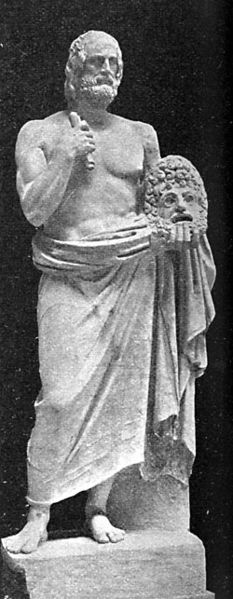
File:Euripides Statue.jpg

All Unhappy Families….

Homer, Iliad 9. 447-461

. . . I first fled Hellas famed for fine women
after rows with my father, Amuntor, son of Ormenus.
He was enraged with me over his well-coiffed mistress.
He loved this woman and he disgraced his wife,
my mother. She pleaded with me all the time
to screw the mistress–make her rebuff the old man.
Persuaded, I did it. But my father found out,
cursed me bitterly, called on the hated Furies
that he never hold a dear son of mine
on his knees. The gods fulfilled the curse,
chthonian Zeus and dread Persephone.

I planned to cut him down with my sharp sword,
but a god checked my rage–he showed my heart
what folks would say, people’s bitter insults–
so I wouldn’t be “father-killer” among Achaeans.

***The final 4 lines are recorded by Plutarch but do not appear in manuscripts or papyri of the epic. Plutarch claims without evidence Aristarchus excised the lines.

οἷον ὅτε πρῶτον λίπον Ἑλλάδα καλλιγύναικα
φεύγων νείκεα πατρὸς Ἀμύντορος Ὀρμενίδαο,
ὅς μοι παλλακίδος περιχώσατο καλλικόμοιο,
τὴν αὐτὸς φιλέεσκεν, ἀτιμάζεσκε δʼ ἄκοιτιν
μητέρʼ ἐμήν· ἣ δʼ αἰὲν ἐμὲ λισσέσκετο γούνων
παλλακίδι προμιγῆναι, ἵνʼ ἐχθήρειε γέροντα.
τῇ πιθόμην καὶ ἔρεξα· πατὴρ δʼ ἐμὸς αὐτίκʼ ὀϊσθεὶς
πολλὰ κατηρᾶτο, στυγερὰς δʼ ἐπεκέκλετʼ Ἐρινῦς,
μή ποτε γούνασιν οἷσιν ἐφέσσεσθαι φίλον υἱὸν
ἐξ ἐμέθεν γεγαῶτα· θεοὶ δʼ ἐτέλειον ἐπαρὰς

τὸν μὲν ἐγὼ βούλευσα κατακτάμεν ὀξέϊ χαλκῷ:
ἀλλά τις ἀθανάτων παῦσεν χόλον, ὅς ῥ’ ἐνὶ θυμῷ
δήμου θῆκε φάτιν καὶ ὀνείδεα πόλλ’ ἀνθρώπων,
ὡς μὴ πατροφόνος μετ’ Ἀχαιοῖσιν καλεοίμην.

Ingmar Bergman. Scenes from a Marriage.

Larry Benn has a B.A. in English Literature from Harvard College, an M.Phil in English Literature from Oxford University, and a J.D. from Yale Law School. Making amends for a working life misspent in finance, he’s now a hobbyist in ancient languages and blogs at featsofgreek.blogspot.com.

Flammable Bones and Renewable Eyes: Some Amazing Animal Facts

Paradoxographus Vaticanus, 4-8

4 “Aristotle says in his work On Animals that all land animals have respiration—as many as have lungs—except for the wasp and bee which do not breathe. However many animals have a bladder also have bowels. But not all animals who have bowels also have a bladder.”

᾿Αριστοτέλης φησὶν ἐν τοῖς περὶ ζῴων τὰ χερσαῖα πάντα ἀναπνεῖν, ὅσα πνεύμονας ἔχει, σφῆκαν δὲ καὶ μέλισσαν οὐκ ἀναπνεῖν. ὅσα τε κύστιν ἔχει, πάντα καὶ κοιλίαν· οὐχ ὅσα δὲ κοιλίαν καὶ κύστιν.

5 “Many of the animals are bloodless, and and, in general they are animals who have more than four feet.”

῎Αναιμα πολλὰ τῶν ζῴων, καθόλου δὲ ὅσα πλείους πόδας ἔχουσι τῶν τεσσάρων.

6 “Fish do not have a throat[?]. For this reason, if a smaller fish is pursued by a bigger one, it pushes the stomach under the mouth [?]”

Οἱ ἰχθύες οὐκ ἔχουσι στόμαχον· διό, ἐὰν διώκηται ὁ ἐλάττων ὑπὸ μείζονος, ἄγει τὴν κοιλίαν ὑπὸ τὸ στόμα.

7 “Snakes have thirty ribs, and their eyes, if anyone strikes them, grow back again. The swallow’s qualities are similar.”

Οἱ ὄφεις πλευρὰς ἔχουσι τριάκοντα. καὶ τὰ ὄμματα αὐτῶν, ἐάν τις ἐκκεντήσῃ, πάλιν γίνονται, καθὰ καὶ τὰ τῶν χελιδόνων.

8 “The bones of a lion are so stiff that when they are struck often they burst into fire.”

Τοῦ λέοντος τὰ ὀστᾶ οὕτως εἰσὶ στερεά, ὥστε πολλάκις κοπτόμενα πῦρ ἐκλάμπειν.

Image result for medieval manuscript lion fire
British Library, Royal MS 12 C. xix, Folio 6r. Lion

Two For Tuesday: Proverbs on Speaking and Not

Diogenianus, 2.93

“Silver springs chatter on.” A proverb applied to the uneducated who speak freely thanks to an excess of wealth.”

᾿Αργύρου κρῆναι λαλοῦσιν: ἐπὶ τῶν ἀπαιδεύτων μὲν, δι’ ὑπερβολὴν δὲ πλούτου παῤῥησιαζομένων.

Zenobius, 2.70

“A bull is on your tongue”: A proverb applied to people who are not able to speak freely….

Βοῦς ἐπὶ γλώττης: παροιμία ἐπὶ τῶν μὴ δυναμένων παῤῥησιάζεσθαι

Two Bonus Proverbs

Zenobius 3.69

“The goats are free of the plows: [a proverb applied] to those who are released from some burden or evils”

᾿Ελεύθεραι αἶγες ἀρότρων: ἐπὶ τῶν βάρους τινὸς ἢ κακῶν ἀπηλλαγμένων.

Diogenianus, 4.87

“freer than Sparta”: due [or applied to] ungovernable and noble thought. For this reason it says that Sparta was not walled.”

     ᾿Ελευθεριώτερος Σπάρτης: διὰ τὸ ἀνυπότακτον καὶ γενναῖον φρόνημα. Διὸ οὐδὲ τειχισθῆναι λέγει τὴν Σπάρτην.

Image result for medieval manuscript goats
Goat nibbling a manuscript border, Luttrell Psalter, England ca. 1325-1340

What Audience Are You Writing For? Cicero on the Middle-Ground

[Marcus Varro is the speaker in this excerpt]

Cicero, Academica 1.4

“Because I recognized that philosophy had been most expertly explored in the Greek language, I believed that anyone from Rome who was inclined toward the subject would prefer to read it in Greek, if they were educated in Greek doctrines. If they shuddered at Greek arts and learning, they would not be interested in those very matters which could not be understood without Greek. So, I did not want to write what the unlearned could not understand or what the learned would not care to.”

Nam cum philosophiam viderem diligentissime Graecis litteris explicatam, existimavi si qui de nostris eius studio tenerentur, si essent Graecis doctrinis eruditi, Graeca potius quam nostra lecturos; sin a Graecorum artibus et disciplinis abhorrerent, ne haec quidem curaturos quae sine eruditione Graeca intellegi non possunt; itaque ea nolui scribere quae nec indocti intellegere possent nec docti legere curarent.

Image result for Ancient Roman philosopher

Nature, Naturally

C.S. Lewis, Studies in Words (2.1) – Natura

By far the commonest native meaning of natura is something like sort, kind, quality, or character. When you ask, in our modern idiom, what something ‘is like’, you are asking for its natura. When you want to tell a man the natura of anything you describe the thing. In nineteenth-century English the word ‘description’ itself (‘I do not associate with persons of that description’) is often an exact synonym for natura. Caesar sent scouts to find out qualis esset natura montis, what the hill was like, what sort of a hill it was. Quintilian speaks of a man ingenii naturâ praestantem (XII, 1), outstanding by the quality of his mind. Cicero’s title De Natura Deorum could be translated ‘What the gods are like’.

It will be noticed that whereas Caesar wanted to know the (doubtless unique) character of a particular hill, Cicero wrote about the common character of all gods, and Horace can speak of humana natura, the character common to all men. There is a logical distinction here, but linguistically the two usages are the same. A class or species has a natura, and so has a particular or an individual.

It is not always possible, or necessary, to decide whether the idea of the species or that of the particular is uppermost. Cicero says that ‘omnis natura strives to preserve itself’. It makes little difference whether we render omnis natura ‘every class or species’ or ‘every kind (of thing)’, hence ‘a thing of whatever kind’, and hence almost ‘everything’.

Those who wish to go further back will notice that natura shares a common base with nasci (to be born); with the noun natus (birth); with natio (not only a race or nation but the name of the birth-goddess); or even that natura itself can mean the sexual organs—a sense formerly born by English nature, but apparently restricted to the female. It is risky to try to build precise semantic bridges, but there is obviously some idea of a thing’s natura as its original or ‘innate’ character.

If we look forward, the road is clear. This sense of natura, though soon to be threatened by vast semantic growths of another origin, has shown astonishing persistence and is still as current a sense as any other for English nature. Every day we speak about ‘the nature of the case’ (or of the soil, the animal, the problem).

For the Love of…A Goose?

Everyone has heard about Leda and the swan. But have you heard about Amphilokhos and his gift-giving goose?

Aelian, De Natura Animalium 5.29

“In Aigion, in Akhaia, a goose was in love with a handsome boy, an Ôlenian named Amphilokhos. Theophrastus tells this story. The boy was under guard with the Olenian exiles in Aigion—there, the goose used to bring him gifts. In Khios, too, there was an especially beautiful woman named Glaukê, a harp player, and many men lusted after her—which is nothing big. But a ram and a goose loved her too, as I have heard.”

Ἐν Αἰγίῳ τῆς Ἀχαίας ὡραίου παιδός, Ὠλενίου τὸ γένος, ὄνομα Ἀμφιλόχου, ἤρα χήν. Θεόφραστος λέγει τοῦτο. σὺν τοῖς Ὠλενίων δὲ φυγάσιν ἐφρουρεῖτο ἐν Αἰγίῳ ὁ παῖς. οὐκοῦν ὁ χὴν αὐτῷ δῶρα ἔφερε. καὶ ἐν Χίῳ Γλαύκης τῆς κιθαρῳδοῦ ὡραιοτάτης οὔσης εἰ μὲν ἤρων ἄνθρωποι, μέγα οὐδέπω· ἠράσθησαν δὲ καὶ κριὸς καὶ χήν, ὡς ἀκούω, τῆς αὐτῆς.

File:Ammannati - Leda and the Swan.jpg

This is Not the Truth You Are Looking For

Caesar, Bellum Civile 2.27.2

“We all willingly believe those things we are wishing for…”

quae volumus, ea credimus libenter


Xenophon, Memorabilia 3.3.9

“You probably know that in every matter people want to obey those most they believe to be best.”


᾿Εκεῖνο μὲν δήπου οἶσθα, ὅτι ἐν παντὶ πράγματι οἱ ἄνθρωποι τούτοις μάλιστα ἐθέλουσι πείθεσθαι οὓς ἂν ἡγῶνται βελτίστους εἶναι. 

Lucretius, De Rerum Natura 2.1023-1039

“Nothing is so simple that at first sight
it is not rather difficult to believe…”

sed neque tam facilis res ulla est, quin ea primum
difficilis magis ad credendum constet


Sophokles, fr. 86

“Indeed, what is believed overpowers the truth”

τό τοι νομισθὲν τῆς ἀληθείας κρατεῖ.


PhaedrusPrologue to Phaedrus’ Collection of Aesopic fables

“Don’t forget: we are playing with the make-believe.”

fictis iocari nos meminerit fabulis.


Philostratus, Life of Apollonius 3.45

“It would be profitable neither to believe in everything nor yet to disbelieve it.”

καὶ γὰρ κέρδος (ἂν) εἴη μήτε πιστεύειν, μήτε ἀπιστεῖν πᾶσιν.


Euenus of Paros, fr. 1

“Go ahead, you think these things, but I believe those”

“σοὶ μὲν ταῦτα δοκοῦντ’ ἔστω, ἐμοὶ δὲ τάδε.”


Pausanias, 1.3.3

“On the opposite wall are painted Theseus, Democracy and the People. Clearly, this painting shows Theseus as the founder of political equality for the Athenians. In other accounts the story has been popularized that Theseus handed the powers of the state over to the people and that the Athenians lived in a democracy from his time until Peisistratus rebelled and became a tyrant. The majority of people repeat many things which are not true, since they know nothing of history and they believe whatever they have heard since childhood in choruses and tragedy. This is how it is with Theseus who actually was king himself and whose descendants continued ruling for four generations until Menestheus died.”

ἐπὶ δὲ τῷ τοίχῳ τῷ πέραν Θησεύς ἐστι γεγραμμένος καὶ Δημοκρατία τε καὶ Δῆμος. δηλοῖ δὲ ἡ γραφὴ Θησέα εἶναι τὸν καταστήσαντα ᾿Αθηναίοις ἐξ ἴσου πολιτεύεσθαι· κεχώρηκε δὲ φήμη καὶ ἄλλως ἐς τοὺς πολλούς, ὡς Θησεὺς παραδοίη τὰ πράγματα τῷ δήμῳ καὶ ὡς ἐξ ἐκείνου δημοκρατούμενοι διαμείναιεν, πρὶν ἢ Πεισίστρατος ἐτυράννησεν ἐπαναστάς. λέγεται μὲν δὴ καὶ ἄλλα οὐκ ἀληθῆ παρὰ τοῖς πολλοῖς οἷα ἱστορίας ἀνηκόοις οὖσι καὶ ὁπόσα ἤκουον εὐθὺς ἐκ παίδων ἔν τε χοροῖς καὶ τραγῳδίαις πιστὰ ἡγουμένοις, λέγεται δὲ καὶ ἐς τὸν Θησέα, ὃς αὐτός τε ἐβασίλευσε καὶ ὕστερον Μενεσθέως τελευτήσαντος καὶ ἐς τετάρτην  οἱ Θησεῖδαι γενεὰν διέμειναν ἄρχοντες.

Thucydides, 1.20.3

“For most people the examination of the truth is so careless that they accept whatever is prepared for them.”

οὕτως ἀταλαίπωρος τοῖς πολλοῖς ἡ ζήτησις τῆς ἀληθείας, καὶ ἐπὶ τὰ ἑτοῖμα μᾶλλον τρέπονται.


Tertullian, Apology 1.4-5

“Those people are ignorant while they hate and they hated unjustly because they were ignorant”

et ignorare illos, dum oderunt, et iniuste odisse, dum ignorant

Image result for medieval manuscript the fool
 gallica.bnf.fr Bibliothèque nationale de France, Département des manuscrits, Latin 1050, fol. 48v.

Supernatural Heat, Some Words

τὸ θάλπος: “warmth”

θάλπω: “to soften with heat”

ἡ θέρμη: “warmth, heat”

ἡ θερμότης: “choking heat”

τὸ καῦμα: “heat”

καυματηρός: “burning”

καυματόομαι: “to be nearly dying because of heat”

Hesiod, Theogony  700

“A supernatural heat overtook the Void…”

καῦμα δὲ θεσπέσιον κάτεχεν Χάος…

Alciphron, Letters 2.9

“When it was midday, I picked out pine tree open to the wind and facing the breeze and I sheltered there from the heat”

Μεσημβρίας οὔσης σταθερᾶς φιλήνεμόν τινα ἐπιλεξάμενος πίτυν καὶ πρὸς τὰς αὔρας ἐκκειμένην, ὑπὸ ταύτῃ τὸ καῦμα ἐσκέπαζον

Dio Chrysostom, Discourse 3

“[one must] survive the heat and tolerate the cold…”

καὶ καῦμα ἀνέχεσθαι καὶ ψῦχος ὑπομένειν

Hippocrates, Air, Water, Places 10.10-20

“Whenever the heat suddenly grows intense thanks to the spring rains and the wind from the south, the temperature necessarily doubles thanks to the hot roiling earth and the burning sun. Since human bowels are not prepare and their brains are not fully dried—for spring is the time when the body and its meat are naturally fatty—that’s when fevers are the most severe in every case, especially among the chronically ill.”

ὁκόταν γὰρ τὸ πνῖγος ἐπιγένηται ἐξαίφνης τῆς τε γῆς ὑγρῆς ἐούσης ὑπὸ τῶν ὄμβρων τῶν ἐαρινῶν καὶ ὑπὸ τοῦ νότου, ἀνάγκη διπλόον τὸ καῦμα εἶναι, ἀπό τε τῆς γῆς διαβρόχου ἐούσης καὶ θερμῆς καὶ ὑπὸ τοῦ ἡλίου καίοντος, τῶν τε κοιλιῶν μὴ συνεστηκυιῶν τοῖς ἀνθρώποις μήτε τοῦ ἐγκεφάλου ἀνεξηρασμένου—οὐ γὰρ οἷόν τε τοῦ ἦρος τοιούτου ἐόντος μὴ οὐ πλαδᾶν τὸ σῶμα καὶ τὴν σάρκα—· ὥστε τοὺς πυρετοὺς ἐπιπίπτειν ὀξυτάτους ἅπασιν, μάλιστα δὲ τοῖσι φλεγματίῃσι.

Plutarch, Life of Marius V

“He claimed that because of the heat he was thirsty enough to ask for cold water.”

ἔφη διὰ τὸ καῦμα διψήσας ὕδωρ ψυχρὸν αἰτῆσαι