“Phandicus, in his Deliakon says that Daedalus embarked on a ship in flight for the reasons I mentioned earlier and when those who were following got close, he spread out a large cloth to get the winds to help them and escaped in this way. When his pursuers returned, they announced that “he escaped with wings”.
Phanodicos Deliacon Daedalum propter supradictas causas fugientem navem conscendisse et, cum imminerent qui eum sequebantur, intendisse pallium ad adiuvandum ventos et sic evasisse: illos vero qui insequebantur reversos nuntiasse pinnis illum evasisse.
Kylix from the British Museum, Attic 520 BCE (1867,0508.963)
“When I want to relax my mind, I take into my hands the writings of that man, who recently published Martial’s Amphitheatrum and Persius. I never laugh more sweetly than when I see something published by that Tuscan. I often marvel that he read so many books that he no longer knew anything. How often he raves! Yet, he has his admirers. Let them have them, but let them be Parisians.”
Quum animum remittere volo, assumo in manus scripta illius, qui Amphitheatrum Martialis et Persium nuper κατακέχοδεν. Nam nunquam suavius rideo, quam cum aliquid ejus lucumonis video. Saepe mirari soleo illum tantum scriptorum legisse, ideo ut nihil sciret. Quam saepe delirat! Et tamen habet admiratores. Habeat igitur, sed Parisienses.
COVID is so 2020. Let’s add Monkeypox and Marburg virus to the anxiety pool.
Plutarch, On Music (Moralia 1146c-d)
“The degree to which the best governed states have dedicated themselves to fine music finds ample testimony, especially in the case of Terpander who brought an end to the civil strife that was ruining the Spartans.
There’s also Thaletas of Crete who people say listened to the Delphic oracle and went Sparta and returned people to health with music, saving Sparta from the Pandemic that was gripping the land, as Pratinas claims.
Homer too says that the Greeks stopped a plague with music, for he says that “sons of the Achaeans propitiated the god with song and dance all day long / singing the noble paean and praising the / far-shooter who took pleasure in hearing the song.”
I’ll leave those verses as the final words in my argument about music, good teacher, since you started this discussion by quoting them to us. In truth, music’s first and finest labor is to give thanks back to the gods, and after that comes a cleansing of the soul, sure tone, and sustained harmony.”
“It is well that we should be alive to the price at which knowledge must be purchased. Day by day, night by night, from the age of twenty upwards, Casaubon is at his books. He realised Boeckh’s ideal, who has told us that in classical learning ‘dies diem docet, ut perdideris quam sine linea transmiseris.’ When he is not at his books, his mind is in them. Reading is not an amusement filling the languid pauses between the hours of action ; it is the one pursuit engrossing all the hours and the whole mind. ‘ The day, with part of the night added, is not long enough.
His life, regarded from the exterior, seems adapted to deter, rather than to invite imitation. A life of hardship, in circumstances humble, almost sordid, short of want, but pinched by poverty; Casaubon renounced action, pleasure, ease, society, health, life itself— killing himself at fifty-six. Shall we say that he did this for the sake of fame ? Fame there was, but it reached him in but faint echoes. Even what there was, was all dashed by the loud slander of the dominant ecclesiastical party, and the whispered suspicion of the vanquished. At best, the limits of such fame must always be circumscribed. To the great, the fashionable, the gay, and the busy, the grammarian is a poor pedant, and no famous man. The approbation of our fellows may be a powerful motive of conduct. It is powerful to generate devotion to their service. It is not powerful enough to sustain a life of research. No other extrinsic motive is so. The one only motive which can support the daily energy called for in the solitary student’s life, is the desire to know. Every intelligence, as such, contains a germ of curiosity. In some few this appetence is developed into a yearning, an eagerness, a passion, an exigency, an ‘inquietude poussante,’ to use an expression of Leibnitz, which dominates all others, and becomes the rule of life.”
J.E.B. Mayor, Preface to Thirteen Satires of Juvenal:
“I often think that much of the labour spent on editing the classics is wasted; at least the same amount of time might be invested to far greater profit. For example, if one of the recent editors of Persius had devoted but three weeks to the preparation of a Lexicon Persianum, he would have produced a κτῆμα ἐς ἀεί, a permanent addition to classical learning. We sorely need lexicons e.g. to Cicero (except his speeches), Varro, Livy, the two Senecas, Quintilian’s declamations, Valerius Flaccus, Silius, the Latin anthology, Macrobius, Tertullian, Augustine, Jerome; to technical authors in general, e.g. agricultural, grammatical, mathematical, medical, military, musical, rhetorical: in Greek to the early Christian literature, Diogenes Laertius, Josephus, Philo, Galen, Stobaeus, Clement of Alexandria, Origon, Chrysostom, Cyril. If every editor would choose, in addition to his author and to the books commonly read in college, one ancient author and one modern critic, as his specialty, commentaries would be far more original than they are. The universities might issue variorum editions, not on the Dutch plan, not like Halm’s Latin editions of Cicero, or Dindorf’s of Greek authors, but more concise and more comprehensive at the same time. Two or three might combine, say, to edit the commentaries on an author, as Livy, Petronius, Suetonius, or Apuleius. A commentary which takes rank as ‘classical’, e.g. Casaubon’s on Suetonius, Persius, Athenaeus, Strabo, should be given almost entire, and form the nucleus, other notes being carefully sifted, and repetitions cleared away. One colleague might he responsible for all editions of the author; while two others ransacked periodical and occasional literature, variae lectiones, adversaria cet. Madvig says, one is ashamed to be called a philologer, when one looks at the obsolete medley brought together by Moser on the Tusculans; in far narrower compass all that is valuable there, and much that is omitted, might be stored for all time. By such a process books like Rader’s Martial, now no doubt, as Prof. Friedlander says, for most of us, ‘völlig veraltet,’ would once more yield their treasures to the ordinary student; Marcile too and Harault would no longer be mere names”
“As long as any person holds on to the beloved flower of youth,
Their heart is light, because they imagine many things are endless.
No one young thinks they will grow old and die.
The healthy person doesn’t spare a thought for sickness either.
Fools have minds like this, because they don’t understand
That mortals have only a short time for youth and life too.
You, learn these things and hold on to the end of your time,
Taking pleasure in the good things in your mind.”
N.B.This fragment is preserved in Stobaeus’ Extracts, under a section entitled “Concerning life, that it is brief and cheap and full of worry” ΠΕΡΙ ΤΟΥ ΒΙΟΥ, ΟΤΙ ΒΡΑΧΥΣ ΚΑΙ ΕΥΤΕΛΗΣ ΚΑΙ ΦΡΟΝΤΙΔΩΝ ΑΝΑΜΕΣΤΟΣ.
Every year, as summer approaches, there’s a raft of newspaper and magazine articles exploring swimmers’ concerns about people peeing in the swimming pool. In May 2017, the New York Times published ‘Come On In. The Water’s Fine (Mostly).’ In May 2019, Forbes published ‘Please Stop Peeing in the Pool, CDC Says’. In July 2021, Prevention magazine published ‘How Bad Is It to Pee in a Pool? The CDC Is Here to Remind You That It’s Not a Good Idea.’ In May 2022, the St. Louis Labor Tribune published ‘Summer’s here: Don’t pee in the pool.’ There are whole pages of memes around this fear, not to mention the popular urban myths about a chemical that will make the water turn red if anyone misbehaves. Even ocean swimming worries many people. Thus Business Insider, in 2014, published ‘Is it OK to pee in the ocean?’, and in 2018, the Sun published ‘Urine Trouble: Why You Should Never Wee in the Sea when Swimming in These Places’.
Doctors assure us it’s safe to swim, so why the recurring, exaggerated concern? We might look back to the nineteenth century. A terrible worldwide cholera pandemic, eventually shown to be spread by contaminated water, surely got people thinking about what other dangers might be lurking in their water. Around the same time, the invention of better microscopes, allowing scientists to really see and understand bacteria, led to a flood of popular pamphlets and newspaper articles alerting people that cleanliness and even sterility was the way to avoid infections. Cities all over the world built dams, created reservoirs and laid thousands of miles of pipe to supply clean water to their residents and carry away sewage, separating sewage from drinking water. The vast new 19th c. enthusiasm for swimming encouraged an association between these public health concerns and the new public pools. All of these factors surely did play a role.
Swimmer, personification of the Orontes River. Bronze, 2nd Century CE Louvre
But concern about people peeing in the water goes back thousands of years, long before people knew anything about germs, and long before Europeans knew how to swim. Ancient people worried about pee in the water throughout Southwest Asia and Europe, at least as long ago as the early Iron Age and probably as far back as the Bronze Age. It goes back to a time even before many people in Europe or Southwest Asia knew how to swim.
The Greek poet Hesiod gives us the first literary exposition of this idea of defilement, writing around 700 BC. He warns us to ‘never cross the sweet flowing water of ever flowing rivers on foot before you have prayed, looking into the beautiful stream, and washed your hands in the much loved clear water. Anyone who wades a river without washing the evil from his hands, the gods resent him and send him trouble later. Hesiod admonishes his readers, ‘Never urinate in rivers flowing to their mouths, or in springs; but be careful to avoid this. And don’t defecate in them: it’s not right.’
Hesiod here doesn’t mention swimming, because hardly anyone in his audience would have known how to swim, and he surely didn’t know how himself. But he’s definitely against peeing (or pooping) in the water. And he adds the warning not to ‘clean your skin in women’s bath water,’ because it’s ‘temporarily cursed.’
Hesiod almost certainly got this idea from Asians further east, who were also not swimmers. In the 500s BC, the prophet Ezekiel, writing in the non-swimming Levant, explicitly blames Egyptians (who were enthusiastic swimmers) for disturbing the water and angering God:
Cry for Pharaoh, king of Egypt, and say to him, You think you are a lion of the nations, but you are like a dragon in the seas. You burst forth in your rivers; you trouble the waters with your feet, and foul their rivers. Thus says the Lord God: I will . . . water with your blood the land in which you swim . . . I will destroy all the livestock [of Egypt] from beside the great waters, so neither men’s feet nor beasts’ hoofs will trouble them anymore. Then I will let the waters run clear (Ezekiel 32:2–14.)
Regio V, Insula X, 3. the Baths of the Swimmer were built during the reign of Domitian.
In the 400s BC, the Greek historian Herodotus informs us that the Persians were even more careful about polluting the water than Hesiod suggests. The Persians, who were also not generally swimmers, ‘never urinate or spit into a river, nor even wash their hands in one; nor let other people do it; instead, they greatly revere rivers.’ North of the Persians in what is now Ukraine, Herodotus tells us that the Scythians bathe in hemp-seed steam baths, ‘for they absolutely will not wash their bodies with water’.
By Herodotus’s time, aristocratic Greeks were beginning to pride themselves on their swimming, and Herodotus plainly means to distinguish the Greeks, who love water, from the Persians and Scythians who fear it. But he’s not wrong. Asian sources agree with him on the perceived dangers of disturbing the water’s surface. Zoroastrian hymns, or Avestas, dating back at least to late antiquity if not further, recount a story that the river spirits ‘were dissatisfied by the defilement of still water, so that they would not flow into the world’. The Lord Ahuramazda ‘will pour six-fold holy water into it and make it wholesome again; he will preach carefulness.’ Late antique Sasanian and Manichaean writers are also convinced that bathing equals sin, so that ‘at the warm baths which many have frequented . . . the pious went in, and came out wicked’. These writers warn against entering rivers and pools, like ‘that wicked man who, in the world, often washed his head and face, and dirty hands, and other pollution of his limbs, in large standing waters and fountains and streams, and distressed Hordad the archangel.’ A particular prohibition, echoing Hesiod a thousand years earlier, forbids swimming, or even approaching water, during menstruation.
Fishermen on the Lac de Bizerte on a Roman Mosaic from the middle of the 5th century AD in the Bardo Museum. Originally from the Frigidarium of a villa in Sidi Abdallah
Looking back on these ancient concerns from today’s perspective, they may seem like simply reasonable concerns about clean water. But ancient writers and doctors didn’t know the germ theory of disease. Their concern with not disturbing the water is only partially about cleanliness. In other contexts, they delivered babies with dirty hands and shared drinking cups. Hippocrates instructs surgeons about the light, their posture, and the size, weight, and finish of their instruments, but says little about cleanliness. Bandages were to hold the wound closed or compress it, not to keep it clean. The ancient emphasis on not disturbing the surface of the water suggests that not cleanliness, but a religious sense of water’s sacredness was uppermost in people’s minds.
Two swimmers on the mosaic floor of a bath from the Roman villa of Pompianus in Cirta, Algeria, c. 4th century CE,’ photo credit Steve Richards’
That sense is still very much with us today. It not only underlies people’s deep concern about people peeing in the pool, but also shows up in other common concerns around swimming. Europeans are often concerned to minimize splashing in the water; they explain that swimming breaststroke, as many Europeans prefer, reduces splashing and is calmer and more respectful of the water. Even Britain’s radical ‘wild swimmers’, who swim in rivers and lakes, repeatedly mention the desirability of swimming ‘without kicking or thrashing around’, being ‘considerate of your effect on others’, and the ‘meditative’ aspect of swimming. They prefer to enter the water ‘gradually while keeping your head above the surface’. British swimmers bemoan the ‘recklessly vigorous breaststroke’ and prefer ‘slipping’ into the water. This aversion to disturbing the water is surely descended from ancient religious strictures.
Swimmers in the River, Cave of the Seafarers (Cave 212), Kizil, c. 6th-7th century AD, wall painting – Ethnological Museum, Berlin
From antiquity to today, this fear has raised much more serious barriers for many would-be swimmers. Both medieval Muslims and modern Turks have been forced out of the water on the grounds that they smelled bad. European missionaries were told they were too dirty to swim. Americans have been told they were too dirty, and Aboriginal Australians that they were unhygienic. Roma children were banned from pools and Italian Jews were barred from Mediterranean beaches on the grounds that their bodies polluted the water. In Eastern Europe and Russia, 20th c. swimming pools demanded doctors’ certificates of good health. People object to sharing swimming pools with people who have cerebral palsy, paralysis, or amputations. They feel the same way about swimmers who are overweight, or old. Swimming pools bar swimmers for having the wrong lotion, the wrong haircut, or the wrong type or color of swimsuit. Swimmers even reimagined Blackness as dirt that might come off in the water, so that in 2009 white women in Philadelphia still pulled their children out of the water rather than let them swim with Black children. Even young white women are routinely asked whether their bodies are ‘ready for the beach’.
This fear of disturbing the water keeps all of us from swimming, and even from learning to swim. Mara Gay, in a recent New York Times article, warned that many New York children can’t swim at all, and listed the many fear-oriented prohibitions of New York’s public pools, from ‘no phones’ to ‘no pool noodles’, ‘no baby strollers,’ and ‘no colored t-shirts.’
Even though much of our enthusiasm for swimming derives from the enthusiasm of ancient swimmers from Cato to Agrippina, much of our fear of the water and of entering the water is also inherited from the ancient world. We must learn to see ancient Greeks and Romans as merely one group of humans among many, right about some things and wrong about others. In swimming, at least, we would do better to be guided by other cultures—African, Native American, Maori, Southeast Asian—with more enthusiasm for swimming and less fear of the water.’
Max Liebermann, Swimmers, 1875
Karen Eva Carr is the author of Shifting Currents: A World History of Swimming (2022), just out from Reaktion Books. She is Associate Professor Emerita in History at Portland State University, and has also written on Roman and Visigothic Spain, on the Roman pottery of North Africa, and on the history of hand fans.
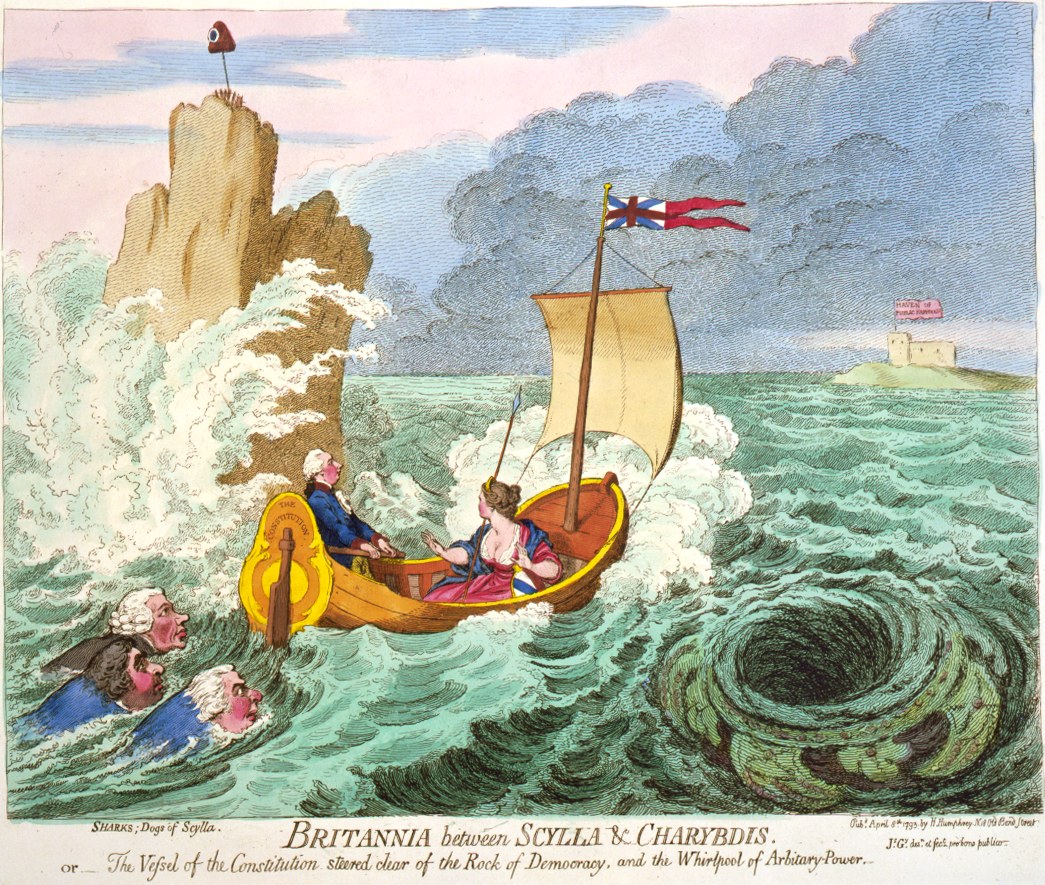
“Avoid Kharybdis and come close to Skyla.” This is similar to the saying, “I avoided it by finding a better evil”
They say about Skyla that she was a Tyrrhenian woman, something if a beast, who was a woman down to the navel but she grew dog heads beneath that point. The rest of her body was a serpent. This kind of a cerature is very silly to imagine. But here is the truth. There were the islands of the Tyrrenians, which used to raid the coasts of Sicily and the Ionian bay. There was a trirereme which had the named Skyla. That trireme used to overtake other ships often and use their food and there was many a story about it. Odysseus fled that ship. trusting a strong and favorable wind and he told this story in Corcyra to Alkinoos, how he was pursued and how he fled and what the shape of the ship was. From these stories, the myth was formed.”
“Charybdis is an obvious name for luxury and endless drinking. Homer has allegorized manifold shamelessness in Skylla, which is why she would logically have a belt of dogs, guardians for her rapacity, daring, and pugnacity. “
“But you, go away from “the smoke and the wave” and depart the ridiculous concerns of mortal life as from that fearsome Charybdis without touching it at all, don’t even, as the people say, brush it with your littlest toe.”
“For satiety seems to be becoming worn out in pleasures from the soul suffering in some way with the body, since the soul does not shirk from its pleasures. But when it is interwoven, as it is said, with the body, it suffers the same things as Odysseus, just as he was held, clinging to the fig tree, not because he desired it or delighted in it, but because he feared Charybdis lurking below him. The soul clings to the body and embraces it in this way not because of goodwill or gratitude but because it fears the uncertainty of death.
As wise Hesiod says, “the gods keep life concealed from human beings.” They have not tied the soul to the body with fleshly bonds, but they have devised and bound around the mind one cell and one guard, our uncertainty and distrust about our end. If a soul had faith in these things—“however so many await men when they die”, to quote Heraclitus—nothing would restrain it at all.”
“Heraclitus says the universe is singular and shared for those who are awake, but each of us returns to our own world when we are sleeping. The superstitious person lacks the shared world. When they are awake they fail to use their thoughts and when they are asleep they are not freed from trouble, since their power of reasoning is dreamed away and fear is always awake. There’s no way to escape or place to move.”
This passage’s emphasis on our shared reality being dependent on using reason may seem super stoic, but it reminds me of Epicurean doctrine too: the notion that what is real is not readily available to individuals, but only comes from sharing experiences and knowledge with others. Those who rail against “wokeness” are like Heraclitean sleepers, refusing to acknowledge that their definitions and interpretations are creations of their own, set apart from the shared universe of human experience by their own arrogance and fear. Dreaming, of course, lets us explore those other worlds of our creation, to compare them for better or worse to the one we make together.
Diogenes Laertius, Epicurus 31
“[Epicureans] dismiss dialectic as being unnecessary—they believe that it is enough for natural scientists to employ the normal words for things. In his Canon, Epicurus asserts that our sensory perceptions and prior experiences and conceptions are the criteria of the truth; and Epicureans also believe that the imagined movements of thoughts are the same. He articulates his own beliefs in his Brief to Herodotus and in his Kurian Beliefs. He says, “Every perception is free of thought and receptive to no memory. Because does not move under its own power or another’s, it cannot add anything or take it away. And there is nothing capable of refuting the senses. For one related perception cannot countermand another because of their equal power nor can inequivalent senses undermine those of a different capacity, since they are not judging the same domains.
Reason depends entirely on perceptions. Different kinds of senses cannot undermine each other, since we use them all. The interdependence of the senses ensures the truth of what we perceive. Our ability to see and hear is just like our ability to feel pain. This is why we must strive to make meaning about unclear things from what actually appears before us.”
“I have not a single but many things to mourn:
My native city, Hektor dead, and the hateful
Fate to which I was tied when I fell
Unworthily into a life of slavery.
Don’t ever say that any mortal is blessed
Before you see how they end life at death
How they finish that last day and go below.”
“No Hektor is in this place.
Nor Priam nor their gold. But this is a Greek city.
Are you so lost in your ignorance, you wretch,
That you dare to sleep with the man who killed
Your husband and to have a child for those who
Killed your family? This is the way of all foreigners:
A father sleeps with his daughter and son with his mother,
A girl sleeps with her brother and the dearest relatives
Fall apart over murder. The law prevents none of these things.
Don’t introduce any of these practices here: it is not good
For one man to hold the reins for two wives.
Anyone who wants to avoid living badly
Prefers looking to one lover in his bed.”