“My Soul Tried to Cross Our Lips”: Platonic Love

Two love poems attributed to Plato

Diogenes Laertius Vita Phil 1.3 [Plato 31] and Athenaeus 589e

“I have a lover from Kolophôn named Arkheanassa—
Potent lust rests even on her wrinkles
Poor wretches who met her during the first sailing
Of her youth—what a conflagration you passed through!”

Ἀρχεάνασσαν ἔχω τὴν ἐκ Κολοφῶνος ἑταίραν,
ἧς καὶ ἐπὶ ῥυτίδων ἕζετο δριμὺς ἔρως.
ἆ δειλοὶ νεότητος ἀπαντήσαντες ἐκείνης
πρωτοπλόου, δι᾿ ὅσης ἤλθετε πυρκαϊῆς.

The Greek Anth. 7.217 attributes a slightly different version to Asclepiades

“I have Arkheanassa, a lover from Kolophôn—
Sweet lust rests even on her wrinkles
Oh lovers who harvested the fruit of her youth
At first bloom—what a conflagration you passed through!”

Ἀρχεάνασσαν ἔχω, τὰν ἐκ Κολοφῶνος ἑταίραν,
ἇς καὶ ἐπὶ ῥυτίδων ὁ γλυκὺς ἕζετ᾿ Ἔρως.
ἆ νέον ἥβης ἄνθος ἀποδρέψαντες ἐρασταὶ
πρωτοβόλου, δι᾿ ὅσης ἤλθετε πυρκαϊῆς.

D. L = Gr. Anth. 7.78

“When kissing Agathon I felt my soul at my lips.
The wretch—for she was trying to cross between us.”

τὴν ψυχὴν Ἀγάθωνα φιλῶν ἐπὶ χείλεσιν εἶχον·
ἦλθε γὰρ ἡ τλήμων ὡς διαβησομένη.

According to Aelian, Plato’s career as a poet was cut short (Varia Historia 2.30); but note, though there is mention of epic and tragedy, the anecdote makes no claims for lyric and elegy:

“Plato, the son of Ariston, at first pursued poetry and used to write heroic verse. But he soon burned it all because he despised it, since he reckoned that his poetry was far inferior when compared to Homer’s. He then tried tragedy and even completed a tetralogy, and he was about to enter the competition, even to the point of giving the verses to actors. But right before the Dionysia, he went and heard Socrates; and once he was seized by that Siren, he not only withdrew from the competition, but he also gave up the writing of tragedy for good to immerse himself in philosophy.”

Πλάτων ὁ ᾿Αρίστωνος τὰ πρῶτα ἐπὶ ποιητικὴν ὥρμησε, καὶ ἡρωϊκὰ ἔγραφε μέτρα• εἶτα αὐτὰ κατέπρησεν ὑπεριδὼν αὐτῶν, ἐπεὶ τοῖς ῾Ομήρου αὐτὰ ἀντικρίνων ἑώρα κατὰ πολὺ ἡττώμενα. ἐπέθετο οὖν τραγῳδίᾳ, καὶ δὴ καὶ τετραλογίαν εἰργάσατο, καὶ ἔμελλεν ἀγωνιεῖσθαι, δοὺς ἤδη τοῖς ὑποκριταῖς τὰ ποιήματα. πρὸ τῶν Διονυσίων δὲ παρελθὼν ἤκουσε Σωκράτους, καὶ ἅπαξ αἱρεθεὶς ὑπὸ τῆς ἐκείνου σειρῆνος, τοῦ ἀγωνίσματος οὐ μόνον ἀπέστη τότε, ἀλλὰ καὶ τελέως τὸ γράφειν τραγῳδίαν ἀπέρριψε, καὶ ἀπεδύσατο ἐπὶ φιλοσοφίαν.
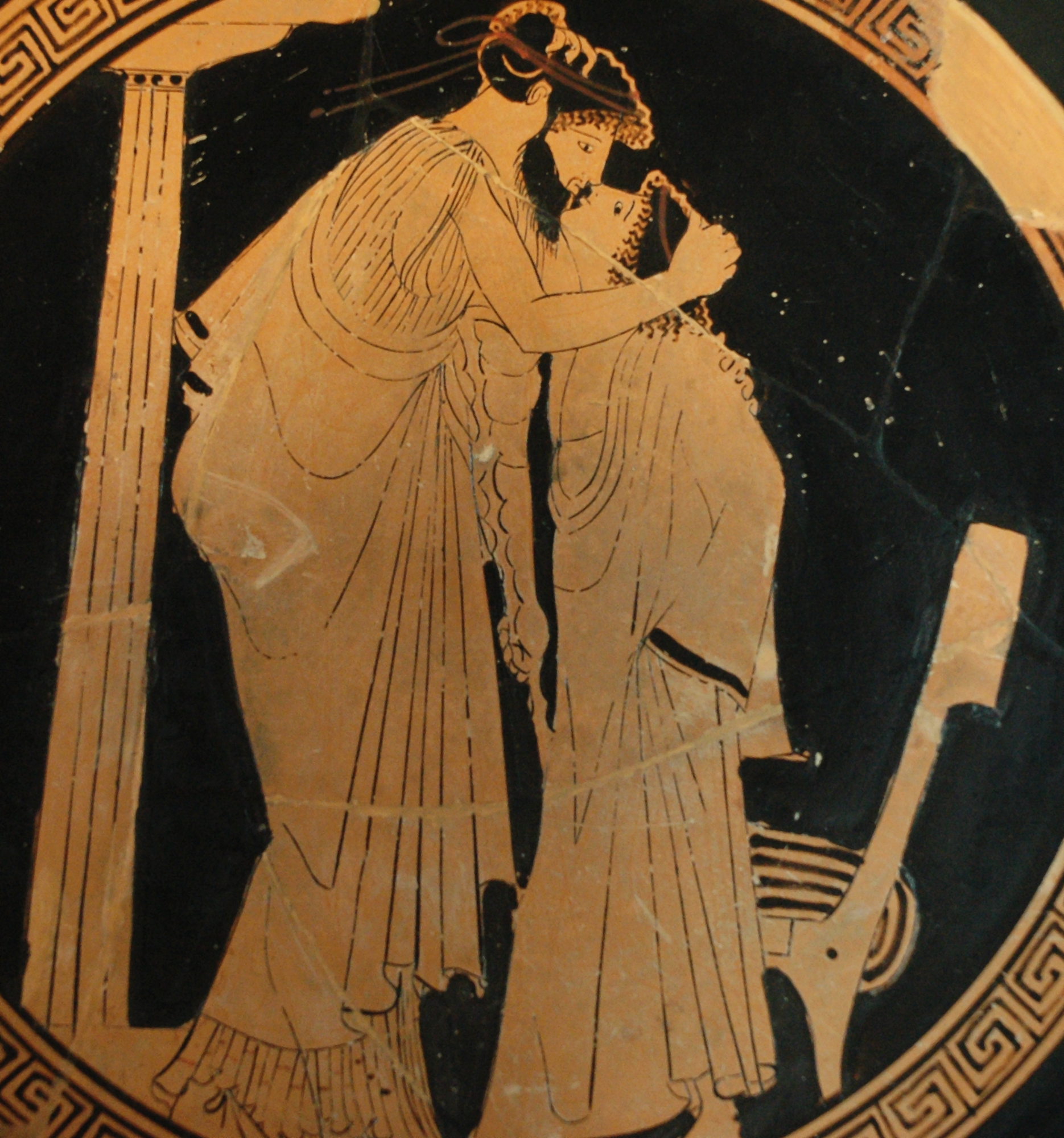
Image result for ancient greek kissing vase
Louvre G 278 Attributed to Briseis Painter

Words and Glory

Pindar, Nemean 6.28-30

“Come, Muse, send straight to that house
A glorifying wind of words .
For when men have passed away
Songs and words preserve their noble deeds…”

εὔθυν᾿ ἐπὶ τοῦτον, ἄγε, Μοῖσα,
οὖρον ἐπέων
εὐκλέα· παροιχομένων γὰρ ἀνέρων
ἀοιδαὶ καὶ λόγοι τὰ καλά σφιν ἔργ᾿ ἐκόμισαν

Bacchylides, Ode 5. 195-197

“I am easily convinced to send
A glorifying word to Hiero, one [not outside] the path—
For this is how the roots of good things grow full
And may Zeus, the greatest father, safeguard them
Immoveable in peace.”

Πείθομαι εὐμαρέως εὐ-
κλέα κελεύθου γλῶσσαν οὐ[]
πέμπειν ῾Ιέρωνι· τόθεν γὰ[ρ]
πυθμένες θάλλουσιν ἐσθλ[ῶν,]
τοὺς ὁ μεγιστοπάτωρ
Ζεὺς ἀκινήτους ἐν εἰρήν[ᾳ φυλάσσοι.]

A watercolor painting with mountains in the background capped by swirling winds and white-capped waves in the foreground
“Wind Mountain”, watercolor painting by James W. Alden (ca 1860)

A Many-Headed Song and Human Happiness

Pindar, Pythian 12.17-32

“Yet when the maiden [Athena] rescued that dear man [Perseus]
From his labors, she composed a song with every note of the pipes,
So she might recall the resounding wail elicited from *Euryale’s
Gasping cheeks with musical instruments.

The goddess created this, but she made it for mortal men to possess
And she named it the tune of many heads,
The well-famed reminder of the contests that attract people,
The sound that issues through fine bronze and reeds
That grow near to the city of beautiful dancing grounds,
The city of the Graces, in the precinct of Kephisos, trusty audiences for dancers.

If humankind has any happiness at all, it never shows up
Without hard work. But what is fated cannot be escaped–
A god will make it happen, maybe today, but
There will be a time that finds someone completely surprised
And give them one thing, but not yet another.”

… ἀλλ᾿ ἐπεὶ ἐκ τούτων φίλον ἄνδρα πόνων
ἐρρύσατο παρθένος αὐλῶν τεῦχε πάμφωνον μέλος,
ὄφρα τὸν εὐρυάλας ἐκ καρπαλιμᾶν γενύων
χριμφθέντα σὺν ἔντεσι μιμήσαιτ᾿ ἐρικλάγκταν γόον.
εὗρεν θεός· ἀλλά νιν εὑροῖσ᾿ ἀνδράσι θνατοῖς ἔχειν,
ὠνύμασεν κεφαλᾶν πολλᾶν νόμον,
εὐκλεᾶ λαοσσόων μναστῆρ᾿ ἀγώνων,

΄λεπτοῦ διανισόμενον χαλκοῦ θαμὰ καὶ δονάκων,
τοὶ παρὰ καλλίχορον ναίοισι πόλιν Χαρίτων
Καφισίδος ἐν τεμένει, πιστοὶ χορευτᾶν μάρτυρες.
εἰ δέ τις ὄλβος ἐν ἀνθρώποισιν, ἄνευ καμάτου
οὐ φαίνεται· ἐκ δὲ τελευτάσει νιν ἤτοι σάμερον
δαίμων—τὸ δὲ μόρσιμον οὐ παρφυκτόν—ἀλλ᾿ ἔσται χρόνος
οὗτος, ὃ καί τιν᾿ ἀελπτίᾳ βαλών
ἔμπαλιν γνώμας τὸ μὲν δώσει, τὸ δ᾿ οὔπω.

*One of Medusa’s sisters

Schol. In Pind. P 12. 39a

She invented an aulos melody and handed it over for humans and named it the “many headed song”. This is because there were many hissing heads of snakes around [Euryale’s] head.

Some people call this many-headed and explain that there were fifty men in the chose that performed the song as an aulete led them. Others claim that the heads are preludes. They claim that an ode is made up of many preludes and that Olympos was the first to invent them”

ἀλλά νιν εὑροῖσα: ἀλλ’ εὑροῦσα τὸ τοῦ αὐλοῦ μέλος μετέδωκε τοῖς ἀνθρώποις ἔχειν, καὶ ὠνόμασε τὸ μέλος πολυκέφαλον νόμον· ἐπεὶ καὶ αἱ τῶν δρακόντων πλείους ἦσαν κεφαλαὶ αἱ συρίξασαι· ὧν κατὰ μίμησιν συνέθηκε. τινὲς δὲ πολυκέφαλον, φασὶν, εἶπεν, ἐπειδὴ πεντήκοντα ἦσαν ἄνδρες, ἐξ ὧν ὁ χορὸς συνεστὼς προκαταρχομένου τοῦ αὐλητοῦ τὸ μέλος προεφέρετο. οἱ δὲ κεφαλὰς ἀκούουσι τὰ προοίμια. ᾠδὴ οὖν διὰ πολλῶν προοιμίων συνεστῶσα, ἣν λέγουσι τὸν ῎Ολυμπον πρῶτον εὑρηκέναι.

he frieze illustrates human desire for happiness in a suffering and tempestuous world in which one contends not only with external evil forces but also with internal weaknesses. The viewer follows this journey of discovery in a stunning visual and linear fashion. It begins gently with the floating female Genii searching the Earth but soon follows the dark, sinister-looking storm-wind giant, Typhoeus, his three Gorgon daughters and images representing sickness, madness, death, lust and wantonness above and to the right. Thence appears the knight in shining armour who offers hope due to his own ambition and sympathy for the pleading, suffering humans. The journey ends in the discovery of joy by means of the arts and contentment is represented in the close embrace of a kiss. Thus, the frieze expounds psychological human yearning, ultimately satisfied through individual and communal searching and the beauty of the arts coupled with love and companionship.
Gustav Klimt, “The Hostile Powers, the Titan Typhoeus, the Three Gorgons” 1901

Poor, Enduring Odysseus

Euripides, Cyclops 375-381

Odysseus: “Zeus! What can I say when I have witnessed awful things,
Terrible things inside this cave, the kinds of things mortals only see in myths?!”

Chorus: What’s up, Odysseus? Is it really true that the most
Unholy Kyklops has gobbled up your dear companions?

Odysseus: Oh, he saw two of them and weighed them in his hands,
Taking those who were the fattest!

Chorus: Oh, my poor dude, how have you endured these things!?”

ΟΔΥΣΣΕΥΣ

ὦ Ζεῦ, τί λέξω, δείν᾿ ἰδὼν ἄντρων ἔσω
κοὐ πιστά, μύθοις εἰκότ᾿ οὐδ᾿ ἔργοις βροτῶν;

ΧΟΡΟΣ
τί δ᾿ ἔστ᾿, Ὀδυσσεῦ; μῶν τεθοίναται σέθεν
φίλους ἑταίρους ἀνοσιώτατος Κύκλωψ;

ΟΔΥΣΣΕΥΣ
δισσούς γ᾿ ἀθρήσας κἀπιβαστάσας χεροῖν,

οἳ σαρκὸς εἶχον εὐτραφέστατον πάχος.
ΧΟΡΟΣ
πῶς, ὦ ταλαίπωρ᾿, ἦτε πάσχοντες τάδε;

Odysseus Hands the Cyclops Polyphemus a Bowl of Wine. The cyclops has three eyes abd is holding a dismembered ram. This is a wall mosaic
Villa Romana del Casale, Piazza Armerina, Italy

Influential Teachers and the Meaning of the Good: Two Anecdotes Concerning Epicurus

Diogenes Laertius 10.2

“Apollodorus the Epicurian writes in his first book of On the Life of Epicurus that the philosopher turned to the study of philosophy when he noted that his teachers could not explain to him the meaning of Chaos in Hesiod.”

᾿Απολλόδωρος δ’ ὁ ᾿Επικούρειος ἐν τῷ πρώτῳ περὶ τοῦ ᾿Επικούρου βίου φησὶν ἐλθεῖν αὐτὸν ἐπὶ φιλοσοφίαν καταγνόντα τῶν γραμματιστῶν ἐπειδὴ μὴ ἐδυνήθησαν ἑρμηνεῦσαι αὐτῷ τὰ περὶ τοῦ παρ’ ῾Ησιόδῳ χάους.

10.6

“I cannot conceive what the good is if I separate it from the pleasures of taste, from the pleasures of sex, from the pleasures of sound, or those of beautiful bodies.”

Οὐ γὰρ ἔγωγε ἔχω τί νοήσω τἀγαθόν, ἀφαιρῶν μὲν τὰς διὰ χυλῶν ἡδονάς, ἀφαιρῶν δὲ τὰς δι᾽ ἀφροδισίων καὶ τὰς δι᾽ ἀκροαμάτων καὶ τὰς διὰ μορφῆς.


Image result for Ancient Greek Epicurus

A few maxims to round things out


  1. “If fear of the skies or about death had never afflicted us—along with the ignoring of the limits of pain and desires—we never would have needed natural science”

Εἰ μηθὲν ἡμᾶς αἱ τῶν μετεώρων ὑποψίαι ἠνώχλουν καὶ αἱ περὶ θανάτου, μή ποτε πρὸς ἡμᾶς ᾖ τι, ἔτι τε τὸ μὴ κατανοεῖν τοὺς ὅρους τῶν ἀλγηδόνων καὶ τῶν ἐπιθυμιῶν, οὐκ ἂν προσεδεόμεθα φυσιολογίας.

  1. “It is not possible to eliminate fear about the most important things unless one understands the nature of everything—otherwise, we live fearing things we heard from myths. Therefore, it is not possible to enjoy unmixed pleasures without natural science.”

XII. Οὐκ ἦν τὸ φοβούμενον λύειν ὑπὲρ τῶν κυριωτάτων μὴ κατειδότα τίς ἡ τοῦ σύμπαντος φύσις, ἀλλ’ ὑποπτευόμενόν τι τῶν κατὰ τοὺς μύθους· ὥστε οὐκ ἦν ἄνευ φυσιολογίας ἀκεραίους τὰς ἡδονὰς ἀπολαμβάνειν.

The Bloom of Good Government, A Song

Pindar, Paeans Fr. 52a [= P. Oxy. 841 (5, 1908) [ΘΗΒΑΙΟΙΣ]]

“Before the painful onset of old age,
Let everyone shelter a heart free of anger
In happiness within measure,
Once they have seen
The strength safeguarded in their home.

Iē, Iē! now the Full Year
And the Seasons, Themis’ offspring,
Have arrived at the horse-whipping city of Thebes,
Bearing a garland-loving banquet for Apollo.

May Paian crown the offspring of these people
With the blooms of good government for a long time.”

πρὶν ὀδυνηρὰ γήραος σ̣[. . . . . μ]ο̣λεῖν,
πρίν τις εὐθυμίᾳ σκιαζέτω
νόημ᾿ ἄκοτον ἐπὶ μέτρα, ἀδών
δύναμιν οἰκόθετον.

ἰ]ὴ ἰή, νῦν ὁ παντελὴς Ἐνιαυτός
Ὧρα[ί] τε Θεμίγονοι
πλάξ]ιππον ἄστυ Θήβας ἐπῆλθον
Ἀπόλ]λωνι δαῖτα φιλησιστέφανον ἄγοντες·
Παιὰ]ν δὲ λαῶν γενεὰν δαρὸν ἐρέπτοι
σαό]φρόνος ἄνθεσιν εὐνομίας.

Figure in toga/robes looking up t o the left while holding on to a marble column. Oil painting.
Paolo Veronese, Good Government. 1551/2

Appeasing the Rage of Medea’s Children

CW: Infanticide

Pausanias, Corinthians, 6.6

“Going along the other road from the marketplace in the direction of Sikyon, one can see on the right side a temple and a bronze statue of Apollo and then a bit farther there’s a well called Glauke’s Well. People say Glauke threw herself into the well because she believed that the water would heal Medea’s drugs.

Above the well there is a place called the Odeion next to which is the tomb of Medea’s children. Their names were Mermeros and Pheres and they were allegedly stoned by the Korinthians because of the gifts they carried to Glauke. Because their death was violent and unjust, the Korinthians’ small babies were killed by them until sacrifices and honors were established for Fear at the advice of an oracle. This practice remained into the modern day and a rather frightening icon of the woman was made. But when Korinth was overthrown by the Romans and the Korinthians of old were eliminated.”

Ἑτέραν δὲ ἐκ τῆς ἀγορᾶς τὴν ἐπὶ Σικυῶνα ἐρχομένοις ἔστιν ἰδεῖν ἐν δεξιᾷ τῆς ὁδοῦ ναὸς καὶ ἄγαλμα χαλκοῦν Ἀπόλλωνος καὶ ὀλίγον ἀπωτέρω κρήνη καλουμένη Γλαύκης· ἐς γὰρ ταύτην ἔρριψεν αὑτήν, ὡς λέγουσι, τῶν Μηδείας ἔσεσθαι φαρμάκων τὸ ὕδωρ νομίζουσα ἴαμα. ὑπὲρ ταύτην πεποίηται τὴν κρήνην καὶ τὸ καλούμενον Ὠιδεῖον, παρὰ δὲ αὐτὸ μνῆμά ἐστι τοῖς Μηδείας παισίν· ὀνόματα μέν σφισι Μέρμερος καὶ Φέρης, καταλιθωθῆναι δὲ ὑπὸ Κορινθίων λέγονται τῶν δώρων ἕνεκα ὧν τῇ Γλαύκῃ κομίσαι 

φασὶν αὐτούς· ἅτε δὲ τοῦ θανάτου βιαίου καὶ οὐ σὺν τῷ δικαίῳ γενομένου, τὰ τέκνα Κορινθίων τὰ νήπια ὑπ᾿ αὐτῶν ἐφθείρετο, πρὶν ἢ χρήσαντος τοῦ θεοῦ θυσίαι τε αὐτοῖς ἐπέτειοι κατέστησαν καὶ Δεῖμα ἐπεστάθη. τοῦτο μὲν δὴ καὶ ἐς ἡμᾶς ἔτι λείπεται, γυναικὸς ἐς τὸ φοβερώτερον εἰκὼν πεποιημένη· Κορίνθου δὲ ἀναστάτου γενομένης ὑπὸ Ῥωμαίων καὶ Κορινθίων τῶν ἀρχαίων ἀπολομένων…

A woman, bare to the breast, looks down on two naked children playing at her feet. Oil painting, stylized reimagining of mythical Corinth. Medea and her children
Médée (1868) par Henri Klagmann (1842-1871), musée des Beaux-Arts de Nancy.

Learning, Recollection, and Babies Laughing in their Sleep

Plutarch, Moralia: other Fragments 217

“A summary of different arguments by Plutarch of Charoneia showing that learning is recollection

    1. Do we think one thing because of another thing? Not unless it was known beforehand. This is a Platonic argument.
    2. Do we supplement ideas that are missing things? This is also Platonic
    3. Are children better at learning because they are nearer to the period before life when memory is preserved? This is an obvious approach.
    4. Are different people more capable for different kinds of learning?
    5. Have many people taught themselves entire art forms?
    6. Do babies laugh while they’re sleeping when they don’t while they are awake? Indeed, many speak when asleep even though they have not yet otherwise.
    7. Are some people frightened of silly things even though they are brave, like someone afraid of a weasel, or a rooster for no clear reason?
    8. Is discovery not attainable otherwise? For no one would seek what we know nor for what we never knew previously and we couldn’t find what we do not know.
    9. Is truth conversant with reality once forgetfulness has been removed? An argument based on diction.
    10. Is Memory the mother of the Muses, since unclear memory is the reason for our examinations.”

Ἐπιχειρημάτων διαφόρων συναγωγὴ δεικνύντων ἀναμνήσεις εἶναι τὰς μαθήσεις ἐκ τῶν τοῦ Χαιρωνέως Πλουτάρχου·

(a) Εἰ ἀφ᾿ ἑτέρου ἕτερον ἐννοοῦμεν. οὐκ ἂν εἰ μὴ προέγνωστο. τὸ ἐπιχείρημα Πλατωνικόν.

(b) Εἰ προστίθεμεν τὸ ἐλλεῖπον τοῖς αἰσθητοῖς· καὶ αὐτὸ Πλατωνικόν.

(c) Εἰ παῖδες εὐμαθέστεροι, ὡς ἐγγίους τῆς προβιοτῆς, ἐν  ἡ μνήμη ἐσῴζετο. ἐπιπόλαιος ὁ λόγος.

(d) Εἰ ἄλλοι πρὸς ἄλλο μάθημα ἐπιτηδειότεροι.

(e) Εἰ πολλοὶ αὐτοδίδακτοι ὅλων τεχνῶν.

(f) Εἰ πολλὰ παιδία ὑπνώττοντα γελᾷ, ὕπαρ δ᾿ οὔπω· πολλὰ δὲ καὶ ὄναρ2 ἐφθέγξατο, ἄλλως οὔπω φθεγγόμενα.

(g) Εἰ ἔνιοι καὶ ἀνδρεῖοι ὄντες ὅμως φοβοῦνται φαῦλ᾿ ἄττα, οἷον γαλῆν ἢ ἀλεκτρυόνα, ἀπ᾿ οὐδεμιᾶς φανερᾶς αἰτίας.

(h) Εἰ μὴ ἔστιν ἄλλως εὑρίσκειν. οὔτε γὰρ ἃ ἴσμεν ζητήσειεν ἄν τις, οὔτε ἃ μηδαμῶς ἴσμεν πρότερον, ἀλλ᾿ οὐδ᾿ ἂν εὕροιμεν ἃ μὴ ἴσμεν.

(i) Εἰ ἡ ἀλήθεια κατ᾿ ἀφαίρεσιν τῆς λήθης ἔντευξις τοῦ ὄντος ἐστί. λογικὴ ἡ ἐπιχείρησις.

(j) Εἰ ἡ μήτηρ τῶν Μουσῶν Μνημοσύνη, ὡς ἡ ἀδιάρθρωτος μνήμη τῶν ζητήσεων αἰτία.

New Mexico Recollections by Marsden Hartley (https://commons.wikimedia.org/wiki/File:New_Mexico_Recollections_by_Marsden_Hartley,_Columbus_Museum_of_Art.jpg)

Three Toasts, Three Fragmentary Songs

917 P. Berol. 270, B.K.T. v (2) (1907)

To the Muses

Reverent daughters
Who bring plentiful food
[For us to share] at the precincts and altars of the gods.

To The Easily Caught

Mix up a bowl of the Graces and
Promise me a wonderful story:
Announce that we will weave together
The numberless hymns of the Maidens with
Troy, her bodies torn down by spears,
And the night-sneaking spy caught
Among the prows of the ships remembered forever.

To Memory

Mother Muse with kind eyes,
Stay here beside the holy offspring of your children.
We are introducing an elaborate song just made,
overflowing with first-practiced skill.

Achelous’ drops have dampened our ship.
Stop rushing ahead, make the sail loose
Open up those linen wings and reach fast
For the sands worn down from stone.

Well done! Keep your eyes on the sea–
When you come near to land
Escape the south wind’s cruel, frightening madness.”

(a) ΜΟΥΣΑΙ
[ σεμν]αὶ] ι θυγάτ[ρ
[ἄ][τ] ῖτα φέρων[
[…]αμοι τεμένη Β[ωμοὶ .. θέ]ων

[ἐ]κέρασον Χαρίτων κρατῆ[ρ]᾿ ἐπ[ε]-
κρ[ π]ρό[ν]ε [λό]γον·
σήμαιν᾿ ὅτι Παρθένν
ἀπε[ί]ρο πλέξομεν ὕμνοις
[τ]ὰν δορὶ σώματα κειραμέναν Τρ[οί]αν
[τ]ὸν παρὰ ναυσὶν ἀειμνά[σ]τοις ἁλόντα
νυκτιβάταν κοπόν.

(c) ΜΝΗΜΟΣΥΝΗ
ὦ Μοῦ᾿ γανατε μᾶτερ,
συνίσπεο σῶν τέκνων [ἁγν]ῶ [όν]ωι·
ἄρτι βρύουσαν ἀοιδὰν
πρωτοπαγεῖ σοφίαι διαποικίλον ἐκφέρομεν·
[νῆά τ] τέγξαν Ἀχελώιου δρόσ[οι·]
[παῦε] παραπροϊών, ὑφίε όδα,
λῦ᾿ ανοῦ τέ, τάχος ἵεσο
λεπτολίθων [ψαμαθῶ]·
εὖ̣· καθόρα πέλαγος,
παρὰ γᾶν ἔκφευγε νότου χαλεπὰν
φοβερὰ[ν διαπο]ντοπλανῆ μνίαν.

Oil painting showing waves with whitecaps in the background, partial bits of sails in the foreground.
John Everett, “View From a Ship At Sea” late 19th Century

Ariadne: A Woman Wronged

Catullus 64. 52-70.

Looking out from Dia’s wave-thudding shores
she sees Theseus and his fleet ships drawing away,
Ariadne does, her heart full of savage rage.

She still cannot believe what she’s been seeing
since shaking off hoodwinking sleep and finding
her luckless self deserted on a lonely shore:

the thoughtless youth putting oar to water, fleeing,
and letting slip to squally winds his empty vows.

It’s him the far-off sad-eyed daughter of Minos
gazes upon, Bacchant-like, from sea-tangled rocks,
gazes upon and swells with upsurges of grief.

She did not clasp to her fair head the fine headpiece,
keep her bossom veiled in her delicate robes
or her milky breasts encircled with the smooth band–

All these things, from all her person, fell haphazard
at her feet, and with them the salty waves sported.
But not for headpiece or flowing robes did she care.

Theseus, it was on you, with all her heart,
all her soul, and all her mind, that she hung, hopeless.

Racine. Phedre. 87-89.

So many others; their names escape even him,
Those too credulous spirits whom his flame deceived:
Ariadne on the rocks reciting wrongs done her . . .

Catullus

namque fluentisono prospectans litore Diae,
Thesea cedentem celeri cum classe tuetur
indomitos in corde gerens Ariadna furores,
necdum etiam sese quae visit visere credit,
utpote fallaci quae tum primum excita somno
desertam in sola miseram se cernat harena.
immemor at iuvenis fugiens pellit vada remis,
irrita ventosae linquens promissa procellae.
quem procul ex alga maestis Minois ocellis,
saxea ut effigies bacchantis, prospicit, eheu,
prospicit et magnis curarum fluctuat undis,
non flavo retinens subtilem vertice mitram,
non contecta levi uelatum pectus amictu,
non tereti strophio lactentis vincta papillas,
omnia quae toto delapsa e corpore passim
ipsius ante pedes fluctus salis alludebant.
sed neque tum mitrae neque tum fluitantis amictus
illa vicem curans toto ex te pectore, Theseu,
toto animo, tota pendebat perdita mente.

Racine

Tant d’autres, dont les noms lui sont même échappés,
Trop crédules esprits que sa flamme a trompés ;
Ariane aux rochers contant ses injustices . . .

Oil painting of a light skinned woman looking to her right, viewer's left. Her hair is disheveled and her clothing is falling off. The background is dark
Ariadne.
Joshua Reynolds (1723-1792).
Private Collection.

Larry Benn has a B.A. in English Literature from Harvard College, an M.Phil in English Literature from Oxford University, and a J.D. from Yale Law School. Making amends for a working life misspent in finance, he’s now a hobbyist in ancient languages and blogs at featsofgreek.blogspot.com.