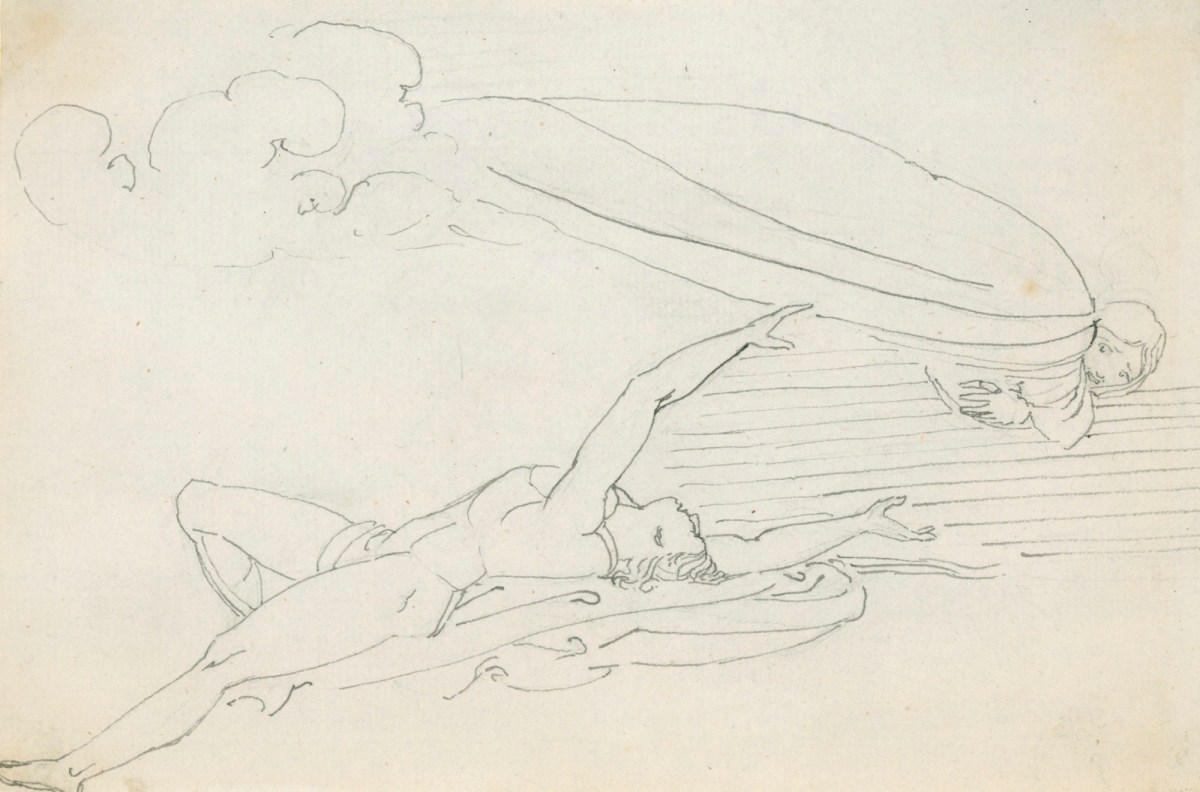
Hint: Either because he likes people. Or, animals have a good sense of smell.
Schol. A ad Il. 1.50c ex.
“First he [attacked] the mules and the fast dogs”
“Because the god is well-disposed toward human beings, he kills mules, dogs, and the other irrational beasts first, so that, by inducing fear through these [deaths], he might nurture proper reverence in the Greeks.
Or, it is because the mules and dogs have a more powerful perception of smell. For, dogs are really good at tracking beasts because of their sense of smell, and mules, when they are left behind, often rediscover their paths thanks to their sense of smell.”
Additional note: On 1.50, Aristonicus denies the claims by by some rogues that “mules” here is a word for “guards”; the bT scholia make the quasi-scientific claim that these animals are more susceptible to diseases than humans. I like the idea of Apollo trying to teach people a lesson before just murdering them all.
Ulrich Von Wilamowitz-Moellendorff, History of Classical Scholarship (trans. Hugh Lloyd-Jones):
“Lachmann, by common consent, was already the greatest living master of textual criticism in the domain of early German literature, where his immortality is assured, and his Berlin friends appealed to him to deal with such exceptionally difficult texts as those of Gaius and the Agrimensores. He acquitted himself well, but the verdict of Mommsen, who once called him ‘the great master of language’ was: ‘His emendations are splendid – if only he had known something about the subject!’”
“It is amazing how the schedule is or seems on individual days in the city when they all blend together. If you ask anyone “what did you do today?” He may say, “I went to a toga-ceremony, an engagement, or a marriage. I was the witness at a will-signing, or at court as a witness or supporter.” These things which you do seem necessary on the day that you do them but empty if you remember that you have done the same kind of things every day and they seem even sillier if you consider them when you are away.
Then the realization comes over you: “How many days have I wasted in trivial pursuits!” This occurs to me whenever I am reading or writing or taking some time to exercise, to keep my mind fit for my work, at my Laurentum. I hear nothing and I say nothing which later on it hurts me that I said or heard. No one troubles me with evil rumors. I find no one to blame but myself when I write with too little ease. I am troubled by no hope, no fear; I am disrupted by no gossip. I speak only with myself and my little books.
What a fine and sincere life! What sweet and honest leisure, finer than nearly any business at all. The sea, the beach, my own true and private museum—how much you discover for me, how much you have told me!
Take the first chance you can to leave that noise, the empty conversation, and so many useless tasks and dedicate yourself to studies or relaxing. For our friend Atilius put it most elegantly and intelligently when he said “it is better to do engage in leisure than to do nothing.”
Plinius Minicio Fundano Suo S.
1Mirum est quam singulis diebus in urbe ratio aut constet aut constare videatur, pluribus iunctisque
Nam si quem interroges “Hodie quid egisti?,” respondeat: “Officio togae virilis interfui, sponsalia aut nuptias frequentavi, ille me ad signandum testamentum, ille in advocationem, ille in 3 consilium rogavit.” Haec quo die feceris, necessaria, eadem, si cotidie fecisse te reputes, inania videntur, multo magis cum secesseris. Tunc enim subit recordatio: “Quot dies quam frigidis rebus absumpsi!” 4 Quod evenit mihi, postquam in Laurentino meo aut lego aliquid aut scribo aut etiam corpori vaco, cuius fulturis animus sustinetur. Nihil audio quod audisse, nihil dico quod dixisse paeniteat; nemo apud me quemquam sinistris sermonibus carpit, neminem ipse reprehendo, nisi tamen me cum parum commode scribo; nulla spe nullo timore sollicitor, nullis rumoribus inquietor: mecum tantum et cum libellis loquor. O rectam sinceramque vitam! O dulce otium honestumque ac paene omni negotio pulchrius! O mare, o litus, verum secretumque μουσεῖον, quam multa invenitis, quam multa dictatis! 7 Proinde tu quoque strepitum istum inanemque discursum et multum ineptos labores, ut primum fuerit occasio, relinque teque studiis vel otio trade. 8 Satius est enim, ut Atilius noster eruditissime simul et facetissime dixit, otiosum esse quam nihil agere. Vale.
Plutarch’s “Table-talk” stands alongside Athenaeus’ Deipnosophists and Petronius Satyricon as presenting a wide variety of fragments and subjects discussed within a somewhat fragile narrative frame. When compared to the other works, Plutarch’s seems to offer even less of an effort to unite the various topics as “Table-talk”. Over nine books, Plutarch presents 90 topics for discussion by a rotating case of characters (often including himself).
Below I have excerpted all of the questions without any of the answers. For a dinner party or get-together with classical or philosophical themes, or just any gathering you might fear will lack good cheer and exciting conversation, I suggest putting each question on a card and distributing them randomly for hilarity.
[PS: if you do this, take notes or record it and share it with the world]
Plutarch Table Talk, [Moralia]
1.1 [612] “Is it right to practice philosophy while drinking?
Εἰ δεῖ φιλοσοφεῖν παρὰ πότον
1.2 [615] “Should the host assign seats to his guests or should they arrange themselves?”
Πότερον αὐτὸν δεῖ κατακλίνειν τοὺς ἑστιωμένους τὸν ὑποδεχόμενον ἢ ἐπ᾿ αὐτοῖς ἐκείνοις ποιεῖσθαι;
1.3 [619] “Why the position called the ‘consul’s’ gained honor?”
Διὰ τί τῶν τόπων ὁ καλούμενος ὑπατικὸς ἔσχε τιμήν
1.4 [620] “What sort of person should be in charge of drinking?”
Ποῖόν τινα δεῖ τὸν συμποσίαρχον εἶναι;
1.5 [622] “Why do people say that “Love teaches the poet”?
Πῶς εἴρηται τὸ “ποιητὴν δ᾿ ἄρα Ἔρως διδάσκει”;
1.6 [623] “On Alexander the Great’s excessive drinking”
Περὶ τῆς Ἀλεξάνδρου πολυποσίας;
“Shining Klytemnestra was resisting the shameful deed
Previously, for she had use of some good advice for her mind.
See, a man was there beside her, a singer whom Agamemnon
Ordered much to safeguard his wife when he went to Troy.
But when the fate of the gods was bound to overcome him,
Then [he*] packed off the singer to some lonely island
And left him there as food and booty for the birds
And he, willingly, took her willing to his own home”
*note how carefully the Homeric text leaves the subject of the action in doubt until the final line.
Schol. EM ad Od. 3.267
“In olden days, singers used to hold the position of philosopher, everyone used to consider them wise and they entrusted their kind to them to be educated. When gathering in festivals and to rest for many days, they used to listen to them if any famous or noble deed had happened. So, the singer who was left with Klytemnestra was trying to hinder wicked thoughts from happening by narrating the virtues of men and women. And she was acting prudently as long as that singer was present. Some people say that the singer did not have genitals, wrongly. Some named him Khariades, others call him Demodokos, others Glaukos.”
“A singer was stationed with her too. For in ancient times, singers used to have the position of philosophers. Some people who know things badly report that he was a Eunuch”
“Demetrius of Phalerum has as follows: “Menelaos, when he went with Odysseus to Delphi asked about the expedition which was about to happen against Troy. At that time, in fact, Kreon was running the nine-year contest of the Pythian games. The Spartan Demodokos won, a student of Automedon of Mycenae who was the first who composted the Battle of Amphritryon against the Teleboans and the Conflict of Kithairon and Helikon for whom the mountains in Boiotia are named. He was also a student of Perimedes the Argive who taught the Mycenean Automedes himself along with Likymnios the Bouprasian and Sinis along with Dôrieus, the Laconian Pharides and the Spartan Probolos.
At that time, Menelaos dedicated the expedition for Helen to Athena thanks to forethought. Agamemnon led Demodokos to Mycenae and ordered him to watch over Klytemnestra.
People used to honor singers excessively as teachers of the gods and other ancient acts of good men and they used to delight in the lyre beyond the other instruments. Klytemnestra clearly honored him—she didn’t have him murdered but instead ordered him to be exiled. Timolaus suggest that he was the brother of Phemios who accompanied Penelope to Ithaca to keep a watch over her. He sang for the suitors under compulsion.”
“The music of rhapsodes applied so much to political matters that people report that the city of Sparta used it especially to encourage like-mindedness and preservation of the customs. They also say that once the Pythia, when a disturbance developed, told people to listen a Lesbian song and stop their rivalry.”
“Apollodorus the Athenian in his Summary of Beliefs, because he wants to demonstrate that the works of Epicurus were written with personal force and were prepared with far fewer quotations than the books of Chrysippos, says in this very wording: “if the books of [Chrysippos] were scrubbed of all the superfluous quotations, only empty paper would be left to him.”
So much for Apollodorus. The old women who used to sit next to [Chrysippos], according to Diocles, used to claim that he wrote 500 lines each day. Hekatôn reports that he turned to philosophy because the property left to him by his father was confiscated to the royal treasury.”
“Pythagoras shut himself in a hole in the ground and told his mother to tell people that he was dead. After that, once he reappeared again later, he was telling fantastic tales of reincarnation and the people of Hades, explaining to the living about the matters of the dead. From these stories, he created that kind of repute for himself that, before the Trojan War, he was Aithalidês the son of Hermes and then Euphorbos, and then Hermotimos of Samos, then Delian Pythios and after all of them, Pythagoras.”
In 2014 or so I was a tenured professor, less than happy in my job, but without any plan for making a change. It is not easy to get a job as a professor in classics; it is harder to get job after you have tenure; and it is nearly impossible to do so without that holiest of holies, the single authored monograph.
I was tenured without a book because the department I was in didn’t expect one and I had published a lot otherwise (including a co-authored general audience book on Homer). The fact is that I really did not want to write one. Most successful academics are expected to turn their dissertation into a book. I hadn’t done that on purpose (I was sick of my dissertation and I wanted to do something different).
Perhaps more importantly, I also didn’t know how to write a book. It is not that I didn’t want to write about things. I just wanted to write about them in shorter segments. It may have been a lack of imagination as much as anything else, but I found many more reasons not to write a book than to write one: the fact that no one reads them, that lives are disrupted to write them, that we have an entire economy of knowledge dedicated to big books about small things, etc. etc.
That last phrase is not fair, completely. But, to crib from an ancient proverb, there’s a difference between a book that needs to be written and needing to write a book. After 2012, however, I started talking, thinking, and writing about the Odyssey in a way that clearly pointed to a lengthy treatment of a topic, if not wholly original, at least markedly different from work I had read before.
Some graduate programs do better jobs than others in training you how to do independent research. Many do a great job in preparing students to turn their dissertations into books. But few anticipate what to do next. This is not a huge problem, since the paths people take are so different depending on their institution, interests, etc. But the irony is that although I was a book review editor for a journal, had reviewed a dozen books, and had helped to write one, I really didn’t know what I was doing.
So, once I gave in to the desire to write a book, I started lamenting that I didn’t have enough time to do it. Fortunately, I have a spouse who is constitutionally incapable of not calling me on my bullshit. Over drinks in 2015, while I complained again that I just needed the time to write a book, she said, “look, you ran a stupid marathon last year. You spent hours every day running, training, and keeping track of every thing you did. I don’t know why you can do that and not write a book. You’re not a runner; you’re a Homerist.”
Now, to be honest, the conversation hurt my feelings a little bit because (1) running marathons didn’t come easy to me (I run like a rhinoceros, except uglier) and (2) she was absolutely right. I started to keep track of hours a week spent on the book project, making lists and schedules, and trying to break down the project into little bits.
It worked: I have books out in 2018, 2019, and 2020 (changing institutions and getting some summer funding for childcare also made a huge difference; the blog was crucial to those books too). But part of the story is also this website. I have written about the importance of the discipline of posting daily on the blog, but what I haven’t explained clearly enough is how each of the books I just mentioned relied on this regular writing practice for drafting, brainstorming, and progress.
So, for curiosity, inspiration, mockery, and whatever else may come, here’s an overview of the more than 30 blogposts that are part of my book on the Odyssey, out this week (The Many Minded Man: The Odyssey, Psychology and the Therapy of Epic). I am posting one each day on twitter with the hashtag #BloggingABook for about a month, but here’s a more organized collection.
Let’s start at the beginning. This post was one of the first that directly translated into content in the book, showing up as a table on page 16. It helped me to organize my thoughts about the structure of the poem without making an entire labor out of the structure of the poem.
A good deal of the theoretical research of this book took me through post-structural theories like those in disability studies, which made me think differently about ideal bodies in Homer. I used some posts, like this one about Telemachus and monstrosity, to think through this. This ended up in a chapter NOT about Telemachus. Several posts arose from my reading of disability studies texts alongside Homer, like this one about Thersities and beautiful minds, which in turn became parts of chapters and a forthcoming article.
I won’t even list all the posts on ancient medicine and mental health—I spent some time trying to learn more about these topics and most of the research ended up on the website (at least a dozen or more). This scholion on drugs made me think about ancient beliefs about addiction. As I explored ancient ideas of madness in philosophy and medicine, it was helpful to see how mythical figures at times appeared to help explain things like isolation and mental anguish (as in this passage from Aristotle). This contributed to Chapter 3’s examination of heroic isolation
Part of what I love about research—when I get to do it freely—is the wandering path I take through things. Blogging gives me a sense of accomplishment (and that important reward feedback loop!) because it provides an end of sorts to a journey that lasts a day or just a few hours. Many posts are just me trying to make sense of scholia, especially longer ones like the large segments attributed to Porphyry in the Odyssey scholia. These were fodder for notes and content in the book.
Sometimes posts came from work in the scholia, like this one, where I tried to figure out the details of Telemachus’ journey for chapter 2. Indeed, many of my mythographical footnotes started or ended as posts on the site, like this one about Penelope and fidelity which contributes to one part of chapter 7. Some of the mythographical posts and studies didn’t make it to the book, but that’s ok because doing the work, as in this one on Nausikaa’s name, sharpened what I would say by helping me figure out what I didn’t need to.
Mythography doesn’t explain what audiences knew, but it can help show what they might have known which is why several posts talk about Thersites’ story outside of Homer like this one. A mere footnote in the book, but a useful one. On many occasions, I would think something might be important or interesting and find out only the latter is true, making it good for a post as in this scholion on Alkinoos’ marriage wish. It didn’t make it into the book, but Alkinoos did. And I can’t even begin to figure out how to map my dozens of posts on Odysseus’ family and multiple sons onto the chapters of the book. But they were definitely formative.
Of course, some of the details I mined were important: this post on the end of the Odyssey was essential for footnotes in more than one publication. Often work on philological and literary problems, like what Penelope was weaving, produced posts that also involved scholarship and ended up in multiple chapters. In this case, a significant part of chapter 9. Sometimes philological investigations started as posts and then later added to larger arguments, as in this exploration of a speech introduction for Telemachus. This speech of Agamemnon became critical for both chapters 7 and 9 and appears in an article on Kassandra too.
Other posts respond to epic and other readings, shaping the tone of a section or chapter without necessarily being part of them as in this post on the hanging of the enslaved women.
Part of writing is figuring out which path to take. Some times this means writing stuff that gets moved around a lot. I had a series of posts on allegory and Homer which eventually contributed to half of the conclusion (originally a transitional segment between the two halfs of the book). Posts include translations of Porphyry’s On Styx, allegories from Pseudo-Plutarch, allegories from Metrodorus, and others attributed to Porphyry by Stobaeus
And, of course, there are posts on expected topics in the Odyssey. Naming Odysseus is no minor affair, so I have several posts looking at Homeric epithetis and their ancient reception of a man of may ways who is also quite shifty. Researching this book forced me to rethink the political situation on Ithaca from ancient perspectives, showing that Laertes likely unified a somewhat odd island ‘state’. This is an important part of chapter 8, which looks at Ithaca as a traumatized community
Rethinking the representation of agency in Homer really made me look differently at the representation of women’s agency in Homer. Some posts arose out of shock at reading passages anew as I had never read them before. The emotion and scene made it to the book. Part of the journey of writing this book was thinking about the suitors as full human beings rather than simple villains, especially in their political wranglings as in this post looking at their debate about killing Telemachus. This scene is critical in the book’s chapter 8.
In rereading representations of agency in the Odyssey it was necessary to think about heroes, non-heroes, children, enslaved people, and women and how these categories intersect. Some of the more explicit comments on these topics informed chapter 6 but are clearer in posts, like this one on the cost of an enslaved person’s life. This post contributes to chapter 6. In the same vein, I also used a post to lay out the passages where Odysseus thinks about or responds to enslaved women’s sexuality. Working through these passages helped me understand the infantilization of enslaved people in the Odyssey.
Many posts were part of my writing process, which is to translate passages I want to write about. Laborious, but it gives me opportunities to post Penelope laying into a suitor like this one. This passage became part of thinking about where Penelope claims agency (and doesn’t). I cover the end of the Odyssey in two chapters, so thinking carefully through the trial of Odysseus was really important, I started this process by translating and discussing the scene in a post. The translations are improved in the book, but have the same core.
A second part of my writing process after translating is looking at scholia and commentaries, a step often preserve in posts like this one on Eumaios as a storyteller. Again, this becomes part of footnotes and discussions, not central arguments in the book. Other posts like this one on the meanings of Odysseus’ pseudonyms ended up as footnotes and detail.
On many occasions I wanted to think more broadly about ancient literature and narrative. Early drafts from chapter 9 look like this post on how liars communicate but ended up being edited quite differently. Similarly, I would at times start to right grandly and in generalizations not fit at the point of the book I was writing. This one on complementarity can be seen in some footnotes from the introduction, but not very clearly.
Many posts start with questions about what lines mean from the perspective of Homer—so doing the whole clarify Homer through Homer thing—like this one on Odysseus’ lack of pleasure from sex in with Calypso. The work here influenced some ideas in the introduction and chapter 3.
Some posts also emerged as summaries of the thoughts in the book, like this one written at the beginning of the pandemic. It reflects on a project finished rather than attesting to work in progress. Others draw on the frameworks developed during research, like the post on Toxic Heroism and a School Massacre. Sometimes ideas started in the book but had no space there. This is true of my work on Kassandra, which went into a post before it became an article elsewhere and my personal reflections on the scene of Argos, the dog.
I did not know what the conclusion of this book would add until one day I saw a line from Cavafy online and then wrote a post about death and the end of the Odyssey. This post formed a third of the conclusion once expanded.
Where there are fewer blog posts, it is because I wrote directly to publication for some topics as in the work that forms some of chapter 4 (“The Clinical Odyssey: Odysseus’ Apologoi and Narrative Therapy.” Arethusa 51: 1–3) and a chapter in a collection that contributed to parts of chapters 2 and 3 (“Learned Helplessness, the Structure of the Telemachy and Odysseus’ Return.” in conference proceedings, Psychology and the Classics, Jeroen Lauwers, Jan Opsomer and Hedwig Schwall (eds.): 129–141). And many sections were also written for talks at professional conferences and invited lectures.
I don’t think there’s a clean and just-so way to end this post. There’s lots of advice out there about writing a book in an hour or two a day and I am here to tell you it is possible. But it helps to have short term goals and ‘outputs’ to work towards. It also helps (probably more than anything) to have a stable job, good funding, and a partner who calls you on your bullshit.
Some sites say this is out tomorrow (in ebook and print); some say it is out November 22nd and December 25th.
“Marcus Pomponius Marcellus was the most irritating enforcer of proper Latinity. Once, when he was serving as an advocate (for he took on a case now and then), he persisted in arguing about a solecism committed by his opponent for so long that, Cassius Severus interrupted the judges and asked for a recess so that his litigator could get another grammarian ‘since he does not think that the controversy against his adversary will be about the law, but about a solecism.’
This same Marcellus had once criticized a word in a speech of the emperor Tiberius, and when Aetius Capito asserted that the word was actually Latin or, if it hadn’t been, certainly would be now that Tiberius had used it. Marcellus responded, ‘You lie, Capito. For you, Caesar, can give citizenship to people, but not to a word.”
M. Pomponius Marcellus sermonis Latini exactor molestissimus, in advocatione quadam—nam interdum et causas agebat—soloecismum ab adversario factum usque adeo arguere perseveravit quoad Cassius Severus, interpellatis iudicibus, dilationem petiit ut litigator suus alium grammaticum adhiberet ‘quando non putat is cum adversario de iure sibi sed de soloecismo controversiam futuram.’ hic idem cum ex oratione Tiberii verbum reprehendisset, adfirmante Ateio Capitone et esse illud Latinum et si non esset futurum certe iam inde, ‘Mentitur,’ inquit, Capito. tu enim, Caesar, civitatem dare potes hominibus, verbo non potes.’
John Flaxman; The Ghost of Patroclus Appearing to Achilles; 1792-3 (c) Royal Academy of Arts
Homer, Iliad 23.65-76
And there appeared to him the ghost of poor Patroclus all in his likeness for stature, and the lovely eyes, and voice, and wore such clothing as Patroclus had worn on his body. The ghost came and stood over his head and spoke a word to him: You sleep, Achilles; you have forgotten me; but you were not careless of me when I lived, but only in death. Bury me as quickly as may be, let me pass through the gates of Hades. The souls, the images of dead men, hold me at a distance, and will not let me cross the river and mingle among them, but I wander as I am by Hades’ house of the wide gates. And I call upon you in sorrow, give me your hand; no longer shall I come back from death, once you give me my rite of burning.
Ghosts, apparitions, miracles, supernatural events, to what extent do we believe in them? And if they were to be real, how much would they differ from each other? At first we need to begin by establishing what we understand by supernatural. If we refer to occurrences that fall outside the laws of nature, then the scope of these events has immediately enlarged, considering that we do not live in nature, but in a world – a human product. Nowadays many things have gone missing from that world; people, places, events. And these disappearances, through quarantine, incarceration or simply prolonged absence, are a kind of supernatural event in reverse – a sudden dis-apparition. But the missing haven’t been abandoned, instead, they lie in a state of abeyance, without being immediately present. With the irresistible and ceaseless flow of time — paraphrasing here Anna Komnene — we begin to question their reality.
Have these things and persons in abeyance then become ghostly presences or apparitions? I like Derrida’s idea that ghosts today are but the return or persistence of elements from the past, because it instantly complicates matters around ghostliness: Since elements from the past are always around us, can we really talk about absence or ghosts? Would it be correct to identify all absences as ghostly? Not sure here what it is exactly that returns or reappears.
We need to turn to dictionaries now, but they aren’t of much help. The only antonyms of ghostly (what is the opposite of a ghost?) that I could find, were the terms ‘natural’ and ‘angelic’, both of which do little in reference to the world, so that there’s not an exact territory of coincidence between ghosts and death. A dictionary of classical literature, on the other hand, tells us that ghosts are difficult to distinguish from supernatural entities or delusions, and yet the really striking part of the definition is that while ghosts seem generally ‘powerless and ineffectual’, they are persistent. I am fascinated by this combination of both persistence and powerlessness in the ghost, because of what it has to say to us about contemporary political narratives.
An example of this persistence comes down to us from the Iliad: Without a proper burial, the ghost of Patroclus, Achilles’ companion, is condemned to wander around the house of Hades for eternity. It would be hard to overstate how important burials were for antiquity (and continue to be so for us, for no clear reason, accounting for the shock at the mass graves of Bergamo and Hart Island during the pandemic) but I don’t want this commonplace trope to distract us from the mysterious apparition. It is one of the strangest dreams in classical literature and the only ghost to appear in the Iliad: Breaking away from the pattern of Homeric dreams, which generally involve divinities that bring knowledge of the future (following a structure of apparition at night when the person has retired, speech, departure, reaction and then dawn), dead Patroclus’ apparition in book XXIII makes no real sense, and it doesn’t bring any new information or steer the narrative in any direction.
The strangeness begins earlier, when Achilles himself performs two unusual tasks one after another (18.316-317): First, he attempts to summon Patroclus back to life by the uncommon gesture of placing his hand on the chest of the dead body as if it were alive and then he greets Patroclus with the formal χαῖρέ (hail!), establishing a distance between himself and Patroclus, implying a separation between them that is hard for Achilles to grasp — is he alive or dead? This attention to detail might seem pesky but given that the repertory of epic is so limited, any deviation in patterns of speech and behavior is telling us something; an innovation is taking place. After the funeral feast, Achilles slumbers into sleep by the seashore, and Patroclus appears to him ‘all in his likeness’ (23.66) with a puzzling request to be buried as soon as possible, given that Achilles had already decided to bury him the next day.
Gregory Buchakjian, photograph of Istanbul’s Tarlabaşı neighborhood that was due to be demolished. May 2013, a few weeks before the Gezi Park demonstrations started. Courtesy of the artist.
Patroclus is dead (at the hand of Hector, who was in turn subsequently slain by Achilles — the heart of the epic) but he hasn’t entered Hades yet. He finds himself in an in-between space, a uniquely hybrid dream/underworld scene where, far from heroic convention, this meeting about memory and the past, is still possible. And yet Patroclus asks Achilles to give him his hand for the last time for he’s nevermore to return from Hades after his burial (23.75). In spite of the immense affection between them, when Achilles tries to embrace him, the shadow suddenly turns into nothingness and dissolves into air (23.99-101), ‘with a shrill cry’. This extraordinary moment of tenderness, apparently innocuous, happens at a pivotal moment in the epic, when the death of Achilles is near – this was no news. Achilles himself is too baffled, and speaks with sadness about Patroclus’ weeping and wailing (23.106), before lighting the funeral pyre, followed by the long funeral games, a series of competitions held in honor of Patroclus and that take up most of the book.
The ghost appears thrice in the book, however on the last appearance (23.221-225), there’s a heartbreaking scene: a distraught Achilles is said to call upon Patroclus’ ghost for a last time, ‘as a father mourns the bones of a son, who was married only now, and died to grieve his unhappy parents’ and ‘[Achilles] dragged himself by the fire in close lamentation’. It seems as if the span of the apparition has come to an end, yet something is about to occur that makes the brief encounter with Patroclus gain immense depth. In book XXIV, Achilles is still agonizingly mourning Patroclus and abusing Hector’s body, dragging it around his friend’s tomb – Hector’s mother Hecuba remarks that even that did not bring Patroclus back to life (24.755-57). The apparition of Patroclus in fact restored Achilles’ humanity which had been buried in his anger and pain. A moment of reckoning arrives here: now he begins to see all the desolation that his anger has caused and there’s a final encounter with mortality in which Achilles accepts Patroclus’ death and also his own.
Commentary on the Iliad is long and intricate – it is a song about war and its disastrous consequences, but also one about political foundations and origins. But I want to dwell on the neglected figure of the ghost. Homeric terminology for the ghost is complex and “Psyché” encompasses meanings as diverse as both life and departed life, and is also used indistinguishably with other terms for soul and mind. As we had earlier seen, the status of the ghost is undefinable, and therefore it stands outside of and sometimes in opposition to the order of memory that establishes a polis upon return to the homeland from the battlefield. In the world of epic, commemoration of great deeds from the past is caught between two temporal modes: Remembering the life of a hero who has already died (remembrance of Achilles from a future standpoint) and preserving that memory as something not forgotten (the lasting permanence of the past), therefore the appearance of the ghost of Patroclus breaks down here the collective recollections of victory and turns inwards, towards remembrance of the past together with Achilles but not collectively with others (23.78).
Though we speak a lot about memory-narratives in the present, collective memory is a function of the regime of history, where things and events have already consolidated into a foundation (or against foundations). Whether the permanence of the memory that founded the body politic in the first place undergoes change, the substance of the space of the polis goes back to a single source. What I want to propose here is an idea of ghosts as communities of memory, distinct from but parallel to political foundations. What if it were possible for memory to become fragmented into different filaments of remembrance of things past and future articulated around the present and stemming from different sources?
A notion of ghosts as communities of memory came from recent work by Turkish sociologists Cihan Erdal (a young scholar now imprisoned in Turkey alongside thousands of other students on bogus charges of political activities) and Derya Fırat, on ‘presentism’ and the temporality of Gezi, the popular uprising that took place in Turkey in 2013 and after which the political landscape of the country has significantly deteriorated into authoritarian rule. Erdal and Fırat question the defeatism of the Western and Turkish Left in regard to utopian moments and whether something remains from them? Has the defeat of Gezi in anyway affected our sense of temporality?
Gezi Park protests graffiti, “The solution is Gandalf, what’s up Derrida?”, Istanbul, June 2013, photograph by the author
On a close reading of Enzo Traverso’s work on the melancholy of the Left, and his assertion that utopias have become a historical form of the past, they speak about the presentism after 1989 that absorbs the past and the future through the opening up of a self-dissolving, sparse present tense, so that this present-timeism builds a thick wall between the present and the past, putting an end to the transference of experience […] particularly in the absence of an alternative model of society. Following from that, their central argument is that the Gezi Park protests attempted to establish a new radical imagination of time (moving simultaneously between past and present, memory and expectation) that disrupted the current neoliberal presentism, and that they did so by imagining utopias both past and future – as a dialogue between different moments of mourning and memory, and between different ghosts that return and persist.
A few words on presentism would help to clarify the extent to which the Iliad as a foundational narrative is able to time-travel in order to tell us something about the present: Admittedly there’s no concept of linear time in Homer, in the same way that our fractured temporality — the temporariness of life under presentist authoritarian regimes, we’ve been ejected from time — attempts to grasp the past in order to imagine other possibilities: The subject of the Iliad is time itself and the durability of memory that withstands the withering flow of this ever-present time. Achilles’ most famously referred description as κλέος ἄφθιτον (of unwithering glory) expresses this desire as an action yet to be completed (9.410-416) simultaneously in the past and future. Time might be abstract but it is also a force that produces change, and this is what presentism (in Homer as the returning cycles of nature and in our times as the capitalist eternity of markets and the internet) is attempting to erase by collapsing the future-orientation of utopia or memory into an obsolete historical form, predicated on the ends of history: This is the best of all possible worlds.
While it’s been constantly argued that memory and mourning is the way out of the amnesia of presentism (why are we so shocked about Bergamo and Hart Island but not so much about the mass graves of wars elsewhere within the same time period?), the politics of ghosts proposed by Erdal and Fırat reframes this work of memory beyond both static remembrance of the past and restoration of past utopias. Remembrance becomes here a different orientation, which created means of communication between different historical moments and social movements, preventing the present or the past from exercising authority over each other. Ghosts from the past are speaking to each other in the here-and-now, expressing not only the”no longer” that has passed, but a sense of continuity anchored in “not yet” and “would be” referred towards the future — a typology of Iliadic time.
The ghosts that we are dealing with in here are moments of upheaval, uprising and utopia that have been deeply buried in the collective imagination but that have the power to return any time – the function of latency – without destroying the fabric of time by attempting futile restorations. These ghosts are not only moments of political action, but also catalysts thereof, such as commemorations of events and memories of violence. In the context of Gezi, for example, Erdal and Fırat mention that when Taksim Square was banned for workers in 1979, the symbols of the left factions were hung on Konak Square in the city of Izmir, a gesture that was repeated in 2013 on the facade of the Atatürk Cultural Center in Istanbul. As a checkpoint in political memory, the building was subsequently demolished, and yet this doesn’t guarantee that these ghosts will not return again and again: Apparently, the trade-free shopping between ghosts continues. Within the world of the Iliad, physical objects, decaying structures — of ships and tombs, and moments lost in time provide a record of the past that continues to exert force upon the present.
The fundamental problem that Erdal and Fırat see with with the work of mourning (over utopian pasts) is that it requires a dead body and a burial, but how can something be buried if it is absent or has never been completed? For Derrida, the ghost cannot even be called a being, because it doesn’t exist – it is both present and non-existent, and therefore one cannot enter into mourning with ghosts, because ghosts never die, they always keep coming back. The recognition of the presence of the ghost in its unburied state, is also a call for practical justice and therefore, a reinscription of experience within time, rather than against it: This proposal is also a formulation of justice so that time out of joint can be rectified. It is one that will provide an exit from the present in crisis and will bring us to justice by building this new relationship with both past and future. It is a politics of ghosts that, on the one hand, aims to put an end to the violence of the present against the past, and on the other hand, it will overcome the possibility of the past and future to dominate / erode the present.
Atatürk Cultural Center, Gezi Park protests, Istanbul, June 2013, photograph by the author
In a time of global upheaval, although we are still trapped in the presentism of catastrophe and disaster which is one of the most common narratives of capitalism — the emergency, the possibility of closing the distance between the present and a horizon of expectation about the future has not been completely closed. The future is still a latent possibility that might awake again at some undefined point. Is this future coming from the past? There’s no assurance, sometimes the future arises out of itself, but the cancellation of movement inside historical planes is not a viable solution when the present alone is too fragile to hold institutions and moral reflexions. In a world replete with ghosts – paraphrasing Derrida – the supernatural is no longer an extraordinary occurrence, but the nature of all political action. Insofar as all human action remains unpredictable, in both motive and intended goal, it is always miraculous and supernatural in the sense that it is highly improbable and yet actual.
But if all worldly existence and political life is invaded by ghosts, how to distinguish then between the ghost and reality? We think that memory should be reconstructed today and considered as a radical invitation to democratize the relationship between generations in political space. Political space is always a term that brings us back to the Iliad again: This isn’t only a concept of memory, since physical spaces as the containers of memory, are replete with debris that functions as “clocks” measuring time through both deterioration and durability. The constant apparitions of the past in these spaces remind us that although encounters with ghosts are ephemeral, they can serve as markers of the short distance between no longer and not yet, as expressed in the “now” emphasis in the words of Menelaus in the Iliad, while remembering Patroclus in such a way that this now, although stemming from the present, becomes a memory for a would-be future:
Homer, Iliad 17.670-672
Now let each one of you remember poor Patroclus who was gentle, and understood how to be kindly toward all men while he lived. Now death and fate have closed in upon him.
Here the conversation about ghosts and the supernatural is also a conversation about very long spans of memory across time: While all politics is grounded in human action and all human action is supernatural, our standard liberal model of society attempts to dovetail action and do away with politics by reducing it to bureaucratic administration and the satisfaction of human needs in nature, therefore its alleged emphasis on the social and economic question. But it was at the very beginning of our tradition of politics, in the Iliad, when the ability to change the flow of time in any direction, was considered the benchmark of rising above the cycles of nature, and therefore making action and speech identical with freedom. Anthropologists David Graeber and David Weingrow speak about freedoms that were common to many early human societies in the past and that we have abandoned: The freedom to refuse orders, to move away and to create entirely new social orders or move between different ones. This ability for new beginnings is at the heart of the Iliad‘s struggle against the destructive influence of time.
Little did they know (they couldn’t), Cihan Erdal and Derya Fırat, at the time their work was published in the end of 2019, that the politics of ghosts would become a mainstay of political life only a few months later when we would temporarily lose the world, and become entirely surrounded by ghosts. But interestingly enough, they do mention at the end of their essay the songs of Victor Jara rising from the squares and balconies in the capital Santiago in Chile or the yellow vests in the streets of Paris as a part of the conversation between ghosts. Only a few days ago, a referendum in Chile overthrew the constitution from the Pinochet dictatorship, even as many other uprisings are taking place and failing elsewhere. The ghost dialogue about new beginnings continues…
‘Being here, today, is accepting to live with our ghosts, to long for them, to feed them’ said Lebanese artists Joana Hadjithomas and Khalil Joreige years ago (I know the quote is real, but I cannot locate its source, therefore it remains itself a ghost), speaking about incomplete mourning: these ghosts are present among us, and the spaces they occupy are irredeemable – a gap that cannot be closed, but they can suddenly break out of the present by throwing us back into the future, a future that can be remembered and over which it is also possible to act. In a fragment from the Myrmidons, a lost play of Aeschylus, recounting aspects of the story of Achilles and Patroclus, unknown or too obvious to the Iliad, Achilles scolds his comrade Antilochus, reversing the nature of mourning over his companion Patroclus – we are not in mourning over the missing, but over ourselves:
Scholia to Aristophanes
Antilochus, bewail me, the living, rather than him, the dead; for I have lost my all.
᾿Αντίλοχ’, ἀποίμωξόν με τοῦ τεθνηκότος τὸν ζῶντα μᾶλλον.
[Fragments in italics, from Cihan Erdal and Derya Fırat, “Toplumsal Hareketler ve Bellek İlişkisi: Yas ve Anmadan Hayaletler Siyasetine” (The Relationship Between Social Movements and Memory: From Mourning and Remembrance to the Politics of Ghosts) Birikim, December 2019, translated and paraphrased by the author]
Cihan Erdal, courtesy of Omer Ongun
On September 25, 2020, Cihan Erdal, a 32-years-old PhD researcher in the Department of Sociology and Anthropology at Carleton University in Canada, was arrested in Istanbul. The charges stem from events back in 2014, which are being used to continue persecuting members of the leftist HDP political party. Erdal and 81 others have been targeted because they are all signatories to a letter calling for the government to protect a Kurdish town under ISIS attacks. He was placed in solitary confinement in Ankara until October 23, 2020. No indictment and no hearing date has been announced yet. If convicted, he might be facing a potential life sentence. Some 2500 academics worldwide have signed a petition for his release. As an LGBT person, he is at risk of additional persecution over his sexuality. Cihan has been based in Canada since 2017 and his research is largely focused on youth-led social movements in Europe, including Turkey. Learn more about the case at https://freecihanerdal.wordpress.com/
Send letters to Cihan Erdal:
Cihan Erdal adına Sincan 2 Nolu F Tipi Yüksek Güvenlikli Kapalı Ceza İnfaz Kurumu 06930 Yenikent/Sincan-ANKARA
Acknowledgements: Gregory Buchakjian & Joana Hadjithomas in Beirut for (almost) a decade of conversations, both present and absent, about ghosts, our own and others’. Dedicated to Cihan Erdal, for your prompt liberation.
Demolition of Atatürk Cultural Center, Istanbul, May 2018, photograph by the author
Arie Amaya-Akkermans is a writer and art critic based in Istanbul. He’s also tweeting about Classics, continental philosophy, contemporary art and Turkey/Greece.
Bibliography:
Arie Amaya-Akkermans, “Revolution or Redemption? The Middle East” in Revolutions: Finished and Unfinished, from Primal to Final, ed. P. Caringella, W. Cristaudo & G. Hughes, Cambridge Scholars Publishing, 2012, pp 329-249
Hannah Arendt, “Introduction to Politics” in The Promise of Politics, Schocken Books, 2005, pp 93-200
Hannah Arendt, “What is Freedom?” in Between Past and Future, Penguin Classics, 2006, pp 142-169
Hannah Čulík-Baird, “The Fragment as Form”, UT Austin Lecture, 25th September 2020, online.
Cihan Erdal & Derya Fırat, “Toplumsal Hareketler ve Bellek İlişkisi: Yas ve Anmadan Hayaletler Siyasetine” (The Relationship Between Social Movements and Memory: From Mourning and Remembrance to the Politics of Ghosts) in Birikim, 368, December 2019, 35-43
R.K. Fischer, “The Concept of Miracle in Homer”, Antichthon, 29 (1995), pp 1-14
Lorenzo F. Garcia, Homeric Durability: Telling Time in the Iliad, Hellenic Studies Series 58, Center for Hellenic Studies, 2013, online.
George Alexander Gazis, Homer and the Poetics of Hades, Oxford University Press, 2018
David Graeber, Debt: The First 5000 Years, Melville House, 2012
Agnes Heller, A Philosophy of History in Fragments, Wiley-Blackwell, 1993
Nat Muller, “What Was Lost: Joana Hadjithomas and Khalil Joreige in conversation with Nat Muller” Ibraaz, 2012, online.
W.B. Stanford, “Ghosts and Apparitions in Homer, Aeschylus and Shakespeare” in Hermathena, No. 56 (November, 1940), pp 84-92
David Wengrow, What Makes Civilization: The Ancient Near East and the Future of the West, Oxford University Press, 2018



![25909_2[1]](https://i0.wp.com/sententiaeantiquae.com/wp-content/uploads/2018/12/53035-6a013488b55a86970c019b04507124970d-500wi.png?resize=500%2C530&ssl=1)