Ἰλιὰς κακῶν, that is, an Iliad of troubles; used when speaking of the greatest and most numerous calamities, because in Homer’s Iliad there is no type of problem which isn’t covered. For this reason, the learned think that the premises of tragedies were taken from it, just as the plots of comedies were taken from the Odyssey. It is, however, a rather wordy work, hardly finished in twenty-four volumes. Thus, they call any speech which is a little more prolix than necessary ‘longer than the Iliad,’ as Aeschines, against Demosthenes wrote, ‘Ταῦτα δὲ εἰπὼν δίδωσιν ἀναγνῶναι ψήφισμα τῷ γραμματεῖ, μακρότερον μὲν τῆς Ἰλιάδος, κενώτερον δὲ τῶν λόγων οὓς εἴωθε λέγειν’ that is, ‘with these words he gave the decision to the scribe to be read, more long-winded than the Iliad, but more empty than the words with which he usually speaks.’
Eustathius inverts the saying thus: ‘Καὶ παροιμία μέντοι κακῶν Ἰλιάδα φησίν, αὕτη δὲ καλοῦ παντὸς Ἰλιάς,’ that is, ‘the proverb says an Iliad of troubles, but this is an Iliad of everything good.’ Synesius writes in a letter to his brother, Καὶ ὅλως κακῶν ἂν Ἰλιάς περιέστη τὴν πόλιν ἡμῶν, that is, ‘in sum, an Iliad of troubles has surrounded our city.’ Plutarch, in his Conjugal Precepts, writes, ‘Ὁ δὲ ἐκείνων Ἰλιάδα κακῶν Ἕλλησι καὶ βαρβάροις ἐποίησεν,’ that is, ‘but their marriage rites brought a whole Iliad of troubles upon the Greeks and the barbarians.’ For he is talking about the wedding of Paris and Helen, which was the cause of inestimable troubles. Cicero, too, uses this expression in his letters to Atticus: ‘such a great Iliad of troubles hangs over us.’
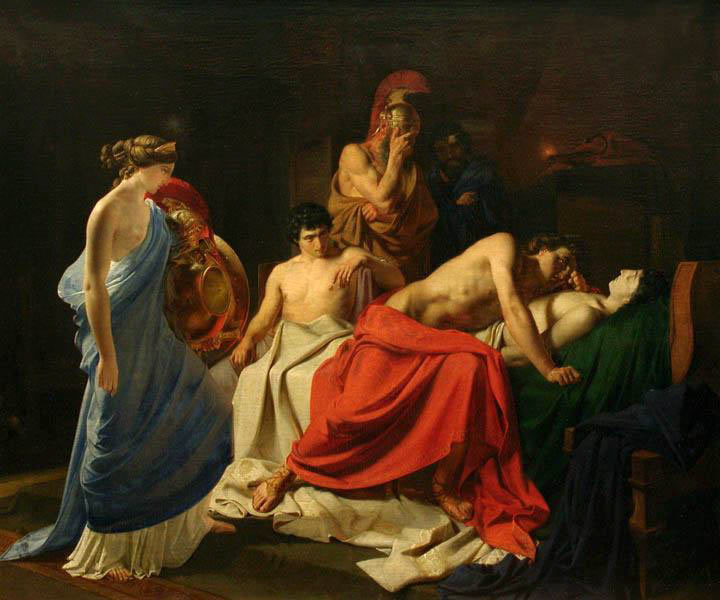
Achilles Lamenting the Death of Patroclus, by Nikolay Ge
Ἰλιὰς κακῶν, id est Ilias malorum. De calamitatibus maximis simul et plurimis. Propterea quod in Iliade Homerica nullum mali genus non recensetur. Vnde ex hac docti putant tragoediarum argumenta fuisse sumpta, sicut ex Odyssea comoediarum. Est autem opus verbosum, viginti quatuor voluminibus vix absolutum. Vnde et quamuis orationem plus satis prolixam Iliade longiorem vocant, vt Aeschines aduersus Demosthenem. Ταῦτα δὲ εἰπὼν δίδωσιν ἀναγνῶναι ψήφισμα τῷ γραμματεῖ, μακρότερον μὲν τῆς Ἰλιάδος, κενώτερον δὲ τῶν λόγων οὓς εἴωθε λέγειν, id est His dictis decretum scribae legendum tradit, prolixius quidem lliade, vanius autem verbis iis quae dicere consueuit.
Eustathius inuertit adagionem ad hunc modum: Καὶ παροιμία μέντοι κακῶν Ἰλιάδα φησίν, αὕτη δὲ καλοῦ παντὸς Ἰλιάς, id est Iliadem malorum prouerbium ait, at haec omnium bonorum llias. Synesius in epistola quadam ad fratrem: Καὶ ὅλως κακῶν ἂν Ἰλιάς περιέστη τὴν πόλιν ἡμῶν, id est In summa, malorum Ilias circunstetit vrbem nostram. Plutarchus in Praeceptis coniugalibus: Ὁ δὲ ἐκείνων Ἰλιάδα κακῶν Ἕλλησι καὶ βαρβάροις ἐποίησεν, id est At illorum nuptiae Iliada malorum Graecis ac barbaris inuexerunt. Loquitur enim de coniugio Paridis et Helenae, quod inaestimabilium malorum fuit causa. Vtitur et M. Tullius in Epistolis ad Atticum: Tanta malorum impendet Ilias.
Chateaubriand, Voyage from Paris to Jerusalem (1):
It had been one hour since nightfall when we began to consider returning to Athens. The sky shone with stars, the air with a sweetness, a clearness, and a purity which were incomparable. Our horses went with small steps, and we fell to silence. The path which we were going along was likely the ancient path of the Academy, bordered by the tombs of the citizens who died for their country and the greatest men of Greece. There lay Thrasybulus, Pericles, Chabrias, Timotheus, Harmodius, and Aristogeiton. It was a noble idea to gather in one field the ash of those famous people who lived in different ages and who, as members of one illustrious family long disperses, came finally to rest in the bosom of their communal mother. What variety of genius, of greatness, of courage! What diversity of habits and virtues one could perceive there with one glance of the eye! And these virtues tempered by death, like those noble wines which one mixes, as Plato says, with a sober divinity, do not offend the sensibilities of the living. The passerby who read on one funeral column these simple words:
Pericles, from the tribe of Acamantis, from the deme of Cholargos
felt nothing more than admiration without envy. Cicero represents to us Atticus wandering among these tombs, seized by a holy regard for these august ashes. It is no longer possible for us to make the same scene. The tombs are destroyed. The illustrious dead whom the Athenians placed by their city like outposts were not raised to defend them. They suffered the Tartars trampling them underfoot. ‘The times, violence, and the plough,’ says Chandler, ‘have leveled it all.’ The plough is too much there. And this remark which I make paints a better picture of Greece’s desolation than do the reflections which I could yield myself to.
Il y avait déjà une heure qu’il faisait nuit quand nous songeâmes à retourner à Athènes : le ciel était brillant d’étoiles, et l’air d’une douceur, d’une transparence et d’une pureté incomparables ; nos chevaux allaient au petit pas, et nous étions tombés dans le silence. Le chemin que nous parcourions était vraisemblablement l’ancien chemin de l’Académie, que bordaient les tombeaux des citoyens morts pour la patrie et ceux des plus grands hommes de la Grèce : là reposaient Thrasybule, Périclès, Chabrias, Timothée, Harmodius et Aristogiton. Ce fut une noble idée de rassembler dans un même champ la cendre de ces personnages fameux qui vécurent dans différents siècles, et qui, comme les membres d’une famille illustre longtemps dispersée, étaient venus se reposer au giron de leur mère commune. Quelle variété de génie, de grandeur et de courage ! Quelle diversité de mœurs et de vertus on apercevait là d’un coup d’œil ! Et ces vertus tempérées par la mort, comme ces vins généreux que l’on mêle, dit Platon, avec une divinité sobre, n’offusquaient plus les regards des vivants. Le passant qui lisait sur une colonne funèbre ces simples mots :
Périclès de la tribu acamantide,
du bourg de Cholargue,
n’éprouvait plus que de l’admiration sans envie. Cicéron nous représente Atticus errant au milieu de ces tombeaux et saisi d’un saint respect à la vue de ces augustes cendres. Il ne pourrait plus aujourd’hui nous faire la même peinture : les tombeaux sont détruits. Les illustres morts que les Athéniens avaient placés hors de leur ville, comme aux avant-postes, ne se sont point levés pour la défendre ; ils ont souffert que des Tartares la foulassent aux pieds. ” Le temps, la violence et la charrue, dit Chandler, ont tout nivelé. ” La charrue est de trop ici ; et cette remarque que je fais peint mieux la désolation de la Grèce que les réflexions auxquelles je pourrais me livrer.
Gustave Flaubert, Letter to Emmanuel Vasse (June 4, 1846):
For me, despite my sorrows, my worries, the troubles of a heap of affairs, I work reasonably enough, that is to say, around eight hours a day. I do some Greek, some history; I read some Latin, I cover myself in these heroic ancients for whom I end up having a sense of artistic worship. I strive to live in the ancient world. I will arrive there, with God’s help.
Pour moi, malgré les chagrins, les soucis, les embarras d’un tas d’affaires, je travaille assez raisonnablement, c’est-à-dire environ huit heures par jour. Je fais du grec, de l’histoire ; je lis du latin, je me culotte un peu de ces braves anciens pour lesquels je finis par avoir un culte artistique ; je m’efforce de vivre dans le monde antique ; j’y arriverai, Dieu aidant.
“To remember the past, you tell a story about it. And in recalling the memory, you tell the story again. It is not always the same story, as the person telling it does not always want the same things….As children become better storytellers, they become better rememberers. But their memory system also becomes more susceptible to distortion.”
Charles Fernyhough, Pieces of Light, 98
“He was like someone speaking many lies similar to the truth.”
When Odysseus returns to Ithaca in the second half of the Odyssey, he spends seven books in disguise. Part of the motivation for this is to give him the ability to test the loyalty of the people in Ithaca and justify the murder of the suitors and the slaughter of the handmaids at the end. But another part is that Odysseus explores who he is by reflecting on others’ stories. He uses his narratives in the second half of the epic to negotiate different parts of identity, to imagine different lives for himself, and to distance himself from the trauma of war and wandering.
In studying memory Martin Conway suggests that there are two forces in human recall: correspondence, which is about equivalence between details of ‘reality’ (or experience) and details of a story and coherence, which means that details make sense together in a narrative. When we tell stories about ourselves, we are not repeating a one-to-one correspondence between what happened and what we say about it. Instead we are engaging in the creation of autobiographical memory to create a coherent sense of ourselves.
The problem with seeing Odysseus as doing this in the second half of the Odyssey, of course, is that his stories are only obliquely about himself. They are mostly lies and they change depending on who he talks to: he shifts in narratives from Eumaios, to the suitors, and to his father at the epic’s end. His lies say something about him, certainly; but they also say something about how he views others.
The stories he tells lets him mirror and then use others. And he uses them to complete the hardest (and most violent) parts of his homecoming.
“I don’t know. No one ever knows his own father himself.”
There are a series of days each year when my father’s memory presses upon me: father’s day, his birthday, the day(s) he died, and holidays. I miss him deeply; but I also spend the years pondering the questions I don’t have answers to, wondering how much of what he was shapes me still.
When my father died, it was a shock both for its suddenness and then for the series of minor mysteries that followed. The first was the uncertainty of what happened. He died at 61 after a sudden bout with pneumonia. The autopsy revealed his lungs were filled with sawdust from years of fiddling around with woodworking, mask-less in a garage with no circulation. He also had Lyme disease. And years of smoking and drug use had made his breathing weaker and his sense of his own health attenuated.
We search out he causes of things but often find no clear answer. So, often, we choose a simple answer to help us get by. How and why he died suddenly gave way to a series of mundane, pressing questions: funeral arrangements, financial concerns. Packing up a life is never easy; the secrets left behind are entangled in ways the living didn’t imagine and the dead will never learn.
After my father’s death, I expected some trouble. He was a man who shifted easily between lives. He had a rich fantasy life—always dreaming that he would accomplish something great, that he would end up someone different. As the oldest of three, it fell to me to try to make sense of the mess: years of unpaid taxes; a maze of debt and collection bureaus; accounts tied to strange addresses; unopened summonses and bills.
At one point, I had to log in into my father’s email account, at first to contact some business associates who owed him money, and later to sift through his last few weeks of correspondence to try to figure out whether or not he knew how sick he was. (He did. Forty-eight hours before his death he sent an email to his older sister, writing “This is the sickest I have ever been.” He still waited another 36 hours to go to the doctor.)
There was a strange type of voyeurism in the process. I suspected some of what I would find, but not everything. Infidelity, I knew about. Debt and delinquency? This had been the story of our lives. But during the process of arranging for my father’s funeral, writing a eulogy, and trying to make an initial reckoning of his accounts, I started emailing with one of my father’s business associates, a man I will call Felix.
“There is one universal law among mortals
And one that is right to the gods, I believe truly—
And to all animals as well: to love the children we bear.
In everything else, we follow different laws.”
Upon his return to Ithaca, Odysseus spends a significant amount of time enjoying hospitality of his enslaved swineherd, Eumaios. He tells Eumaios some terrific stories: he was a warrior from Crete who made the wrong decision to go to war and after years of suffering and betrayal he ended up enslaved and sold. Part of that story is true, of course; and the enslavement can function as a metaphor for his pains at sea and how he was subject to cruel fate. But the story also serves to endear Odysseus to Eumaios by anticipating Eumaios’ own story: how he was kidnapped as a child by a devious nurse and sold off to slavers who brought him to Ithaca.
When we meet new people, we eagerly find common ground through personal stories: we grew up in the same/similar place; we went to school in the same city; we worked in similar industries, etc. But as relationships deepen, we share those harder stories. Sometimes, to identify with people, or even to upstage them, we embellish or reshape our stories.
Even false tales can arise from real pain. Life leaves physical markers on us as literal as Odysseus’ scar. But the marks that define us are more often than not unseen. Just as the year’s calendar eventually becomes a catalog of days for the lost and gone, so too can our memories become a latticework of scars and open wounds. The facts of the stories we tell can be less meaningful than the truth they are trying to convey.
Odysseus and his father
My father’s colleague Felix confided in me that my dad had become a close friend, in part because of his empathy regarding Felix’s daughter. His daughter had suffered from an “unknown progressive neuro-muscular disorder causing severe dystonia” and the pain she endured alongside the uncertainty of her diagnosis (which seemed to indicate a shortened life) wracked him and his family with the kind of suffering that only parents can imagine.
Felix made it clear that my father changed his life because he was always there just to listen and because he inspired him with his love of his family and his expressions of religious faith. He also inspired him, he revealed, because he shared with him his own story of loss, the loss of his daughter Rachel.
“There is a good time for lies and god honors it”
ψευδῶν δὲ καιρὸν ἔσθ’ ὅπου τιμᾷ θεός #Aeschylus
I never had a sibling named Rachel. But I didn’t say this to Felix because he had forwarded me an email where my father wrote:
“Every day I wake up thinking of my daughter –Rachel – go to bed thinking of Rachel. We had 4 children – now 3 but the blessings and gifts they have brought blow my mind […] but always Rachel is the background- never goes away- but I have still have joy and overwhelmed with blessings.”
Felix assured me that he had never mentioned this email to anyone. Even as I type this now I can smell the stale smoke in my father’s office where I read this for the first time. I remember calling my wife in to read it. Under the pall of our grief, we couldn’t process this, we couldn’t make sense of what it meant or whether it was possible. Soon, like my father, I was waking up and thinking about Rachel.
“If I tell the truth, I won’t make you happy.
But if I am to make you happy, I will say nothing true.”
There’s a scholarly tradition of dismissing the end of the Odyssey. Ancient scholars complain that the Odyssey ended properly with the reunion of Odysseus and Penelope, while the Archbishop of Thessaloniki, Eustathius, observed that book 24 is full of really important things, like “the recognition scene between Odysseus and Laertes.” Odysseus’ reunions take him through the major roles he plays in life as part of re-establishing an Ithakan identity. In book 24, he must reconcile with his community and his dad.
Infant and Skull, Medieval, Louvre
When I talk about the Odyssey publicly and I get to its end, I explain that I never really understood the reunion scene until I became a father and lost my father in the same year. Odysseus tests and teases his father cruelly, only to panic and give up the ruse when he makes Laertes cry. Odysseus’ scar is a necessary but insufficient proof of his identity to his father. To confirm their relationship, they rehearse the stories of the groves and trees they used to tend together when Odysseus was young.
My father spent a good deal of the last few decades of his life clearing and planting in the woods of southern Maine. His primary engagement with my brother and me was this land: planting grass, mowing the lawn, developing gardens, planning for the future. The land my mother and brother still live on is also a map of memory: the places where we played games; the trees we climbed; where we fought; where we buried pets. In my father’s absence, there was one fewer person in the world who could attest to the truth of our stories.
So I was left with new stories for this landscape. Eventually, I tried to make ‘Rachel’ cohere with reality. My mother had miscarriages before me and after me and, as family lore goes, was told she wasn’t able to have children. When I was younger and the whole family was more religious, they told me (the oldest) that they hadn’t had a child until they joined a new church and started to pray. I was baptized and confirmed in that church. The minister was my godfather. I have a picture of him holding my daughter.
But when I asked my mother, in a probably less than sensitive way, if there were any other children or if they had planned on naming one of the miscarriages Rachel, she thought it was absurd. It didn’t seem to me likely that my father had spent years brooding in secret over a lost child when he had three healthy children.
But as a recent father, I could imagine the possibility at least. From the moment I knew my wife was pregnant, I would feel a deep, gut-wrenching fear at even imagining the death of a child. In this I have found the ultimate failure of Stoic prior contemplation: I cannot conceive of a world where I knit myself back together after losing a child. Is that what happened with my father?
As we approached his funeral, I daydreamed a future story where I interviewed distant relatives and friends about may father’s past, the type of people who might know about a lost child, or about a baby born out of wedlock whose brief existence had been hidden from my mother. As the long hours past, I thought that maybe this was Rachel: a brief alternative life in the past whose loss had festered in my father as a metonym for all of the other lives he could have lived. Or, as that fourth child, that extra helping of happiness that might have tipped the scales in a middling life.
“I once lived in a house among men, a blessed man in a
wealthy house, and I used to give much to a wanderer”
There is a cold empathy in Odysseus’ stories—he is a kind of predating narrator in echoing Eumaios’ greatest sorrow, his kidnapping and enslavement as a child. When Odysseus tells his lies to manipulate Eumaios or test the suitors, he instrumentalizes narrative. He plays upon their suspicions and experiences to put himself in a better position. But that’s an oversimplification of the story too. He also can be seen tracing out he story of his own life, exploring different ways of thinking about what happened to him. As the fugitive Cretan, he tells Eumaios that his men forced him to go to the Trojan War (14.261), he laments that he cared too much for war, and laments how cruel fate has been to him.
Lovis Corinth “Odysseus Fighting the Beggar” 1903
In my own narrative quest, I emailed a woman my father had an affair with and asked her directly if she knew anything about ‘Rachel’. She, who had known my father quite well for years, said she would have been shocked if there were or had been another child, that my father loved his children so much that it would be inconceivable that he would have never mentioned Rachel. And, then, she added enigmatically, “He did say last summer that he would have named your [daughter] Rachel, if it was up to him.”
After my father’s funeral, things spiraled downhill for my family. We eventually got most of the finances under control by writing off credit debt and paying federal and state taxes; two new grandchildren were born over the next year. I left the issue of Rachel quiet to protect my mother and the rest of us from the uncertainty. But I never really stopped thinking about it
When Telemachus first sees Odysseus revealed in the Odyssey, he refuses to believe it his father. Odysseus appears suddenly and he looks too good. There’s a slight delay before Odysseus gets angry, but then Telemachus accepts him, even though he has no proof. Penelope, however, delays acknowledging her husband to the point that when she knows who he is remains an interpretive knot of the poem. I like to imagine her suspecting from the beginning, but resisting seeing in this old, broken beggar the man who left her so many years ago. Even after the slaughter of the suitors—or perhaps, especially after it—she makes him wait, testing him first to see how he reacts when she claims to have moved the bed around which their home was built.
I eventually concluded that there were three possibilities: (1) that my father had emotionally connected with a miscarriage, naming it Rachel and keeping the pain to himself; (2) that he had fathered another child who died (or was estranged); or (3) that he had made up the child drawing on his experiences to empathize with Felix. Given the absence of any evidence for the first two options, I decided that the last was most likely.
When Odysseus lies to his father, crafting a tale that echoes the pain they have both gone through, it is a step too far. As his father cries, Odysseus breaks in and says, “I myself, I am the one about whom who you ask / I have come home in this twentieth year to my paternal land” (κεῖνος μὲν δὴ ὅδ’ αὐτὸς ἐγώ, πάτερ, ὃν σὺ μεταλλᾷς, / ἤλυθον εἰκοστῷ ἔτεϊ ἐς πατρίδα γαῖαν, 24.321–22). But this is not enough for Laertes after so many lies: he asks for a clear sign (σῆμά τί μοι νῦν εἰπὲ ἀριφραδές, 329) and Odysseus shows him his scar and tells him the story of the trees his father described to him when he was a child (333–45). Laertes’ limbs give away as he “recognizes the signs” (σήματ’ ἀναγνόντος … ).
What does it mean to believe that your father was the kind of man who would fabricate a dead child in order to make a connection with someone? Is this even possible? What was the name Rachel to him and why did it recur in different contexts?
Sirens and Odysseus by Fracesco Primaticcio, 1560
My father was a man cut off from many people by his deafness and his aloofness (interconnected). He was also capable of long-term deceit (for self-defense) and short-term confabulation (to try to keep others happy). If he did manufacture the memory of a child, I am almost certain he did it with a full range of emotions drawn from the rest of his life and that part of him wanted to believe it. We make up stories all the time. We all bend the truth and introduce new details into old stories. If he invented a Rachel to console Felix, he did it because he wanted to feel with him, to be his friend, and through grief to be more fully human.
But perhaps this conclusion is still just more evidence of me creating the father I wanted to have rather than acknowledging the man he really was. To some, inventing a dead child might sound diabolical. But, given the other options, it speaks to me of someone who wanted to feel, of a man who into his last days was trying to be something real.
And this in turn is a lesson on the complexity of what makes each one of us who we are.
Many of the concepts in this entry come from this book
Yet, whatever Hope may persuade, or Reason evince, Experience can boast of very few Additions to ancient Fable. The Wars of Troy and the Travels of Ulysses have furnished almost all succeeding Poets with Incidents, Characters, and Sentiments. The Romans are confessed to have attempted little more than to display in their own Tongue the Fictions of the Greeks. There is in all their Writings such a perpetual Recurrence of Allusions to the Tales of the fabulous Age, that they must be confessed often to want that Power of giving Pleasure which Novelty supplies; nor can we wonder that they excelled so much in the Graces of Diction, when we consider how little they were employed in Search of new Thoughts.
The warmest Admirers of the great Mantuan Poet can extol him for little more than the Skill with which he has, by making his Hero both a Traveller and a Warrior, united the Beauties of the Iliad and Odyssey in one Composition; yet his Judgment was perhaps sometimes overborn by his Avarice of the Homeric Treasures, and for fear of suffering a sparkling Ornament to be lost, has inserted it where it cannot shine with its original Splendor. When Ulysses visited the infernal Regions, he found among the Heroes who died at Troy, his Competitor Ajax, who, when the Arms of Achilles were adjudged to Ulysses, died by his own Hand in the Madness of Disappointment. He still appeared to resent, as on Earth, his Loss and Disgrace. Ulysses endeavoured to pacify him with Praises and Submission; but Ajax walked away without Reply. This Passage has always been considered as eminently beautiful, because Ajax the haughty Chief, the unlettered Soldier, of unshaken Courage, of immoveable Constancy, but without the Power of recommending his own Virtues by Eloquence, or enforcing his Assertions by any other Argument than the Sword, had no way of making his Resentment known but by gloomy Sullenness and dumb Ferocity. He therefore naturally showed his Hatred of a Man whom he conceived to have defeated him only by Volubility of Tongue, by Silence more contemptuous and affecting than any Words that so rude an Orator could have found, and which gave his Enemy no Opportunity of exerting the only Power in which he was superior. When Aeneas is sent by Virgil into the Regions below, he meets with Dido the Queen of Carthage, whom his Perfidy had hurried to the Grave; he accosts her with Tenderness and Excuses, but the Lady turns away like Ajax in mute Anger. She turns away like Ajax, but she resembles him in none of those Qualities which give either Dignity or Propriety to Silence. She might, without any Departure from the Tenour of her Conduct, have burst out like other injured Ladies into Clamour, Reproach, and Denunciation; but Virgil had his Imagination full of Ajax, and therefore could not prevail on himself to teach Dido any other Mode of Resentment.
If Virgil could be thus seduced by Imitation there will be little Hope that common Wits should escape; and accordingly we find, that besides the universal and acknowledged Practice of copying the Ancients, there has prevailed in every Age a particular Species of Fiction. At one Time all Truth was conveyed in Allegory; at another nothing was seen but in a Vision; at one Period all the Poets followed Sheep, and every Event produced a Pastoral; at another they busied themselves wholly in giving Directions to a Painter.
Adam Gopnik writes in a New Yorker piece, “Pope’s Homer read like Homer when it was published…” Pope’s Homer was undoubtedly a commercial success, but certainly it failed to impress those who were qualified to judge its merits relative to the Greek original. Pope’s translation is a testament to his thorough saturation in the spirit of the English Augustan spirit, but revealed to his contemporaries a failure to steep himself in the classical springs.
Edward Gibbon, Memoirs of My Life:
“Before I left Kingston school I was well acquainted with Pope’s Homer and the Arabian Nights Entertainments, two books which will always please by the moving picture of human manners and specious miracles: nor was I then capable of discerning that Pope’s translation is a portrait endowed with every merit, excepting that of likeness to the original.”
Matthew Arnold, On Translating Homer:
“Yet it is strictly true that, for want of duly penetrating themselves with the first named quality of Homer, his rapidity, Cowper and Mr. Wright have failed in rendering him; that, for want of duly appreciating the second named quality, his plainness and directness of style and diction, Pope and Mr. Sotheby have failed in rendering him
James Boswell, The Life of Samuel Johnson:
“I remember also distinctly, (though I have not for this the authority of my journal,) that the conversation going on concerning Mr. Pope, I took notice of a report which had been sometimes propagated that he did not understand Greek. Lord Bathurst said to me, that he knew that to be false; for that part of the Iliad was translated by Mr. Pope in his house in the country; and that in the mornings when they assembled at breakfast, Mr. Pope used frequently to repeat, with great rapture, the Greek lines which he had been translating, and then to give them his version of them, and to compare them together.”
Sir Leslie Stephen, Alexander Pope:
“It is needless to say that he never became a scholar in the strict sense of the term. Voltaire declared that he could hardly read or speak a word of French; and his knowledge of Greek would have satisfied Bentley as little as his French satisfied Voltaire.”
[…]
“But he could say with perfect truth that, ‘thanks to Homer,’ he ‘could live and thrive, indebted to no prince or peer alive.’ The money success is, however, of less interest to us than the literary. Pope put his best work into the translation of the Iliad. His responsibility, he said, weighed upon him terribly on starting. He used to dream of being on a long journey, uncertain which way to go, and doubting whether he would ever get to the end. Gradually he fell into the habit of translating thirty or forty verses before getting up, and then “piddling with it” for the rest of the morning; and the regular performance of his task made it tolerable. He used, he said at another time, to take advantage of the “first heat,” then correct by the original and other translations; and finally to “give it a reading for the versification only.” The statement must be partly modified by the suggestion that the translations were probably consulted before the original. Pope’s ignorance of Greek—an awkward qualification for a translator of Homer—is undeniable. Gilbert Wakefield, who was, I believe, a fair scholar and certainly a great admirer of Pope, declares his conviction to be, after a more careful examination of the Homer than any one is now likely to give, that Pope ‘collected the general purport of every passage from some of his predecessors—Dryden’ (who only translated the first Iliad), ‘Dacier, Chapman, or Ogilby.’ He thinks that Pope would have been puzzled to catch at once the meaning even of the Latin translation, and points out proofs of his ignorance of both languages and of ‘ignominious and puerile mistakes.’”
Thomas Jefferson to Joseph Priestley, January 27th 1800:
“To read the Latin and Greek authors in their original, is a sublime luxury; and I deem luxury in science to be at least as justifiable as in architecture, painting, gardening, or the other arts. I enjoy Homer in his own language infinitely beyond Pope’s translation of him, and both beyond the dull narrative of the same events by Dares Phrygius; and it is an innocent enjoyment. I thank on my knees, him who directed my early education, for having put into my possession this rich source of delight; and I would not exchange it for anything which I could then have acquired, and have not since acquired.”
Finally, a note on Pope’s theology:
Sir Leslie Stephen, Alexander Pope:
“The old gods, then, were made into stiff mechanical figures, as dreary as Justice with her scales, or Fame blowing a trumpet on a monument. They belonged to that family of dismal personifications which it was customary to mark with the help of capital letters. Certainly they are a dismal and frigid set of beings, though they still lead a shivering existence on the tops of public monuments, and hold an occasional wreath over the head of a British grenadier. To identify the Homeric gods with these wearisome constructions was to have a more serious disqualification for fully entering into Homer’s spirit than even an imperfect acquaintance with Greek, and Pope is greatly exercised in his mind by their eating and drinking and fighting, and uncompromising anthropomorphism. He apologizes for his author, and tries to excuse him for unwilling compliance with popular prejudices. The Homeric theology he urges was still substantially sound, and Homer had always a distinct moral and political purpose. The Iliad, for example, was meant to show the wickedness of quarrelling, and the evil results of an insatiable thirst for glory, though shallow persons have thought that Homer only thought to please.”
“What sort of speech has escaped the bulwark of your teeth!?”
“As true Wit consists in the Resemblance of Ideas, and false Wit in the Resemblance of Words, according to the foregoing Instances; there is another kind of Wit which consists partly in the Resemblance of Ideas, and partly in the Resemblance of Words; which for Distinction Sake I shall call mixt Wit. This kind of Wit is that which abounds in Cowley, more than in any Author that ever wrote. Mr. Waller has likewise a great deal of it. Mr. Dryden is very sparing in it. Milton had a Genius much above it. Spencer is in the same Class with Milton. The Italians, even in their Epic Poetry, are full of it. Monsieur Boileau, who formed himself upon the Ancient Poets, has every where rejected it with Scorn. If we look after mixt Wit among the Greek Writers, we shall find it no where but in the Epigrammatists. There are indeed some Strokes of it in the little Poem ascribed to Musœus, which by that, as well as many other Marks, betrays it self to be a modern Composition. If we look into the Latin Writers, we find none of this mixt Wit in Virgil, Lucretius, or Catullus; very little in Horace, but a great deal of it in Ovid, and scarce any thing else in Martial.”
Aldus Manutius, Preface to Joannes Crastonus’ Greek Dictionary
“I had originally designed not to publish the Greek lexica (which we can call dictionaries in Latin) from our press before I had them sufficiently abundant and correct. But I changed my mind about this when I recognized that it was difficult in the extreme, not just for me – a man burdened by family obligations and my printing business – but even for an unencumbered person thoroughly knowledgeable of both languages, as well as the liberal arts, medicine, and all of the sciences. Indeed it is proper to know all, and to interpret all of the words according to their most proper sense, but I doubt whether anyone of our own time other than a stray person here and there has achieved excellence in this matter, when Greek and Latin literature – though they are thriving more than in many previous years – nevertheless languish in some obscurity.
For, who really knows the liberal arts? Who is thoroughly learned in the most simple things which are necessary in medicine? Alas – it is a shame to say, we hardly recognize lettuce, cabbage, and the herb which shows itself even to the blind. When I think about this, even though I cannot grieve about it too vehemently, I not only refrain from giving way to my pain, but I gird myself night and day to remedy the situation while avoiding no labor, so that I may hope that it will soon come to pass that the people of our age will know all the good arts and even have some fine skill in medicine, and that each scholar will have the strength to contend with antiquity as long as they not fail themselves. If there are any haters, imbeciles, or barbarians, then let them grieve, let them criticize, let them stand in the way as much and as long as they want. But this will turn out beautifully – it will.”
Gerardus Vossius, On the Nature and Constitution of the Poetic Art, Cap. II:
Whether the name of poet is given for making verses or for contriving stories.
“The latter opinion pleased Aristotle and even Plato. Words in metrical form were not sufficient to get someone called a poet; rather, the diction had to be worked up and bound by meter, and animated by the poetic spirit. Yet although meter was not sufficient to make something a poem, yet that is always required. The opposite opinion is attrbuted to Aristotle both by others and by Robortellus. How greatly the most learned men seem to disagree with him about what Aristotle understood by plain words or epic poetry and the speeches of Socrates. Assent has been granted to them who understand plain words to mean prose; epic to mean imitation wrought either in prose or in song; the speeches of Socrates to mean the dialogues of Plato. Those who claim that the mimes of Sophron were written in prose have been deceived by a corrupt passage in the Suda. The true sense of song (carminis) can be recognized by that alone, that the name of poets comes more from the meter than from the contrivance of fiction. It would be right to call the history of Herodotus poetry if it were worked out in verse, and Homer’s Iliad prose if it were written without meter.”
Utrum poetis a faciendis versibus, an a fingendis fabulis, nomen impositum sit. Posteriorem sententiam placuisse Aristoteli, atque etiam Platoni. Λόγον ἔμμετρον non sufficere, ut quis poeta dicatur: sed exigi praeterea dictionem metro ligatam, et spiritu poetico animatam. Utcumque vero non sufficiat metrum, ut quid poema dicatur, semper tamen id requiri. Contrariam sententiam tribui Aristoteli, cum ab aliis, tum Robortello. Quantopere de eo dissentiant homines doctissimi, quid Aristoteles intellexerit per ψιλοὺς λόγους , per ἐποποΐαν , et per Socratis sermones. Iis assensum, qui per ψιλοὺς λόγους intelligunt sermonem pedestrem; per ἐποποΐαν , imitationem seu prosa, seu carmine, institutam; per Socratis sermones, Platonis dialogos. corrupto Suidae loco deceptos, qui Sophronis mimos prosa fuisse scriptos contendunt. Carminis ἔτυμον , ac vel eo solo cognosci, poetis potius a metro esse nomen, quam a fictione. Quo nomine vocare oporteat Herodoti historiam, si in carmen redigatur; vel Homeri Iliada, si eadem prosa conscribatur.
“Emanuel Chrysoloras, who first brought Greek literature back to Italy seven hundred years after it had been driven out by various barbarian invasions, was endowed with such humanity of liberal intellect in his teaching, that his famous image seems worthy of being placed first among the images of Greeks of exceptional merit, although no monuments of his weighty learning remain except some rules on the art of grammar. He was an indefatigable teacher, but he is open to the charge of having been lazy in writing, since the other part of the glory which we have chosen was sought by his useful profession.
He was sent from Byzantium by the emperor John to seek aid for Greece, which was on the verge of collapse, by pleading with all of the kings of Europe. He completed this task with such diligent traveling that he finally stopped in Italy when Greece was liberated from fear, since Tamerlane – the terror of the East – had captured alive near Mount Stella the Ottoman sultan Bayezid I (who had received the epithet of “Lightning” from the incredible swiftness of his movements). And so Chrysoloras, delighted that Greece had been freed from such an awful enemy, first in Venice, then in Florence, Rome, and finally in Pavia, which was under the rule of Giangaleazzo Visconti, managed to excite such a zeal for Greek literature that there sprang from his school minds worthy of the highest honor which on that account will never perish. Among these were Leonardo Bruni, Francesco Barbaro, Francesco Filelfo, Guarino Veronese, and Poggio Bracciolini. Later, when the synod which was called for resolving the controversy surrounding the pseudo-pontificate roused with desire to see such a spectacle, when Baldassare Cossa was deposed. Chrysoloras died in Constance. Poggio Bracciolini decorated his tomb with these lines:
‘Here lies Manuel Chrysoloras, the ornament of the Attic tongue, who came here to seek help for his afflicted country. Italy, this was a fortunate event for you, for he restored to you the grace of the Greek language, so long hidden. This was a fortunate event for you, Emanuel, for you found on Italian soil the honor which Greece never gave you – Greece, ruined in war.'”