Gnom. Vat.160 “Biôn used to say that [we have] two teachers for death: the time before we were born and sleep.”
Βίων ἔλεγε δύο διδασκαλίας θανάτου εἶναι, τόν τε πρὸ τοῦ γενέσθαι χρόνον καὶ τὸν ὕπνον.
446 “Plato said that sleep was a short-lived death but death was a long-lived sleep.”
῾Ο αὐτὸς ἔφησε τὸν μὲν ὕπνον ὀλιγοχρόνιον θάνατον, τὸν δὲ θάνατον πολυχρόνιον ὕπνον.
Recently, I saw my grandfather, who is 91, at a family wedding. He told me he does not even like to buy green bananas any more because he can’t be sure he will be around to eat them when they ripen. This made me remember and then question that old Ciceronian claim that “no one is so old that he does not think he will live another year” (nemo enim est tam senex qui se annum non putet posse vivere, de Senectute 24)
A few of my students do this thing where they—only half-jokingly, I think—ask if I am ok, like really, really ok, after I make some quip about how we are all going to die or mention Seneca’s or Plutarch’s thoughts on life and death. When I talk about the Odyssey being obsessed with the death of Odysseus, or the Iliad deeply impacted by the precarity and scarcity of human existence, they seem to worry instead that I am the one obsessed, that I have some sort of morbid fixation.
Indeed, I would not be surprised if readers of this blog or the twitter feed have a similar suspicion when I ask questions like what text you would read if you knew you could only read one before you died or when I repeatedly post the dirges of Simonides. But the fact is, I am really acting with restraint here. If I were not sure that it would alienate most followers, I would set up the twitter feed to remind us of death every day, if not every hour.
Ok, this might be a little obsessive. But unlike what I think my students fear, I am not depressed about it. And I know I am not depressed because I spent a large part of my life depressed and fighting the feeling of the ultimate futility of life. One of my earliest memories of this is of being in third grade and lying awake at night trying to imagine what it was like to be nothing. I grew up in a fairly (but perhaps not deeply) religious family. We were Scandinavian protestants, though. This means we went to church frequently, but we didn’t really talk about it.
In fourth grade I remember talking with our minister about my doubts and objections. We went through the Nicene and Apostolic Creeds line by line and she told me I could leave out the words I did not believe in if it really bothered to say something aloud when I was uncertain. When I told her that I just could not make sense of the resurrection as a phenomenon, she told me that doubt was an important part of faith.
This kept me going for a long time. But my doubts did not fade and talking about them in a religious context seemed only to make things worse. By the time I was in high school, I would regularly spend nights awake nearly paralyzed by fear and sorrow. Even though I had a delightful undergraduate career by all measures, some of my strongest memories from those years remain breaking down and laboring under the weight of the depression.
Solon, fr. 18
“I grow old, always learning many things.”
γηράσκω δ’ αἰεὶ πολλὰ διδασκόμενος·
Graduate school is not a good place for mental health. It is a great place to develop harmful coping mechanisms (narcissism, drug and alcohol abuse, etc.). Again, I think I probably seemed functional as a graduate student (and early career professor), but like many of us I was on a very precarious tight-rope. Even to this day, I know it was sheer luck that I did not suffer some kind of irreparable harm.
In graduate school, however, I did start to read more widely and to lean on my reading more to make sense of life in general. I started reading pre-Socratic philosophers and Roman writers like Seneca. When I was an undergraduate and I first read Plato’s Socrates asserting that “death is one of two things” either a dreamless sleep or the transformation of the soul in Greek, I was elated because here was something I could relate to. When we talked about Plato in philosophy classes, however, this topic rarely came up. When it did, it was discussed only briefly and almost elliptically.
But what is more important than talking about death? How many errors do we make because we refuse to do so? How many days are wasted in pursuits we might otherwise discredit if we really considered our lives in their entirety?
We have a cultural taboo about talking about death. When we do so individually and outside rather narrow confines, we are pathologized as quirky, morbid, or mentally ill. Even in psychological research, there is a reluctance to study how we think about death and its impact on our lives. As Solomon, Greenberg and Pyszczynski 2015 argue, however, this taboo itself is pathological and it has a wide impact on the well-being of individuals and whole cultures. We don’t want to talk about death because it is painful; but by not talking about death we collectively suffer more pain than we need to. Even Galen notes the paradox that fear of death can become a depressive obsession which robs us of the very thing we don’t want death to take.
So, for a great part of my life I did not talk about death because no one else wanted to. But this had a harmful effect–it meant that I bottled it up, I ruminated over it, and it would come bubbling out, uncontrollably, at the worst times.
In graduate school, I did finally find some professors who would talk about death, but only in the terms laid out by ancient authors. Here, there was an acceptable, but indirect way to have a conversation. There is this basic idea which I have seen described as Epicurean and Stoic but which really emerges as a regular part of Roman eclecticism that death should not be feared because when it comes we will not experience it. Seneca (EM 30.17-18) asserts that we do not fear death itself, but the thought of death (Non mortem timemus, sed cogitationem mortis), which I guess is true in a way, but it is still a prevarication. Is it not the thought of anything that we initially and mostly fear or desire? (Seneca actually cites Lucretius here, not a Stoic exemplar.) Of course, Plutarch rightly asks us whether we are more moved by fear of death or love of life.
Sophocles, fr. 65
“No one loves living as much as a man growing old”
τοῦ ζῆν γὰρ οὐδεὶς ὡς ὁ γηράσκων ἐρᾷ
Elsewhere, Seneca says that death is either “the end or a transformation” (EM 65) and that the former should not be feared because it is the same as never having begun (Aut finis aut transitus. Nec desinere timeo, idem est enim, quod non coepisse). This is the same as the basic assertion that we know what death is because it is a return to what we were before we were alive. In response to this notion, even the Stoic master Marcus Aurelius insists that we should consider we might die in every action we take. But, as Erik notes in an essay on “Frost, Horace and Death”, lyric poets like Catullus and Horace muse on the cyclical nature of the natural world only to conclude that our conscious lives are something different—As Catullus puts it, when the time comes “we must sleep one endless night” (nox est perpetua una dormienda, Carm. 5)
I wish my story involved going to therapy because I think that step is something which is a little easier to offer to others instead of prescribing that people spend a decade reading Seneca and Greek poetry. But this would be a lie. Like many of my generation, I was raised considering therapy for mental health a sign of weakness. I don’t rationally believe this, but the level of my disinclination to seek any kind of assistance is certainly problematic. Also, I do believe that, while therapy is absolutely the right move for people afflicted by depression, the injunction to do so is unrealistic for so many people because of costs and access issues.
On Timon, D. L. 9.12
“Antigonos says that Timon was fond of drinking; and, whenever he had free time from philosophizing, he wrote poems”
Ἦν δέ, φησὶν ὁ Ἀντίγονος, καὶ φιλοπότης καὶ ἀπὸ τῶν φιλοσόφων εἰ σχολάζοι ποιήματα συνέγραφε
The truth is that I only emerged from what was almost decades of suffering through slow, deliberate change. And reading—especially reading philosophy and poetry—was instrumental in helping me along the way. At some point, I learned to make thinking about death a practice. Obviously, some of this is just growing older and more stable—one chief antidote to depression is having a sense of belonging and something to do. And having children is a double-gift: it provides that sense of belonging and purpose while also allowing us to remember that life is full of real, precious wonder.
(The importance of belonging and purpose should make us even more aware of the position we put undergraduate and graduate students in: they are necessarily in precarious positions when it comes to social roles and cultural capital; but they also often have limited access to support services.)
Cicero, de Senectute
“Every age is burdensome to those who have no means of living well and happily”
Quibus enim nihil est in ipsis opis ad bene beateque vivendum
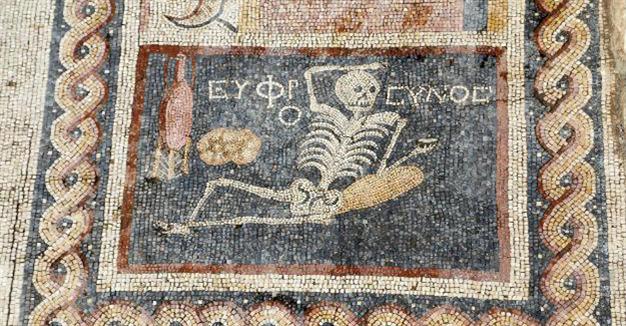
It is not really classical reflections on the nature of death that I have found especially enlightening or moving, but rather the constant reminder that, given what we know (or don’t know) about death, learning how to live is critical. Once you absorb this lesson, it seems like it should have been patently obvious from the beginning. It is as simple as this: we really don’t know anything about what happens after death, but we are certain we are alive now and that this life is limited. Is it not absolute insanity to do anything but try to live it well?
I don’t want to moralize much here or in any way denigrate systems of thought that bring people comfort when facing that starkest of uncertainties, but belief systems that deprive us of joy and (non-harmful) pleasure in this life steal from us by trading on the promise of the unknown. Yes, these systems of thought can do us good by enforcing standards of behavior that make us treat each other better than we would in a state of nature. And, yes, many of them do provide true comfort against that chilling fear of the endless night. But I think many of us make this deal before we can possibly understand the value of what we are bargaining.
The problem is that we wonder at death and we think it is something remarkable. What is remarkable is that each of our individual consciousnesses exist. The miracle is that we live at all. This should be celebrated and life should be enjoyed—we should revel in the fact that we are because we know for certain that we once were not and must understand the very good chance that we will not be.
This does not, of course, mean we have to be destructive. We can live fully and experience life well without taking the same opportunities from others. We don’t need to wear out life, heeding a refrain we hear from Pliny who admits his own fear of death and implores “So, while life remains to us, let’s make it so that death discovers as little as possible to destroy.” (Proinde, dum suppetit vita, enitamur ut mors quam paucissima quae abolere possit inveniat, Epistle 5.5). But we must take some stock of what it means to live.
Plato, Critias 108d
“I need to do this already, I can’t procrastinate anymore!”
τοῦτ᾿ οὖν αὐτὸ ἤδη δραστέον, καὶ μελλητέον οὐδὲν ἔτι.
This is in part why I love the two epitaphs assigned to Ashurbanipal in Athenaeus’ Deipnosophists. Both feature the King known for his legendary wealth reminding his addressee that we are mortal and that even the wealthy and powerful like himself die. He continues by asserting “I kept whatever I ate, the insults I made, and the joy / I took from sex. My wealth and limitless blessings are gone” (κεῖν’ ἔχω ὅσσ’ ἔφαγον καὶ ἐφύβρισα καὶ σὺν ἔρωτι / τέρπν’ ἔπαθον· τὰ δὲ πολλὰ καὶ ὄλβια πάντα λέλυνται). The variant has a slightly less hedonistic take: “I keep whatever I learned and the thoughts I had and the fine things / I experienced with them. Everything else, however pleasing, is gone.” (ταῦτ’ ἔχω ὅσσ’ ἔμαθον καὶ ἐφρόντισα καὶ μετὰ τούτων / ἔσθλ’ ἔπαθον· τὰ δὲ λοιπὰ καὶ ἡδέα πάντα λέλειπται).
I think that these two options belong together—that the dueling versions do not present opposite ways of living, but instead mark out that one life is incomplete without the other. We are bodies and we are minds and the two are entwined. This is why the extreme Cyrenaic claim that life’s balance of pleasure and pain should be considered as a reason for suicide is suspect. It underestimates the value of being able to ask and answer this question in the first place.
When people ask how I ended up pursuing a career in academia in general and, in particular, why Classics, I usually tell them about my deep love of literature and how I ended up pursuing Classics as an undergraduate degree because I wanted the same type of education as my favorite authors. This is true, but not complete. When I was younger I decided that a life spent doing something that did not have a meaningful connection to what I believed life was all about was a life wasted. (Yes, I was a lot of fun in high school too.)
Achilles Tatius, Leucippe and Clitophon 18
“For when beauty, wealth and sex converge upon you, you better not sit or procrastinate!”
κάλλος γὰρ καὶ πλοῦτος καὶ ἔρως εἰ συνῆλθον ἐπὶ σέ, οὐχ ἕδρας οὐδὲ ἀναβολῆς
The problem with this statement is figuring out what life is “all about”. My short answer was—and remains—that having the time and allowing yourself the freedom to think about what life is for is an essential part of living fully and well. When I considered a future life as an adolescent, I wanted more time and I did not want to be in a subculture where thinking was discouraged. I wanted to be able to read and write. I wanted to have access to ancient thoughts on the same problems. Moment by moment, becoming a Classicist became almost inevitable. Indeed, Petrarch certainly sees the transience of human life through a Classical frame.
Instead, what I want to point out is there is at the base of Classical Humanism a deep and abiding contemplation of what it means to be human (including what it means to be mortal). I fear too often that Philology and many current academic practices emphasize minutiae and actually disincentivize any thought about larger pictures. To return again to Seneca, he laments that too many of us turn “to teachers not for the nourishing of the soul, but the cultivation of our wit. Thus what was philosophy has been turned into philology” (adferunt ad praeceptores suos non animum excolendi, sed ingenium. Itaque quae philosophia fuit, facta philologia est, EM 108).
When I read Seneca’s Moral Epistles now, part of what emerges is the sense of a writing practice to remind oneself that life must be lived. From his first letter to Lucilius, Seneca emphasizes that time is the only thing we really have and that most people do not realize how valuable it is. Even though he insists in the de Brevitate Vitae that life is plenty long and the problem is that most people waste it, it argues in the Epistles that we must still “embrace every hour” (omnes horas complectere). Indeed, in a different essay, Seneca begs his reader to seize life because not even the next hour is guaranteed.
And how Seneca himself does this is an object lesson. He does not mean we should spend every hour in pleasure or its pursuit—indeed, he would be a hypocrite if he meant this. No, what he means is the living of life with intention and meaning. His writing of the Moral Epistles is actually a demonstration of this, of a life lived through and for contemplation but not in contempt of the experiences of the body and of others.
Seneca, Moral Epistles 76.3-5
“You must learn as long as you are ignorant—if we may trust the proverb, as long as you live. And nothing is more fit to the present than this: as long as you live you must learn how to live. Nevertheless, there is still something which I teach there. You ask, what may I teach? That an old man must learn too.”
Tamdiu discendum est, quamdiu nescias; si proverbio credimus, quamdiu vivas. Nec ulli hoc rei magis convenit quam huic: tamdiu discendum est, quemadmodum vivas, quamdiu vivas. Ego tamen illic aliquid et doceo. Quaeris, quid doceam? Etiam seni esse discendum.
Plato famously has one of his speakers say that “In truth, those who practice philosophy correctly practice dying” (τῷ ὄντι ἄρα, ἔφη, ὦ Σιμμία, οἱ ὀρθῶς φιλοσοφοῦντες ἀποθνῄσκειν μελετῶσι, Phaedo 67e). I cannot disagree with this, but I think that it needs to be explained a bit. Cicero’s gloss on this “that the life of philosophers, as the same man says, is a contemplation of death” Tota enim philosophorum vita, ut ait idem, commentatio mortis est (Tusc. Disp. 30.74-31.71.5) gets a little closer to what Montaigne understands: that without understanding death and acknowledging it for what it likely is, we make the mistake every day of not remembering to live. To contemplate death is to remind ourselves every day that life must be lived and should be lived well. To ignore it, is pretty much the opposite. This practice is not about learning how to die but instead about learning to accept that we are mortal and through that acceptance to learn truly how to live.
I started writing this in honor of turning 40 this week. I am not delighted about this number—even though I know that this is irrational and that 39 was in no real material way that different. Oh, how strange the number 40 is! My students think I’m old; my older colleagues think I am still young. I feel generally the same as I have for years, except I know rationally that the number of years which have passed are most likely now to outnumber those that remain.
To celebrate this, I am leaving the country. My wife surprised me with a trip to Greece and this is a big deal because, somehow, I have never actually made it to Greece. I know it is ridiculous that a Hellenist has never been to Greece and I am sure that this among many other things exposes what a charlatan I am, but there are plausible explanations. My parents never possessed passports; a good deal of my travel abroad was funded by someone else. Etc. etc.
When my wife told me she had booked a trip to Greece to mark (or perhaps avoid?) this auspicious occasion, I had to wonder aloud if we could afford to go. She said, can we afford not to? Who am I to argue with wisdom so deep?
So, for the next week there will be a series of pre-scheduled posts about Athens, a place I deeply love from texts, but a world to which I have never truly been. Until then, a reminder from Martial.
Martial, 5.58
“Postumus, you always say that you will live tomorrow, tomorrow!
But that ‘tomorrow’ of yours – when does it ever come?
How far off is that ‘tomorrow’! Where is it, or where should it be sought?
Does it lie hidden among the Parthians, or the Armenians?
That ‘tomorrow’ is as old as Priam or Nestor.
For how much can ‘tomorrow’ be purchased?
You will live tomorrow, you say?
Postumus, even living today is too late;
he is the wise man, who lived yesterday.“
Cras te uicturum, cras dicis, Postume, semper:
dic mihi, cras istud, Postume, quando uenit?
Quam longe cras istud! ubi est? aut unde petendum?
Numquid apud Parthos Armeniosque latet?
Iam cras istud habet Priami uel Nestoris annos. 5
Cras istud quanti, dic mihi, possit emi?
Cras uiues? Hodie iam uiuere, Postume, serum est:
ille sapit quisquis, Postume, uixit heri.



#/media/File:Arch_of_Hadrian_Athens.jpg)