Love = Death

Jacopo Sannazzaro, Epigrams 2.56
(To His Own Soul)
“You burned, and the flame consumed your wretched marrow –
your desiccated bones dissolved into tenuous ash.
You wept, and your eyes poured forth a perennial dew;
Sebeto himself grew from your tears.
Why this unbridled desire for burning and crying?
O, my soul, you should learn to fear your funeral,
and not to go on seeking over and over for your destruction, your death.
Be happy that you have made it past the Sirens’ rocks.”
Image result for jacopo sannazzaro
Titian, Portrait of Jacopo Sannazzaro
Arsisti; et miseras consumsit flamma medullas;
Aridaque in cineres ossa abïere leves:
Flevisti; roremque oculi fudere perennem;
Sebethus lacrimis crevit et ipse tuis:
Ardendi, fledique igitur quae tanta cupido est?
O anime, exsequias disce timere tuas;
Neve iterum tua damna, iterum tua funera quaeras:
Sirenum scopulos praeteriisse juvet.

Cicero Is Wrong About Puppies

My sister-in-law got a puppy this weekend. Of course, this means I went home and started looking at what Greeks and Romans say about puppies. (I have done this before, but, wait, there’s more!) Let me tell you, it starts objectionable and gets gruesome.

Cicero, De natura deorum, 2.13

“Therefore, it is that same Chrysippos, who, by furnishing images, teaches that everything is better in its perfect and mature form, that a horse is better than a foal, a dog better than a puppy, a man better than a boy, etc. He also shows that what is best in the whole world ought to be found in that same perfect and complete creature and that there is, moreover, nothing more perfect in the whole world, nothing better than virtue. Because of this, virtue is a fundamental element of the world. Now, the nature of a human being is not perfect, but virtue may still emerge in a person.”

Bene igitur idem Chrysippus, qui similitudines adiungens omnia in perfectis et maturis docet esse meliora, ut in equo quam in eculeo, in cane quam in catulo, in viro quam in puero; item quod in omni mundo optimum sit id in perfecto aliquo atque absoluto esse debere; est autem nihil mundo perfectius, nihil virtute melius; igitur mundi est propria virtus. Nec vero hominis natura perfecta est, et efficitur tamen in homine virtus

But, perhaps we should be forgiving of dear Tully’s inability to recognize the perfection of nature in a puppy’s cuteness. Roman approaches to dogs present some interesting challenges to modern readers:

Pliny, Natural History 29.14

“I have mentioned the glory earned by geese when the incursion of the Gauls onto the Capitoline hill was uncovered. For the very same reason, dogs hang in an annual punishment between the temple of Juventas and that of Summanus, crucified while still alive on a cross of elder wood.

The traditions of our ancestors demand that many things be said about this animal. They used to believe that puppies who were still nursing were such pure food for appeasing the gods that they even used to offer them in place of sacrificial victims. The divine rite of Genita Mana is performed with a puppy and at dinners for the gods even today puppy-meat is set out on the table.

The plays of Plautus provide a good indication that puppy meat was a proper dish in special banquets. It was also believed that nothing was a better remedy for poisonous arrows than puppy’s blood and this creature also seems to have shown human beings the use of emetics…”

XIV. De anserum honore quem meruere Gallorum in Capitolium ascensu deprehenso diximus. eadem de causa supplicia annua canes pendunt inter aedem Iuventatis et Summani vivi in furca sabucea armo fixi. sed plura de hoc animali dici cogunt priscorum mores. catulos lactentes adeo puros existimabant ad cibum ut etiam placandis numinibus hostiarum vice uterentur iis. Genitae Manae catulo res divina fit et in cenis deum etiamnunc ponitur catulina. aditialibus quidem epulis celebrem fuisse Plauti fabulae indicio sunt. sanguine canino contra toxica nihil praestantius putatur, vomitiones quoque hoc animal monstrasse homini videtur, et alios usus ex eo mire laudatos referemus suis locis. nunc ad statutum ordinem pergemus.

Image found here

Reading Like a Scholar (i.e. Like a Boss)

Celio Calcagnini, Letter to Tommaso Calcagnini:

“For my part, whatever I read, whatever I think, I store it in the storehouses of my mind as if I were about to bring it forth for the use of human activity. And since I think that it is too difficult to excerpt everything separately, I put many things into a commentary, or write it separately on a little sheet. But in the margin, I make compendious notes, separate from the text, of everything which seems worth of some notice. If any of these things really stand out as particularly capital or excellent, I place them in the peak (or one might say the crown) of the margin. From this practice springs some utility, allowing me to reconsider several volumes within the space of an hour and a half. I once tried to wrangle Pliny’s Natural History into an epitome, since I always burned with wondrous desire for that author. But undoubtedly I acted the fool, because I ended up copying out almost everything in Pliny.”

CALCAGNINI CELIO

Ego profecto quicquid lego, quicquid meditor, ita omne in arcanis animi recondo, quasi mox ad usum humanarum actionum expositurus. Et quoniam arduum nimis reor omnia seorsum excerpere, multa sane in commentarium refero, aut seorsum in pagella exscribo. Sed in margine compendiose omnia, quae digna sunt aliqua animadversione, sepono: quod siqua praestant, quasi coryphaea et optimatia in summa marginis coronide. Hinc ea mihi utilitas nascitur, ut vel sesquihora multa possim volumina recognoscere. Tentavi aliquando Plinii Naturalem Historiam in epitomen revocare, quando eius autoris mira semper cupidine exarsi: sed rem sine controversia ridiculam feci, qui omnem ferme Plinium exscripserim.

Non-Elite Latin for the Classroom

The following is a thoroughly masterful and fascinating introduction to using non-elite Latin in teaching by Brandon Conley.

Introduction

This is a brief introduction to non-elite Latin texts, intended for use in the classroom as a supplement to the more traditional Latin readings. For the majority of the following texts, knowledge of Latin equivalent to the first two to three semesters at the college level is advised, though several are suitable for first-year courses.

Firstly, what is non-elite Latin? Generally speaking, non-elite Latin comprises the texts produced outside of Rome’s powerful, exclusive literary circles, the arbiters of linguistic prestige—the ‘literati,’ so to speak. Other terms are often used to describe these texts, such as non-literary or non-standard. These definitions often, but not always, apply, and regularly more than one can be used to describe the same text. For example, we wouldn’t use ‘non-standard’ to describe an epitaph written for a freedwoman in Dacia that adheres to the linguistic standards of classical Latin (its adherence makes it, in fact, standard), but we could describe it as both non-elite and non-literary. The texts here can be standard or not (though most contain non-standard forms), as well as literary or not (though most aren’t). But they are all non-elite by virtue of the statuses, locations, and linguistic conventions of their authors.
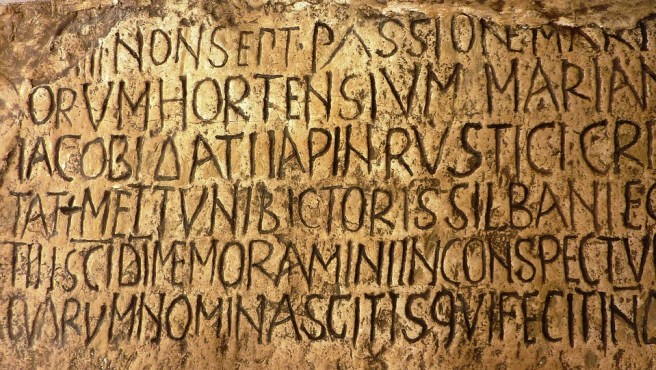
nelatin

Reading non-elite texts, with few exceptions, presents a set of challenges different from those of classical Latin. Linguistic features are more prone to diachronic and geographic change than the comparatively change-resistant classical standards. Spellings can be phonetic, colloquial, learned conventions, or intentionally archaic for effect. Morphology and syntax often differ widely as well, as in the increased usage of the indicative or the expanded role of the accusative (at the expense of the ablative, regularly). Vocabulary can be geographically specific, and differences in semantic value between non-elite and classical Latin are not uncommon.

Some of these features are discussed below to aid in reading. Efforts were made to add punctuation, etc., for ease of reading and approachability to students. Spellings are often left in their non-standard forms, though to aid in reading, many words are edited using brackets or parentheses; for particularly problematic spellings, a classical form of the word is added in parentheses. Texts (and translations, where available) are taken from the sources linked, with modifications (unless otherwise noted).

Exercises in non-elite Latin are often exercises in editing, critical reading, and emendation, as many of the texts are damaged or difficult to interpret. Reading these texts presents a practical opportunity to discuss textual editing as a scholarly process.

Lastly, accessibility is paramount. Students, instructors, and independent scholars often lack access to the databases and publications in which many non-elite texts are presented. All of the texts presented below are freely available online. At the end of this document, however, the recommended reading list contains mostly sources that are not open access.

Feel free to add, remove, edit, scream at, or pour coffee on the text—though should you choose to pour the coffee, print it first.

Spelling

Motives for the spellings can be any number of things, from a widespread phonetic change to a local scribe’s misspelling. Often, unsurprisingly and necessarily, there is considerable debate on the causes of the spellings. Likewise, we must resist, often with great difficulty, tendencies to generalize non-standard spellings as broader linguistic features without the presence of more evidence.

These are some of the most common differences in spelling between non-elite and classical Latin.

Word-initial and Intervocalic Aspirate, h-, /h/ (habeo, hic, mihi, ): The initial and intervocalic aspirate /h/ had disappeared from most speech varieties by the imperial period, and from all eventually (with the exception of a select few prescriptive grammarians, perhaps). Hence, it is often omitted in non-elite texts, with resulting forms such as abes, mi, and ic.

Word-final -m, /m/ (dicam, amicum, etc.): -m was not pronounced (as /m/, at least) at the end of a word in spoken Latin, even before the time of Cicero; consider, for example, the impact this had in classical poetry in the process of elision. It is omitted from spelling with great frequency in non-elite texts, and can often cause confusion for first-time readers.

The v/b Shift, /w/ à /β/ (cf. the v in Spanish): this is a simplification of the process, but essentially the glide /w/ of classical pronunciation became increasingly pronounced as a bilabial fricative. This change is represented in non-standard spellings by the replacement of Latin v for b (e.g. dibi, classical divi, “gods”), as writers considered b to more closely represent the sound.

xs for x (dixsit,): there are potentially a few, if separate, factors that motivated this spelling. In short, an s was added after x due to the differing phonetic qualities of x as it was written (by itself, not representing /ks/). This is a common spelling feature, but generally not a problematic one for reading.

Assimilation and Weakening: a widespread trend in non-elite spellings is the simplification of consonant clusters, often through assimilation (i.e. one sound in the cluster ‘absorbs’ another sound) or weakening leading to loss. These can result in either a different letter being used to represent the altered sound (imveni, inveni) or the complete loss of a consonant (nuc, cf. nunc; meses, cf. menses). A notable loss, in cosul, is even reflected in standardized inscriptions in the abbr. cos. Loss is also quite common with consonants preceding the semivowel /j/, i (aiuto, cf. adiuto, “I help”).

Doubling of letters and reduction of doubled letters (faccio, facio; anis, cf. annis): multiple operations are at work, including the strengthening, weakening, and shortening of consonants, gemination and degemination, as well as the general tendency to eliminate letters that are not reflected in speech. Though not all spellings of these types can be ascribed to changes in pronunciation. For reading purposes, the doubling of letters (e.g. faccio) is usually not problematic. The absence of doubled letters can be problematic, though, as the non-standard forms frequently resemble other words with standard spellings (e.g. annis, dat/abl pl. ‘years,’ but anis, dat/abl pl. ‘rings’; or suum ‘own’, but sum ‘I am’).

Deletion: Vowels and consonants are regularly deleted in medial positions. Unstressed vowels are most commonly deleted (aspros, cf. asperos; copla, cf. copula), reducing the number of syllables in a word. This trend is not entirely unusual even in literary Latin.

Often duplicate vowels are reduced to one letter (serus, seruus; tus, cf. tuus).

Voiced and Devoiced Consonant Switching: switching in both directions is common, and the motives vary. The use of t for d and vice versa are perhaps the most common in the texts below (ed, set, at, ). Sometimes they are even used interchangeably in the same document. There is considerable doubt that these spellings reflected wider speech patterns.

Other Orthographic Consonant Substitutions: k is regularly used for c (karissimo), as is, to a lesser extent, q before u (mequm, quravit). These generally do not pose problems for readers.

e/i Representation: the writing of e for i and vice versa is one of the most commonly found spelling deviations from classical standards. Spellings of this type sometimes, though not always, reflect a widespread phonetic change in Latin speech well into the imperial period, whereby the vowels long e /e:/ and short i /i/ merged into a single vowel, /ẹ/. Both letters were used with little consistency to represent this phoneme. Another motive was the tendency for /e/ and /i/ to become a semivowel /j/ after a consonant (vinia as two syllables, rather than vinea). Occasionally, e was even used to represent ī /i:/. Some examples: sene, nese, dicet, ube, ibe, and signabet.

u/o Representation: another very common set of vowel substitutions, o is frequently used in place of u. The majority of instances occur in final syllables of the nominative and accusative singular; -us and -um become -os and -om, respectively. While another widespread vowel merger (similar to e/i) occurred very late in the imperial period, whereby ō /o:/ and u /u/ merged to a closed o /ọ/, the great majority of non-elite texts from the Roman Empire likely do not reflect this process. The use of o for u is far more likely to be an orthographic remnant (a ‘relic’, perhaps) of the old Latin spelling, which reflects the original o-stem. As mentioned above, there is also a strong stylistic tendency against writing the consecutive vowels uu, and o often replaces the second one. Examples: servos, mortuos, novom, salvom.

ei for i (tibei, ubei, etc.): the use of the vowels ei for classical i occurs regularly, and is an archaism of spelling, either for style or by learned inheritance, rather than an indication of pronunciation. It is a remnant of a popular spelling in old Latin which did reflect speech; the original diphthong /ei/ underwent a change to /i:/.

Monophthongization: ae /ae/ à e /ɛ/: other diphthongs disappear as well, but ae to e is present most frequently in the texts. Examples: que, quae; Cecilius, cf. Caecilius; and equum, cf. aequum. These can be problematic, as evidenced by the final example equum (potentially confused for the classical ‘horse’).

Morphology and Syntax

While there are numerous morphological and syntactic differences from classical Latin, they rarely impede reading to the extent of spelling differences. For example, a Latin student might recognize that the ‘incorrect’ verb tense is used in a conditional, but meaning can still be deduced. As such, only a few points will be mentioned here; see the recommended readings for further discussion.

Accusatives with Prepositions: there is plenty of evidence to support the convincing notion that the accusative became the default case for prepositional phrases. Most notably, cum, de, pro and in regularly take accusatives (even in instances in which the classical ‘ablative of place where’ would be expected). The situation is further complicated by the status of word-final -m, which made the ablative and accusative cases sound identical in speech in some instances, and the omission of which in writing can make a word appear ablative, though a writer originally had in mind an accusative. Advice for readers is to expect accusatives with prepositions which would otherwise be unexpected in classical Latin.

Analogy and Paradigm Leveling: analogy was a productive process in Latin, and in non-elite texts it occurs often in verbal and nominal morphology. Forth declension nouns in classical Latin sometimes use the more regular endings of the second declension in non-elite texts (an ongoing process that eventually saw the near-complete elimination of the fourth declension). Verbal constructions are leveled as well, for example in posso (“I can”) being given a common -o 1st singular ending in place of the standard possum.

Indicative or Infinitive: in instances where classical Latin would employ a subjunctive, such as in an indirect question, it is not uncommon in non-elite texts to see an indicative or an infinitival construction.

The conjunctions et and sed: a number of texts rely heavily on these conjunctions, including them where syntactically unnecessary or where other conjunctions would be more appropriate for clarity. One must not always take these literally or strictly when reading.

Vocabulary

Reading any different author or genre of Latin usually requires familiarization with new vocabulary, and non-elite texts are no exception. Cicero’s surviving works, for example, do not contain inventories of materials or equipment, and in the texts that do contain these, some words will be new to readers. In some instances, however, things are more complicated. Loanwords or local words with limited attestation are common, and their meanings are uncertain; the ostraka found at Bu Njem, for example, contain several Punic words. The texts below were chosen with these considerations in mind, though it will perhaps be necessary to look up some military terms, for example.

Keep reading for some phenomenal texts….

Continue reading “Non-Elite Latin for the Classroom”

Filthy Friday: Rank Misogyny

Antonio Beccadelli, Hermaphroditus 2.8:

“If such a tremendous stink were always blowing upon the sea, so that no one’s nose could bear the shore, what sailor would be a shipwreck on the Adriatic or Scythian or Tyrrhenian Sea? But you – don’t be afraid. When you get it up for Ursa, when you really want her badly, her stinking vagina will drive you off. It breathes such a horrid stench, that a fat and stinking corpse would smell like lilies when set against it; it blows out such a smell that if one were to compare her crotch to shit, a huge sewer would suddenly see like violets and roses. If your nose is not put off by such a smell, I will give you something to make it tighter.”

beccadelli2


The One Who Needs Forgiveness: Clytemnestra on Her Husband

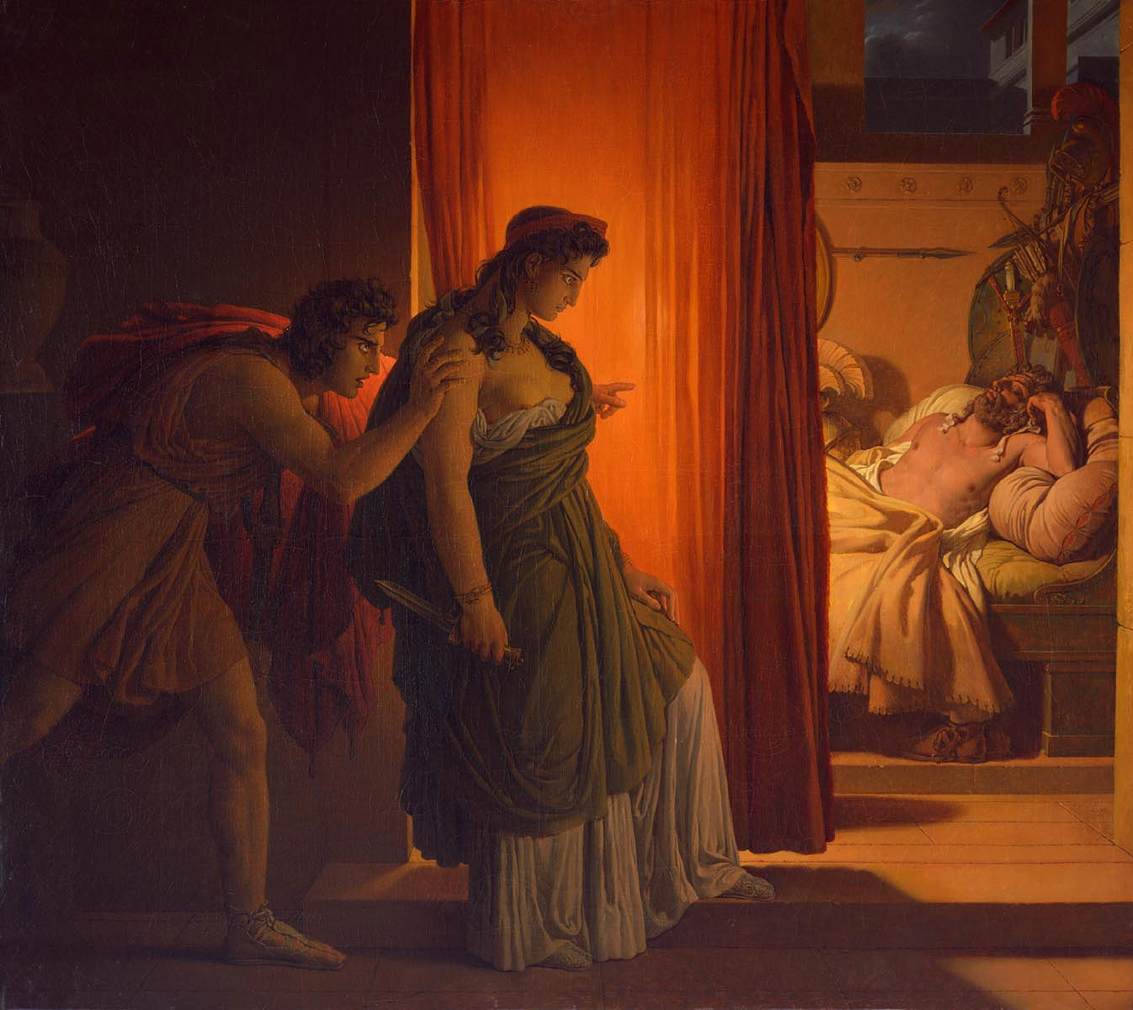
Seneca, Agamemnon 260-267

“Aegisthus, why do you push me again into the deep
And re-kindle my rage which was just cooling down?
The victor has indulged himself a bit with a captive girl—
It befits neither a wife nor a mistress to acknowledge it.
The law for the throne is different from the one for a man’s bed.

Even with this, why does my mind not allow me
To bring the harsher laws to bear on my husband when I have been shamed?
It’s right for the one who needs forgiveness to grant it easily.”

Aegisthe, quid me rursus in praeceps agis
iramque flammis iam residentem incitas?
permisit aliquid victor in captam sibi:
nec coniugem hoc respicere nec dominam decet.
lex alia solio est, alia privato in toro.
quid, quod severas ferre me leges viro
non patitur animus turpis admissi memor?
det ille veniam facile cui venia est opus.

Image result for clytemnestra and agamemnon
Pierre-Narcisse Guérin – Clytemnestra and Agamemnon

Thanks for the Homer!

Petrarch, Epistulae Familiares 18.2:

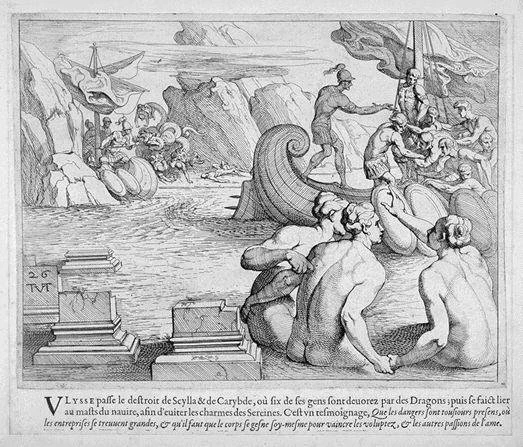
“My dearest man, remembering both my desire and your promise, you gave this book to me, and – what adds more than a little to the gift – you gave it to me, not funneled by some violent channel into another language, but pure and uncorrupted, from the very springs of Greek eloquence, just as it first flowed from Homer’s divine intellect. I consider it the highest gift and, if the true price of the thing be considered, it is one of entirely incalculable value. Nothing more could be added to it if you would bestow along with Homer your gracious presence, with the aid of which I first entered upon the narrow paths of a foreign tongue. Happily would I enjoy your gift, and astonished I would glance the ‘light’ and the ‘visual marvels’ about which Horace writes in his Art of Poetry, 

 Antiphates and Scylla, and the Cyclops with Charybdis.”

Image result for scylla and charybdis

Hunc tu michi, vir amicissime, donasti, promissi tui simul ac desiderii mei memor, quodque non modicum dono adicit, donasti eum non in alienum sermonem violento alveo derivatum, sed ex ipsis greci eloquii scatebris purum et incorruptum et qualis primum divino illi perfluxit ingenio. Summum utique et, si verum rei precium exquiritur, inextimabile munus habeo, cuique nil possit accedere si cum Homero tui quoque presentiam largireris, qua duce peregrine lingue introgressus angustias, letus dono tuo fruerer attonitusque conspicerem “lucem” illam et “speciosa miracula” de quibus in Arte poetica Flaccus ait:

 Antiphatem Scyllamque et cum Cyclope Caribdim.


“Fire Will Not Freeze”: Some Words

Basil, Letter 189

“Fire will not freeze; ice will not turn warm.”

οὔτε ψύχει τὸ πῦρ, οὔτε θερμαίνει ὁ κρύσταλλος


Pliny, Natural History 14.132

“Wine does not usually freeze, it only gets numb with cold temperatures.”

vini natura non gelascit: alias ad frigus stupet tantum.

 Ovid, Ex Ponto 4.85-90

“Is it that I lie, or does the Black sea turn hard at the cold
And ice overtakes many acres of its surface?
When he says these things, ask what reputation I have
Or seek in what way now I survive these hard times.
Here I meet no hatred; and I have not earned hatred either.
Nor has my mind changed at all with my fortune”

mentiar, an coëat duratus frigore Pontus,
et teneat glacies iugera multa freti.
haec ubi narrarit, quae sit mea fama require,
quoque modo peragam tempora dura roga.
nec sumus hic odio, nec scilicet esse meremur,
nec cum fortuna mens quoque versa mea est.

Aristotle, Generation of Animals 735a        

“Watery things certainly freeze but semen does not freeze when it is given to frost in the open air…”

καίτοι πήγνυταί γε τὰ ὑδατώδη· τὸ δὲ σπέρμα οὐ πήγνυται τιθέμενον ἐν τοῖς πάγοις ὑπαίθριον

Plutarch, On the Principle of Cold (Moralia 949b)

“When something freezes, which is the most extreme and most violent of the things that can happen to objects because of the cold, the effect is from water but the cause is the air. For water is a thing which is fluid and not solid and not cohesive. When it is pressed and strained by air in its cold state, it becomes compact.

Καὶ μὴν ἁπάντων γε τῶν γινομένων ὑπὸ ψυχρότητος ἐν τοῖς σώμασι σφοδρότατον καὶ βιαιότατον ἡ πῆξις οὖσα, πάθος μέν ἐστιν ὕδατος, ἔργον δ᾿ ἀέρος· αὐτὸ μὲν γὰρ καθ᾿ ἑαυτὸ τὸ ὕδωρ εὐδιάχυτον καὶ ἀπαγὲς καὶ ἀσύστατόν ἐστιν, ἐντείνεται δὲ καὶ συνάγεται τῷ ἀέρι σφιγγόμενον ὑπὸ ψυχρότητος· διὸ καὶ λέλεκται

Xenophon, Anabasis 4.22.4

“From there they were marching through massive amounts of snow and a for three miles and thirteen parasangs. The third part of it was especially hard: a northern wind was blowing directly against them, slamming everything and freezing the people.”

Ἐντεῦθεν ἐπορεύοντο διὰ χιόνος πολλῆς καὶ πεδίου σταθμοὺς τρεῖς παρασάγγας τρεῖς καὶ δέκα. ὁ δὲ τρίτος ἐγένετο χαλεπὸς καὶ ἄνεμος βορρᾶς ἐναντίος ἔπνει παντάπασιν ἀποκαίων πάντα καὶ πηγνὺς τοὺς ἀνθρώπους.

Snow istotle

N.B.

ψυχή, ἡ: soul, life

ψύχωσις: life-giving/generating

ψυχοανάκαλυπτος: soul-baring, revealing

ψυχοκλέπτης: soul-thief

ψυχοκτόνος:soul-killing

ψυχοπλανής: soul-wandering

ψυχοπότης: soul drinker (drinking of life, i.e. blood)

ψῦχος, τό: cold

ψυχρία: cold

ψυχκρασία: growing cold

ψυχολογία: frigid talking

ψυχροποιός: making cold

ψυχροπότης: cold drinker (one who drinks cold water)

ψυχρόσαρκος: with cold flesh

soulCOld1

Bellum Incivile: The Unlikely Candidate

Another text tentatively attributed to Caesar was discovered along with the fragments of the De Silvis and an appendix to De Bello Gallico. This is almost surely the lost Bellum Incivile.

C. Julius Caesar (?), Bellum Incivile. Edited by Dani Bostick

1.30 Although he had five draft deferments, did not pay taxes along with everyone else, had nothing to do with politics, and had no skill in public speaking, Manicula sought the consulship, but not out of a desire to serve the people nor out of enthusiasm for his political party.

For which reason his associates Michael Cohen, Ivanka, Don Jr., Paul Manafort, Michael Flynn, George Papadopoulus, Carter Page, Roger Stone, and Rick Gates, driven by the hope of influence and rewards, started communicating with Russians that Manicula had hoped for a long time to build opulent housing in their country and that he was seeking the enemy’s help so that he could be elected consul.

Manicula and his associates were completely incapable of reading Cicero’s orations, but they believed his words: “There are no plots more undetectable than those carried out under the guise of public duty or in the name of some sort of obligation. For you can easily avoid a known enemy by being cautious; to contrast, a hidden and deep-seated domestic threat not only exists, but actually crushes you before you can detect it and learn more about it.”* Because of this, they all thought they were able to avoid suspicion.

1.30 Manicula cum militiae quinque vacationes haberet neque tributa una cum reliquis penderet neque forum attingeret neque ullam dicendi facultatem haberet, tamen consulatum petivit, sed neque cupiditate serviendi populi neque studio partium adficiebatur.

Qua de causa eius comites M. Coenus et Ivanca et Donaldellus et P. Virfortus et M. Flinnus et G. Papadus et P. Cartus et R. Lapis et R. Porta spe auctoritatis atque munerum inducti cum legatis Sarmatiae loqui coeperant: Maniculam se aulam auream in Sarmatiae finibus aedificaturum diu speravisse et auxilium hostium quo consul nuntiaretur petere.

Manicula comitesque orationes Ciceronis legere haudquaquam poterant, sed crederunt eius verbis: “Nullae sunt occultiores insidiae quam eae quae latent in simulatione offici aut in aliquo necessitudinis nomine. Nam eum qui palam est adversarius facile cavendo vitare possis; hoc vero occultum intestinum ac domesticum malum non modo non exsistit, verum etiam opprimit antequam prospicere atque explorare potueris.” Ob eam causam omnes sese suspicionem vitare posse arbitrabantur.


*Cicero, Verrine Oration 2.39

frog

Persius Addresses a Petulant Man-Baby

Persius, Satires 3.15-19

“Fool, more foolish with each passing day,
Is this what we’ve come to? Ah, why not just be like
A little pigeon or a baby prince and insist on eating chopped up food
Or stop your mom from singing to you because you’re so angry?”

“o miser inque dies ultra miser, hucine rerum
venimus? a, cur non potius teneroque columbo
et similis regum pueris pappare minutum
poscis et iratus mammae lallare recusas?”

Livre d’astrologie, France, XIVe siècle
Paris, BnF, département des Manuscrits, Latin 7344, fol. 7v.