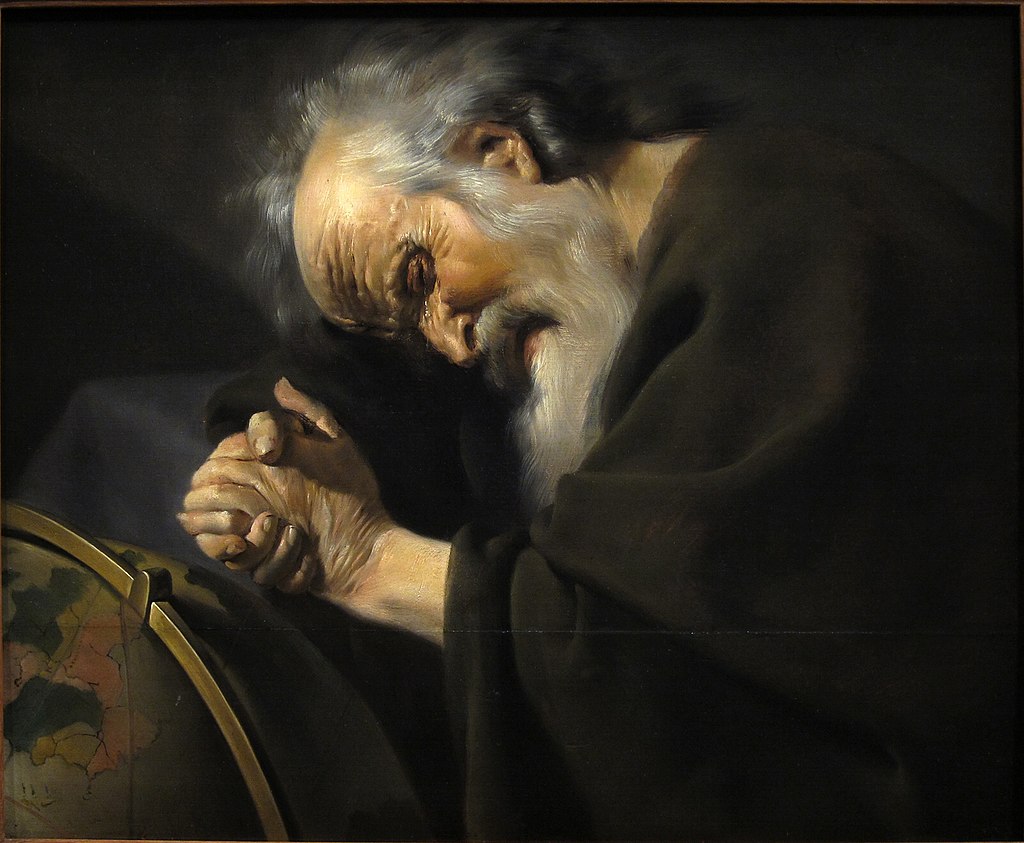
“Some animals are called Ephemera and they take their name from the length of their life. For they are born in wine and when the container is opened they fly out, they see the light, and they die. Therefore, nature has granted that they come into life but it has also rescued them from the evils in life, since they neither experience any suffering of their own and they know nothing of others’ misfortunes.”
“We would not rightly say that an ox or a horse or any other animal is happy. For it is not possible for any of these to have a common share of ennobling work. This is the reason a child is not happy—they are not yet capable of ennobling actions because of their age. When children are called this, they are being blessed because of their hope for future nobility. There is a need yet, as we said, for complete excellence and a full lifetime.
There are certainly many changes and fortunes of every sort throughout life. It is possible for someone who is extremely fortunate to meet great troubles in old age, just as the story is told about Priam in the heroic epics. No one considers someone who faces these kinds of misfortunes and then dies terribly happy.
But if we then believe that no human being should be considered happy while they live, according to that Solonic saying, “look to the end”—if indeed it must mean this—is it really the case that a person is happy when they’re dead? Well, that would be really strange, right, for us to say others size that this is a kind of obvious happiness? Unless we mean that that dead person is happy, not in the way that Solon wants, but that someone can only say that someone is happy safely when he is out of the way of evils and misfortune.
Even this interpretation has some controversy. For then evil and good seem to be possible for the dead, even as it is for the living even when they do not perceive it, as in the case of honors, and dishonors or the noble or ignoble deeds of children and all of their descendants.
These things are a problem too. For it is possible that someone has lived a rather blessed life up to old age and died in the same way, he could still experience many troubles because of his descendants—some of whom are good and received a life worthy of this, and others who were opposite. It is clear that it is possible for them to be different in every way from their forebears. It would be strange if the dead man would change along with them and become wretched when he was blessed before. But it would also be strange if the affairs of descendants had no impact on their ancestors at all.”
There is an old anecdote about John Dryden, illustrating both his bookish ways and his casual and malicious disregard for his wife:
Dryden himself told us that he was of a grave cast and did not much excel in sallies of humour. One of his bon mots, however, has been preserved. He does not seem to have lived on very amicable terms with his wife, Lady Elizabeth, whom, if we may believe the lampoons of the time, he was compelled by one of her brothers to marry. Thinking herself neglected by the bard, and that he spent too much time in his study, she one day exclaimed, ‘Lord, Mr. Dryden, how can you always be poring over those musty books? I wish I were a book, and then I should have more of your company.’ ‘Pray, my dear,’ replied old John, ‘if you do become a book let it be an almanack, for then I shall change you every year.’ [Oxford Book of Literary Anecdotes, p.49]
As I considered telling my students this anecdote, I realized that while the reference to Dryden was likely to be incomprehensible to them, the joke itself would fall flat because they likely do not know what an almanac is. (Lest this seem too much of a stretch for my readers who do not work with teenagers, many of these students cannot tell time on an analog clock, have no knowledge of Roman numerals, and get entirely stumped by lexical curiosities such as pejorative or gubernatorial.)
The almanac is today both charmingly obsolete and quaint to the point of absurdity. To be sure, I have seen The Old Farmer’s Almanac for sale in the check-out lane at the hardware store every year, but I could not imagine people purchasing them for serious consultation. Nevertheless, I find that a fair number of online reviews for the 2020 edition of The Old Farmer’s Almanac combine a curious enthusiasm for its outmoded practicality with a sentimental nostalgia about the publication’s venerable old age.
Obsolescence occurs in two ways. The first may be readily observed in the world of classical scholarship by the rapid obsolescence of traditional dictionaries. Though I wrote before of my own tendency to fetishize the dictionary as a physical object, I nevertheless rarely use a physical lexicon anymore because I find Logeion so powerful and effective. But electronic lexical resources have not made dictionaries themselves obsolete – merely their physical forms. An online dictionary may aggregate entries from various lexica, but the basic premise of recording the definitions and uses of individual words in one place, used as a reference, remains fundamentally the same.
A more profound form of obsolescence occurs when the world itself changes in such a way as to make something wholly irrelevant or useless. Phone books, and even publicly available phone directories, are no longer necessary in an age of cheap web hosting, constant internet access, and efficient search engines; moreover, the evanescence and rapid mutability of cell phone numbers would render such a directory entirely unmanageable. Indeed, one need not be surprised that the Terminator, in the 1984 film of that name, was unable to kill Sara Connor – it looked her up in a phone book. Did the AI which orchestrated human extinction really have no better way of seeking her out? At any rate, it is clear enough that our timeline diverged sharply from that imagined future, since we have been treated to an endless string of increasingly horrible sequels, revealing that Skynet’s plan was actually just to bore us to death.
Occasionally I hear authors and critics speculate (usually with some show of ambivalent feeling) about the end of literary fiction. Closer to home, I know that it is fashionable to speculate about the end of Classics. The sense, in both cases, is that neither of these disciplines is particularly suited to a rapidly changing world, in which the memeification of culture has rendered attention, critical thought, and even history itself apparently irrelevant. My own students have told me that they would much rather spend ten seconds fully absorbing a post on Instagram than reading a book, because it is so “short and to the point.” I suppose that one cannot blame them, considering that the orange, suppurating mass which currently fills out a suit and a chair in the White House has bragged about his entire estrangement from books, which he thinks could be much more readily digested as sound-bite summaries.
Tweets and Instagram posts may be “short and to the point,” but so are aphorisms and epigrams. Nevertheless, I don’t see that anyone is lining up to buy copies of Martial. The appeal of these social media is not their brevity, as is made clear by the fact that no one reads old posts with any enthusiasm or fervor. Rather, social media creates a kind of Heraclitean horror show – an ever fluid and dynamic present in which we cannot even step into the same river once. In truth, nothing good actually happens on the internet, but I like many people often find myself transfixed, refreshing for the latest updates, most of which I gloss over entirely. This frenzied update and consumption cycle not only produces the impression that events in our world are occurring more rapidly than they used to, but also causes them to occur at a more rapid rate. News does not become obsolete because a story has been fully investigated or dealt with. Rather, it becomes obsolete because the very act of engaging with the news on social media (especially if it is powerful people who are engaging with it) in itself triggers more news. Even apparently “timeless” content like photos of cute dogs or silly cats has an internet shelf life of a day at the most. All of those dog videos just washed along by the endless stream of other dog videos.
To return to the outmoded almanac. While it would be tempting to say that these manuals have undergone the first kind of obsolescence thanks to real-time weather updates accessible on the internet, it is unfortunately the case that they have fallen victim just as much to the second form of obsolescence, in which the rapidly changing patterns of our planet’s climate have rendered traditional wisdom and climactic prognostication largely futile. Much the same can be said of traditional punditry. In an age of chaos, it seems frightfully masturbatory and absurd to sit behind a glass desk and deliver Pythian proclamations about the political landscape of next year when the entire geopolitical landscape is drastically altered every few hours, usually in response to something posted on a certain someone’s social media feed.
An old friend of mine used to say that he considered all literature published before the 20th century irrelevant. As repugnant as I found the notion, I could see that he had some point. Virginia Woolf once observed that, ”on or about December 1910 human character changed,” and a facile reading of the classics (whether construed as the Greek and Roman canon or old books more generally) may suggest that they have little to offer to someone after trench warfare, the Holocaust, the nuclear arms race, or any of the other horrors of the 20th century. If some of the horrors of the 21st seem less blatantly aggressive and horrific than those of the 20th, it may be because our passive acceptance of and complicity in them renders them so much harder to confront honestly. Yet it is perhaps because of the new existential horror of these two centuries that our older literature will not be rendered obsolete. As a classic example, Jonathan Shay’s Achilles in Vietnamdraws on Homer to make sense of PTSD. One of my professors once sold his Greek and Roman civilization courses by arguing that anyone who had read ancient history could open the newspaper any day and say, “I’ve seen this bullshit before.”
But the chief value of literature (old and new) is its ability to allow us to engage with what is human. Ostensibly, social media presents us with our most human selves, but really it just aggregates a pullulating mass of swollen id shouting into the vacuous ether of a present which has already been lost. In a curious way, constant engagement with the present is the firmest assurance that we will never experience the present at all. Rather, a meaningful engagement with all of human experience – including its past, even or especially when mediated through the artificiality of literature – is essential to making sense of an accelerating and vanishing present.
People used to change their almanacs out every year, and the malice of Dryden’s joke is his suggestion that he would do the same to a person. Yet this is, in effect, what we do both to our culture and the people with whom we interact. I have inadvertently jettisoned a number of friends from my life by first turning them into social media correspondents and then simply forgetting to put in the minimal and largely passive effort of “keeping in touch.” So, too, relating with people personally or “IRL” has in some sense degenerated to friends asking each other whether they had seen the latest thing online. From Descartes on, philosophers were terrified by the fact that we have no immediate access to reality; in the 21st century, we have responded to this terror by adding new layers of mediation to it, which may explain why it all feels so unreal.
This is not meant as a manifesto, or a rallying cry for Classics, or even for literature more generally. Despite the apparently strident and indignant tone of what may be observed above, this screed ends with something in the old confessional mode. I find myself every day drawn more and more by the Siren song of nostalgia. Indeed, I find the continued viability of a published Farmer’s Almanac not just charming, but somehow deeply comforting. Reading actual books feels better as media update faster; older films and even old television attract me far more as YouTube gets better at predicting what kinds of mindless and insipid trash might seize my attention for a few minutes; and as the very idea of civilization seems to be collapsing into the dark and abysmal nullity of hypercapitalist moral and intellectual corruption, it is nice to remember that human civilization was once a thing, and that for all of its problems it occasionally produced things which were poignant or profound or beautiful. By the time we feel it, our step into the river has already been taken, but we can pause for a moment and watch as the water rushes on.
“The king, swelling up with rage because of what was said, responded, “You think that I am lying about them, when I have discovered that they are the most disgusting of people who are plotting against me?
And you are saying that they are good people, and serious? Well, I suppose if they were asked about you that they wouldn’t say that you’re a wizard, a madman, a braggart who is greedy and breaks the laws? That’s how evil your conspiracy is, you filthy criminals.
The trial will prove everything. I know how much you all swore under other, why you did it, when you did it, and what you sacrificed, as if I were there and joined in with you!”
“When the city was taken by storm and the Romans were grabbing and taking measureless wealth from it, Camillus looked from the citadel at what was happening, and at first stood there crying, and then when congratulated by someone present he raised his hands to the gods and prayed, ‘O greatest Zeus and you gods, judges of good and evil deeds, you know well that we have set upon this city of enemies and lawless men not in contravention of justice, but because of necessity. And if,’ he said, ‘some retribution is owed to us for our present prosperity, I pray that it be visited upon me (with the smallest amount of harm) in place of the city and the army of the Romans.’ Saying this, as it is customary for the Romans in prayer or adoration of the gods to spin to the right, he tripped as he was turning. Everyone present was greatly disturbed, but Camillus, picking himself back up from the fall, said that a minor misfortune had befallen him in exchange for the greatest fortune, just as he had prayed.”
The following two passages are from the Mirabilia ofApollonius the Paradoxographer (usually dated to the 2nd Century BCE, making him one of the earliest extant paradoxographers).
This plant makes you bigger [=BNJ 81 F17]
“Phularkhos writes in the eighth book of his Histories that near the Arabian Gulf there is a spring of water from which if anyone ever anoints their feet what transpires miraculously is that their penis becomes enormously erect. For some it never contracts completely, while others are put back in shape with great suffering and medical attention.”
“Phularkhos in book 20 of the Histories says that there is a white root imported from India which when [people] cut it and smear it over their feet with water, those who are smeared with it experience forgetfulness of sex and become similar to eunuchs. For this reason still some apply it before they are fully adults and are not aroused for the rest of their life.”
“Phularkhos says that Sandrokottos, the king of the Indians, sent along with other gifts to Seleukos some drugs with erectile powers, the kind of which, when they are applied beneath feet of those who are going to have sex, give the urge like birds, while some people lose their ability [for sex].”
“To be able to fuck a lot: mix fifty [pine nuts] with two measures of honey and seeds of pepper and drink it. To have an erection whenever you want: mix pepper with honey and rub it on your thing.”
Solon: They [the Amphiktyones] selected this man to be their adviser for war against the Kirrhaians. When they were consulting the oracle about victory, the Pythia said: “you will not capture and raze the tower of this city before the wave of dark-eyed Amphitritê washes onto my precinct as it echoes over the wine-faced sea.”
Solon persuaded them to make Kirrhaia sacred to the god so that the sea would become a neighbor to Apollo’s precinct. And another strategy was devised by Solon against the Kirrhaians. For he turned a river’s water which used to flow in its channel into the city elsewhere.
The Kirrhaians withstood the besiegers by drinking water from wells and from rain. But [Solon] filled the river with hellebore roots and when he believed the water had enough of the drug, he returned it to its course. Then the Kirrhaians took a full portion of this water. And when they went AWOL because of diarrhea, the Amphiktyones who were stationed near the wall took it and then the city.”
“In his work On Plants, in the last part of the material, Theophrastos says that Eunomos, the Khian and purveyor of drugs, did not [cleanse himself/die] while drinking many draughts of hellebore. Once, even, when together with his fellow craftsmen he took over 22 drinks in one day as he sat in the agora and he did not return from his implements. Then he left to wash and eat, as he was accustomed, and did not vomit. He accomplished this after being in this custom for a long time, because he started from small amounts until he got to so many large ones. The powers of all drugs are less severe for those used to them and for some they are even useless.”
“Odysseus defeated Palamedes in the court of the Achaeans by charging him of having barbarian gold in his tent, and thus that wisest of all Greeks was convicted of treason by a trick, by a stratagem.”
Olisbos: Genitals made from leather which the Milesian women used to use as tribades(!) and shameful people do. Widowed women also use them. Aristophanes writes “I did not see an eight-fingered dildo*/ which might be our leathered aid.”** This second part is drawn from the proverb “fig-wood aid” applied to weak people.
“Courtesanizers: The women who are called ‘rubbers'” [or ‘grinders’? i.e. Lesbians] Ἑταιρίστριαι: αἱ καλούμεναι τριβάδες. See also Hesychius s.v. dietaristriai: “Women who rub themselves against girls in intercourse the way men do. For example, tribades.” διεταρίστριαι· γυναῖκες αἱ τετραμμέναι πρὸς τὰς ἑταίρας ἐπὶ συνουσίᾳ, ὡς οἱ ἄνδρες. οἷον τριβάδες (Plat. conv. 191 e).
The Lexicographer Photius repeats only the following definition:
Olisboi: Leather dicks
῎Ολισβοι: δερμάτινα αἰδοῖα.
The Scholion to Aristophanes’ Lysistrata 109-110 basically presents the same information:
Olisbon: A leather penis. And that is for the Milesian women. He is joking that they use dildos. The next part, “leathery aid” plays upon the proverb “fig-tree aid”, used for the weak. He has changed it to “leathery” because dildos are made of leather. They are leather-made penises which widowed women use.”
“Because his country was a tyranny was ruled harshly under Nearchus, he set up a conspiracy against the tyrant. But when he was discovered and was compelled by Nearchus under torture to divulge who was aiding him, he said, “if only I were as in control of my body as I were my tongue.” The tyrant attacked him even more with torture for this, but Zeno withstood it for some time.
After this exchange, because he wanted to be freed from the torture and also to pay back Nearchus, he made the following plan. When the pain of the torture was at its greatest peak, he pretend that he was about to die because of the pain and yelled out, “Stop, I will tell you everything.” Once they stopped, he asked him to come close to hear what he said alone since many of the things which were about to be said he would prefer to keep secret.
When the tyrant approached happily and brought his ear near Zeno’s mouth, Zeno grabbed the tyrant’s ear with his teeth and clamped down. Even though his attendants rushed up and were serving up everything kind of pain to the tortured man to loosen the bite, he sank his teeth in further. Finally, when they could not conquer the man’s bravery, they stabbed him until he released his teeth. By this plan he found freedom from his pains and obtained what payback their was from the tyrant.”
In the other version of this story, Zeno of Elea bites off his own tongue
From the Suda
“Zeno, the son of Teleutagoros, Elean, one of the philosophers who lived in the same time as Pythagoras and Democritus during the 78th Olympiad. He was a student of Xenophanes or Parmenides. He wrote Disagreements, and Explanation of Empedokles and Against the Philosophers on Nature. They say that he invented dialectic, and that Empedokles invented rhetoric. Some say that he was caught trying to kill the tyrant Nearkhos—although some say it was Diomedon. When he was being questioned by him, he bit down on his own tongue, cut it off, and spat it at the Tyrant. Then he was thrown into a mortar and ground down into a mush.”
Diogenes Laertius tells the same story as Diodorus:
Diogenes Laertius, Lives of the Philosophers 9.26
“When he was interrogated about his conspirators and the arms he was bringing to Liparas, he informed on all the friends of the tyrant because he wished to isolate that man. Then, telling him that he could tell him something about these things to his ear only, he bit down on [Nearchus’] ear and would not let go until he was stabbed to death, suffering the same fate as the tyrannocide Aristogeiton.”