Don’t See ‘Joker’ – Just Read Some Jokes

Hungry Hungry Hippos – Philogelos 9b:

A scholar, wishing to teach his horse not to eat so much, stopped giving it food. Later, when the horse died of hunger, the scholar said, “Ah, I’ve suffered a great loss! Just when he learned not to eat, he died!”

β: Σχολαστικὸς θέλων τὸν ἵππον αὐτοῦ διδάξαι μὴ τρώγειν πολλὰ οὐ παρέβαλλεν αὐτῷ τροφάς. ἀποθανόντος δὲ τοῦ ἵππου τῷ λιμῷ ἔλεγε· Μεγάλως ἐζημιώθην· ὅτε γὰρ καλῶς ἔμαθε μὴ τρώγειν, τότε ἀπέθανεν.

“You Motherfucker!” – Philogelos 45.1:

“One night a student slept with his grandmother. He consequently received a beating from his father, and complained, ‘You’ve been having sex with my mother all these years without suffering anything at my hands, but now you’re angry at me because you found me having sex with your mother once?’”

aβ: Σχολαστικὸς νυκτὸς ἐπανέστη τῇ μάμμῃ αὐτοῦ. πληγὰς δὲ διὰ τοῦτο ὑπὸ τοῦ πατρὸς λαβών· Σύ, εἶπεν, τοσοῦτος χρόνος ἐστὶν ἐξ οὗ τὴν μητέρα μου ὀχεύεις, μηδὲν ὑπ’ ἐμοῦ παθών, καὶ νῦν ὀργίζῃ ἐπὶ τῇ μητρί σου ἅπαξ με εὑρών;

A version of this joke is also found in Laurence Sterne’s The Life and Opinions of Tristram Shandy, Gentleman (Vol. 4 Chp. 29):

“—But this, Triptolemus, cried Didius, proves too much—for from this authority cited it would follow, not only what indeed is granted on all sides, that the mother is not of kin to her child—but the father likewise.—It is held, said Triptolemus, the better opinion; because the father, the mother, and the child, though they be three persons, yet are they but (una caro (Vide Brook Abridg. tit. Administr. N.47.)) one flesh; and consequently no degree of kindred—or any method of acquiring one in nature.—There you push the argument again too far, cried Didius—for there is no prohibition in nature, though there is in the Levitical law—but that a man may beget a child upon his grandmother—in which case, supposing the issue a daughter, she would stand in relation both of—But who ever thought, cried Kysarcius, of laying with his grandmother?—The young gentleman, replied Yorick, whom Selden speaks of—who not only thought of it, but justified his intention to his father by the argument drawn from the law of retaliation.—’You laid, Sir, with my mother,’ said the lad—’why may not I lay with yours?’—’Tis the Argumentum commune, added Yorick.—’Tis as good, replied Eugenius, taking down his hat, as they deserve.”


A Dad Joke – Historia Augusta: Hadrian (20)

“In his conversation with the lower orders, he was most civil, and detested those who would take this pleasure away from him under the pretext of guarding the imperial dignity. In Alexandria, he proposed many questions to the professors, and resolved them himself. Marius Maximus says that he was cruel by nature and on that account acted in many cases very piously, fearing that what had happened to Domitian might happen to him.

Although he was not fond of placing inscriptions on his works, he named many cities Hadrianopolis, as for example Carthage and even a part of Athens. He also named a countless number of aqueducts this way. Hadrian was also the first to institute a lawyer in charge of advocating for the treasury.

Hadrian had an enormous memory and was possessed of boundless ability – he himself dictated his orations and responded to everything. Many of his jokes survive, too, for he was a fairly witty man. That one line became well known, in which he responded to an old man to whom he had already refused something yet who had put on a hairpiece and asked again, ‘I already denied that to your father.’”

In conloquiis etiam humillimorum civilissimus fuit, detestans eos qui sibi hanc voluptatem humanitatis quasi servantes fastigium principis inviderent. apud Alexandriam in Museo multas quaestiones professoribus proposuit et propositas ipse dissolvit. Marius Maximus dicit eum natura crudelem fuisse et idcirco multa pie fecisse quod timeret, ne sibi idem quod Domitiano accidit eveniret.

Et cum titulos in operibus non amaret, multas civitates Hadrianopolis appellavit, ut ipsam Carthaginem et Athenarum partem. aquarum ductus etiam infinitos hoc nomine nuncupavit. fisci advocatum primus instituit.

Fuit memoriae ingentis, facultatis immensae; nam ipse et orationes dictavit et ad omnia respondit. ioca eius plurima exstant; nam fuit etiam dicaculus. unde illud quoque innotuit quod, cum cuidam canescenti quiddam negasset, eidem iterum petenti sed infecto capite respondit: “Iam hoc patri tuo negavi”.

Joker 2019 1 - Fan Theory Suggests Joaquin Phoenix’s JOKER Isn’t the Same Joker of Batman Lore

Oppressing the Oppressed: Two Early Christian Letters on Evil Men

Letters of Ignatius, To the Smyrneans 8.6

“Learn the truth of those who render false the grace that has come to us from Jesus Christ, how they are truly opposite to the judgment of God. They don’t care about love, about the widow, about the orphan, the oppressed, the people in chains, those who have been set free, or the hungry, or the orphans.”

καταμάθετε δὲ τοὺς ἑτεροδοξοῦντας εἰς τὴν χάριν Ἰησοῦ Χριστοῦ τὴν εἰς ἡμᾶς ἐλθοῦσαν, πῶς ἐναντίοι εἰσὶν τῇ γνώμῃ τοῦ θεοῦ. περὶ ἀγάπης οὐ μέλει αὐτοῖς, οὐ περὶ χήρας, οὐ περὶ ὀρφανοῦ, οὐ περὶ θλιβομένου, οὐ περὶ δεδεμένου ἢ λελυμένου, οὐ περὶ πεινῶντος ἢ διψῶντος.

Barnabas, Epistle 20

“The path of the dark one is crooked and curse-filled. For it is the path of endless death with punishment—on it are those things which destroy the soul: idolatry, arrogance, glorification of power, duplicity, adultery, murder, theft, hubris, transgression, lying, wickedness, insolence, drugs, magic, and not fearing God.

This road is filled with those who persecute good people, who hate the truth, who delight in lying, who do not understand the reward of justice, who are not curbed by good or righteous judgment, who do not defend the widow and the orphan, who do not have a sense of reverence for God but instead for wickedness—meekness and kindness are very distant from these men.

They delight in what is empty and pursue profit—they do not pity the poor or work for the oppressed. They do not recognize who has formed them—they are murderers of children, destroyers of God’s creation. They turn their backs on the man in need, they further oppress the oppressed and are partisans of the wealthy. They sit as judges of the poor without law, these men of total sin.”

1.Ἡ δὲ τοῦ μέλανος ὁδός ἐστιν σκολιὰ καὶ κατάρας μεστή. ὁδὸς γάρ ἐστιν θανάτου αἰωνίου μετὰ τιμωρίας, ἐν ᾗ ἐστὶν τὰ ἀπολλύντα τὴν ψυχὴν αὐτῶν· εἰδωλολατρεία, θρασύτης, ὕψος δυνάμεως, ὑπόκρισις, διπλοκαρδία, μοιχεία, φόνος, ἁρπαγή, ὑπερηφανία, παράβασις, δόλος, κακία, αὐθάδεια, φαρμακεία, μαγεία, πλεονεξία, ἀφοβία θεοῦ·

διῶκται τῶν ἀγαθῶν, μισοῦντες ἀλήθειαν, ἀγαπῶντες ψεῦδος, οὐ γινώσκοντες μισθὸν δικαιοσύνης, οὐ κολλώμενοι ἀγαθῷ, οὐ κρίσει δικαίᾳ, χήρᾳ καὶ ὀρφανῷ οὐ προσέχοντες, ἀγρυπνοῦντες οὐκ εἰς φόβον θεοῦ, ἀλλ᾿ ἐπὶ τὸ πονηρόν, ὧν μακρὰν καὶ πόρρω πραΰτης καὶ ὑπομονή, ἀγαπῶντες μάταια, διώκοντες ἀνταπόδομα, οὐκ ἐλεοῦντες πτωχόν, οὐ πονοῦντες ἐπὶ καταπονουμένῳ, εὐχερεῖς ἐν καταλαλιᾷ, οὐ γινώσκοντες τὸν ποιήσαντα αὐτούς, φονεῖς τέκνων, φθορεῖς πλάσματος θεοῦ, ἀποστρεφόμενοι τὸν ἐνδεόμενον, καταπονοῦντες τὸν θλιβόμενον, πλουσίων παράκλητοι, πενήτων ἄνομοι κριταί, πανθαμάρτητοι.

Image result for medieval manuscript barnabas letter

Some words:

μισοβάρβαρος: “foreigner-hating”
μισοδημία: “democracy-hating”
μισοδημότης: “commonwealth-hating”
μισόθριξ: “hair-hating”
μισόκοσμος: “universe-hating”
μισόνοθος: “bastard-hating”
μισοξενία: “guest-hating”
μισόπαις: “child-hating”
μισοπάτωρ: “father-hating”
μισόφιλος: “friend-hating”
μισότεκνος: “child-hating”

The Wakeful Mind and Happiness

Cicero, De Finibus 5. 87

“For this reason we must examine whether or not it is possible for the study of the philosophers to bring us [happiness].”

Quare hoc videndum est, possitne nobis hoc ratio philosophorum dare.


Aristotle, Eudemian Ethics, 2.1 (1219a25)

“Let the work of the mind be the performance of life—and what this means is using life and being awake (for sleep is some kind of a rest and cessation of life). As a result, since the work of the mind and its virtue are identical, then the work of virtue is an earnest life.

This, then, is the complete good, which is itself happiness. For it is clear from what we have argued—as we said that happiness was the best thing; the goals and the greatest of the goods are in the mind, but aspects of the mind are either a state of being or an action—it is clear that, since an action is better than a state and the best action is better than the best state, that the performance of virtue is the greatest good of the mind. Happiness, then, is the action of a good mind.”

Ἔτι ἔστω ψυχῆς ἔργον τὸ ζῆν ποιεῖν, τοῦτοχρῆσις καὶ ἐγρήγορσις (ὁ γὰρ ὕπνος ἀργία τις καὶ ἡσυχία)· ὥστ᾿ ἐπεὶ τὸ ἔργον ἀνάγκη ἓν καὶ ταὐτὸ εἶναι τῆς ψυχῆς καὶ τῆς ἀρετῆς, ἔργον ἂν εἴη τῆς ἀρετῆς ζωὴ σπουδαία.

τοῦτ᾿ ἄρ᾿ ἐστὶ τὸ τέλεον ἀγαθόν, ὅπερ ἦν ἡ εὐδαιμονία. δῆλον δὲ ἐκ τῶν ὑποκειμένων (ἦν μὲν γὰρ ἡ εὐδαιμονία τὸ ἄριστον, τὰ δὲ τέλη ἐν ψυχῇ καὶ τὰ ἄριστα τῶν ἀγαθῶν, τὰ ἐν αὐτῇ δὲ ἢ ἕξις ἢ ἐνέργεια), ἐπεὶ βέλτιον ἡ ἐνέργεια τῆς διαθέσεως καὶ τῆς βελτίστης ἕξεως ἡ βελτίστη ἐνέργεια ἡ δ᾿ ἀρετὴ βελτίστη ἕξις, τὴν τῆς ἀρετῆς ἐνέργειαν τῆς ψυχῆς ἄριστον εἶναι. ἦν δὲ καὶ ἡ εὐδαιμονία τὸ ἄριστον· ἔστιν ἄρα ἡ εὐδαιμονία ψυχῆς ἀγαθῆς ἐνέργεια.

ψυχή: can be translated into English as “spirit” or “soul” instead of “mind”. I avoided the former to sidestep the implication that Aristotle is making some kind of a mystical argument; I avoided the latter because it has such strong religious associations in English.

Seneca De Beneficiis 22

“A just reason for happiness is seeing that a friend is happy—even better, is to make a friend happy.”

iusta enim causa laetitiae est laetum amicum videre, iustior fecisse

Image result for medieval manuscript philosophy happiness
Ms 3045 fol.22v Boethius with the Wheel of Fortune, from ‘De Consolatione Philosophiae’, translated by Jean de Meung

A Sick Country and a Tyrannical Soul

Demosthenes, Or. 19.258

“Citizens, it is always right to hate and hinder traitors and corrupt people, but at this current moment, this would be necessary help to all humankind. For a terrible and harsh sickness has come over our country, one which needs great luck and your constant attention.”

Ἀεὶ μὲν γάρ, ὦ ἄνδρες Ἀθηναῖοι, προσήκει μισεῖν καὶ κολάζειν τοὺς προδότας καὶ δωροδόκους, μάλιστα δὲ νῦν ἐπὶ τοῦ καιροῦ τούτου γένοιτ᾿ ἂν καὶ πάντας ὠφελήσειεν ἀνθρώπους κοινῇ. νόσημα γάρ, ὦ ἄνδρες Ἀθηναῖοι, δεινὸν ἐμπέπτωκεν εἰς τὴν Ἑλλάδα καὶ χαλεπόν, ὃ πολλῆς τινος εὐτυχίας καὶ παρ᾿ ὑμῶν ἐπιμελείας δεόμενον

Plato, Republic 9, 575c

“I said, well, these minor crimes are small in comparison to serious ones but all of these are not one step in the direction—as the proverb goes—to the evil and suffering a tyrant introduces. For whenever there are many people like this and others who follow them and they sense how large their followers are, then these are the people who produce a tyrant with the ignorance of the people, a man who has the biggest and most tyrant-like nature in his soul.”

Τὰ γὰρ σμικρά, ἦν δ’ ἐγώ, πρὸς τὰ μεγάλα σμικρά ἐστιν, καὶ ταῦτα δὴ πάντα πρὸς τύραννον πονηρίᾳ τε καὶ ἀθλιότητι πόλεως, τὸ λεγόμενον, οὐδ’ ἵκταρ βάλλει. ὅταν γὰρ δὴ πολλοὶ ἐν πόλει γένωνται οἱ τοιοῦτοι καὶ ἄλλοι οἱ συνεπόμενοι | αὐτοῖς, καὶ αἴσθωνται ἑαυτῶν τὸ πλῆθος, τότε οὗτοί εἰσιν οἱ τὸν τύραννον γεννῶντες μετὰ δήμου ἀνοίας ἐκεῖνον, ὃς ἂν αὐτῶν μάλιστα αὐτὸς ἐν αὑτῷ μέγιστον καὶ πλεῖστον ἐν τῇ ψυχῇ τύραννον ἔχῃ.

A reminder: words for treason and a post:

ἀπιστία, “treachery”
προδοσία, “high treason”, “betrayal”
προδότης “traitor”
ἐπιβουλή, “plot”

Etymologies for the word “tyrant”:

Euripides, fr. 267

“The sick state is ingenious at discovering crimes.”

δεινὴ πόλις νοσοῦσ’ ἀνευρίσκειν κακά.

And the evergreen:

Sophocles, fr. 873 [= Mich. Apostol 13.8]

“Whoever does business with a tyrant is
That man’s slave, even if he starts out free.”

ὅστις γὰρ ὡς τύραννον ἐμπορεύεται
κείνου ‘στι δοῦλος, κἂν ἐλεύθερος μόλῃ.

Fragment: Harmodius and Aristogeiton

How a Leader Should Speak

Plutarch, Precepts of Statecraft 802d-803a

“A politician’s speech should not be childish and dramatic, as if he were playing out some skit in public and weaving together a garland of sensitive and florid words. But, in turn, it should also not smell like midnight oil and academic excess, as Pytheas characterized Demosthenes’ speech, made up with sharp points and phrases marked out with a ruler and a compass.

Instead, such as musicians think that the touch on the strings should demonstrate emotion and not just technique, so too the speech of a politician, a councilperson, or a leader should not exhibit cleverness or the ability to do anything and should not be marked out for its fluency, artistry, or arrangement, but instead it should indicate a direct character, true intelligence, a paternal directness, forethought, and real concern for other people. In addition to nobility of spirit, a leader’s speech should have the charm that comes from appropriate language and decent and persuasive thoughts.”

Ὁ μέντοι λόγος ἔστω τοῦ πολιτικοῦ μήτε νεαρὸς καὶ θεατρικός, ὥσπερ πανηγυρίζοντος καὶ στεφανηπλοκοῦντος ἐξ ἁπαλῶν καὶ ἀνθηρῶν ὀνομάτων· μήτ᾿ αὖ πάλιν, ὡς ὁ Πυθέας τὸν Δημοσθένους ἔλεγεν, ἐλλυχνίων ὄζων καὶ σοφιστικῆς περιεργίας ἐνθυμήμασι πικροῖς καὶ περιόδοις πρὸς κανόνα καὶ διαβήτην ἀπηκριβωμέναις· ἀλλ᾿ ὥσπερ οἱ μουσικοὶ τὴν θίξιν ἀξιοῦσι τῶν χορδῶν ἠθικὴν καταφαίνεσθαι μὴ κρουστικήν, οὕτω τῷ λόγῳ τοῦ πολιτευομένου καὶ συμβουλεύοντος καὶ ἄρχοντος ἐπιφαινέσθω μὴ δεινότης μηδὲ πανουργία, μηδ᾿ εἰς ἔπαινον αὐτοῦ τιθέσθω τὸ ἑκτικῶς ἢ τεχνικῶς ἢ διαιρετικῶς, ἀλλ᾿ ἤθους ἀπλάστου καὶ φρονήματος ἀληθινοῦ καὶ παρρησίας πατρικῆς καὶ προνοίας καὶ συνέσεως κηδομένης ὁ λόγος ἔστω μεστός, ἐπὶ τῷ καλῷ τὸ κεχαρισμένον ἔχων καὶ ἀγωγὸν ἔκ τε σεμνῶν ὀνομάτων καὶ νοημάτων ἰδίων καὶ πιθανῶν.

Impish designs like this were common in medieval books
Image from Erik Kwakkel via twitter via historycollection.co

Subverting Institutions to Avoid Banishment

Plutarch, Aristides 7.3:

When they had begun to punish lowly and base born people with this penalty, they finally stopped and ostracized Hyperbolus last. It is said that Hyperbolus was ostracized for this reason: Alcibiades and Nicias, then at the height of their power in the city, were at odds with each other. When the people were about to conduct the ostracism, and it was clear that it would vote to banish either Alcibiades or Nicias, they reached an understanding with each other and, mustering each of their factions to the same purpose, effected the ostracism of Hyperbolus. The people, upset by this outcome as an insult to the practice, abandoned it and got rid of it entirely.

By Giovanni Dall’Orto. – https://commons.wikimedia.org/w/index.php?curid=9672123

ἐπεὶ δ’ ἤρξαντό τινες ἀνθρώπους ἀγεννεῖς καὶ πονηροὺς ὑποβάλλειν τῷ πράγματι, τελευταῖον ἁπάντων Ὑπέρβολον ἐξοστρακίσαντες ἐπαύσαντο. λέγεται δὲ τὸν Ὑπέρβολον ἐξοστρακισθῆναι διὰ τοιαύτην αἰτίαν. Ἀλκιβιάδης καὶ Νικίας μέγιστον ἐν τῇ πόλει δυνάμενοι διεστασίαζον. ὡς οὖν ὁ δῆμος ἔμελλε φέρειν τὸ ὄστρακον καὶ δῆλος ἦν τὸν ἕτερον γράψων, διαλεχθέντες ἀλλήλοις καὶ τὰς στάσεις ἑκατέρας εἰς ταὐτὸ συναγαγόντες τὸν Ὑπέρβολον ἐξοστρακισθῆναι παρεσκεύασαν. ἐκ δὲ τούτου δυσχεράνας ὁ δῆμος ὡς καθυβρισμένον τὸ πρᾶγμα καὶ προπεπηλακισμένον ἀφῆκε παντελῶς καὶ κατέλυσεν.

A Decision to Leave

CW: Suicide, self-harm

Tacitus, Histories 4.11

“Julus Priscus, prefect of the praetorians under Vitellius, committed suicide because of shame more than necessity.”

Iulius Priscus praetoriarum sub Vitellio cohortium praefectus se ipse interfecit, pudore magis quam necessitate.

Dio Roman History 19. = Zonaras 9.21

“He learned this beforehand and killed himself because he was not able to escape.”

προμαθὼν τοῦτ᾿ ἐκεῖνος καὶ διαδρᾶναι μὴ οἷός τε ὢν ἑαυτὸν διεχρήσατο.

Aristotle, Eudemian Ethics 1230e

“Those kinds of people who escape trouble by killing themselves as many do are not brave.”

οὔτ᾿ εἰ φεύγοντες τὸ πονεῖν, ὅπερ πολλοὶ ποιοῦσιν, οὐδὲ τῶν τοιούτων οὐθεὶς ἀνδρεῖος

Seneca, De Vita Beata 19

“They deny that Diodorus, the Epicurean philosopher who in the last few days ended his life with his own hand was acting according to the law of Epicurus when he cut his own throat. Some want his deed to be seen as insanity; others consider it impulsive.

But at the time he was happy and filled with good cheer and made his own testimony as he left life. He praised the hears he spent in port and at anchor and pronounced those words which you would have heard unwillingly as if you must do the same thing: “I have lived and I have completed the journey life gave to me.”

Diodorum, Epicureum philosophum, qui intra paucos dies finem vitae suae manu sua imposuit, negant ex decreto Epicuri fecisse, quod sibi gulam praesecuit. Alii dementiam videri volunt factum hoc eius, alii temeritatem; ille interim beatus ac plenus bona conscientia reddidit sibi testimonium vita excedens laudavitque aetatis in portu et ad ancoram actae quietem et dixit, quod vos inviti audistis, quasi vobis quoque faciendum sit:

Vixi et quem dederat cursum fortuna peregi.

Plutarch’s Moralia 1042D Stoic Self Contradictions

“But they say that Chrysippus claims that the decision for leaving should be based not on how many good things or bad things there are in life but whether the things in between the extremes are natural—this is why it happens sometimes that happy people commit suicide and the unlucky decide to remain alive.”

ἀλλ᾿ οὐδὲ ὅλως, φασίν, οἴεται δεῖν Χρύσιππος οὔτε μονὴν ἐν τῷ βίῳ τοῖς ἀγαθοῖς οὔτ᾿ ἐξαγωγὴν τοῖς κακοῖς παραμετρεῖν ἀλλὰ τοῖς μέσοις κατὰ φύσιν· διὸ καὶ τοῖς εὐδαιμονοῦσι γίγνεταί ποτε καθῆκον ἐξάγειν ἑαυτοὺς καὶ μένειν αὖθις ἐν τῷ ζῆν τοῖς κακοδαιμονοῦσιν.

We have posted about suicide before and do not do it lightly.

If you or someone you know feel alone, uncertain, depressed or for any reason cannot find enough joy and hope to think life is worth it, please reach out to someone. The suicide prevention hotline has a website, a phone number (1-800-273-8255), and a chat line. And if we can help you find some tether to the continuity of human experience through the Classics or a word, please don’t hesitate to ask.

Sisyphus depicted on a black-figure amphora vase
Persephone and Sisyphus

Simonides and Boris

It has recently been reported that Boris Johnson, current Prime Minister of the UK and Donald Trump bookend, is fond of reciting Simonides:

Johnson’s penchant for the Classics and his ability to recite Greek are often mentioned either to illustrate that he might actually be intelligent or to furnish some additional evidence for his winsome quirkiness. This quotation of Simonides is not only not impressive but it is entirely predictable and tiresome.

What is Simonides known for? Perhaps apocryphally, he is known for surviving a disaster and remembering where everyone was seated.  He is also said to have been saved from a sinking ship by a dream (everyone else died). Of equal interest, he is maligned or at least singled out in antiquity for being one of the first to make money from his poetry.

Sure, memorizing stuff isn’t easy, but it doesn’t mean you understand it or are noble at all. It means you come from a place of privilege where you were given the time and instruction to memorize it.

There’s a lot more to Simonides’ poetry than the muscular epigram in praise of Sparta little BoJo managed to keep in his head when he was failing to learn empathy and how to tell the truth. Memorizing a key bit about Thermopylae just shows you drank int he canon at Boarding school deep and full and you have been trading on shared delirium in your charlatan’s career.

Here are some of our favorites:

Fr. 14

“Weakness is the mortal’s lot,
nor yet does grief avail –
in such truncated time there’s naught
but toil heaped on travail.”

ἀνθρώπων ὀλίγον μὲν
κάρτος, ἄπρακτοι δὲ μεληδόνες,
αἰῶνι δ’ ἐν παύρωι πόνος ἀμφὶ πόνωι

Fr. 15 (definitely on Brexit plans)

“Human strength is meager
Our plains incomplete
Toil follows toil in our short lives.
Death looms inescapable for all—
Men who are good and bad draw
of that an equal portion.”

ἀνθρώπων ὀλίγον μὲν
κάρτος, ἄπρακτοι δὲ μεληδόνες,
αἰῶνι δ’ ἐν παύρωι πόνος ἀμφὶ πόνωι·
ὁ δ’ ἄφυκτος ὁμῶς ἐπικρέμαται θάνατος·
κείνου γὰρ ἴσον λάχον μέρος οἵ τ’ ἀγαθοὶ
ὅστις τε κακός.

Fr. 17 (on a No-deal Brexit?)

“Everything comes to a single, dreadful Charybis—
The great virtues and wealth the same.”

πάντα γὰρ μίαν ἱκνεῖται δασπλῆτα Χάρυβδιν,
αἱ μεγάλαι τ’ ἀρεταὶ καὶ ὁ πλοῦτος.

Fr. 16 (for some humility)

“Since you are human, never say what will come tomorrow.
Nor, if you see a fortunate man, how long it will last.
For not even the time of a tender-winged fly
Is not as fast.”

ἄνθρωπος ἐὼν μή ποτε φάσηις ὅ τι γίνεται 〚αὔριον〛,
μηδ’ ἄνδρα ἰδὼν ὄλβιον ὅσσον χρόνον ἔσσεται·
ὠκεῖα γὰρ οὐδὲ τανυπτερύγου μυίας
οὕτως ἁ μετάστασις.

Fr. 18

“Not even those who were long ago,
The half-divine sons of our lord gods,
Came to old age without finishing
A life of toil, pain and danger.”

†οὐδὲ γὰρ οἳ πρότερόν ποτ’ ἐπέλοντο,
θεῶν δ’ ἐξ ἀνάκτων ἐγένονθ’ υἷες ἡμίθεοι,
ἄπονον οὐδ’ ἄφθιτον οὐδ’ ἀκίνδυνον βίον
ἐς γῆρας ἐξίκοντο τελέσαντες.†


Fr. 525 (perhaps to explain people listing to BoJo)

“The gods easily make off with the minds of men”

ῥεῖα θεοὶ κλέπτουσιν ἀνθρώπων νόον


Fr. 524

“Death catches up with those who run from battle too.”

ὁ αὖ θάνατος κίχε καὶ τὸν φυγόμαχον

Fr. 37

“It is hard for a man to be truly good,
built evenly with hands,
feet and mind without blame.”

ἄνδρ’ ἀγαθὸν μὲν ἀλαθέως γενέσθαι
χαλεπὸν χερσίν τε καὶ ποσὶ καὶ νόωι
τετράγωνον ἄνευ ψόγου τετυγμένον·

https://twitter.com/SarahEBond/status/1179390489650499584?s=20

As Sarah Bond makes clear, there is more behind the choice of this Simonides: it is about claiming the ever so muscular Spartan mystique. This is all nonsense of course.

Myke Cole has talked about the lie of Sparta (“The Sparta Fetish is a Cultural Cancer”The New Republic). Bond published a piece for Eidolon  about the appropriation of Spartan iconography and values in the modern world (“This Is Not Sparta: Why the Modern Romance with Sparta is a Bad One”).  Neville Morely’s subsequent post on the use of Sparta by the far right is also a must-read. I have gathered some sources on this too.

Nuremberg chronicles f 60r 3.png

Destroying the People

Homer, Iliad 2.115 (Agamemnon Speaking)

“But now Zeus has given me evil deception as counsel, and orders me
To return home to Argos infamous, since I ruined a great people.”

νῦν δὲ κακὴν ἀπάτην βουλεύσατο, καί με κελεύει
δυσκλέα ῎Αργος ἱκέσθαι, ἐπεὶ πολὺν ὤλεσα λαόν.

Iliad 22.104–107 (Hektor speaking)

“But I now, since I ruined our people because of my own recklessness,
I am ashamed to face the Trojans and Trojan-women with their trailing robes,
That some other person who is worse than me will say
Hektor ruined the people because he believed too much in his own strength.”

νῦν δ’ ἐπεὶ ὤλεσα λαὸν ἀτασθαλίῃσιν ἐμῇσιν,
αἰδέομαι Τρῶας καὶ Τρῳάδας ἑλκεσιπέπλους,
μή ποτέ τις εἴπῃσι κακώτερος ἄλλος ἐμεῖο·
῞Εκτωρ ἧφι βίηφι πιθήσας ὤλεσε λαόν.

Hom. Il. 1.231

“You are a people-eating king who rules over nobodies”
δημοβόρος βασιλεὺς ἐπεὶ οὐτιδανοῖσιν ἀνάσσεις·

Apollonius Sophista

“People-eater: one who eats the people’s common goods”
δημοβόρος ὁ τὰ τοῦ δήμου κοινὰ κατεσθίων.

Photius

“People Eater: one who eats the common goods”
Δημοβόρος· ὁ τὰ δημόσια ἐσθίων.

Schol. ad Il. bT ad. Il. 1.231ex

“This [comment] disturbs the masses. For the most serious accusation is making the common goods your own…”

ex. δημοβόρος: κινητικὰ ταῦτα τοῦ πλήθους· μεγίστη γὰρ κατηγορία τὸ σφετερίζεσθαι τὰ κοινά.

Eustathius, Commentary on the Iliad 1.143.27

“The insult “people-devouring king” is aimed especially at moving the people and provoking Agamemnon to Anger. Just as the term “gift-devourer” emphasizes the evil of taking bribes, just so here the term dêmoboros highlights the injustice which is more subtly announced in the phrase “deprive one of gifts”. Note as well that Agamemnon is maligned not just for drinking [being “wine-heavy”] but also for eating.”

σφόδρα δὲ κινητικὸν τοῦ δήμου τὸ δημοβόρος βασιλεύς καὶ ἐρεθιστικὸν εἰς θυμόν. ὥσπερ δὲ παρ’ ῾Ησιόδῳ τὸ δωροφάγοι ἐπιτείνει τὸ κακὸν τοῦ δωροληπτεῖν, οὕτω κἀνταῦθα τὴν ἀδικίαν τὸ δημοβόρον, ὃ ἠρέμα ὑπελαλήθη καὶ ἐν τῷ «δῶρ’ ἀποαιρεῖσθαι». ὅρα δὲ καὶ ὅτι οὐ μόνον οἰνοβαρὴς ὁ ᾿Αγαμέμνων σκώπτεται ἀλλὰ καὶ βορός.

Eustathius, Commentary to the Iliad 4.448.7

“For the allies of the Trojans eat the public goods of the people and the leaders of the Argives drink the public goods. It has already been shown that, when a division of spoils was made, some portion was granted from the common shares to the king and for the symposia of the best men—the misuse of this makes the king a “people-eater”—by which this means a “consumer of the people’s things. For to claim that dêmoboros is the same as cannibalism [anthropo-phagy], that he eats the people, is both bitter to the thought and harmful to the sense. For it is clear that this is not what is being criticized, because it is not the people [demos] rather than the things of the people, the public goods, as is clear from other compounds like demiopratôn, which Kômikos brings up, or also from the Homeric dêmioergôn.”

οἵ τε γὰρ τῶν Τρώων ἐπίκουροι δήμια ἤσθιον τὰ τῶν λαῶν ἔδοντες, καὶ οἱ τῶν ᾿Αργείων ἡγήτορες δήμια ἔπινον. δεδήλωται γὰρ ἤδη ὅτι δασμοῦ γινομένου μερὶς ἐδίδοτό τις τῷ βασιλεῖ ἐκ τῶν κοινῶν καὶ εἰς τὰ τῶν ἀριστέων συμπόσια, ὧν ἡ παράχρησις δημοβόρον τὸν βασιλέα ποιεῖ, ταὐτὸν δ’ εἰπεῖν δημιοβόρον. [Φάναι γὰρ δημοβόρον τὸν δίκην ἀνθρωποφάγου αὐτὸν τὸν δῆμον ἐσθίοντα δριμὺ μὲν τῇ ἐννοίᾳ, πάνυ δὲ ἀτηρὸν τῇ τροπῇ. Σημείωσαι δὲ καὶ ὅτι ἔκπαλαι μὲν οὐ ψεκτὸν ἦν, ὥσπερ οὐδὲ ὁ δῆμος, οὕτως οὐδὲ ὁ δήμιος οὐδὲ τὸ δήμιον, ὡς δῆλον ἔκ τε τῶν δημιοπράτων, ὧν μέμνηται καὶ ὁ Κωμικός, καὶ ἐκ τῶν ῾Ομηρικῶν δημιοεργῶν.

Theognis 1179-1182

“Kyrnus, revere and fear the gods. For this restrains a man
From doing or saying anything sinful.
Put a people-eating tyrant to rest however you want—
No criticism will come from the gods for that.”

Κύρνε, θεοὺς αἰδοῦ καὶ δείδιθι· τοῦτο γὰρ ἄνδρα
εἴργει μήθ’ ἕρδειν μήτε λέγειν ἀσεβῆ.
δημοφάγον δὲ τύραννον ὅπως ἐθέλεις κατακλῖναι
οὐ νέμεσις πρὸς θεῶν γίνεται οὐδεμία.

Hes. Works and Days 219-223

“Oath runs immediately from crooked judgments.
And a roar rises from wounded Justice where men strike,
Bribe-eating men who apply the law with crooked judgments.

αὐτίκα γὰρ τρέχει ῞Ορκος ἅμα σκολιῇσι δίκῃσιν·
τῆς δὲ Δίκης ῥόθος ἑλκομένης ᾗ κ’ ἄνδρες ἄγωσι
δωροφάγοι, σκολιῇς δὲ δίκῃς κρίνωσι θέμιστας·

263-266

“Guard against these things, kings, and straighten your stories,
Bribe-eaters, forget about your crooked rulings completely.
Who fashions evil for another man brings it on himself.
The vilest end comes for the man who has made evil plans.”

ταῦτα φυλασσόμενοι, βασιλῆς, ἰθύνετε μύθους,
δωροφάγοι, σκολιέων δὲ δικέων ἐπὶ πάγχυ λάθεσθε.
οἷ αὐτῷ κακὰ τεύχει ἀνὴρ ἄλλῳ κακὰ τεύχων,
ἡ δὲ κακὴ βουλὴ τῷ βουλεύσαντι κακίστη.

Schol ad Hes. Prolg. 125

“He says this educationally, answering to the kings who should make a great effort to make people prosperous even though some of them take bribes. Not only this, he says clearly that if the kingly right is bestowed by the gods to do good, then it is right that kingly men be givers of wealth, and to expunge wrong doing, including a desire for money, for which they should be leaders for others according to the will of the gods.”

ΠΛΟΥΤΟΔΟΤΑΙ. Τοῦτο παιδευτικῶς εἶπεν, ἀποκρινόμενος πρὸς τοὺς βασιλεῖς, οἳ πολλοῦ δέουσιν εὐπόρους ποιεῖν τοὺς ἀνθρώπους δωροφάγοι τινὲς ὄντες. Μονονουχὶ λέγει σαφῶς, εἰ γέρας ἐστὶ βασιλικὸν προτεινόμενον ὑπὸ τῶν θεῶν τὸ ἀγαθοποιεῖν, καὶ πλουτοδότας εἶναι δεῖ τοὺς βασιλικοὺς ἄνδρας, καθαρεύειν τε πάσης κακουργίας, καὶ τῆς τῶν χρημάτων ἐπιθυμίας, ὧν εἰσιν ἄλλοις χορηγοὶ κατὰβούλησιν τῶν θεῶν.

Neoptolemus kills Priam

Tawdry Tuesday: The First Greek Sex Manual

From the Suda

Astuanassa: A handmaid of Helen, Menelaos’ wife. She first discovered positions for intercourse and wrote On Sexual Positions. Philainis and Elephantinê rivaled her in this later—they were women who danced out these sorts of wanton acts.

Ἀστυάνασσα, Ἑλένης τῆς Μενελάου θεράπαινα: ἥτις πρώτη τὰς ἐν τῇ συνουσίᾳ κατακλίσεις εὗρε καὶ ἔγραψε περὶ σχημάτων συνουσιαστικῶν: ἣν ὕστερον παρεζήλωσαν Φιλαινὶς καὶ Ἐλεφαντίνη, αἱ τὰ τοιαῦτα ἐξορχησάμεναι ἀσελγήματα.

Photius Bibl. 190.149a 27-30

We have learned about this embroidered girdle, that Hera took it from Aphrodite and gave it to Helen. Her handmaid Astuanassa stole it but Aphrodite took it back from her again.

Περὶ τοῦ κεστοῦ ἱμάντος ὡς λάβοιμὲν αὐτὸν ῞Ηρα παρὰ ᾿Αφροδίτης, δοίη δ’ ῾Ελένῃ, κλέψοι δ’ αὐτὸν ἡ ῾Ελένης θεράπαινα ᾿Αστυάνασσα, ἀφέλοι δ’ αὐτὸν ἐξ αὐτῆς πάλιν ᾿Αφροδίτη.

Hesychius, sv. Astuanassa

Astuanassa: A handmaiden of Helen and the first to discover Aphrodite and her licentious positions.

᾿Αστυάνασσα· ῾Ελένης θεράπαινα ἥτις πρώτη ἐξεῦρεν ᾿Αφροδίτην καὶ ἀκόλαστα σχήματα

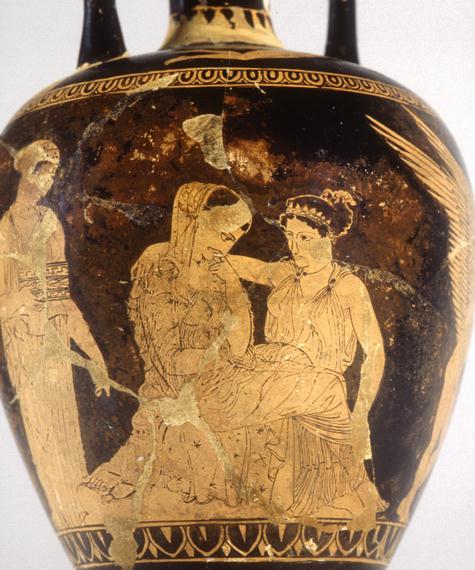
Image result for Ancient Greek Helen vase

As is largely unsurprising from the perspective of Greek misogyny, excessive interest in sexual behavior is projected a female quality. Expertise beyond interest is made the province of female ‘professionals’ (slaves) who may act as scapegoats and marginal figures for the corruption of both men and women. There is a combination of such interest with an excessive emphasis on eating (and eating really well) in Athenaeus where the pleasures of the body are combined.

Athenaeus, Deipnosophists 8.335c

“Dear men, even though I have great admiration for Chrysippus as the leader of the Stoa, I praise him even more because he ranks Arkhestratos, well-known for his Science of Cooking along with Philainis who is credited with a licentious screed about sexual matters—even though the iambic poet of Samos, Aiskhriôn, claims that Polycrates the sophist started this slander of her when she was really quite chaste. The lines go like this:

“I, Philainis, circulated among men
Lie here thanks to great old age.
Don’t laugh, foolish sailor, as your trace the cape
Nor make me a target of mockery or insult
For, by Zeus and his sons in Hell
I was never a slut with men nor a public whore.
Polykrates, Athenian by birth,
A bit clever with words and with a nasty tongue,
Wrote what he wrote. I don’t know anything about it.”

But the most amazing Chrysippus combines in the fifth book of his On Goodness and Pleasure that both “the books of Philianis and the Gastronomiai of Arkhestratos and forces of erotic and sexual nature, and in the same way slave-girls who are expert at these kinds of movements and positions and who are engaged in their practice.” He adds that they learn this type of material completely and then thoroughly possess what has been written on these topics by Philainis and Arkhestratos and those who have written on similar topics. Similarly, in his seventh book, he says ‘As you cannot wholly learn the works of Philianis and Arkhestratos’ Gastronomia because they do have something to offer for living better.’ “

Χρύσιππον δ᾿, ἄνδρες φίλοι, τὸν τῆς στοᾶς ἡγεμόνα κατὰ πολλὰ θαυμάζων ἔτι μᾶλλον ἐπαινῶ τὸν πολυθρύλητον ἐπὶ τῇ Ὀψολογίᾳ Ἀρχέστρατον αἰεί ποτε μετὰ Φιλαινίδος κατατάττοντα, εἰς ἣν ἀναφέρεται τὸ περὶ ἀφροδισίων ἀκόλαστον cσύγγραμμα, ὅπερ φησὶ | ποιῆσαι Αἰσχρίων ὁ Σάμιος ἰαμβοποιὸς Πολυκράτη τὸν σοφιστὴν ἐπὶ διαβολῇ τῆς ἀνθρώπου σωφρονεστάτης γενομένης. ἔχει δὲ οὕτως τὰ ἰαμβεῖα·

ἐγὼ Φιλαινὶς ἡ ᾿πίβωτος ἀνθρώποις
ἐνταῦθα γήρᾳ τῷ μακρῷ κεκοίμημαι.
μή μ᾿, ὦ μάταιε ναῦτα, τὴν ἄκραν κάμπτων
χλεύην τε ποιεῦ καὶ γέλωτα καὶ λάσθην.
ὐ γὰρ μὰ τὸν Ζῆν᾿, οὐ μὰ τοὺς κάτω κούρους, |
dοὐκ ἦν ἐς ἄνδρας μάχλος οὐδὲ δημώδης.
Πολυκράτης δὲ τὴν γενὴν Ἀθηναῖος,
λόγων τι παιπάλημα καὶ κακὴ γλῶσσα,
ἔγραψεν οἷ᾿ ἔγραψ᾿· ἐγὼ γὰρ οὐκ οἶδα.

ἀλλ᾿ οὖν ὅ γε θαυμασιώτατος Χρύσιππος ἐν τῷ πέμπτῳ Περὶ τοῦ Καλοῦ καὶ τῆς Ἡδονῆς φησι· καὶ βιβλία τά τε Φιλαινίδος καὶ τὴν τοῦ Ἀρχεστράτου Γαστρονομίαν καὶ δυνάμεις ἐρωτικὰς καὶ συνουσιαστικάς, ὁμοίως δὲ καὶ τὰς θεραπαίνας ἐμπείρους τοιῶνδε κινήσεών τε καὶ σχημάτων καὶ περὶ τὴν eτούτων μελέτην γινομένας. καὶ πάλιν· ἐκμανθάνειν | τ᾿ αὐτοὺς τὰ τοιαῦτα καὶ κτᾶσθαι τὰ περὶ τούτων γεγραμμένα Φιλαινίδι καὶ Ἀρχεστράτῳ καὶ τοῖς τὰ ὅμοια γράψασιν. κἀν τῷ ἑβδόμῳ δέ φησι· καθάπερ γὰρ οὐκ ἐκμανθάνειν τὰ Φιλαινίδος καὶ τὴν Ἀρχεστράτου Γαστρονομίαν ἔστιν ὡς φέροντά τι πρὸς τὸ ζῆν ἄμεινον.