“And what about you, Nikêratos—what kind of knowledge do you cherish?” And he said “My father, because he wished for me to be a good man, compelled me to memorize all of Homer. And now I can recite the whole Iliad and Odyssey.” Antisthenes said “Has it escaped you that all the rhapsodes know these epics too?”
Over the past few weeks there has been a bit of a frenzy over Oxford University’s potential move to drop Homer and Vergil from their required curriculum for Classics. We have heard the typical cries of “O Tempora, O Mores” in articles lamenting the fall of education and the decline of the west. This news even made The Blaze!, quoting only a student who calls it “a fatal mistake” because “Homer has been the foundation of the classical tradition since antiquity.”
(And you know that if a cultural question got Blazed. it is of real, deep, ethical concern.)
The ‘terrible’ nature of this decision is not just blamed on “diversity” but also on the inability of modern students to cope, supported by cherry-picked quotations from faculty. And this has also been characterized as part of a “diversity drive” with the adjective there used as a dog-whistle for cultural supremacists and not a sign of progressive, inclusive intent.
You know what I haven’t heard much of? People defending this proposal. Well, here I am, and that’s what I am going to do.
I am a Homerist. I have spent more than half my life reading, teaching, and writing on Homer. To say that I love the Homeric epics is such an understatement that it breaks my basic constative ability to do so. But this proposal makes sense. Let me tell you why.
Leonardo Bruni de Studiis et Litteris 21
“What is lacking in Homer, that we should not consider him to be the wisest man in every kind of wisdom? Some people claim that his poetry is a complete education for life, equally divided between times of war and peace.”
Quid Homero deest, quominus in omni sapientia sapientissimus existimari possit? Eius poesim totam esse doctrinam vivendi quidam ostendunt, in belli tempora pacisque divisa
First, the brouhaha mis-characterizes the proposal which is to make Homer and Vergil optional. From years of teaching Homer to undergraduates, I know that fewer are prepared to read something of this length and depth. They have read little in pre-collegiate classes of this length and intricacy. And we do not have the time in class to move from understanding a sentence to its relationship to the whole to its critical engagement with cultures over time.
The worst thing I see happening—and I know this happens at Oxford—is teaching Homer badly. Students don’t have the cultural frameworks, or the training to understand what they’re looking at. And this is in part because many people who teach Homer have a backwards idea of what the epics are and how they work.
These backwards ideas come from a teleological perspective that has over time selected from the past only works that conform to certain expectations and then force them to conform to others. Teaching Homer badly is objectively a bad thing. It turns students off to Homer; it gives them misconceptions about the ancient world; and it harmfully enforces the history of European literature.
Homer contains some nasty stuff. Taught in the wrong way, it glorifies violence, perpetuates misogyny, oversimplifies “heroes”, their faults, and gives terrible lessons on life and death. “Reading” a text is not merely passing one’s eyes over it or uttering the words aloud. It requires patience, contemplation, identification, alienation, communion with others and repetition
This is about the way we teach Homer as a holy, simple thing, with clear messages and heroes who can be understood in a few lessons. Homeric epics are dialogic, they are complex creations between audiences and the words themselves and without time, deep learning, and space, they function to advance a simplistic, but powerful policy of canon-enforcement
Henry David Thoreau, from his essay Walking (1862)
“The poet to-day, notwithstanding all the discoveries of science, and the accumulated learning of mankind, enjoys no advantage over Homer.”
Homer as often taught as canon—which is the main argument in many articles—is a product not of antiquity but of the time between antiquity and now. To disentangle the layers of interpretation and the centuries of misunderstandings that have accrued, students need sensitive reading skills and agile teachers.
Before reading Homer, students need to learn to read, to understand the relationship between text and audience, and the operation of literature—and especially the literary canon—as part of cultural discourse. We are better off by spending time teaching students a few poems by Sappho or lyric and elegiac poets, if what we want to learn about is Greek culture and poetry.
(And all of this sidesteps what modern program in Classical Studies is for. If we have only a small handful of credit hours to enlighten the mind and prepare it to engage fruitfully with the world it encounters, is slogging through an epic the best use of our time?)
But if you read even passively, the stalwart Homeric defenders aren’t really interested in the past. They are interested in Homer as a marker of their own culture. And look at the way people defend it! In one piece, the author cries that Homer is the beginning of a Trojan war story that made London “New Troy”. No cultural supremacy or appropriation there.
Yes, understanding Homer can be important for cultural literacy of the past, but it is not the only way to gain this (and most Renaissance paintings based on myth are not Homeric). Yes, Homer poses important questions about what it means to be a Human being—but Homeric universality is wildly overplayed. Who gets left out?
Werner Jager, Paideia (tr. Gilbert Highet, pp.35-36)
“We are right in feeling such bare utilitarianism to be repulsive to our aesthetic sense; but it is none the less certain that Homer (like all the great Greek poets) is something much more than a figure in the parade of literary history. He is the first and the greatest creator and shaper of Greek life and the Greek character.”
Homer, as taught in many places, is a ‘genius author’ who laid the foundations of western literature. Homer “wrote” the Iliad and the Odyssey and handed down the guidebook for mimetic narrative and human achievement. These ‘facts’ are demonstrably false and yet the way many teach Homer and position the epics as canon are based on these premises.
The ‘lie’ of Homer is an originary tale of ‘authenticity’ and cultural hegemony which intentionally overlooks that the Homeric epics are products and well as producers of this culture. This is deeply connected to how easily the Classics can be appropriated by white supremacists.
And the ‘Homer’ we possess is one of our own creation. There is a fundamental problem here in the concept of the word “authentic”, a quasi-religious belief and consequent search for the original, authoritative, and authentic form of Homer which goes back to antiquity (once “Homer” was separated from its performance context and reassembled by Hellensitic authors) and which is reborn and supercharged in that overlapping space between Classical and Biblical philology. M.L. West’s, an Oxford prodcut, posthumous text of the Odyssey, for example, operates on the principle that there was a single author and a single text and that the task of a textual critic—and philology at large—is to help us get closer to that original, that authentic, that divine genius.
And there is a Christian, revelationist stance in some of the philology that emerges from this background. In his recent commentary to Odyssey book 1, Simon Pulleyn, rejecting the idea of an oral tradition as critical to the epic we possess, tradition, revealingly combines belief in God with belief in Homer: “Just as the faith once put in God reposes nowadays largely in committees, so we are invited to see the epics not as masterpieces of an individual artist but as the product of numerous generations of bards each contributing their bit. We are asked to rid ourselves of anachronistic notions of the genius of individual authors” (2019 39).
Too much of what we call “classical studies” and canon are retrograde assumptions about the world and what it means to be human. They reduce everything to divinely-derived aesthetics and marginalize people and creeds who do not confirm to “Western” measures (as defined after the age in which the epics were formed). When we talk about what we should teach as the foundation of Classical Studies, we need to think about what our goals are, what we want students to be able to do when they are done.
“Why do we train our children in the liberal arts? It is not because these studies can grant someone virtue, but because they prepare the soul for accepting it.”
Quare ergo liberalibus studiis filios erudimus?” Non quia virtutem dare possunt, sed quia animum ad accipiendam virtutem praeparant.
Making Homer optional is not “watering down” the curriculum. It is opening up our education to do what we are supposed to do: critically and pointedly examine the past. Sure, advanced students, graduate students, professionals in the field, they should probably read Homer, but should everyone?
I am not saying that we should not have students reading Homer—but that if we only have a small collection of classes, they can acquire critical language, reading, reasoning, and cultural skills in other ways. This is important both in focusing on what our undergraduate learning goals are and in thinking about what we want classical studies to become in the future.
Are we going to merely perpetuate the same training, beliefs and ideas over and over again without reflecting on where they come from or what they mean? Are we going to ignore the fact that our histories of the Mediterranean have been figuratively and literally whitewashed in the service of colonial, nationalist, and racist discourse? Or are we a field where we train people to think critically, to re-frame the past, and then reclaim it?
As a Homerist, I think I’ve found myself in part by searching for “Homer”—and I think this is indeed one of the most salubrious effects of literature. But this is not the only goal and this is not the Aristotelian end for Classical Studies. We need students to enter with the world with the ability to question and reframe the worth of the pasts we have inherited.
Because if we keep doing the same thing over and over again, it is not going to turn out well. And soon.
Aeneas Silvius Piccolomini, de Liberorum Educatione
“The ancients decided that reading should begin from Homer and Vergil, though it requires a firm sense of judgment to understand their virtues.”
Veteres instituerunt, ut ab Homero atque Vergilio lectio inciperet, quamvis ad intelligendum eorum virtutes opus esset firmiori iudicio.
Lübbey Kışlağı, [all images by the author unless stated otherwise]I. An Ancient Route
Euripides, Bacchae, 451-465
Pentheus
Release his hands, for caught in the nets he is not swift enough to escape me. But your body is not ill-formed, stranger, for women’s purposes, the very reason you have come to Thebes. For your hair is long, you’re not a wrestler, scattered all over your cheeks, full of desire; and you keep your skin white, protected from the sun, by hunting after Aphrodite beneath the shade. First then tell me who your family is.
Dionysus
I can tell you this easily, without boasting. I suppose you are familiar with flowery Tmolus.
Pentheus
I know of it; it surrounds the city of Sardis.
Dionysus
I am from there, and Lydia is my fatherland.
From the road alone, it is difficult to grasp the extension of the Boz Dağ, a mountain range known in antiquity as the Tmolus. It runs from east to Izmir all the way to Turkey’s western Anatolian Plateau, with a summit at around 2200-2400 m. Now it’s tucked somewhere between the modern Turkish provinces of Izmir, Manisa and Uşak, hiding its lush valleys, irregular elevations, and largely abandoned villages. At present, the area is a destination for hikers and bikers, who spend time in between the mountains (see The Figs and Mountains of Izmir: Travel horizontally in any direction and you see no change in landscape, by Smithsonian journalist Alastair Bland who biked in the area in 2011) and mostly local tourists, who visit the area around Lake Gölcük and the Ottoman-era town of Birgi (the distance between them is around 21 km), both located at the easternmost end of the mountain range. The real attraction though is Mount Bozdağ itself, and its short skiing season. But during the journey, we traveled only in a triangle between the regional capital, modern-day Ödemiş (a former capital of the Aydınoğlu Sultanate in the 13th and 14th century), the historical Birgi and the more remote settlement of Lübbey.
Even though the Tmolus is flanked by the valleys of very important fluvial channels in antiquity, and in the neighborhood of the Aegean Coast, one of the best known parts of the ancient world – Aeolis, Ionia, Lydia – little is known about the mountains. This remoteness has contributed to their mythological status as a home of the gods: Euripides tells us in his posthumous masterpiece that Dionysus was born there (and already in the opening lines, the God informs us that he has arrived in Thebes, taking a mortal form, after leaving behind many riches in Lydia and Phrygia; Eur. Ba. 13-22). The first appearance of the mythological Tmolus, goes back to Theognis, a 6th century lyric poet from Megara, <Οὔποτε τοῖσ’ ἐχθροῖσιν ὑπὸ ζυγὸν αὐχένα θήσω / δύσλοφον, οὐδ’ εἴ μοι Τμῶλος ἔπεστι κάρηι.> ( Never will I set my neck under the galling yoke of mine enemies, nay, not though Tmolus be upon my head); according to myth Tmolus is a mountain-god, son of Ares and Theogone and he judged the musical contest between Pan and Apollo (Ov. Met. 11.146-194). Mount Tmolus is named after him, a king of Lydia, with the capital Sardis at its foot and Hypaepa on the southern slope.
Ancient Lydia, map by Sami Patacı
The historical Lydia, however, is an Iron Age kingdom, named after 2nd millennium king Lydus (Hdt. 1.7) from the dynasty of the Maeonian kings, and which occupied, in its pre-Greek setting, large swathes of Western Anatolia. It was reduced after the Persian contest roughly to its Hellenistic border with Ionia and Phrygia, especially after Cyrus conquered Sardis. But for all the importance of Lydia, the mythical Mt. Tmolus remained a place of isolation, shepherds and woodcutters.
The myth of its seclusion continued into the Christian era with monastic foundations but once again sources are hard to come by. Yet the importance of Mt. Tmolus had always to do with its privileged location between the Anatolian Plateau and the Aegean Coast, except that as Western explorers found out in the 19th century (especially the Swiss botanist Edmond Boissier in 1842), it cannot be crossed from east to west in modern times; “the fertile valleys are separated from each other by large and complex ranges of mountains where communication is difficult and agricultural resources are inadequate to support a large population” (Foss, 1978).
Map of Efeler Yolu
However the Tmolus is not impassable: “Most of the range consists of smaller chains of peaks which run north and south and enclose long, narrow valleys, called yayla, ‘summer pasture’, in Turkish” (Foss, 1978). Ancient roads led from Sardis to Hypaepa (an ancient city at the southern slope of the the Tmolus), a convenient route that connected the plateau and the coast, and that existed since Hittite times. It bypassed the Tmolus altogether along the Hermus, following parallel mountain ranges with lower elevations.
Other parallel roads were carved by political events: the Persian conquest of the Asia Minor in 546 BCE and the subsequent Athenian take over in 499 BCE. From the perspective of a contemporary visitor, the unspoiled nature is breathtaking and inviting, but under the dense vegetation of the valleys or the barren slopes, lurk long centuries of seasonal migrations, archaeological remains, agricultural landscaping, population exchange and massive public works. Since the departure of the man-god Dionysus for Thebes, the mysterious land of the gods has been hotly contested, often in battle, but ultimately abandoned to overgrown nature.
Lübbey Kışlağı
II. One City, Many Names
Thucydides, The Peloponnesian War, 8.19.2-3
A message, however, reaching them from Chalcideus to tell them to go back again, and that Amorges was at hand with an army by land. They sailed to Dios Hieron and there saw ten more ships sailing up with which Diomedon had started from Athens after Thrasycles, They were fleeing with one ship to Ephesus, the rest to Teos.”
Finally, summing up everything, he judged it wise to arrest Nicephorus. The latter was preparing his meditated escape and, wishing the start on his way to Christopolis during the night, sent to Constantine Porphyrogenitus in the evening and begged him to lend him the swift steed the Emperor had given him. However, Constantine refused, saying it was impossible to give away a gift from the Emperor of such value to another the very same day.
The historical center of Birgi is our base camp for exploration and one of the arteries in a 500 km long walking path, the Efeler Yolu (roughly translated as the Bandit’s Route, explanation forthcoming); a path connecting partly abandoned villages and valleys that were once inhabited by the so-called bandits of the area. Unlike the famous Lycian Way, extending from Fethiye to Antalya, designed and marked by amateur historian Kate Clow (and Turkey’s most famous footpath), however Efeler Yolu is a coordinated effort of Ege University in Izmir, under the direction of Dr. Özgür Özkaya, involving key stakeholders in the region, such as municipalities and development agencies.
The newly established footpath, overlaid on ancient and modern roads, seeks to reactivate the region through different strategies of sustainable tourism. Already in the 19th century (Wagner, 1892) the Ottoman Birgi was largely abandoned as population displaced towards the regional capital Ödemiş, but it is now a heritage tourism destination, with its Ottoman period houses and artisanal production, from which traces of its antiquity are rather absent and have to be carefully carved out through obscure sources.
Its ancient name of Dios Hieron – Sanctuary of Zeus – is very poorly attested and there’s a confusion in the sources given that there’s another Dios Hieron on the Ionian coast that figures prominently in Greek sources as a city in the Delian League (Thuc. 8.19.2), and Thucydides, Stefan of Byzantium, Pliny the Elder, Strabo and Herodotus provide confusing, often conflicting accounts. The only reliable source is merely the name of the city listed by Ptolemy, and there’s doubt whether we are talking about the same exact settlement, or somewhere nearby. Many coins were minted here in antiquity with the inscription “Διοσιερειτων” or different variants thereof.
“Seal of Leo, the most humble bishop of Pyrgion”, Byzantine seal, 11th/12th century obverse, Dumbarton Oaks
Its name changed to Diopolis and Christians called it Christopolis (see Anna Komnene), but it was known as Pyrgion by the end of the Byzantine era – a place mentioned in many sources but without much detail. When Pyrgion fell to the Turks in 1307, its name changed to Birgi and became the capital of a sultanate. By the time Ibn Battuta visited in the 14th century he described the hospitality of Muslim institutions, but little is known about Christian life through the centuries, except that a number of Greeks and Armenians were also settled in the area.
The great mosque of Birgi (Ulu Cami), was erected in 1312, by Mehmed Bey of the Aydınoğlu Emirate, and the builder integrated into the construction a fascinating piece of spolia: A Lydian lion, bearing witness to the pre-Greek past of the region (a Lydian tomb was excavated in the region as a part of the Sardis expeditions in the 20th century). After Turks settled in the surrounding area, nomadism became the established way of life, and whole tribes would move great distances between the summer and winter pastures, called yayla and kışlak in Turkish (Foss, 1978),]. Mt Tmolus or the Boz Dağ, was known through the Ottoman period as a refugee for bandits (hence the name Efeler Yolu), but its reputation for banditry is also ancient: In the Novellae Constitutiones, a code of Roman law initiated by Roman Emperor Justinian I, there was a discussion of Pisidian banditry and the punishments meted out to thieves and bandits. It is also thought that the lack of Christian sources is perhaps due to heretic sects living in this remote highland. But during the Ottoman era, the authorities found it extremely difficult to impose law and order in these valleys.
Ulu Cami, the Great Mosque of Birgi
Several kilometers from Birgi, we arrive at the kışlak of Lübbey, a semi abandoned winter village where only a handful of inhabitants, ruined houses and a mosque remain. Interestingly enough, the archaeological knowledge of the area is very poor, and most of the descriptive work of Clive Foss is based on the yayla, not on the kışlak. Visiting the kışlak with the Izmir Vakfı (a non-profit organization), we are led by Emin Başaranbilek, an archaeologist from Birgi, who completes the picture of this settlement on the Cayster valley, called Küçük Menderes in Turkish, largely against the background of the work of Foss and the Sardis expeditions (he’s also written about the mosque of Lübbey in Turkish). Information about this settlement, populated by Turkmen in the modern era, is very scarce, mostly limited to the late Ottoman period and cadastral records. The history of Lübbey is completely unknown, as the word has no meaning in Turkish (toponyms that begin with L are foreign to Turkish), and could be perhaps related to Datbey (a place famous for kiln firing), around Hypaepa, an important Greek city on the southern slope of the Tmolus that loses importance to Birgi/Pyrgion.
III. Wine from Tmolus
Painting by Emin Başaranbilek, historical hammam, undated
Euripides, Bacchae, 135-167
Chorus
He is sweet in the mountains, whenever, after the running dance, he falls on the ground, wearing the sacred garment of fawn skin, hunting the blood of the slain goat, a raw-eaten delight, rushing to the Phrygian, the Lydian mountains, and the leader of the dance is Bromius, evoe!
The plain flows with milk, it flows with wine, it flows with the nectar of bees. The Bacchic one, raising the flaming torch of pine and his thyrsos darts about, like the smoke of Syrian incense, arousing the wanderers with his racing and dancing, agitating them with his shouts, casting his rich locks into the air.
And among the Maenads his voice cries deep: “Go, Bacchae, go, Bacchae, with the luxury of Tmolus that flows with gold, sing of Dionysus, beneath the heavy beat of drums, celebrating in delight the god of delight with Phrygian shouts and cries, when the sweet-sounding sacred pipe sounds a sacred playful tune suited to the wanderers, to the mountain, to the mountain!”
And the Bacchantes, rejoicing like a foal with its grazing mother, rouses her swift foot in a gamboling dance.
In Euripides’ Bacchae, the god Dionysus is constantly bragging about the quality of wines from Lydia and the Tmolus, fact that has been corroborated by Strabo, “And indeed the Ephesian and Metropolitan wines are good; and Mt. Mesogis and Mt. Tmolus and the Catacecaumene country and Cnidos and Smyrna and other less significant places produce exceptionally good wine, whether for enjoyment or medicinal purposes” (Strab. 14.1).
The Aegean coast has always been famous for its wine culture (Hom. Il. 13.673) but in the historical agriculture presented in Foss’ description, vineyards are quite absent: Fruit and nut trees of all kinds, wheat, potatoes, hazelnuts, chestnuts, grapes, apples, and pomegranates. In modern times, the vineyards are located on the lower slopes of the Boz Dağ, though of course wine culture has been affected by population exchanges that drove away from Anatolia Christian minorities traditionally concerned with wine-making. But Turkey’s Aegean region, nevertheless, has experienced a mild rebirth of its wine culture in recent years, paradoxically as the currency has slipped and freedom of expression became very restricted.
Dios Hieron minted coins, Lydia, reign of Antoninus Pius, circa 147-161 CE, ƐΠΙ Λ ΙΟVΛ(Ι) ΜΙΘΡΟV ΔΙΟϹΙƐΡΙΤΩΝ, Goddess Hera, Ashmolean Museum
Part of the appeal for Efeler Yolu is actually the return to small scale agriculture that can serve other purpose than survival: The region’s archaeology of food, for which we have no good sources, indicates that not only is the agricultural panorama radically different from antiquity (unlike Greece for example), but it has profoundly transformed the environment as well. For a country whose modernization has always emphasized large-scale industrial production, massive dependence on imports – a dangerous situation as the currency has lost so much of its value – and a move away from traditional craftsmanship, there’s a lack of much needed incentives for local, regional agriculture. As Alastair Bland mentions in his article from the experience of biking through the ancient roads of the Tmolus in 2011, there was plenty of local produce on offer, olives, figs, oil, and a limited quantity of fruits. Would it be possible to transform back the environment through a gesture as simple as a footpath? Perhaps not, but it creates a different, deeper historical space, where such ideas are possible.
Lübbey Yaylası, Clive Foss, 1978
The cultural history of nomadism and the role of traditional religion and the progressive abandonment of villages have not only transformed the environment, but brought gigantic rings of poverty to capital cities that can no longer sustain a growing young population with high employment rates. By the end of the Ottoman era and definitely in the beginning of the Turkish republic, nomadism was largely eradicated and a degree of law and order was established, but with its departure came also the abandonment of the Tmolus.
It might seem strange to casual observers today, but classical and Byzantine settlements have been found throughout the area, and while significant remains of antiquity have not been found, it is also suspected that the banditry culture contributed to massive looting and that antiquities were unearthed before heritage laws were passed. According to Clive Foss, who documented a number of inscriptions in the 1970s, inscriptions were broken up for stone and carried off for roadworks, without much oversight. That this happens is no surprise to observers in Turkey, where archaeological sites are covered by roadworks and botched restorations are a matter of course.
Chris Roosevelt, an archaeologist specializing in the Lydia region, has also documented testimonies from other archaeologists in the same period and as late as the early 2000s, about mysterious shepherds, overnight digs, weak law enforcement and unreported antiquities, including looting and destruction of remains. He even theorizes that in the absence of the state (in the remains-rich Bin Tepe, north of Mt. Tmolus), archaeological excavations in fact encourage more plunder and looting. It is perhaps possible, to think, that a multidirectional project such as Efeler Yolu, a coordinated effort across different state and private actors and agencies, could in fact serve to magnify efforts in heritage (preventive) preservation. Through its engagement with nature and the built environment (an artificial construct with political implications), a contemporary archaeological practice (of the kind espoused by archaeologists such as Dan Hicks and his project “Lande: The Calais Jungle” or Yannis Hamilakis’ “Transient Matter”) could arise, reversing the socio-cultural damage that survival agriculture and decades of poor planning have inflicted on the Lydian mountains.
The Emperor was detained for some time by his care for the Franks; and when he had arranged everything satisfactorily for them, he took the road home to Byzantium. But after his return he did not give himself entirely to rest and repose, for, when he reflected how the barbarians had laid the whole sea-coast of Smyrna in ruins up to Attalia, he thought it would be a disgrace if he could not restore the cities to their pristine state, bring back their former prosperity, and re-people them with the inhabitants who were now scattered far and wide.
Constantine P. Cavafy, “Anna Komnena”, Poems 1919-1933
In the prologue to her Alexiad,
Anna Komnena laments her widowhood.
Her soul is all vertigo.
“And I bathe my eyes,” she tells us,
“in rivers of tears… Alas, for the waves” of her life,
“alas for the revolutions.” Sorrow burns her
“to the bones and the marrow of the splitting” of her soul.
But the truth seems to be this power-hungry woman
knew only one sorrow that really mattered;
even if she doesn’t admit it, this arrogant Greek woman
had only one consuming pain:
that with all her dexterity,
she never managed to gain the throne,
virtually snatched out of her hands by impudent John.
Στον πρόλογο της Aλεξιάδος της θρηνεί,
για την χηρεία της η Άννα Κομνηνή.
Εις ίλιγγον είν’ η ψυχή της. «Και
ρείθροις δακρύων», μας λέγει, «περιτέγγω
τους οφθαλμούς….. Φευ των κυμάτων» της ζωής της,
«φευ των επαναστάσεων». Την καίει η οδύνη
«μέχρις οστέων και μυελών και μερισμού ψυχής».
Όμως η αλήθεια μοιάζει που μια λύπη μόνην
καιρίαν εγνώρισεν η φίλαρχη γυναίκα·
έναν καϋμό βαθύ μονάχα είχε
(κι ας μην τ’ ομολογεί) η αγέρωχη αυτή Γραικιά,
που δεν κατάφερε, μ’ όλην την δεξιότητά της,
την Βασιλείαν ν’ αποκτήσει· μα την πήρε
σχεδόν μέσ’ απ’ τα χέρια της ο προπετής Ιωάννης.
Lübbey
The presence of the Ottoman minorities along the footpath of Efeler Yolu is as weak as the evidence for its classical past, and often apocryphal – mostly accounts of Western travelers. Although in the case of Birgi hardly avoidable, given the status of Christopolis, and especially Pyrgion, as a borderline in the mountains of a receding empire as the Seljuk presence closed in on the Byzantines. In a way, Turks and Greeks first encountered each other in these mountains, and continued to do so for centuries. The erasure of the Greek presence is today near absolute, to the extent that a number of Roman and Byzantine tombs (even inside of Birgi) are mistakenly attributed to the Ottoman Seljuks, and incorrectly dated. The Fall of Constantinople, thanks not to the Turks but to Latins on August 12, 1204, thus moving the Byzantine Empire out of Constantinople and to Nicaea, created a wave of refugees from the city to the Aegean region and a new dynamic in the area (Anna Komnene writes bitterly about the first Italo-Norman invasions). This situation surprisingly empowered the Byzantine presence versus the new Seljuk arrivals from the East.
But the nomadic nature of the Turks put the long-settled Greek and Armenian population at terrible disadvantage, and since then, imperial power became increasingly fragmented around this region. Many Byzantines converted to Islam, sometimes for practical reasons but often also forced; other populations welcomed the Ottomans in protest of the oppressive Byzantine taxation and even fought alongside them, and since then both Muslims and Christians (and a minor Jewish population) lived in a complex archipelago of settlements, in which facing each other was unavoidable.
The highland gave advantage to the Turkish bandits in terms of inaccessible geography, but in terms of battle it is a place where scarce resources and water make it impossible to remain hidden for long, therefore mobility between the valleys was a necessity. Birgi fell (1307) long before Constantinople and the Aydın sultanate was established rapidly, but it wasn’t going to be the last time Turks and Greeks would be facing it off in battle: On May 15, 1919 the Greek forces advanced as far as Birgi during the independence war and not unlike other battles in the Anatolian Aegean, Greeks were defeated with devastating consequences.
Application by A. Stavrakoudis, οικοισμοι προσφυγες
An online application, created by Anastasios Stavrakoudis, at the University of Ioannina, maps out all the locations from which Greeks were expelled on the aftermath of the Greek-Turkish war in 1922, when Greece and Turkey exchanged their entire minority populations (after hundreds of thousands were massacred, the vast majority in Turkey), with the exception of Istanbul. You easily can find Birgi and Ödemiş in this map. A documentary film by Turkish filmmaker Nefin Dinç and Herkül Millas, a Greek writer from the minorities of Anatolia, “The Other Town” (2011), takes place in two towns, one in Turkey (Birgi) and one in Greece (Dimitsana), on the mountains of Peloponnese, a place very similar to Mt. Tmolus, and a borderland with the Ottomans that played a role in the Greek independence in 1821. In both towns, Millas discusses the ‘other’, with both the young and the elderly, in places where people have learnt about each other only through the history textbooks that present only one version of events, being both versions quite symmetrically based on the similar events and nationalistic discourse that has led to multigenerational ethnic hatred.
The Greek presence on the Aegean coast and the Tmolus is something that cannot be expunged from memory, the play of Euripides tells us. In the vicinity of Lübbey, the remote yayla we just visited, a Hellenistic inscription was found by Foss, bearing the uncommon name Nicopolis, attested only in Hypaepa, but all of this disappeared from public memory in Turkey, and traces are difficult to pin down without specialized archaeological knowledge, how is this process possible? The 500 km path of Efeler Yolu, almost unknowingly, on its twenty-something village stops – chosen for a number of strategic reasons, highlights not only the history of ancient roads in a remote and importantly connected region of historical Lydia, but also uncovers an unfinished, multilayered, historical memory, both recent and in the far past, rich in archaeological implications and made invisible not only by the overgrown nature but also by the political maneuvers of modern nation states. According to Millas, myths mean more than they narrate, “Nations believe in myths even if the myths are not sensible and rational, they are not documented, they are full of contradictions, even if they are proven fake.”
Whether a project so ambitious (it’s still not fully operational, and I suspect, much work remains to be done), and so deeply embedded in institutions of the state at a time of turmoil will be capable of independently achieving aims other than presenting a neutral (or neutralized) image of the past/present, remains to be seen. As we know from the struggles of indigenous peoples in many countries at present, the environment is never neutral, and represents a key factor in the frontline of decolonization, especially against the background of redrawing historical borders and questions of belonging. In a country that has historically struggled with complexity and cultural memory, and where the history of minorities has been largely erased and archaeology is a contentious point in the construction of national identity, it is not possible to turn the clock back. Nevertheless, the hope remains that a vision of sustainable development comes not at the expense of a serious consideration of the value of material culture that might problematize the past not as myth, but as shared heritage. So much remains to be seen insofar as what lies ahead in the rest of the month-long trail.
Hellenistic inscription, the rare name Nicopolis, Lübbey Yaylası, Clive Foss, 1978
George Seferis, “Mythistorima”, XIX, 1935
Even if the wind does blow it brings us no relief
the shade cast by the cypress-tree is tight and narrow
and all around are steep paths leading to the mountains;
they weight upon us
those friends who no longer know how to die.
Κι αν ο αγέρας φυσά δε μας δροσίζει
κι ο ίσκιος μένει στενός κάτω απ’ τα κυπαρίσσιακι
όλο τριγύρω ανήφοροι στα βουνά·
μας βαραίνουν
οι φίλοι που δεν ξέρουν πια πώς να πεθάνουν.
*In the course of the coming year, I will visit a number of points in the trail of Efeler Yolu, seeking the map out details and stories from classical antiquity, Byzantine and pre-modern past of the region. Efeler Yolu is on Instagram, only in Turkish.
Visiting Lübbey Kışlağı with İzmir Vakfı
Bibliography:
Dimiter Angelov, The Byzantine Hellene: The Life of Emperor Theodore Laskaris and Byzantium in the Thirteenth Century, Harvard University Press, 2019
Emin Başaranbilek, Lübbey Kışlağı ve Lübbey Camisi, 2015
Clive Foss, Explorations in Mount Tmolus, California Studies in Classical Antiquity, Vol. 11 (1978), pp. 21-60
Dimitri Korobeinikov, Byzantium and the Turks in the Thirteenth Century, Oxford Studies in Byzantium, Oxford University Press, 2014
George Ramsay, The Historical Geography of Asia Minor, Royal Geographical Society, Supplementary Papers, Vol. 4, John Murray, 1890
Alexandros Rizos Rankabes, Antiquités Helléniques ou répertoire d’inscriptions et d’autres antiquités, Athens Archaeological Society, 1842
Louis Robert, Monnaies grecques de l’époque impériale, Revue Numismatique, Vol. 18 (1976), pp. 25-56
Christopher Roosevelt, The Archaeology of Lydia, Cambridge University Press, 2014
Christopher H. Roosevelt, Christina Luke, Mysterious Shepherds and Hidden Treasures: The Culture of Looting in Lydia, Western Turkey, Journal of Field Archaeology, 31-2 (2016), pp. 185-198
Speros Vryonis, The Decline of Medieval Hellenism in Asia Minor and the Process of Islamization from the Eleventh through the Fifteenth Century, Center for Medieval and Renaissance Studies, University of California Press, 1971
G. Weber, Hypaepa, le Kaleh d’Aïasourat, Birghi et Oedémich, Revue des Études Grecques, Vol. 5-17 (1892), pp. 7-21
Arie Amaya-Akkermans is a writer and art critic based in Istanbul. He is interested in the Greek heritage of the Asia Minor and the relationship between (pseudo)archaeology and nationalism in the Eastern Mediterranean. He’s also tweeting about Classics, Byzantium, contemporary art and Turkey/Greece.
Small talk follows predictable patterns and rarely veers off of script, and so people often ask me in casual conversation about my hobbies. These same people are generally either perplexed or disappointed when I tell them that a shortage of free time in general precludes the possibility of practicing a wide array of hobbies in earnest, but that I typically spend most of my spare time reading. Indeed, if I could find myself gainfully employed simply reading, analyzing, synthesizing, and commenting, I would achieve a pinnacle of happiness otherwise reserved only for the rich.
Perhaps I cannot account for what I accomplished in 2019 because all of it consisted simply of the perusal of books. And while it strikes me that this may appear insufferably vain as I type this, I have noticed that people tend to develop lists of their top recommendations for the year only at the end of the year (perhaps following the general thread of Solonian advice about not evaluating someone’s fortune in life until they are dead), and I have decided to follow suit by posting a set of recommendations from my bookshelf this year.
Released in 2019:
Anthony Grafton – Forgers and Critics: Creativity and Duplicity in Western Scholarship
Technically, this is a re-release, but the updated foreword and afterword constitute 2019 material. I would read anything by Anthony Grafton (and I’m dying to read his new book Inky Fingers in 2020), and anyone who is familiar with his work will know that he treats masses of erudition with a light and inviting style. Sure, it’s a serious and learned book, but it also lends itself to armchair reading with a coffee in hand. Perhaps the best insight to be gleaned from the book is the association between critical scholars and forgers – the tools necessary for each occupation being essentially the same.
Jia Tolentino, Trick Mirror:
Ever since I read her article, The Repressive, Authoritarian Soul of “Thomas the Tank Engine & Friends”, Jia Tolentino has been the only regular contributor to The New Yorker whose work I both look forward to and read through without fail. I recall reading somewhere that Zadie Smith thought that she was the perfect Millennial writer (or something to that effect), in that she managed to have a firm foothold in and understanding of the culture of my generation without it having ruined her. The essays which bookend the collection The I in Internet (about the elision of self and the commodification of identity in digital culture) and I Thee Dread (cynically romantic or romantically cynical reflections on marriage) were alone worth the price of the book.
Daniel Mendelsohn, Ecstasy and Terror: From the Greeks to Game of Thrones
This was fortunately mercifully short on Game of Thrones material, because I find myself unable to come to terms with my former avid fondness for that show after its full-on commitment to wrapping up at the expense of making sense. Yet it was also less strictly Classical than I had anticipated, too. The book is a collection of Mendelsohn’s essays and criticism, and its range is wide and expansive. I took a particularly sick satisfaction in Mendelsohn’s brutal review of Stephen G. Kellman’s Redemption: The Life of HenryRoth, for no other reason than the fact that Kellman once shot me a surly glare when I was an undergraduate and opened a door for him and his wife, poet and professor Wendy Barker.
Guy Gavriel Kay, A Brightness Long Ago:
I tried to pick this up at the bookstore several times without any success because it had never occurred to me to look in the sci-fi/fantasy section. If either of those genres sounds unappealing to you, don’t worry: it is not really either of them. Kay’s work occupies a distinct space adjacent to historical fiction, or what I once heard him describe as a quarter-turn toward fantasy. All of the characters and settings are entirely fictional, yet it is set in what is clearly a fictionalized Renaissance Italy. Much of the narrative follows the central character Gudanio Cerra as he tries to keep himself alive amidst an ongoing conflict between two powerful condottieri, Folco Cino d’Acorsi and Teobaldo Monticola di Remigio. In addition to the wonderfully sad lyrical asides, the plot is constantly engaging throughout, and I was so involved that I read the book in a marathon session one Saturday.
Older Books:
Zadie Smith, Feel Free:
This was released in 2018, and so qualifies as an “older book,” but I cannot recommend it enough. Feel Free is another one of those books which I ploughed through in a marathon session because it was so engaging. I had not read Zadie Smith before this collection, but I was so impressed that I went on a binge and read all of her novels afterward.
Edward Gibbon: The Decline and Fall of the Roman Empire
Don’t @ me on this one. Despite all of Gibbon’s flaws and shortcomings, I feel the need every few years to read through the Decline and Fall in its entirety, and I’m afraid that it might be my desert island book. The edition by J.B. Bury lets you feel the satisfaction of seeing Gibbon’s factual errors as you read. Some of the later volumes are more of a slog than the first few, but I will still probably read straight through this again in a year or two.
Herman Melville, Moby Dick:
A lovely trip to Nantucket’s whaling museum with Joel and his family this summer kindled the urge to read this bad boy for a third time, which did indeed prove to be the charm. Although I had read it twice before, I found this run through it to be the most engaging, and no book in my library is so thoroughly dog-eared throughout. A work of unparalleled genius, and definitely the most quotable book I’ve ever read.
Historia Augusta:
How did I read all of the complaints about the gossipy and tawdry nature of this book for so many years without dipping into it? It may not be the most reliable history, or even a forgery, but it’s one of the most engaging Latin prose works we have outside of the Satyricon.
Kristine Haugen, Richard Bentley: Poetry and Enlightenment
Ezra Pound may have been a villain, and even in the narrow field of criticism he often goes off the rails pretty hard, but I blasted through this in one sitting because it was so utterly engaging throughout. Pound’s reflections on reading, and especially his thoughts on ancient poetry, are not bad. But his unwavering insistence on Chaucer and Provençal poets reminded me of the anecdote in Menelsohn’s collection about Mary Renault trying to push everyone into reading Thomas Malory.
The Book I Wanted to Like But Couldn’t:
Herman Melville, Pierre:
One need look no further than the comparison between Pierre and Moby Dick to dispel the cult of genius. An author may be able to produce a work of genius, but they may have just the one. Pierre was criticized as one of the world’s most unreadable books, and I took up the challenge only to toss it aside about halfway through. The plot is unbearably absurd, and I found that I could not get past the stilted and affected archaism of the dialogue. This work alone made me wonder whether it is not for the best that so much of ancient literature has perished, allowing us to shower the surviving poets’ works with accolades while being spared the disappointment of reading some of their abortive attempts at art.
Dynamic and divisive figures like Bentley are apt to leave in their wake a mass of biographical recollection neatly divided into hagiography and hate. Though the average person may be surprised to learn that some of the most bitterly partisan divisions outside of politics can be found within the realm of scholarship, there is a long tradition of scholarly work serving as the basis of personal animus, and there are few scholars whose work ignited as much passionate controversy in the broader literary world as did Richard Bentley. While famous among Classical scholars, Bentley is largely forgotten to the broader intellectual world, except to those who recall him as the butt of the joke in Pope’s Dunciad and Swift’s Battle of the Books. Our man Bentley, a graduate of St. John’s College, Oxford, spent much of the 1680s in the household of Edward Stillingfleet before rolling on to the scholarly scene in the 1690s with two works which display what Gibbon would call “a stock of erudition which would have puzzled a doctor.”
Bentley’s Letter to Mill and Dissertationson the Epistles of Phalaris represent apparently epochal moments in the history of English Classical scholarship, and they were certainly important. Yet there is a temptation to regard Bentley’s work as wholly sui generis, if for no other reason than because his towering genius and the fame accruing to him for his polemical savagery place him so high in the pantheon of English scholarship that his predecessors have been largely effaced from memory. (Indeed, so strong is this tendency, that C.O. Brink’s volume on English Classical scholarship was entitled Bentley, Porson, Housman – not because there were no other English Classical scholars, but rather because these three are so manifestly preeminent as to force the rest into the unenviable position of ambient historical noise.) One may compare Bentley’s reputation with that of his contemporary, Isaac Newton. While Newton, too, was working within a tradition of scientific work laid out before him, the singularity of his individual achievement led to the elision of his predecessors.
In her study Richard Bentley: Poetry and Enlightenment, Kristine Louise Haugen positions Bentley within a well-established set of scholarly work in 17th century England. A chapter on Restoration Cambridge lays the ground for understanding Bentley’s development by analyzing the work of Thomas Stanley, John Pearson, and Thomas Gale. Thomas Stanley’s History of Philosophy, a scholarly engagement with Diogenes Laertius’ Lives of the Philosophers, sought to augment and correct the biographies which Laertius wrote. Much of the value of this work is attributed to Stanley’s extensive compilation of chronological and biographical material supplemental to Diogenes. Stanley also produced the “first large-scale edition of a classical poet ever published” with his Aeschylus. Stanley was not endowed with the same keen power for textual criticism which characterized Bentley, and Haugen notes that it is his preoccupation with and commentary upon the more strictly literary qualities of the text which set him apart from Bentley, whose own process inclined toward commenting only upon textual problems in need of remedy.
While Thomas Stanley played the literary gentleman, John Pearson was the polemical scholar whose edition of the philosopher Hierocles dove into the weeds of commentary upon pseudo-Pythagorean verses with a hint of polemical fire. Haugen paints Pearson as something like a Mr. Casaubon (not the scholar, but the character from Middlemarch), who “evidently never hit on the reigning ideas that could have turned his masses of notes into a meaningful narrative or a decisive editorial procedure.” [p.30] Pearson was also the author of the Vindication of the letters of Ignatius of Antioch, which set a precedent for Bentley in its striving to find a way to blend scholarship and polemic.
The methods of Thomas Gale approach more closely to the methodical rigor of Bentley. Gale composed a series of comments and notes upon the Library of Apollodorus. Haugen devotes some pages to explicating Gale’s methods by analyzing his approach to the corruptions at Apollodorus 1.9.26. Gale’s approach drew on comparative analysis between passages in Apollodorus, Apollonius of Rhodes, Hesychius, Strabo, and a scholiast in order to restore Apollodorus’ text. She notes the parallel between the method of comparative reading in Gale’s work and that in Bentley’s Horace of 1711, and demonstrates that Bentley’s approach, though it was both criticized and ridiculed, simply represented the employment of an established scholarly procedure. Bentley’s fault was in offending the sensibilities of 18th century literary gentlemen, for whom the received text was regarded as canon passed down to them from their school days, and reinforced through a series of endless and ostentatious quotations in periodical publication.
Bentley’s major works can be separated into roughly three periods: the polemical works on obscure books (Letter to Mill and Dissertation on the Epistles of Phalaris) in the 1690’s; the scholarly analysis of canonical literature (Horace, New Testament, Terence, and the discovery of digamma in the works of Homer); and his preoccupation with the figure of the meddling editor (in his edition of Manilius, and in the much maligned edition of Paradise Lost).
Bentley’s intellectual development was fostered by privileged patronage. For all that has been made about “Bentley’s idexes”, it is worth noting that one cannot embark profitably on the project of indexing unless one has access to books. In 1682, Bentley became the tutor to James Stillingfleet, the younger son of Edward Stillingfleet. This position involved more than simply educating young James. Bentley was a member of the household, and served as an all-purpose toady for Stillingfleet: amanuensis, ghost writer, and procurer of books. In this last function, it serves to note that Bentley was charged with purchasing volumes for Stillingfleet’s library, a task which on some occasions led to the acquisition of rare or useful classical books. Moreover, Bentley’s position also meant that he had access to the whole of Stillingfleet’s library, and it would be hard to overstate the effect which access to such a treasury would have had on Bentley’s later stock of erudition. Later, owing in part to the boost in life granted him by Stillingfleet’s patronage, Bentley was made Keeper of the Royal Library in 1693. We are perhaps liable now to underestimate the value of access to information in light of the relative cheapness of both books and information today. While Bentley was undoubtedly endowed with a remarkably acute intellect, one must concede that he would not have become the colossus of English classical scholarship were it not for the patronage of the rich and powerful.
Bentley rolled on to the public scholarly scene in 1691 with his Letter to Mill, which is ostensibly intended as commentary upon Mill’s edition of the Byzantine historian John Malalas. The story goes that Bentley wanted to see the edition before its publication, and Mill agreed to let him take a look in exchange for penning a commentary essay on it. The text of Malalas as it stood offered fertile ground for Bentley’s intellect, and what was supposed to be simply some “remarks” morphed into a full blown essay, focused in large part on Greek drama. Haugen judges that the “Letter to Mill was largely the work of an autodidact, with all of the freedoms and some of the deficiencies that this implies.” [p.82] Yet it is perhaps this very sense of freedom which makes Bentley’s scholarship so novel and invigorating.
The Battle of the Books (or The Quarrel Between Ancients and Moderns) has been forgotten by the public at large, perhaps because the debate has been so firmly settled on the side of modernity, but it was still capable of exciting tempers at the end of the 17th century, and served as the foundation for Bentley’s famous Dissertation Upon the Epistles of Phalaris. The epistles were literary forgeries (or playful literary exercises) written in the persona of Phalaris, the tyrant of Akragas, who cooked his enemies inside a brazen bull which he kept at his court. Many astute readers had long seen that the Epistles were not actually written by the tyrant himself, but that did not prevent Sir William Temple from blundering his way into citing them as proof for his claim that the achievements of antiquity far surpassed those of the modern world. Temple described the Epistles as having “more Race, more Spirit, more Force of Wit and Genius than any others I have ever seen, either antient or modern.” William Wotton, one of Bentley’s friends, penned a response to Temple arguing for the superiority of modern achievement, and published it along with the 78 page first edition of the Dissertation, composed by Bentley, which showed that the Epistles were neither original, nor as ancient as Temple had supposed. This led to a counterattack by Francis Atterbury, which in turn drove Bentley to publish a substantially enlarged, 540 page edition of the Dissertation. Unsurprisingly, the second edition of the Dissertation was far more diffuse and digressive than the first, and it does more than simply prove its point about the Epistles – it provides commentary upon and solutions to a wide range of textual and chronographic problems which are tangentially related to issues suggested by the Epistles themselves.
The expanded Dissertation makes for a tough read, but Haugen does an admirable job of summarizing the key arguments and conclusions, with helpful notes on Bentley’s method of scholarly exposition. It is unlikely that readers today would take sufficient interest in the controversy to read through Bentley’s work, and even a Classical scholar can be forgiven for feeling somewhat stupefied when confronted with the sheer mass of intimidating erudition which Bentley drew up for the book. Yet, the expanded edition was written and published with remarkable haste (released only one year after Atterbury’s attack), suggesting that this was all material which Bentley had ready in the chamber. Nevertheless, the literary world found the massive display of erudition distasteful, and served as the basis for the ridicule which Jonathan Swift and Alexander Pope leveled against Bentley in The Battle of the Books and The Dunciad. Moreover, the 1699 publication of the Dissertation marks the end of Bentley’s publication in the realm of the rarefied and minutely obscure, as he ceased after this point to write on forgotten Greek works, and turned his attention to something a bit more canonical.
Bentley’s edition of Horace, published in 1712, exposed him to broader public notice than his earlier works on account of Horace’s widespread popularity as a gentleman’s reading material. The broad popularity and canonical status of that poet meant that many of Bentley’s contemporaries had learned Horace by heart in their school days. Thus, when Bentley produced a triple decker quarto edition of Horace consisting of over 700 pages (more than 400 of which were devoted to his notes and commentary), it is not surprising that Horace’s drawing room readers were disconcerted and even offended by Bentley’s apparent audacity. Much of the impetus for the publication came from Bentley’s position at the head of Cambridge University Press, which was busily engaged in the project of releasing ‘editions’ – that is, collected volumes of a single author’s work – in an effort to catch up with the rival Oxford University Press.
Haugen spends some time examining Bentley’s method in emending the text of Horace, which marked a departure from the scholarly practice of the Letter and the Dissertation. In each of those works, Bentley was offering broader scholarly commentary on particular issues, not trying to correct the problems of a single text. And so, where his previous publications relied heavily on the marshalling of masses of erudition, Bentley relied far more on his own innate critical and aesthetic genius to produce the conjectures in his edition of Horace. This could on occasion produce the right result, but Bentley’s enthusiasm for emendation (Haugen notes that nearly every page of Bentley’s text features some deviation from the received text) suggests that he got a bit carried away by his own critical spirit. As such, Bentley’s edition of Horace, while surely a work of critical genius in its own right, is nevertheless remembered today more for the interest of its methods and arguments than for its textual soundness.
Bentley’s later work is still suffused with his characteristic critical acuity and deep erudition, but there is something less immediately gratifying about the metrical arcana of his edition of Terence, or the marked emphasis on manuscript work (as contrasted to conjectural enthusiasm in his Horace) found in his New Testament work. Haugen’s chapter Vi Commodavi provides a clear and readable account of Bentley’s metrical expertise and its bearing on his edition of Terence, but it is hard to imagine a reader waking up early to peruse these pages unless they are already captivated by the subject of meter. While the documentation and explication of Bentley’s later work are all just as thoroughgoing as in earlier chapters, it is Bentley’s work itself which lacks the potent polemical interest of the early publications. Perhaps it is because we see here Bentley the scholar, while the Letter and the Dissertation presented us with Bentley the bumptious genius.
Of course, no study of Bentley would be complete without a treatment of his most embarrassing mistake: his edition of Milton’s Paradise Lost. The publication of critical editions of English poets was not wholly unexampled, as is clear from Pope’s own critical edition of Shakespeare, but Bentley’s mangling of Milton was ill-conceived, and may be more responsible for the posthumous ridicule which he received than were the attacks leveled against him by Pope and Swift. Bentley thought that he detected errors in Milton’s epic which had been introduced intentionally by a shadowy and malicious figure known as the Editor. Having postulated the existence of this literary villain, Bentley could then frame his conjectural emendation of Paradise Lost as a restoration of Milton’s true intent, and not an attempt to correct Milton’s diction by the standards of Bentleian genius.
In her discussion of this colossal wreck of abortive scholarship, Haugen draws the connection between Bentley’s anti-editorial crusade in his Milton to a similar impulse characterizing his edition of the Roman astronomical poet, Manilius. Although he had begun his edition of Manilius decades before its publication in 1739, it is characterized more by the preoccupation with evil interpolators found in his Milton (1732) than it is with the broad scholarship which had interested him in the 1680s-1690s. “At the same time, it is quite possible that the Paradise Lost edition stood behind the final form of Bentley’s Manilius, centrally devoted as both editions were to exposing the work of spectacularly active interpolators.” [p.212]
Haugen’s study of Bentley is engaging, and one could easily spend months reading it to mine a full history of 17th and 18th century English scholarship from its pages. Certainly, it does not have the same racy and gossipy quality which can be found in Jebb’s or Monk’s biographies. The latter two gentlemen were certainly concerned with Bentley’s scholarship, and addressed the intellectual side of his life, but they were also far more keen to include extensive details about Bentley’s disastrously pugnacious life as the head of Trinity College. In eschewing the more gossipy (though exceptionally entertaining) bits of Bentley’s life and focusing in such detail both on the development of Bentley’s intellect and the history of his intellectual milieu stemming from the work of scholars in Restoration era Cambridge, Haugen has provided an essential volume for anyone who has anything more than a passing interest in the history of scholarship.
“It would be annoying to list all the people who spent their lives pursuing board games, ball games, or sunbathing. Men whose pleasures are so busy are not at leisure. For example, no one will be surprised that those occupied by useless literary studies work strenuously—and there is great band of these in Rome now too.
This sickness used to just afflict the Greeks, to discover the number of oarsmen Odysseus possessed, whether the Iliad was written before the Odyssey, whether the poems belong to the same author, and other matters like this which, if you keep them to yourself, cannot please your private mind; but if you publish them, you seem less learned than annoying.”
Persequi singulos longum est, quorum aut latrunculi aut pila aut excoquendi in sole corporis cura consumpsere vitam. Non sunt otiosi, quorum voluptates multum negotii habent. Nam de illis nemo dubitabit, quin operose nihil agant, qui litterarum inutilium studiis detinentur, quae iam apud Romanos quoque magna manus est. Graecorum iste morbus fuit quaerere, quem numerum Ulixes remigum habuisset, prior scripta esset Ilias an Odyssia, praeterea an eiusdem essent auctoris, alia deinceps huius notae, quae sive contineas, nihil tacitam conscientiam iuvant sive proferas, non doctior videaris sed molestior.
“Clearly, something must be published – ah, it would be best if I could just publish what I have already finished! (You may hear in this the wish of laziness)”
Est enim plane aliquid edendum — atque utinam hoc potissimum quod paratum est! Audis desidiae votum
“My heart is wounded, when I see such virtue afflicted by the weight of such misfortunes.”
(Addison, Cato)
Following a brutal winter encamped at Valley Forge, George Washington decided to raise the spirits of his troops with a theatrical production. His choice of entertainment, Joseph Addison’s Cato: A Tragedy, may strike the contemporary reader as something less than an ideal choice. Though it enjoyed considerable popularity in the 18th century, Addison’s Cato is by now largely relegated to the inconspicuous curio cabinet of academic interest. The reasons for this are sufficiently plain to anyone who has read the text of the play: it consists largely of stilted and high-flown rhetorical exchanges which, while perfectly concordant with the Neoclassical taste of Addison’s day, strike a somewhat preening and pompous (not to mention boring) note today.
Set in Utica immediately after the Battle of Thapsus (46 BC), where the forces of Cato and his senatorial ally Scipio were defeated by the army of Julius Caesar, Cato and his surviving cronies are confronted with the choice of surrendering to their conqueror or attempting to sustain their fight against him. Among Cato’s counselors is the villainous Sempronius, who intends to betray Cato to Caesar in a ploy to take Cato’s daughter Marcia as a captive following her father’s defeat. Cato is supported by the Numidian king Juba, who also has his eyes on Marcia, but loves her for her virtue rather than her looks. Juba in turn has a treacherous counselor, the aged Syphax, who despises the Romans for their degenerate hypocrisy. Syphax hopes that Caesar, being less ideological and self-assuredly virtuous than Cato, will make a more favorable leader of the Roman state than Cato.
Addison’s Cato presents us with implausibly balanced moral antitheses in its dramatis personae. Juba and Marcia are both paragons of virtue, while Sempronius and Syphax are vice incarnate. (Indeed, the word virtue appears 46 times within the short span of the play.) Juba pronounces this encomium on the man he hopes to claim as his father-in-law:
Turn up thy eyes to Cato;
There may’st thou see to what a godlike height
The Roman virtues lift up mortal man.
While good, and just, and anxious for his friends,
He’s still severely bent against himself;
And when his fortune sets before him all
The pomps and pleasures that his soul can wish,
His rigid virtue will accept of none.
Witness, too, this exchange between Cato and Decius, as the latter attempts to convince Cato to accept terms from Caesar:
Cato. Nay, more, though Cato’s voice was ne’er employ’d
To clear the guilty, and to varnish crimes,
Myself will mount the rostrum in his favour,
And strive to gain his pardon from the people.
Dec. A style like this becomes a conqueror.
Cato. Decius, a style like this becomes a Roman.
Dec. What is a Roman, that is Cæsar’s foe?
Cato. Greater than Cæsar: he’s a friend to virtue.
If one can see past the heavy handed rhetorical construction of the play, it becomes more apparent why it gained such popularity: as a convenient sourcebook for self-congratulatory quotes and tags. America’s founding generation provides clear examples of this. Nathan Hale’s famous line, “I only regret that I have but one life to lose for my country”, is a reference to Cato’s speech (Act IV Scene 4), “What a pity it is that we can die but once to serve our country.” In their letters, both John Adams and George Washington both quoted Portius’ line, “’Tis not in mortals to command success, but we’ll do more, Sempronius—we’ll deserve it.” (Act I Scene 1)
Conveniently for the reader or audience member who would pilfer the play for justificatory tags, Addison does not deal with the messy social and political details of Rome’s late Republican period. From a dispassionate historical perspective, one can see that Cato’s talk of preserving Roman liberty was colossally self-aggrandizing: he identified the cause of liberty with himself, and Caesar, who never appears as anything but an off-stage threat throughout the play, is simply a metonym for the enslavement of the Roman people and the death of the Roman state. Yet it is not clear that life for the average Roman not involved in the military conflict would have differed much had either side prevailed. Would it have mattered to the people in the street whether Rome were governed by one rich man instead of a few rich men? The talk of despotism is all very frightening, but when men like Cato spoke of being deprived of liberty, they meant that they were going to be deprived of the ability to keep their own hands on the levers of governmental power. Moreover, we can see in retrospect that Cato’s suicide, while earning him a posthumous reputation as a martyr for the republic, nevertheless precluded the possibility of his leading the senate following Caesar’s assassination two years later.
But Addison’s aims are limited, and he does not touch upon any of this. Consequently, his play is an empty mold of rhetorical antithesis into which one might inject their own favorite cause. Elizabeth Inchbald explained the play’s popularity with both Whigs and Tories:
The most fortunate of all occurrences took place, from the skill with which Addison drew this illustrious Roman—he gave him so much virtue, that both Whigs and Tories declared him of their party; and instead of any one, on either side, opposing his sentences in the cause of freedom, all strove which should the most honour him.
Both auditors and readers, since that noted period, much as they may praise this tragedy, complain that it wants the very first requisite of a dramatic work—power to affect the passions. This criticism shows, to the full extent, how men were impassioned, at that time, by their political sentiments. They brought their passions with them to the playhouse, fired on the subject of the play; and all the poet had to do was to extend the flame.
It is for this same reason that the bigwigs of the American Revolution could earnestly frame themselves as a group of virtuous Catonians struggling against the malice and the manacles of that Caesarian villain, George III. Similarly, it is why the Koch Brothers’ propaganda operation can be called, without a hint of irony, The Cato Institute – for some reason, The Self-Righteous Reactionary Oligarch Institute simply doesn’t have the same ring.
What accounts for all of this Catonian posturing? Is this virtue signaling? That phrase is typically directed from the right to the left as a pejorative meant to discredit a person’s statements or actions for being obnoxiously righteous and largely ineffective in the real world. Yet what better example of virtue signaling can one find than the suicide of Cato, which did little for “republican liberty,” but turned Cato into a celebrity paragon of libertarian virtue?
The term ‘virtue signaling’ is particularly noxious and loaded, in part because its aim is to discredit the notion that causes associated with ‘wokeness’ (most of them centered upon advocacy for empathy and social justice, i.e. basic human decency) are little more than bespoke ideology tags which can enhance the social prestige of their users, as would fashionable accessories or perfectly filtered and curated Instagram accounts. According to this cynical worldview, people cannot feel genuine moral outrage about deep systemic injustice in the world and simultaneously find themselves unable to do anything substantial about it. But this misses the point entirely, given that many of the world’s most egregious and imminent problems could largely be obviated if a few hundred of its obscenely rich and powerful citizens could simply stop being evil. Gibbon was able to describe history as little more than the record of the crimes and follies of mankind because human affairs have almost always been horribly mismanaged by the powerful, if for no other reason than because one has to be at least a little evil to gain such power in the first place. Lord Acton’s old line about absolute power corrupting absolutely had it entirely backwards: only an absolutely corrupt person gets hold of absolute power.
Amidst all of the talk of ‘virtue signaling’, we never hear of its opposite: vice dissimulation. Among the Roman emperors, those like Augustus, who managed to keep their vices largely private, were often respected far more than those like Commodus, who made an open display of their criminality. The Koch brothers put money into “libertarian think tanks,” because such institutions serve as a palatable and attractive front for pre-emptive criminal apologetics. Other billionaires pretend to donate apparently large sums (which represent insignificant fractions of their wealth) to charities (which are really just shell operations which they managed) in order to make themselves appear to be relatively benign and decent people, and to distract us from the fact that their own abuse of capital and power has ruined life for countless people on this planet now and in the future. Yet, when an ordinary citizen with no effectual power but their own voice and some minimal capital to spend upon small indulgences takes to complaining about the state of the world, it is deemed intolerably self-righteous.
Of course, the reactionary right has embraced the Trump era with such enthusiasm because he has almost single-handedly eliminated the need for vice dissimulation. Criminality is now front-and-center as an agenda item, and all of the suppurating evil of the Republican soul can be given a fresh airing. When he falls, Donny T. will be hailed by his acolytes as a modern Cato saving us from the Caesarian tyranny of Obama’s deep state. Dirty, fundamentally oligarchic power politics will proceed in their same corrupt fashion, and the continued onslaught against ‘virtue signaling,’ led by villainy’s chief propagandists, will attempt to deprive us of the only remaining powers we have: our voice and our conscience.
Yesterday I posted a list of the top 10 posts on the site based on page-views. Sometimes we can guess which posts are going to generate some traffic; other times, we are surprised both by those that are popular and those.
When Erik gets on a roll, we all just want to tag along. One of a few essays on the curmudgeonly creep masquerading as a Classicist named Victor Hanson
Christopher Brunelle’s “discovery” is hilarious and deeply learned. This should have broken the Internet. You know, if more people knew about papyri and ancient music…
Thanks to our friends Deborah Beck, Christopher Brunelle, Amy Coker, Brandon Conley, Hannah Čulík-Baird, Ari Akkermans, Dani Bostick, Amy Lather, Alexandra Ratzlaff for making this year fabulous.
“Reading is not an amusement filling the languid pauses between the hours of action; it is the one pursuit engrossing all the hours and the whole mind.”
Mark Pattison
I never went to graduate school, and yet it happens that I am badly afflicted with grad student syndrome – the compulsion to read more before putting anything of my own down on paper. Perhaps the best literary exemplar of this tendency is the figure of Casaubon in George Eliot’s Middlemarch, whose Key to All Mythologies remained until his death in the note-taking phase, despite its having been his entire life’s work. I have read a reasonable amount in my life, but there is something about the authorial voice which dupes me like the most naïve of tyros every time. I always believe that the author is in full command of everything at once, despite the fact that I know full well from experience that all long form written work is assembled piecemeal – a process which the stately linear progression of a finished book does much to disguise.
Since the publication of Middlemarch, debate has raged about whether the Casaubon of the book was modeled on Mark Pattison, the Rector of Lincoln College, whose chief production was his biography Isaac Casaubon. Pattison’s biography of Casaubon paints the picture of a morose and tortured scholar who wanted nothing more than to be left alone with his books:
But over and above Casaubon’s constitutional fretfulness, we must make allowance for the irritability engendered by a life of hard reading against time. Casaubon thought every moment lost in which he was not acquiring knowledge. He resented intrusion as a cruel injury. To take up his time was to rob him of his only property. Casaubon’s imagination was impressed in a painful degree with the truth of the dictum ‘ars longa, vita brevis.’ [Isaac Casaubon, pp.28-29]
Casaubon was in many ways the perfect subject for Pattison, given his own approach to reading and study. Pattison’s Memoirs abound in the type of reflections observed in Casaubon’s diary about the need for systematic reading, and the race against death to master it all. One anecdote about Pattison reveals that he scared a young scholar away from a chosen project by revealing his own method of work:
He suggested that I should edit Selden’s Table Talk. The preparation was to be, first to get the contents practically by heart, then to read the whole printed literature of Selden’s day, and of the generation before him. In twenty years he promised me that I should be prepared for the work. He put the thing before me in so unattractive a way that I never did it or anything else worth doing. I consider the ruin of my misspent life very largely due to that conversation. [Tollemarche, Recollections of Pattison]
Surely, dear readers, any of you who write can feel a certain inner Pattisonian voice making the same claim against your starting to write today: first you must read more! I have countless little essays and other written projects which I would love to pen, but alas, that hateful little voice springs forth and says, “Stay! You have not read enough!”
This same impulse seems to underlie the projects of systematic reading which, if Johnson and Gibbon may be taken as exemplars of their age, were so fashionable in the 18th century. Each of them, at least once in their lives, drew up programs of systematic chronological reading of ancient authors. Gibbon had far more success with this (as his Decline and Fall shows), but although Johnson would joke about his aversion to reading books all the way through, it does appear to have caused him some distress that he was unable to follow through on his plans to read systematically for intellectual gain. Occasionally I will feel like drafting an essay on ancient philosophy, but then (and here comes Pattison), I feel that I must start by reading all of the fragments of Presocratic philosophers, then read all of Plato, then all of Aristotle, and proceed thus through Plotinus. This is of course such an appalling prospect that the project has never gotten off the ground.
This kind of rabid study-oriented bibliomania seems to have affected people in antiquity, too. Who can forget how Pliny the Elder felt compelled to read against the clock like Casaubon:
Once he returned home, he gave the rest of his time up to study. Often, after eating (which, in the ancient way, was always light and sparing) he would lie in the summer sun if he had the leisure, and read a book which he annotated and excerpted from. He never read anything without at least making some notes: he was in the habit of saying that no book was so bad that it was not useful in at least some way. After the sun, he would wash in cold water, then eat and sleep a little bit; soon, as if it were a new day already, he would study again until dinnertime. While eating dinner, he would read and take notes in a cursory fashion. I remember that he was once reading out loud, and was asked by one of his friends to repeat what he had just recited; to this man, my uncle said, ‘Surely, you understood the meaning?’ When the friend said that he had, my uncle responded, ‘Why then did you ask me to repeat it? I have lost the time for reading ten more verses because of your interruption.’ Such was his parsimony of his time. [Pliny the Younger, Letters 3.5]
When I was younger, reading was just a simple pleasure. I remember devouring the Goosebumps books in 2nd grade with such ungentlemanly haste that the excitement of a Saturday morning purchase at the bookstore quickly turned into a bored perception of the emptiness of life by Saturday night. Back then, I appreciated each book as a clear end in itself – reading them gave me a kind of uncomplicated joy. When I was about 15, I began reading “serious” books: philosophy, science, and capital L Literature. In those early days, it was still an uncomplicated process, but something happened after I went to college. If nothing else, college teaches you how little you know. Every fresh accession of knowledge comes with the realization that there are vast frontiers of untrodden territory, each of which would take you a lifetime to master. It is in college, too, that you really begin to pay attention to bibliography, and learn that the process of reading is exponentially expansive. Every time I read a really good book, I find that it suggests at least five others to my mind, and though it is a good problem to have, books can be purchased far faster than they can be read.
But the most insidious part about college is the way in which reading gets reframed as a kind of professional and moral obligation. When I was twenty, a professor referenced John Updike, and when I was naïve enough to confess that I had not read any of his books, I was asked, “What do they even teach you in school now?” Twelve years later, I still haven’t read any Updike, but I do feel a sense of dread that I will find myself in a conversation which hinges upon some piece of important or ‘canonical’ reading, and be brought up short as a fraud or an intellectual poser. This has given to my reading a sense of frenzied, greedy acquisitiveness. To be sure, I still love the act of reading, and if I had my way, I would devote a solid ten hours a day to it. But it is no longer a simple, entirely unadulterated pleasure. When I read, I read with a kind of vain and pretentious instrumentality in the back of my mind. The literary canon, as a concept, can be weaponized as an instrument of exclusion, but in an even more trivial way, it ruins reading by turning it into another one of our many dreary extra-professional chores, like exercise. Sure, I enjoy activity, but I only exercise every day because I know that I’m supposed to.
Over the past few years, I have begun to keep track of what I have read through the course of each year by placing every finished book onto a separate “completed” bookshelf. Some years are better than others, but I have been averaging about 100 books a year. Compared to the prodigious rate at which some people read, this may not be impressive; compared to my aspirations for reading when I buy five books on Friday night and dream that I could finish them all by Sunday, it falls far short. And yet, even at the rate of 100 a year, I will look at the shelf and realize that I don’t even remember reading some of the books on there.
Maybe this is sheer careless reading or inattentiveness, but maybe it is true of life more generally. Some reading has stayed with me through years, but I have forgotten the great bulk of everything I have ever read. It is a sad reflection, made sadder when I realize that the same is true of my life more generally. Most of my experiences and feelings have also slipped away from my memory, but at least I can go back and re-read a book – those parts of my life are lost forever.
Reading is a way of accessing a kind of permanent collective memory available to everyone. Ancient authors were conscious of achieving a kind of immortality through their written works, which would be transmitted through ages long after physical monuments had decayed. Reading can help us to cope with and even defy mortality by expanding our temporal horizons. While it has been complicated by a kind of deontological creep which ruins everything you enjoyed in childhood, reading remains my favorite activity, and one which I wish that I could spend my whole life on. And yet, if I knew that I would die tomorrow, I would not spend a second of today reading. Most likely, I would go on a frenzied quest for various sorts of sensual pleasure, which I suspect would be less enjoyable with the prospect of death looming so near. There is a curious paradox in wanting to spend one’s life on an activity which would suddenly seem so pointless at the very end of that life, when carpe librum becomes carpe diem with all of its pressing force. Such sad reflections can only drive me to one place: back to my books.
Watching Marriage Story, I could not help but be reminded of that other, similarly-titled film with a narrow focus on the evolution of a relationship, Love Story. While the ending of Marriage Story is, in the strictest sense of the term, more tragic, I found myself far more devastated by the ending of Love Story, if for no reason than the fact that the inexorable workings of fate can still produce outcomes which are far more heartbreaking than the ways in which humans casually but steadily ruin their own lives.
A part of the dramatic backdrop for the relationship between Charlie and Nicole is their joint development of a modern adaptation of Electra, which is slated to move to Broadway as the couple begin their separation, with Nicole moving out to L.A. to resume her pursuit of a screen acting career. Electra serves as a potent precursor to the dramatic fallout between Charlie and Nicole, given that Electra (along with her brother Orestes) avenge their father Agamemnon’s murder at the hands of their mother, Clytemnestra. There, too, a once (apparently?) happy couple had been driven apart by distance and bad decisions on the part of a husband. While Nicole claims throughout the movie that Charlie had neglected her emotionally because he was too absorbed in his own work to take note of anyone else’s needs, so too one might see Agamemnon’s violent sacrifice of his daughter Iphigenia as the summit of professional self-absorption.
For a movie entirely separate from the horror genre, Marriage Story features two separate Halloweens – one near the middle of the film, and the other in the last scene. When we first see Nicole on the set of her new TV pilot, she is trying on different masks. The film is pressing us hard to see our individual characters as just that – masks or personae, mutable projections of who we are to an external audience whose love and adoration we seek. When, in the middle of the film, Henry opts to go as a ninja for Halloween rather than the Frankenstein costume which was custom made for him back in New York, he is not only asserting his nascent sense of autonomy in a new setting, but he is rejecting the persona which his father (a respected director) is offering him, one which would have him represented as the intentional creation of a mad genius.
We are inclined to think that love is a deeply genuine and authentic experience of penetrating behind the veil of fabricated social personae. America’s leading philosopher of relationships, Chris Rock, once said that marriage involved learning to love “the crust of that person.” One night stands and casual dating are dismissed as superficial lust or mere attraction, while the noun love is freighted with hefty emotional and spiritual baggage.
“Now I know what love is.”
nunc scio quid sit Amor
Vergil, Eclogues 8.43
It is, perhaps, for this reason that a contemporary reader of Roman love elegy finds it so perplexing. As a genre, elegy was built around a set of conventional tropes and expressions, many of which involved the most passionate effusions of romantic sentiment and devotion. And yet, the mistress of the Roman love elegist was either a fiction, or (if a real person), a persona or stylized version of that person placed in genre-appropriate situations and scenes. While the love poems of Catullus can on occasion appear to be sincere enough, he is not really an elegist. By the time that Ovid and Propertius are on the scene, we get the sense that they are keen enough on love, but perhaps even more keen on writing about it in novel ways. This requires not only that they fashion mistresses and fictional backdrops for their poems, but also that they contrive expressions of their own personae as lovers. Consider Propertius 1.8B as a parallel to a situation in Marriage Story. After she leaves for L.A., Charlie is eager for Nicole to return to New York, and a central point of their potential redemption as a couple in his mind is her return to this geographical center:
“Here she will be! Here she remains! Fuck the haters! We have won – she did not withstand our constant prayers.”
Hic erit! hic iurata manet! rumpantur iniqui!
vicimus: assiduas non tulit illa preces.
Despite Charlie’s initial hope that their romance can be renewed, and later his hope that he can at least give his son Henry a New York life, the geographical decentering of his life in New York into a far-flung and sprawling L.A. existence serves as a metaphor for the gradual dissolution of his family’s bonds.
While much of the love talk from poetic personae among the Roman poets may seem to us somewhat disingenuous (playing upon such grave emotion for artistic effect), Marriage Story presents us with a romance shot through the filter of hyperrealism. The film’s most believable and affecting scene begins as an attempt at reconciliation between Charlie and Nicole, who have realized that the lawyers involved in the process of divorce have complicated matters substantially. A series of small misunderstandings and frustrations lead this conversation into their most heated argument in the whole movie:
Nicole: You’re so merged with your own selfishness, you don’t even identify it as selfishness anymore! You’re such a dick!
Charlie: Every day I wake up and I hope you’re dead! Dead, like if I could guarantee Henry would be okay, I’d hope you’d get an illness, and then get hit by a car and die! Oh, God! I’m sorry.
Nicole: Me too.
One of the hardest parts of watching Marriage Story is trying to convince yourself that Scarlett Johansson and Adam Driver were ever a happy couple. But if you can suspend this initial disbelief, the movie is so captivating because it is so real, and this particular argument was one of the most believable lovers’ quarrels on film, because it ended not with violence or with one party storming away, but with an utterly pathetic Charlie on his knees, apologizing for the winged words which just escaped the bulwark of his teeth. Love, like death, wounds us so deeply because we cannot really understand it.
Old Sinatra sings,
Love and marriage, love and marriage
They go together like a horse and carriage
This I’ll tell you brother
You can’t have one without the other
We know, of course, that this is the kind of facile codswollop that people love in popular music, but it is manifestly untrue to experience, unless one takes the metaphor to suggest that love (the horse) is yoked to the institution of marriage (the carriage) until it has been so thoroughly worn out by dragging it that it collapses and dies. To be sure, I know some people whose marriages still seem imbued with a spirit of love and romance, but I know just as many who have settled into a kind of loveless cohabitation with the other parent of their child. (A friend of mine once said bluntly, “We definitely don’t love each other anymore – he’s kind of a jerk – but we’re like roommates with kids, and divorce is expensive.” Indeed, though the internet has managed to distort the narrative into some kind of Charlie vs. Nicole prize fight, it seems clear that the only villain in the story is the teeming mass of swamp monsters that make up the legal profession.)
Love is something which simply happens to you, but marriage is a project which must be made to work. English novels in the 19th century were wholly absorbed with the theme of marriage, yet somehow managed never to get around the central paradox of the marriage plot: all of the older married couples were insufferably meddling and obviously miserable, yet the highest happiness is held out to the young prospective couple if only they can get married. Why do we never see the central young couple of the 19th century grow to hate each other? Because the novel always ends when they get married! George Eliot reversed this trope in Middlemarch, with a conscious intention to write a story which begins, rather than ends, with the heroine’s marriage. This marriage, which begins as a wholly loveless but idealistic (for Dorothea) and practical (for Casaubon) business produces nothing but misery for the young Dorothea. But, as Aeschylus says, learning from suffering and all that, eh? Dorothea comes into her own as an unhappy bride, and then later as a widow. Only at the end of the book does she manage to fuse the concepts of love and marriage when she is betrothed to Will Ladislaw. (Of course, we never know how that goes in the end.) Moreover, despite its ostensible simplicity, Marriage Story is a rather complicated title, because the movie is not about marriage so much as divorce, i.e. the end of a marriage. Whereas most marriage-driven narratives work us toward the point of marriage as a goal of life, Marriage Story explores lives which have moved beyond marriage as something left behind.
Love is one of the oldest and most well-trodden paths in our literature, but no amount of analysis will ever resolve its mysteries. Marriage Story takes up in medias res, and presents us with a muddling mess of a life shared between two people who still love each other in some way. So much of our narrative focuses on the inception of love that Marriage Story can hold our attention almost by default, as something of a novelty – how often do you see such a genuine and honest movie about divorce? There is no real resolution in the end – just a final shot of a former couple who have begun to adjust to a different kind of relationship. Charlie and Nicole may not be Agamemnon and Clytemnestra, but they join the ranks of countless couples before them, whose lives outstripped their loves.
Murder of Agamemnon, Pierre-Narcisse Guérin
“Was never true love loved in vain,
For truest love is highest gain.
No art can make it: it must spring
Where elements are fostering.
So in heaven’s spot and hour
Springs the little native flower,
Downward root and upward eye,
Shapen by the earth and sky.”
Ye gods, what havoc does ambition make among your works!
Joseph Addison, Cato 1.1
As news reports make clear that the grim specter of despotism has begun to prevail all the world over, it may be a salutary exercise to remember that tyrannical abuse of authority is enshrined and even championed in some of our oldest literature. In the Iliad, when Agamemnon makes a trial of the Achaeans under his command, he finds that – contrary to his expectation – all are eager to abandon the field and head home after years of fruitless war. (Perhaps the Trojan War can be viewed as a precursor of America’s foreign adventures – military quagmires waged for dubious motivation, entailing that unpalatable combination of wholesale slaughter and crime at which humanity seems to excel.)
Odysseus rallies round and attempts to stop the men by doubling down on this cheerfully antidemocratic sentiment:
Let there be one ruler, one king…
…εἷς κοίρανος ἔστω, εἷς βασιλεύς… [Iliad 2.204-5]
Perhaps we ought to be more surprised that the men are recalled to their martial project not by a speech calling for common effort or reminding them of the chance for personal emolument which may follow a successful siege, but a miniature disquisition on their personal inferiority to the king. Thersites is meant to be a reviled character, and Homer paints an unflattering portrait of him, but he is the only one to advocate for what a dispassionate observer of the facts might call common sense.
After pointing out that Agamemnon has already appointed to himself a hefty share of plunder and captive women, he notes that Agamemnon had erred in affronting Achilles, who was a better man than himself. Thersites urges the men to return home and let Agamemnon finish the war on his own, when Odysseus strikes him. This violence inflicted upon their champion actually instills a sense of delight in the men for whose benefit Thersites had just advocated.
This acceptance of personal despotism may strike the attentive reader as unrealistic, but it is easy for to be idly carried away by this propaganda, and Odysseus’ soundbite formulation, “Let there be one ruler,” has the sort of captivating quality which all propagandistic sloganeering is meant to. “Drill Here. Drill Now. Pay Less.” has such a harshly commonsensical sound about it that all more prudent alternatives are gracefully elided by its elegant tricolonic balance of six syllables.* Sideshow Bob, in a Simpsons episode in which he steals the mayoral election, explains why the citizens of Springfield need him:
Your guilty conscience may force you to vote Democratic, but deep down inside, you secretly long for a cold-hearted Republican to lower taxes, brutalize criminals, and rule you like a king.
Many (I am among them) have expressed surprise that so many Republicans have abased themselves to such a shocking degree for a man who seems so patently unworthy of it. The subtext of this is of course that we could, though still appalled, understand the fervor to defend him if he were more intelligent, more charming, less loathsome and vile. Yet this seems to miss the point that loathsome and vile is what Republicans have been shilling for over the past several decades. Who are the mainstream figureheads of their public outreach? Hannity, O’Reilly, Tucker Carlson, Rush Limbaugh. They are loud, obnoxious, and perfectly content to advertise their stupidity as a kind of common-man credential. Roger Ailes developed the Fox News model with the specific intention, not of vying with CNN for straightforward news coverage, but of appealing to an audience who would find ready comfort in propaganda already prepackaged for their prejudices.
After Romney’s defeat in 2012, the Republican party reportedly did some strategizing, and decided that they may need to jettison racism, misogyny, and other forms of unregenerate barbarism in order to win elections. Four years later, Trump offered a kind of catharsis for real Republican values, and became so beloved because, like so many reality stars and social media figures before him, he showed that it’s okay – nay, even profitable – to be a vile piece of shit. Trump ungirded the belt of restraint imposed by the fastidious managerial class of Republicans (like William F. Buckley, Romney, etc.), and urged Republicans to stop sucking it in, to let the fatty accretion of 19th century prejudice hang free.
If only yesterday were farther away.
In his Decline and Fall of the Roman Empire, Gibbon explains that Commodus was killed by his domestics once they had reason to fear his violence. Commodus was succeeded by Pertinax:
Such an uniform conduct had already secured to Pertinax the noblest reward of a sovereign, the love and esteem of his people. Those who remembered the virtues of Marcus were happy to contemplate in their new emperor the features of that bright original; and flattered themselves that they should long enjoy the benign influence of his administration. A hasty zeal to reform the corrupted state, accompanied with less prudence than might have been expected from the years and experience of Pertinax, proved fatal to himself and to his country. His honest indiscretion united against him the servile crowd, who found their private benefit in the public disorders, and who preferred the favour of a tyrant to the inexorable equality of the laws.
Chafing under the virtuous discipline of Pertinax, and missing the vicious and licentious indulgence of Commodus, the praetorian guards murdered Pertinax in turn and literally sold the office of emperor to Didius Julianus. In much the same way, the Republican base, molded by years of racist, misogynist, and crackpot ranting, was eager to throw off the oppressive yoke of feigned civility, and return to the gilded age of honest and forthright evil.
Having lived my entire life in the south (Texas, Arkansas, Tennessee), I remember friends’ dads who were still ardent enthusiasts for the Confederacy, the “lost cause”. Of course, this was peppered with the sort of apologetics (developed during Reconstruction) which insisted that the Civil War was a conflict about states’ rights. Though we may lament the “rise” in white supremacy, I suspect that the old Pertinacious restraint has simply been removed, and that these guys are just happy that Trump allows them to be honest (a privilege which he rarely affords himself). That is, we have experienced, not a rise in racism, but simply a revelation of it.
The narrative of the “lost cause” is central to the current crisis. Much has been made of the kompromat which may have induced certain once reluctant Republicans (like Lindsey Graham) to lodge their lips on the Trumpian sphincter, and there may be something to that notion. Yet the simplest explanation is that they are simply engaged in the bald and unapologetic pursuit of power. One may modify Samuel Johnson:
Greek, sir, is like lace despotic power; every man gets as much of it as he can.
Any sensible and cynical power broker could easily see that the base won’t go away, even if Trump does. They have become unshakeable in their faith, and regard him as something close to a savior. (Lest this seem exaggerated, just watch Rick Perry talk about him as God’s Chosen One, or look up the videos of the Trumpians saying that they would pick Trump over Jesus.) One day he will be gone. But the damage won’t. His ideas won’t. His base won’t. And what began as but a recrudescence of infantile barbarism will be revealed as one of the dominant forces in our politics for some time to come. Trump himself will be “the lost cause.” Whether he is impeached or voted out, he will always be a martyr to his acolytes. Every time his swamp monsters abase themselves in public, they are simply auditioning for the role of St. Peter to Trump’s Christ. Trump revealed that what had begun as a base loosely organized around talk radio and cable news talking points could be transformed into an intensely loyal hive mind ready to give obeisance to one person.
It may be time to consider altogether abandoning executive power as a governing instrument. Even Agamemnon was ostensibly just primus inter pares, serving as something like a president of the Trojan expedition (seeing that the other kings did not owe him hereditary fealty or anything of the sort). Yet, his wanton abuse of power in his conflict with Achilles lay at the root of the suffering in the Iliad. Had all decisions been made by a council of equals rather than an irresponsible executive, it is likely that the conflict would not have led to Achilles’ withdrawal. Yet, Agamemnon’s position as executive meant that he stood as a metonym for the war effort itself, and so Achilles justified renouncing what was at root a communal and cooperative endeavor because he could not brook the insolence of the man presiding over it. (It is moreover clear that the problem was not simply the intransigence of the two men, but the wanton abuse of power on Agamemnon’s part.)
Much of our popular entertainment is devoted to the pursuit of power in the hands of one person. Audiences who wasted the better part of a decade on Game of Thrones were eager to see who would finally sit on the Iron Throne, despite the fact that the internal logic established by the narrative itself showed a.) that it actually didn’t matter to practically everyone in Westeros who sat on the throne, and b.) that there is no finality implied by that first sedentary moment upon the throne, since several rulers were killed off in the course of the series. Amidst all of the other interesting narratives, we really just wanted to know who would seize power – the very possession of it has the power to enchant us.
Similarly, our contests for president have resulted in a twisted political system which rewards organizing, not around an idea, but around a person, and regarding that person as the captain or figurehead of the team. This was true even during the Clinton years, when Democrats mounted a defense of a man who really didn’t need or warrant defending simply because he was the boss.
Of course, the presidency, like all of the basic elements of our government, was a contrivance of the founders, some of whom floated the idea that it (along with senate seats) should be a lifetime appointment. It was intentionally designed to be limited to a small elite (indeed, so petty were many of the founding generation, the requirement that a candidate be a citizen born within the U.S. was designed to exclude Alexander Hamilton from ever attaining the office) and was not intended to be a democratically elected office.
It was a bad idea then, and it is a bad idea now, especially given the size of the population governed by this one person, and the immense power which they have at their disposal. No individual, irresponsible to the will of the nation, should be trusted with such power, especially as it has apparently become the operative norm that no president can be held accountable for any crime. What is this but semi-elective, short term despotism? Indeed, a recent Pew Research poll suggests that Republicans in particular have become more keen on eliminating the system of checks and balances altogether, granting presidents more absolute and unrestrained power in order to “address the country’s problems.” Naturally, this is because they think that their man (and by extension, their team or even they) will be the conductor of the old tyranny train as it takes off from despotism depot.
Naturally, like most critics, I have no useful schemes to suggest as alternatives, if for no other reason than that I suspect that the human drive for individual power is too deeply entrenched to allow for such a radical shift in political organization. In America, the popular will has repeatedly been thwarted by design. It is a truth universally acknowledged that the founders had something of a fond partiality for classical learning and exempla. Although Classics department websites may tout knowledge of Greek as some introduction to “the civilization that invented democracy,” one would be hard pressed to find a literature as virulently anti-democratic as the classics. And to think, it all started with Odysseus’ assault on Thersites. Maybe it is time to reconsider Thersites as the true tragic hero of the Iliad – the one man who, in arguing that the common soldier’s subservience to Agamemnon primarily benefited Agamemnon, could have saved countless lives had his counsel prevailed. In this light, maybe Odysseus deserved another ten years of suffering. I only fear that we can expect at least as many for ourselves.
What need we fear who knows it, when none can call our power to account? (Lady Macbeth in Macbeth, 5.1)
As Augustus knew, despotic power is most effective when disguised as republican government.
*I confess that this is Joel’s favorite example, and I have used it here as a tribute to his sagacity in analyzing political rhetoric.

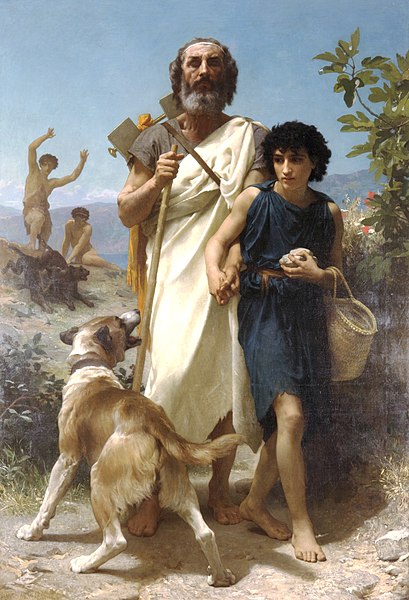



_-_Homer_and_his_Guide_(1874).jpg)