Books All Day and Night

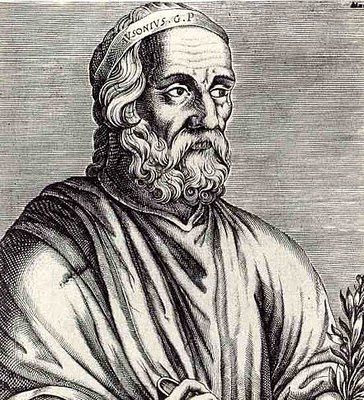
Mark Pattison, Isaac Casaubon (Sect. X)

“It is well that we should be alive to the price at which knowledge must be purchased. Day by day, night by night, from the age of twenty upwards, Casaubon is at his books. He realised Boeckh’s ideal, who has told us that in classical learning ‘dies diem docet, ut perdideris quam sine linea transmiseris.’ When he is not at his books, his mind is in them. Reading is not an amusement filling the languid pauses between the hours of action ; it is the one pursuit engrossing all the hours and the whole mind. ‘ The day, with part of the night added, is not long enough.

His life, regarded from the exterior, seems adapted to deter, rather than to invite imitation. A life of hardship, in circumstances humble, almost sordid, short of want, but pinched by poverty; Casaubon renounced action, pleasure, ease, society, health, life itself— killing himself at fifty-six. Shall we say that he did this for the sake of fame ? Fame there was, but it reached him in but faint echoes. Even what there was, was all dashed by the loud slander of the dominant ecclesiastical party, and the whispered suspicion of the vanquished. At best, the limits of such fame must always be circumscribed. To the great, the fashionable, the gay, and the busy, the grammarian is a poor pedant, and no famous man. The approbation of our fellows may be a powerful motive of conduct. It is powerful to generate devotion to their service. It is not powerful enough to sustain a life of research. No other extrinsic motive is so. The one only motive which can support the daily energy called for in the solitary student’s life, is the desire to know. Every intelligence, as such, contains a germ of curiosity. In some few this appetence is developed into a yearning, an eagerness, a passion, an exigency, an ‘inquietude poussante,’ to use an expression of Leibnitz, which dominates all others, and becomes the rule of life.”

Image result for isaac casaubon

Editing the Classics

J.E.B. Mayor, Preface to Thirteen Satires of Juvenal:

“I often think that much of the labour spent on editing the classics is wasted; at least the same amount of time might be invested to far greater profit. For example, if one of the recent editors of Persius had devoted but three weeks to the preparation of a Lexicon Persianum, he would have produced a κτῆμα ἐς ἀεί, a permanent addition to classical learning. We sorely need lexicons e.g. to Cicero (except his speeches), Varro, Livy, the two Senecas, Quintilian’s declamations, Valerius Flaccus, Silius, the Latin anthology, Macrobius, Tertullian, Augustine, Jerome; to technical authors in general, e.g. agricultural, grammatical, mathematical, medical, military, musical, rhetorical: in Greek to the early Christian literature, Diogenes Laertius, Josephus, Philo, Galen, Stobaeus, Clement of Alexandria, Origon, Chrysostom, Cyril. If every editor would choose, in addition to his author and to the books commonly read in college, one ancient author and one modern critic, as his specialty, commentaries would be far more original than they are. The universities might issue variorum editions, not on the Dutch plan, not like Halm’s Latin editions of Cicero, or Dindorf’s of Greek authors, but more concise and more comprehensive at the same time. Two or three might combine, say, to edit the commentaries on an author, as Livy, Petronius, Suetonius, or Apuleius. A commentary which takes rank as ‘classical’, e.g. Casaubon’s on Suetonius, Persius, Athenaeus, Strabo, should be given almost entire, and form the nucleus, other notes being carefully sifted, and repetitions cleared away. One colleague might he responsible for all editions of the author; while two others ransacked periodical and occasional literature, variae lectiones, adversaria cet. Madvig says, one is ashamed to be called a philologer, when one looks at the obsolete medley brought together by Moser on the Tusculans; in far narrower compass all that is valuable there, and much that is omitted, might be stored for all time. By such a process books like Rader’s Martial, now no doubt, as Prof. Friedlander says, for most of us, ‘völlig veraltet,’ would once more yield their treasures to the ordinary student; Marcile too and Harault would no longer be mere names”

Nature, Naturally

C.S. Lewis, Studies in Words (2.1) – Natura

By far the commonest native meaning of natura is something like sort, kind, quality, or character. When you ask, in our modern idiom, what something ‘is like’, you are asking for its natura. When you want to tell a man the natura of anything you describe the thing. In nineteenth-century English the word ‘description’ itself (‘I do not associate with persons of that description’) is often an exact synonym for natura. Caesar sent scouts to find out qualis esset natura montis, what the hill was like, what sort of a hill it was. Quintilian speaks of a man ingenii naturâ praestantem (XII, 1), outstanding by the quality of his mind. Cicero’s title De Natura Deorum could be translated ‘What the gods are like’.

It will be noticed that whereas Caesar wanted to know the (doubtless unique) character of a particular hill, Cicero wrote about the common character of all gods, and Horace can speak of humana natura, the character common to all men. There is a logical distinction here, but linguistically the two usages are the same. A class or species has a natura, and so has a particular or an individual.

It is not always possible, or necessary, to decide whether the idea of the species or that of the particular is uppermost. Cicero says that ‘omnis natura strives to preserve itself’. It makes little difference whether we render omnis natura ‘every class or species’ or ‘every kind (of thing)’, hence ‘a thing of whatever kind’, and hence almost ‘everything’.

Those who wish to go further back will notice that natura shares a common base with nasci (to be born); with the noun natus (birth); with natio (not only a race or nation but the name of the birth-goddess); or even that natura itself can mean the sexual organs—a sense formerly born by English nature, but apparently restricted to the female. It is risky to try to build precise semantic bridges, but there is obviously some idea of a thing’s natura as its original or ‘innate’ character.

If we look forward, the road is clear. This sense of natura, though soon to be threatened by vast semantic growths of another origin, has shown astonishing persistence and is still as current a sense as any other for English nature. Every day we speak about ‘the nature of the case’ (or of the soil, the animal, the problem).

Romans? Forgotten!

Rousseau, Confessions I:

My vocation having been determined, I was made an apprentice, not this time under a clockmaker, but with an engraver. The contempt of the clerk had greatly humbled me, and I obeyed without complaint. My master, M. Ducommun, was a rude and violent young man, who came finally, in a very short time, to tarnish the shine of my youth, and to stultify my loving and strong character, and to reduce me, as much in spirit as in fortune, to my true state of apprentice. My Latin, my antiquities, my history, all had been forgotten for some time, and I did not even remember that there were once Romans in the world.

Ma vocation ainsi déterminée, je fus mis en apprentissage, non toutefois chez un horloger, mais chez un graveur. Les dédains du greffier m’avaient extrêmement humilié, et j’obéis sans murmure. Mon maître, M. Ducommun, était un jeune homme rustre et violent, qui vint à bout, en très-peu de temps, de ternir tout l’éclat de mon enfance, d’abrutir mon caractère aimant et vif, et de me réduire, par l’esprit ainsi que par la fortune, à mon véritable état d’apprenti. Mon latin, mes antiquités, mon histoire, tout fut pour longtemps oublié ; je ne me souvenais pas même qu’il y eût eu des Romains au monde.

Ausonius Sucks?

Gore Vidal, Julian (Chp. 1):

Not long ago I sent round to the library to see what they had by Ausonius. The slave returned with a wheelbarrow full of books. Ausonius must be read to be believed! As poet, no subject is too trivial for him; as courtier, no flattery too excessive. He did write one passable nature poem on the Moselle, but I’m not keen on rivers. The rest of his work is quite marvellous in its tedium. Particularly those verses he wrote at Valentinian’s request. Among the subjects chosen by the Emperor were the source of the Danube (Ausonius did not locate it but he made a good try), Easter, and (best of all) four odes to the Emperor’s four favourite horses. I had one of these equine odes copied out and Hippia reads it to me whenever I am depressed. It begins “Oh raven steed, whose fortune it is to spread the golden thighs and Mars-like firm convexities of divine Augustus…” I don’t know when I have enjoyed a poem so much. I’ll enclose a copy. Anyway, I suggest you see Ausonius as soon as possible. And of course you will remember to express admiration for his work! In a good cause hypocrisy becomes virtue.

https://upload.wikimedia.org/wikipedia/commons/7/75/Ausonius.jpg

Translation Nation

Samuel Johnson, The Idler No. 68:

The Greeks for a time travelled into Egypt, but they translated no books from the Egyptian language; and when the Macedonians had overthrown the empire of Persia, the countries that became subject to Grecian dominion studied only the Grecian literature. The books of the conquered nations, if they had any among them, sunk into oblivion; Greece considered herself as the mistress, if not as the parent of arts, her language contained all that was supposed to be known, and, except the sacred writings of the Old Testament, I know not that the library of Alexandria adopted any thing from a foreign tongue.

The Romans confessed themselves the scholars of the Greeks, and do not appear to have expected, what has since happened, that the ignorance of succeeding ages would prefer them to their teachers. Every man, who in Rome aspired to the praise of literature, thought it necessary to learn Greek, and had no need of versions when they could study the originals. Translation, however, was not wholly neglected. Dramatick poems could be understood by the people in no language but their own, and the Romans were sometimes entertained with the tragedies of Euripides and the comedies of Menander. Other works were sometimes attempted; in an old scholiast there is mention of a Latin Iliad; and we have not wholly lost Tully’s version of the poem of Aratus; but it does not appear that any man grew eminent by interpreting another, and perhaps it was more frequent to translate for exercise or amusement, than for fame.

Dismal Despite Democritus

Laurence Sterne, A Sentimental Journey:

—The town of Abdera, notwithstanding Democritus lived there, trying all the powers of irony and laughter to reclaim it, was the vilest and most profligate town in all Thrace. What for poisons, conspiracies, and assassinations,—libels, pasquinades, and tumults, there was no going there by day—’twas worse by night.

Now, when things were at the worst, it came to pass that the Andromeda of Euripides being represented at Abdera, the whole orchestra was delighted with it: but of all the passages which delighted them, nothing operated more upon their imaginations than the tender strokes of nature which the poet had wrought up in that pathetic speech of Perseus, O Cupid, prince of gods and men! &c. Every man almost spoke pure iambics the next day, and talked of nothing but Perseus his pathetic address,—“O Cupid! prince of gods and men!”—in every street of Abdera, in every house, “O Cupid! Cupid!”—in every mouth, like the natural notes of some sweet melody which drop from it, whether it will or no,—nothing but “Cupid! Cupid! prince of gods and men!”—The fire caught—and the whole city, like the heart of one man, open’d itself to Love.

No pharmacopolist could sell one grain of hellebore,—not a single armourer had a heart to forge one instrument of death;—Friendship and Virtue met together, and kiss’d each other in the street; the golden age returned, and hung over the town of Abdera—every Abderite took his eaten pipe, and every Abderitish woman left her purple web, and chastely sat her down and listened to the song.

’Twas only in the power, says the Fragment, of the God whose empire extendeth from heaven to earth, and even to the depths of the sea, to have done this.

Always Relevant: An Iliad of Troubles

Erasmus, Adagia 226:

Ἰλιὰς κακῶν, that is, an Iliad of troubles; used when speaking of the greatest and most numerous calamities, because in Homer’s Iliad there is no type of problem which isn’t covered. For this reason, the learned think that the premises of tragedies were taken from it, just as the plots of comedies were taken from the Odyssey. It is, however, a rather wordy work, hardly finished in twenty-four volumes. Thus, they call any speech which is a little more prolix than necessary ‘longer than the Iliad,’ as Aeschines, against Demosthenes wrote, ‘Ταῦτα δὲ εἰπὼν δίδωσιν ἀναγνῶναι ψήφισμα τῷ γραμματεῖ, μακρότερον μὲν τῆς Ἰλιάδος, κενώτερον δὲ τῶν λόγων οὓς εἴωθε λέγειν’ that is, ‘with these words he gave the decision to the scribe to be read, more long-winded than the Iliad, but more empty than the words with which he usually speaks.’

Eustathius inverts the saying thus: ‘Καὶ παροιμία μέντοι κακῶν Ἰλιάδα φησίν, αὕτη δὲ καλοῦ παντὸς Ἰλιάς,’ that is, ‘the proverb says an Iliad of troubles, but this is an Iliad of everything good.’ Synesius writes in a letter to his brother, Καὶ ὅλως κακῶν ἂν Ἰλιάς περιέστη τὴν πόλιν ἡμῶν, that is, ‘in sum, an Iliad of troubles has surrounded our city.’ Plutarch, in his Conjugal Precepts, writes, ‘Ὁ δὲ ἐκείνων Ἰλιάδα κακῶν Ἕλλησι καὶ βαρβάροις ἐποίησεν,’ that is, ‘but their marriage rites brought a whole Iliad of troubles upon the Greeks and the barbarians.’ For he is talking about the wedding of Paris and Helen, which was the cause of inestimable troubles. Cicero, too, uses this expression in his letters to Atticus: ‘such a great Iliad of troubles hangs over us.’

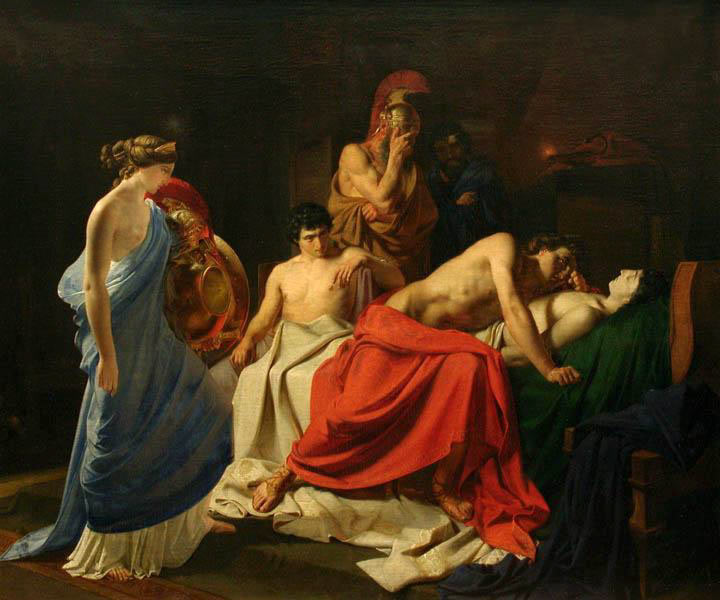
Achilles Lamenting the Death of Patroclus, by Nikolay Ge

Ἰλιὰς κακῶν, id est Ilias malorum. De calamitatibus maximis simul et plurimis. Propterea quod in Iliade Homerica nullum mali genus non recensetur. Vnde ex hac docti putant tragoediarum argumenta fuisse sumpta, sicut ex Odyssea comoediarum. Est autem opus verbosum, viginti quatuor voluminibus vix absolutum. Vnde et quamuis orationem plus satis prolixam Iliade longiorem vocant, vt Aeschines aduersus Demosthenem. Ταῦτα δὲ εἰπὼν δίδωσιν ἀναγνῶναι ψήφισμα τῷ γραμματεῖ, μακρότερον μὲν τῆς Ἰλιάδος, κενώτερον δὲ τῶν λόγων οὓς εἴωθε λέγειν, id est His dictis decretum scribae legendum tradit, prolixius quidem lliade, vanius autem verbis iis quae dicere consueuit.

Eustathius inuertit adagionem ad hunc modum: Καὶ παροιμία μέντοι κακῶν Ἰλιάδα φησίν, αὕτη δὲ καλοῦ παντὸς Ἰλιάς, id est Iliadem malorum prouerbium ait, at haec omnium bonorum llias. Synesius in epistola quadam ad fratrem: Καὶ ὅλως κακῶν ἂν Ἰλιάς περιέστη τὴν πόλιν ἡμῶν, id est In summa,  malorum Ilias circunstetit vrbem nostram. Plutarchus in Praeceptis coniugalibus: Ὁ δὲ ἐκείνων Ἰλιάδα κακῶν Ἕλλησι καὶ βαρβάροις ἐποίησεν, id est At illorum nuptiae Iliada malorum Graecis ac barbaris inuexerunt. Loquitur enim de coniugio Paridis et Helenae, quod inaestimabilium malorum fuit causa. Vtitur et M. Tullius in Epistolis ad Atticum: Tanta malorum impendet Ilias.

Greece Unforgotten

Alfred de Musset, Les Vœux stériles

O Greece, mother of the arts, land of idolatry,

Eternal home of my foolish wishes,

I was born for the time when flowers

Crowned your brow in the azure waves of the Hellespont.

I was a citizen of your ancient age.

My soul, like the bee, wanders under your porticoes.

The language of your people, Greece, can perish;

We are not able to forget the name of your mountains,

But in digging through the heart of your golden fields

Our sights come all at once to discover

Some god of your woods, some lost Venus…

The language which the heart of Phidias spoke

Will always live, always be heard.

The marbles have been mastered, and will not be forgotten.

Grèce, ô mère des arts, terre d’idolâtrie,
De mes vœux insensés éternelle patrie,
J’étais né pour ces temps où les fleurs de ton front
Couronnaient dans les mers l’azur de l’Hellespont.
Je suis un citoyen de tes siècles antiques ;
Mon âme, avec l’abeille, erre sous tes portiques.
La langue de ton peuple, ô Grèce, peut mourir.
Nous pouvons oublier le nom de tes montagnes ;
Mais qu’en fouillant le sein de tes blondes campagnes,
Nos regards tout à coup viennent à découvrir
Quelque dieu de tes bois, quelque Vénus perdue…
La langue que parlait le cœur de Phidias
Sera toujours vivante et toujours entendue ;
Les marbres l’ont apprise, et ne l’oublieront pas.

Envy, Regard, Desolation

Chateaubriand, Voyage from Paris to Jerusalem (1):

It had been one hour since nightfall when we began to consider returning to Athens. The sky shone with stars, the air with a sweetness, a clearness, and a purity which were incomparable. Our horses went with small steps, and we fell to silence. The path which we were going along was likely the ancient path of the Academy, bordered by the tombs of the citizens who died for their country and the greatest men of Greece. There lay Thrasybulus, Pericles, Chabrias, Timotheus, Harmodius, and Aristogeiton. It was a noble idea to gather in one field the ash of those famous people who lived in different ages and who, as members of one illustrious family long disperses, came finally to rest in the bosom of their communal mother. What variety of genius, of greatness, of courage! What diversity of habits and virtues one could perceive there with one glance of the eye! And these virtues tempered by death, like those noble wines which one mixes, as Plato says, with a sober divinity, do not offend the sensibilities of the living. The passerby who read on one funeral column these simple words:

Pericles, from the tribe of Acamantis, from the deme of Cholargos

felt nothing more than admiration without envy. Cicero represents to us Atticus wandering among these tombs, seized by a holy regard for these august ashes. It is no longer possible for us to make the same scene. The tombs are destroyed. The illustrious dead whom the Athenians placed by their city like outposts were not raised to defend them. They suffered the Tartars trampling them underfoot. ‘The times, violence, and the plough,’ says Chandler, ‘have leveled it all.’ The plough is too much there. And this remark which I make paints a better picture of Greece’s desolation than do the reflections which I could yield myself to.

Il y avait déjà une heure qu’il faisait nuit quand nous songeâmes à retourner à Athènes : le ciel était brillant d’étoiles, et l’air d’une douceur, d’une transparence et d’une pureté incomparables ; nos chevaux allaient au petit pas, et nous étions tombés dans le silence. Le chemin que nous parcourions était vraisemblablement l’ancien chemin de l’Académie, que bordaient les tombeaux des citoyens morts pour la patrie et ceux des plus grands hommes de la Grèce : là reposaient Thrasybule, Périclès, Chabrias, Timothée, Harmodius et Aristogiton. Ce fut une noble idée de rassembler dans un même champ la cendre de ces personnages fameux qui vécurent dans différents siècles, et qui, comme les membres d’une famille illustre longtemps dispersée, étaient venus se reposer au giron de leur mère commune. Quelle variété de génie, de grandeur et de courage ! Quelle diversité de mœurs et de vertus on apercevait là d’un coup d’œil ! Et ces vertus tempérées par la mort, comme ces vins généreux que l’on mêle, dit Platon, avec une divinité sobre, n’offusquaient plus les regards des vivants. Le passant qui lisait sur une colonne funèbre ces simples mots :

Périclès de la tribu acamantide,
du bourg de Cholargue,

n’éprouvait plus que de l’admiration sans envie. Cicéron nous représente Atticus errant au milieu de ces tombeaux et saisi d’un saint respect à la vue de ces augustes cendres. Il ne pourrait plus aujourd’hui nous faire la même peinture : les tombeaux sont détruits. Les illustres morts que les Athéniens avaient placés hors de leur ville, comme aux avant-postes, ne se sont point levés pour la défendre ; ils ont souffert que des Tartares la foulassent aux pieds. ” Le temps, la violence et la charrue, dit Chandler, ont tout nivelé. ” La charrue est de trop ici ; et cette remarque que je fais peint mieux la désolation de la Grèce que les réflexions auxquelles je pourrais me livrer.