Ennius the Press Secretary

Petrarch, Africa 9.10-31:

Ennius sat silently meditating on the deck, the constant witness to and companion in Scipio’s affairs. Scipio approached him and began in these pleasant words:

‘Will you never break your silence, o my sweet solace of my many labors? Speak, I beg you. For you can see my heart melting away from many cares. You’re accustomed to ease them with your pleasant speech. Just relax your face, loosen your expression, if highest Apollo gave you the talent which you excel in at your birth, if the crowd of the goddesses washed you as an infant submerged in the Castalian pool on sacred Helicon, led you to the high hills, and have you the pen, the voice, and the mind of a poet.’

Ennius raised his head at these words and spoke thus: ‘O young flower of Italy, certain pledge of divine offspring, why does it please you to be moved by my mouth, or why do you order me thus? Indeed, I was considering in my silent heart that no age will ever bring forth a greater work of outstanding virtue than the one which our happy age sees; no one will ever move anything great under his mind for whom an honest name does not sound among his great hopes, who will not, coming to the point, wish to recall the deeds of Scipio, who would not wish to see your face as a gift. The greater fame of the grave will remain for you after the grave, for Spite plucks away at mortal achievements. But Death consumes Envy and wards it off from the funeral busts. Your glory had already conquered this pest, and now it safely flees the ground, the diseases and malignant habits of people, through the lofty breezes, and bore itself as the equal to the gods.”
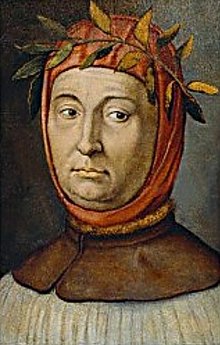
Petrarch - Wikipedia

Puppe ducis media tacitus meditansque sedebat

Ennius, assiduus rerum testisque comesque;

Scipio quem tandem aggreditur verbisque benignis

Excitat incipiens: “Nunquamne silentia rumpes,

O michi multorum solamen dulce laborum?

Fare, precor; nam perpetuis tabentia curis

Pectora nostra vides. Placido sermone levare

Illa soles; faciesque modo, tantum ora resolve,

Si tibi nascenti, quo polles, summus Apollo

Ingenium celeste dedit, si turba dearum

Castalio infantem demersum gurgite lavit

Ex Elicone sacro, collesque eduxit in altos,

Et calamum et vocem tribuit mentemque poete.”

Ennius auditis caput extulit atque ita fatur:

“O flos Italie, iuvenis, stirpisque deorum

Certa fides, quid nunc nostro placet ore moveri,

Quidve iubes? Equidem tacito modo pectore mecum

Volvebam quod nulla ferent iam secula maius

Eximie virtutis opus, quam nostra quod etas

Leta videt, nullusque unquam sub mente movebit

Grande aliquid, cui non, magnas spes inter, honestum

Nomen in ore sonet, qui non venturus ad actum

Scipiade meminisse velit, pro munere vultus

Non cupiat vidisse tuos. Maiorque sepulcri

Post cineres te fama manet. Mortalia Livor

Carpit enim; at Mors Invidiam consumit et arcet

Ac procul a bustis abigit. Tua gloria pridem

Vicerat hanc pestem, iamque altas tuta per auras

Fugit humum morbosque hominum moresque malignos,

Seque parem tulit alma deis.

How Many Gods Do You Count?

Montesquieu, Dissertation on Roman Politics in Religion (Part 14)

The political system which prevailed in the religion of the Romans developed itself more fully in their victories. If they had listened to superstition, they would have brought among the vanquished the gods of the victors; they would have overturned their temples; and, in establishing a new mode of worship, they would have imposed upon them a cruder servitude than before. Rome herself submitted to the gods of foreigners, and received them in her breast; and through this connection, the strongest which can exist among humans, she attached herself to people who regarded her more as the sanctuary of religion than as the mistress of the world.

But, in order to avoid multiplying the number of beings, the Romans, following the example of the Greeks, adroitly mixed the foreign gods among their own. If they found among their conquests a god who had some resemblance to one of those worshipped in Rome, they adopted it, as it were, in giving it the name of a Roman deity, and they accorded it, if I may use the expression, the rights of the bourgeoisie in their city. So, when they found some famous hero who had purged the land of some monster, or who subjugated some barbarous people, they gave him straightaway the name of Hercules. ‘We have pierced all the way to the Ocean,’ says Tacitus, ‘and we have found there the columns of Hercules: either because Hercules was there, or because we have attributed to this hero all of the deeds worthy of Herculean glory.’

Varro counted forty four of these defeaters of monsters; Cicero counted but six, twenty two Muses, five Suns, four Vulcans, five Mercuries, four Apollos, three Jupiters. Eusebius goes farther: he counts as many Jupiters as there were people.

The Romans, who had no other divinity than the genius of the Republic, paid no attention to the disorder and confusion which they introduced into mythology: the credulity of the people, which is always beyond ridicule and extravagance, made up for it all.

La politique qui régnait dans la religion des Romains se développa encore mieux dans leurs victoires. Si la superstition avait été écoutée, on aurait porté chez les vaincus les dieux des vainqueurs: on aurait renversé leurs temples ; et, en établissant un nouveau culte, on leur aurait imposé une servitude plus rude que la première. On fit mieux : Rome se soumit elle-même aux divinités étrangères, elle les reçut dans son sein ; et, par ce lien, le plus fort qui soit parmi les hommes, elle s’attacha des peuples qui la regardèrent plutôt comme le sanctuaire de la religion que comme la maîtresse du monde.

Mais, pour ne point multiplier les êtres, les Romains, à l’exemple des Grecs, confondirent adroitement les divinités étrangères avec les leurs : s’ils trouvaient dans leurs conquêtes un dieu qui eût du rapport à quelqu’un de ceux qu’on adorait à Rome, ils l’adoptaient, pour ainsi dire, en lui donnant le nom de la divinité romaine, et lui accordaient, si j’ose me servir de cette expression, le droit de bourgeoisie dans leur ville. Ainsi, lorsqu’ils trouvaient quelque héros fameux qui eût purgé la terre de quelque monstre, ou soumis quelque peuple barbare, ils lui donnaient aussitôt le nom d’Hercule. « Nous avons percé jusqu’à l’Océan, dit Tacite, et nous y avons trouvé les colonnes d’Hercule ; soit qu’Hercule y ait été, soit que nous ayons attribué à ce héros tous les faits dignes de sa gloire. »

Varron a compté quarante-quatre de ces dompteurs de monstres ; Cicéron n’en a compté que six, vingt-deux Muses, cinq Soleils, quatre Vulcains, cinq Mercures, quatre Apollons, trois Jupiters. Eusèbe va plus loin: il compte presque autant de Jupiters que de peuples.

Les Romains, qui n’avaient proprement d’autre divinité que le génie de la république, ne faisaient point d’attention au désordre et à la confusion qu’ils jetaient dans la mythologie : la crédulité des peuples, qui est toujours au-dessus du ridicule et de l’extravagant, réparait tout.

More Cyrenaic Wisdom

Diogenes Laertius, Lives of the Philosophers – Aristippus (70)

“When someone proposed a riddle to Aristippus and asked him to solve it, Aristippus responded, ‘You idle fool, you want this solved, even though it offers us plenty of trouble in its unsolved state?’

He said that it was better to be a beggar than to be uneducated, for a beggar is lacking money, but the uneducated person is lacking humanity.

One time, when upbraided, he ran away. When someone pursued him, asking why he fled, he responded, ‘Because you have the power of talking trash, and I have the power of not listening.’

When someone said that he always saw philosophers at the doorways of the rich, Aristippus replied, ‘So too you always find doctors at the doorways of the sick. But one would not on that account choose rather to be sick than to be a doctor.”

Aristippus

Αἴνιγμά τινος αὐτῷ προτείναντος καὶ εἰπόντος, “λῦσον,” “τί, ὦ μάταιε,” ἔφη, “λῦσαι θέλεις ὃ καὶ δεδεμένον ἡμῖν πράγματα παρέχει;” ἄμεινον ἔφη ἐπαιτεῖν ἢ ἀπαίδευτον εἶναι· οἱ μὲν γὰρ χρημάτων, οἱ δ’ ἀνθρωπισμοῦ δέονται. λοιδορούμενός ποτε ἀνεχώρει· τοῦ δ’ ἐπιδιώκοντος εἰπόντος, “τί φεύγεις;”, “ὅτι,” φησί, “τοῦ μὲν κακῶς λέγειν σὺ τὴν ἐξουσίαν ἔχεις, τοῦ δὲ μὴ ἀκούειν ἐγώ.” εἰπόντος τινὸς ὡς ἀεὶ τοὺς φιλοσόφους βλέποι παρὰ ταῖς τῶν πλουσίων θύραις, “καὶ γὰρ οἱ ἰατροί,” φησί, “παρὰ ταῖς τῶν νοσούντων· ἀλλ’ οὐ παρὰ τοῦτό τις ἂν ἕλοιτο νοσεῖν ἢ ἰατρεύειν.”

Forgetting the Classics

Thomas Arnold, Rugby School – Use of the Classics

Now when it is said, that men in manhood so often throw their Greek and Latin aside, and that this very fact shows the uselessness of their early studies, it is much more true to say that it shows how completely the literature of Greece and Rome would be forgotten, if our system of education did not keep up the knowledge of it. But it by no means shows that system to be useless, unless it followed that when a man laid aside his Greek and Latin books, he forgot also all that he had ever gained from them. This, however, is so far from being the case, that even where the results of a classical education are least tangible, and least appreciated even by the individual himself, still the mind often retains much of the effect of its early studies in the general liberality of its tastes and comparative comprehensiveness of its views and
notions.

All this supposes, indeed, that classical instruction should be sensibly conducted; it requires that a classical teacher should be fully acquainted with modern history and modern literature, no less than with those of Greece and Rome. What is, or perhaps what used to be, called a mere scholar, cannot possibly communicate to his pupils the main advantages of a classical education. The knowledge of the past is valuable, because without it our knowledge of the present and of the future must be scanty; but if the knowledge of the past be confined wholly to itself, if, instead of being made to bear upon things around us, it be totally isolated from them, and so disguised by vagueness and misapprehension as to appear incapable of illustrating them, then indeed it becomes little better than laborious trifling, and they who declaim against it may be fully forgiven.

Ambition Reduces Me to Nullity

Arthur Stanley, The Life of Thomas Arnold:

Whatever may have been the exact notions of his future course which presented themselves to him, it is evident that he was not insensible to the attraction of visions of extensive influence, and almost to his latest hour he seems to have been conscious of the existence of the temptation within him, and of the necessity of contending against it. “I believe,” he said many years afterwards, in speaking of these early struggles to a Rugby pupil who was consulting him on the choice of a profession, — “I believe that, naturally, I am one of the most ambitious men alive,” and “the three great objects of human ambition,” he added, to which alone he could look as deserving the name, were ” to be the Prime-Minister of a great kingdom, the governor of a great empire, or the writer of works which should live in every age and in every country.” But in some respects the loftiness of his aims made it a matter of less difficulty to confine himself at once to a sphere in which, whilst he felt himself well and usefully employed, he felt also that the practical business of his daily duties acted as a check upon his own inclinations and speculations. Accordingly, when he entered upon his work at Laleham he seems to have regarded it as his work for life. “I have always thought,” he writes in 1823, “with regard to ambition, that I should like to be aut Caesar aut nullus [“either Caesar or a nobody”], and as it is pretty well settled for me that I shall not be Caesar, I am quite content to live in peace as nullus.”

Thomas Arnold by Thomas Phillips.jpg

A War of Deliberation

Montesquieu, Dissertation on Politics in Roman Religion (Part 14)

The Romans had this advantage, that they had as a legislator the most sage prince that profane history has ever spoken of. This great man sought nothing in his entire reign but that justice and equity should flourish, and he made it so that his moderation was felt no less by his neighbors than by his subjects. He established the Fetials, who were priests without whose ministry the Romans could make neither peace nor war. In the peace which Rome concluded with Alba Longa, a Fetial says in Livy, ‘If the Roman people be the first to depart from this treaty, whether from the public counsel or an evil trick, it prays that Jupiter will strike it just as it will strike the pig which it holds in its hands.’ And the priest straightaway slaughtered the pig with the strike of a stone.

Before beginning a war, the Romans sent one of these Fetials to make their complaints to the people who had inflicted some injury on the Republic. He gave them some time for consultation and for looking for the means of reestablishing good terms; but if they neglected this accommodation, the Fetial turned around and departed from this unjust people after having invoked against them both the celestial and the infernal gods. At that time, the senate ordained that which it believed just and pious. Thus, wars were never undertaken in haste, and they could not occur except as a sequel to a long and mature deliberation.

Les Romains avaient cet avantage, qu’ils avaient pour législateur le plus sage prince dont l’histoire profane ait jamais parlé: ce grand homme ne chercha pendant tout son règne qu’à faire fleurir la justice et l’équité, et il ne fit pas moins sentir sa modération à ses voisins qu’à ses sujets. Il établit les fécialiens, qui étaient des prêtres sans le ministère desquels on ne pouvait faire ni la paix ni la guerre. Nous avons encore des formulaires de serments faits par ces fécialiens quand on concluait la paix avec quelque peuple. Dans celle que Rome conclut avec Albe, un fécialien dit dans Tite-Live: « Si le peuple romain est le premier à s’en départir, publico consilio dolove malo, qu’il prie Jupiter de le frapper comme il va frapper le cochon qu’il tenait dans ses mains ; » et aussitôt il l’abattit d’un coup de caillou.

Avant de commencer la guerre, on envoyait un de ces fécialiens faire ses plaintes au peuple qui avait porté quelque dommage à la république. Il lui donnait un certain temps pour se consulter, et pour chercher les moyens de rétablir la bonne intelligence ; mais, si on négligeait de faire l’accommodement, le fécialien s’en retournait et sortait des terres de ce peuple injuste, après avoir invoqué contre lui les dieux célestes et ceux des enfers : pour lors le sénat ordonnait ce qu’il croyait juste et pieux. Ainsi les guerres ne s’entreprenaient jamais à la hâte, et elles ne pouvaient être qu’une suite d’une longue et mûre délibération.

Roman Royal Remnants

Montesquieu, Dissertation on Politics in Roman Religion (Part 13)

The duumvirs had the direction of sacred affairs: the quindecemvirs had the care of the religious ceremonies and preserved the Sibylline Books, which the decemvirs and the duumvirs did before them. The consulted the oracles when the senate ordered it, and they made reports on them, adding their opinions. They were also commissioned to perform what was prescribed in the Sibylline Books, and to make sure that the Secular Games were celebrated, so that all religious ceremonies passed through the hands of the magistrates.

The kings of Rome had a sort of priesthood: there were certain ceremonies which could not be performed except by them. When the Tarquins were expelled, it was feared that the people might perceive some change in the religion. So there was established a magistrate called the rex sacrorum, who performed the functions of the ancient kings in sacrifices, and whose wife was called the regina sacrorum. This was the only vestige of royalty which the Romans preserved among them.

Botticelli, The Story of Lucretia

Les duumvirs avaient la direction des choses sacrées ; les quindécemvirs avaient soin des cérémonies de la religion, gardaient les livres des sibylles ; ce que faisaient auparavant les décemvirs et les duumvirs. Ils consultaient les oracles lorsque le sénat l’avait ordonné, et en faisaient le rapport, y ajoutant leur avis ; ils étaient aussi commis pour exécuter tout ce qui était prescrit dans les livres des sibylles, et pour faire célébrer les jeux séculaires : de manière que toutes les cérémonies religieuses passaient par les mains des magistrats.

Les rois de Rome avaient une espèce de sacerdoce : il y avait de certaines cérémonies qui ne pouvaient être faites que par eux. Lorsque les Tarquins furent chassés, on craignait que le peuple ne s’aperçût de quelque changement dans la religion ; cela fit établir un magistrat appelé rex sacrorum, qui, dans les sacrifices, faisait les fonctions des anciens rois, et dont la femme était appelée regina sacrorum. Ce fut le seul vestige de royauté que les Romains conservèrent parmi eux.

The Old Debate on Church & State

Montesquieu, Dissertation on Politics in Roman Religion (Part 12)

Among the Egyptians, the priests formed a separate body, which was maintained at the public expense. From this sprang many disadvantages. All of the riches of the state were found to be swallowed up in a society of people who, always receiving and never providing, insensibly drew everything to themselves. The priests of Egypt, being thus likely to do nothing, all languished in an idleness from which they never departed except with the vices which it produced. They were disorganized, disturbed, and excessively forward; these qualities made them extremely dangerous. Finally, a body whose interests were violently separated from those of the state was a monster. And those who established it tossed into society the seed of discord and civil wars. It was not the same in Rome, where the priesthood had a civil charge. The dignities of the augurs, of the pontifex Maximus, were those of magistracies; those who took them on were members of the senate, and as a consequence, they did not have interests differing from those of the senatorial body. Far from preserving the superstition for oppressing the republic, they employed it usefully to sustain it. ‘In our city,’ says Cicero, ‘the kings and the magistrates who succeeded them have always had a double character, and have governed the state under the auspices of religion.’

Chez les Égyptiens, les prêtres faisaient un corps à part, qui était entretenu aux dépens du public ; de là naissaient plusieurs inconvénients : toutes les richesses de l’État se trouvaient englouties dans une société de gens qui, recevant toujours et ne rendant jamais, attiraient insensiblement tout à eux. Les prêtres d’Égypte, ainsi gagés pour ne rien faire, languissaient tous dans une oisiveté dont ils ne sortaient qu’avec les vices qu’elle produit : ils étaient brouillons, inquiets, entreprenants ; et ces qualités les rendaient extrêmement dangereux. Enfin, un corps dont les intérêts avaient été violemment séparés de ceux de l’État était un monstre ; et ceux qui l’avaient établi avaient jeté dans la société une semence de discorde et de guerres civiles. Il n’en était pas de même à Rome : on y avait fait de la prêtrise une charge civile ; les dignités d’augure, de grand pontife, étaient des magistratures : ceux qui en étaient revêtus étaient membres du sénat, et par conséquent n’avaient pas des intérêts différents de ceux de ce corps. Bien loin de se servir de la superstition pour opprimer la république, ils l’employaient utilement à la soutenir. « Dans notre ville, dit Cicéron, les rois et les magistrats qui leur ont succédé ont toujours eu un double caractère, et ont gouverné l’État sous les auspices de la religion. »

Notes on Roman Ignorance

It is true that the Egyptian religion was always proscribed in Rome. That is because it was intolerant, and wanted to reign alone while establishing itself among the ruins of the others, in the way that the spirit of mildness and peace which ruled among the Romans was the real cause of the war which they made without a break. The senate decreed that the temples of the Egyptian divinities be torn down, and Valerius Maximus reports on this subject that Aemilius Paulus delivered the first blows, in order to encourage by his own example the working classes thunderstruck by superstitious fear.

But the priests of Serapis and Isis had in turn more zeal for establishing these ceremonies which were not held in Rome due to their proscription. Although Augustus, according to Dio, defended their practice in Rome, Agrippa, who governed the city in his absence, was obliged to defend it a second time. One can see in Tacitus and Suetonius the frequent stops which the senate was obliged to make to ban this worship from Rome.

It is necessary to note that the Romans confounded the Jews with the Egyptians, as we know that they confused the Christians with the Jews. These two religions were long regarded as two offshoots of the first, and took part with it in the hate, the contempt, and the persecution of the Romans. The same stops which abolished from Rome the Egyptian ceremonies always set the Jewish ceremonies with them, as it appears from Tacitus and Suetonius in the lives of Tiberius and Claudius. It is also clear that the historians never distinguished the worship of the Christians from that of the others. They had not come away from their error from the time of Hadrian, as it appears from a letter which that emperor wrote from Egypt to the consul Servianus: ‘All those who worship Serapis in Egypt are Christians, and all those who are called bishops are likewise attached to the worship of Serapis. There is no Jew, no prince of the synagogue, no samaritan, no priest of the Christians, no mathematician, no divine, no bather, who does not worship Serapis. The patriarch of the Jews himself worships Serapis and Christ with no distinction. These people have no other god than Serapis – that is, the God of the Christians, the Jews, and all people.’ Could one have any more confused ideas about these three religions, or could one mix them up more rudely?

Il est vrai que la religion égyptienne fut toujours proscrite à Rome : c’est qu’elle était intolérante, qu’elle voulait régner seule, et s’établir sur les débris des autres ; de manière que l’esprit de douceur et de paix qui régnait chez les Romains fut la véritable cause de la guerre qu’ils lui firent sans relâche. Le sénat ordonna d’abattre les temples des divinités égyptiennes ; et Valère Maxime rapporte, à ce sujet, qu’Émilius Paulus donna les premiers coups, afin d’encourager par son exemple les ouvriers frappés d’une crainte superstitieuse.

Mais les prêtres de Sérapis et d’Isis avaient encore plus de zèle pour établir ces cérémonies qu’on n’en avait à Rome pour les proscrire. Quoique Auguste, au rapport de Dion, en eût défendu l’exercice dans Rome, Agrippa, qui commandait dans la ville en son absence, fut obligé de le défendre une seconde fois. On peut voir, dans Tacite et dans Suétone, les fréquents arrêts que le sénat fut obligé de rendre pour bannir ce culte de Rome.

Il faut remarquer que les Romains confondirent les Juifs avec les Égyptiens, comme on sait qu’ils confondirent les chrétiens avec les juifs : ces deux religions furent longtemps regardées comme deux branches de la première, et partagèrent avec elle la haine, le mépris et la persécution des Romains. Les mêmes arrêts qui abolirent à Rome les cérémonies égyptiennes mettent toujours les cérémonies juives avec celles-ci, comme il parait par Tacite et par Suétone, dans les vies de Tibère et de Claude. Il est encore plus clair que les historiens n’ont jamais distingué le culte des chrétiens d’avec les autres. On n’était pas même revenu de cette erreur du temps d’Adrien comme il paraît par une lettre que cet empereur écrivit d’Égypte au consul Servianus: « Tous ceux qui, en Égypte, adorent Sérapis, sont chrétiens, et ceux même qu’on appelle évêques sont attachés au culte de Sérapis. Il n’y a point de juif, de prince de synagogue, de samaritain, de prêtre des chrétiens, de mathématicien, de devin, de baigneur, qui n’adore Sérapis. Le patriarche même des juifs adore indifféremment Sérapis et le Christ. Ces gens n’ont d’autre dieu que Sérapis ; c’est le dieu des chrétiens, des juifs et de tous les peuples. » Peut-on avoir des idées plus confuses de ces trois religions, et les confondre plus grossièrement ?

Mind Bending Poetry

Cristoforo Landino, Preface to Vergil in a Florentine Gymnasium (Part 5)

But, in order to finally return from such distant regions to Italy and Latium specifically, we should in no way think, my lords, that before Livy who (as Cicero has it) in the 410th year after the foundation of the republic first published the story that there was no poet among the Latins, when Marcus Cato in his Origins wrote that it was the most ancient custom for the notable deeds of excellent men to be sung to the tibia at dinner parties. Livy however, the truest historian of all, related that song was established in sacred ceremonies by Numa Pompilius. But I think that it has now been demonstrated by the most obvious arguments that there was no type of writers by which the poets were surpassed in antiquity.

But now, lest anything which we proposed be omitted, consider in the briefest account how much utility and pleasantness they offer both publicly and privately. But, since amidst such an abundance of material it is far more difficult to find the end than the beginning, I cannot find what I should say first, and what later. But in order to begin from that eloquence by whose strength nearly everything is ruled and which is rightly called “mind-bending”, who could be found with such a dull mind, that he doesn’t see how much spirit, how much splendor, how much dignity the poet offers to the orator? Who is ignorant of how sublime they are in the greatest matters, how moderated in the middling ones, how elegant in trifles? Let their exordia be attended to, let their narrations be read, their divisions be numbered, let their affirmations and refutations be weighed out carefully, and finally let their conclusions and epilogues not be passed over: you will understand, surely, that nothing could be found more accommodated to fostering good will, nothing more brief or clear for the purpose of narrating, nothing more indissoluble for division, nothing weightier in proof nor more forceful in refutation, nothing finally more abundant or ornate for delivering a conclusion. But all of these things pertain to oratorical arguments. Who handled philosophy itself more splendidly? Not only do poets select diverse passages from it and adorn them with a certain wondrous sweetness, but they even encompassed the whole business most totally, as we see among the Greeks Pittacus of Mytilene, Xenophanes, Parmenides, Empedocles, and many others from the family of the Pythagoreans; and among the Latins Lucretius, and Marcus Varro, whom Jerome called the most learned of all the Romans.

Sed ut quandoque ex tam longinquis regionibus in Italiam Latiumque redeamus, nullo pacto existimandum est, domini viri, ante Livium illum qui, ut est apud Ciceronem, decimo et quadringentesimo post conditam urbem anno primus fabulam edidit, nullum apud Latinos poetam fuisse, cum M. Cato in suis Originibus scriptum reliquerit vetustissimam fuisse consuetudinem, ut in conviviis egregia excellentium virorum facta ad tibiam canerentur. Livius autem, historicus omnium verissimus, a Numa Pompilio carmen in sacris cerimoniis institutum refert. Sed iam nullum esse scriptorum genus, a quo poetae antiquitate superentur, manifestissimis argumentationibus demonstratum esse arbitror.

Nunc vero, ne quid ex iis quae a nobis proposita sunt omittatur, quantum illi utilitatis, quantum etiam iocunditatis publice privatimque afferant, brevissimis accipite. Verum, quoniam in tanta rerum copia multo difficilius est finem quam initium invenire, quid prius, quid posterius dicam non reperio. Sed ut ab ea, cuius vi pene omnia reguntur quaeque iure «flexianima» appellata est, eloquentia exordiar, quis adeo hebeti erit ingenio, ut quantum spiritus, quantum splendoris, quantum dignitatis oratori poeta afferat non viderit? Quis quantum illi in maximis rebus sublimes, in mediocribus temperati, in humilibus elegantes sint ignoraverit? Attendantur exordia, legantur narrationes, enumerentur divisiones, pendantur diligentius confirmationes et confutationes, denique conclusiones epilogique non praetereantur: intelligetis profecto neque ad captandam benivolentiam accomodatius neque ad narrandum brevius et apertius neque ad dividendum absolutius neque ad confirmandum gravius neque ad confutandum vehementius neque postremo ad concludendum copiosius ornatiusque quicquam inveniri. Sed haec ad oratorias argumentationes pertinent. Philosophiam vero ipsam quis splendidius tractavit? Neque enim solum diversos ex ea locos decerpunt atque mira quadam suavitate condiunt poetae, verum etiam totam rem absolutissime perscripserunt, quemadmodum apud Graecos Pittacum Mytilenaeum, Xenophanem, Parmenidem, Empedoclem et plerosque alios ex Pythagoreorum familia, apud vero Latinos Lucretium et quem Romanorum omnium doctissimum Hieronymus appellavit M. Varronem videmus.