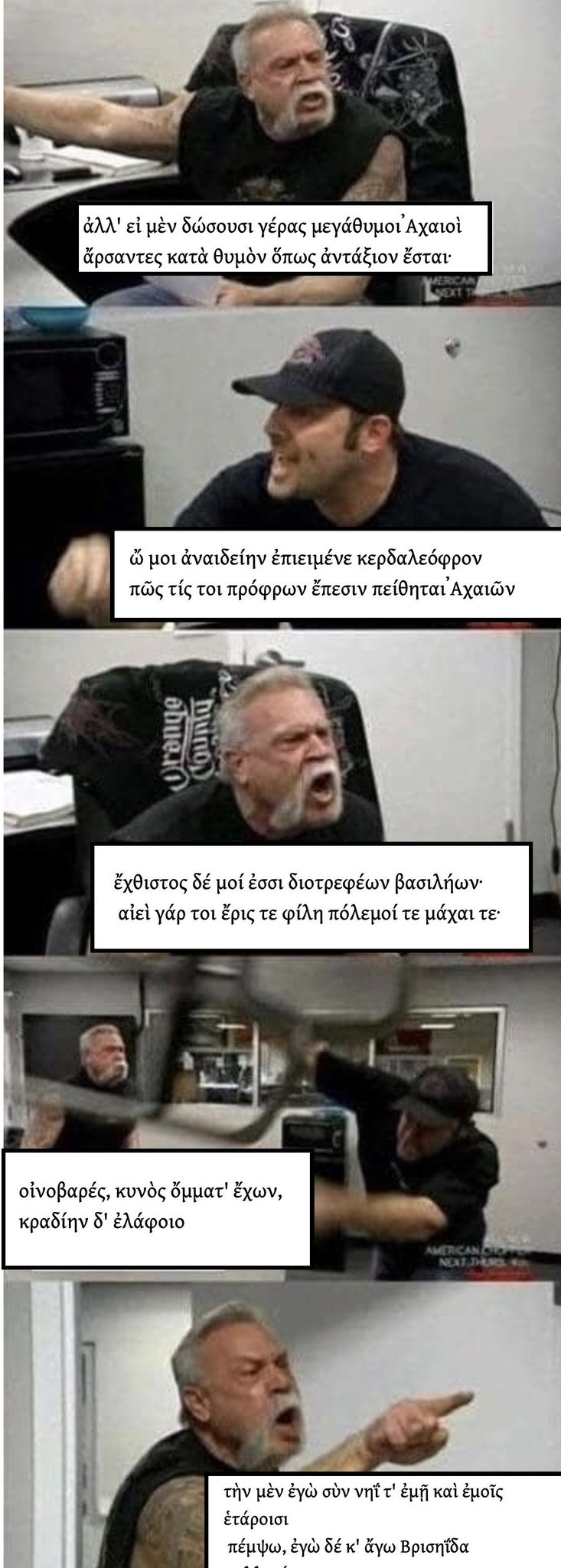
“That famous lord of the Achaeans, Agamemnon
Will make me a wife harder to handle than Helen:
I will kill him. I will destroy his home
And take vengeance for my brothers and father…”
“Listen how it is with Hektor’s mournful tale:
He died, leaving a reputation as the best man.
The coming of the Greeks made this happen.
If they had stayed home, his value would have stayed hidden.”
“Narratives ought to prefer likely events, even if impossible, to improbable possible ones. Stories should not be made from illogical parts: in the best case, they should contain nothing illogical, unless it comes from outside the plot itself as when Oedipus is not aware how Laios died, instead of in the play itself, as when they report the events at Delphi in the Elektra or when the silent man comes from Tegea to Mysia in the Mysians. To say that otherwise the plot would be wrecked is ridiculous—it isn’t right to set up these sorts of events from the beginning.
If a poet does this, and there is a more logical option available, it is strange. Even those illogical events in the Odyssey when Odysseus is put ashore [asleep by the Phaeacians] would have been manifestly intolerable if a lesser poet had created it. In the poem now, Homer softens and erases the strangeness with his other good traits.”
“Clearly, the resolution of the plots should come from the plot itself and not, as in the Medea, from some divine contrivance or as in the Iliad during the rush to the ships (Il. 2.155). The divine device should instead be used for events that are outside the drama either for those that come before what people could know or those that come later which require prophecy and revelation—since we allow that the gods may see everything. There should be nothing illogical in the events, unless it comes from outside the tragedy itself as in Sophocles’ Oedipus.”
“Narratives ought to prefer likely events, even if impossible, to improbable possible ones. Stories should not be made from illogical parts: in the best case, they should contain nothing illogical, unless it comes from outside the plot itself as when Oedipus is not aware how Laios died, instead of in the play itself, as when they report the events at Delphi in the Elektra or when the silent man comes from Tegea to Mysia in the Mysians. To say that otherwise the plot would be wrecked is ridiculous—it isn’t right to set up these sorts of events from the beginning. If a poet does this, and there is a more logical option available, it is strange. Even those illogical events in the Odyssey when Odysseus is put ashore [asleep by the Phaeacians] would have been manifestly intolerable if a lesser poet had created it. In the poem now, Homer softens and erases the strangeness with his other good traits.”
“Nireus who was the most beautiful man who came to Troy
Of the rest of the Danaans, after Peleus’ blameless son.
But he was weak and a small army followed him.”
<Lemma> his beauty in reputation was not of a kind with his family; Achilles, however, was adorned in both ways. Because [the poet] was a philhellene, he was trying to make everyone worthy of memory and used to praise everyone as far as he might be believed and so that we might imagine the Greeks to be differentiated in their manliness, or their body, or their beauty.”
“Diplai have been applied to question these three lines because Zenodotus athetized two of them, although he did not mark the middle one, (674) because Homer always strove to have Achilles stand out far in front of the rest.”
“And because of that, Homer mentioned [Nireus] only once and in the Catalog Of Ships, as it seems to me, to make a demonstration of the uselessness of the most beautiful men, when they have none of the other things that are useful for life.”
“I also see, Ion, and I am about to show you what I think this means. For talking well about Homer is not some skill within you—as I was just saying—but it is a divine power that moves you, just as in that stone which Euripides calls a ‘Magnet” but which most people call Herakleian. For this stone not only moves iron rings but it also imbues the rings with the same power so that they can do the same thing as the stone in turn—they move other rings and as a result there is a great chain of iron and rings connected to each other. But the power from that stone runs through them all. In this way, the Muse herself makes people inspired, and a linked chain of inspired people extend from her.
All the good poets of epic utter those beautiful poems not because of skill but because they are inspired and possessed—the good lyric poets are the same, just as the Korybantes do not dance when they are in their right minds, so too the lyric poets do not compose their fine lines when they are sensible, but when they embark upon their harmony and rhythm, they are in revelry and possessed. They are just like the bacchants who draw honey and milk from rivers when they are possessed, not when they are in their normal state of mind. The soul of the lyric poets does this too, which they themselves admit: for they claim, as I see it, that they bring to us their songs by gathering from the honey-flowing springs from certain gardens and glades of the Muses like bees—and they fly too!
And they speak the truth. For a poet is an empty thing—winged, and sacred and not capable of composing before it is inspired and out of mind, when thought is no longer inside. Until one has gained this state, every person is incapable of composing or giving oracles. Because they compose not by skill—when they say many fine things about their subjects—but by divine dispensation, as you do about Homer, each is only capable of composing well in the arena where the Musa compels—one person composes dithyramb, one encomia, another dance songs, another epic and another iambic poetry. But each is useless in the other genres.”
“Do you understand that the audience is the last of the rings which I was describing as transmitting through one another the power from the Herakleian stone and that you are the middle as the rhapsode and interpreter—that the poet himself is the first ring? The god moves the soul of all of these people wherever he wants, stringing the power from one into another.”
“So she spoke, and his longing for mourning swelled within him—
He wept holding the wife fit to his heart, a woman who knew careful thoughts.
As when the land appears welcome to men as the swim
Whose well-made ship Poseidon has dashed apart on the sea,
As it is driven by the wind and a striking wave.
Then few men flee from the grey sea to the shore
As they swim and the bodies are covered with brine on their skin,
They happily climb on the shore, escaping evil.
So welcome a sight was her husband to her as she looked upon him
And she would not pull her white arms away from his neck.”
This simile is exceptional because it starts out making us think that it is about Odysseus but then shifts during its telling to be about Penelope’s reaction.
St Omer Psalter, England (Norfolk), c. 1330-c. 1440, Yates Thompson MS 14, f. 70v
Xenarchus’ Porphyra fr. 7 (preserved in Athenaeus’ Deipnosophists, 6. 224-225)
“Poets are ridiculous. They never invent
anything new—each one of them simply
remixes the same things again and again.
But there is no race more creative or profane
than the fish-sellers!
Since it is no longer permitted to them to dampen
Their fish, a practice forbidden by the law,
When some man completely hateful to the gods
Saw that his fish were drying, well,
He started a brawl among them quite intentionally
There were punches; he acted as if he were hit hard,
Fell to the ground pretending to pass out lying
Among his fish. Someone shouted “water, water”!
And a different guy grabbed a pitcher and poured it out—
A little on the man, but the rest on the fish!
You would have claimed they’d just been caught!”
“After he was brought to the Troad, he set up camp in the shrine of Aphrodite. Once he fell asleep at night, he dreamed he say that goddess standing over him and speaking: “Why are you sleeping, great-hearted lion? The fawns are near [for you]”.
After he woke up and called his friends, he explained the dream while it was still night. And then there were some men from Troy who were announcing that thirteen of the king’s ships had been seen sailing near the harbor of the Achaeans going toward Lemnos. Lucuss then went out immediately and captured them and killed their general Isodorus, and then he was sailing after the other captains.
I received an email about this passage from a friend (Aaron Beek) who was wondering where this line came from. Plutarch is famous for his quotation of other ancient others. His Lives are filled with figures who quote constantly; his own essays in the Moralia sometimes seem to be mere thin pretext for the assemblage of ancient sententiae. So, it is more than reasonable to imagine that when he places Lucullus near Troy and has that Trojan-loving Aphrodite speak in a dream, she might speak a line from a Trojan tale of Old.
The problem Aaron and I face that this line seems to have no attestation beyond this scene. The Suda lists this line twice (s.v. Κνώσσω and Λούκουλλος) and it appears in the Oracular Appendix of the Greek Anthology (231). All three appearances undoubtedly have Plutarch as the source. But what was Plutarch’s source? Rather than keeping this question to ourselves, we are bringing it to the world….
Others may contemplate the content of this line and how it might pertain to some moment in the Trojan War narrative (Aaron has suggested that it might work as something said by Aphrodite to Hektor when the Greeks first appear which would be a cool intertext). Since I am a Homeric philologist by training, I need to start by looking at the language.
The thing the strikes me first about this is the epithet. It shows up twice in the Iliad when Glaukos and Asteropaios respond to Diomedes and Achilles (respectively: 6.145, 21.153). Indeed, the epithet is rather popular after Homer too. Here are the lines with the vocative:
There are other aspects of this line, however, which make me doubt an Archaic or even classical origin. The first is the meter. Here’s how to get six feet (Unless I have missed something here)* Τί κνώ / σσεις ‖ μεγά / θυμε λέ /ον; νεβ / ροὶ δε τοι / ἐγγύς. The adverb ἐγγύς can end the line in Homer, but the combination δε τοι as part of the fifth foot is just dreadful. We do have this combination, however much I hate it. (e.g. Il. 7.48Q ἦ ῥά νύ μοί τι πίθοιο, κασίγνητος δέ τοί εἰμι·cf. 8.104: ἠπεδανὸς δέ νύ τοι θεράπων, βραδέες δέ τοι ἵπποι.)
A second problem for me is the verb κνώσσω, which is highly defective and does not seem to appear much in hexameter (although it appears twice in Pindar [κνώσσοντί, Ol. 13.72; κνώσσων, Pyth. 1.9] and once in Epic. Adesp.[ 2.34: εὖτε νέους κνώσσοντας̣ [ἐποτρύνειε κατ’ αὖλιν]]).
Here’s Beekes on the verb:
Other brief observations: heroes are called lion-hearted in early poetry (in the Iliad: Agenor, Hektor, Achilles and Epeios):, but lions are not really called “great hearted”. To me, this looks like later “paint-by-number” versification: so, the work of a literate writer imitating oral composition rather than a genuinely early line. To add to this–the address “great-hearted lion, there are fawns…” is the use of a metaphor in a way we don’t really find in early epic. There are lots of antecedents in similes etc, but this device seems more Hellenistic. I don’t think I would claim that Plutarch composed this–the fact that he does not provide a source implies that (1) it is so well known that he does not need to or (2) there isn’t one and Plutarch is presenting this as the oracular content of a dream (or it is in fact part of a tradition handed down in the annals of Lucullus).
So, just to recap: to me, this line seems post-classical because of its meter, its address of the figure as a lion, and its diction. That said: my sense is based on privileging the Homeric epics we have (which are Ionian and then standardized a bit to Attic). Other localized traditions might have slightly different vocabulary and conventions. So, if for example, this line did come from the Cypria, it might indeed exhibit different qualities.
Any other ideas?
Some responses from twitter below. My impression of this being post-classical is, as I suspected, a bit warped by my strict focus to Homer. The passage might be typical of oracle speech. In this case, it might not then hail from a Trojan War narrative, unless of course it comes from a section of the narrative that draws on oracular language
Have a look at Iliad 16.485-90 for a stout-hearted bull.
If indeed the verse is post-classical (but none of the good versifiers would admit to it; even the so-so versifiers are capable of 'better') I think that one of the Oracular writers would be capable of releasing that into the wild.
“Clearly, the resolution of the plots should come from the plot itself and not, as in the Medea, from some divine contrivance or as in the Iliad during the rush to the ships (Il. 2.155). The divine device should instead be used for events that are outside the drama either for those that come before what people could know or those that come later which require prophecy and revelation—since we allow that the gods may see everything. There should be nothing illogical in the events, unless it comes from outside the tragedy itself as in Sophocles’ Oedipus.”
“Narratives ought to prefer likely events, even if impossible, to improbable possible ones. Stories should not be made from illogical parts: in the best case, they should contain nothing illogical, unless it comes from outside the plot itself as when Oedipus is not aware how Laios died, instead of in the play itself, as when they report the events at Delphi in the Elektra or when the silent man comes from Tegea to Mysia in the Mysians. To say that otherwise the plot would be wrecked is ridiculous—it isn’t right to set up these sorts of events from the beginning. If a poet does this, and there is a more logical option available, it is strange. Even those illogical events in the Odyssey when Odysseus is put ashore [asleep by the Phaeacians] would have been manifestly intolerable if a lesser poet had created it. In the poem now, Homer softens and erases the strangeness with his other good traits.”
“[Eratosthenes] said that the poet arranges everything for delighting the mind and not for education. Quite the opposite—ancients used to say that poetry was the first philosophy which integrates us into life from youth and teaches our characters, informs our experiences, and our actions in a pleasurable way.
The scholars of our day claim that the poet is the only wise person. For this reason too, the cities of Greece educate their children at the earliest stages through poetry, not only of course for the sake of entertaining them, but for nurturing wisdom as well. Indeed, for this reason too, music teachers who instruct those who play strings, lyre, and pipes help to shape their character. For these teachers say that they are also reformers of their ways. It is not only common to hear Pythagoreans making such claims, but even Aristoxenos asserts this, and Homer said that the singers were the wisest people of his day.”