“Whenever you also consider the amazing and the disturbing, you amplify the pleasure which is a magic charm for learning. In the early years, we must use this sort of thing to entice children, but as their age increases we must lead them to a knowledge of reality as soon as their perception has gotten stronger and they no longer need much cajoling. Every illiterate and ignorant person is in some way a child and loves stories like a child. The one who has been only partially educated is similar, for he does not abound in the ability to reason and, in addition, his childish custom persists. Since not only frightening but also disturbing tales bring pleasure, we need to use both of these kinds of tales for children and those who are grown up too. For children, we provide pleasing fictions to encourage them and frightening tales to deter them.”
When he arrives in Odysseus’ household, the seer Theoklymenos gets a little judgy:
Homer, Odyssey 20.351-57
“Wretches! What evil is this you are suffering? Now your heads
Are covered with night along with your faces and legs below.
A wailing burns and your cheeks streak with tears
As the walls and fine rafters are sprayed with blood.
The entryway is filled with ghosts, the courtyard is filled with ghosts
Heading to Erebos under the darkness. The sun has perished
From the sky and a wicked mist rushes over us.”
A suitor’s response is appropriately dismissive: 20.360-362
“A crazy stranger has just arrived from somewhere else.
Come, quick, young men, send him out of the house
To to to the assembly since he thinks this is like the night!”
“A solar eclipse did not happen but Theoklymenos sees it this way as he tells a prophecy under divine influence since the sun will eclipse for these guys.”
People cite Plutarch (On the Face in the Moon 19), suggesting that he presents this scene as being an eclipse: but he is, in my opinion, satirizing a man who marshals an excess of questionable poetic ‘proofs’ to display his own erudition about eclipses. You can read a free version of this at Lacus Curtius.
“I’ll put your lights out….”
Peter Gainsford has a great piece about this from 2012 (TAPA 142 1-22). Over twitter, he pointed out that he did not include P. Oxy. 53, 3710 (M.W. Haslam, 1986) which contains a lot of information about eclipses in conjunction with the passage from the Odyssey.
I have read a good deal of scholia and I am not convinced that the passage changes anything about whether or not this part of Odyssey refers to an eclipse. Some ancient scholars may have thought so—and the scholion implies that—but scholiasts also tend to fill commentary with displays of erudition and minutiae. But, here’s my [hasty] translation of a section of the fragment. You can view the whole fragment here. Also, I welcome any suggestions for cleaning up this translation.
“Aristonikos says that it was the new moon then, from which [we get?] Apollo, since he is the sun himself. Aristarkhos of Samos writes that this is because eclipses happen on the new moon. Thales says that the sun goes into eclipse when the moon is in front of it and when the day [….] marks it, on which it makes the eclipse which some call the thirtieth day and others call the new moon.
Heraclitus says as follows: when the months come together [the eclipse?] appears then before the second new moon and then they grow sometimes less and at other times more. Diodorus explains the same thing. For, after the moon is hidden it moves towards the sun during the final [days] of the month until it impedes the rays of the sun and…..makes it disappear and then in turn….”
Everyone has heard about Leda and the swan. But have you heard about Amphilokhos and his gift-giving goose?
Aelian, De Natura Animalium 5.29
“In Aigion, in Akhaia, a goose was in love with a handsome boy, an Ôlenian named Amphilokhos. Theophrastus tells this story. The boy was under guard with the Olenian exiles in Aigion—there, the goose used to bring him gifts. In Khios, too, there was an especially beautiful woman named Glaukê, a harp player, and many men lusted after her—which is nothing big. But a ram and a goose loved her too, as I have heard.”
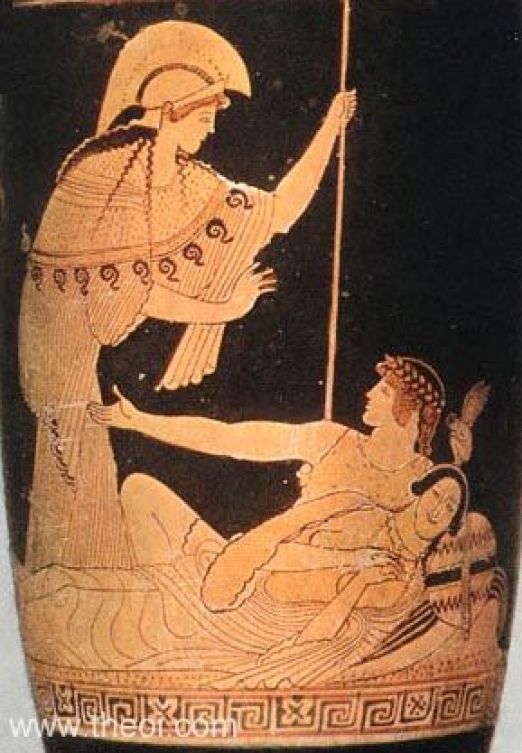
The following account is interesting for the variations in the story of Ariadne and Theseus but also for the strange detail of the ritual where young men imitate a woman in childbirth. Also, the counterfeit letters bit is precious. What would they say?.
Other tales about Ariadne, According to Plutarch (Theseus 20)
“There are many other versions circulated about these matters still and also about Ariadne, none of which agree. For some say that she hanged herself after she was abandoned by Theseus. Others claim that after she was taken to Naxos by sailors she lived with Oinaros a priest of Dionysus and that she was abandoned by Theseus because he loved another.
“A terrible lust for Aiglê the daughter of Panopeus ate at him” [fr. 105]—this is a line Hereas the Megarean claims Peisistratus deleted from the poems of Hesiod, just as again he says that he inserted into the Homeric catalogue of dead “Theseus and Perithoos, famous children of the gods” [Od. 11.631] to please the Athenans. There are some who say that Ariadne gave birth to Oinipiôn and Staphulos with Theseus. One of these is Ion of Khios who has sung about his own city “Oinopiôn, Theseus’ son, founded this city once.” [fr. 4D]
The most reputable of the myths told are those which, as the saying goes, all people have in their mouths. But Paiôn the Amathousian has handed down a particular tale about these events. For he says that Theseus was driven by a storm, to Cyprus and that he had Ariadne with him, who was pregnant and doing quite badly because of the sea and the rough sailing. So he set her out alone and he was carried back into the sea from the land while he was tending to the ship. The native women, then, received Ariadne and they tried to ease her depression because of her loneliness by offering her counterfeit written to her by Theseus and helping her and supporting her during childbirth. They buried her when she died before giving birth.
Paiôn claims that when Theseus returned he was overcome with grief and he left money to the island’s inhabitants, charging them to sacrifice to Ariadne and to have two small statues made for her—one of silver and one of bronze. During the second day of the month of Gorpiaon at the sacrifice, one of the young men lies down and mouns and acts as women do during childbirth. They call the grove in which they claim her tomb is that of Ariadne Aphrodite.
Some of the Naxians claim peculiarly that there were two Minoses and two Ariadnes. They claim one was married to Dionysus on Naxos and bore the child Staphulos, and the young one was taken by Theseus and left when he came to Naxos with a nurse named Korkunê—whose tomb they put on display. They claim that Ariadne died there and has honors unequal to those of the earlier one. The first has a festival of singing and play; the second has one where sacrifices are performed with grief and mourning.”