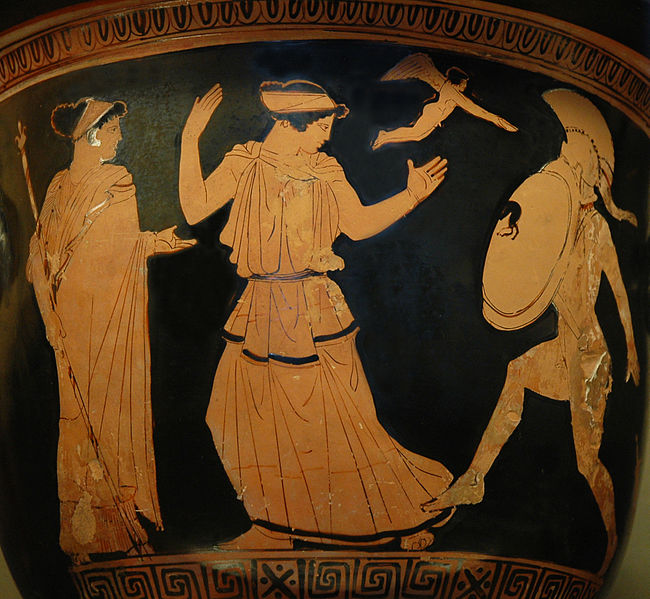
“In these halls, I [Andromache] produced this male child / after sleeping with Achilles’ son, my master]:
One source says that she bore only one son to Neoptolemos while others say that there were three: Pyrrhos, Molossos, Aiakos and a daughter named Troas. Lysimachus, in the second volume of his On Homecomings, writes that Proxenos and Nikomedes the Akanthian report in Macedonian Matters that Andromache gave birth to those who were just mentioned, and from Leonassa, Kleodaios’ daughter, [he fathered?] Argos, Pergamos, Pandaros, Dorieus, Genyos, Danae and Eurylockus. They also say that Pyrrhos received the kingdom from his father and that the country was named Mossia to give honor to Molossos.”
“He used the word Kastorian because of the account of some that the Dioskouri invented the dance in armor. For some say that the Dioskouroi are dancers. Epicharmus, however, says that Athena played the martial song for the Dioskouri on an Aulos and for this reason the Lakonians march against the enemy to the same sound. But others claim that he Kastorean is a certain rhythm and that the Laconians use it when attacking the enemy.
There is also a distinction between the dance of the pyrrikhê for which the hyporkhêmata were composed. For some say that the Kouretes invented dancing in armor and performed this dance, or that Pyrrikhos of Krete or Thaletas first created them. But Sosibios argues that all hyporkhêmata are Cretan.
Still, some say that the pyrrhic dance is not named from Pyrrikhos of Crete but from Achilles’ son Pyrrhos who danced in his arms over his victory over Telephos, which the Kyprians call the prulis, making the name pyrrikhê from the pyre.”
58 “First of the Greeks, the Cretans were possessing the laws which Minos set down. Minos claimed to have learned them from Zeus after he wandered for nine years over a certain month which is called the “cave of Zeus”. The children of the Cretans are raised in common and brought up hardy with one another. They learn the arts of war, and hunts, and they also practice uphill runs without shoes and they work hard on the pyrrhic dance which Purrikhos invented first.”
A war-dance was performed in honor of Athena’s birth in full-armor at the Panathenain festival (pyrrhiche). See Walter Burkert, Greek Religion 1985, 102.
late 6th–early 5th century BC, Attic black-figure (lekythos)
In Homer, Helen and Menelaos have a single child, Hermione and there is a reference to Menelaos’ son Megapenthes. But there are no mentions of Helen having children with anyone else. The mythographical tradition fixes this.
Jacoby BNJ 758 F 6 = Scholia on Euripides, Andromache 898
“Lysimachus and some others report that Nikostratos was also born from Helen. But the one who gathered the Cypriot tales says that it was Pleisthenes who came to Cyprus with Aganos and that he was the child born to Alexander from Helen.”
“Menelaos fathered Hermione from Helen and according to some others Nikostraos; Akousilaos claims that [Menelaos] fathered Megapenthes with a servant girl who was Aitolian in race (she was named Pieres, or, it was Tereis who was Pierian; according to Eumelos he gave birth to a son named Xenodamos from a nymph named Knossia.”
Juba, BNJ 275 F 5 (=Pseudo-Plutarch, Parallel Stories 23 p. 311b-c)
“After the destruction of Troy, Diomedes was shipwrecked in Libya where the king was Lykos. He had the custom of sacrificing foreigners to his father Ares. But Kallirhoe, his daughter, betrayed her father because she was infatuated with Diomedes.
She saved Diomedes by releasing him from his chains. But he sailed away without any concern for the woman who helped him and she killed herself by hanging. That is the story of Juba in the third book of his Libyan Tales.”
“After Troy was sacked, Diomedes threw stones from the walls of Troy into his ship for ballast. When he arrived in Argos and went unnoticed by Aigialeia, his wife, he went to Italy. When he found a Skythia dragon laying waste to Phaiacia, he killed it as he held Glaukos’ golden shield (and the dragon thought the shield was the golden skin of the ram).
Diomedes was especially honored for this act and he made a statue, shaping it from the stones taken from Troy. Timaios tells this story and Lykos does too in his third book. Later on, Daunos killed Diomedes and threw the statues into the sea. But they returned again over the waves and proceeded back to their bases. That’s the story, at least.”
“Phylarkhos claims that Thetis went to Hephaistos on Olympos so that he might create weapons for Achilles and that he did it. But, because Hephaistos was lusting after Thetis, he said he would not give them to her unless she had sex with him. She promised him that she would, but that she only wanted to try on the weapons first, so she could see if the gear he had made was fit for Achilles. She was actually the same size as him.
Once Hephaistos agreed on this, Thetis armed herself and fled. Because he was incapable of grabbing her, he took a hammer and hit Thetis in the ankle. Injured in this way, she went to Thessaly and healed in the city that is called Thetideion after her.”
The sacrifice of Iphigenia is a pivotal moment in the tale of the House of Atreus—it motivates Agamemnon’s murder and in turn the matricide of Orestes—and the Trojan War, functioning as it does as a strange sacrifice of a virgin daughter of Klytemnestra in exchange for passage for a fleet to regain the adulteress Helen, Iphigeneia’s aunt by both her father and mother. The account is famous in Aeschylus’ Agamemnon and the plays Iphigenia at Aulis and Iphigenia among the Taurians by Euripides. Its earliest accounts, however, provide some interesting variations:
Hes. Fr. 23.13-30
“Agamemnon, lord of men, because of her beauty,
Married the dark-eyed daughter of Tyndareus, Klytemnestra.
She gave birth to fair-ankled Iphimede in her home
And Elektra who rivaled the goddesses in beauty.
But the well-greaved Achaeans butchered Iphimede
on the altar of thundering, golden-arrowed Artemis
on that day when they sailed with ships to Ilium
in order to exact payment for fair-ankled Argive woman—
they butchered a ghost. But the deer-shooting arrow-mistress
easily rescued her and anointed her head
with lovely ambrosia so that her flesh would be enduring—
She made her immortal and ageless for all days.
Now the races of men upon the earth call her
Artemis of the roads, the servant of the famous arrow-mistress.
Last in her home, dark-eyed Klytemnestra gave birth
after being impregnated by Agamemnon to Orestes,
who, once he reached maturity, paid back the murderer of his father
and killed his mother as well with pitiless bronze.”
This fragment presents what is possibly the earliest account of the tale of Iphigenia and contains the major elements: the sacrifice of Agamemnon’s daughter is tied to vengeance against Helen; the daughter is rescued by Artemis, made immortal and made her servant. [In some traditions she is either made immortal or made into a priestess of Artemis at Tauris]. Orestes kills the murderer of his father and his mother. Continue reading “The Names of Agamemnon’s Daughters and the Death of Iphigenia”→
“Menestheus of the dancing-breastplate led one contingent,
son of the swift-flowing river Sperkheios
whom the daughter of Peleus, beautiful Poludôrê bore
when she shared the bed with the indomitable river-god, Sperkheios
although by reputation he was the son of Boros, the son of Periêrês
who wooed her openly by offering countless gifts.”
The confusion, shock and horror of this detail—which I presume the vast majority of Homer’s audiences have overlooked or forgotten as with the sad fate of Odysseus’ sister—can be felt as well in the various reactions of the Scholia where we encounter (a) denial—it was a different Peleus!; (b) sophomoric prevarication—why doesn’t Achilles talk about her, hmmm?; (c) conditional acceptance through anachronistic assumptions—she’s suppressed because it is shameful that she is a bastard; (d) and, finally, citation of hoary authorities to insist upon a ‘truth’ unambiguous in the poem.
I have translated the major scholia below. Note that we can see where the ‘fragments’ of several authors come from here (hint: they’re just talked about by the scholiasts). We can also learn a bit about the pluralistic and contradictory voices to be found in the Homeric scholia. The bastard child bit is my favorite part.
Schol A. ad Il. 16.175
“Pherecydes says that Polydora was the sister of Achilles. There is no way that this has been established in Homer. It is more credible that this is just the same name, as in other situations, since [the poet] would have added some sign of kinship with Achilles.”
” “Daughter of Peleus”: A different Peleus, for if he were a nephew of Achilles, this would be mentioned in Hades when they speak about his father and son or in the allegory of the Litai when he says “a great spirit compelled me there” or “my possessions and serving women” he might mention the pleasure of having a sister. The poet does not recognize that Peleus encountered some other woman. Neoteles says that Achilles’ cousin leads the first contingent and gives evidence of knowledge of war. And he gave countless gifts to marry the sister of Achilles. Should he not mentioned her in Hades? Odysseus does not mention Ktimene [his sister].
Pherecydes says that [Polydore] was born from Antigonê, the daughter of Eurytion; the Suda says her mother was Laodameia the daughter of Alkmaion; Staphulos says she was Eurudikê the daughter of Aktôr. Zenodotos says the daughter’s name was Kleodôrê; Hesiod and everyone else calls her Poludôrê.”
“They say that she is from another Peleus. For if he were a nephew of Achilles wouldn’t this be mentioned or wouldn’t he ask about his sister in Hades along with his father and son? At the same time, the poet does not know that Peleus encountered some other women. More recent poets say that Menestheus is his nephew and that this is the reason he leads the first contingent and shows knowledge of war and that ‘he gave countless gifts to marry the sister of Achilles’. But if he does not mention it, it is not necessarily foreign to him. For the poet is rather sensitive to certain proprieties.”
“Since, otherwise, if Polydora were his sister, she would be a bastard and he would not want to mention her. Or, maybe it is because she has already died.”
“Did Peleus have a daughter Polydôrê from another? Staphulos says in the third book of his Thessalika that she was born from Eurydike the daughter of Aktôr. Pherecydes says it was the daughter of Eurytion; others says Laodameia, the daughter of Alkmaion.”
What happened to Peleus’ first wife—if they were married? According to John Tzetzes (see Fowler 2013, 444) Peleus accidentally killed his father-in-law during the Kalydonian Boar Hunt, so he had to go abroad and in Iolkos the king’s wife tried to seduce him and told Antigone that Peleus would abandon her. Antigone killed herself, leaving Peleus free to marry Thetis. (But who took care of their daughter?).
It can get more confusing: some traditions (Apollodorus, 3.163 and 168) make a Polymele the daughter of Peleus and Patroklos’ mother whereas Polydora is Peleus’ wife in between Antigone and Thetis. Whatever the case, we can do our own scholiastic justification for Achilles not talking about his sister without creating a second Peleus. She must have been a bit older than Achilles since by all accounts Peleus fathered her before (1) the Kalydonian Boar Hunt, (2) the sacking of Iolkos and (3) the Voyage of the Argo. She would likely have been raised in a separate household from Achilles and married off before he went to study with the centaur Cheiron!
(More importantly: In the poetic world of Homer, sisters just don’t matter. Brothers do. Helen does not mention missing her sisters. Hektor talks to multiple brothers, but where are his sisters? In the Odyssey, Achilles asks about his father and son because Odysseus is interested in fathers and sons. This may make it more, not less, appropriate that Achilles says nothing of his sister: Odysseus just doesn’t care about sisters. Nor, it seems, does Homer.)
Works Consulted (apart from the Greek Texts).
Timothy Gantz. Early Greek Myth. Baltimore, 1993.
Robert Fowler. Early Greek Mythography. Vol. 2:Commentary, 2013.
“And the fair-haired Grey-eyed goddess / Once made Diomedes an immortal god”: This is the Argive Diomedes who was immortalized because of his excellence. There is a sacred Island Diomedeia in the Adriatic where he is honored as a god. Ibykos records this.”
“After marrying Hermione Diomedes was made a god with the Dioskouroi. For he shares their life. Polemon records this. Among the Argyrippoi he has a sacred place. And in Mentapontion as well he receives honor like a god. Among the Thourians as well, they put up statues of him as if he were a god.”
“Another explanation: Didn’t Athena also make Diomedes a god? For during the Theban War, Melanaippos, a Theban hero, wounded Tydeus. And Tydeus, enraged over the wound, sought Amphiaros to kill Melanippus and bring him his head. When the head was brought to him and his anger overcame his reason, he took a taste of the Melanippian meat, as Euripides writes in the Meleager: “he will arrive at man-eating pleasures / and tear into Melanippus’ head with blood-crusted jaws”
When Tydeus was wounded, Athena was planning on making him immortal, but she did not grant that gift because he ate human flesh. So, because he was not able to receive immortality, he thought it right for the goddess to transfer the gift to Diomedes. Diomedes is therefore honored as a god among the Thourians and Metapontians and there is no record of his death among the historians.”
The Lamia (or, just Lamia to her friends) is one of the figures from Greek myth who seems like a frightening monster but really is a particular distillation of misogyny. She is often called a Greek ‘vampire’ along with Empousa. Unlike the latter, however, Lamia is specifically associated with killing children.
Diodorus Siculus, 20.40
“At the rock’s root there was a very large cave which was roofed with ivy and bryony in which the myths say the queen Lamia, exceptional for her beauty, was born. But, because of the beastliness of her soul, they say that her appearance has become more monstrous in the time since then.
For, when all her children who were born died, she was overwhelmed by her suffering and envied all the women who were luckier with their children. So she ordered that the infants be snatched from their arms and killed immediately. For this reason, even in our lifetime, the story of that women has lingered among children and the mention of her name is most horrifying to them.
But, whenever she was getting drunk, she would allow people to do whatever pleased them without observation. Because she was not closely watching everything at that time, the people in that land imagined that she could not see. This is why the myth developed that she put her eyes into a bottle, using this story a metaphor for the carelessness she enacted in wine, since that deprived her of sight.”
The story of why Lamia killed children gets a little more depressing in the Fragments of the Greek Historians
Duris, BNJ 76 F17 [= Photios s.v. Lamia]
“In the second book of his Libyan History, Duris reports that Lamia was a fine looking woman but after Zeus had sex with her, Hera killed the children she bore because she was envious. As a result she was disfigured by grief and would seize and kill the children of others.”
Elsewhere, the evidence of narratives about Lamia are rather limited. She becomes just another negative, female monster.
Suda, Lambda 85
“Lamia: a monster. The name comes from having a gaping throat, laimia and lamia. Aristophanes: “It has the smell of a seal, the unwashed balls of a Lamia.” For testicles are active—and he is making a fantasy image of Lamia’s balls, since she is female.”
“There is a crag rising up over the ground on which the Delphians claim that a woman stood singing oracles, named Hêrophilê but known as Sibyl. There is the earlier Sibyl, the one I have found to be equally as old as the others, whom the Greeks claim is the daughter of Zeus and Lamia, the daughter of Poseidon. She was the first woman to sing oracles and they say that she was named Sibyl by the Libyans. Hêrophilê was younger than here, but she was obviously born before the Trojan War since she predicted Helen in her oracles, that was raised up in Sparta as the destruction for Asia and Europe and that Troy would be taken by the Greeks because of her.”
“Foremost he differed from previous authors in this, by which I mean how he took on a subject that was not a single thread nor one divided in many different and also disconnected parts. And then, because did not include mythical material in his work and he did not use his writing for the deception and bewitchment of many, as every author before him did when they told the stories of certain Lamiai rising up from the earth in groves and glens and of amphibious Naiads rushing out of Tartaros, half-beasts swimming through the seas and then joining together in groups among humans, and producing offspring of mortals and gods, demigods—and other stories which seem extremely unbelievable and untrustworthy to us now.”
Mormô, in the genitive Mormous, declined like Sappho. There is also the form Mormôn, genitive Mormonos. Aristophanes says “I ask you, take this Mormo away from me”. This meant to dispel frightening things. For Mormo is frightening. And again in Aristophanes: “A Mormo for courage”. There is also a mormalukeion which they also call a Lamia. They were also saying frightening things like this.”
Plutarch, De Curiositate [On Being a Busybody] 516a
“Now, just as in the myth they say that Lamia sleeps at home, putting her eyes set aside in some jar, but when she goes out she puts them back in and peers around, in the same way each of us puts his curiosity, as if fitting in an eye, into meanness towards others. But we often stumble over our own mistakes and faults because of ignorance, since we fail to secure sight or light for them.
For this reason, a busybody is rather useful to his enemies, since he rebukes and emphasizes their faults and shows them what they should guard and correct, even as he overlooks most of his own issues thanks to his obsession with everyone else. This is why Odysseus did not stop to speak with his mother before he inquired from the seer about those things for which he had come to Hades. Once he had made his inquiry, he turned to his own mother and also the other women, asking who Tyro was, who beautiful Khloris was, and why Epikaste had died.”
“They report that Gaia, annoyed over the murder of the giants, slandered Zeus to Hera and that she went to speak out to Kronos. He gave her two eggs and he rubbed them down with his own semen and ordered her to put them down in the ground from where a spirit would arise who would rebel against Zeus from the beginning. She did this because she was really angry and set them down below Arimos in Kilikia.
But when Typhoeus appeared Hera relented and told Zeus everything. He struck him down with lightning and named him Mt. Aetna. This report works well for us not to have an issue that this is the Homeric Account. He names the grave a resting place euphemistically.”