The Wings of Daedalus’ Ship

Servius Danielis, Commentary ad Aeneid, 6, 14

“Phandicus, in his Deliakon says that Daedalus embarked on a ship in flight for the reasons I mentioned earlier and when those who were following got close, he spread out a large cloth to get the winds to help them and escaped in this way. When his pursuers returned, they announced that “he escaped with wings”.

Phanodicos Deliacon Daedalum propter supradictas causas fugientem navem conscendisse et, cum imminerent qui eum sequebantur, intendisse pallium ad adiuvandum ventos et sic evasisse: illos vero qui insequebantur reversos nuntiasse pinnis illum evasisse.

Pottery: black-figured kylix (drinking cup) with scenes of a merchant vessel being chased and attacked by pirates.
Kylix from the British Museum, Attic 520 BCE (1867,0508.963)

Reputable Tales about Ariadne; And Strange Ones

The following account is interesting for the variations in the story of Ariadne and Theseus but also for the strange detail of the ritual where young men imitate a woman in childbirth. 

Other tales about Ariadne, According to Plutarch (Theseus 20)

“There are many other versions circulated about these matters still and also about Ariadne, none of which agree. For some say that she hanged herself after she was abandoned by Theseus. Others claim that after she was taken to Naxos by sailors she lived with Oinaros a priest of Dionysus and that she was abandoned by Theseus because he loved another.

“A terrible lust for Aiglê the daughter of Panopeus ate at him” [fr. 105]—this is a line Hereas the Megarean claims Peisistratus deleted from the poems of Hesiod, just as again he says that he inserted into the Homeric catalogue of dead “Theseus and Perithoos, famous children of the gods” [Od. 11.631] to please the Athenans. There are some who say that Ariadne gave birth to Oinipiôn and Staphulos with Theseus. One of these is Ion of  Khios who has sung about his own city “Oinopiôn, Theseus’ son, founded this city once.” [fr. 4D]

The most reputable of the myths told are those which, as the saying goes, all people have in their mouths. But Paiôn the Amathousian has handed down a particular tale about these events. For he says that Theseus was driven by a storm, to Cyprus and that he had Ariadne with him, who was pregnant and doing quite badly because of the sea and the rough sailing. So he set her out alone and he was carried back into the sea from the land while he was tending to the ship. The native women, then, received Ariadne and they tried to ease her depression because of her loneliness by offering her a counterfeit letter written to her by Theseus and helping her and supporting her during childbirth. They buried her when she died before giving birth.

Paiôn claims that when Theseus returned he was overcome with grief and he left money to the island’s inhabitants, charging them to sacrifice to Ariadne and to have two small statues made for her—one of silver and one of bronze. During the second day of the month of Gorpiaon at the sacrifice, one of the young men lies down and mouns and acts as women do during childbirth. They call the grove in which they claim her tomb is that of Ariadne Aphrodite.

Some of the Naxians claim peculiarly that there were two Minoses and two Ariadnes. They claim one was married to Dionysus on Naxos and bore the child Staphulos, and the young one was taken by Theseus and left when he came to Naxos with a nurse named Korkunê—whose tomb they put on display. They claim that Ariadne died there and has honors unequal to those of the earlier one. The first has a festival of singing and play; the second has one where sacrifices are performed with grief and mourning.”

Πολλοὶ δὲ λόγοι καὶ περὶ τούτων ἔτι λέγονται καὶ περὶ τῆς Ἀριάδνης, οὐδὲν ὁμολογούμενον ἔχοντες. οἱ μὲν γὰρ ἀπάγξασθαί φασιν αὐτὴν ἀπολειφθεῖσαν ὑπὸ τοῦ Θησέως, οἱ δὲ εἰς Νάξον ὑπὸ ναυτῶν κομισθεῖσαν Οἰνάρῳ τῷ ἱερεῖ τοῦ Διονύσου συνοικεῖν, ἀπολειφθῆναι δὲ τοῦ Θησέως ἐρῶντος ἑτέρας· Δεινὸς γάρ μιν ἔτειρεν ἔρως Πανοπηΐδος Αἴγλης. τοῦτο γὰρ τὸ ἔπος ἐκ τῶν Ἡσιόδου Πεισίστρατον ἐξελεῖν φησιν Ἡρέας ὁ Μεγαρεύς, ὥσπερ αὖ πάλιν ἐμβαλεῖν εἰς τὴν Ὁμήρου νέκυιαν τὸ Θησέα Πειρίθοόν τε θεῶν ἀριδείκετα τέκνα,χαριζόμενον Ἀθηναίοις· ἔνιοι δὲ καὶ τεκεῖν ἐκ Θησέως Ἀριάδνην Οἰνοπίωνα καὶ Στάφυλον· ὧν καὶ ὁ Χῖος Ἴων ἐστὶ περὶ τῆς ἑαυτοῦ πατρίδος λέγων· Τήν ποτε Θησείδης ἔκτισεν Οἰνοπίων.

Ἃ δ᾿ ἐστὶν εὐφημότατα τῶν μυθολογουμένων, πάντες ὡς ἔπος εἰπεῖν διὰ στόματος ἔχουσιν. ἴδιον δέ τινα περὶ τούτων λόγον ἐκδέδωκε Παίων ὁ Ἀμαθούσιος. τὸν γὰρ Θησέα φησὶν ὑπὸ χειμῶνος εἰς Κύπρον ἐξενεχθέντα καὶ τὴν Ἀριάδνην ἔγκυον ἔχοντα, φαύλως δὲ διακειμένην ὑπὸ τοῦ σάλου καὶ δυσφοροῦσαν, ἐκβιβάσαι μόνην, αὐτὸν δὲ τῷ πλοίῳ βοηθοῦντα πάλιν εἰς τὸ πέλαγος ἀπὸ τῆς γῆς φέρεσθαι. τὰς οὖν ἐγχωρίους γυναῖκας τὴν Ἀριάδνην ἀναλαβεῖν καὶ περιέπειν ἀθυμοῦσαν ἐπὶ τῇ μονώσει, καὶ γράμματα πλαστὰ προσφέρειν, ὡς τοῦ Θησέως γράφοντος αὐτῇ, καὶ περὶ τὴν ὠδῖνα συμπονεῖν καὶ βοηθεῖν· ἀποθανοῦσαν δὲ θάψαι μὴ τεκοῦσαν. ἐπελθόντα δὲ τὸν Θησέα καὶ περίλυπον γενόμενον τοῖς μὲν ἐγχωρίοις ἀπολιπεῖν χρήματα, συντάξαντα θύειν τῇ Ἀριάδνῃ, δύο δὲ μικροὺς ἀνδριαντίσκους ἱδρύσασθαι, τὸν μὲν ἀργυροῦν, τὸν δὲ χαλκοῦν. ἐν δὲ τῇ θυσίᾳ τοῦ Γορπιαίου μηνὸς ἱσταμένου δευτέρᾳ κατακλινόμενόν τινα τῶν νεανίσκων φθέγγεσθαι καὶ ποιεῖν ἅπερ ὠδίνουσαι γυναῖκες· καλεῖν δὲ τὸ ἄλσος Ἀμαθουσίους, ἐν ᾧ τὸν τάφον δεικνύουσιν, Ἀριάδνης Ἀφροδίτης.

Καὶ Ναξίων δέ τινες ἰδίως ἱστοροῦσι δύο Μίνωας γενέσθαι καὶ δύο Ἀριάδνας, ὧν τὴν μὲν Διονύσῳ γαμηθῆναί φασιν ἐν Νάξῳ καὶ τοὺς περὶ Στάφυλον τεκεῖν, τὴν δὲ νεωτέραν ἁρπασθεῖσαν ὑπὸ τοῦ Θησέως καὶ ἀπολειφθεῖσαν εἰς Νάξον ἐλθεῖν, καὶ τροφὸν μετ᾿ αὐτῆς ὄνομα Κορκύνην, ἧς δείκνυσθαι τάφον. ἀποθανεῖν δὲ καὶ τὴν Ἀριάδνην αὐτόθι καὶ τιμὰς ἔχειν οὐχ ὁμοίας τῇ προτέρᾳ. τῇ μὲν γὰρ ἡδομένους καὶ παίζοντας ἑορτάζειν, τὰς δὲ ταύτῃ δρωμένας θυσίας εἶναι πένθει τινὶ καὶ στυγνότητι μεμιγμένας.

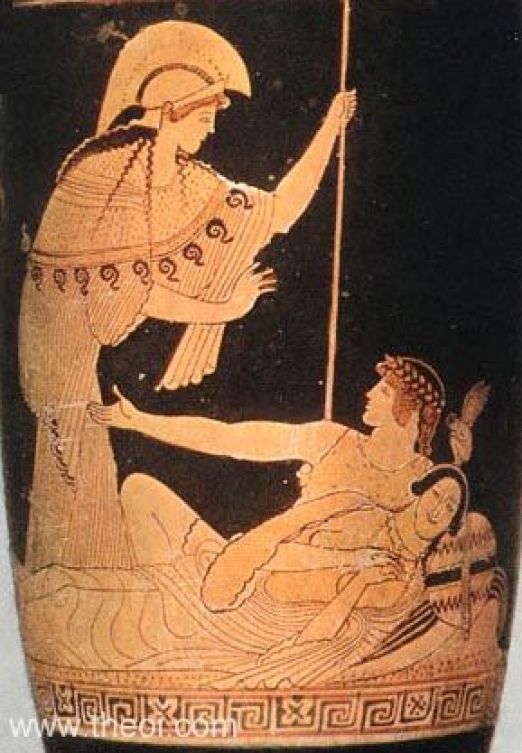
Image result for Ariadne and Theseus ancient
Athena, Ariadne, and Theseus: IL MUSEO ARCHEOLOGICO NAZIONALE DI TARANTO

Andromache’s Sons With Neoptolemos

Scholia ad Eur. Andromache, 24

“In these halls, I [Andromache] produced this male child / after sleeping with Achilles’ son, my master]:

One source says that she bore only one son to Neoptolemos while others say that there were three: Pyrrhos, Molossos, Aiakos and a daughter named Troas. Lysimachus, in the second volume of his On Homecomings, writes that Proxenos and Nikomedes the Akanthian report in Macedonian Matters that Andromache gave birth to those who were just mentioned, and from Leonassa, Kleodaios’ daughter, [he fathered?] Argos, Pergamos, Pandaros, Dorieus, Genyos, Danae and Eurylockus. They also say that Pyrrhos received the kingdom from his father and that the country was named Mossia to give honor to Molossos.”

κἀγὼ δόμοις [τοῖσδ᾽ ἄρσεν᾽ ἐντίκτω κόρον / πλαθεῖσ᾽ ᾽Αχιλλέως παιδί, δεσπότῃ γ᾽ ἐμῷ] ἰδίως ἕνα φησὶ παῖδα γενέσθαι τῷ Νεοπτολέμῷ, ἄλλων τρεῖς λεγόντων Πύρρον, Μολοσσόν, Αἰακίδην καὶ Τρωάδα. Λυσίμαχος δὲ ἐν τῷ δευτέρῳ τῶν Νόστων φησὶ Πρόξενον καὶ τὸν ᾽Ακάνθιον Νικομήδην ἐν τοῖς Μακεδονικοῖς ἱστορεῖν ἐκ μὲν ᾽Ανδρομάχης γενέσθαι τοὺς προειρημένους, ἐκ δὲ Λεωνάσσης τῆς Κλεοδαίου ῎Αργον, Πέργαμον, Πάνδαρον, Δωριέα, Γένυον, †δανάην, Εὐρύλοχον. φασὶ δὲ Πύρρῳ μὲν ἐγχειρίσαι τὴν βασιλείαν τὸν πατέρα, Μολοσσῷ δὲ τὴν ἐκ τῆς προσηγορίας τιμὴν προστάξαντα τὴν χώραν Μολοσσίαν ὀνομάζειν.

Andromache and Neoptolemus, by Pierre-Narcisse Guerin

The Palladion and Pelops’s Bones

Clement of Alexandria, Protreptikos, 4.47.6

“Many would probably be amazed if they learned that the Palladion, reportedly heaven sent, which Diomedes and Odusseus are said to have taken from Troy and then gave to Demophon, was made of Pelops’s bones, just as the Olympion was made from various bones of an Indian animal. I rely on Dionysus for this, who reports it in the fifth book of his Cycle.”

πολλοὶ δ᾽ ἂν τάχα που θαυμάσειαν, εἰ μάθοιεν τὸ Παλλάδιον τὸ διοπετὲς καλούμενον, ὃ Διομήδης καὶ ᾽Οδυσσεὺς ἱοτοροῦνται μὲν ὑφελέσθαι ἀπὸ ᾽Ιλίου, παρακαταθέσθαι δὲ Δημοφῶντι, ἐκ τῶν Πέλοπος ὀστῶν κατεσκευάσθαι, καθάπερ τὸν ᾽Ολύμπιον ἐξ ἄλλων ὀστῶν ᾽Ινδικοῦ θηρίου. καὶ δὴ τὸν ἱστοροῦντα Διονύσιον ἐν τῶι πέμπτωι μέρει τοῦ Κύκλου παρίστημι.

Image result for odysseus diomedes palladium
Roman Marble Relief of Palladium

Ignoring Women and Magic Stones: Diomedes after Troy

Juba, BNJ 275 F 5 (=Pseudo-Plutarch, Parallel Stories 23 p. 311b-c)

“After the destruction of Troy, Diomedes was shipwrecked in Libya where the king was Lykos. He had the custom of sacrificing foreigners to his father Ares. But Kallirhoe, his daughter, betrayed her father because she was infatuated with Diomedes.

She saved Diomedes by releasing him from his chains. But he sailed away without any concern for the woman who helped him and she killed herself by hanging. That is the story of Juba in the third book of his Libyan Tales.”

Μετὰ τὴν ᾽Ιλίου πόρθησιν ἐξεράσθη Διομήδης εἰς Λιβύην, ἔνθα Λύκος ἦν βασιλεύς, ἔθος ἔχων τοὺς ξένους ῎Αρει τῶι πατρὶ θύειν. Καλλιρρόη δὲ ἡ θυγάτηρ ἐρασθεῖσα Διομήδους τὸν πατέρα προύδωκε, καὶ τὸν Διομήδην ἔσωσε λύσασα τῶν δεσμῶν. ὁ δὲ ἀμελήσας τῆς εὐεργέτιδος ἀπέπλευσεν, ἡ δὲ βρόχωι ἐτελεύτησεν, ὡς ᾽Ιόβας ἐν τρίτηι Λιβυκῶν.

Scholia to Lykophron Alexandra 615

“After Troy was sacked, Diomedes threw stones from the walls of Troy into his ship for ballast. When he arrived in Argos and went unnoticed by Aigialeia, his wife, he went to Italy. When he found a Skythia dragon laying waste to Phaiacia, he killed it as he held Glaukos’ golden shield (and the dragon thought the shield was the golden skin of the ram).

Diomedes was especially honored for this act and he made a statue, shaping it from the stones taken from Troy. Timaios tells this story and Lykos does too in his third book. Later on, Daunos killed Diomedes and threw the statues into the sea. But they returned again over the waves and proceeded back to their bases. That’s the story, at least.”

ἁλούσης τῆς ᾽Ιλίου, Διομήδης ἀντὶ τοῦ ἕρματος ἐκ τοῦ τείχους τῶν Τρώων λίθους εἰς τὴν ναῦν ἐβάλετο. παραγενόμενος δὲ εἰς τὸ ῎Αργος καὶ ἐλαθεὶς ὑπὸ Αἰγιαλείας τῆς γαμετῆς παρεγένετο εἰς ᾽Ιταλίαν. εὑρὼν δὲ τηνικαῦτα τὸν ἐν τῆι Σκυθίαι δράκοντα λυμαινόμενον τὴν Φαιακίδα, διέφθειρε τοῦτον, τὴν τοῦ Γλαύκου χρυσῆν ἀσπίδα κατέχων, νομίσαντος τοῦ δράκοντος τὸ χρυσοῦν δέρας εἶναι τοῦ κριοῦ. τιμηθεὶς δὲ ἐπὶ τούτωι σφόδρα, ἀνδριάντα κατασκευάσας, ἱδρύσατο ἐκ τῶν λίθων τῶν ἐκ τῆς ᾽Ιλίου. ἱστορεῖ δὲ τοῦτο Τίμαιος καὶ Λύκος ἐν τῶι τρίτωι. ὕστερον δὲ ἀνελὼν ὁ Δαῦνος αὐτόν, ἔρριψε καὶ τοὺς ἀνδριάντας εἰς θάλασσαν· οὗτοι δὲ ἀνεχόμενοι τὰ κύματα, πάλιν ἐξήρχοντο πρὸς τὰς βάσεις αὐτῶν. καὶ ἡ μὲν ἱστορία τοιαύτη.

Some other tales: Odysseus tried to kill Diomedes

Angelica Kauffman, Zeuxis Selecting Models for His Painting of Helen of Troy, c 1778

What Hephaestus Really Wanted from Thetis

Schol. to Pin. Nemian Odes, 4.81

“Phylarkhos claims that Thetis went to Hephaistos on Olympos so that he might create weapons for Achilles and that he did it. But, because Hephaistos was lusting after Thetis, he said he would not give them to her unless she had sex with him. She promised him that she would, but that she only wanted to try on the weapons first, so she could see if the gear he had made was fit for Achilles. She was actually the same size as him.

Once Hephaistos agreed on this, Thetis armed herself and fled. Because he was incapable of grabbing her, he took a hammer and hit Thetis in the ankle. Injured in this way, she went to Thessaly and healed in the city that is called Thetideion after her.”

Φύλαρχός φησι Θέτιν πρὸς ῞Ηφαιστον ἐλθεῖν εἰς τὸν ῎Ολυμπον, ὅπως ᾽Αχιλλεῖ ὅπλα κατασκευάσηι, τὸν δὲ ποιῆσαι. ἐρωτικῶς δὲ ἔχοντα τὸν ῞Ηφαιστον τῆς Θέτιδος, οὐ φάναι ἂν δώσειν αὐτῆι, εἰ μὴ αὐτῶι προσομιλήσαι. τὴν δὲ αὐτῶι ὑποσχέσθαι, θέλειν μέντοι ὁπλίζεσθαι, ὅπως ἴδηι εἰ ἁρμόζει ἃ ἐπεποιήκει ὅπλα τῶι ᾽Αχιλλεῖ· ἴσην γὰρ αὐτὴν ἐκείνωι εἶναι. τοῦ δὲ παραχωρήσαντος ὁπλισαμένην τὴν Θέτιν φυγεῖν, τὸν δὲ οὐ δυνάμενον καταλαβεῖν σφύραν λαβεῖν καὶ πατάξαι εἰς τὸ σφυρὸν τὴν Θέτιν· τὴν δὲ κακῶς διατεθεῖσαν ἐλθεῖν εἰς Θετταλίαν καὶ ἰαθῆναι ἐν τῆι πόλει ταύτηι τῆι ἀπ᾽ αὐτῆς Θετιδείωι καλουμένηι.

Image result for Thetis Berlin F2294
Hephaistos Thetis Kylix by the Foundry Painter Antikensammlung Berlin F2294

The Last Mythic Hero

Pausanias, 6.9.6-9

“In the Olympiad before that one they say that Kleomêdês the Astupalaian killed the Epidaurian Hippos while boxing him. When he was charged by the referees with cheating and was deprived of the victory, he went out of his mind with grief and returned to Astupalaia.

There, he attacked a school there which held as many as sixty children and knocked down the pillar which supported the roof. After the roof fell on the children, the citizens threw stones at Kleomêdês and he fled into the Temple of Athena. Inside, he climbed into a chest and closed the lid over him.

The Astupalaians wore themselves out trying to open or break the chest. When they finally broke open the chest and did not find Kleomêdês there dead or alive, they send representatives to Delphi to ask what kind of thing had happened with Kleomêdês. The Pythia is said to have given the oracle that:

Kleomêdês the Astupalaian was the last of the heroes—
Honor him with sacrifices since he is no longer mortal.”

For this reason the Astupalaians have honored Kleomêdês as a hero since that time.

τῇ δὲ Ὀλυμπιάδι τῇ πρὸ ταύτης Κλεομήδην φασὶν Ἀστυπαλαιέα ὡς Ἴκκῳ πυκτεύων ἀνδρὶ Ἐπιδαυρίῳ τὸν Ἴκκον ἀποκτείνειεν ἐν τῇ μάχῃ, καταγνωσθεὶς δὲ ὑπὸ τῶν Ἑλλανοδικῶν ἄδικα εἰργάσθαι καὶ ἀφῃρημένος τὴν νίκην ἔκφρων ἐγένετο ὑπὸ τῆς λύπης καὶ ἀνέστρεψε μὲν ἐς Ἀστυπάλαιαν, διδασκαλείῳ δ᾽ ἐπιστὰς ἐνταῦθα ὅσον ἑξήκοντα ἀριθμὸν παίδων ἀνατρέπει τὸν κίονα ὃς τὸν ὄροφον ἀνεῖχεν. ἐμπεσόντος δὲ τοῦ ὀρόφου τοῖς παισί, καταλιθούμενος ὑπὸ τῶν ἀστῶν κατέφυγεν ἐς Ἀθηνᾶς ἱερόν: ἐσβάντος δὲ ἐς κιβωτὸν κειμένην ἐν τῷ ἱερῷ καὶ ἐφελκυσαμένου τὸ ἐπίθημα, κάματον ἐς ἀνωφελὲς οἱ Ἀστυπαλαιεῖς ἔκαμνον ἀνοίγειν τὴν κιβωτὸν πειρώμενοι: τέλος δὲ τὰ ξύλα τῆς κιβωτοῦ καταρρήξαντες, ὡς οὔτε ζῶντα Κλεομήδην οὔτε τεθνεῶτα εὕρισκον, ἀποστέλλουσιν ἄνδρας ἐς Δελφοὺς ἐρησομένους ὁποῖα ἐς Κλεομήδην τὰ συμβάντα ἦν.  τούτοις χρῆσαι τὴν Πυθίαν φασίν:“

ὕστατος ἡρώων Κλεομήδης Ἀστυπαλαιεύς,
ὃν θυσίαις τιμᾶθ᾽ ἅτε μηκέτι θνητὸν ἐόντα.

”Κλεομήδει μὲν οὖν Ἀστυπαλαιεῖς ἀπὸ τούτου τιμὰς ὡς ἥρωι νέμουσι:

Plutarch, Life of Romulus 4-7

“This is, then, similar to those stories told by the Greeks about Aristeas of Prokonnesos and Kleomêdês of Astupalaia. For they claim that Aristeas died in a fuller’s shop and his body disappeared when his friends came to get it. Soon after, people who were returning from abroad said that they met Aristeas travling towards Croton.

Then there was Kleomêdês who had extreme strength and size but was easily enraged and like a crazy person. They claim he did many violent things and then finally went into a school for children and punched the pillar which supported the roof and broke it in the middle which made the roof collapse. Because the children were killed, he was pursued and he hid in a giant chest. He closed the lid and held himself inside so that many people struggling together were not able to lift it. After they broke the chest apart they found no one alive or dead inside. In their shock, they sent people to consult the Delphic oracle. The Pythia responded: “Kleomêdês the Astupalaian is the last of the heroes.”

Ἔοικε μὲν οὖν ταῦτα τοῖς ὑφ᾿ Ἑλλήνων περί τε Ἀριστέου τοῦ Προκοννησίου καὶ Κλεομήδους τοῦ Ἀστυπαλαιέως μυθολογουμένοις. Ἀριστέαν μὲν γὰρ ἔν τινι κναφείῳ τελευτῆσαί φασι, καὶ τὸ σῶμα μετιόντων αὐτοῦ τῶν φίλων ἀφανὲς οἴχεσθαι· λέγειν δέ τινας εὐθὺς ἐξ ἀποδημίας ἥκοντας ἐντυχεῖν Ἀριστέᾳ τὴν ἐπὶ Κρότωνος πορευομένῳ· Κλεομήδη δέ, ῥώμῃ καὶ μεγέθει σώματος ὑπερφυᾶ γενόμενον ἔμπληκτόν τε τῷ τρόπῳ καὶ μανικὸν ὄντα, πολλὰ δρᾶν βίαια, καὶ τέλος ἔν τινι διδασκαλείῳ παίδων τὸν ὑπερείδοντα τὴν ὀροφὴν κίονα πατάξαντα τῇ χειρὶ κλάσαι μέσον καὶ τὴν στέγην καταβαλεῖν. ἀπολομένων δὲ τῶν παίδων διωκόμενον εἰς κιβωτὸν καταφυγεῖν μεγάλην, καὶ τὸ πῶμα κατακλείσαντα συνέχειν ἐντός, ὥστε ἀποσπάσαι μὴ δύνασθαι πολλοὺς ὁμοῦ βιαζομένους· κατασχίσαντας δὲ τὴν κιβωτὸν οὔτε ζῶντα τὸν ἄνθρωπον εὑρεῖν οὔτε νεκρόν. ἐκπλαγέντας οὖν ἀποστεῖλαι θεοπρόπους εἰς Δελφούς, οἷς τὴν Πυθίαν εἰπεῖν·

Ἔσχατος ἡρώων Κλεομήδης Ἀστυπαλαιεύς.

λέγεται δὲ καὶ τὸν Ἀλκμήνης ἐκκομιζομένης νεκρὸν ἄδηλον γενέσθαι, λίθον δὲ φανῆναι κείμενον ἐπὶ τῆς κλίνης. καὶ ὅλως πολλὰ τοιαῦτα μυθολογοῦσι, παρὰ τὸ εἰκὸς ἐκθειάζοντες τὰ θνητὰ τῆς φύσεως ἅμα τοῖς θείοις.

Plutarch’s account does not specify the lost boxing match or mention the temple of Athena. While some of the diction is shared with Pausanias’ account, most of the common words are nouns for specific objects. The only real echo may be οὔτε ζῶντα τὸν ἄνθρωπον εὑρεῖν οὔτε νεκρόν for ὡς οὔτε ζῶντα Κλεομήδην οὔτε τεθνεῶτα εὕρισκον

The Suda’s version has many of the same phrases and is likely drawn from Pausanias. The comparison of the three makes me think that while Plutarch and Pausanias are drawing on the same story, they are not likely drawing on the same textual tradition.

Suda, Kappa 1725

“Kleomêdês, an Astupalaian, he killed the Epidaurian Kikkos in a boxing match. But when he was stripped of the victory, he went out of his mind because of grief and returned to Astupalaia. He fell upon a school there which held 80 students and he knocked down the pillar which was supporting the roof. After the roof collapsed and killed everyone, he was pelted with stones by the citizens and fled to a temple where he put himself into a chest and made hard work for the Astupalaians by holding down the lid. After they finally broken the wood of the chest, they found no one there.”

Κλεομήδης, ᾿Αστυπαλαιεύς, Κίκκον τὸν ᾿Επιδαύριον ἀπέκτεινεν ἐν τῇ πυγμῇ καὶ ἀφῃρημένος τὴν νίκην ἔκφρων ἐγένετο ὑπὸ τῆς λύπης καὶ ἀνέστρεψεν εἰς ᾿Αστυπάλαιαν. διδασκαλείῳ δὲ ἐπιστάς, ἐν ᾧ παῖδες ἦσαν ξ′, ἀνατρέπει τὸν κίονα, ὃς τὸν ὄροφον εἶχεν. ἐμπεσόντος δὲ τοῦ ὀρόφου καὶ πάντας ἀποκτείναντος, καταλιθούμενος ὑπὸ τῶν ἀστῶν κατέφυγεν ἐς ἱερὸν καὶ ἐμβὰς ἐς κιβωτὸν καὶ τὸ ἐπίθεμα ἐφελκυσάμενος κάματον τοῖς ᾿Αστυπαλαιεῦσι παρεῖχε. τέλος τὰ ξύλα τῆς κιβωτοῦ καταρρήξαντες οὐδένα εὗρον.

Orestes Delphi BM GR1917.12-10.1.jpg
Orestes at Delphi. Paestan red-figured bell-krater, ca. 330 BC.

Explaining the Cuckoo: Women Know Everything

Scholion on Theokritos, Idylls 15.64

“Women know everything, even how Zeus married Hera.”

Homer has, “They traveled together to bed, avoiding their parents’ notice”. Aristokles in his work “On the Cults of Hermione”, provides something of an odd tale about the marriage of Zeus and Hera. For, as the story goes, Zeus was planning on having sex with Hera when he noticed that she was separated from the other gods. Because he did not want to be obvious and did not want to be seen by her, he changed his appearance into a cuckoo and was waiting on a mountain which was first called Thornax but is now just called Cuckoo.

Zeus made a terrible storm on that day and when Hera was going toward the mountain alone, she stopped at the very place where there is currently a temple to Hera Teleia. The cuckoo, flew down and sat on her lap when he saw her, shivering and freezing because of the weather. Hera saw the bird and pitied him and covered him with her cloak. Then Zeus suddenly transformed his appearance and grabbed a hold of Hera. Because she was refusing him due to their mother, he promised that he would marry her.

Among the Argives, who honor the goddess the most of all the Greeks, the cult image of Hera sits in the temple on a throne holding a scepter in one hand on which a cuckoo is seated.”

πάντα γυναῖκες ἴσαντι, καὶ ὡς Ζεὺς ἀγάγεθ᾽ ῞Ηραν] … ῞Ομηρος «εἰς εὐνὴν φοιτῶντε φίλους λήθοντο τοκῆας.» ᾽Αριστοκλῆς δὲ ἐν τῶι Περὶ τῶν ῾Ερμιόνης ἱερῶν ἰδιωτέρως ἱστορεῖ περὶ τοῦ Διὸς καὶ [τοῦ τῆς] ῞Ηρας γάμου. τὸν γὰρ Δία μυθολογεῖται ἐπιβουλεύειν τῆι ῞Ηραι μιγῆναι, ὅτε αὐτὴν ἴδοι χωρισθεῖσαν ἀπὸ τῶν ἄλλων θεῶν. βουλόμενος δὲ ἀφανὴς γενέσθαι καὶ μὴ ὀφθῆναι ὑπ᾽ αὐτῆς τὴν ὄψιν μεταβάλλει εἰς κόκκυγα καὶ καθέζεται εἰς ὄρος, ὃ πρῶτον μὲν Θόρναξ ἐκαλεῖτο, νῦν δὲ Κόκκυξ. τὸν δὲ Δία χειμῶνα δεινὸν ποιῆσαι τῆι ἡμέραι ἐκείνηι· τὴν δὲ ῞Ηραν πορευομένην μόνην ἀφικέσθαι πρὸς τὸ ὄρος καὶ καθέζεσθαι εἰς αὐτό, ὅπου νῦν ἐστιν ἱερὸν ῞Ηρας Τελείας. τὸν δὲ κόκκυγα ἰδόντα καταπετασθῆναι καὶ καθεσθῆναι ἐπὶ τὰ γόνατα αὐτῆς πεφρικότα καὶ ῥιγῶντα ὑπὸ τοῦ χειμῶνος. τὴν δὲ ῞Ηραν ἰδοῦσαν αὐτὸν οἰκτεῖραι καὶ περιβαλεῖν τῆι ἀμπεχόνηι. τὸν δὲ Δία εὐθέως μεταβαλεῖν τὴν ὄψιν καὶ ἐπιλαβέσθαι τῆς ῞Ηρας. τῆς δὲ τὴν μίξιν παραιτουμένης διὰ τὴν μητέρα, αὐτὸν ὑποσχέσθαι γυναῖκα αὐτὴν ποιήσασθαι. καὶ παρ᾽ ᾽Αργείοις δέ, οἳ μέγιστα τῶν ῾Ελλήνων τιμῶσι τὴν θεόν, τὸ [δὲ] ἄγαλμα τῆς ῞Ηρας ἐν τῶι ναῶι καθήμενον ἐν τῶι θρόνωι τῆι χειρὶ ἔχει σκῆπτρον, καὶ ἐπ᾽ αὐτῶι τῶι σκήπτρωι κόκκυξ.

Pausanias (2.17.4) describes a statue in a temple to Hera outside of Corinth:

“The statue of Hera—extraordinarily huge—sits on a throne made of gold and ivory, a work of Polykleitos. She has a crown embossed with Graces and the Seasons and carries in one hand a pomegranate fruit and in the other a scepter. I must pass over the reason for the pomegranate, since the tale is protected by sacred rite. But people say that the cuckoo bird sitting on the scepter is Zeus: because he was in love with Hera when she was a maiden and turned himself into this bird which she hunted to have as a pet. I record this story as much as the others of the gods which I offer incredulously—but I record them still.”

τὸ δὲ ἄγαλμα τῆς ῞Ηρας ἐπὶ θρόνου κάθηται μεγέθει μέγα, χρυσοῦ μὲν καὶ ἐλέφαντος, Πολυκλείτου δὲ ἔργον· ἔπεστι δέ οἱ στέφανος Χάριτας ἔχων καὶ ῞Ωρας ἐπειργασμένας, καὶ τῶν χειρῶν τῇ μὲν καρπὸν φέρει ῥοιᾶς, τῇ δὲ σκῆπτρον. τὰ μὲν οὖν ἐς τὴν ῥοιὰν—ἀπορρητότερος γάρ ἐστιν ὁ λόγος—ἀφείσθω μοι· κόκκυγα δὲ ἐπὶ τῷ σκήπτρῳ καθῆσθαί φασι λέγοντες τὸν Δία, ὅτε ἤρα παρθένου τῆς ῞Ηρας, ἐς τοῦτον τὸν ὄρνιθα ἀλλαγῆναι, τὴν δὲ ἅτε παίγνιον θηρᾶσαι. τοῦτον τὸν λόγον καὶ ὅσα ἐοικότα εἴρηται περὶ θεῶν οὐκ ἀποδεχόμενος γράφω, γράφω δὲ οὐδὲν ἧσσον.


Jupiter and Juno on Mt. Ida, by James Barry (1773)


The Names of Agamemnon’s Daughters and the Death of Iphigenia

The sacrifice of Iphigenia is a pivotal moment in the tale of the House of Atreus—it motivates Agamemnon’s murder and in turn the matricide of Orestes—and the Trojan War, functioning as it does as a strange sacrifice of a virgin daughter of Klytemnestra in exchange for passage for a fleet to regain the adulteress Helen, Iphigeneia’s aunt by both her father and mother. The account is famous in Aeschylus’ Agamemnon and the plays Iphigenia at Aulis and Iphigenia among the Taurians by Euripides. Its earliest accounts, however, provide some interesting variations:

Hes. Fr. 23.13-30

“Agamemnon, lord of men, because of her beauty,
Married the dark-eyed daughter of Tyndareus, Klytemnestra.
She gave birth to fair-ankled Iphimede in her home
And Elektra who rivaled the goddesses in beauty.
But the well-greaved Achaeans butchered Iphimede
on the altar of thundering, golden-arrowed Artemis
on that day when they sailed with ships to Ilium
in order to exact payment for fair-ankled Argive woman—
they butchered a ghost. But the deer-shooting arrow-mistress
easily rescued her and anointed her head
with lovely ambrosia so that her flesh would be enduring—
She made her immortal and ageless for all days.
Now the races of men upon the earth call her
Artemis of the roads, the servant of the famous arrow-mistress.
Last in her home, dark-eyed Klytemnestra gave birth
after being impregnated by Agamemnon to Orestes,
who, once he reached maturity, paid back the murderer of his father
and killed his mother as well with pitiless bronze.”

γ̣ῆμ̣[ε δ’ ἑὸν διὰ κάλλος ἄναξ ἀνδρ]ῶν ᾿Αγαμέμνων
κού[ρην Τυνδαρέοιο Κλυταιμήσ]τρην κυανῶπ[ιν•
ἣ̣ τ̣[έκεν ᾿Ιφιμέδην καλλίσφυ]ρον ἐν μεγάρο[ισιν
᾿Ηλέκτρην θ’ ἣ εἶδος ἐρήριστ’ ἀ[θανά]τηισιν.
᾿Ιφιμέδην μὲν σφάξαν ἐυκνή[μ]ιδες ᾿Αχαιοὶ
βωμῶ[ι ἔπ’ ᾿Αρτέμιδος χρυσηλακ]ά̣τ[ου] κελαδεινῆς,
ἤματ[ι τῶι ὅτε νηυσὶν ἀνέπλ]εον̣ ῎Ιλιον ε̣[ἴσω
ποινὴ[ν τεισόμενοι καλλισ]φύρου ᾿Αργειώ̣[νη]ς̣,
εἴδω[λον• αὐτὴν δ’ ἐλαφηβό]λο̣ς ἰοχέαιρα
ῥεῖα μάλ’ ἐξεσά[ωσε, καὶ ἀμβροσ]ίην [ἐρ]ατ̣ε̣[ινὴν
στάξε κατὰ κρῆ[θεν, ἵνα οἱ χ]ρ̣ὼς̣ [ἔ]μ̣πε[δ]ο̣[ς] ε̣[ἴη,
θῆκεν δ’ ἀθάνατο[ν καὶ ἀγήρ]αον ἤμα[τα πάντα.
τὴν δὴ νῦν καλέο[υσιν ἐπὶ χ]θ̣ονὶ φῦλ’ ἀν̣[θρώπων
῎Αρτεμιν εἰνοδί[ην, πρόπολον κλυ]τοῦ ἰ[ο]χ[ε]αίρ[ης.
λοῖσθον δ’ ἐν μεγά[ροισι Κλυτ]αιμ̣ή̣στρη κυα[νῶπις
γείναθ’ ὑποδμηθ[εῖσ’ ᾿Αγαμέμν]ον[ι δῖ]ον ᾿Ορέ[στην,
ὅς ῥα καὶ ἡβήσας ἀπε̣[τείσατο π]ατροφο[ν]ῆα,
κτεῖνε δὲ μητέρα [ἣν ὑπερήν]ορα νηλέι [χαλκῶι.

This fragment presents what is possibly the earliest account of the tale of Iphigenia and contains the major elements: the sacrifice of Agamemnon’s daughter is tied to vengeance against Helen; the daughter is rescued by Artemis, made immortal and made her servant. [In some traditions she is either made immortal or made into a priestess of Artemis at Tauris]. Orestes kills the murderer of his father and his mother.
Continue reading “The Names of Agamemnon’s Daughters and the Death of Iphigenia”

Achilles’ (Missing) Sister

Reading over Merkelbach and West’s Fragmenta Hesiodea often reminds me of many things I have forgotten. I am too young to blame this forgetfulness on senility; and yet too old to blame it on youthful ignorance.

Today’s particular disturbance comes from fragment 213 which tells us that Achilles, like Odysseus, has a sister (fragment included within the scholia below).

At first, I thought that this was some sort of Lykophrontic fantasy. But, alas, upon looking into the details, she is actually mentioned in the Iliad!

Iliad, 16.173-178

“Menestheus of the dancing-breastplate led one contingent,
son of the swift-flowing river Sperkheios
whom the daughter of Peleus, beautiful Poludôrê bore
when she shared the bed with the indomitable river-god, Sperkheios
although by reputation he was the son of Boros, the son of Periêrês
who wooed her openly by offering countless gifts.”

τῆς μὲν ἰῆς στιχὸς ἦρχε Μενέσθιος αἰολοθώρηξ
υἱὸς Σπερχειοῖο διιπετέος ποταμοῖο·
ὃν τέκε Πηλῆος θυγάτηρ καλὴ Πολυδώρη
Σπερχειῷ ἀκάμαντι γυνὴ θεῷ εὐνηθεῖσα,
αὐτὰρ ἐπίκλησιν Βώρῳ Περιήρεος υἷι,
ὅς ῥ’ ἀναφανδὸν ὄπυιε πορὼν ἀπερείσια ἕδνα.

The confusion, shock and horror of this detail—which I presume the vast majority of Homer’s audiences have overlooked or forgotten as with the sad fate of Odysseus’ sister—can be felt as well in the various reactions of the Scholia where we encounter (a) denial—it was a different Peleus!; (b) sophomoric prevarication—why doesn’t Achilles talk about her, hmmm?; (c) conditional acceptance through anachronistic assumptions—she’s suppressed because it is shameful that she is a bastard; (d) and, finally, citation of hoary authorities to insist upon a ‘truth’ unambiguous in the poem.

I have translated the major scholia below. Note that we can see where the ‘fragments’ of several authors come from here (hint: they’re just talked about by the scholiasts). We can also learn a bit about the pluralistic and contradictory voices to be found in the Homeric scholia. The bastard child bit is my favorite part.


Schol A. ad Il. 16.175

“Pherecydes says that Polydora was the sister of Achilles. There is no way that this has been established in Homer. It is more credible that this is just the same name, as in other situations, since [the poet] would have added some sign of kinship with Achilles.”

ὃν τέκε Πηλῆος θυγάτηρ: ὅτι Φερεκύδης (Fr. 61-62) τὴν Πολυδώραν φησὶν ἀδελφὴν ᾿Αχιλλέως. οὐκ ἔστι δὲ καθ’ ῞Ομηρον διαβεβαιώσασθαι. πιθανώτερον οὖν ὁμωνυμίαν εἶναι, ὥσπερ καὶ ἐπ’ ἄλλων, ἐπεὶ προσέθηκεν ἂν τεκμήριον τῆς πρὸς ᾿Αχιλλέα συγγενείας.


Schol T. ad Il. 16.175

”  “Daughter of Peleus”: A different Peleus, for if he were a nephew of Achilles, this would be mentioned in Hades when they speak about his father and son or in the allegory of the Litai when he says “a great spirit compelled me there” or “my possessions and serving women” he might mention the pleasure of having a sister. The poet does not recognize that Peleus encountered some other woman. Neoteles says that Achilles’ cousin leads the first contingent and gives evidence of knowledge of war. And he gave countless gifts to marry the sister of Achilles. Should he not mentioned her in Hades? Odysseus does not mention Ktimene [his sister].

Pherecydes says that [Polydore] was born from Antigonê, the daughter of Eurytion; the Suda says her mother was Laodameia the daughter of Alkmaion; Staphulos says she was Eurudikê the daughter of Aktôr. Zenodotos says the daughter’s name was Kleodôrê; Hesiod and everyone else calls her Poludôrê.”

ex. Πηλῆος θυγάτηρ: ἑτέρου Πηλέως· εἰ γὰρ ἦν ἀδελφιδοῦς ᾿Αχιλλέως, καὶ ἐμνήσθη αὐτοῦ ἐν τῷ ῞Αιδῃ περὶ τοῦ πατρὸς καὶ τοῦ υἱοῦ ἐρωτῶν (cf. λ 494—537), καὶ ἐν ταῖς Λιταῖς, φάσκων „ἔνθα δέ μοι μάλα <πολλὸν> ἐπέσσυτο θυμός” (Ι 398), „κτῆσιν ἐμὴν δμῶάς τε” (Τ 333), ἔφασκεν ἂν καὶ τῆς ἀδελφῆς ἀπόλαυσιν. Πηλέα τε οὐκ οἶδεν ὁ ποιητὴς ἑτέρᾳ γυναικὶ συνελθόντα. Νεοτέλης δὲ ὡς ἀδελφιδοῦν᾿Αχιλλέως φησὶ τῆς πρώτης τάξεως ἡγεῖσθαι, ὡς καὶ μαρτυρεῖ ἐπιστήμην πολέμου· †ὡς ἀχιλλέως τε ἀδελφὴν γαμεῖν† ἀπερείσια δίδωσιν ἕδνα (cf. Π 178). εἰ δὲ μὴ ἐμνήσθη αὐτῆς ἐν ῞Αιδου· οὐδὲ γὰρ ᾿Οδυσσεὺς Κτιμένης (cf. ο 363 cum λ 174—9). Φερεκύδης (FGrHist 3, 61 b) δὲ ἐξ ᾿Αντιγόνης τῆς Εὐρυτίωνος, Σουίδας (FGrHist 602, 8) ἐκ Λαοδαμείας τῆς ᾿Αλκμαίωνος, Στάφυλος (FGrHist 269,5) ἐξ Εὐρυδίκης τῆς῎Ακτορος. Ζηνόδοτος (FGrHist 19,5) δὲ Κλεοδώρην φησίν, ῾Ησιόδου (fr. 213 M.—W.) καὶ τῶν ἄλλων Πολυδώρην αὐτὴν καλούντων.

Schol. BCE ad Il. 16.175

“They say that she is from another Peleus. For if he were a nephew of Achilles wouldn’t this be mentioned or wouldn’t he ask about his sister in Hades along with his father and son? At the same time, the poet does not know that Peleus encountered some other women. More recent poets say that Menestheus is his nephew and that this is the reason he leads the first contingent and shows knowledge of war and that ‘he gave countless gifts to marry the sister of Achilles’. But if he does not mention it, it is not necessarily foreign to him. For the poet is rather sensitive to certain proprieties.”

ἑτέρου, φασί, Πηλέως· εἰ γὰρ ἦν ἀδελφιδοῦς ᾿Αχιλλέως, πῶς οὐκ ἐμνήσθη αὐτοῦ ἢ τῆς ἀδελφῆς ἐν τῷ ῞Αιδῃ περὶ τοῦ πατρὸς ἐρωτῶν καὶ τοῦ υἱοῦ; ἅμα τε οὐκ οἶδεν ὁ ποιητὴς Πηλέα ἑτέρᾳ συνελθόντα γυναικί. οἱ δὲ νεώτεροι ἀδελφιδοῦν αὐτοῦ λέγουσιν· ὅθεν καὶ τῆς πρώτης τάξεως ἡγεῖται καὶ πολέμων ἐπιστήμων μαρτυρεῖται, καὶ ὡς †ἀχιλλέως ἀδελφὴν γαμῶν ἀπερείσια δίδωσιν. εἰ δὲ μὴ ἐμνήσθη αὐτῆς ἢ τούτου, οὐ ξένον· περὶ γὰρ τῶν καιριωτέρων αὐτῷ ἡ φροντίς.

Schol. b ad Il. 16.175

“Since, otherwise, if Polydora were his sister, she would be a bastard and he would not want to mention her. Or, maybe it is because she has already died.”

ἄλλως τε ἐπειδὴ νόθη ἦν ἡ Πολυδώρη αὐτοῦ ἀδελφή, τάχα οὐδὲ μνημονεύειν αὐτῆς ἐβουλήθη. ἢ ὅτι καὶ αὐτὴ ἤδη τετελευτηκυῖα ἦν.

Schol D ad Il. 16.175

“Did Peleus have a daughter Polydôrê from another? Staphulos says in the third book of his Thessalika that she was born from Eurydike the daughter of Aktôr. Pherecydes says it was the daughter of Eurytion; others says Laodameia, the daughter of Alkmaion.”

ἐκ τίνος Πηλεὺς Πολυδώρην ἔσχεν; ὡς μὲν Στάφυλός φησιν ἐν τῇ τρίτῃ Θεσσαλικῶν, ἐξ Εὐρυδίκης τῆς ῎Ακτορος θυγατρός. Φερεκύδης δὲ ἐξ ᾿Αντιγόνης τῆς Εὐρυτίωνος, ἄλλοι δὲ ἐκ Λαοδαμείας τῆς ᾿Αλκμαίωνος.

What happened to Peleus’ first wife—if they were married? According to John Tzetzes (see Fowler 2013, 444) Peleus accidentally killed his father-in-law during the Kalydonian Boar Hunt, so he had to go abroad and in Iolkos the king’s wife tried to seduce him and told Antigone that Peleus would abandon her. Antigone killed herself, leaving Peleus free to marry Thetis. (But who took care of their daughter?).

It can get more confusing: some traditions (Apollodorus, 3.163 and 168) make a Polymele the daughter of Peleus and Patroklos’ mother whereas Polydora is Peleus’ wife in between Antigone and Thetis. Whatever the case, we can do our own scholiastic justification for Achilles not talking about his sister without creating a second Peleus. She must have been a bit older than Achilles since by all accounts Peleus fathered her before (1) the Kalydonian Boar Hunt, (2) the sacking of Iolkos and (3) the Voyage of the Argo. She would likely have been raised in a separate household from Achilles and married off before he went to study with the centaur Cheiron!

(More importantly: In the poetic world of Homer, sisters just don’t matter. Brothers do. Helen does not mention missing her sisters. Hektor talks to multiple brothers, but where are his sisters? In the Odyssey, Achilles asks about his father and son because Odysseus is interested in fathers and sons. This may make it more, not less, appropriate that Achilles says nothing of his sister: Odysseus just doesn’t care about sisters. Nor, it seems, does Homer.)

Works Consulted (apart from the Greek Texts).

Timothy Gantz. Early Greek Myth. Baltimore, 1993.
Robert Fowler. Early Greek Mythography. Vol. 2:Commentary, 2013.

Image result for ancient greek achilles