Dio Chrysostom, Oration 11 (“On the Fact that Troy Was Never Sacked”)
“I know with some certainly that it is hard to teach all people, but easy to deceive them. And if they learn anything, they scarcely learn it from the few who do really know, while they are easily deceived by many who know nothing, and not only by others, but by themselves too. For the truth is bitter and unpleasant to the ignorant; a lie, however, is sweet and appealing. In the same way, I suppose, light is unpleasant for those with diseased eyes to see, while the darkness is harmless and dear, even if they cannot see. Or, how else would lies often be stronger than the truth, unless they prevailed because of pleasure? Although it is hard to teach, as I was saying, it is harder in every way to re-teach when people have heard lies for a long time and, even worse, when they have not been alone in their delusion, but their fathers, grandfathers and nearly every forebear has been deceived with them.
For it is not easy to take a false belief from them, not even if someone should refute it completely. Similarly, I imagine that, when children have been raised with superstitious beliefs, it is hard for someone to speak the truth later regarding the very things they would not have accepted if someone had just told them in the beginning. This impulse is so strong that many prefer wicked things and agree that they belong to them properly, if they have previously believed so, instead of good things they hear later on.”
“I would not even be surprised, Trojan men, that you believed Homer was more trustworthy when he told the harshest lies about you than me when I told that truth—since you believe him to be a divine man and wise and you have taught your children epic right from the beginning, even though he has only curses for your city, and untrue ones at that. But you wouldn’t accept that I describe things as they are and have been, because I am many years younger than Homer. Certainly, most people say that time is also the best judge of affairs, and, whenever they hear something after a long time, they disbelieve it for this very reason.
If I were dare to speak against Homer among the Argives and to show in addition that his poetry was false concerning the greatest matters, chances are they would be rightfully angry with me and expel me from the city if I appeared to be erasing and cleansing their fame. But it is right that you have some gratitude towards me and listen eagerly. I have stood in defense of your ancestors. I say at the outset to you that these stories have by necessity already been recited by others and that many have learned them. Some of those men will not understand them; others will pretend to discount them, even though they do not, and still others will try to refute them, especially, I think, those ill-fated sophists. But I know clearly that they will not be pleasing to you. For most men have their minds corrupted by fame to the extent that they would prefer to be infamous for the greatest failures rather than be unknown and suffer no evil.”
“For I think that the Argives themselves would not wish for the matters concerning Thyestes, Atreus and the descendants of Pelops to have been any different, but would be severely angry if someone were to undermine the myths of tragedy, claiming that Thyestes never committed adultery with Atreus wife, nor did the other kill his brother’s children, cut them up, and set them out as feast for Thyestes, and that Orestes never killed his mother with his own hand. If someone said all of these things, they would take it harshly as if they were slandered.
I imagine that things would go the same among the Thebans, if someone were to declare that their misfortunes were lies, that Oedipus never killed his father nor had sex with his mother, nor then blinded himself, and that his children didn’t die in front of the wall at each other’s hands, and the Sphinx never came and ate their children. No! instead, they take pleasure in hearing that the Sphinx came and ate their children, sent to them because of Hera’s anger, that Laios was killed by his own son, and Oedipus did these things and wandered blind after suffering, or how the children of previous king of theirs and founder of the city, Amphion, by Artemis and Apollo because they were the most beautiful men. They endure musicians and poets singing these things in their presence at the theater and they make contests for them, whoever can sing or play the most stinging tales about them. Yet they would expel a man who claimed these things did not happen. The majority has gone so far into madness that their obsession governs them completely.For they desire that there be the most stories about them—and it does not matter to them what kind of story it is. Generally, men are not willing to suffer terrible things because of cowardice, because they fear death and pain. But they really value being mentioned as if they suffered.”
. . . I first fled Hellas famed for fine women
after rows with my father, Amuntor, son of Ormenus.
He was enraged with me over his well-coiffed mistress.
He loved this woman and he disgraced his wife,
my mother. She pleaded with me all the time
to screw the mistress–make her rebuff the old man.
Persuaded, I did it. But my father found out,
cursed me bitterly, called on the hated Furies
that he never hold a dear son of mine
on his knees. The gods fulfilled the curse,
chthonian Zeus and dread Persephone.
I planned to cut him down with my sharp sword,
but a god checked my rage–he showed my heart
what folks would say, people’s bitter insults–
so I wouldn’t be “father-killer” among Achaeans.
***The final 4 lines are recorded by Plutarch but do not appear in manuscripts or papyri of the epic. Plutarch claims without evidence Aristarchus excised the lines.
“In these halls, I [Andromache] produced this male child / after sleeping with Achilles’ son, my master]:
One source says that she bore only one son to Neoptolemos while others say that there were three: Pyrrhos, Molossos, Aiakos and a daughter named Troas. Lysimachus, in the second volume of his On Homecomings, writes that Proxenos and Nikomedes the Akanthian report in Macedonian Matters that Andromache gave birth to those who were just mentioned, and from Leonassa, Kleodaios’ daughter, [he fathered?] Argos, Pergamos, Pandaros, Dorieus, Genyos, Danae and Eurylockus. They also say that Pyrrhos received the kingdom from his father and that the country was named Mossia to give honor to Molossos.”
“He used the word Kastorian because of the account of some that the Dioskouri invented the dance in armor. For some say that the Dioskouroi are dancers. Epicharmus, however, says that Athena played the martial song for the Dioskouri on an Aulos and for this reason the Lakonians march against the enemy to the same sound. But others claim that he Kastorean is a certain rhythm and that the Laconians use it when attacking the enemy.
There is also a distinction between the dance of the pyrrikhê for which the hyporkhêmata were composed. For some say that the Kouretes invented dancing in armor and performed this dance, or that Pyrrikhos of Krete or Thaletas first created them. But Sosibios argues that all hyporkhêmata are Cretan.
Still, some say that the pyrrhic dance is not named from Pyrrikhos of Crete but from Achilles’ son Pyrrhos who danced in his arms over his victory over Telephos, which the Kyprians call the prulis, making the name pyrrikhê from the pyre.”
58 “First of the Greeks, the Cretans were possessing the laws which Minos set down. Minos claimed to have learned them from Zeus after he wandered for nine years over a certain month which is called the “cave of Zeus”. The children of the Cretans are raised in common and brought up hardy with one another. They learn the arts of war, and hunts, and they also practice uphill runs without shoes and they work hard on the pyrrhic dance which Purrikhos invented first.”
A war-dance was performed in honor of Athena’s birth in full-armor at the Panathenain festival (pyrrhiche). See Walter Burkert, Greek Religion 1985, 102.
late 6th–early 5th century BC, Attic black-figure (lekythos)
In Homer, Helen and Menelaos have a single child, Hermione and there is a reference to Menelaos’ son Megapenthes. But there are no mentions of Helen having children with anyone else. The mythographical tradition fixes this.
Jacoby BNJ 758 F 6 = Scholia on Euripides, Andromache 898
“Lysimachus and some others report that Nikostratos was also born from Helen. But the one who gathered the Cypriot tales says that it was Pleisthenes who came to Cyprus with Aganos and that he was the child born to Alexander from Helen.”
“Menelaos fathered Hermione from Helen and according to some others Nikostraos; Akousilaos claims that [Menelaos] fathered Megapenthes with a servant girl who was Aitolian in race (she was named Pieres, or, it was Tereis who was Pierian; according to Eumelos he gave birth to a son named Xenodamos from a nymph named Knossia.”
Remember that the frontier of the Rebellion is everywhere. And even the smallest act of insurrection pushes our lines forward. And then remember this. The Imperial need for control is so desperate because it is so unnatural.
Karis Nemik, Andor, episode 12
If you spend a little time learning about Greek myth and ancient epic, you’ll encounter the Epic Cycle, a term for a group of poems around that told the story of the Trojan War from the very beginning (the wedding of Peleus and Thetis?) to the very end (Odysseus’ return home and its aftermath). Recent years have seen dozens of articles and books on the topic. As a Homerist, I have had to engage with this scholarship a great deal.
And my central problem is this: I think the Epic Cycle, as we talk about it, is a scholarly fiction.
***
I have been catching up with the Disney series Andor over the past few weeks and find myself agreeing deeply with a general opinion of its excellence–the plot is exciting, the characters are moving, and the themes of the rebellion both advance those of the original movie and complicate them. The rebels here are conflicted–some are aggrieved, some are true believers, and some are more venal. Together, they dramatize the cost of resistance and the seductive dangers of that complacency that makes us all complicit in oppression.
But watching Andor and enjoying it–after also cheering for The Mandalorian, Obi-Wan, and the Book of Boba–has made me think repeatedly about the relationship between canon and fixity and what it means to be an audience to an expanding universe. As a Homerist who comes from the end of Gen X (I was born in 1978), watching the explosion of the Star Wars universe has made me think a lot about the epic cycle and secondary narratives.
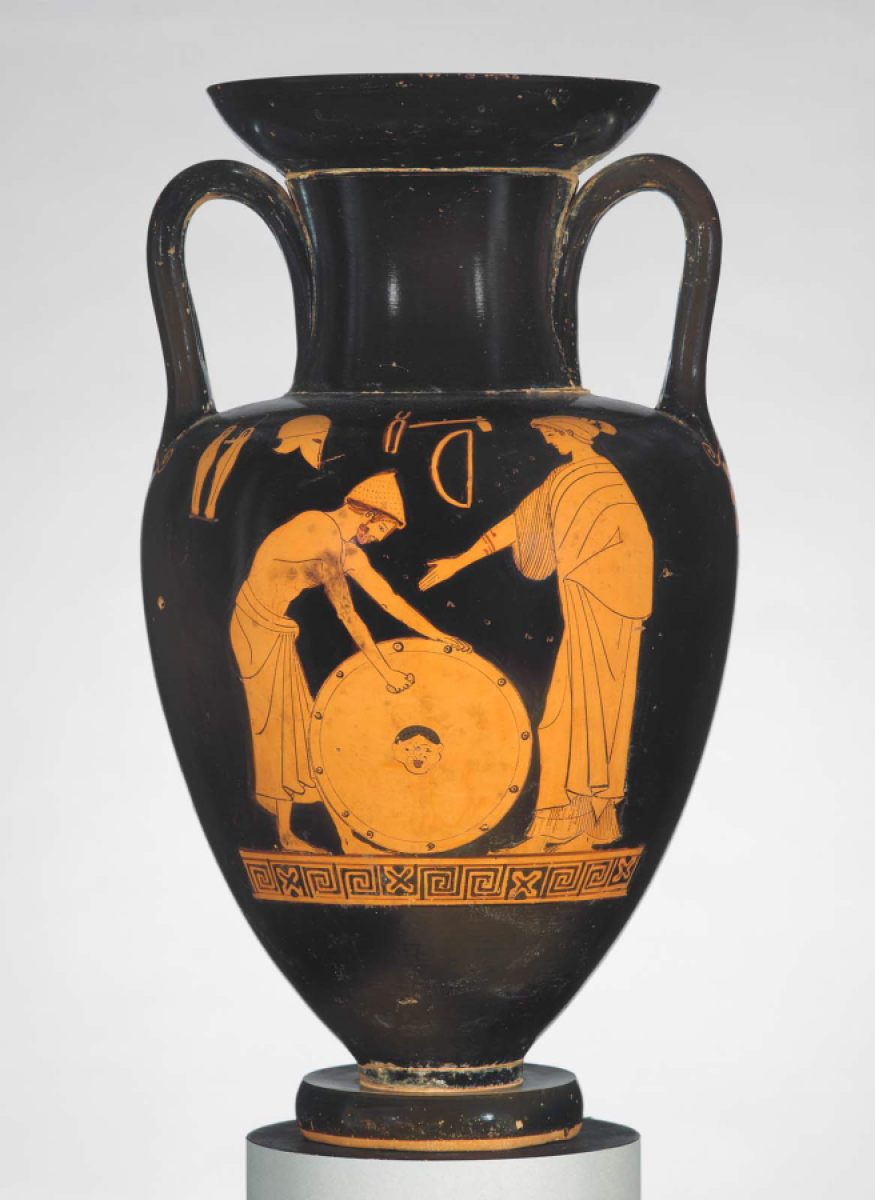
Hephaistos Polishing Achilles’ Shield – THE SHIELD OF ACHILLES. Caskey-Beazley, Attic Vase Paintings (MFA), no. 082.
The making of a canon
It is impossible for my children to imagine what Star Wars meant when I was their age. One of my first memories is seeing The Empire Strikes Back in a drive-in theater with my parents and being terrified by Darth Vader. Anyone who can remember prior to 1999 knew of Star Wars as an unfinished but finished trilogy: there were always rumors that George Lucas would return to a galaxy far away and long ago, seeded especially by the numbering of the first movie as IV, but for a decade or so it seemed like it would never happen.
To be a fan of Star Wars prior to the return of the movies was to rewatch VHS cassettes and read authorized novels and wait for random viewings of the super strange Ewok adventures, The Battle for Endor and Caravan for Courage. Part of what made Star Wars moving was its boundedness and the promise of more. As a child, I would weep at the end of Return of the Jedi because I didn’t want it to end. As an adult, I have written about our uncomfortable relationship with narrative closure, how we want it to come but we also dread it because it is the end of a world and is, in some way, an echo of our own deaths.
Episodes and Universes
There are two ways of thinking about entries or episodes in a narrative universe. For Star Wars what became canon were the movies–but the more episodes added to the list, the less stable the canon became. There’s a danger of surplus narrative and how we refer to the whole changes two. I think people mean two different things when they talk about the epic cycle. One is general, expansive: the cycle refers to the full range of narratives associated with the Trojan War. The other is an imagined canon of episodes.
So, the classic Trojan Cycle described by Proclus include the Cypria, Aithiopis, Little Iliad, Iliou Persis (Sack of Troy), Nostoi (also called, according to some, The Return of the Atreids [ἡ τῶν Ἀτρειδῶν κάθοδος], and the Telegony. We have only a handful of fragments for most of these poems Some scholars have also suggested different ‘cycles’ which would focus around heroes (a cycle of epics about Herakles, for example, the Calydonian Boar Hunt or the Argo) or centering around cities other than Troy (where a Theban cycle might include the Oidipodeia, Thebais, Epigonoi, and perhaps even the Alkmeonis). This is the one I don’t think is real.
The larger a canon is, the less effective it is in exerting authority. I think that the original Star Wars trilogy exerted a centripetal force on its audiences, pulling them together to a narrative center. As the universe expands–or as the canon multiples–its force is more centrifugal, moving audiences into clusters. This is one way I think comparing a modern entertainment ‘universe’ to Trojan War narratives is useful: the Iliad and the Odyssey were panhellenic texts that persisted in applying aesthetic pressures on other traditions and their audiences. But the narrative world of the Trojan War included countless other stories and spanned many different kinds of genres.
Often when we talk about the authority of the Homeric poems, we are talking about the cultural position they occupied in Archaic and Classical Greece as performance narratives connected to political power. This authority transformed as they moved into fixed texts and aesthetic objects for Hellenistic readers and later. Over time, they became quasi-sacred. But other stories set in the Trojan War world existed prior to our epics and kept on spinning out from a notional but fictive center: local, epichoric traditions preceded the Iliad and Odyssey and persisted well into the Christian era. The discrete episodes filled out the Universe and allowed audiences to live within them: the static nature of the canonized object is mitigated by the fluidity of ongoing traditions.
This comes clear often in accounts of ritual and local practices, like those observed by Pausanias who puts Penelope’s grave in the Peloponnese, not far from that of Aeneas’ father Anchises. What’s different, I think, about ancient Trojan War narratives is that these local or epichoric narratives developed prior to the canonized epics and continued long after. As Irad Malkin has shown in The Returns of Odysseus, as Greeks spread across the Mediterranean, they took their stories with them, adapting their myths of people like Odysseus to accommodate their new realities.
When I first watched the Mandalorian, I was simultaneously charmed and critical: prior to the new movies, you could not imagine two characters with more commercial potential than a Boba Fett analog and a baby Yoda. People my age loved Boba Fett because his action figure looked so cool. (I used to sleep with Boba as a toddler, I confess.) These characters are also tangential to the canonized storyline, they allow the space to create a new story while also still drawing on the nostalgia and cache of the center. This is part of the thrill and peril of expanding narrative traditions: the cameo of a main character in a peripheral story can be fun, but when the canon limits overmuch, the story becomes campy and over allusive (which explains, in part I think, why Rogue One works well but Solo does not).
The cultural forces of capitalism that produced the Mandalorian are, of course, different from those that perpetuated Trojan War narratives in Archaic and Classical Greece, but they remain somewhat analogous cultural forces. Both rely on audience interest and respond to changing cultural trends.
Audiences and Change
When we talk about the market forces that influence the expansion of the Star Wars universe, we are talking in part about audiences. Discussions of the epic cycle–and Homer in general–too often forget that ancient performers responded to their audiences as well. Audiences exist through time and time creates different kinds of audiences. When we talk about interpreting or making sense of cultural objects, we emphasize the intention of creators because it is so difficult to talk about the multiplicity of audiences. But I have been thinking about audiences as palimpsest. A palimpsest is a manuscript that has been cleaned and repurposed for a new text, and yet the old text can often be seen underneath it. Christos Tsagalis has used it productively as a metaphor for how oral traditions work. Yet this model is still about the object and not the people who view it. We change as individuals over time and our relationship to a text or cultural object changes from one generation to another.
I took dates to the rerelease of the original three movies in high school. When The Phantom Menace was released, I was there on the first weekend with roommates and my future wife (who purchased Star Wars legos while waiting to see the movie and assembled them during the film). And despite the exhilaration of the opening chyron and the music, I left disappointed. The second trilogy is cluttered, confused and confusing, and tries too hard to fill in the blanks of the later/earlier films. The second trilogy is both shaped and trapped by nostalgia.
Part of the problem is the difference between a backstory that is unexplained and a forced explanation. The “clone wars” as referenced in Star Wars are nebulous and strange: we know they were in the past and bad. When we get to them in the later trilogy, they lose the menace and strangeness. What was a detail in service of another narrative fails in certain ways when it is fleshed out because it does not and cannot exist on its own terms.
The later Star Wars films have a secondariness in that they both serve to fill out a preexisting story and they also attempt to establish intertexts and references to the earlier films that prevent them from truly being their own. This is part of the challenge of judging narratives that develop in the shadow of a canon: we love them because they continue the larger story, but also begrudge them for not being the originals they imitate. Indeed, when authors like Jasper Griffin critique the poems of the epic cycle–without actually having access to them–for their fantastic content or their derivative nature, they are judging them by aesthetic standards, by rules, that they can never actually attain.
But changing some of the boundaries creates new space: consider the effectiveness of different kinds of Trojan War narratives on the tragic stage. Similarly, the later film Rogue One and the television series inhabit a familiar and attractive world but have their own stories to tell. They are compelling because they do not rely on their audiences fully knowing the original trilogy, but merely being familiar with the general ‘rules’ and characteristics of the Star Wars universe. They are free to respond to contemporary concerns and to establish new narratives. Further, with the television shows especially, they benefit from different generic boundaries: the pacing of episodic television lends itself to different kinds of stories from a 120 minutes space opera.
What I am trying to say, I guess, is that the process of canonization limits narratives that try to do the same thing as the canonized object but provides space for those that forge into new genres or plots. In addition, the further from the canon that narratives go, the more space they have to respond to changing audiences. Once Lucas released Star Wars into the world as a billion dollar intellectual property, others were able to escape the canonicity, to use the familiar world to tell new stories.
Mykonos vase (Archaeological Museum of Mykonos, Inv. 2240). Decorated pithos found at Mykonos, Greece depicting one of the earliest known renditions of the Trojan Horse
Homer and Trojan War Narratives
The relationship between the later narratives of the Star Wars universe and the original trilogy has made me think a lot about the relationship between the Iliad and the Odyssey and Trojan War narratives. This analogy fails at a certain point because the Homeric epics likely had many different versions of their own narratives and were engaged with and responding to epic performance of all kinds (and not just Trojan War and heroic poems). But the main point I take with me is the willingness of audiences to engage in the expansion of narrative worlds and how narratives in the expanded Trojan War universe change based on new genres and new audiences.
One of the things I regularly emphasize about the limits of our own ability to understand ancient epic because we know so little about what ancient audiences knew or how they experienced epic. Think here of the difference between someone like me for whom Star Wars was canonical and my children who love Grogu and have always known who Luke Skywalker’s father was. They don’t labor under the same aesthetic weight either: they do not judge Phantom Menace by the standard of Star Wars because they don’t remember a time before when these films did not co-exist. The difference between the expanded Star Wars universe material and the second trilogy is that between inhabiting/exploring a world and concretizing/freezing it.
When it comes to the cultural position of the Homeric epics, we make the mistake of assuming the Iliad and the Odyssey always had the same monumental status as they gained by the end of the 5th century BCE. I have had exchanges recently with the Assyriologist Seth Sanders who has been somewhat perplexed by Classicists’ tendency to see “cycles” in ancient near eastern literature. He has remarked on how the development of fixed–or ‘charismatic texts’–occludes the varied and continuing nature of oral traditions and living narrative mythscapes. As a comparison, he points out the possibility that some texts from the Hebrew bible were transmitted as “monuments”. In calling it this, he notes he is adapting the art historian Alous Reigl’s notion of monumentality as a dialogic dynamic between a cultural artifact and an audience for whom that object defines something of their community’s past or authoritative identity.
The impulse to tell the whole story is a feature of post-canonization. Audiences yearned for more Star Wars and eventually got them. But the narrative satiety that resulted was disappointing until the limits set by the canon could be exceeded. As the Iliad and the Odyssey became canon, the Trojan War mythscape moved to another genre with different boundaries (tragedy) and different narrative traditions. There was no cycle telling the later tale until scholars of a post-canonized period felt the need for it.
The Fictive Epic Cycle
Imagine a future scholar of narrative, say in 3023, trying to make sense of the Star Wars universe. The collapse of time might very well lead them to believe that the nine movies of three trilogies were always part of an authoritative cycle. But the content and contemporary responses to the later movies would likely perplex them. The collection of stories about the Trojan War are from a much longer period in time than the mere forty years that spans the release of the Star Wars movies. We know less about the alleged poems origins than we do about their contents, but they are not centered in the same cultural space and time.
But to step back for a moment: what is the epic cycle? The ‘Epic Cycle’ most often refers to the Trojan War poems recorded by Proclus (2nd or 4th Century ce) in his Chrestomathia (appended to the Venetus A manuscript; 10th Century ce, Codex Marcianus Graecus 822) and summarized by the later Photius (9th Century ce, Patriarch). The limited fragments of these poems are conventionally dated to the 7th through 6th centuries bce. The phrase Epic Cycle refers both to the mythical events spanning from creation to the end of the race of heroes and in the same way as Proclus, in isolating a specific group of poems that tell the story of the Trojan War. There are many similarities between Proclus’ summary and the work of the mythographer Apollodorus; but there is not a one-to-one correspondence between the events of the Trojan War myths and the poems of the cycle.
Rudolf Pfeiffer suggested that kuklos meant everything that was composed by Homer, everything that was attributed to a heroic world set in the story of the Trojan War. Gregory Nagy suggests that there’s some relationship between the etymology of the name Homeros as “one who fits things together” and that the kuklos points to the whole. Marco Fantuzzi and Christos Tsagalis expand on this idea in their introduction to their 2015 handbook by suggesting that the term is “historically ambiguous” referring to the entirety of the sky, a ring composition, or anything that repeats and returns.
The dual notion of totality and repetition, I think, makes the or a kuklos an attractive concept but an impossibility in actuality. It is both a metonym and a metaphor. This reading works well if we consider kuklos as indicating potential entirety or completion rather than an actual one. In the world of performance, the terms kuklos and Homeros may rightly become signals of authority: to be Homeros is to be a singer who has the skills to bring the potential of the kuklos into reality; to assert that a story or song is part of the kuklos is to authorize it ex post facto as part of the tradition. It is both a nodding to a canon and an alteration of it.
I am only partly convinced that kuklos functioned in this way in performance traditions in Greece; I am certain, however, that it became something completely different in the hands of literate and literary scholars. There is a wider discussion of kuklika poems and kuklikoi poets among Hellenistic scholars (starting with Aristarchus of Samothrace, 3rd-2nd Centuries bce). But evidence for both the term kuklos and the practice of separating the kuklikoi poems from the Iliad and the Odyssey is often traced back to Aristotle who makes a few enigmatic references to Kuklos poetry (Elench. 171a10 7-11) and who also distinguishes Homeric epics from other poems by other poets based on assessments of quality (Poetics 1459a37). The poems (and poets) who appear in these scholarly traditions, however, do not align with Proclus’ summary. Scholars have explained this away by saying there were other cycles, e.g., those around Thebes, Herakles, or other topics.
Here is my summary of the principles to keep in mind.
There is no evidence of a series of epic poems that told the whole story of the Trojan War from the same performance tradition and period of the composition of the Iliad and the Odyssey
All of our evidence comes from Aristotle and later. The evidence is from literary scholars treating the Iliad and the Odyssey as texts.
There is evidence of long narrative poems about other traditions (e.g. Thebais)
Our emphasis on the Epic Cycle is skewed by the gravity of Homer: We have more extensive fragments from Panyassis and Aristeas than we have for anything from the epic cycle
There is significant evidence of Trojan War narratives in other genres: lyric, elegiac, iconographic contemporaneous to or even prior to the epics we possess
The Epic Cycle is an initial creation of Hellenistic scholars trying to provide narrative and aesthetic frameworks for the Iliad and the Odyssey. This initial creation has been concretized by subsequent Classical scholarship, a process intensified by some of the scholarship of the past decade.
The positivistic assumption of the epic cycle as a stable set of texts and plots reasserts textual and literary aesthetics on a system that was much more fluid and dynamic (leading to a range of interpretive problems)
And, from this, a secondary list of things we can say about the epic cycle:
Everything we know about the epic cycle is subordinate to the Iliad and the Odyssey as canonized, monumentalized epics.
This subordination occurred either as part of trying to tell the whole story of The Trojan War or as evidence of the aesthetic superiority of the Iliad and the Odyssey
The fragments and their summaries were selected to facilitate point #2 and are likely secondary or tertiary selections rather than excerpts taken from whole poems at the hands of Hellenistic editors.
The privileging of Trojan War narratives as part of these efforts has suppressed the extent and importance of non-Trojan War epics: e.g. Thebais, Oedipodea, Heraklea.
The Riddle of the Sphinx: An Attic red-figure lekythos | NGV
There are many moments while watching a show like Andor that invite audiences to think about its relationship to various narrative authorities–to the shape of the empire in the original trilogy to the future events of Rogue One. But it succeeds in part because its narrative is different enough. Successful expansions of narrative universes allow traditional narratives to respond to contemporary concerns, the way that Sophocles’ Oedipus Tyrannos turns an ancient myth to an opportunity to reflect on plague and politics in contemporary Athens. Authoritative narratives exert a special gravity on their audiences; but audiences push back too: they make these stories into vehicles for their own lives. When the stories become too inflexible, they adapt them or make new ones.
The expanding Star wars universe allows this now too, and sometimes with discomfort. One of the subplots of Mandalorian Season 3 troubled me: the presentation of the New Republic’s amnesty program and the betrayal of Dr. Pershing by Elia Kane suggests that while the attempts of the New Republic to be progressive and inclusive are more just than the fascism of the Empire (and its descendants), they remain coercive and subject to the baser impulses of human nature.
This ‘both-sides’ approach to the struggle against fascism in an imaginary universe is a reflex of our own contemporary experiences and conversations. Such a thematic reflection would likely be lost on future audiences as they treat the Star Wars narratives as part of a canonized cycle of tales. In much the same way, Trojan War stories developed in particular times and places, in responses to their audience’s experiences and needs. Subsequent scholars imposed an order and created a systemized series of tales that never truly existed, to respond to their own needs for stability and closure.
Some things cited and some things to read
Alwine, A. T., ‘‘The Non-Homeric Cyclops in the Homeric Odyssey’’, GRBS 49 (2009) 323-333.
Arft, J., and J. M. Foley. 2015. “The Epic Cycle and Oral Tradition.” In Fantuzzi and Tsagalis, 78–95.
Barker, E.T.E. 2008. “ ‘Momos Advises Zeus’: The Changing Representations of Cypria Fragment One.” In Greece, Rome and the Near East, ed. E. Cingano and L. Milano, 33–73. Padova.
Barker, E. T. E., and J. P. Christensen. 2006. “Flight Club: The New Archilochus
Fragment and its Resonance with Homeric Epic.” Materiali e Discussioni per l’Analisi dei Testi Classici 57:19–43.
———. 2008. “Oedipus of Many Pains: Strategies of Contest in Homeric Poetry.”
Malcolm Davies. The Greek Epic Cycle. London: Bristol, 1989.
Fantuzzi, M., and C. Tsagalis, eds. 2014. The Greek Epic Cycle and its Ancient Reception: A Companion. Cambridge.
Margalit Finkelberg. The Cypria, the Iliad, and the Problem of Multiformity in Oral and Written Tradition, ‹‹CP›› 95, 2000, pp. 1-11.
Lulli, L. 2014. “Local Epics and Epic Cycles: The Anomalous Case of a Submerged Genre.” In Submerged Literature in Ancient Greek Culture, ed. G. Colesanti and Giordano, 76–90. Berlin and Boston.
L. Huxley. Greek Epic Poetry from Eumelos to Panyassis, Cambridge 1969.
Richard Martin. Telemachus and the Last Hero Song, ‹‹Colby Quarterly›› 29, 1993, pp. 222-240.
Jasper Griffin. “The epic cycle and the uniqueness of Homer.” Journal of Hellenic Studies 97 (1977) 39-53.
Ingrid Holmberg “The Creation of the Ancient Greek Epic Cycle”
Malkin, I., The Returns of Odysseus: Colonization and Ethnicity, Berkeley 1998.
Marks, J., ‘‘Alternative Odysseys: The Case of Thoas and Odysseus’’, TAPhA 133.2 (2003) 209-226.
Gregory Nagy. The Best of the Achaeans: Concepts of the Hero in Archaic Greek poetry. Baltimore 1999.
Nagy, G., “Oral Traditions, Written Texts, and Questions of Authorship”, in: M. Fantuzzi / C. Tsagalis (eds.), Cambridge Companion to the Greek Epic Cycle, Cambridge 2015, 59-77.
Nelson, T. J., ‘‘Intertextual Agōnes in Archaic Greek Epic: Penelope vs. the Catalogue of Women’’, YAGE 5.1 (2021) 25-57.
Rutherford, I., “The Catalogue of Women within the Greek Epic Tradition: Allusion, Intertextuality and Traditional Referentiality”, in: O. Anderson / D. T. T. Haug (eds.), Relative Chronology of Early Greek Epic Poetry, Cambridge 2012, 152-167.
Albert Severyns. Le cycle épique dans l’école d’Aristarque. Paris: Les Belles Lettres 1928.
Albert Severyns. Recherches sur la Chrestomathie de Proclos. Paris: Faculté de Philosophie et Lettres, Liége, 1938.
Giampiero Scafoglio. La questione ciclica, ‹‹RPh››78, 2004, pp. 289-310.
Laura Slatkin. The Power of Thetis: Allusion and Interpretation in the Iliad. Berkeley 1991.
Michael Squire. The Iliad in a Nutshell: Visualizing Epic on the Tabulae Iliacae. Oxford: 2011.
Tsagalis, C., Early Greek Epic Fragments I: Antiquarian and Genealogical Epic, Berlin / Boston 2017.
Marco Fantuzzi and Christos Tsagalis. “Introduction: Kyklos, Epic Cycle, and Cyclic Poetry.” In M. Fantuzzi and C. Tsagalis (eds.). ACompanion to the Greek Epic Cycle and Its Fortune in the Ancient World. (Brill, 2014).
Martin L. West. The Epic Cycle: A Commentary on the Lost Troy Epics. Oxford: Oxford University Press, 2013.
“That famous lord of the Achaeans, Agamemnon
Will make me a wife harder to handle than Helen:
I will kill him. I will destroy his home
And take vengeance for my brothers and father…”
“Listen how it is with Hektor’s mournful tale:
He died, leaving a reputation as the best man.
The coming of the Greeks made this happen.
If they had stayed home, his value would have stayed hidden.”
Astuanassa: A handmaid of Helen, Menelaos’ wife. She first discovered positions for intercourse and wrote On Sexual Positions. Philainis and Elephantinê rivaled her in this later—they were women who danced out these sorts of wanton acts.
We have learned about this embroidered girdle, that Hera took it from Aphrodite and gave it to Helen. Her handmaid Astuanassa stole it but Aphrodite took it back from her again.
As is largely unsurprising from the perspective of Greek misogyny, excessive interest in sexual behavior is projected a female quality. Expertise beyond interest is made the province of female ‘professionals’ (slaves) who may act as scapegoats and marginal figures for the corruption of both men and women. There is a combination of such interest with an excessive emphasis on eating (and eating really well) in Athenaeus where the pleasures of the body are combined.
Athenaeus, Deipnosophists 8.335c
“Dear men, even though I have great admiration for Chrysippus as the leader of the Stoa, I praise him even more because he ranks Arkhestratos, well-known for his Science of Cooking along with Philainis who is credited with a licentious screed about sexual matters—even though the iambic poet of Samos, Aiskhriôn, claims that Polycrates the sophist started this slander of her when she was really quite chaste. The lines go like this:
“I, Philainis, circulated among men
Lie here thanks to great old age.
Don’t laugh, foolish sailor, as your trace the cape
Nor make me a target of mockery or insult
For, by Zeus and his sons in Hell
I was never a slut with men nor a public whore.
Polykrates, Athenian by birth,
A bit clever with words and with a nasty tongue,
Wrote what he wrote. I don’t know anything about it.”
But the most amazing Chrysippus combines in the fifth book of his On Goodness and Pleasure that both “the books of Philianis and the Gastronomiai of Arkhestratos and forces of erotic and sexual nature, and in the same way slave-girls who are expert at these kinds of movements and positions and who are engaged in their practice.” He adds that they learn this type of material completely and then thoroughly possess what has been written on these topics by Philainis and Arkhestratos and those who have written on similar topics. Similarly, in his seventh book, he says ‘As you cannot wholly learn the works of Philianis and Arkhestratos’ Gastronomia because they do have something to offer for living better.’ “
The sacrifice of Iphigenia is a pivotal moment in the tale of the House of Atreus—it motivates Agamemnon’s murder and in turn the matricide of Orestes—and the Trojan War, functioning as it does as a strange sacrifice of a virgin daughter of Klytemnestra in exchange for passage for a fleet to regain the adulteress Helen, Iphigeneia’s aunt by both her father and mother. The account is famous in Aeschylus’ Agamemnon and the plays Iphigenia at Aulis and Iphigenia among the Taurians by Euripides. Its earliest accounts, however, provide some interesting variations:
Hes. Fr. 23.13-30
“Agamemnon, lord of men, because of her beauty,
Married the dark-eyed daughter of Tyndareus, Klytemnestra.
She gave birth to fair-ankled Iphimede in her home
And Elektra who rivaled the goddesses in beauty.
But the well-greaved Achaeans butchered Iphimede
on the altar of thundering, golden-arrowed Artemis
on that day when they sailed with ships to Ilium
in order to exact payment for fair-ankled Argive woman—
they butchered a ghost. But the deer-shooting arrow-mistress
easily rescued her and anointed her head
with lovely ambrosia so that her flesh would be enduring—
She made her immortal and ageless for all days.
Now the races of men upon the earth call her
Artemis of the roads, the servant of the famous arrow-mistress.
Last in her home, dark-eyed Klytemnestra gave birth
after being impregnated by Agamemnon to Orestes,
who, once he reached maturity, paid back the murderer of his father
and killed his mother as well with pitiless bronze.”
This fragment presents what is possibly the earliest account of the tale of Iphigenia and contains the major elements: the sacrifice of Agamemnon’s daughter is tied to vengeance against Helen; the daughter is rescued by Artemis, made immortal and made her servant. [In some traditions she is either made immortal or made into a priestess of Artemis at Tauris]. Orestes kills the murderer of his father and his mother. Continue reading “The Names of Agamemnon’s Daughters and the Death of Iphigenia”→