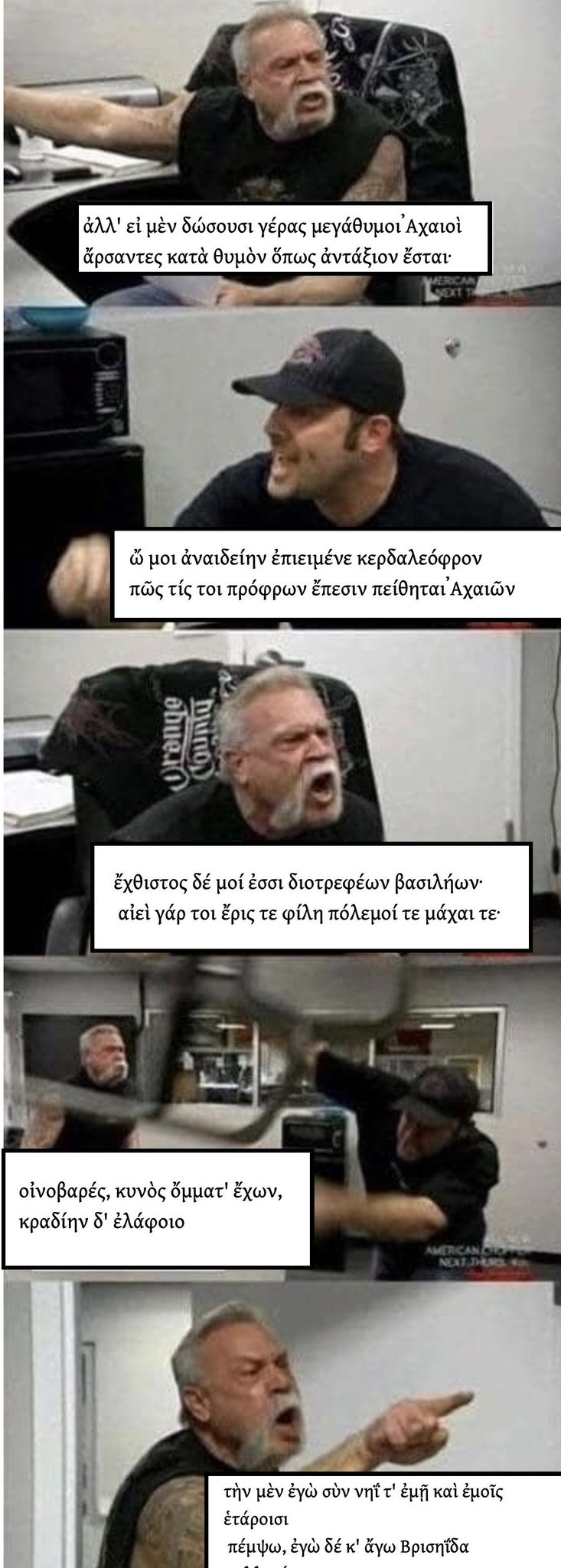
I am afraid that my work too is a camel in Egypt and people admire its bridle and its sea-purple, since even the combination of those two very fine creations, dialogue and comedy, is not enough for beauty of form if the blending lacks harmony and symmetry.
The synthesis of two fine things can be a freak—the hippocentaur is an obvious example: you would not call this creature charming, rather a monstrosity, to go by the paintings of their drunken orgies and murders. Well then, can nothing beautiful come from the synthesis of two things of high quality, as the mixture of wine and honey is exceedingly pleasant? Yes, certainly. But I cannot maintain that this is the case with my two: I’m afraid that the beauty of each has been lost in the blending.
Dialogue and comedy were not entirely friendly and compatible from the beginning.
“Mêrionês then killed Phereklos, the son of the carpenter,
Son of Joiner, who knew who to fashion all sorts of intricate tings
With his hands. Pallas Athena loved him especially.
He is the one who designed Alexander’s fantastic ships,
Those kindlers of evil which brought evil on all the Trojans
And on him especially, since he understood nothing of the divine prophecies.
Well, Mêrionês, once he overtook him in pursuit,
Struck him through the right buttock. The sharp point
Went straight through his bladder under the bone.
He fell to his knee and groaned. Then death overtook him.
Whole Schol. bT ad Il.5.59 glosses the name Phereklos as “one who brings the turmoil of war through the ships” (Φέρεκλος ὁ φέρων κλόνον διὰ τῶν νέων), I would also like to believe that name Phere-klos, might make someone think of ‘fame-bringer’. And the connection between poetic fame and the activity of the war arises elsewhere in this passage two.
Note that the this Phere-klos is the son of Harmonidês, a man who, according to the passage, is the one who build the ships “the bringers of evil” (ἀρχεκάκους) for Paris (those ships which carried him from Troy to Sparta…). The name Harmonidês is not insignificant: Gregory Nagy has etymologized Homer as “one who fits the song together”. Phereklos’ father is a “craftsman” (“tektôn”) who built the very ships that allowed his son (and Paris) to bring the conflict to Troy and generate the fame of the songs it generated. Here, the ships are positioned as the first steps in evil, but I would suggest, that as the means by which the songs themselves travel across the sea, the ships are, as products of specialized craftsmen, both metonymns for the stories themselves and necessary vehicles for their transmission.
If this is not too blinkered or mad a suggestion, perhaps Phereklos’ death here is a reassertion of the poetic power of song over the pragmatic craft of shipwrights….
“Antigonos says [of sheep intestines] that those of rams are voiceless, but those from females can sing. This fact has not escaped the poet, for he says “He stretched the seven strings from female sheep.”
I breathed a song into the air
It fell to earth, I knew not where;
For who has sight so keen and strong
That it can follow the flight of song?
Horace, Ars Poetica 347
“The string does not always return the sound that the hand and mind desire”.
neque chorda sonum reddit quem volt manus et mens.
Homer, Odyssey 21.407-409
“Just as a man who knows both lyre and song
easily stretches a string on a new peg
as he attaches the twisted sheep-gut to both sides
just so, without haste, Odysseus strung the great bow”
“Many are the swift arrows
Within the quiver
Under my arm—
They speak to those who understand,
But they lack interpreters
In every direction. Wise is the one who knows many things
by nature…”
Xenarchus’ Porphyra fr. 7 (preserved in Athenaeus’ Deipnosophists, 6. 224-225)
“Poets are ridiculous. They never invent
anything new—each one of them simply
remixes the same things again and again.
But there is no race more creative or profane
than the fish-sellers!
Since it is no longer permitted to them to dampen
Their fish, a practice forbidden by the law,
When some man completely hateful to the gods
Saw that his fish were drying, well,
He started a brawl among them quite intentionally
There were punches; he acted as if he were hit hard,
Fell to the ground pretending to pass out lying
Among his fish. Someone shouted “water, water”!
And a different guy grabbed a pitcher and poured it out—
A little on the man, but the rest on the fish!
You would have claimed they’d just been caught!”
“So he spoke, and stripping off his cloak he grabbed a discus,
Larger and wider, not a little heavier than the ones
Which the Phaeacians where throwing among one another.
He turned around and whirled it from his strong hand
And the stone boomed. Then the oar-wielding Phaeacians
Leapt to the ground, those men famous for their ships,
At the hurl of the stone. Then it flew past all of their markers,
Swiftly hurling it from his hand. Then Athena set the boundary
After taking on the form of a man, and she spoke a word and called out:
“Even a blind person, friend, could find this marker
As he felt all around, since it is not at all mixed in with the others—
No, it is first by far. Be happy at this competition–
None of the Phaeacians will come close or surpass it.”
So much-enduring Odysseus said and he laughed
Taking pleasure in the fact that he had a real friend in the game.”
Recently, I posted about the simile that helped to make me spend the last twenty years studying Homer. I did not provide the full context that really got to me for sake of brevity. After Homer compares the sides of the battle over the wall to two men struggling over a corner of a field, the slaughter is also compared to the scales of a woman measuring out wool for weaving.
Iliad 12.427-438
“Many were struck across their flesh by pitiless bronze
Whenever they turned and bared their backs
As they struggled, although many were also struck through their shields.
The towers and walls were decorated everywhere with the blood
Of men from both sides, from Trojans and Achaeans.
Yet, they still could not force the Achaians to flee—
No, it held as when an honest weaving woman holds
The balance and draws out the weight and the wool on both sides
to make them equal so she might earn some wretched wage for her children.
So the battle and the war was stretched even on each side
Until Zeus gave the glory over to Hektor
Priam’s son, who first broke through the wall of the Achaeans.”
“The equal balance of those fighting, [Homer] compared to the beam of a loom, again. For nothing is so precisely similar to an even balance. And the one weighing this out is not the mistress of the household—for she does not often trouble this much for so small an equal bit—nor is it one of the household maids—for they would not seek to make so precise a measure since they are fed by the household’s master and do not risk their nourishment if they mess up on the loom weights—but it is a woman for hire who must provide what is needed for living by the effort of her hands.”
This passage has always moved me because, as with the earlier simile, the great ‘epic’ themes and images of war were reduced to something simple, daily, and completely understandable. Even in the ancient world where many members of the audiences probably had considerably more experience of violence than we do and where most aristocratic audience members would certainly have nothing but contempt for working for a living, many probably heard a crucial echo of their own lives in this surprising comparison.
I also appreciate the way that the scholiasts here home in on how dire this woman’s position is, making the dubious but nonetheless striking claim that the household servants led less precarious lives than the woman of the simile who draws the weight so precisely because her pay—and the lives of her children—depend upon it. In a crucial way, this simile evokes the same sense of scarcity as that of the men on the field—but it adds that an all too familiar anxiety from the precarity that emerges when one lives constantly with the sense of how scarce those things we value are.
It may seem a stretch, but the image of the weaving woman evokes for me the creative power of women presented elsewhere in Homer–Helen weaves the story of her own kleos,Penelope weaves shroud whose images are never revealed. In a way, the tension prepared by the woman’s hands within the simile is a comparison for the balance of war and a metaphor for an act of creation. The epic’s plot and the audience’s experience are similarly drawn out in the narrator’s hands.
Indeed, the scarcity and precarity evoked by this simile and the one that precedes it extends the transitional moment begun with the image of the farmers to create anticipatory tension in the audience. At the epic’s middle, before we move from book 12 to 13 and to the slaughter of the Achaeans at the ships, the balance hangs ever briefly before it breaks. Hektor surges through the Achaean fortification: the balance of action fails just as the balance of the plot will too—the story of Achilles’ withdrawal will now translate into the slaughter he asked Zeus to precipitate leading to the death of Patroklos, Hektor and, ultimately, Achilles too.
MS Royal 16 Gv 56 British Library (France, 15th Century)
“Simonides said that Hesiod is a gardener while Homer is a garland-weaver—the first planted the legends of the heroes and gods and then the second braided together them the garland of the Iliad and the Odyssey.”