“Why, therefore, the reasoning would go, do you still not believe it when you see that the weaker part still exists after the person has died? Doesn’t it seem to you necessary that the part which lasts long should be preserved still in this time? Think about this when you consider what I am saying. Like Simmias, I guess, I need some kind of an analogy.
It seems to me as if someone is saying similar things when he makes the comparison of an old weaver who has died. He claims that the man is not dead, but is still somewhere safe somehow because he can provide as proof a cloak which the man wove himself and was wearing and is still safe and has not perished. And if someone were skeptical at this, he would ask whether a human being lives longer than a cloak which was used and worn and the when he answered that human beings last longer than cloaks in general, he would think he had proved that the person remains sound since the shorter-lived thing had not withered.
This, Simmias, I do not think is true. Think about what I am saying. Everyone would imagine that it is stupid when someone says this. For this weaver, although he has worn out and then woven many of these kinds of cloaks, died and disappeared long after they did when there were many of them. But he did not before the last one. Even in this the person is no weaker or less complex than the cloak.
I think that the soul responds to the same analogy and anyone who said the same things about it would seem sensible to me. The soul is longer-lived, and the body is weaker and has less time. But if you were to say that each soul wears out many bodies, or something else if it has many years—since the body wears out and could be ruined while the person still lives, but the soul could always reweave what gets worn out—whenever the soul perishes, it would the be necessary for it to have taken on its final garment and to perish before only this one. Once the soul dies then, the body would display the nature of its weakness and disappear by rotting quickly.”
Schol. ad. Od. 8.17 (On why Odysseus is only responsible for the companions in his particular ship)
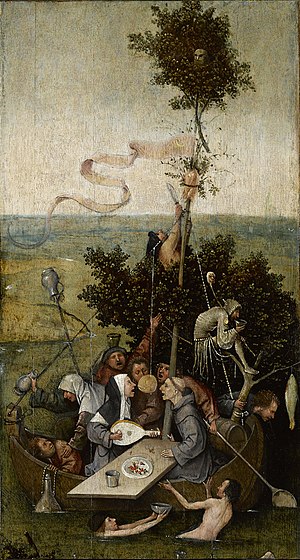
“According to the proverb “Common ship, common safety”
κατὰ τὴν παροιμίαν “κοινὴ ναῦς κοινὴ σωτηρία,”
Sophocles, Antigone 175–190 (Creon speaking)
“It is impossible to really learn a man’s
mind, thought and opinion before he’s been initiated
into the offices and laws of the state.
Indeed—whoever attempts to direct the country
but does not make use of the best advice
as he keeps his tongue frozen out of fear
Seems to me to be the worst kind of person now and long ago.
Anyone who thinks his friend is more important than the country,
I say that they live nowhere.
May Zeus who always sees everything witness this:
I could never be silent when I saw ruin
Overtaking my citizens instead of safety.
And I could never make my country’s enemy a friend
For myself, because I know this crucial thing: The state is the ship which saves us And we may make friends only if it remains afloat.”
Heraclitus the Commentator, in defending the application of allegorical readings to Homer, argues that allegory is of considerable antiquity—used clearly by Archilochus when he compares the troubles of a war (fr. 54) and by Alcaeus when he compares the troubles of a tyranny to a storm at sea. He writes that Alcaeus “compares the troubles of a tyranny to the turmoil of a stormy sea.” (τὰς γὰρ τυραννικὰς ταραχὰς ἐξ ἴσου χειμερίῳ προσεικάζει καταστήματι θαλάττης, Homeric Problems 5.8)
Alcaeus fr. 326
“I cannot make sense of the clash of the winds
One wave whirls from this side,
Another wave comes from the other, and we in the middle
Are borne in our dark ship
Toiling ever on in this great storm.
The swell has taken he mast
And the sail is completely transparent—
There are great tears through it
And the anchors have broken free…”
Alcaeus, fr. 6a [P. Oxy. 1789 1 i 15–19, ii 1–17, 3 i, 12 + 2166(e)4]
“Now this higher wave comes harder than the one before
And will bring us much toil to face
When it overcomes the ship
Let us strengthen the ship’s sides
As fast as we can and hurry into a safe harbor.
Let no weak hesitation take anyone.
For a great contest is clearly before us.
Recall your previous toil.
Today, let every man be dedicated.
And may we never cause shame
To our noble parents who lie beneath the earth”
Consider this how this could turn out on many ships or even just one: there is a captain of some size and strength beyond the rest of the men in the ship, but he is deaf and similarly limited at seeing, and he knows as much about sailing as these qualities might imply. So, the sailors are struggling with one another about steering the ship, because each one believes that he should be in charge, even though he has learned nothing of the craft nor can indicate who his teacher was nor when he had the time to learn. Some of them are even saying that it is not teachable, and that they are ready to cut down the man who says it can be taught.
They are always hanging all over the captain asking him and making a big deal of the fact that he should entrust the rudder to them. There are times when some of them do not persuade him, and some of them kill others or kick them off the ship, and once they have overcome the noble captain through a mandrake, or drugs, or something else and run the ship, using up its contents drinking, and partying, and sailing just as such sort of men might. In addition to this, they praise as a fit sailor, and call a captain and knowledgeable at shipcraft the man who is cunning at convincing or forcing the captain that they should be in charge. And they rebuke as useless anyone who is not like this.
Such men are unaware what a true helmsman is like, that he must be concerned about the time of year, the seasons, the sky, the stars, the wind and everything that is appropriate to the art, if he is going to be a leader of a ship in reality, how he might steer the ship even if some desire it or not, when they believe that it is not possible to obtain art or practice about how to do this, something like an art of ship-steering. When these types of conflicts are occurring on a ship, don’t you think the one who is a true helmsman would be called a star-gazer, a blabber, or useless to them by the sailors in the ships organized in this way?
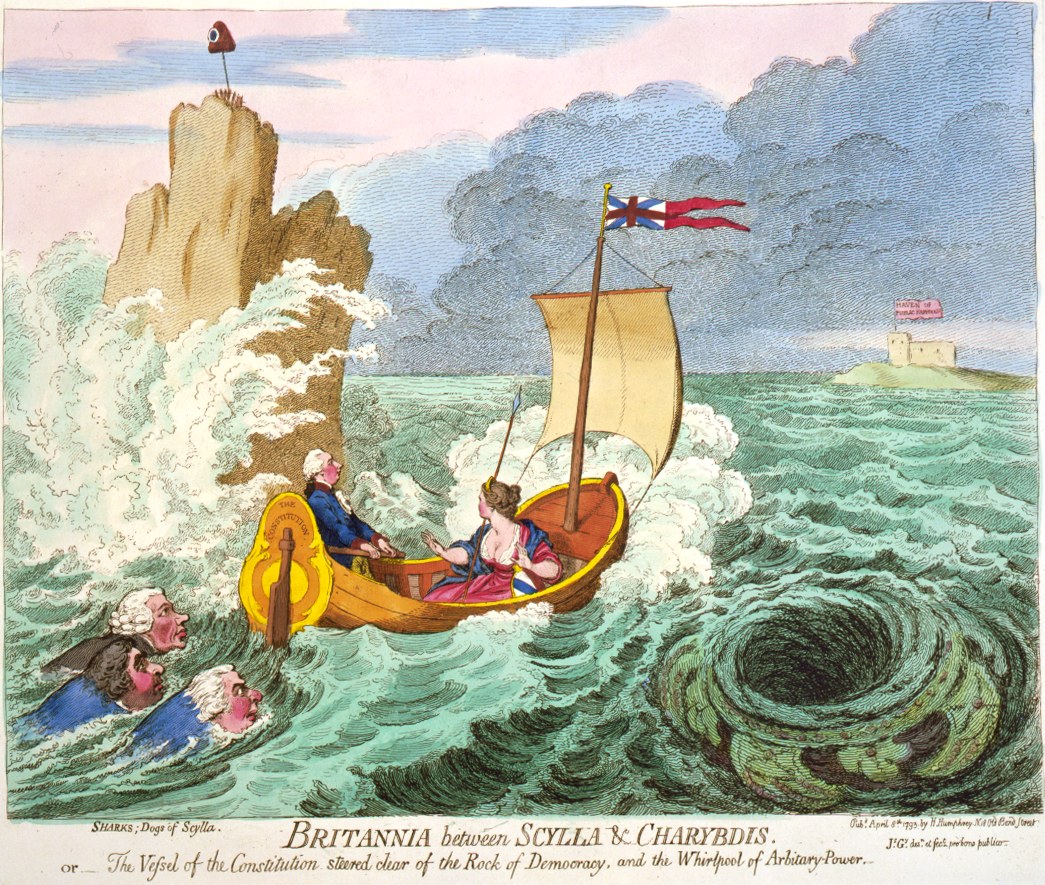
“Avoid Kharybdis and come close to Skyla.” This is similar to the saying, “I avoided it by finding a better evil”
They say about Skyla that she was a Tyrrhenian woman, something if a beast, who was a woman down to the navel but she grew dog heads beneath that point. The rest of her body was a serpent. This kind of a cerature is very silly to imagine. But here is the truth. There were the islands of the Tyrrenians, which used to raid the coasts of Sicily and the Ionian bay. There was a trirereme which had the named Skyla. That trireme used to overtake other ships often and use their food and there was many a story about it. Odysseus fled that ship. trusting a strong and favorable wind and he told this story in Corcyra to Alkinoos, how he was pursued and how he fled and what the shape of the ship was. From these stories, the myth was formed.”
“Charybdis is an obvious name for luxury and endless drinking. Homer has allegorized manifold shamelessness in Skylla, which is why she would logically have a belt of dogs, guardians for her rapacity, daring, and pugnacity. “
“But you, go away from “the smoke and the wave” and depart the ridiculous concerns of mortal life as from that fearsome Charybdis without touching it at all, don’t even, as the people say, brush it with your littlest toe.”
“For satiety seems to be becoming worn out in pleasures from the soul suffering in some way with the body, since the soul does not shirk from its pleasures. But when it is interwoven, as it is said, with the body, it suffers the same things as Odysseus, just as he was held, clinging to the fig tree, not because he desired it or delighted in it, but because he feared Charybdis lurking below him. The soul clings to the body and embraces it in this way not because of goodwill or gratitude but because it fears the uncertainty of death.
As wise Hesiod says, “the gods keep life concealed from human beings.” They have not tied the soul to the body with fleshly bonds, but they have devised and bound around the mind one cell and one guard, our uncertainty and distrust about our end. If a soul had faith in these things—“however so many await men when they die”, to quote Heraclitus—nothing would restrain it at all.”
“Why, therefore, the reasoning would go, do you still not believe it when you see that the weaker part still exists after the person has died? Doesn’t it seem to you necessary that the part which lasts long should be preserved still in this time? Think about this when you consider what I am saying. Like Simmias, I guess, I need some kind of an analogy.
It seems to me as if someone is saying similar things when he makes the comparison of an old weaver who has died. He claims that the man is not dead, but is still somewhere safe somehow because he can provide as proof a cloak which the man wove himself and was wearing and is still safe and has not perished. And if someone were skeptical at this, he would ask whether a human being lives longer than a cloak which was used and worn and the when he answered that human beings last longer than cloaks in general, he would think he had proved that the person remains sound since the shorter-lived thing had not withered.
This, Simmias, I do not think is true. Think about what I am saying. Everyone would imagine that it is stupid when someone says this. For this weaver, although he has worn out and then woven many of these kinds of cloaks, died and disappeared long after they did when there were many of them. But he did not before the last one. Even in this the person is no weaker or less complex than the cloak.
I think that the soul responds to the same analogy and anyone who said the same things about it would seem sensible to me. The soul is longer-lived, and the body is weaker and has less time. But if you were to say that each soul wears out many bodies, or something else if it has many years—since the body wears out and could be ruined while the person still lives, but the soul could always reweave what gets worn out—whenever the soul perishes, it would the be necessary for it to have taken on its final garment and to perish before only this one. Once the soul dies then, the body would display the nature of its weakness and disappear by rotting quickly.”
Some of the language used by scholiasts to designate sections of the Odyssey as spurious is based in a metaphor drawn from the legitimacy of offspring. As such, it might be rigidly authoritarian and misogynistic in emphasizing one (paternal) authority and one legitimate text.
Schol. HQ ad Od. 13.320-323
“These lines are spurious…”
νοθεύονται δ′ στίχοι.
Schol H. ad Od. 15.19
“Some people think these lines are illegitimate…”
ἔνιοι τοὺς γ′ νοθεύουσιν…
Schol. H ad Od. 15.45
“This [line] is spurious because it is adapted from a half-line from book 10 of the Iliad
I breathed a song into the air
It fell to earth, I knew not where;
For who has sight so keen and strong
That it can follow the flight of song?
Horace, Ars Poetica 347
“The string does not always return the sound that the hand and mind desire”.
neque chorda sonum reddit quem volt manus et mens.
Homer, Odyssey 21.407-409
“Just as a man who knows both lyre and song
easily stretches a string on a new peg
as he attaches the twisted sheep-gut to both sides
just so, without haste, Odysseus strung the great bow”
“Many are the swift arrows
Within the quiver
Under my arm—
They speak to those who understand,
But they lack interpreters
In every direction. Wise is the one who knows many things
by nature…”
“Sardinian Laugh”: A proverb used for people who laugh at their own death. According to Demôn it developed from the fact that the Sardinians used to sacrifice the best and the oldest of their captives each year to Cronus as they laughed to display their courage. Timaios, on the other hand, claims that men who had lived a long enough time were in the habit of laughing when they were pushed by their sons into the trenches in which they would bury them. But others claim the saying comes from smiling with devious intent.
Others say—and this includes Cleitarchus—that when they place a small child in Kronos’ hand in Carthage during their most important prayers (a bronze statue is set out with hands stretched out over a cooking pot) and after they light the fire, the boy seems to laugh as he is shriveled by the fire. But Simonides says that when the Sardinians were not willing to hand over Talos—the fabricated man—to Minos, that Talos leapt into the fire, because he was bronze, clutched them to his chest and killed them as they gasped for air.
Silenus argues in the fourth book of his On the Syracusans that there is a sweet plant similar celery which when people eat it they bite off segments of their own faces. There are also some who say that this is to laugh at danger. This is what happens when Homer says that “shining Odysseus grinned sardonically” and in other places,” she laughed with her lips, but she was not pleased under her dark brows”
“Simonides said that Hesiod is a gardener while Homer is a garland-weaver—the first planted the legends of the heroes and gods and then the second braided together them the garland of the Iliad and the Odyssey.”
κηποφύλαξ: “guardian of the garden” Od. 24. 336–339
“But, come, if I may tell you about the trees through the well-founded orchard
The ones which you gave to me—when I was a child I asked you about each
As I followed you through the garden. We traced a path through them
And you named and spoke about each one.”
Alex Purves (2010:228) retraces these steps as Odysseus “taking an imaginary walk through the orchard in his mind just as [Elizabeth] Minchin has suggested that Homer takes a cognitive walk through the Peloponnese in order to recount the Catalogue of Ships (2001: 84-7).”
Plato, Ion
“For poets certainly tell us that they bring us songs by drawing from the honey-flowing springs or certain gardens and glades of the Muses just like bees. And because they too are winged, they also speak the truth.”
Some of the language used by scholiasts to designate sections of the Odyssey as spurious is based in a metaphor drawn from the legitimacy of offspring. As such, it might be rigidly authoritarian and misogynistic in emphasizing one (paternal) authority and one legitimate text.
Schol. HQ ad Od. 13.320-323
“These lines are spurious…”
νοθεύονται δ′ στίχοι.
Schol H. ad Od. 15.19
“Some people think these lines are illegitimate…”
ἔνιοι τοὺς γ′ νοθεύουσιν…
Schol. H ad Od. 15.45
“This [line] is spurious because it is adapted from a half-line from book 10 of the Iliad
“The orator Isokrates used to say that the city of Athens was like prostitutes: men who are taken in by the beauty want to have sex with them, but no one is so totally insane that he wants to stay and live with them. In the same way, the Athenian city was a pleasurable place to visit and was quite different from all the other cities in Greece. But it was not a safe place to inhabit any more. In saying this he was indicating all of the flatterers who came from abroad and the various plots of the demagogues.”