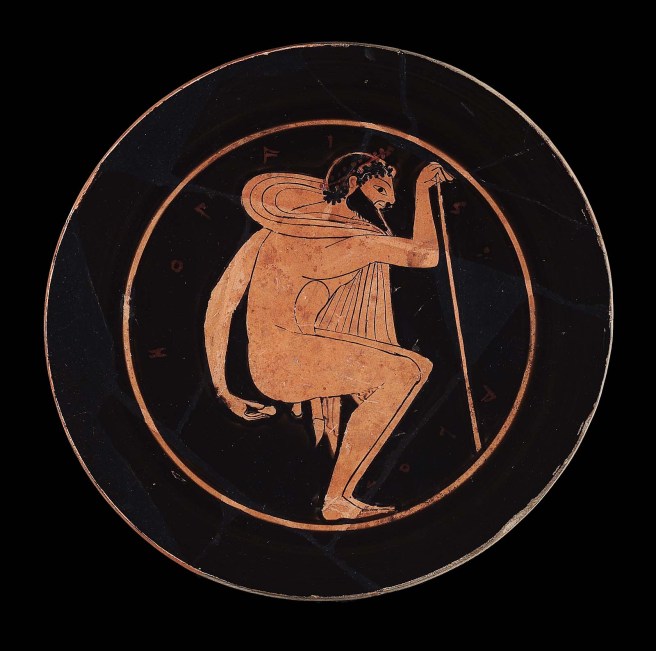
For the word-builders: messêgu (“in the middle of”) + dorpos (“dinner, meal”)+ khestês (a nomina agentis—agentive noun—from the Greek verb χέζω, “to shit”).
Since we are all about to be rendered powerless by shameless show trials, why not wrest back for ourselves a gesture appropriate to the tenor of our times.
In Aristophanes’ Peace a rude hand gesture is mentioned (549):
Καὶ τὸν δορυξὸν οἷον ἐσκιμάλισεν.
Perseus’ translation (“this sickle-maker is thumbing his nose at the spear-maker?” ) may not do justice to the gesture or its meaning. Ancient commentary glosses this in a slightly different way. (See this site for a reference to the digitus impudicus in the Clouds)
Schol ad Ar. Pax. 549
Eskimálisen: “instead of he stuck his finger up” for to skimalísai is properly to shove a finger into a bird’s anus. But when people wish to insult someone, they extend their middle finger, retract the rest, and show it.”
Apart from loving this passage’s instructions about how to give a middle finger, I am intrigued by the fact that Greeks gave the middle finger at all and by the chance that the reference to a bird’s anus might provide an amusing folk etymology for why we call it the “bird”. But, first and foremost, we can learn why the Greeks gave the finger.
A popular article in Slate claims that the middle finger is offensive because it is phallic, so sticking it up is like rudely showing someone a penis. Wikipedia says it is all about sexual intercourse. The Greek evidence, however, indicates that while phallic meaning is operative, what one does with the threatened phallus is truly insulting (at hubris levels even!). So, let’s go through some of the extant evidence.
We have some confirmation of the synonymy the scholion indicates between giving the middle finger and sticking a finger in an anus:
Phrynichus, 83.15
Katadaktulizein: “to wantonly touch through the rectum with a finger. Attic Greeks use the term skimalizein.
There is also a proverb recorded that repeats much of the same material as we find in the scholion.
Michal. Apostol. Parom. 7.98
“You should get fingered” : [This is a proverb applied] for those worthy of insult. For skimalísai means when someone wants to insult someone, people raise their middle finger, retract the rest, and show it. Properly, this indicates shoving a finger into a bird’s anus.”
The Suda pretty much provides the same information but with an opening alternative:
“Eskimalisen: [This is when] one insults by joining thumb and middle finger and striking them. Or, instead it means to give the finger [katedaktulise]: for “to finger” is, properly, to place your middle finger into a bird’s anus. But it is not only this: whenever people want to insult someone, they stretch out their middle finger, withdraw the rest, and show it. So Aristophanes says: “[see] how he fingered the spear-maker.”
In another entry we find a more abstract use of the verb with several options for translation. (There is also an explanation about why people are sticking fingers in birds.) Don’t sleep on the Suda: the entry combines agricultural information with an anecdote from philosophy:
Skimalisô: “I treat as nothing; I mock; I grab with a little finger as I would a woman’s ass”. Skimalizein means to examine with a little finger, to see if chickens are about to lay eggs.
When two men were resting above at one of Zeno’s drinking parties, and the one below him was sticking his foot in the other’s ass, and Zeno was doing the same thing to him with his knee, he turned around and said, “what kind of pain do you think you were causing the man below you?”
The entries from the Suda are pretty far removed from the time of Aristophanes’ Peace (only 1500 years or so). Although the steady tradition from the scholia through the lexicographers indicates some consistency, we still need a little more to help flesh this out.
So, a final piece of evidence to wrap this all up. One of the words for the middle finger in Attic Greek is καταπύγων (a meaning attested by both Photius and Hesychius: Καταπύγων: ὁ μέσος δάκτυλος). This word, when not referring to fingers, generally indicates someone “given to unnatural lust” (LSJ) or one who is lecherous, derived from the preposition kata and the noun pugê (buttocks, ass). The point, if I may, is that the middle finger in this colloquialism is directly associated with something that goes deep in the buttocks.
To stay with the assertion in Slate, as the largest finger, the middle finger raised does seem to have a phallic association, but in the Greek usage at least the showing of such a phallic symbol is a threat of its use. Based on the association of the gesture and the word for the middle finger with “wantonness”, the gesture threatens deep anal penetration, a threat like Catullus’ pedicabo (“I will sexually violate your ass”). Google searches will find this answer, but without the pleasant lexical tour!
A FALISCAN BLACK-GLAZED ASKOS | CIRCA 4TH CENTURY B.C. | Ancient Art & Antiquities Auction | Ancient Art & Antiquities, vases | Christie’s from Pinterest
But lest you fear that the gesture is now too base and vulgar to be used, no less a luminary than the philosopher Diogenes employed it:
Diogenes Flips off Demosthenes (Diogenes Laertius, 6.34 and 35)
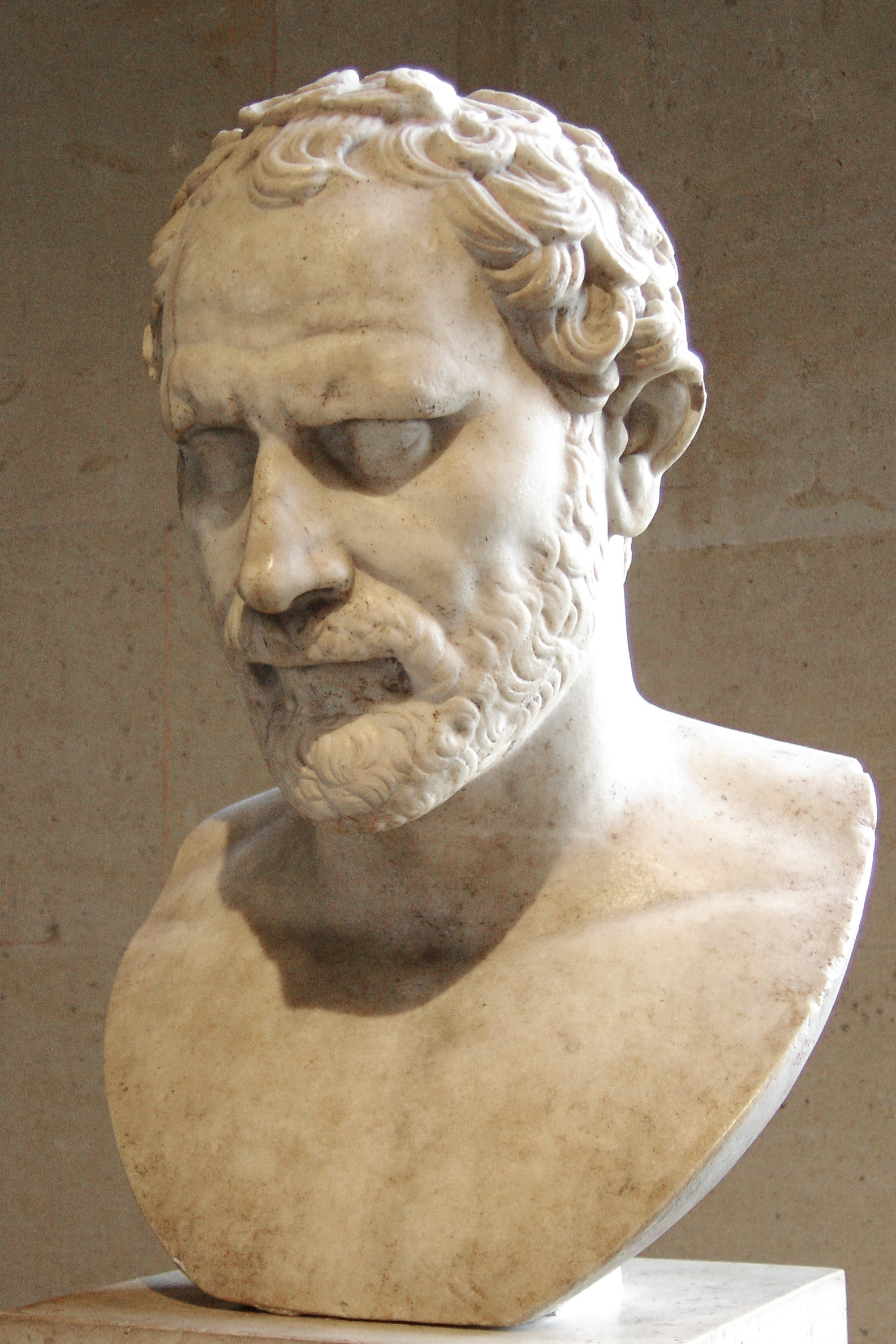
Once, when some foreigners wanted to see Demosthenes, he put up his middle finger, and said, “this is the Athenian demagogue!”
“[Diogenes] used to say that most people were a single finger away from insanity. If someone walks around holding out his middle finger, he seems nuts. But if he is holding his index, he doesn’t.”
“Hesitation is fear of future action. Agony is fear of failure and otherwise fear of worse outcomes. Shock is fear of an uncustomary surprise. Shame is fear of a bad reputation. A ruckus is fear pressing down with sound. Divine fright is fear of gods or divine power. Terror is fear of a terrible thing. A fright is fear that comes from a story.”
“Fear: flight or cowardice. Fear is expecting evil. These emotions are categorized as fear: terror, hesitation, shame, shock, commotion, anxiety. Terror is fear that brings dread. Hesitation is fear about future action. Shame is fear about a bad reputation. Shock is fear from an unusual thing. Commotion is fear from a striking sound. Anxiety is fear of an uncertain matter.”
This popped into my mind for no particular reason.
μύκης, μύκητος: “mushroom”…2. membrum virile
Herodian. Anecd. Ox. iii.231.5 = Archilochus 252
“Mushroom: can also mean a man’s genitals—which is what Archilochus says when he presents it with the same number of syllables: “The tendons of my ‘mushroom’ were ruptured.”
Beekes, Etymological Dictionary of Ancient Greek 2010
Dio Cassius, Rom. Hist. Ep. 41
“Nero has also left for us a saying worth remembering. For he used to say that mushrooms were food of the gods because [Claudius] became a god thanks to a mushroom”
“The young daughter of Pausanias ate a raw mushroom and felt nausea, choking, and stomach pain. Drinking warm melicrêt and puking relieved her along with a warm bath. She puked up the mushroom in the bath and she sweated while she was getting better”
How does one say “shithole” in Ancient Greek?As with other such esoteric considerations, this takes us into the depths of metaphor and meaning. Is a “shithole” a place whence shit emerges or one in which shit properly settles to age? To be more pointed, when we say “shithole”, do we mean the rectum (so is it a synonym for “asshole”) or do we mean a receptacle too primitive and unformed to be graced with the designation ‘toilet’?
I think when the leader of what was once the free world uses the term , he probably means the second meaning–that the countries designated so are “primitive”, bereft of proper sanitation, and, as such, both filled with excrement (in his excitable mind) and a worthy place for excrement to stay. Thanks to the magic of the conceptual metaphor, of course, the “shithole” can simultaneously indicate both origin and receptacle. One reason it is terribly racist is that the people who move from one to the other or inhabit them are, by extension, excrement.
Because I process trauma and horror through ancient Greek and lexicography, I need to ‘own’ this word by putting it in Greek. I think the stronger force of this metaphor is the location of discarded shit not the organ of excretion. Ancient Greek does not have a clear parallel (and believe me, gentle reader, I looked). I would love to hear some other suggestions. I put the call on Twitter.
The best suggestion, I think, is σκατοχάσμα (skatokhasma, see below). I like it because it has clear parallels (e.g. skatophage). Also, it sounds like “shit-gasm” which is what I think happens every time a certain chief executive speaks. Weaknesses: khasma is not very productive in ancient Greek compounds and is also rather ‘epic’ in scope. In English, “hole” is dimunitive a small. Shitholes are thus additionally awful because of their insignificance.
Honorable Mentions: τὸ σκατώρυγμον (skatorugmon). this has the sense of something hastily and poorly made by people. Also, κοπροβάραθρον is, as one correspondent declared, totally “metal” and, really epic. (Also, coprophilia is something the captain of our ship might cop to). The Lexicographer Zonaras treats all three of these nouns as synonyms (“Barathron: A ditch. A depth. The maw of the earth.” Βάραθρον. ὄρυγμα· βάθος· χάσμα γῆς). For me, barathron is mythical; orugmon is man-made, and khasma is more generic and ‘natural’. I prefer it, in sum, because of its huuugeness. It is really big. And the speaker mentioned above doesn’t do anything small.
The Suda has the following anecdote which seems to be taken and altered from Diogenes Laertius or something similar.
“thunderous-mouth-milling”: Eubulides says this “the eristic, asking his horn questions and discombobulating the orators with his falsely-intellectual arguments, taking with him the “thunderous-mouth-milling” of Demosthenes.
ῥομβοστωμυλήθρη (lit. “thunderous-mouth-milling” (?) seems to be a misunderstanding or humorous take on ῥωποπερπερήθρη, usually translated as “braggadocio” but is more like “cheap/petty bragging”
From Diogenes Laertius, Lives of the Eminent Philosophers 2.10
“The eristic Euboulides, asking questions about horns
And discombobulating the speakers with his falsely-intellectual arguments
Has gone off, taking the petty self regard of Demosthenes with him
For it seems that Demosthenes was a student of Eubulides and was able to stop his problems with the letter ‘r’ because of it. Eubulides was also in conflict with Aristotle and undermined him a lot.
“How, then, is it possible to prove that Clodius conspired against Milo? For such an audacious, nefarious monster it is enough to show that he had a great reason, that great hope resided in the death of Milo, and that there was great purpose to it. And so, let that proverb of Cassius “Who profited from it?” [cui bono fuerit] frame the players on the stage, if truly good men are compelled to deception by no prize while the wicked often are moved by a small one.
Once Milo was killed, Clodius advanced in these ways: not only was he as a praeter under no consul who would do something about his crime, but he was also a praeter serving under consuls with whose plans if not their actually help he hoped that he would be able to get away with his planned insanities. These men, as I am sure we were thinking, would not want to restrain his actions if they could, since they would think about the great benefit they owed him; men who, even if they wanted to, would hardly be capable of squashing the boldness of the most criminal person, an audacity fully strengthened by time.”
Quonam igitur pacto probari potest insidias Miloni fecisse Clodium? Satis est in illa quidem tam audaci, tam nefaria belua docere, magnam ei causam, magnam spem in Milonis morte propositam, magnas utilitates fuisse. Itaque illud Cassianum, “cui bono fuerit,” in his personis valeat, etsi boni nullo emolumento impelluntur in fraudem, improbi saepe parvo. Atqui Milone interfecto Clodius haec adsequebatur, non modo ut praetor esset non eo consule, quo sceleris nihil facere posset, sed etiam ut eis consulibus praetor esset, quibus si non adiuvantibus, at coniventibus certe speraret posse se eludere in illis suis cogitatis furoribus: cuius illi conatus, ut ipse ratiocinabatur, nec cuperent reprimere, si possent, cum tantum beneficium ei se debere arbitrarentur, et, si vellent, fortasse vix possent frangere hominis sceleratissimi conroboratam iam vetustate audaciam.
The famous Lucius Cassius, whom the Roman people used to consider the most truthful and wisest judge, often used to say in evaluating cases “who stood to profit” [cui bono fuisset]. This is the human way: no one pursues a crime without the hope of some profit.”
Cassius ille, quem populus Romanus verissimum et sapientissimum iudicem putabat, identidem in causis quaerere solebat, “cui bono” fuisset. Sic vita hominum est, ut ad maleficium nemo conetur sine spe atque emolumento accedere.
Roman Coin depicting Vestal Virgin on one side and L. Cassius on the other (he famously prosecuted the Vestal Virgins for not being chaste)
“I cannot think…or figure out any reason why
I might impeach him. What would let you accuse someone
Who is honorable, if he is good? And if he is not honorable
What would let you impeach him if he thinks it is but a
Minor thing?”
Nequeo . . .
qua causa accusem hunc exputando evolvere.
Nam si veretur quid eum accuses qui est probus?
Sin inverecundum animi ingenium possidet,
quid autem accuses qui id parvi auditum
aestimet? . . .
Aristophanes fr 228 = Suda sigma 290
“Shaking-down”: Blackmail, this is a metaphor from people who shake trees: “I was shaking them down, I demanded money, I was threatening them and was extorting them again and again.”
“From there for nine days I was carried by ruinous winds
over the fish-bearing sea. On the tenth we came to the land
of the Lotus-Eaters where they eat the florid food.
There we disembarked to the shore and we drew water;
soon my companions made dinner around the swift ships.
But after we had shared the food and drink
I sent out companions to go and discover
whatever men there were who ate the fruit of the earth.
I chose two men and sent a herald as a third.
They went and met the Lotus-eating men.
The Lotus-Eaters didn’t bring any harm to my companions,
but they gave them their lotus to share.
Whoever ate the honey-sweet fruit of the lotus
no longer wished to report back or return home,
but just longed to stay there among the Lotus-eating men
to wait and pluck the lotus, forgetting his homecoming.”
The scholia present reactions to this passage that are not altogether alien from some arguments in the debate about drug enforcement and addiction.
One scholiast quotes Heraclitus the Paradoxographer with approval, noting that this scene is about how the wise man can resist pleasure.
Schol. T ad. Od. 9 89
“From Herakleitos. If someone wishes to examine Odysseus’ wanderings precisely, he will find an allegorical tale. For he has set up Odysseus as something of a vehicle of every kind of virtue through which he has philosophized. And then he resists the vices that corrupt human life: the land of the Lotus-eaters represents pleasure, a land of foreign corruption which Odysseus masterfully passes by, and then he settles the wild heart of each man with either chastisement or persuasion.”
Another commentator actually speaks of the Lotus-eaters as just men. This author implies that Odysseus’ men choose to take the drugs. Therefore, the blame is on them.
Schol. Q ad Od. 9.92
“Because they are righteous men, the [Lotus-eaters] do not restrain anyone by force, but by persuasion. For in the word “they were devising” it is clear that the ruin which attends these men does not happen without their consent. For, because the Lotus-eaters are righteous men, they were detaining no one by force but they were bewitching them with words alone.”
And another comment explains that the men who partake of the lotus don’t actually forget their homecoming, but they merely stop worrying about it. Because, you know, it is their fault.
Schol. HQ ad Od. 9.97
“They forgot their homecoming” This follows from their nature, as it happens with the irrational animals, that the Lotus brings them forgetfulness and because of pleasure they spurn their homecoming. The sentiment is similar to the Iliad’s “they forgot their rushing valor”—they did not really forget it, but they stopped fostering it.”
In these three cases, drug addiction is treated as an individual responsibility and not as either a biological challenge [e.g. addiction as a disease] or a social problem [an act of oblivion in a society with no collective meaning or sense of belonging].