“May you fall into Hades’ asshole”: [a curse]: may you die.
῞Αιδου πρωκτῷ περιπέσῃς: ἤγουν τελευτήσῃς.
Note: Even though Ancient Greek prôktos can merely mean “rear end” (as in butt), it most often means ‘anus’ in comedy and insults. Also, I wanted to use something profane and given the British/American divide on arse/ass, I decided just to go with “asshole” because it is funnier.
Diogenianus (v.1 e cod. Marz. 2.42)
“I wish you’d fall into Hades’ asshole”: this is clear
῞Αιδου πρωκτῷ περιπέσοις: δῆλον.
Diogenianus (v.2 e cod. Vindob. 133, 1.97 )
“I wish you’d fall into Hades’ asshole”: Used for cursing someone
“The asshole survives the bath” [or, “Ass surpasses the bath”]. Whenever someone is not able to wash himself, but his bowels still assail him. This is a proverb used for things done uselessly.
“The asshole survives the bath”: This proverb is used for things done uselessly and done for show. For people with thick asses and potbellies are not able to wash themselves off easily.”
“It was cured by Akesias”: this is a proverb for when things are healed for the worse. Aristotle provides the proverb in tetrameters: “Akesias healed his asshole.”
Apopatêma: this is the same as ‘dung’ Eupolis has in his Golden Age: “What is that man? Shit of a fox.” And Kratinus has in Runaway Slaves: I knocked Kerkyon out at dawn when I found him shitting in the vegetables.” We also find the participle apopatêsomenoi (“they are about to shit”) which means they are going to evacuate the feces from their bodies. But patos also means path.
Aristophanes writes “No one sacrifices the old way any more or even enters the temple except for the more than ten thousand who want to shit. So, apopatos is really the voiding of the bowels. Aristophanes also says about Kleonymous: “He went off to shit after he got he army and shat for ten months in the golden mountains? For how long was he closing his asshole? A whole turn of the moon?”
“By a Lemnian Hand: [meaning] cruelly and lawlessly. This is from a story: for they say that the women in Lemnos allegedly killed their husbands because they weren’t having sex with them”
A few years ago I was looking up some odd word or another in the work of the lexicographer Hesychius (ok, to be honest, I was looking up words for feces and was looking at κοκκιλόνδις· παιδὸς ἀφόδευμα; kokkilondis: “a child’s excrement”). I found the following words which are pretty much absent from all modern lexica.
Kikkasos: the sweat flowing from between the thighs
κίκκασος· ὁ ἐκ τῶν παραμηρίων ἱδρὼς ῥέων.
Kikkê: Sex. Or the bad smell [that comes] from genitals
κίκκη· συνουσία. ἡ ἀπὸ τῶν αἰδοίων δυσοσμία
Obviously, the specificity of these two lexical items is amusing. But their very existence perplexed me a bit. Where did they come from? How were they used? (They don’t actually appear anywhere but in Hesychius.) After some contemplation and a little restraint, I can only conclude that the words emerge from a generally misogynistic context which also considered sex in some way unclean.
The story that I kept thinking of was that of the Lemnian women—it is one of the few connections I could make between sex and bad smells. It is also one of my least favorite myths because it echoes modern misogynistic taboos which marginalize and alienate female bodies. So, I almost didn’t write this post. But I do think that it is worth making these connections, however uncomfortable they are.
Here are two versions of the Lemnian women tale.
Apollodorus, 1.114
“Jason was the captain of the ship as they disembarked and neared Lemnos. The island then happened to be bereft of men and was ruled by Hypsipyle, Thoas’ daughter, for the following reason. The Lemnian women used not to honor Aphrodite. She cast a terrible smell upon them and, for this reason, their husbands acquired spear-won women from Thrace and slept with them.
Because they were dishonored, the Lemnian women slaughtered their fathers and husbands. Hypsipyle alone spared her father Thoas by hiding him. After they landed on the women-controlled island, they slept with the women. Hypsipyle gave birth to sons after sleeping with Jason: Eunêos and Nebrophonos.”
“The story goes like this: Because the Lemnian women had carried out the honors for Aphrodite improperly, the goddess inflicted a bad smell upon them: for this reason, men turned them away. They all worked together and killed their husbands in a plot. Then the Argonauts, as they were travelling to Skythia, arrived in in Lemnos; when they found that the island was bereft of men, they slept with the women and then left. The sons who were born from them went to Sparta in search of their fathers and, once they were accepted among the Lakonians, they became citizens there and settled in Sparta.
This tale seems to combine with a larger treatment of Lemnos as clear from the proverb above and this one:
A proverb from Zenobius (4.91)
“A Lemnian evil”: A proverb which they say comes from the lawless acts committed against husbands by the women of Lemnos. Or it derives from the story of the women who were abducted from Attica by the Pelasgians and settled in Lemnos. Once they gave birth, they taught their sons the ways and the language of the Athenians. They honored each other and ruled over those who descended from Thracians. Then the Pelasgians, because they were angry over this, killed them and their mothers. Or the proverb derives from the bad smell of the Lemnian women.”
The story of the Lemnian crimes (Lêmnia Erga) is told by Herodotus (6.137-138): the Pelasgians were driven out of Attic and took Lemnos; then they got their revenge by abducting Athenian women during a festival. When the sons of these women grew up, they frightened the native Pelasgians and they were all killed.
In the major tales, it is clear that the women are not completely at fault, but they are the ones who seem to suffer the most. Within the broader narrative of the Argonaut tale, especially, we can see how women are defined by their bodies as loci of sexual interest or disinterest, the ability to produce children, and anxiety that they might not remain subordinate to male desire. The casual detail of the Pelasgian tale is especially harrowing.
Since we have a short time left to salute a certain someone…
In Aristophanes’ Peace a rude hand gesture is mentioned (549):
Καὶ τὸν δορυξὸν οἷον ἐσκιμάλισεν.
Perseus’ translation (“this sickle-maker is thumbing his nose at the spear-maker?” ) may not do justice to the gesture or its meaning. Ancient commentary glosses this in a slightly different way. (See this site for a reference to the digitus impudicus in the Clouds)
Schol ad Ar. Pax. 549
Eskimálisen: “instead of he stuck his finger up” for to skimalísai is properly to shove a finger into a bird’s anus. But when people wish to insult someone, they extend their middle finger, retract the rest, and show it.”
Apart from loving this passage’s instructions about how to give a middle finger, I am intrigued by the fact that Greeks gave the middle finger at all and by the chance that the reference to a bird’s anus might provide an amusing folk etymology for why we call it the “bird”. But, first and foremost, we can learn why the Greeks gave the finger.
A popular article in Slate claims that the middle finger is offensive because it is phallic, so sticking it up is like rudely showing someone a penis. Wikipedia says it is all about sexual intercourse. The Greek evidence, however, indicates that while phallic meaning is operative, what one does with the threatened phallus is truly insulting (at hubris levels even!). So, let’s go through some of the extant evidence.
We have some confirmation of the synonymy the scholion indicates between giving the middle finger and sticking a finger in an anus:
Phrynichus, 83.15
Katadaktulizein: “to wantonly touch through the rectum with a finger. Attic Greeks use the term skimalizein.
There is also a proverb recorded that repeats much of the same material as we find in the scholion.
Michal. Apostol. Parom. 7.98
“You should get fingered” : [This is a proverb applied] for those worthy of insult. For skimalísai means when someone wants to insult someone, people raise their middle finger, retract the rest, and show it. Properly, this indicates shoving a finger into a bird’s anus.”
The Suda pretty much provides the same information but with an opening alternative:
“Eskimalisen: [This is when] one insults by joining thumb and middle finger and striking them. Or, instead it means to give the finger [katedaktulise]: for “to finger” is, properly, to place your middle finger into a bird’s anus. But it is not only this: whenever people want to insult someone, they stretch out their middle finger, withdraw the rest, and show it. So Aristophanes says: “[see] how he fingered the spear-maker.”
In another entry we find a more abstract use of the verb with several options for translation. (There is also an explanation about why people are sticking fingers in birds.) Don’t sleep on the Suda: the entry combines agricultural information with an anecdote from philosophy:
Skimalisô: “I treat as nothing; I mock; I grab with a little finger as I would a woman’s ass”. Skimalizein means to examine with a little finger, to see if chickens are about to lay eggs.
When two men were resting above at one of Zeno’s drinking parties, and the one below him was sticking his foot in the other’s ass, and Zeno was doing the same thing to him with his knee, he turned around and said, “what kind of pain do you think you were causing the man below you?”
The entries from the Suda are pretty far removed from the time of Aristophanes’ Peace (only 1500 years or so). Although the steady tradition from the scholia through the lexicographers indicates some consistency, we still need a little more to help flesh this out.
So, a final piece of evidence to wrap this all up. One of the words for the middle finger in Attic Greek is καταπύγων (a meaning attested by both Photius and Hesychius: Καταπύγων: ὁ μέσος δάκτυλος). This word, when not referring to fingers, generally indicates someone “given to unnatural lust” (LSJ) or one who is lecherous, derived from the preposition kata and the noun pugê (buttocks, ass). The point, if I may, is that the middle finger in this colloquialism is directly associated with something that goes deep in the buttocks.
To stay with the assertion in Slate, as the largest finger, the middle finger raised does seem to have a phallic association, but in the Greek usage at least the showing of such a phallic symbol is a threat of its use. Based on the association of the gesture and the word for the middle finger with “wantonness”, the gesture threatens deep anal penetration, a threat like Catullus’ pedicabo (“I will sexually violate your ass”). Google searches will find this answer, but without the pleasant lexical tour!
A FALISCAN BLACK-GLAZED ASKOS | CIRCA 4TH CENTURY B.C. | Ancient Art & Antiquities Auction | Ancient Art & Antiquities, vases | Christie’s from Pinterest
But lest you fear that the gesture is now too base and vulgar to be used, no less a luminary than the philosopher Diogenes employed it:
Diogenes Flips off Demosthenes (Diogenes Laertius, 6.34 and 35)
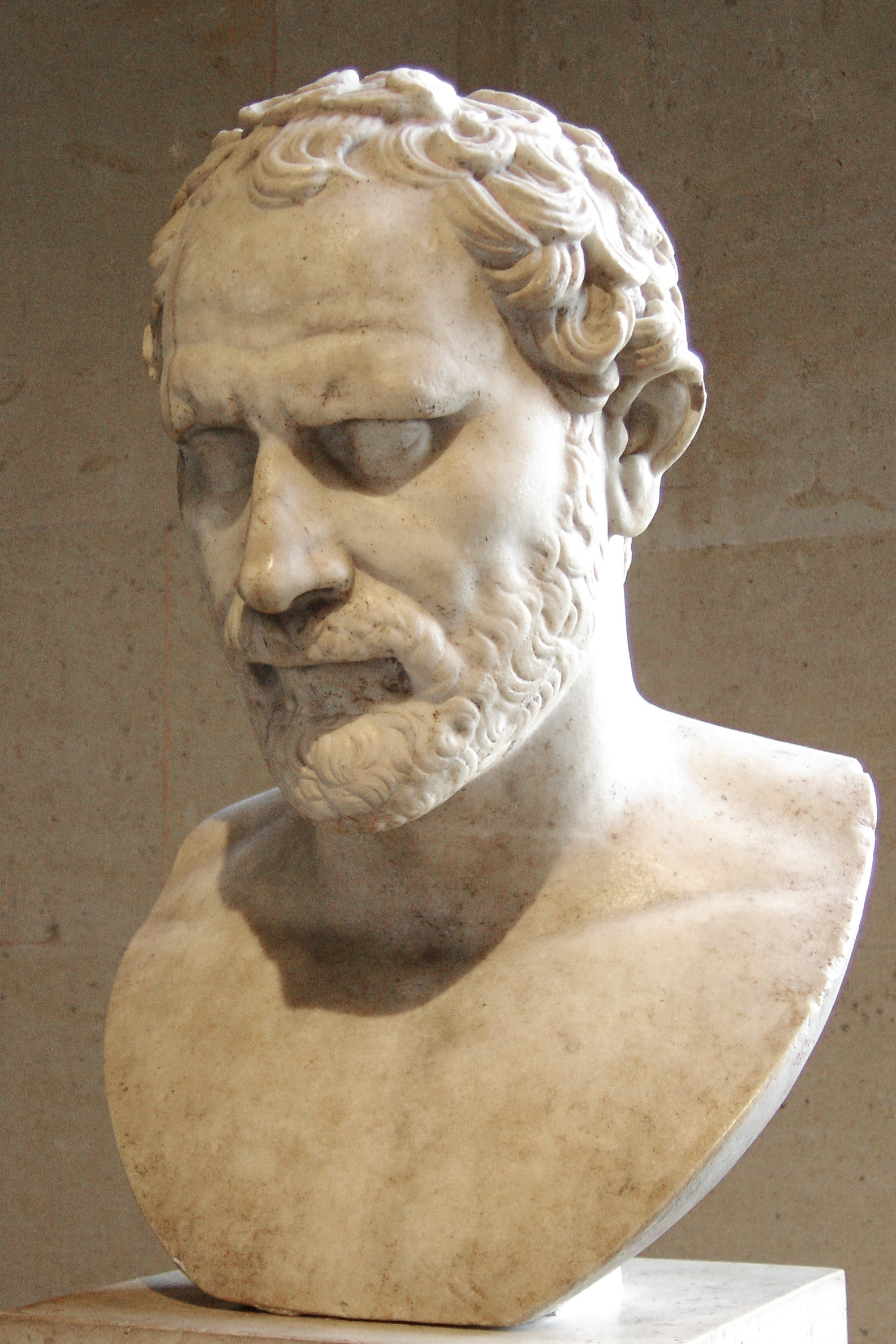
Once, when some foreigners wanted to see Demosthenes, he put up his middle finger, and said, “this is the Athenian demagogue!”
“[Diogenes] used to say that most people were a single finger away from insanity. If someone walks around holding out his middle finger, he seems nuts. But if he is holding his index, he doesn’t.”
The Suda has the following anecdote which seems to be taken and altered from Diogenes Laertius or something similar.
“thunderous-mouth-milling”: Eubulides says this “the eristic, asking his horn questions and discombobulating the orators with his falsely-intellectual arguments, taking with him the “thunderous-mouth-milling” of Demosthenes.
ῥομβοστωμυλήθρη (lit. “thunderous-mouth-milling” (?) seems to be a misunderstanding or humorous take on ῥωποπερπερήθρη, usually translated as “braggadocio” but is more like “cheap/petty bragging” From Diogenes Laertius, Lives of the Eminent Philosophers 2.10
“The eristic Euboulides, asking questions about horns
And discombobulating the speakers with his falsely-intellectual arguments
Has gone off, taking the petty self regard of Demosthenes with him
For it seems that Demosthenes was a student of Eubulides and was able to stop his problems with the letter ‘r’ because of it. Eubulides was also in conflict with Aristotle and undermined him a lot.
Someone asked me to put together a post on nostos. Here’s what I got. I am happy to add anything someone else can find. This is far from exhaustive.
The Greek noun nostos (“homecoming”) is mostly reconstructed as a reflex of a verbal root neomai (“to come or go”) but its semantic range drifts to include ideas of salvation and rescue.
From Beekes’ Etymological Dictionary of Ancient Greek (2010)
In early Greek poetry, nostos is a song that is about homecoming. On this, see Nagy 1999 [1997], 97; Murnaghan 2002, 147. Douglas Frame (1978) argues that it also means “return to light and life” whereas Anna Bonifazi adds “salvation not death”. For more on the nostoi as a tradition, see the discussion and bibliography in Barker and Christensen 2015. Gregory Nagy surveys the meaning of the term nostos in the Odyssey as return and a song of homecoming in his Ancient Greek Hero in 24 Hours.
In later Greek, the term retained much of this meaning but, as I will show below, it can also mean “sweetness”. The thematic and proverbial power of the poetic tradition seems to have kept this specialized meaning as primary as the language developed.
From E.A. Sophocles “Dictionary of Byzantine Greek”
Our English word nostalgia comes from a post-classical Latin compound which has deep resonance with Greek epic, especially Odysseus. Odysseus has thematic associations with algea (neuter plural for algos, “grief, pain”). Our modern meaning of “acute longing for familiar surroundings” or “sentimental longing for a period of the past (OED online)” may draw on ancient poetic associations. A nostos is a return to the home, which is symbolically a return to the past. Ultimately, it is partly a futile wish because neither home nor person (neither the past, nor the rememberer) remain the same.
Nostalgia was originally coined by Johannes Hofer in 1688 for a pathological mental disorder, a type of mania that involved longing for the past. Some modern psychological studies still examine the phenomenon. It has been described as both parafunctional in undermining a sense of well-being and rootedness in the future (Verplanken 2012) and as a useful resource of memory which can help reinforce identity against existential threats (Routledge et al 2012 and Sedikedis and Wildschut 2016).
The ancient etymological dictionaries pretty much provide the same information as the Byzantine Suda:
Suda, Nu 500
“Nostos: The return to home. From the sweetness of a homeland. Or it comes from the giving of flavor. But also “the poets who sang the songs of Return follow Homer to the extent they are capable. It seems that not only one poet composed and wrote the homecoming of the Achaeans, but some others did too.
“Homecoming: in regular use it is “sweetness”, applied to edibles. This comes from the [sweetness] of returning and coming back again home. From the sweetness of your homeland, for nothing is sweeter than your fatherland, according to Homer. From nostos in customary use we also have nostimon, which can mean “pleasant”, “sweet”. And there is a certain god, Eunostos, a divinity of the mill. The poetic term nostos comes from neô [to go], in, for example “now I am not going home.” This means “I do not return” [epanerkhomai]. There is also the form nostô, which provides the compounds palinostô, and aponostô.”
Barker, Elton T. E. and Christensen, Joel P. 2015. “Odysseus’s Nostos and the Odyssey’s Nostoi,” in G. Scafoglio, Studies on the Epic Cycle. Rome. 85–110.
Bonifazi, A. 2009. “Inquiring into nostos and its cognates.” American Journal of Philology 130: 481–510.
Routledge, Clay, Wildschut Tim, Sedikides, Constantine, Juhl, Jacob, , and Arndt, Jamie. 2012”The power of the past: Nostalgia as a meaning-making resource.” Memory, 1-9.
Sedikides, Constantine and Wildschut, Tim. 2016. ”Nostalgia: A Bittersweet Emotion that Confers Psychological Health Benefits.” The Wiley Handbook of Positive Clinical Psychology, 126–136.
Verplanken, Bas. 2012. “When bittersweet turns sour: Adverse effects of nostalgia on habitual worriers.” European Journal of Social Psychology, 42, 285–289.
“The problem: Polytropos [“many-wayed”] Antisthenes claims that Homer doesn’t praise Odysseus as much as he criticizes him when he calls him polytropos. He didn’t make Achilles and Ajax polytropoi, but they were direct [‘simple’] and noble. Nor did he make Nestor the wise tricky, by Zeus, and devious in character—he simply advised Agamemnon and the rest and if he had anything good to counsel, he would not stand apart keeping it hidden; in the manner Achilles showed that he believed the man the same as death “who says one thing but hides another in his thoughts.”
“Antisthenes in interpreting this asks “why, then, is wretched Odysseus called polytropos? Really, this is the way to mark him out as wise. Isn’t it true that his manner never indicates his character, but that instead it signals his use of speech? The man who has a character difficult to penetrate is well-turned. These sorts of inventions of words are tropes/ways/manners”
“If wise men are clever at speaking to others, then they also know how to speak the same thought in different ways; and, because they know the many different ways of words about the same matter. And if wise men are also good, then this is reason Homer says that Odysseus who is wise is many-wayed: he knew how to engage with people in many ways.
Thus Pythagoras is said to have known the right way to address speeches to children, to make those addresses appropriate for women to women, those fit for leaders to leaders, and those appropriate for youths to youths. It is a mark of wisdom to find the manner best for each group of people; and it is a mark of ignorance to use a single type of address toward people who are unaccustomed to it. It is the same for medicine in the successful use of its art, which fits the many-wayed nature of therapy through the varied application to those who need assistance. This manner of character is unstable, much-changing.
Many-wayedness of speech is also a finely crafted use of language for different audiences and it becomes single-wayed. For, one approach is appropriate to each. Therefore, fitting the varied power of speech to each, shaping what is proper to each for the single iteration, makes the many-wayed in turns single in form and actually ill-fit to different types of audiences, rejected by many because it is offensive to them.
Students often complain about the lack of verisimilitude in the heroic diet–even though the Odyssey mentions that Odysseus’ companions fish and hunt birds before they kill the cattle in Thrinacia, students find something odd about a diet of meat, bread and wine.
Apparently ancient comic poets did too–and they were concerned about the reality of heroic sexual habits as well. Obviously, as the beginning of book 1 of the Iliad makes clear, eligible ladies were not in excess supply.
[Warning: this next passage is a little, well, explicit] Athenaeus, Deipnosophists 1.46
“Sarpedon makes it clear that they ate fish when he says that being captured is similar to hunting with a fishing net. In the comic charm, Eubolos also says jokingly:
Where dies Homer say that any of the Achaeans Ate fish? They only ever roast meat—he never has Anyone of them boil it at all! And not a one of them sees a single prostitute— They were stroking themselves for ten years! They knew a bitter expedition, those men who After taking a single city went back home With assholes much wider than the city they captured.
The heroes also didn’t allow freedom to the birds in the air, but they set snares and nets for thrushes and doves. They practices for bird hunting when they tied the dove to the mast of the ship and shot arrows at it, as is clear from the Funeral Games. But Homer leaves out their consumption of vegetables, fish and birds because of gluttony and because cooking is inappropriate, he judged it inferior to heroic and godly deeds.”
An Anonymous Grammarian, De Adfinium Vocabulorum Differentia (“On Similar but different words”) 120
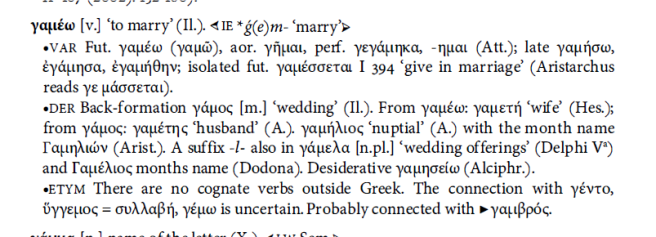
“Marrying [gêmai] is different from ‘getting married’ [gêmasthai] in that a man marries but a woman gets married. Homer has made the difference between them clear when he said of getting married: “once she [Epikastê] got married to her own son; and he married her / after killing his father.”
And Anakreon [demonstrates the distinction] when he mocks someone for being effeminate: “and the bedroom in which that guy didn’t marry but got married instead.”
Aeschylus too in his Amumône writes: “it is your fate to be married but it is mine to marry.”
The distinction between gêmai [or gamein] and gêmasthai [gameisthai] is an important example of Greek active versus mediopassive voice. The active here means “to take a spouse”; while the mediopassive form [according to LSJ] means to “offer to have your child made a spouse” or, “to give oneself in marriage”. This is also a good example of how gendered difference in agency and personhood is structured into basic linguistic distinctions.
As I teach my students, the middle voice is often about indirect agency* (when the agent of an action is not the same as the grammatical subject of the sentence). So, with the verb luô, it means in the active “I release” and in the passive “I am released” but in the middle “ransom”, because in the background is the idea that “x arranges for y to release z”. (And this is a pretty ancient meaning: Chryses appears to the Achaeans in book 1 of the Iliad “for the purpose of ransoming his daughter” [λυσόμενός τε θύγατρα]).
In two examples cited by the anonymous grammarian above words are morphologically middle (γημαμένη and ἐγήματο are aorists, one of the two tenses that has distinct middle and passive morphology in Greek), but the semantics of the words seem less middle than passive to me. At the very least, we have Epikaste “[allowing herself] to be married” in the Homeric example. Anacreon’s joke emasculates the target by taking agency away from him and Aeschylus attests to a similar distinction in the fragment. But the point to take away is that it would be striking in ancient Greece to say that a woman marries someone else as an active agent.
*Often, but not always! The middle voice can be causative, alternate with the active for transitive/intransitive meanings, be quasi-reflexive, or just downright weird (‘idiomatic’!).