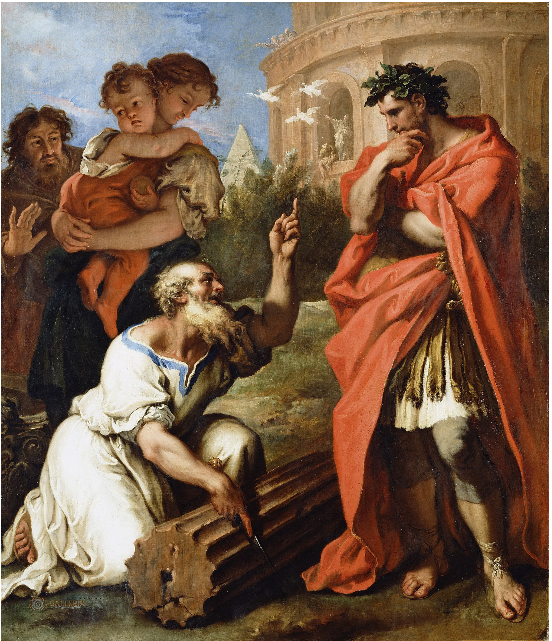
Tarquinius is slain by the sons of Marcius for usurping their throne:
The sons of Marcius then set upon Tarquinius, since he did not pass the throne on to them, but instead preferred a certain Tullius who was born to him by a captive woman. This indeed was a thing which had caused the nobles substantial distress. The sons of Marcius therefore enlisted the help of some of these nobles and plotted against Tarquinius; their plan was to send, in rustic fashion, two men armed with axes and sickles to attack Tarquinius. When it happened that they did not encounter Tarquinius in public, they went to the doors of his regal home, indeed striving against each other as they needed to come into his presence. When they met him, they fell into an argument with each other, and while Tarquinius paid attention to one of the men as he was pleading his case, the other man slew him.
This year I taught my last class at my first institution and soon I will teach my first at a very different school. Although I am happy to start anew, there will be many people to miss and among them stand many of the students who have impacted my life. This time of year teachers are mostly worn down—it is often hard to see the good we do in the midst of it. Indeed, as I tell my students, we are conditioned to see our failures (of which there are many without a doubt) and to minimize our successes.
I tried to downplay my departure—my department held a small gathering to mark it and a few students were invited. One of the students brought a card from a student who graduated several years ago:
The bit about “be the best” is a truth that makes me shudder a bit because it can be terrible advice to set someone up for disappointment. I remember the conversation distinctly—the student had finished a senior thesis and was ready to go to law school but the process had been frustrating for us both. After letting the student know she had done just fine, I told her law school was going to be harder and she had a choice of doing well (which she would) or doing great. Then I quoted the Iliad.
Il. 6.206-208
“Hippolochus fathered me—I claim him as my father.
He sent me to Troy and gave me much advice,
To always be the best and to be better than the rest.”
“Old Peleus advised his son Achilles
To always be the best and be better than the rest.
And to you in turn your father Menoitios, Aktor’s son, advised:
‘My child, Achilles is superior to you by birth,
But you are older. And he is much stronger than you.
But you must do well to speak and give him a close word,
And to advise him. He will obey you to a good end.”
In the first passage, Glaukos is telling Diomedes who he is and they ‘bond’ over their shared background (really, I think Glaukos comes out on top—though he exchanges gold armor for bronze, he lives to fight another day). In the second, Nestor is attempting to persuade Patroklos that he too is responsible for Achilles’ behavior because of their fathers’ injunctions.
Most of us who teach are more like Nestor than Patroklos, but we have Patroklos’ ability to advice, apply a convincing word here and there and hope (sometimes against all logic) that what we say will have some “good” outcome. While we watch hundreds (if not thousands) of students pass through our classrooms over the years, we remember mostly those we don’t seem to move, the good we seem not to have accomplished.
But every once in a while, we are lucky enough to hear that what we do makes a real difference. And it is often not in the exam we set, the lecture we give, or the grades we dole out. We make impacts in those human interactions between the scripted moments. Don’t get me wrong—everything else is important too: the scripted moments allow us to “be the best” in one way, to offer that “close-kept word”. But our unassessed, unquantified, and unmandated contributions help to take our work from the classroom to the world our students (and we) inhabit.
In nearly a decade at my first job I was honored to have many students like the one who sent me this thank-you note—bright young people who will go on to make their lives better and improve the lives of those around them. I am thankful to have had this opportunity and humbled that I too have been able to make a difference.
“Zeus made himself look like a swan and joined Nemesis near the river Ocean. From this union, she laid an egg which Leda received, warmed, and then bore Helen and the Dioscouri”
“Ramnos is a deme in Attica where Zeus slept with Nemesis who then produced an egg which Leda found, warmed and which produced in turn the Dioscuri and Helen.”
The fragmentary poem from the epic cycle dubbed the Cypria was attributed to lesser known poets like Stasinus and Hegesias by ancient authors. Its name, however, comes from the fact that it was largely believed to be composed in Cyprus (or by a Cypriot poet traveling abroad).
The first fragment of the poem tends to be its most well-known since it places the Trojan War in a context of global discussion and echoes the Iliad in making this all part of Zeus’ plan. But the ninth fragment has some frightening details. First, it alleges that Helen is not the daughter of Zeus and Leda (of the swan scene) but instead is the offspring of Zeus and the unwilling goddess Nemesis. Second, it shows Zeus pursuing her all over the earth no matter what form she took.
Cypria, Fr. 9 Benarbé [fr 10. West 2013]
“After them [he?] bore a wonder to mortals, a third child Helen—
Fine-haired Nemesis gave birth to her after having sex
With Zeus, the king of the gods, under forceful compulsion.
For she was not willing to have sex with Kronos’ son
Father Zeus, since her mind rushed with shame and opposition [nemesis].
She fled over the earth and the dark, barren sea,
But Zeus pursued her—and he longed to catch her in his heart.
At one time along the waves of the much-resounding sea,
He broke through the water as she took the form of a fish—
At another he followed her through the river Ocean to the ends of the earth.
Again, across the much-nourishing land. She became all the terrible
Beasts, the many the land raises up, in trying to escape him.”
As West (2013, 81-83) points out, there is some motif transference going on here in the fragment. For one, in many testimonia Thetis is said to change shapes to elude Peleus. In addition, we know the popular account of Zeus changing into a swan [or goose] to seduce Leda. Finally, Nemesis—as a concept and less as a character—is often associated with Helen’s behavior. She receives “nemesis and shame” for her actions. Much of this may linger in the mythopoetic background when the leaders of the Trojans declare upon seeing her again in the Iliad “there’s no nemesis for the Trojans and Achaeans, that they suffered pain for so long for this kind of woman….” (οὐ νέμεσις Τρῶας καὶ ἐϋκνήμιδας ᾿Αχαιοὺς τοιῇδ’ ἀμφὶ γυναικὶ πολὺν χρόνον ἄλγεα πάσχειν).
But other accounts have Zeus changing to match Nemesis as well. Apollodorus (3.10.7) attempts to harmonize the two accounts:
“Some allege that Helen is the daughter of Nemesis and Zeus and that when she was fleeing Zeus’ sexual advance she changed her shape into a goose and that Zeus matched her and approached her as a swan. She produced an egg from this intercourse—people say that some shepherd found this egg in a thicket, fetched it and gave it to Leda who placed it in a box where she guarded it. When, after some time, it hatched and produced Helen, Leda raised her as her own daughter.”
Tarquinius Priscus punishes a Vestal Virgin who violated her oath of chastity:
Later, Tarquinius waged war against the Latin tribes who were rebelling, and subsequently he fought against the Sabines who were aided by the Etruscans; he conquered them all. When he learned that a certain one of the Vestal Virgins (who were ordered to preserve their maidenhood throughout their lives) had engaged in indiscreet intercourse with a man, he had an oblong passage dug underground, in which he placed a couch and a table with an abundance of food. He had the ruined woman sent down there, and after she was led into the chamber, he had it sealed off. Thus, from that event, the custom prevailed that those priestesses who did not take care of their chastity were punished. The men who so defiled these women were forced to place their heads upon cloven logs in the forum, and after being stripped naked and degraded, were deprived of their lives.
In the Odyssey Telemachus goes from Ithaka to Sparta (via Pylos) and back. When he travels in both directions, he makes a stop for the night in a scene that I think most of us often forget: Od. 15.185-188 (=3.486-490)
“All day long they shook the yoke around their necks.
The sun set and the wide ways were shadowed.
They arrived at Phêrai, the home of Diokles,
The son of Ortilokhos, the child whom Alpheios fathered.
There they spent the night and he gave them guest-gifts.”
Though he stops at this town twice, we get very little information about it from the epic itself. The scholia do provide some information:
Scholia HQ Ad Od. 15.186-193:
“Phêrai: the name of a town in Laconia. The journey from Sparta to Phêrai is one day; and it is nearly another day from Phêrai to Pylos… This is the same night that Odysseus sleeps at Eumaios’ place.”
Most interesting for me here is the almost throw-away line from the scholiast that this night spent in Phêrai is the same night during which Odysseus is entertained by Eumaios. Although some scholars entertain this seriously (e.g. Olson 1995, 91ff) a more standard take is presented by De Jong in her Narratological Commentary… (2001, 588):
If we count the days from Odysseus’ return to Ithaca (when Athena leaves him to go find Telemachus (13.439-440: ἡ μὲν ἔπειτα / ἐς Λακεδαίμονα δῖαν ἔβη μετὰ παῖδ’ ᾿Οδυσῆος.), we get a slightly different timeline for the second half of the Odyssey:
Day 1
14: Odysseus goes to Eumaios, they sleep (14.523)
15: Telemachus leaves Sparta, sleeps at Diokles’ house (Simultaneous action shown in parallel)
Day 2
15.301-494: Eumaios and Odysseus dine again and talk through most of the night
15: Telemachus bypasses Pylos for his ship,(15.296-300) (Simultaneous action shown in parallel)
Day 3
15.495-500: Telemachus arrives arrives in Ithaca and goes to Eumaios’ home (16); the suitors return from their ambush; Eumaios, Telemachus and Odysseus sleep (16)
Day 4
17: Telemachus and Odysseus go to their home separately; the suitors go home to sleep (18.427-428); Penelope sleeps (19.600-604); Odysseus sleeps (20.54-55)
Day 5
20.91: Dawn comes and the suitors return; 21: The Bow; 22: Mnesterophonia; 23.342-43: They sleep
Day 6
23.345-349 Dawn comes, Odysseus wakes and goes to see his father; the second Nekyuia; Testing of Laertes; Ithacan Assembly; Final showdown
Of course, thanks to a thing called “Zielinski’s Law” (see De Jong 2001, 590 for a bibliography and Cook 2009, 148 for a brief discussion) Homerists tend not to believe that Homeric narrative shows simultaneous actions…
Who is Diokles? Why do we care if the end of the Odyssey takes 6 or 7 days? Tune in next week….
Attus Navius gets the better of the impious Tarquinius.
Indeed, Tarquinius Priscus would have accomplished many other startling reforms, if a certain Attus Navius (who was a finer augur than any who had ever lived) had not prevented him from altering the arrangement of the tribes. Tarquinius was enraged by his opposition, and sought to entirely discredit Attus’ craft. He therefore put a razor and a whetstone in his cloak, and went among the people with the intention of cutting the whetstone with the razor – a clearly impossible task. When he began to lay out his plans and Attus began to speak out against him most violently, he did not cave in but rather said, ‘If you are not speaking against me simply from your love of argument, but are indeed telling the truth, tell me whether what I now have in mind will occur.’ Attus, divining immediately what was meant, said, ‘Indeed, my king – what you wish will come to pass.’ Tarquinius then responded, ‘Then take that whetstone, and cut it with that blade. This is what I had in mind.’ Attus then took the whetstone immediately and cut it asunder. Tarquinius was amazed, and offered to Attus various honors, including the honor of a bronze statue; he also ceased to reform civic institutions, but began to employ Attus as his advisor in all things.
“Hermes found him sitting on a cliff. His eyes were never dry
Of tears and his sweet life drained away as he mourned.
Over his homecoming, since the goddess was no longer pleasing to him.
But it was true that he stretched out beside her at night by necessity
In her hollow caves, unwilling when she was more than willing.
Though he sat by day on the rocks and sands
Wracking his heart with tears, groans and grief,
Shedding tears as he gazed upon the barren sea.
I have always read and taught the line emphasized above as indicating that Odysseus’ displeasure had not lasted seven years–that he took some pleasure in the events described in the following line (having sex with Kalypso) and that his sorrow over his homecoming had increased over time.
Ancient scholarship does not agree with this reading. Instead, it makes a strange distinction in marking Odysseus as having once been pleased by Kalypso:
Schol ad Od. 6.153
“She never was making good by sending him away—first he was pleased because she saved him, but after this, no longer. This ‘longer’ can indicate the following authoritatively: she was pleasing to him before when she plucked him up from the shipwreck, but no longer because she is restraining him.”
The passage he refers to (Il. 1.24, ἀλλ’ οὐκ ᾿Ατρεΐδῃ ᾿Αγαμέμνονι ἥνδανε θυμῷ) might be a less than pleasing parallel, since this is where Agamemnon is shown to be displeased with Chryses’ supplication—which turns out rather poorly for the Achaeans
But the root of the verb ἁνδάνω is certainly related to the same root that gives us “pleasure”(hêdus) in Greek. From Chaintraine’s Dictionarie Etymologique:
Et. Aucun présent du même type hors du grec, mais le skr. a svádati, svádate “plaire, se plaire à” et le latin le factifif suadeo. Le tout appartient évidemment à la familie ἥδομαι.
The adjective ἥδυς and the verb ἥδομαι are also related to the noun ἡδονή–whence English hedonism and the more clinical anhedonia. The English derivative is easier to see from the Latin suadeo and Sanskrit su/vad: sweet!
The story, of course, doesn’t end there. After Kalypso promises to send him home, they retire into those aforementioned caves:
Od. 5.226-227
“Then, after going into the deepest recess of the hollow cave
They took pleasure in sex, staying next to one another.”
Note the similarity of line 5.227 and 23.201—they are structurally (and nearly syntactically) identical. But where Kalypso and Odysseus merely “are present near one another” (παρ’ ἀλλήλοισι μένοντες), Penelope and Odysseus tell each other their stories (πρὸς ἀλλήλους ἐνέποντες) and take pleasure in words (μύθοισι) not just in sex. And I have posted before about the importance of post-coital conversation in Homeric sex.
“Who would not be made dull if he had to bear a single teacher of a single science throughout the entire day?”
Quis vero non obtundatur, si per totum diem unius artis unum magistrum ferat?
-Aeneas Silvius Piccolomini, de Liberorum Educatione, chp. 95
Aeneas Silvius Piccolomini, de Liberorum Educatione cp.6
“We encounter few, however, who are unteachable by nature. For just as birds (as Quintilian notes) are born for flying, and horses for running, and beasts for savagery, so too are cunning and mental activity the proper sphere of humanity. Dull and ineducable people are therefore born no more according to nature than are prodigious and remarkable bodies are in monsters. And though one person might excel another in natural talent, there is no one to be found who cannot attain something with a bit of application.”
“Pauci tamen reperiuntur quibus natura indocilis est. Sicut enim aves ad volatum (Quintilianus ait), equi ad cursum, as saevitiam ferae gignuntur, sic hominis propria est agitatio mentis atque solertia; hebetes vero et indociles non magis secundum naturam quam prodigiosa corpora et insignia monstris eduntur. Et quamvis alius alium praestet ingenio, nemo tamen reperitur qui nihil sit studio consecutus.”
Quintilian, Institutio 1.1.1-3
“It is a false complaint that the faculty of understanding what is taught is granted to only a few, and that most people waste their time and energy due to the slowness of their intellect. Just the opposite: you can find many who have an easy time with thinking, and are ready to learn. Certainly, this is natural for humans, just as birds are born to fly, horses are born to run, and beasts are born for savagery; similarly, the activity and ingenuity of the mind is peculiarly our own.
Slow and ineducable people are no more the product of human nature than are giants and wondrously deformed people, but these have been but few. A proof of this is the fact that the hope of many things shines forth in children: if it passes away with age, it is clear that the fault lay not with human nature, but with our lack of care. One might object, ‘But nevertheless, some people are superior in intellect to others.’ I readily concede that point; but that will do more for some than for others. However, no one will be found who has pursued nothing with effort.”
Falsa enim est querela, paucissimis hominibus vim percipiendi quae tradantur esse concessam, plerosque vero laborem as tempora tarditate ingenii perdere. Nam contra plures reperias et faciles in excogitando et ad discendum promptos. Quippe id est homini naturale, ac sicut aves ad volatum, equi ad cursum, ad saevitiam ferae gignuntur, ita nobis propria est mentis agitatio atque sollertia: unde origo animi caelestis creditur. Hebetes vero et indociles non magis secundum naturam hominis eduntur quam prodigiosa corpora et monstris insignia, sed hi pauci admodum fuerunt. Argumentum, quod in pueris elucet spes plurimorum: quae cum emoritur aetate, manifestum est non naturam defecisse sed curam. “Praestat tamen ingenio alius alium.” Concedo; sed plus efficiet aut minus: nemo reperitur qui sit studio nihil consecutus.
Martial, 5.58
“Lupus, you ask long and anxiously to what teacher you should entrust your son. I advise you to avoid all teachers and professors: don’t let him have anything to do with the books of Cicero or Vergil. Let him leave Tutilius to his own reputation. If he writes verses, you will disown him as a poet. Does he want to learn a more… pecuniary skill? Make him learn to be a lute player or a flute player; if he seems a bit on the untalented side, just make him an auctioneer or a builder.”
56
Cui tradas, Lupe, filium magistro
quaeris sollicitus diu rogasque.
Omnes grammaticosque rhetorasque
deuites moneo: nihil sit illi
cum libris Ciceronis aut Maronis; 5
famae Tutilium suae relinquat;
si uersus facit, abdices poetam.
Artes discere uolt pecuniosas?
Fac discat citharoedus aut choraules;
si duri puer ingeni uidetur, 10
praeconem facias uel architectum.
Plutarch, Alexander 8.1-2
“Aristotle, more than others, seems to me to have fostered in Alexander a love of healing. For he delighted not just in talking about medicine but he even used to help his sick friends and assign to them certain therapies and treatments, as one can see from his letters. He was by nature a lover of language, a lover of learning and a lover of reading. Because he believed and named the Iliad the roadmap of military excellence, he took a copy corrected by Aristotle which they called the “Box-Iliad” and he always had it with his knife lying under his pillow, as Onesikritos recounts. And when he did not have other books deep in Asia, he ordered Harpalos to send him some. Harpalos sent him the books of Philistos, the tragedies of Euripides, Sophocles and Aeschylus, and the dithyrambs of Telestos and Philoxenos.
In the beginning, Alexander revered Aristotle and said that he loved him no less than his father because he was alive thanks to one and living well thanks to the other. Later, he was rather suspicious of him, not so much that he harmed him at all, but his attachment and attention were not as eager as before—and this was a sign of their alienation.”
Today was my first day back to work after a rather indolent summer break, and the general sense of distress caused by the infandus dolor of that return kept me from getting to sleep last night. Therefore, I reached for a book which I remembered with something less than keen enthusiasm – Lucan’s de Bello Civili (or Pharsalia, if you’re a bit more old-fashioned). Though I expected to be lulled to sleep by endless geography and rhetorical exercise, I found myself rather captivated this time around, and managed to finish Book 1 before feeling tired enough to turn off the lights. (It remains to be seen whether this is a sustainable enthusiasm.)
Before presenting some of the highlights, I pose this question to our readers:
What book have you initially hated, only to find during a later reading that you actually rather appreciate it?
Here are some of the high points from Book 1 of Lucan:
“Caesar cannot tolerate a better, and Pompey cannot tolerate an equal. One cannot say who took up arms with more semblance of justice; each one vindicates himself with great authority. The gods preferred the winning side – Cato preferred the vanquished.” nec quemquam iam ferre potest Caesarue priorem Pompeiusue parem. quis iustius induit arma scire nefas: magno se iudice quisque tuetur; uictrix causa deis placuit sed uicta Catoni. (1.125-128)
“This was no longer that nation which could enjoy a quiet peace, which once feasted on its freedom and left its sword unswung. Then, they became quick to anger and whatever poverty urged – a vile crime – and it became a great glory which one might obtain violence to have more power than one’s whole country; violence became the arbiter of justice.”
non erat is populus quem pax tranquilla iuuaret, quem sua libertas inmotis pasceret armis. inde irae faciles et, quod suasisset egestas, uile nefas, magnumque decus ferroque petendum plus patria potuisse sua, mensuraque iuris 175 uis erat… (1.171-176)
“Make haste – delay has always harmed those who are prepared.”
Tolle moras; semper nocuit differre paratis. (1.281)
“And the Vangiones, who are like the Sarmatians in wearing loose pants.”
Et qui te laxis imitantur, Sarmata, bracis Vangiones… (1.430-431)
“Thus, the frenzied crowd rushed through the city with hurried steps, and, as if its one hope was to escape from the walls of its home city, fled with no direction.” …sic turba per urbem praecipiti lymphata gradu, uelut unica rebus spes foret adflictis patrios excedere muros, inconsulta ruit. (1.495-498)
“Virtue will be just a word, and this madness will last for many years. What good is it to entreat the gods to end it? Along with peace, we will have a tyrant.” nomen erit uirtus, multosque exibit in annos hic furor. et superos quid prodest poscere finem? cum domino pax ista uenit. (1.668-670)
Lucius Tarquinius consolidates his power among the senate and people:
This opinion however, did not last. When Ancus Marcius died, Lucius Tarquinius did wrong by Marcius’ sons, and made the throne his own. When the senate and people were on the verge of selecting the sons of Marcius as their rulers, Tarquinius went to hold an interview with the most powerful of the senators, and sent the two orphan boys off to a hunt; and by what he did and said he contrived to have the throne voted to himself. Having thus made himself the master of Roman political affairs, he managed the Romans in such a way as to prevent the two boys from ever being chosen as kings. As he made the sons of Ancus more accustomed to luxury he charmed their souls and bodies into destruction. He lived in fear because he operated this way, and so he girded himself about with force in assembly meetings. He enlisted into the senate and patrician order about two-hundred men who were favorablly disposed toward him. In this way, he placed the senate and many of the common people under his own influence. He also transformed his clothing into something more befitting his greatness. This took the form of a toga and a tunic which were entirely purple, inlaid with gold, as well as a crown set with gold stones and an ivory chair. After all of this, other people holding the the imperial throne enjoyed absolute political supremacy. He also paraded in triumphs on a four-horse chariot, and had twelve lictors through his life.