“Death is the Only Doctor”

Epistles of Phalaris, I : To Lucinus

“Polycleitus the Messenian, whom you accuse of betraying his countrymen, has cured me of an unbearable illness. I am not unconscious of the fact that, in announcing this to you, you will find yourself afflicted with pain and tears. As for you, even (among all the gods) Asclepius himself, the commander of the medicinal arts, could heal you. Medicine can cure the sickness of the body, but death is the only doctor for diseases of the soul. Accept, then, this most efficacious remedy for your many great injustices which were not forced upon you (such as those things for which you accuse me), but were performed entirely of your own choice.”

Λυκίνῳ.
Πολύκλειτος ὁ Μεσσήνιος, οὗ κατηγορεῖς παρὰ τοῖς πολίταις προδοσίαν, ἰάσατό μου νόσον ἀνήκεστον, οὐκ ἀγνοῶ δὲ λύπας εὐαγγελιζόμενός σοι καὶ δάκρυα· σὲ δ’ οὐκ ἂν οὐδ’ αὐτὸς ὁ τῆς τέχνης ἡγεμὼν ᾿Ασκληπιὸς μετὰ πάντων ἰάσαιτο τῶν θεῶν. σώματος μὲν γὰρ ἀρρωστίαν θεραπεύει τέχνη, ψυχῆς δὲ νόσον ἰατρὸς ἰᾶται θάνατος, ὃν ἐπαχθέστατον ἀντὶ πολλῶν καὶ μεγάλων ἀδικημάτων, οὐκ ἀκουσίων, ὧν ἐμοὶ προστρίβεις, ἀλλ’ ἑκουσίων, ὧν αὐτὸς εἴργασαι, προσδέχου.

Diocletian’s Horse Saves the City

John Malalas, Chronographia, 309:

“At that time, the Egyptians held a tyranny and slaughtered their leaders. Diocletian marched against them, and waged war in Alexandria. He besieged them and dug a trench around the city. He then cut off the aqueduct and diverted it away from Canopus, as it had been of some use to the city. When he took Alexandria, he set it ablaze. He came into it mounted on his horse, which trotted about on the corpses. He ordered one of his officers not to desist from slaughter until the blood of the slain reached the knee of the horse upon which he sat. It happened, in accordance with this order, that as he approached close to the gate, the horse upon which he was riding tripped over the corpse of a man, and collapsing* upon it had its knee covered in blood. This gave a pretense for indulgence, and the soldiers ceased killing the citizens of Alexandria. The Alexandrians erected a bronze statue to the horse out of gratitude. Up to this day, this spot is called the ‘Horse of Diocletian.'”

*For κονδάψαντα; I have no idea what this word means, and found nothing in a quick lexicon search. I felt better about this ignorance after reading Bentley’s note: ‘novum plane mihique inauditum hoc vocabulum.’ (‘This word is obviously new, and I have never heard it.’)


  ᾿Εν αὐτῷ δὲ τῷ χρόνῳ ἐτυράννησαν οἱ Αἰγύπτιοι καὶ ἐφόνευσαν τοὺς ἄρχοντας αὑτῶν. καὶ ἐπεστράτευσε κατ’ αὐτῶν ὁ αὐτὸς Διοκλητιανός, καὶ ἐπολέμησεν ἐν ᾿Αλεξανδρείᾳ τῇ μεγάλῃ, πολιορκήσας αὐτὴν καὶ ποιήσας φοσάτα, κόψας τὸν ἀγωγὸν καὶ στρέψας αὐτὸν ἀπὸ τοῦ λεγομένου Κανώπου καὶ παρέχοντα χρῆσιν τῇ πόλει. παραλαβὼν δὲ ᾿Αλεξάνδρειαν ἐνέπρησεν αὐτήν· εἰσῆλθε δὲ ἐν αὐτῇ ἔφιππος, τοῦ ἵππου αὐτοῦ περιπατοῦντος ἐπάνω τῶν λειψάνων. ἦν δὲ κελεύσας τῷ ἐξπεδίτῳ μὴ φείσασθαι τοῦ φονεύειν, ἕως οὗ ἀνέλθῃ τὰ αἵματα τῶν σφαζομένων ἕως τὸ γόνυ τοῦ ἵππου οὗ ἐκάθητο. συνέβη δὲ κατὰ κέλευσιν θεοῦ πλησίον τῆς πόρτας εἰσελθόντος αὐτοῦ τὸν ἵππον ἐν ᾧ ἐκάθητο ὁ βασιλεὺς πατῆσαι λείψανον ἀνθρώπου καὶ κονδάψαντα εἰς αὐτὸ γονατίσαι καὶ αἱματωθῆναι τὸ γόνυ τοῦ ἵππου· καὶ προσεσχηκὼς ἔδωκεν ἰνδουλγεντίας, καὶ ἐπαύσαντο οἱ στρατιῶται κόπτοντες τοὺς πολίτας ᾿Αλεξανδρείας. καὶ ἀνέστησαν οἱ αὐτοὶ ᾿Αλεξανδρεῖς στήλην χαλκῆν τῷ ἵππῳ ὑπὲρ εὐχαριστίας· ὅστις τόπος οὕτως ὀνομάζεται ἕως τῆς σήμερον ὁ ἵππος Διοκλητιανοῦ.

Happiness is Fleeting: Expect Misery

Boethius, Consolatio Philosophiae 1.1:

“I, who once perfected poems while my zeal was at its height, am now, in tears, compelled to embrace a sadder metre. Behold! The mangled Muses dictate what I should write, and these elegies drench my face with real tears. These, at least, no terror could deter from following my path as my lone companions. Once the glory of my happy, vibrant youth, they now console me for my fate as a sad old man. Unexpected old age has come, hastened by misfortunes, and pain adds yet another age to that. My hair, grey before its time, falls from my head, and my loose skin trembles on my weakened body. It is a happy death, which does not intrude upon our happy years, but comes when called in our sadder days. Alas! Death turns a deaf ear to the wretched, and in her savagery, refuses to close my crying eyes! While Fortune, hardly faithful, favored me with trifling gifts, one sad hour nearly buried me. Now that she, cloud-like, has changed her deceitful countenance, my accursed life draws on these unpleasing delays. Why, my friends, did you boast so often that I was happy? He who has fallen never had a stable step.”

carmina qui quondam studio florente peregi,
flebilis heu maestos cogor inire modos.
ecce mihi lacerae dictant scribenda Camenae
et ueris elegi fletibus ora rigant.
has saltem nullus potuit peruincere terror,
ne nostrum comites prosequerentur iter.
gloria felicis olim uiridisque iuuentae,
solantur maesti nunc mea fata senis.
uenit enim properata malis inopina senectus
et dolor aetatem iussit inesse suam.
intempestiui funduntur uertice cani
et tremit effeto corpore laxa cutis.
mors hominum felix, quae se nec dulcibus annis
inserit et maestis saepe uocata uenit.
eheu, quam surda miseros auertitur aure
et flentes oculos claudere saeua negat!
dum leuibus male fida bonis fortuna faueret
paene caput tristis merserat hora meum;
nunc quia fallacem mutauit nubila uultum
protrahit ingratas impia uita moras.
quid me felicem totiens iactastis, amici?
qui cecidit, stabili non erat ille gradu.

Beginning the Iliad and Ilium

 This is the first thing I ever memorized in Ancient Greek (Iliad 1.1–7)

Μῆνιν ἄειδε θεὰ Πηληϊάδεω ᾿Αχιλῆος
οὐλομένην, ἣ μυρί’ ᾿Αχαιοῖς ἄλγε’ ἔθηκε,
πολλὰς δ’ ἰφθίμους ψυχὰς ῎Αϊδι προΐαψεν
ἡρώων, αὐτοὺς δὲ ἑλώρια τεῦχε κύνεσσιν
οἰωνοῖσί τε πᾶσι, Διὸς δ’ ἐτελείετο βουλή,
ἐξ οὗ δὴ τὰ πρῶτα διαστήτην ἐρίσαντε
᾿Ατρεΐδης τε ἄναξ ἀνδρῶν καὶ δῖος ᾿Αχιλλεύς.

“Goddess, sing the rage of Pelias’ son Achilles,
Destructive, how it gave the Achaeans endless pain
And send many brave souls of heroes to Hades—
And it made them food for the dogs
And all the birds as Zeus plan was being fulfilled.
Start from when those two first diverged in strife,
The lord of men Atreus’ son and godly Achilles.”

Compare The Beginning of Dan Simmons’ Ilium:

Rage.

Sing, O Muse, of the rage of Achilles, of Peleus’ son, murderous, man-killer, fated to die, sing of the rage that cost the Achaeans so many good men and sent so many vital, hearty souls down to the dreary House of Death. And while you’re at it, O Muse, sing of the rage of the gods themselves, so petulant and so powerful here on their new Olympos, and of the rage of the post-humans, dead and gone though they might be, and of the rage of those few true humans left, self-absorbed and useless though they may have become. While you are singing, O Muse, sing also of the rage of those thoughtful, sentient, serious but not-so-close-to-human beings out there dreaming under the ice of Europa, dying in the sulfur-ash of Io, and being born in the cold folds of Ganymede.

Oh, and sing of me, O Muse, poor born-again-against-his-will Hockenberry—poor dead Thomas Hockenberry, Ph.D., Hockenbush to his friends, to friends long since turned to dust on a world long since left behind. Sing of my rage, yes, of my rage, O Muse, small and insignificant though that rage may be when measured against the anger of the immortal gods, or when compared to the wrath of the god-killer, Achilles.

On second thought, O Muse, sing of nothing to me. I know you. I have been bound and servant to you, O Muse, you incomparable bitch. And I do not trust you, O Muse. Not one little bit.

This continues throughout the first part of chapter 1, culminating in a memorable dismissal: “Fuck all these heroes and the wooden chariots they rode in on.”

Other Iliads

The manuscript traditions of the Iliad provide in addition to the well-known 9 line proem, a few shorter, alternate beginnings:

“An Iliad which appears to be ancient, called Apellicon’s, has this proem:

I sing of the Muses and Apollo, known for his bow…

This is recorded by Nikanôr and Crates in his Critical Notes on the Text of the Iliad. Aristoxenus in the first book of his Praxidamanteia says that some had as the first lines:

Tell me now Muses who have Olympian Homes

How rage and anger overtook Peleus’ son

And also the shining son of Leto. For the king was enraged…”

ἡ δὲ δοκοῦσα ἀρχαία ᾿Ιλιάς, λεγομένη δὲ ᾿Απελλικῶνος, προοίμιον ἔχει τοῦτο·

Μούσας ἀείδω καὶ ᾿Απόλλωνα κλυτότοξον

ὡς καὶ Νικάνωρ μέμνηται καὶ Κράτης ἐν τοῖς διορθωτικοῖς. ᾿Αριστόξενος
δ’ ἐν α′ Πραξιδαμαντείων φησὶν κατά τινας ἔχειν·

῎Εσπετε νῦν μοι, Μοῦσαι ᾿Ολύμπια δώματ’ ἔχουσαι,
ὅππως δὴ μῆνίς τε χόλος θ’ ἕλε Πηλεΐωνα,
Λητοῦς τ’ ἀγλαὸν υἱόν· ὁ γὰρ βασιλῆι χολωθείς.

Obviously, these variant beginnings don’t signal a different poem, but they do set up the audience in different ways. The latter variants especially point to a greater emphasis (perhaps) on Apollo.

This information is crammed in the critical apparatus of Allen’s edition of the Iliad (1931):Allen Iliad 1

It is also to be found in West’s more recent edition (1998):

West Iliad 1

A Method of Reading, and Judgment on Athenian Blockheads

James Boswell, The Life of Samuel Johnson:

“The particular course of his reading while at Oxford, and during the time of vacation which he passed at home, cannot be traced. Enough has been said of his irregular mode of study. He told me that from his earliest years he loved to read poetry, but hardly ever read any poem to an end; that he read Shakspeare at a period so early, that the speech of the ghost in Hamlet terrified him when he was alone; that Horace’s Odes were the compositions in which he took most delight, and it was long before he liked his Epistles and Satires. He told me what he read SOLIDLY at Oxford was Greek; not the Grecian historians, but Homer and Euripides, and now and then a little Epigram; that the study of which he was the most fond was Metaphysicks, but he had not read much, even in that way. I always thought that he did himself injustice in his account of what he had read, and that he must have been speaking with reference to the vast portion of study which is possible, and to which a few scholars in the whole history of literature have attained; for when I once asked him whether a person, whose name I have now forgotten, studied hard, he answered ‘No, Sir; I do not believe he studied hard. I never knew a man who studied hard. I conclude, indeed, from the effects, that some men have studied hard, as Bentley and Clarke.’ Trying him by that criterion upon which he formed his judgement of others, we may be absolutely certain, both from his writings and his conversation, that his reading was very extensive. Dr. Adam Smith, than whom few were better judges on this subject, once observed to me that ‘Johnson knew more books than any man alive.’ He had a peculiar facility in seizing at once what was valuable in any book, without submitting to the labour of perusing it from beginning to end. He had, from the irritability of his constitution, at all times, an impatience and hurry when he either read or wrote. A certain apprehension, arising from novelty, made him write his first exercise at College twice over; but he never took that trouble with any other composition; and we shall see that his most excellent works were struck off at a heat, with rapid exertion.

No man had a more ardent love of literature, or a higher respect for it than Johnson. His apartment in Pembroke College was that upon the second floor, over the gateway. The enthusiasts of learning will ever contemplate it with veneration. One day, while he was sitting in it quite alone, Dr. Panting, then master of the College, whom he called ‘a fine Jacobite fellow,’ overheard him uttering this soliloquy in his strong, emphatick voice: ‘Well, I have a mind to see what is done in other places of learning. I’ll go and visit the Universities abroad. I’ll go to France and Italy. I’ll go to Padua.—And I’ll mind my business. For an Athenian blockhead is the worst of all blockheads.'”

Which Homeric Hero Would You Be?

Dio Chrysostom, The Second Discourse on Kingship, 15

 “Next Philip asked, “But you, Alexander, would you choose to have been Agamemnon, Achilles, or some other of those heroes—or even Homer?” Alexander responded, “Not at all, but I would prefer to be much more than Achilles and the rest.”

Ἐκ τούτου δὲ ἤρετο ὁ Φίλιππος, Ἀλλὰ σύ, ὦ Ἀλέξανδρε, πότερον ἕλοιο ἂν Ἀγαμέμνων ἢ Ἀχιλλεὺς ἢ ἐκείνων τις γεγονέναι τῶν ἡρώων,  ἢ Ὅμηρος; Οὐ μέντοι, ἦ δ᾿ ὃς ὁ Ἀλέξανδρος, ἀλλὰ ὑπερβάλλειν πολὺ τὸν Ἀχιλλέα καὶ τοὺς ἄλλους.

Alexander is clearly responding to something he learned from Homer:

Il. 6.206-208

“Hippolochus fathered me—I claim him as my father.
He sent me to Troy and gave me much advice,
To always be the best and to be better than the rest.”

῾Ιππόλοχος δέ μ’ ἔτικτε, καὶ ἐκ τοῦ φημι γενέσθαι·
πέμπε δέ μ’ ἐς Τροίην, καί μοι μάλα πόλλ’ ἐπέτελλεν
αἰὲν ἀριστεύειν καὶ ὑπείροχον ἔμμεναι ἄλλων…

11.783-789

“Old Peleus advised his son Achilles
To always be the best and be better than the rest.
And to you in turn your father Menoitios, Aktor’s son, advised:
‘My child, Achilles is superior to you by birth,
But you are older. And he is much stronger than you.
But you must do well to speak and give him a close word,
And to advise him. He will obey you to a good end.”

Πηλεὺς μὲν ᾧ παιδὶ γέρων ἐπέτελλ’ ᾿Αχιλῆϊ
αἰὲν ἀριστεύειν καὶ ὑπείροχον ἔμμεναι ἄλλων·
σοὶ δ’ αὖθ’ ὧδ’ ἐπέτελλε Μενοίτιος ῎Ακτορος υἱός·
τέκνον ἐμὸν γενεῇ μὲν ὑπέρτερός ἐστιν ᾿Αχιλλεύς,
πρεσβύτερος δὲ σύ ἐσσι· βίῃ δ’ ὅ γε πολλὸν ἀμείνων.
ἀλλ’ εὖ οἱ φάσθαι πυκινὸν ἔπος ἠδ’ ὑποθέσθαι
καί οἱ σημαίνειν· ὃ δὲ πείσεται εἰς ἀγαθόν περ.

Those who know me would not be surprised at my answer to Philip’s question. Diomedes, obviously, is the best hero in Homer (or at least the least despicable). Achilles and Odysseus both are problematic–something Plato lets us know in the Hippias Minor

364c: “Homer made Achilles the best man of those who went to Troy, Nestor the wisest, and Odysseus the most shifty.”

φημὶ γὰρ Ὅμηρον πεποιηκέναι ἄριστον μὲν ἄνδρα Ἀχιλλέα τῶν εἰς Τροίαν ἀφικομένων, σοφώτατον δὲ Νέστορα, πολυτροπώτατον δὲ Ὀδυσσέα.

365b: “Achilles is true and simple; Odysseus is shifty and false.”

ὡς ὁ μὲν Ἀχιλλεὺς εἴη ἀληθής τε καὶ ἁπλοῦς, ὁ δὲ Ὀδυσσεὺς πολύπροπός τε καὶ ψευδής

Now, choosing your hero might not be as simple as I have made it. For instance, Homer was clearly prejudiced in Achilles’ favor.  And he is really nice to Odysseus, who is a bit of a creep. If you’re more inclined to distribute your character traits along the lines of strength, intelligence, wisdom and charisma, you may want to consider the following.

Hes. Fr. 203

“The Olympian gave bravery to the descendants of Aiakos,
Brains to the offspring of Amythaon, and wealth to the sons of Atreus.”

ἀλκὴν μὲν γὰρ ἔδωκεν ᾿Ολύμπιος Αἰακίδηισι,
νοῦν δ’ ᾿Αμυθαονίδαις, πλοῦτον δ’ ἔπορ’ ᾿Ατρεΐδηισι.

Aiakos was the father of Peleus and Telamon, making him the grandfather of Achilles and Ajax. The descendants of Amythaon were prophets through his son Melampous. The sons of Atreus were Agamemnon and Menelaos.

Related image

Life’s Purpose, The Pursuit of Knowledge?

Diogenes Laertius, Lives of the Eminent Philosophers 7.2

“Hêrillos the Karthaginian said that our purpose was knowledge: we should live by adducing the life of knowledge to everything and surrendering nothing to ignorance. He believed that knowledge was a practice of the imagination, imperturbable by argument. He used to say that there was no single end, but that it changed depending on events and situations, just as a bronze figure could be made into either Alexander or Socrates.”

Ἥριλλος δ᾿ ὁ Καρχηδόνιος τέλος εἶπε τὴν ἐπιστήμην, ὅπερ ἐστὶ ζῆν ἀεὶ πάντ᾿ ἀναφέροντα πρὸς τὸ μετ᾿ ἐπιστήμης ζῆν καὶ μὴ τῇ ἀγνοίᾳ διαβεβλημένον. εἶναι δὲ τὴν ἐπιστήμην ἕξιν ἐν φαντασιῶν προσδέξει ἀνυπόπτωτον ὑπὸ λόγου. ποτὲ δ᾿ ἔλεγε μηδὲν εἶναι τέλος, ἀλλὰ κατὰ τὰς περιστάσεις καὶ τὰ πράγματ᾿ ἀλλάττεσθαι αὐτό, ὡς καὶ τὸν αὐτὸν χαλκὸν ἢ Ἀλεξάνδρου γινόμενον ἀνδριάντα ἢ Σωκράτους.”

Lactantius, Inst. Div. 3.7

“The highest good according to Herillus is knowledge; according to Zeno, to live congruously with nature, and according to some Stoics, to pursue virtue.”

Herilli summum bonum est scientia, Zenonis cum natura congruenter vivere, quorundam Stoicorum virtutem sequi.

Cicero, De Finibus 2.14

“Erillus, moreover, since he refers everything back to knowledge, imagines one certain good, but it is not the greatest good by which you could steer a life. For this reason, Erillus has been dismissed for a long time. No one has directly disputed him since Chrysippus.”

Erillus autem ad scientiam omnia revocans unum quoddam bonum vidit, sed nec optimum nec quo vita gubernari possit. Itaque hic ipse iam pridem est reiectus; post enim Chrysippum non sane est disputatum.

Cicero, Academica  2.42

“I am not including the philosophies which now seem abandoned, for example Erillus who positioned the highest good in thinking and knowledge. Although he was a pupil of Zeno, you can see how much he disagreed with him and how little with Plato.”

Omitto illa quae relicta iam videntur—ut Erillum, qui in cognitione et scientia summum bonum ponit; qui cum Zenonis auditor esset, vides quantum ab eo dissenserit et quam non multum a Platone.

Image result for ancient roman scientia

“The Ascension of Fools” Some Ancient Comments on Stupidity

μωρολογία: properly, “stupid-talking” or “the talk of fools”. But why not: “the science of stupidity”?

Sophocles, fr. 924

“Stupidity is a terrible opponent to wrestle”
ὡς δυσπάλαιστόν <ἐστιν> ἀμαθία κακόν

Terence, Phormio, 659-660

“Whether I claim he does this because of stupidity or

malice—whether this is a knowing plot, or incompetence, I am unsure.”

utrum stultitia facere ego hunc an malitia
dicam, scientem an imprudentem, incertu’ sum.

Sophocles, fr. 925

“Stupidity really is evil’s sibling”

ἡ δὲ μωρία
μάλιστ᾿ ἀδελφὴ τῆς πονηρίας ἔφυ

Suetonius, Divus Claudius 38

“But he did not stay quiet even about his own stupidity: but claimed that he had faked it on purpose under Gaius because he would have not escaped and advanced to his eventual position otherwise—and that this was supported by certain oracles. But he persuaded no one. And after a brief time, a book was published with the title “The Ascension of Fools” which posited that no one can pretend stupidity.”

Ac ne stultitiam quidem suam reticuit simulatamque a se ex industria sub Gaio, quod aliter evasurus perventurusque ad susceptam stationem non fuerit, quibusdam oratiunculis testatus est; nec tamen49 persuasit, cum intra breve tempus liber editus sit, cui index erat μωρῶν ἐπανάστασις, argumentum autem stultitiam neminem fingere.

Plutarch, Rational Beasts 998a

“Note that a lack of intelligence or stupidity in some animals emerges in contrast with the abilities and sharpness of others as you might compare an ass or a sheep with a fox, a wolf or a bee. It would be the same if you would compare Polyphemos or that idiot Koroibos to your grandfather Autolykos. For I do not think that there is so great a difference between beasts as there is between individual people in thinking, using reason, and in memory.”

ἐννόησον δ᾿ ὅτι τὰς ἐνίων ἀβελτερίας καὶ βλακείας ἐλέγχουσιν ἑτέρων πανουργίαι καὶ δριμύτητες, ὅταν ἀλώπεκι καὶ λύκῳ καὶ μελίττῃ παραβάλῃς ὄνον καὶ πρόβατον· ὥσπερ εἰ σαυτῷ τὸν Πολύφημον ἢ τῷ πάππῳ σου τῷ Αὐτολύκῳ τὸν Κόροιβον ἐκεῖνον τὸν μωρόν οὐ γὰρ οἶμαι θηρίου πρὸς θηρίον ἀπόστασιν εἶναι τοσαύτην, ὅσον ἄνθρωπος ἀνθρώπου τῷ φρονεῖν καὶ λογίζεσθαι καὶ μνημονεύειν ἀφέστηκεν.

Andocides, On His Return 2

“These men must be the dumbest of all people or they are the most inimical to the state. If they believe that it is also better for their private affairs when the state does well, then they are complete fools in pursuing something opposite to their own advantage right now. If they do not believe that they share common interests with you, then they must be enemies of the state”

δεῖ γὰρ αὐτοὺς ἤτοι ἀμαθεστάτους εἶναι πάντων ἀνθρώπων, ἢ τῇ πόλει ταύτῃ δυσμενεστάτους. εἰ μέν γε νομίζουσι τῆς πόλεως εὖ πραττούσης καὶ τὰ ἴδια σφῶν αὐτῶν ἄμεινον ἂν φέρεσθαι, ἀμαθέστατοί εἰσι τὰ ἐναντία νῦν τῇ ἑαυτῶν ὠφελείᾳ σπεύδοντες· εἰ δὲ μὴ ταὐτὰ ἡγοῦνται σφίσι τε αὐτοῖς συμφέρειν καὶ τῷ ὑμετέρῳ κοινῷ, δυσμενεῖς ἂν τῇ πόλει εἶεν·

Seneca the Elder, Suasoriae, 21

“A special recognition for stupidity needs to be given to the rhetorician Corvus who said, “Since Xerxes is already sailing against us on his sea, shouldn’t we flee before the earth is taken from us””

Corvo rhetori testimonium stuporis reddendum est, qui dixit: “quidni, si iam Xerses ad nos suo mari navigat, fugiamus, ntequam nobis terra subripiatur?”

Image result for ancient greek stupidity

Naps Can Be Deadly: Acilius Aviola’s Flame Out

Valerius Maximus, Memorable Sayings and Deeds, 1.8.12

“Another spectacle for our state was the pyre of Acilius Aviola. Doctors and his servants believed that he was dead since he had stretched out still in his house for some time. When he was taken out for burial, once the fire overtook his body, he yelled that he was alive and asked for help from his teacher—for he had remained there alone. But, because he was already surrounded by flames, he could not be saved from his death.”

1.8.12a Aliquid admirationis civitati nostrae Acilii etiam Aviolae rogus attulit, qui et a medicis et a domesticis mortuus creditus, cum aliquamdiu domi iacuisset, elatus, postquam corpus eius ignis corripuit, vivere se proclamavit auxiliumque paedagogi sui—nam is solus ibi remanserat—invocavit, sed iam flammis circumdatus fato subtrahi non potuit.

Pliny the Elder presents a shortened version of this  (Natural History, 1.173)

“Aviola the consul revived on the funeral pyre and since it was not possible to help him because the fire was too strong, he was cremated alive.”

 Aviola consularis in rogo revixit et, quoniam subveniri non potuerat praevalente flamma, vivus crematus est

Image result for Ancient Roman Funeral pyre

Odysseus, Necromancer

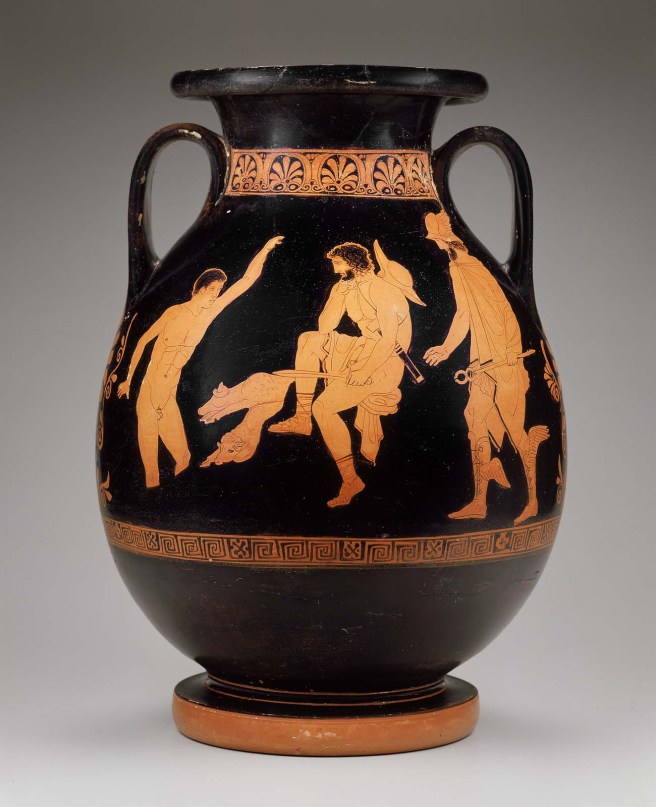
A student paper on the Elpenor Pelike at the MFA in Boston drew my attention to the following passage.

Servius ad Aen. 6.107

“For this reason the place is named without joy since, as people claim, it would not have been there but for necromancy or spellcraft. For, Aeneas completed these sacred rites when Misenus was killed and Ulysses did it with the death of Elpenor. This very scene Homer himself presented falsely from the detail of its location which he specifies along with the length of time of the journey. For he claims that Ulysses sailed for one night and came to the place where he completed these sacrifices. For this reason it is abundantly clear that he doesn’t mean the ocean but Campania.”

sine gaudio autem ideo ille dicitur locus, quod necromantia vel sciomantia, ut dicunt, non nisi ibi poterat fieri: quae sine hominis occisione non fiebant; nam et Aeneas illic occiso Miseno sacra ista conplevit et Vlixes occiso Elpenore. quamquam fingatur in extrema Oceani parte Vlixes fuisse: quod et ipse Homerus falsum esse ostendit ex qualitate locorum, quae commemorat, et ex tempore navigationis; dicit enim eum a Circe unam noctem navigasse et ad locum venisse, in quo haec sacra perfecit: quod de Oceano non procedit, de Campania manifestissimum est.

The relevant passages from the Odyssey don’t give any hint that Elpenor was intentionally killed for black magic. When Odysseus actually does summon the dead, now that gets a little dark.

Odyssey, 10.552–560

“I could not even lead my companions unharmed from there.
The youngest of my companions was a certain Elpênor,
He was neither especially brave in battle or composed in his thoughts.
He separated himself from the companions in Kirkê’s holy home
Because he needed some air; then he fell asleep because he was drunk.
When he heard the noise and trouble of our companions moving out,
He got up immediately and it completely escaped his thoughts
To climb down again by the long ladder—
So he fell straight from the roof and his neck
Shattered along his spine; then his spirit flew down to Hades.”

οὐδὲ μὲν οὐδ’ ἔνθεν περ ἀπήμονας ἦγον ἑταίρους.
᾿Ελπήνωρ δέ τις ἔσκε νεώτατος, οὔτε τι λίην
ἄλκιμος ἐν πολέμῳ οὔτε φρεσὶν ᾗσιν ἀρηρώς,
ὅς μοι ἄνευθ’ ἑτάρων ἱεροῖσ’ ἐν δώμασι Κίρκης,
ψύχεος ἱμείρων, κατελέξατο οἰνοβαρείων·
κινυμένων δ’ ἑτάρων ὅμαδον καὶ δοῦπον ἀκούσας
ἐξαπίνης ἀνόρουσε καὶ ἐκλάθετο φρεσὶν ᾗσιν
ἄψορρον καταβῆναι ἰὼν ἐς κλίμακα μακρήν,
ἀλλὰ καταντικρὺ τέγεος πέσεν· ἐκ δέ οἱ αὐχὴν
ἀστραγάλων ἐάγη, ψυχὴ δ’ ῎Αϊδόσδε κατῆλθεν.

Elpênor appears twice more in the epic: 11.51–80 (Odysseus meets Elpênor’s ghost when he summons the dead); 12.9-15 (Odysseus buries Elpênor).

MFA Boston, Accession Number 34.79; Caskey-Beazley, Attic Vase Paintings (MFA), no. 111; Highlights: Classical Art (MFA), p. 070-071.

Nekuomanteia, glossed by Hesychius as nekromanteia (i.e. “necromancy”) is an alternate name for the Nekyuia, the parade of the dead in book 11 of the Odyssey. From the Greek Anthology: ᾿Εν τῷ Η ἡ τοῦ ᾿Οδυσσέως νεκυομαντεία· (3.8); Scholia to the Odyssey, Hypotheses: Λ. Νεκυομαντεία, ἢ, Νεκυία. Cf. Eustathius, Comm. Ad Od. 1.396.10