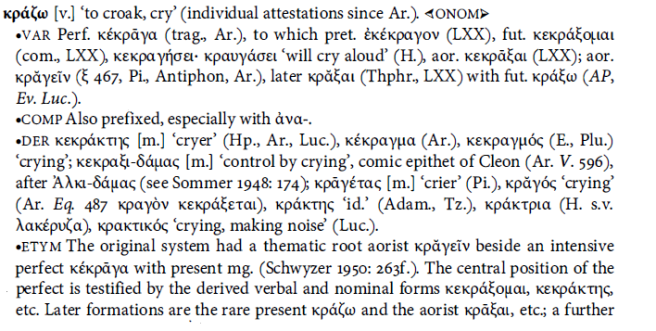
Longing for a Time of Peace

The consummate artistry of the Homeric poems, and their relevance to contemporary life, are perfectly illustrated in the following lines from the Iliad (22.153-156):

“There, right next to the springs, there were broad and beautiful washing-basins made of stone, where the beautiful wives and daughters of the Trojans used to wash dirty clothes, back in the time of peace before the sons of the Achaians came.”

ἔνθα δ᾽ ἐπ᾽ αὐτάων πλυνοὶ εὐρέες ἐγγὺς ἔασι
καλοὶ λαΐνεοι, ὅθι εἵματα σιγαλόεντα
πλύνεσκον Τρώων ἄλοχοι καλαί τε θύγατρες
τὸ πρὶν ἐπ᾽ εἰρήνης πρὶν ἐλθεῖν υἷας Ἀχαιῶν.

Homer does not rely on cheap and easy effects to develop deep, gut-wrenching pathos. The simplicity of the scene from daily life reminds the listener/reader of exactly what the Trojan women were no longer able to do after the commencement of the war – a troublesome daily chore, to be sure, but one which comes to represent a happier time.

But it is the last line quoted which evokes so much without stating it explicitly. The informed reader, armed with the knowledge of the war’s outcome, knows that these washing basins will never be used again, and so the phrase ‘before the sons of the Achaians came’ calls to mind not just a minor inconvenience in the Trojan women’s lives; it reminds us that the lives of these women are already, effectively, over. Moreover, the use of the phrase ‘previously, at a time of peace,’ (which is balanced so clearly in the Greek against the word ‘before’ with ‘to prin…prin’) underscores the fact that after the sons of the Achaeans arrive, the Trojans never know peace again – their entire city is destroyed, and most of the citizens wiped from the face of the planet.

The destruction of an entire polity is horrific, whether it result from ten years of brawling or from ten minutes of bombing. It is easy to blame the Trojan War on Helen, or Paris, or Aphrodite, but the real causes were folly and intransigence; these are immortal, and in no shorter supply than they were three thousand years ago. This passage brings tears to my eyes every time I read it and remember that, though they did not yet know it, the ‘time of peace’ was forever lost to the Trojans – never again would they visit the washing basins; rape, death, and slavery were all that remained. I sincerely hope that we do not find ourselves in the same position of longing for our own ‘time of peace, before the sons of the Achaians came.’
Zooglossia 7: Roosters, Cuckoos, Ravens and Crows

Yes. More animal sounds. When they stop making noise, I will stop searching for it…

The representation of birdsong tends to be onomatopoetic for fairly obvious reasons. There are other examples to add, but below are just a few instances of what birds say in ancient Greek. In English, birds caw; roosters cockle-doodle-do. In Greek, crows and ravens kro and krag-; roosters and cuckoos kokku kokku. Birds in general pip pip while birds giving birth go kakka.

Image result for ancient greek birds

Ammonius, On Improper Speech 2

“There is a difference between speaking and howling—speaking is used for humans; howling is for wolves. We should not the proper name for each of the rest, for example, we say goats , sheep bleat, cows moo, donkeys bray, horses whinny, lions roar, a dog barks among the Athenians from the sound ar of his voice, while we say they howl. For other birds: ravens and crows crow [krôzein], roosters go kok kuo as do the cuckoo birds. Doves [trugonoi] trill. The rest of the animals are similar.”

     διαφέρει μὲν οὖν τὸ φωνεῖν τοῦ ὠρύεσθαι, ὅτι τὸ μὲν φωνεῖν ἐπὶ ἀνθρώπου, τὸ δὲ ὠρύεσθαι ἐπὶ λύκων. παρατηρητέον οὖν καὶ ἐπὶ τῶν λοιπῶν τὸ οἰκεῖον ἑκάστου ὄνομα οἷον μηκᾶσθαι ἐπὶ αἰγῶν, βληχᾶσθαι ἐπὶ προβάτων, μυκᾶσθαι ἐπὶ βοῶν, βρωμᾶσθαι ἐπὶ ὄνων, χρεμετίζειν ἐπὶ ἵππων, βρυχᾶσθαι ἐπὶ λεόντων, ἀρρίζειν ἐπὶ κυνῶν παρ’ ᾿Αθηναίοις ἀπὸ τῆς αρ φωνῆς, παρ’ †ἡμῶν† τούτοις τὸ ὑλακτεῖν λέγεται. καὶ ἐπὶ τῶν πτηνῶν κρώζειν μὲν ἐπὶ κορωνῶν καὶ κοράκων, κοκκύζειν δὲ ἐπὶ ἀλεκτρυόνων καὶ κοκκύγων, τρύζειν δὲ ἐπὶ τρυγόνων. καὶ τὰ λοιπὰ ὁμοίως.

Hesychius

Krôzein: to cry like a raven.”

*κρώζειν· ὡς κόραξ κράζειν

Etym. Gud.

“To krôzein: to make a sound like a raven, or, as a crow cries”

Κρώζειν, ὡς κόραξ, ἢ ὡς κορώνη κράζειν.

Crow Sounds

Rooster and Cuckoo

Cratinus, fr. 311

“They cannot endure the rooster crooning”

κοκκύζειν τὸν ἀλεκτρυόν’ οὐκ ἀνέχονται.

Aristophanes the Grammarian

kokkuzein is for the sound of a rooster”

Καὶ κοκκύζειν ἐπὶ τοῦ ἀλεκτρυόνος.

Hes. Works and Days, 486

“When the cuckoo cuckoos on the leaves of the oak tree.”

ἦμος κόκκυξ κοκκύζει δρυὸς ἐν πετάλοισι


General Chirping and Stranger Things

Hesychius

Pipiazein: “chirping, this lexical item is formed from the sound of birds. People also say potizein or pipiskein

πιπίζειν· κατὰ μίμησιν ἡ λέξις πεποίηται τῆς τῶν ὀρνέων φωνῆς.

     λέγουσι δὲ τὸ ποτίζειν, ἢ πιπίσκειν

Pipo

The following terms are also likely onomatopoetic and may be similar to English “quack”. Note the reduplication common of other animal sounds. Also, note the strange assertion that there is a sound particular of birds producing offspring.

Photius

“Kakkazein: an imitation of the sound of birds producing young.”

Κακκάζειν: μίμησις τικτουσῶν ὀρνίθων φωνῆς.

“Kikkabizein: Aristophanes uses this sound for the noise of owls”

Κικκαβίζειν: τὴν τῶν γλαυκῶν φωνὴν οὕτως καλεῖ ᾿Αριστοφάνης.

Kakka 1

Kikka

Zooglossia 6: A Dog Goes Βαὺ Ϝαύ

This is yet another entry in the search for Greek animal sounds. You can find earlier notes on goats, pigs, sheep, donkeys and cows.

Aristophanes Wasps, 902-3

Ph.“Where is the plaintiff, the Kudathênaian dog?

Dog: Ow, Ow!

ποῦ δ’ ὅ γε διώκων, ὁ Κυδαθηναιεὺς κύων;

ΚΥΩΝ   αὖ αὖ.

When I was in graduate school I had a few table lecterns built by my late father who used to spend time under the influence working in the woodshop in his later years. He made a series of unfinished lecterns that worked to various degrees. One of them had some of my favorite lines from Greek scrawled on them—as I worked my way through the PhD reading list, I would throw fragments on it when they entertained me. (This practice, if any, represents the extreme origin of this blog and the twitter feed).

The dog’s comment above from the Wasps was one of a dozen on it. For years, I thought of ancient Greek dogs as saying au au until, last week, in a fit of fancy over animal noises, I posted this on twitter and was corrected. Ancient Greek dogs don’t say au au. They probably spoke the same language our dogs do and said Βαὺ Ϝαύ.

There was a lively twitter conversation about this.

As usual, the Suda would have helped explain the confusion. According to it (and a comment repeated in the scholion to Aristophanes’ Wasps), “au au is the imitation of the howling of dogs” (αὖ αὖν: μίμημα ὑλακῆς κυνῶν). The verb   ὑλακτεῖν—a secondary formation from the onomatopoetic ὑλάω—is, as any student of Athenaze would know, used at times to mean “bark”, but it more properly means to howl. From Beekes:

Ulaw

Aristonicus, De Signis Iliadis ad 21.575

“The howl is the special sound of dogs.”

ὁ γὰρ ὑλαγμὸς ἴδιος κυνῶν.

Zonaras, beta 379

“Barking: ulaktôn: In Aristophanes [Thesm. 173] “Barking, for I was like this….”

Βαΰζων. ὑλακτῶν. ᾿Αριστοφάνης· βαΰζων γὰρ καὶ ἐγὼ τοιοῦτος ἦν.

That Greek dogs likely said bau wau like our own is confirmed by a few fragments and the existence of another onomatopoetic verb, βαΰζειν. The loss of the digamma in Greek obscures the similarity, but, as we have seen from other Greek words for animal sounds, there is a tendency to represents them through reduplication. There is probably something interesting to say about this and Greek phonetic representations of linguistic otherness, as in the reduplicated bar-bar-os.

BauFCG Anonymous Fragments, Fr. 195 (=IEG fr. 50)
“Bau, bau—you also utter the sound of a dog!”

Βαὺ βαὺ καὶ κυνὸς φωνὴν ἱείς.

Pseudo-Herodian, De prosida Catholica 3.1.495

“The bau is accented in imitation of a dog….from this too comes the word “to bark”

καὶ τὸ βαύ κατὰ μίμησιν κυνὸς ὀξύνεται «βαὺ βαὺ καὶ κυνὸς φωνὴν ἱείς». ἐξ οὗ καὶ τὸ βαύζω ῥῆμα.

Aristophanes, Thesmo. 173-4

“Stop barking at him. I was also the like this
When I was that age, when I was beginning to compose.”

ΕΥ.                Παῦσαι βαΰζων· καὶ γὰρ ἐγὼ τοιοῦτος ἦν
ὢν τηλικοῦτος, ἡνίκ’ ἠρχόμην ποεῖν.

Cause of Death? Bullshit.

Diogenes Laertius, Lives of the Philosophers 9.1.2-4:

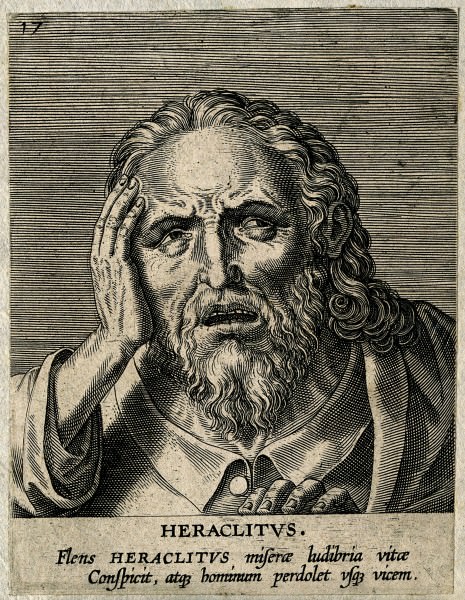
“Hermippus says that Heraclitus asked the doctors if one could, by emptying his bowels, dry out the moisture [from dropsy]. When they denied that it could be done, he laid himself out in the sun and ordered some boys to smother him in cow shit. On the next day, he died stretched out in that way, and was buried in the agora. Neanthes of Cyzicus says that because he was unable to get it off, the shit remained on him; because of this change in his appearance, he was unrecognized, and was eaten by dogs.”

Ἕρμιππος δέ φησι λέγειν αὐτὸν τοῖς ἰατροῖς εἴ τις δύναται <τὰ> ἔντερα κεινώσας τὸ ὑγρὸν ἐξερᾶσαι: ἀπειπόντων δέ, θεῖναι αὑτὸν εἰς τὸν ἥλιον καὶ κελεύειν τοὺς παῖδας βολίτοις καταπλάττειν: οὕτω δὴ κατατεινόμενον δευτεραῖον τελευτῆσαι καὶ θαφθῆναι ἐν τῇ ἀγορᾷ. Νεάνθης δ᾽ ὁ Κυζικηνός φησι μὴ δυνηθέντ᾽ αὐτὸν ἀποσπάσαι τὰ βόλιτα μεῖναι καὶ διὰ τὴν μεταβολὴν ἀγνοηθέντα κυνόβρωτον γενέσθαι.

Zooglossia 5: Cows Go Moo in Mycenae

Another entry in an animal obsession. Sheep go baa, baa. Ancient Greek cows may have said moo….

Did Ancient Greek cows say Μῦ μῦ?

Suda, cf. Photius s.v. Μυκηθμός

“Mukêthmos: the sound of bulls”

Μυκηθμός: ἡ τῶν βοῶν φωνή.

Cf. Schol. Q ad Hom. Od. 10.413:  μυκώμεναι] βοῶσαι· μυκηθμὸς γὰρ ἡ τῶν βοῶν φωνή. Q.

We also have independent confirmation that cows may have said mu as early as the Mucynean period:

This nominal root, likely onomatopoetic from the sound of animals, has a few verbal reflexes in Greek, including μυκάομαι and μύζω. There are additional derivatives: μυκητής (“bellower”, μυκήμων “bellow”, μύκημα (“lowing, bellowing”; used of lions and thunder too). The upsilon is long to contrast with the short vowel in μύκης (“mushroom”) and Μυκήνη (Mycenae).  Here’s Beekes again:

Mu 1Mu 2

Perhaps this is not a sound exclusive to cattle, however. Consider Suda mu 1390:

Mycalê and Mukalêsos: name for a city. It comes from the fact that the Gorgons bellowed here.”

Μυκάλη καὶ Μυκαλησός, ὄνομα πόλεως. παρὰ τὸ ἐκεῖ μυκᾶσθαι τὰς Γοργόνας.

The verb is also used to indicate the low sound of objects or the roar of a lion. See Suda, mu 1394

Mukêsantos: “after it sounded”—Homer has “on their own, the gates of heaven sounded, the gates the seasons hold” and in the Epigrams, “after the drum sounded deeply, the boldest of the rest of the animals ran off faster than a deer.”

Μυκήσαντος: ἠχήσαντος. Ὅμηρος: αὐτόμαται δὲ πύλαι μύκον οὐρανοῦ, ἃς ἔχον Ὧραι. καὶ ἐν Ἐπιγράμμασι: οὗ βαρὺ μυκήσαντος, ὁ θαρσαλεώτερος ἄλλων τετραπόδων ἐλάφων ἔδραμεν ὀξύτερον.

And the sound moo seems to be used for non-verbal soundmaking for humans too:

Aristophanes, Thesm. 231-231   

Kê: Moo, Moo

Eu: Why are you mootering? Everything has been done well.

 ΚΗ.                Μῦ μῦ.

 ΕΥ.                       Τί μύζεις; Πάντα πεπόηται καλῶς.

There might be multiple layers of onomatopoetic derivatives here—one for the cow and another for the human moan, and even this is probably a simplification.

Zonaras, s.v. Μῦ (=Etymologicum Magnum s.v)

Moo: a simple sound, this utterance imitates a moan. A moan is an echo of moo, a sound coming from the nose.”

Μῦ. τὸ στοιχεῖον, ὅτι μυγμόν τινα ἔχει ἡ τούτου ἐκφώνησις. μυγμὸς δέ ἐστιν ὁ τοῦ μῦ ἦχος, διὰ τοῦ μυκτῆρος ἐξερχόμενος.

Image result for ancient Greek cow

Not a Plea for Greek

Basil Gildersleeve, Hellas and Hesperia

“I am not going to plead for Greek, even if it were only for the Grecians in this audience; for if there is one thing that a classical scholar cares less to read than another, it is a plea for classical scholarship; if there is one thing that a Grecian would fain be excused from hearing, it is an impassioned oration in behalf of Greek studies. For every classical scholar has himself had to plead for classical scholarship, and every Hellenist has lifted up his voice in behalf of Hellenism. We are aweary of our own arguments, our own illustrations; and only a short time since, being called on for some confirmatory remarks on an orthodox exposition of the value of the Greek language and the Greek literature, I felt stirred to pro-test against the whole thing. If the study is doomed, I said, let it die. Living is the test of vitality, for that is the sum and substance of pragmatism, the latest phase of what I may venture to call truistic philosophy — truistic philosophy to match altruistic ethics, of which one hears so much, which one practices so little. If classical culture has outlived its usefulness; if its teachers are squeaking and gibbering ghosts and not real men, let in the light, turn on the current and have done with it. So I am not to make a speech pro domo, for my house, which is my castle, my fortress. Everybody knows every redoubt, every salient. The gabions are all counted, and the fascines all numbered, and the chevaux de frise all roughshod, and the fosse all flooded with ditchwater eloquence. This then is to be no vindication of Greek as a study. Call it an exemplification of Greek as a study and I will not protest so strenuously, Invidious as It may be to set one’s self up as an example of anything, especially when critics have proved triumphantly that I have not profited by my lifelong studies, and that the chaste reserve of my classic models has not properly regulated my style.”

Advice to Authors: Know Your Subject

Pliny, Epistles V.6

“In sum (and why should I not reveal to you what is either my keen judgment or my error?) I consider it the chief business of an author to read his own title and ask himself again and again what he has begun to write. He should know that he will not be tedious if he sticks to his material, but will become wearisome if he calls up and adds something extra. You see how many verses Homer and Vergil used to describe the battles of Aeneas and Achilles; but each of these authors was brief because he stuck to his established subject. You see how Aratus pursues inquiries concerning even the most insignificant stars, but he still stays within the bounds: this is not just some digression of his – it is the work itself.”

Image result for pliny epistles


In summa – cur enim non aperiam tibi vel iudicium meum vel errorem? – primum ego officium scriptoris existimo, titulum suum legat atque identidem interroget se quid coeperit scribere, sciatque si materiae immoratur non esse longum, longissimum si aliquid accersit atque attrahit. Vides quot versibus Homerus, quot Vergilius arma hic Aeneae Achillis ille describat; brevis tamen uterque est quia facit quod instituit. Vides ut Aratus minutissima etiam sidera consectetur et colligat; modum tamen servat. Non enim excursus hic eius, sed opus ipsum est.

Zooglossia 4: Sheep Go “Baa” and an Absurd Etymology

My new ‘serious academic obsession’ has been Greek representations of animal sounds. So far, we have had goats, donkeys, and pigs. Now, sheep.

Aristophanes, fr. 642

“He is about to sacrifice me and he is telling me to say “baa”.”

θύειν <με> μέλλει καὶ κελεύει βῆ λέγειν.


Aelian, On Animals, 16.16

τῶν δὲ οἰῶν βληχή, “The bleating of sheep”


Hermippus, fr. 19

“Baa”
[βᾶ]


Suda, s.v. Βή (beta, 240)

Baa: This is the imitation of the sound of sheep—since Attic speakers do not say bai. Cratinus in his Dionysalexandros says “the last one walks forward saying “baa baa” like a sheep.”

Βή τὸ μιμητικὸν τῆς τῶν προβάτων φωνῆς, οὐχὶ βαὶ λέγουσιν Ἀττικοί. Κρατῖνος Διονυσαλεξάνδρῳ: ὁ δὴ λοίσθιος ὥσπερ πρόβατον βὴ βὴ λέγων βαδίζει.

Image result for Ancient Greek sheep


Perhaps one of the reasons the metonymic name probata stuck for sheep is that they “baa” in front (probata means to “walk in front”, from bainô).


Here’s Beekes on baaing and bleating:

Baa


Bleat

Grammar, the Driest and Deathliest of All Disciplines

Basil Gildersleeve, Hellas and Hesperia

“According to the conditions of the Foundation, the lecturer is to speak of that which lies within the range of his special studies, and it is a sad fact that most of those who know me at all, know me, first, as the author of a Latin Grammar, and next, as a professor of Greek — Greek, which they tell me is doomed, and grammar which is damned already. Some years ago I had a new shudder, as Victor Hugo calls it, when I found that in some schools there are classes in Gildersleeve as there are classes in Conic Sections. ‘Grammar,’ says an eminent academic authority, himself a Hellenist, ‘is to the average healthy human being the driest and deathliest of all the disciplines;’ and grammarians have not been looked on with much favor in either ancient or modern times, at best as a higher type of hedge schoolmaster. Such a hedge schoolmaster figures in the Greek Anthology. His name has an aristocratic ring and recalls the great Arcadian seeress who taught Socrates the secret of true love. But Diotimus had come down in the world, and the mocking anthologist sings :

Αἰάζω Διότιμον ὃς ἐν πέτραισι κάθηται
Γαργαρέων παισὶν βῆτα καὶ ἄλφα λέγων

or, if he had lived to-day, and been utterly desperate, would perhaps have sung :

Diotimus, poor grammarian!
If my heart hath pitied e’er a one,
It is he.
Who, an almost centenarian,
Perched upon a ‘peak in Darien,’
Teaches little Jack and Mary Ann
ABC

In the same anthology, a grammarian of a somewhat better class is ridiculed, a university
professor, who is supposed to say:

Χαίρετ’ Ἀριστείδου τοῦ ῥήτορος ἑπτὰ μαθηταί
τέσσαρες οἱ τοῖχοι καὶ τρία συψέλια

which is being interpreted:

I’m a success, sir, I’m a success, sir,
Seven steady students are at each lecture.
Count if you please, sir, four walls and three desks, sir.

Now if these things were done in the green wood of antiquity, what is to be expected of the dry wood of modern times ? All literature is full of absurd grammarians, Dominie Sampsons, and Doctor Panglosses, and Doctor Syntaxes; and though I am a great stickler for the honor of the guild to which I belong, still I must say again that I should not like to have my individuality merged in my Latin Grammar, and this sensible warm motion to become the kneaded clod of a crabbed textbook. To be sure, in Browning’s Grammarian’s Funeral, the poet has done something to redeem the craft, and I welcome the vindication; for whilst Browning and his commentators do not fail to tell us that the technical grammarian of the present day was not meant so much as the grammarian of the Renascence — the student of antique literature — still the man who ‘properly based oun, dead from the waist down,’ belongs to our guild. He belongs to the ‘corner-hummers’ and ‘monosyllablers’ of the old epigram.


The Wonder, the Horror of Humans

Euripides, Hippolytus 916-920

“O humanity, you f#ck up pointlessly so often!
You teach so many skills,
and you have contrived and discovered all things,
yet why do you not know nor seek
how to teach fools to reason rightly?”

ὦ πόλλ᾽ ἁμαρτάνοντες ἄνθρωποι μάτην,
τί δὴ τέχνας μὲν μυρίας διδάσκετε
καὶ πάντα μηχανᾶσθε κἀξευρίσκετε,
ἓν δ᾽ οὐκ ἐπίστασθ᾽ οὐδ᾽ ἐθηράσασθέ πω,
φρονεῖν διδάσκειν οἷσιν οὐκ ἔνεστι νοῦς;

Homer, Odyssey 18.130-5

“The earth raises up nothing feebler than human beings—
[of all the things that creep and breathe over the earth]
For we think that we will never suffer evil tomorrow
As long as the gods give us excellence and our limbs are quick.
But when the gods carry out painful things too,
We endure them unwillingly with a tormented heart.”

οὐδὲν ἀκιδνότερον γαῖα τρέφει ἀνθρώποιο
[πάντων, ὅσσα τε γαῖαν ἔπι πνείει τε καὶ ἕρπει.]
οὐ μὲν γάρ ποτέ φησι κακὸν πείσεσθαι ὀπίσσω,
ὄφρ’ ἀρετὴν παρέχωσι θεοὶ καὶ γούνατ’ ὀρώρῃ·
ἀλλ’ ὅτε δὴ καὶ λυγρὰ θεοὶ μάκαρες τελέωσι,
καὶ τὰ φέρει ἀεκαζόμενος τετληότι θυμῷ.

Uplifting? Yes. And it made me think of the famous “Ode to Man” from Sophocles’ Antigone (332-41):

There are many wonders and none
is more surprising than humanity.
This thing that crosses the sea
as it whorls under a stormy wind
finding a path on enveloping waves.
It wears down imperishable Earth, too,
the oldest of the gods, a tireless deity,
as the plows trace lives from year to year
drawn by the race of horses….

?Ο. Πολλὰ τὰ δεινὰ κοὐδὲν ἀν-
θρώπου δεινότερον πέλει·
τοῦτο καὶ πολιοῦ πέραν
πόντου χειμερίῳ νότῳ
χωρεῖ, περιβρυχίοισιν
περῶν ὑπ’ οἴδμασιν, θεῶν
τε τὰν ὑπερτάταν, Γᾶν
ἄφθιτον, ἀκαμάταν, ἀποτρύεται,
ἰλλομένων ἀρότρων ἔτος εἰς ἔτος,
ἱππείῳ γένει πολεύων.

Image result for Ancient Greek creation of man

(It keeps going… Go here for the full text).  This, of course, I cannot consider without thinking of Shakespeare’s Hamlet (2.2.303-12):

“What a piece of work is a man, how noble in reason, how
infinite in faculties, in form and moving how express and
admirable, in action how like an angel, in apprehension how like
a god! the beauty of the world, the paragon of animals—and yet,
to me, what is this quintessence of dust? Man delights not me—
nor woman neither, though by your smiling you seem to say so.”

And this led me to listen to the musical ‘version’ from Hair, the sweetness of the song makes the bitter lesson a bit easier to swallow: