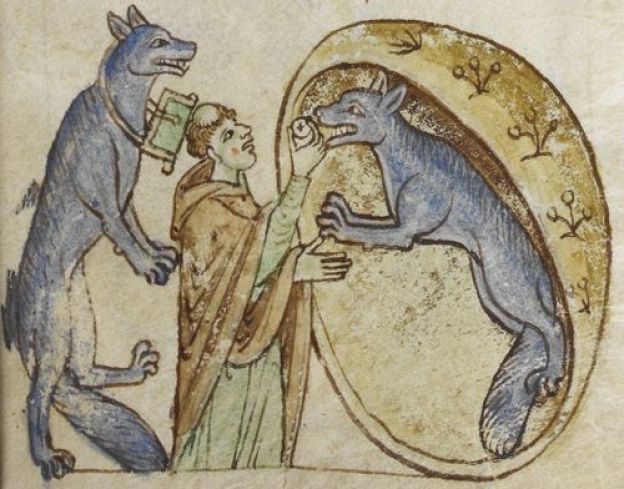
‘Ignatius pulled his flannel nightshirt up and looked at his bloated stomach. He often bloated while lying in bed in the morning contemplating the unfortunate turn that events had taken since the Reformation. Doris Day and Greyhound Scenicruisers, whenever they came to mind, created an even more rapid expansion of his central region. But since the attempted arrest and the accident, he had been bloating for almost no reason at all, his pyloric valve snapping shut indiscriminately and filling his stomach with trapped gas, gas which had character and being and resented its confinement. He wondered whether his pyloric valve might be trying, Cassandralike, to tell him something. As a medievalist Ignatius believed in the rota Fortunae, or wheel of fortune, a central concept in De Consolatione Philosophiae, the philosophical work which had laid the foundation for medieval thought. Boethius, the late Roman who had written the Consolatione while unjustly imprisoned by the emperor, had said that a blind goddess spins us on a wheel, that our luck comes in cycles. Was the ludicrous attempt to arrest him the beginning of a bad cycle? Was his wheel rapidly spinning downward? The accident was also a bad sign. Ignatius was worried. For all his philosophy, Boethius had still been tortured and killed. Then Ignatius’ valve closed again, and he rolled over on his left side to press the valve open.
“Oh, Fortuna, blind, heedless goddess, I am strapped to your wheel,” Ignatius belched.
“Do not crush me beneath your spokes. Raise me on high, divinity.”
“What you mumbling about in there, boy?” his mother asked through the closed door.
“I am praying,” Ignatius answered angrily.
“Patrolman Mancuso’s coming today to see me about the accident. You better say a little Hail Mary for me, honey.”
“Oh, my God,” Ignatius muttered.
“I think it’s wonderful you praying, babe. I been wondering what you do locked up in there all the time.”
“Please go away!” Ignatius screamed. “You’re shattering my religious ecstasy.”’
“But the same chance struck that man ignorant of what he used to say, that he was a philosopher, and smeared him with the gore and dirt of that most unclean and most immoderate monster.”
sed idem casus illum ignarum quid profiteretur, cum se philosophum esse diceret, istius impurissimae atque intemperantissimae pecudis caeno et sordibus inquinavit.
Cicero, Post Reditum in Senatu, 15
But how lusty, filthy, immoderate a man he is at home where his pleasures’ servants sneak in through a secret passage instead of the door. But when he began to lust after literature, when his huge beastliness began to philosophize with the little Greeks, he was an Epicurean—not deeply dedicated to that discipline, but seduced by the single word of pleasure. Moreover, he took as teachers not those boring ones who talk all day long about duty and virtue or who exhort their students to work, diligence, to undergo dangers for their country. No, he chose those who argue that no hour should be free of pleasure and that it is right to make sure that every part of the body is always pursuing some joy or delight.”
Idem domi quam libidinosus, quam impurus, quam intemperans non ianua receptis, sed pseudothyro intromissis voluptatibus! Cum vero etiam litteris studere incipit et belua immanis cum Graeculis philosophari, tum est Epicureus, non penitus illi disciplinae quaecumque est deditus, sed captus uno verbo voluptatis. Habet autem magistros non ex istis ineptis, qui dies totos de officio ac de virtute disserunt, qui ad laborem, ad industriam, ad pericula pro patria subeunda adhortantur, sed eos, qui disputent horam nullam vacuam voluptate esse debere: in omni parte corporis semper oportere aliquod gaudium delectationemque versari.
This week in honor of Halloween we are returning to an obsession with lycanthropy. There is a trove of ancient Greek medical treatises on the diagnosing and treatment of the disease.
Oribasius is said to have studied medicine in Alexandria; he later served as the court doctor to Julian the Apostate. He wrote several encyclopedic summaries of medical knowledge at the time. The text produced for a friend’s son (Synopsis ad Eustathium) is identical to that attributed to Paulus of Aegina and seems to form the core of medical treatises on lycanthropy.
On Lycanthropy:
“Men who are afflicted with lycanthropy go out at night and imitate wolves in every way, spending time until daybreak among the gravestones. You will recognize that someone is suffering from this by the following symptoms. They appear pale and look weak; they have dry eyes and cannot cry. You may observe that their eyes are hollow and their tongue is especially dry: they cannot really produce saliva. They are thus thirsty and in addition they have wounded shins from scraping the ground frequently.
These are the symptoms; for treatment it is important to recognize that this is a type of melancholy which you may treat at the time the disease is noticed by cutting open the veins and draining blood until the patient almost passes out. Let him be washed in a sweet bath. After rubbing him down with milk-whey for three days, apply a pumpkin salve* to him on the second and third day. Following these cleansings, anoint him with the antidote for viper-venom and do the rest of the things prescribed for melancholy. When they disease has already come over those who are accustomed to sleepwalk, anoint them with lotion. And rub opium on their ears and nostrils when they are ready to sleep.”
* The pumpkin or gourd (Gr. kolokunthos) was associated with life and health due to its “juicy nature”; see LSJ s.v. This may explain its ritual/therapeutic use both in cleansing an association with death and with treating a patient exhibiting extreme symptoms of dryness.
Dolon the Trojan Wears a Wolf Skin on a Red Figure Vase…His ‘treatment’ was less than therapeutic…
Aetius was a Byzantine doctor and writer who may have lived as early as the fifth century CE.He also studied at Alexandria and collated sixteen books of medicine—much of which was drawn from Galen and Oribasius. His indebtedness to the latter is clear from his passage on lycanthropy, but there are interesting additions. I have marked the significant additions in bold.
On Lykanthropy or Kynanthropy, following Marcellus*
Those who are afflicted by the disease once-called kynanthropy or lycanthropy go out at night during the month Pheurouarion** and imitate wolves or dogs in every way as they spend time until daybreak around gravestones especially. You will recognize people who suffer in this way from the following symptoms: They are pale, they look weak, they have dry eyes and a dry tongue and they don’t completely secrete saliva. They are thirsty and they have festering wounds on their shins from falling continuously and from dog bites.
Such are the symptoms. For treatment, you need to understand that lycanthropy is a type of melancholy. You treat it at the time the disease is noticed by cutting open the veins and draining the blood until the point when the patient passes out, then treat the sick with well-flavored food. Let him be washed in a sweet bath, and after rubbing him with milk-whey for three days, apply a pumpkin salve to him from [Rouphos, Archigenos, or Ioustos]. After these cleansings, anoint him with the viper-venom antidote. Also do all the other things that are prescribed earlier for melancholy.
When the disease comes on in the evening, rub down the heads of those who tend to sleepwalk with a lotion and for those who hunt by scent, smear some opium on their nostrils. Sometimes it is also necessary to administer a sleeping medicine.”
*According to the Suda, Marcellus was a doctor of Marcus Aurelius (2nd Century) who wrote two books on medicine in dactylic hexameter.
**Presumably this coincides with the month February and may have a special connection with Lycanthropy due to the Lupercalia.
Paulus (of Aegina, c. 7th Century CE) A 7th Century CE Byzantine Physician who wrote De Re Medica Libri Septem) The Suda (s.v. Paulus) writes: Παῦλος, Αἰγινήτης, ἰατρός. ἔγραψεν ἰατρικὰ βιβλία διάφορα (“Paulos, from Aeigina, a doctor. He wrote various medical books”).
The text below is identical to that attributed to Oribasius:
“Men who are afflicted with lycanthropy go out at night and imitate wolves in everyway, spending time until daybreak among gravestones. You will recognize that someone is suffering from this by the following symptoms. They appear pale and look weak; they have dry eyes and cannot cry. You may observe that their eyes are hollow and their tongue is especially dry: they cannot really produce saliva. They are thus thirsty and in addition they have wounded shins from scraping the ground frequently.
These are the symptoms; for treatment it is important to recognize that this is a type of melancholy, which you may treat at the time the disease is noticed by cutting open the veins and draining blood almost until the patient passes out. Let him be washed in a sweet bath. After rubbing him down with milk-whey for three days, apply a pumpkin salve to him on the second and third day. Following these cleansings, anoint him with the antidote for viper-venom and do the rest of the things prescribed for melancholy. When the disease has already come over those who are accustomed to sleepwalk, anoint them with lotion. And rub opium on the ears and nostrils of those preparing to sleep.”
Johannes Zacharias Actuarius was also a Byzantine doctor. He composed many works on medicine that drew on Galen, Aëtiusand Paulus—which is clear from his text on lycanthropy. Significant differences from Aëtius’ text are in bold.
De Diagnosi 1.34.24
“A type of this madnessis called lycanthropy—it convinces those so afflicted to go outside in the middle of the night, among the graves and desolate places, like wolves and to return at night, to become themselves again, and to remain at home. But some of them have feet and shins marked up from touching stones and thorns and they have dry eyes and tongue. They are thirsty, and they look weak. I will pass over how much the others suffer—but some of them die after fearing death for long while others desire it fiercely. In the same way, some avoid large groups of people and maintain the strictest silence, while the others, if they are not among a crowd where they remain calm, they make a racket and seem out of their minds. These things happen when some kind of humor is imbalanced, and the place which reddens when it comes to the surface and returns energy to the person’s spirit.”
Anonymi Medici, A Collection of ancient treatises on disease and treatments. Some tracts are dated to the first century CE. There are some textual issues I have only barely tried to solve. The additions and differences seem to imply a text later than Paulus or Aëtius.
“Lycanthropy is a type of madness when people go out at night and spend time among graves. You will recognize those who suffer from it thus. Their skin is pale and they appear weak. They have dry eyes and they neither cry nor produce moisture. You may note that their eyes are hollow and their forehead is damp; they may have an extremely dry tongue and may not completely produce saliva. They are thirsty and they have open wounds on their shins from striking them frequently. Their body bears the particular marks of melancholy sometimes, since this is melancholic in nature, and they have been afflicted [with this] by some thought or sleeplessness, or spoiled food, or contact with birth fluids [?], bloody discharge, or menstrual blood. These are the indications and signs of lycanthropy.
This is how you treat it: I cut the veins at the elbows and I drain blood almost until the patient passes out then treat the sick with well-flavored food. Let him be washed in a sweet bath. After rubbing him down with milk-whey for three days, apply pumpkin salve to him on the second and third day. After running him down with milk-whey for three days, apply a pumpkin salve to him on the second and third day. After these cleansings, I would anoint him with the antidote for viper-venom and do the rest of the things prescribed for melancholy. In addition, I would suggest draining off any bloody discharge and avoiding any menstrual blood in order to stop the conditions that created the disease. Also commendable is furnishing diuretics and cleaning any pustules.”
As a Homerist, my experience in late Greek prose is limited; my experience in medical terminology is worse. I believe I have made sense of all of this, but I am happy to have suggestions or additions.
τῇ διὰ τῆς κολοκυνθίδος ἱερᾷ: This phrase has given me fits. I at first made the mistake of taking ἱερᾷ to mean something sacred (e.g. rite, but not “shrine”, because that would be neuter!). But the LSJ lists ἱερὰ ἡ: a kind of serpent adding “II. A name for many medicines in the Greek pharmacopia…of a plaster; esp. of aloes.” So, since it does not seem likely that the treatment being prescribed is a “snake through a pumpkin”. In addition, later Greek prose uses dia + genitive to denote the thing from which something was made (LSJ s.v. dia A.III.c.2). So, I have settled on a “pumpkin salve”
τῇ διὰ τῆϲ κολυκυνθίδοϲ ἱερᾷ ῾Ρούφου ἢ ᾿Αρχιγένουϲ ἢ ᾿Ιούϲτου: I have no idea what is going on with the three proper names here: are these places or people that produce the pumpkin poultice?
“Education, of these accidental causes of melancholy, may justly challenge the next place, for if a man escape a bad nurse, he may be undone by evil bringing up. Jason Pratensis puts this of education for a principal cause; bad parents, stepmothers, tutors, masters, teachers, too rigorous, too severe, too remiss or indulgent on the other side, are often fountains and furtherers of this disease. Parents and such as have the tuition and oversight of children, offend many times in that they are too stern, always threatening, chiding, brawling, whipping, or striking; by means of which their poor children are so disheartened and cowed, that they never after have any courage, a merry hour in their lives, or take pleasure in anything. There is a great moderation to be had in such things, as matters of so great moment to the making or marring of a child. Some fright their children with beggars, bugbears, and hobgoblins, if they cry, or be otherwise unruly: but they are much to blame in it, many times, saith Lavater, de spectris, part. 1, cap. 5.ex metu in morbos graves incidunt et noctu dormientes clamant, for fear they fall into many diseases, and cry out in their sleep, and are much the worse for it all their lives: these things ought not at all, or to be sparingly done, and upon just occasion. Tyrannical, impatient, hair-brain schoolmasters, aridi magistri, so Fabius terms them, Ajaces flagelliferi, are in this kind as bad as hangmen and executioners, they make many children endure a martyrdom all the while they are at school, with bad diet, if they board in their houses, too much severity and ill-usage, they quite pervert their temperature of body and mind: still chiding, railing, frowning, lashing, tasking, keeping, that they are fracti animis, moped many times, weary of their lives, nimia severitate deficiunt et desperant, and think no slavery in the world (as once I did myself) like to that of a grammar scholar. Praeceptorum ineptiis discruciantur ingenia puerorum, saith Erasmus, they tremble at his voice, looks, coming in. St. Austin, in the first book of his confess. et 4 ca. calls this schooling meliculosam necessitatem, and elsewhere a martyrdom, and confesseth of himself, how cruelly he was tortured in mind for learning Greek, nulla verba noveram, et saevis terroribus et poenis, ut nossem, instabatur mihi vehementer, I know nothing, and with cruel terrors and punishment I was daily compelled. Beza complains in like case of a rigorous schoolmaster in Paris, that made him by his continual thunder and threats once in a mind to drown himself, had he not met by the way with an uncle of his that vindicated him from that misery for the time, by taking him to his house. Trincavellius, lib. 1. consil. 16. had a patient nineteen years of age, extremely melancholy, ob nimium studium, Tarvitii et praeceptoris minas, by reason of overmuch study, and his tutor’s threats. Many masters are hard-hearted, and bitter to their servants, and by that means do so deject, with terrible speeches and hard usage so crucify them, that they become desperate, and can never be recalled.”
“How, then, is it possible to prove that Clodius conspired against Milo? For such an audacious, nefarious monster it is enough to show that he had a great reason, that great hope resided in the death of Milo, and that there was great purpose to it. And so, let that proverb of Cassius “Who profited from it?” [cui bono fuerit] frame the players on the stage, if truly good men are compelled to deception by no prize while the wicked often are moved by a small one.
Once Milo was killed, Clodius advanced in these ways: not only was he as a praeter under no consul who would do something about his crime, but he was also a praeter serving under consuls with whose plans if not their actually help he hoped that he would be able to get away with his planned insanities. These men, as I am sure we were thinking, would not want to restrain his actions if they could, since they would think about the great benefit they owed him; men who, even if they wanted to, would hardly be capable of squashing the boldness of the most criminal person, an audacity fully strengthened by time.”
Quonam igitur pacto probari potest insidias Miloni fecisse Clodium? Satis est in illa quidem tam audaci, tam nefaria belua docere, magnam ei causam, magnam spem in Milonis morte propositam, magnas utilitates fuisse. Itaque illud Cassianum, “cui bono fuerit,” in his personis valeat, etsi boni nullo emolumento impelluntur in fraudem, improbi saepe parvo. Atqui Milone interfecto Clodius haec adsequebatur, non modo ut praetor esset non eo consule, quo sceleris nihil facere posset, sed etiam ut eis consulibus praetor esset, quibus si non adiuvantibus, at coniventibus certe speraret posse se eludere in illis suis cogitatis furoribus: cuius illi conatus, ut ipse ratiocinabatur, nec cuperent reprimere, si possent, cum tantum beneficium ei se debere arbitrarentur, et, si vellent, fortasse vix possent frangere hominis sceleratissimi conroboratam iam vetustate audaciam.
The famous Lucius Cassius, whom the Roman people used to consider the most truthful and wisest judge, often used to say in evaluating cases “who stood to profit” [cui bono fuisset]. This is the human way: no one pursues a crime without the hope of some profit.”
Cassius ille, quem populus Romanus verissimum et sapientissimum iudicem putabat, identidem in causis quaerere solebat, “cui bono” fuisset. Sic vita hominum est, ut ad maleficium nemo conetur sine spe atque emolumento accedere.
Roman Coin depicting Vestal Virgin on one side and L. Cassius on the other (he famously prosecuted the Vestal Virgins for not being chaste)
In discussing tales of Diomedes’ companions being turned into birds, Augustine in De Civitate Dei (City of God) discusses werewolves (18.17, the full text):
“In order to make this seem more likely, Varro reports other fantastic tales concerning the infamous witch Circe, who transformed Odysseus’ companions into beasts, and concerning the Arcadians, who were by chance transformed when they swam across a certain lake in which they were turned into wolves. Then, they lived as wolves in the same region. If they did not eat human flesh, then they would be returned to human form after swimming across the same lake again.
And he also specifies that a certain Demanaetus tasted of the sacrifice which the Arcadians used to make to the Lycaean god, after the child was burned on the altar, and that he transformed into a wolf and, once he became a man again, competing in boxing at the Olympian games and achieved a victory. Varro does not believe for this reason that Pan or Jupiter were given the name “Lykaios” in Arcadia for any other reason than their ability to turn men into wolves, since they did not believe that this could happen except through divine power. As you know, a wolf is called lykos in Greek, and this is where the name Lykaian comes from. Varro adds that the Roman Luperci arose from their own mysteries similarly.
But what can we who talk about these things say about this kind of deceit by the devil’s forces?”
Augustine goes on to object to these tales and discuss Apuleius’ Golden Ass. I started translating this, but it is a bit of a Halloween buzzkill..
No Room For Werewolves in this city…
[XVII] Hoc Varro ut astruat, commemorat alia non minus incredibilia de illa maga famosissima Circe, quae socios quoque Vlixis mutauit in bestias, et de Arcadibus, qui sorte ducti tranabant quoddam stagnum atque ibi conuertebantur in lupos et cum similibus feris per illius regionis deserta uiuebant. Si autem carne non uescerentur humana, rursus post nouem annos eodem renatato stagno reformabantur in homines.
Denique etiam nominatim expressit quendam Demaenetum gustasse de sacrificio, quod Arcades immolato puero deo suo Lycaeo facere solerent, et in lupum fuisse mutatum et anno decimo in figuram propriam restitutum pugilatum sese exercuisse et Olympiaco uicisse certamine. Nec idem propter aliud arbitratur historicus in Arcadia tale nomen adfictum Pani Lycaeo et Ioui Lycaeo nisi propter hanc in lupos hominum mutationem, quod eam nisi ui diuina fieri non putarent. Lupus enim Graece *lu/kos dicitur, unde Lycaei nomen apparet inflexum. Romanos etiam Lupercos ex illorum mysteriorum ueluti semine dicit exortos.
Sed de ista tanta ludificatione daemonum nos quid dicamus…
In the second century CE, Pausanias composed ten books on the sights and wonders of ancient Greece. His text provides some of the only accounts of architecture, art and culture that have been lost in intervening centuries. In his eighth book, he turns to Arcadia and starts by discussing the rituals performed in honor of Lykian Zeus.
The story, mentioned by Plato too, is one of those ‘original sin’ tales from Greek myth–like the story of Tantalos and Pelops, it hearkens back to a golden age when gods and men hung out together. Its details about werewolves are similar to those offered by Pliny (especially the 9-10 year period as a wolf).
“Cecrops was the first to declare Zeus the Highest god and he thought it wrong to sacrifice anything that breathed, so he burned on the altar the local cakes which the Athenians call pelanoi even today. But Lykaon brought a human infant to the altar of Lykaian Zeus, sacrificed it, spread its blood on the altar, and then, according to the tale, turned immediately from a man into a wolf.
This tale convinces me for the following reasons: it has circulated among the Arcadians since antiquity and it also seems probable. For in those days men were guests and tablemates of the gods because of their just behavior and reverence. Those who were good received honor openly from the gods; divine rage fell upon the unjust—then, truly, gods were created from men, gods who have rites even today such as Aristaios, Britomartis the Cretan, Herakles the son of Alkmene, Amphiaros the son of Oicles and, finally, Kastor and Polydeukes.
For this reason we should entertain that Lykaon was turned into a beast and that Niobe became a stone. In our time, when wickedness has swelled to its greatest size and looms over every land and city, no god can come from men, except in the blandishment offered to rulers. Today, divine rage lies in wait for the wicked when they leave for the lower world.
In every age many ancient events—and even those that are current—end up disbelieved because of those who create lies by using the truth. Men report that since the time of Lykaon a man always transforms from a human into a wolf at the sacrifice of Lykaian Zeus, but that he doesn’t remain a wolf his whole life. Whenever someone turns into a wolf, if he refrains from human flesh, people say he can become a man again ten years later. But if he does taste it, he will always remain a beast.”
“Trimalchio turned to Niceros and said: “You used to be more pleasant company—I don’t know why you are now so quiet and subdued. If you want to make me happy, please tell us what happened to you.
Niceros, excited at his friend’s request, replied: “May all profit escape me, if I cannot deflate your joy—when I see how you are. Nevertheless, may happiness be ours, even if I am afraid that these scholars will laugh at me. Let them look on: I will tell the story nonetheless, what difference is it to me? It is better to tell a joke than be one.”
Once he had uttered these words, he began the following tale:
‘When I was a slave, we were living in a narrow street where the home of Gavus is now. There is was where the gods decided I would fall in love with the wife of Terence the Innkeeper. You do remember Melissa from Tarentum—that most beautiful little package? By god, I loved her less for her body and sexcapades than I did for her fine morals. She didn’t deny me anything I sought. She made a penny, I got half! I put everything I had into her lap, and I was never cheated.
Her husband passed away at the inn one day. As you can imagine, I risked Skylla and Charybdis so I could get to her: for, as they say, Friends are present in times of need.
By chance, my master was visiting Capua in pursuit of some business. I took my chance and compelled a guest to accompany me to the fifth milestone. He was a soldier and as strong as Orcus. We blundered off around the time of the cock’s crow while the moon was shining as bright as midday. We went among the graves and my friend went among the stones to defecate. I sat singing and counting gravemarkers. And then, as I looked for my companion, he appeared and placed all his clothes near the road.
My breath nearly jumped out my nose—I was standing like a corpse. But he pissed around his clothes and suddenly became a wolf! Don’t you dare imagine I am joking, that I am lying. I make up nothing for such an inheritance as this! But, back to what I started to say, after he turned into a wolf, he began to howl and fled into the forest. At first, I didn’t remember where I was: then I went to gather up his clothes, but they had transformed into stones! What could I do but die from fear?
I drew my sword and struck all the shadows before me until I made it to my girlfriend’s home. I entered as pale as a ghost with sweat rushing down to my groin, my eyes nearly dead. I could hardly regain myself. My Melissa was at first surprised because I had gone out so late. And then she said “I wish you had come earlier, you could have helped us: a wolf entered the house and loosed more blood from the ship than a butcher! He escaped, but he didn’t laugh: an older slave tore his throat with a spear.”
Once I heard these words, I could not sleep any longer. At first light I fled the home of Gaius like an angry landlord. But once I came to the place where his clothing had turned into stone, I found nothing but blood. Honestly, I went home and my soldier was lying like a bull on his bed as a doctor was tending to his neck. I knew that he was a shapeshifter* then, and I wouldn’t have been able to share a meal with him even if you threatened to kill me. Let these men believe what they want about this, but if I am lying, let the gods hate me.”
*”shapeshifter”: Latin, versipellis (lit. “pelt-changer”) is used several times for form-changing in Latin literature. Often, this example and that of Pliny EN 8.80 (cf. LSJ s.v.) are translated as “werewolf”. I chose the more general sense.
[LXI] … Trimalchio ad Nicerotem respexit et: “Solebas, inquit, suavius esse in convictu; nescio quid nunc taces nec muttis. Oro te, sic felicem me videas, narra illud quod tibi usu venit.” Niceros delectatus affabilitate amici: “Omne me, inquit, lucrum transeat, nisi iam dudum gaudimonio dissilio, quod te talem video. Itaque hilaria mera sint, etsi timeo istos scolasticos ne me rideant. Viderint: narrabo tamen, quid enim mihi aufert, qui ridet? satius est rideri quam derideri.”
Haec ubi dicta dedit talem fabulam exorsus est:
“Cum adhuc servirem, habitabamus in vico angusto; nunc Gavillae domus est. Ibi, quomodo dii volunt, amare coepi uxorem Terentii coponis: noveratis Melissam Tarentinam, pulcherrimum bacciballum. Sed ego non mehercules corporaliter aut propter res venerias curavi, sed magis quod benemoria fuit. Si quid ab illa petii, nunquam mihi negatum; fecit assem, semissem habui; in illius sinum demandavi, nec unquam fefellitus sum. Huius contubernalis ad villam supremum diem obiit. Itaque per scutum per ocream egi aginavi, quemadmodum ad illam pervenirem: nam, ut aiunt, in angustiis amici apparent.
[LXII] “Forte dominus Capuae exierat ad scruta scita expedienda. Nactus ego occasionem persuadeo hospitem nostrum, ut mecum ad quintum miliarium veniat. Erat autem miles, fortis tanquam Orcus. Apoculamus nos circa gallicinia; luna lucebat tanquam meridie. Venimus inter monimenta: homo meus coepit ad stelas facere; sedeo ego cantabundus et stelas numero. Deinde ut respexi ad comitem, ille exuit se et omnia vestimenta secundum viam posuit. Mihi anima in naso esse; stabam tanquam mortuus. At ille circumminxit vestimenta sua, et subito lupus factus est. Nolite me iocari putare; ut mentiar, nullius patrimonium tanti facio. Sed, quod coeperam dicere, postquam lupus factus est, ululare coepit et in silvas fugit. Ego primitus nesciebam ubi essem; deinde accessi, ut vestimenta eius tollerem: illa autem lapidea facta sunt. Qui mori timore nisi ego? Gladium tamen strinxi et umbras cecidi, donec ad villam amicae meae pervenirem. In larvam intravi, paene animam ebullivi, sudor mihi per bifurcum volabat, oculi mortui; vix unquam refectus sum. Melissa mea mirari coepit, quod tam sero ambularem, et: ‘Si ante, inquit, venisses, saltem nobis adiutasses; lupus enim villam intravit et omnia pecora tanquam lanius sanguinem illis misit. Nec tamen derisit, etiamsi fugit; senius enim noster lancea collum eius traiecit’. Haec ut audivi, operire oculos amplius non potui, sed luce clara Gai nostri domum fugi tanquam copo compilatus; et postquam veni in illum locum, in quo lapidea vestimenta erant facta, nihil inveni nisi sanguinem. Vt vero domum veni, iacebat miles meus in lecto tanquam bovis, et collum illius medicus curabat. Intellexi illum versipellem esse, nec postea cum illo panem gustare potui, non si me occidisses. Viderint quid de hoc alii exopinissent; ego si mentior, genios vestros iratos habeam.”
Gilbert Murray, The Interpretation of Ancient Greek Literature
“I remember about twenty years ago reading an obituary notice of Bohn, the editor of the library of translations, written by Mr. Labouchere. The writer attributed to Bohn the signal service to mankind of having finally shown up the Classics. As long as the Classics remained a sealed book to him, the ordinary man could be imposed upon. He could be induced to believe in their extraordinary merits. But when, thanks to Mr. Bohn, they all lay before him in plain English prose, he could estimate them at their proper worth and be rid for ever of a great incubus. Take Bohn’s translation of the Agamemnon, as we may presume it appeared to Mr. Labouchere, and take the Agamemnon itself as it is to one of us: there is a broad gulf, and the bridging of that gulf is the chief part of our duty as interpreters. We have of course another duty as well — our duty as students to know more and improve our own understanding. But as interpreters, as teachers, our main work is to keep a bridge perpetually up across this gulf. On the one side of it is Aeschylus as Bohn revealed him to Mr. Labouchere, Plato as he appeared to John Bright, Homer as he still appears to Mr. Carnegie; I will go much further and take one who is not only a man of genius, like Bright, but a great poet and a Greek scholar, Euripides as he appears to Mr. Swinburne; on the other side is the Aeschylus, the Plato, the Homer, the Euripides, which we, at the end of much study, have at last seen and realized, and which we know to be among the highest influences in our lives. This is not a matter of opinion or argument. What we have felt we have felt. It is a question of our power to make others, not specialists like us, feel the same. It is no impossible task. Like most others, it is one in which a man sometimes succeeds and sometimes fails, and in which he reaches various degrees of comparative success. There is not a classical tutor in this room who does not know that it can be done, and that he can himself do it.”
“But in Italy they also believe that the gaze of a wolf is harmful—specifically that it will take the voice from any man they see first. Africa and Egypt have wolves that are slow and small, while the colder climates produce fierce and wild animals. We ought to believe with certainty that accounts of men turning into wolves and then back to themselves again are false; or we should be prepared to believe all the tales that are fantastic from as many generations.
Nevertheless, since the tale is popular enough that it has earned the curse-term “versepellis”, I will explain its origin. Euanthes, not unknown among Greek authors, reports that the Arcadians hold that a member of a family of a certain Anthus is selected by lot, transported to a certain lake in the region, and, after he hangs his clothes on an oak tree, he crosses the lake and enters the desert where he turns into a wolf and joins with others of his kind for nine years.
If he keeps himself from humans for this period of time, he returns to the same lake and once he has crossed it regains his form, except that nine years of age have accumulated. Fabius adds to this tale that he also regains his clothing. It is amazing how far Greek gullibility will go! There is no lie so shameful that it will lack partisans.
Similarly, the author Apollas who wrote the Olympionics, claims that Demaenetus of Parrhasia, when the Arcadians were still performing human sacrifices to Jupiter Lycaeus, sampled the entrails of a child who had been sacrificed, and transformed into a wolf. That same man transformed back 10 years later, became an athlete, and returned to the Olympic games as a victor.
It is also believed that there is a thin tip of hair on the tail of this animal which acts as an aphrodisiac—when the animal is caught, it has no force unless it is plucked while the animal is still alive.”
Sed in Italia quoque creditur luporum visus esse noxius vocemque homini, quem priores contemplentur, adimere ad praesens. inertes hos parvosque Africa et Aegyptus gignunt, asperos trucesque frigidior plaga. homines in lupos verti rursusque restitui sibi falsum esse confidenter existimare debemus aut credere omnia quae fabulosa tot saeculis conperimus. unde tamen ista vulgo infixa sit fama in tantum, ut in maledictis versipelles habeat, indicabitur.
Euanthes, inter auctores Graeciae non spretus, scribit Arcadas tradere ex gente Anthi cuiusdam sorte familiae lectum ad stagnum quoddam regionis eius duci vestituque in quercu suspenso tranare atque abire in deserta transfigurarique in lupum et cum ceteris eiusdem generis congregari per annos VIIII. quo in tempore si homine se abstinuerit, reverti ad idem stagnum et, cum tranaverit, effigiem recipere, ad pristinum habitum addito novem annorum senio. id quoque adicit, eandem recipere vestem.
mirum est quo procedat Graeca credulitas! nullum tam inpudens mendacium est, ut teste careat. item Apollas, qui Olympionicas scripsit, narrat Demaenetum Parrhasium in sacrificio, quod Arcades Iovi Lycaeo humana etiamtum hostia facebant, immolati pueri exta degustasse et in lupum se convertisse, eundem X anno restitutum athleticae se exercuisse in pugilatu victoremque Olympia reversum.
quin et caudae huius animalis creditur vulgo inesse amatorium virus exiguo in villo eumque, cum capiatur, abici nec idem pollere nisi viventi dereptum.