Hadrian, fr. II [A minor Latin Poet and a Major Roman Emperor]
“You were wanton in verse, but pure of thought”
Lascivus versu, mente pudicus eras.
Martial, 12.97
“Even though your wife is a girl of a kind
A man would scarcely seek with inappropriate prayers
(rich, noble, erudite, chase, what a find!)
You bust your nut, Bassus, but on the hair
Of the the men you buy with your wife’s money.
And when to its mistress your dick is returned
Though it was for so many thousands bought
It is so limp that its full size cannot be earned
Even if by sweet whispers or soft strokings sought.
For once, have some shame or let’s go to court.
Bassus, you sold it—your dick ain’t yours.”
Uxor cum tibi sit puella qualem
votis vix petat improbis maritus,
dives, nobilis, erudita, casta,
rumpis, Basse, latus, sed in comatis,
uxoris tibi dote quos parasti.
et sic ad dominam reversa languet
multis mentula milibus redempta
ut nec vocibus excitata blandis
molli pollice nec rogata surgat.
sit tandem pudor aut eamus in ius.
non est haec tua, Basse: vendidisti.
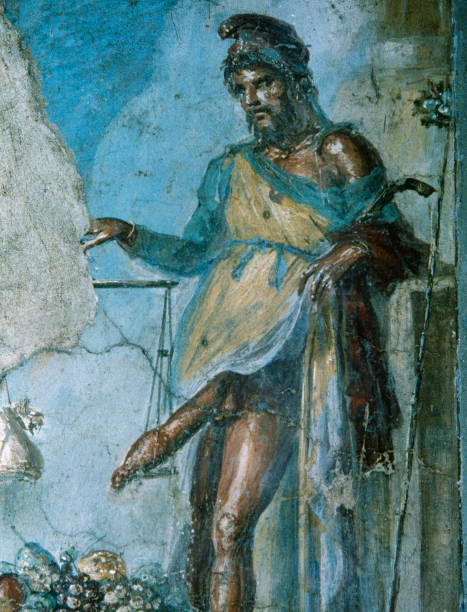
Wall-painting: Priapus weighing his phallus (Pompeii)
We went on to our room. I sat down at the translation of Caesar I was doing for him, since he had to pass Latin at last this year or fail to graduate. I thought I was doing a pretty good job of it.
“Is anything exciting happening now?
“This part is pretty interesting,” I said, “if I understand it right. About a surprise attack.”
“Read me that.”
“Well let’s see. It begins, ‘When Caesar noticed that the enemy was remaining for several days at the camp fortified by a swamp and by the nature of the terrain, he sent a letter to Trebonius instructing him’—’instructing him’ isn’t actually in the text but it’s understood; you know about that.”
“Sure. Go on.”
“ ‘Instructing him to come as quickly as possible by long forced marches to him’—this ‘him’ refers to Caesar of course.”
Finny looked at me with glazed interest and said, “Of course.”
“ ‘Instructing him to come as quickly as possible by long forced marches to him with three legions; he himself—Caesar, that is—’sent cavalry to withstand any sudden attacks of the enemy. Now when the Gauls learned what was going on, they scattered a selected band of foot soldiers in ambushes; who, overtaking our horsemen after the leader Vertiscus had been killed, followed our disorderly men up to our camp.’”
“I have a feeling that’s what Mr. Horn is going to call a ‘muddy translation.’ What’s it mean?”
“Caesar isn’t doing so well.”
“But he won it in the end.”
“Sure. If you mean the whole campaign—” I broke off. “He won it, if you really think there was a Gallic War …” Caesar, from the first, had been the one historical figure Phineas refused absolutely to believe in. Lost two thousand years in the past, master of a dead language and a dead empire, the bane and bore of schoolboys, Caesar he believed to be more of a tyrant at Devon than he had ever been in Rome. Phineas felt a personal and sincere grudge against Caesar, and he was outraged most by his conviction that Caesar and Rome and Latin had never been alive at all … “If you really think there ever was a Caesar,” I said.
Finny got up from the cot, picking up his cane as an afterthought. He looked oddly at me, his face set to burst out laughing I thought. “Naturally I don’t believe books and I don’t believe teachers,” he came across a few paces, “but I do believe—it’s important after all for me to believe you. Christ, I’ve got to believe you, at least. I know you better than anybody.”
Epitaphios: A speech performed annually in honor of those who have died in war. The most famous that remains is Thucydides’ version of Perikles’ funeral oration (2.35-46).
Thucydides, 2.35
“Many of those who have spoken here already praised the one who made this speech law, that it is a noble thing to speak over the burials of those who died in war. But honors paid in deeds for deeds performed by good men would seem to be sufficient to me—the acts which you see performed now by the public at this burial. The virtues of many should not be risked by entrusting them to the good or poor speaking of one man alone. “
“If I believed it were possible, men in attendance, to make clear in this speech the virtue of the men who lie here, I would complain to those who summoned me to speak after only a few days.
Plato’s Menexenus (236dff), Socrates recites an epitaphios given by Aspasia:
“In deed, these men have what is required for them materially—now that they have obtained it, they proceed along the fated path: they have been carried out in common by the city and in private by their families. But in speech it is necessary to pay out the remaining rite which custom assigns us.
“Since it seems right to the state to bury those lying in this grave publicly because they proved themselves noble in war and it has been assigned to me to deliver the customary speech on their behalf, I immediately began to examine how others have crafted the appropriate praise. But while I was considering and examining this, I realized that speaking worthily of the dead is one of those things that is impossible for men.”
Some Archaic Latin Inscriptions from the Loeb Classical Library (the LCL numbers are first, translations are mine). There are earlier poetic epitaphs on this site as well, even legendary ones
Epitaphs 14 [CIL 1861]
“Here lies the sweet clown and slave of Clulius
Protogenes, who created many moments of happiness for people with his joking”
Protogenes Cloul[i] | suavis heicei situst | mimus
plouruma que | fecit populo soueis | gaudia nuges.
15 [CIL 1202]
“This monument was erected for Marcus Caecilius
We give you thanks, Friend, since you stopped by this home.
May you have good fortune and be well. Sleep without worry.”
Hoc est factum monumentum | Maarco Caicilio. |
Hospes, gratum est quom apud | meas restitistei seedes. |
Bene rem geras et valeas, | dormias sine qura.
18 [CIL 1211]
“Friend, what is written here is brief—stop and read it all.
This is the unattractive tomb of an attractive woman.
Her parents named her Claudia
She loved her own husband with her whole heart.
She had two sons and leaves one of them
On the earth, but placed the other beneath it.
[She was] charming in conversation; but proper in behavior.
She safeguarded her house. She made wool. I have said it all. Go.”
Hospes, quod deico paullum est; asta ac pellege.
Heic est sepulcrum hau pulcrum pulcrai feminae.
Nomen parentes nominarunt Claudiam.
Suom mareitom corde deilexit souo.
Gnatos duos creavit, horunc alterum
in terra linquit, alium sub terra locat.
Sermone lepido, tum autem incessu commodo.
Domum servavit, lanam fecit. Dixi. Abei.
39 [CIL 1219]
“Here are the bones of Pompeia the first daughter
Fortune promises a lot to many but makes a guarantee for no one.
Live for all days and all hours. For nothing is yours wholly.
Salvius and Heros donated this.”
Primae | Pompeiae | ossua heic.|
Fortuna spondet | multis, praestat nemini;
vive in dies | et horas, nam proprium est nihil. |
Salvius et Heros dant.
NOTE: If you are put off by wistful sentimentality, skip this one!
As Classicists, we all know the old tags about the flight of time and the transience of all mortal things. Yet it must also be true that Classicists harbor in their breasts something of a more conservative temper, a desire to hold on to what has long since passed. I used to think that college was the best time of my life, and have long worn those rosy retrospectacles in my reminiscence on those heady days, brimming with Romance and hope for the future. My twenties were a wash, and so it was perhaps natural that I placed the aurea aetas well in my past. But all of that is no longer true, as I realize that this past year as a teacher has been the richest one in all my thirty one years. Yet, all of this has morphed those old Classical sayings from empty cliché into profound distillations of the spirit of human life. No longer can I read the old tempus fugit ‘time flies’ or ‘as the generations of leaves, so too the generations of humans’ without them cutting at the very fiber of my soul.
I have never wept so much in my life. This Friday, I will say farewell to my senior class, the largest group of students ever to have stuck with the course all the way through Latin IV AP. I started teaching three years ago, so this is the last generation of students who began their Latin studies at my school with the old Latin teacher, and in some sense, this makes their graduation all the more poignant. I was a novice when I arrived to teach their Latin II class, and they – in that they had been there for a year – had the advantage on me. Yet they were also still very much children at that time in a way that the jaded and cynical 3rd and 4th year students were not, so they imprinted on me much more. After these students are gone, an entire generational memory will have vanished entirely as they drift apart to lead their separate lives. And, though I will still remain as the glue which links the students of all four levels, an important and defining cultural touchstone in the experience of the school will be lost forever.
I cried thinking about this loss by myself. I cried when two students said that they would die for me. I cried when I gave them a speech before the AP test. I cried at our Latin Club meeting when I told them how much their work had meant. I cried when one of the freshmen gave an impressive speech and I realized that I would be dreading her departure in years. I cried when another student gave a speech in which she claimed that all assembled knew that I was ‘so much more than a teacher’ to them. In my overwrought state, I cried more violently and hysterically than at any other point in my life as I thought about all of this taken together. I am choking back a tear as I ramble on about all of this. And I know for sure that I will be unable to make it through 2nd period this Friday without some torrent of lachrymal effusion. Never have I felt so much with such intensity.
These students are not dying – they are leaving the narrow confines and shallow pettiness of high school to do great things, and though I feel a sense of terror at the screaming decay of our world every time I read the news, I cannot even fathom the depths of the wellspring of love and hope in my heart when I think about these kids I’ve taught for years. Yet, for all of that, the feeling of anticipated loss has already thoroughly devastated me. My favorite student (please, gentle reader, do not pretend that you think it possible for teachers not to develop favorites) sits every morning in the alcove down the hall from my room, and I see her every morning. How many times this year we had this exchange,
“Mr. Robinson, do we really have a quiz today?”
-“Uh, do you not want to have a quiz?”
“Uhhhmm, noooo?”
-“Alright, cancel that then.”
The more traditionally-minded might think that consulting student inclinations at the last minute when planning your class period is an affront to educational decency, but these fuddy-duddies can eat a fig. I love these kids, and this was Latin IV – by this point we have such an understanding that I barely need to function as an authority figure anymore.
In any event, seeing her in the alcove is ritual, and what gives more solidity and comfort to our lives than the pleasant rituals which we contrive as palliatives for the incessant monotony of minor struggle and inconvenience throughout the day? It feels like just yesterday that I first read her name from my roster, whereupon she asked to be addressed with a nickname which has stuck for three years. After Friday, she will be gone. It feels like just yesterday that I kept thinking that one of my students was named Luke. He forgave me the transgression, and even planned to drop athletics to stick with AP-track Latin with me if his coach forced a conflict. After Friday, he will be gone. Another of my students is a class-clown beyond compare. Just see how he pulled the age-old prank of “Slashing” the tires of one of our buses when we went to the state JCL competition last April:
He is as far as I can tell an absolute genius, and has never ceased to make me laugh, as when he suggested that the name of Aeolus’ island in The Aeneid be rendered as ‘Vape Nation.’ His humor has brought joy to my life, and I always indulge his wild digressions in class because he never fails to entertain. After Friday, he will be gone.
After Friday, they will all be gone. I know that I will still hear from them, but everything will have changed. What is a teacher, anyway? I feel a deep paternal concern for these kids, but I am not their father. I feel a certain fraternity with them, but I am not their brother. After all these years, I feel a deep bond of friendship with them, but while I am their teacher I cannot be their friend. It is the curious admixture of all of these powerful feelings which makes the love I bear them so profound; yet it is the fact that I cannot actually be any of those things for them that makes Friday feel so fraught with dread and terror.
There was little permanence in my own childhood, and I moved away from all the dearest friends I had, never to see them again. Perhaps this taught me early on that all relationships are, in some sense, ephemeral. Moreover, the death of my first Classics professor last year forcibly impressed upon my mind that the heady and golden age of exciting and exploratory youth has, for me, come to a close. Several of my former teachers now lie in the grave, and I have come to fill the didactic chair for the next generation. How can this have happened? How did I arrive here, swept in by the rapid tide of time, without noticing the profound change? Who the hell am I, that students should look to me for guidance?
On the day of the AP test, I set out to give my students an encouraging pep talk, but instead lost my composure as I told them how much I loved them, and how much they had improved my life. Several of them had expressed concern about disappointing me on the exam, but I wanted to assure them that the test was just a punctuation point in the book of our experience together. I ought not to confess it to them, but I don’t care about the exam and I barely even care about the Latin at this moment. They will forget their declensions and conjugations for sure, but I know that they will remember my wild digressions, my absurd anecdotes, and my cringeworthy puns. High school is miserable for any intelligent, mature, and introspective student, and though I love Latin, I care far more about my students and their ability to live a happy and meaningful life. The only problem is that, in order for them to do this, I must bid them farewell.
To be sure, I have fantastic students in my lower levels to keep me going – I love this year’s freshman class more than in any previous year. Yet it will never be the same, and I realize that I am approaching a moment – a real discrimen – at which everything in their lives and in mine will change, and a particular feeling, an exceptional localized Zeitgeist will be lost forever, retained only in our increasingly hazy and spotted memories. Does teaching really hurt this much? I suspect that my colleagues have an easier time of it because they only have these kids for one year. Last Fall, I thought that I only had one more year of teaching left in me, but the exceptional closeness of the senior class and our Latin Club changed my mind entirely, and I now feel that I could commit to this for life.
So I realize that, much as the children with Frosty the Snowman, my grief will be renewed in a regular cycle every year – this one will, I suspect, be one of the hardest. I am unmarried and have no children of my own, so these students receive the full measure of my love and emotional engagement. This Friday, I will be devastated. After Friday, that alcove in the hall will be empty, a symbol of the desolate emptiness in my heart, a hollow chamber waiting to be filled with the spring of love which only begins to flow in fall.
“Solon the Athenian, the son of Eksêkestides, when his nephew sang some song of Sappho at a drinking party, took pleasure in it and asked the young man to teach it to him. When someone asked why he was eager to learn it, he responded: “So, once I learn it, I may die.”
@sentantiq#deathandclassics more seriously, I guess it would have to be Sappho? After all death is nothing but a distance between you and your loved ones
— Ye Olde Philologer Cokedril (@PhiloCrocodile) May 24, 2018
There were lots of interesting answers–it would be annoying to post all the tweets here, but I have added some to give an idea of the range of responses.
“Human strength is meager
Our plains incomplete
Toil follows toil in our short lives.
Death looms inescapable for all—
People who are good and bad draw
of that an equal portion.”
“Since you are human, never claim what tomorrow might bring.
Nor, if you see a fortunate man, how long it will last.
For not even the time of a tender-winged fly
Is not as fast.”
Here are the tweets I sent to try to contextualize the question:
I ask the #deathandclassics question in all seriousness because it is a question I actually consider often (1/8)
I actually have been memorizing the opening lines of the #Odyssey to recite to myself in times of agitation. And I think, if I know I am going to die, I will recite it to myself. (2/8)
Why the #Odyssey? I think the #Iliad is the poem of death and the Odyssey is the poem of life. Both poems are at some level about what it means to be a person, but the Odyssey is about how life is lived. #deathandclassics (3/8)
In a way, it will be like a replaying of my life through a story I have read many times. There is also the ancient allegorical tradition that the Odyssey is about the transition from one realm to the next, the movement of a soul from one plane to another #deathandclassics (4/8)
Even without the allegory, the Odyssey is about the journey of a person and the journey that IS the person. #deathandclassics (5/8)
I think that this might be nice to think about in the final moments—that even though I individual am passing on, I am drifting away on words that have moved through a thousand years #deathandclassics (6/8)
A few days back I ran a twitter poll setting the Iliad against the Odyssey. I figured that the Iliad would win, but I did not expect this to be as close as it was.
Another question for #classicstwitter. You can only save 1. Do you protect Homer's
If we were to evaluate the popularity of the epics based on their mentions (using the Google ngram function), we would see that a few centuries ago, the Iliad had a pretty impressive lead over the Odyssey.
In the past century the mentions of the epics started to draw closer together. Is this because more people had less experience of war? Is there something more modern or simpler about the Odyssey?
the manuscript tradition for the Iliad is much better–there are more copies surviving from almost every period for which we have evidence. The epics were different enough that Samuel Butler (only partly joking) proposed that the Odyssey was composed by a woman. The epics differences were sensed in antiquity as well. Here’s how Aristotle puts it:
Aristotle, Poetics, 1459b
“for [Homer’s] two poems are complementary in structure, the Iliad being simple in plot and a poem of passion, and the Odyssey complex (it has recognitions throughout) and a poem of character; moreover they surpass all other poems in excellent of language and thought.”
To pit one poem against another is, to my mind, to imagine a combat between day and night, land and sea, or life and death. These contrasts can be seen as polar–opposites canceling each other out–or they can be treated as binary where one can only exist because the other is there first. But it may be best not to think of them at all in terms of opposition, but instead as contrastive complements. This works on the level of content:
“This complementarity extends into other areas too. The so-called Monro’s Law states that the Odyssey never refers to any incident recounted in the Iliad, which at the very least strongly suggests that the Odyssey knew of the Iliad and deliberately stayed off its territory. Indeed, at the times when the Odyssey threatens to sing of Iliadic material, the moments are marked as highly problematic.” Barker and Christensen 2013
For all the years I have taught Homer in literature and myth courses, I have emphasized their complementarity in slightly different ways. Sometimes, I follow Aristotle’s emphasis on plots, pointing out that the Iliad ends in a funeral and the Odyssey ends in a wedding, anticipating in turn the plot structures of tragedy and comedy respectively. At other times, I have instead described the Iliad as a poem of death and the Odyssey as a poem of life. The former explores what is (and mostly what isn’t) worth fighting and dying for; the latter helps s understand what we live for and who we are outside of war.
Together, the epics teach how to live and how to die. One is essentially and forever incomplete without the other. But in concert, they reflect on the totality of life. (And I am so bold as to believe that this characteristic is part of why these two epics surpassed all others and survived antiquity: any other epic from their period would have been redundant).
But what really changed my relationship with the Odyssey was my own life. When I was writing on the Iliad in the 2000s, we were living a new state of war, sending our soldiers from the west to kill and be killed in a dwindling “coalition of the willing” in the east. The Iliad made sense to me. I used to mock the Odyssey too as that ‘other’ epic.
In 2010-11, I taught that other epic three times. We also welcomed two children into the world and lost my father to a sudden sickness in between. There is nothing like losing a parent and becoming one in the same year to force a reconsideration of life. These years also marked half a decade in Texas and a decade since I left New England. The Odyssey‘s exploration of who we are and nostalgia started to resonate with me like never before.
In antiquity, traditions of allegory were extremely influential among various approaches to the epics. Among these, one of my favorite readings of the epics as complements frames one as a narrative concerned with the development and excellence of the body and the other about the virtues of the mind.
Pseudo-Plutarch, De Homero 31–32
“Of these poems, the Iliad features the acts of the Greeks and the Barbarians over the abduction of Helen, especially the valor demonstrated by Achilles in that war; the Odyssey details Odysseus’ return home from the Trojan War and how much he endured wandering during his nostos and how he avenged himself on those plotting against him in his home. From these summaries it is clear that the Iliad is really about the bravery of the body while the Odyssey concerns the nobility of the soul.
It is not right to fault the poet if he does not only present virtues in his poem, but includes as well weaknesses of spirit, pains, pleasures, fears and desires. For it is necessary that the poet show not just noble characters but weak ones too—without these unexpected accomplishments do not appear—from all of these it is possible that an audience will choose the better ones.”
Of course, not all contrasts made between the two epics were positive. (Pseudo)-Longinus believed that the differences in the poem were results of the senility of the Iliad poet as he turned to the Odyssey.
From (Ps.) Longinus On the Sublime, 9.11-13
“Nevertheless, all through the Odyssey, which must be examined for many reasons, Homer reveals that as great inspiration fades away, storytelling becomes the dominant attribute of old age. For it is clear in many ways that this epic was composed second. Throughout the Odyssey we find episodes modeled on scenes from the Iliad, and, by Zeus, he apportions his heroes grief and misery as if these tales were long already known. The Odyssey is nothing other than an epilogue to the Iliad:
There lies fierce Ajax; here lies Achilles
There likes Patroklos, an advisor equal to the gods,
There lies my own dear son. (Od. 3.109-111)
The cause of this fact, I imagine, is that when the Iliad was being written at the peak of his strength, Homer imbued the whole work with dramatic power and action; when he was composing the Odyssey, however, he made it more of a narrative, as appropriate for old age. For this reason, you can compare the Odyssey’s Homer to a setting sun: the magnitude remains without its power. Since, in it, he no longer preserves the same power of the Iliad, that overwhelming consistency which never ebbs, nor the same rush of changing experiences, the variety and reality of it, packed full with things from true experience. It is as if the Ocean were to withdraw into itself, quietly watching its own measure. What remains for us is the retreating tide of Homer’s genius, his wandering in storytelling and unbelievable things. When I claim this, I am not forgetting the storms in the Odyssey and the events placed near the Kyklopes and elsewhere—I am indicating old age, but it is still Homer’s old age. And, yet, the mythical overpowers in every one of these scenes.”
I think Longinus is on to something here. But rather than being a sign of senility, the Odyssey‘s differences are indications of maturity. I don’t mean ‘mature’ as a sign of greater progress, necessarily; but I mean that the Odyssey is a poem that appeals more to those who have lived more in life, who have, like its hero, “suffered much on the seas and learned the minds of many people”.
So, if I had to save only 1, I would save the Odyssey, not because it is better than or superior to the Iliad but because its existence presupposes the existence of the other. And, one is, for better or worse, currently more meaningful to me.
“I was not well grounded even in the Greek grammar; as to accentuation and metrical law I had everything to learn. But the worst of all was that I had not been shown how to read, and that the general mystery of exact language was hidden from me. The book which had taken most hold of my mind was Thucydides; I had written out translations of all the speeches. The political pregnancy of certain words in these had excited my interest, and served afterwards as a kind of introduction to the study of philosophical terms. But I had no apprehension of the refined beauties of poetical expression, the exquisitely clean-cut wording of Sophocles, and no doubt preferred Horace to Vergil. All that my extensive reading had given me was a mere empirical familiarity with the languages, an enlarged vocabulary, and an idea of various and contrasted styles. I had been practised a good deal in translating back from an English Cicero, and had a general sense of Ciceronian Latin as a type to work to, but was very far from being able easily to compose a Latin theme.”
5 “Others tell the story that in the land of the Lapiths the king Elatos had a daughter whose name was Kainis. After Poseidon had sex with her he promised to make her into whatever she wanted. She said she wanted to be changed into a man who was invulnerable. When Poseidon did this—as was right—he changed her name to Kaineus.”
This story is older than Ovid and Phlegon. It is detailed in the fragments of Akousilaus, perhaps alluded to in Homer, definitely indicated by Apollonius Rhodes, and present even in Plato. While the sex-change narrative remains an important element, the main feature of Kaineus’ tale is his hubris–because of his invulnerability he asks to be made into a god.
“Poseidon has sex with Kainê of Elatos. Then—for it was not right for him [sic] to have children with him nor anyone else—Poseidon turned him into an invulnerable man, who had the greatest strength of the men at that time. Whenever anyone tried to strike him with iron or bronze, [the attacker] was completely defeated.
Then [Kaineus] became king of the Lapiths and was warring with the Centaurs. After he set up his javelin in the agora he was asking to be included in the number of the gods. This was not pleasing to the gods. And when Zeus saw him doing this, he threatened him and raised the Centaurs against him. They struck him straight down into the earth and placed a stone above as assign. Then he died.”
In this account, Poseidon seems to be changing Kaineus because of his inability to have children. This makes it rather clear what women are good for from this cultural perspective. In addition, it is interesting that Kaineus as an intersex figure is involved in the war between the Lapiths and Centaurs, a conflict which has its origins in a rapes at a wedding and is often seen as a reflection of the civilized Lapiths struggling against the primitive and violent urges of the Centaurs.
But, as can be seen from the relief below which dates to the early Archaic period, the punishment of Kaineus is a primary motif of the story tradition. In a way, if the sex-change and rape were equally ancient, this is a tale about a women who is raped ultimately being punished for surviving and thriving and exacting retribution for her suffering.
D Scholia ad Il. 264
“Kaineus was a son of Elatos and king of the Lapiths. He was a very beautiful virgin girl before. But after Poseidon had sex with her, she asked to be changed from a young woman into a man. And he became invulnerable, and the most excellent of those alive at the time. And after he stuck his javelin into the middle of the agora, he demanded to be entered into the number of the gods for this reason.
Zeus was annoyed by this request and he arranged the following type of payback from him for impiety. For, even though he was invincible, he made him less while he was fighting the Centaurs. For they were hurling and striking him with pines and oak trees and they drove him into the ground. Apollonius recalls this in the Argonautica saying this, “For the singers used to report the fame that Kaineus was killed by Centaurs, when he alone from the rest of the best drove them, they surged back. They were not strong enough to repel him nor to kill him, but he went under the earth, unbroken, unbent, pummeled by the striking force of powerful pines.”
This story is held up as a wistful impossibility by Plato in the laws. This passage is, well, upsetting.
Plato’s Laws 944d-c
“What then would be the right punishment for someone who has thrown away this kind of a power of a defensive weapon for the opposite? For it is not possible for a person to do the opposite of what they say the god did when he changed the Thessalian Kaineus from a women into a man. For one who throws away his shield, the opposite of this transformation, changing from a man into a women, in some way would be the best of all punishments for this.”
“The child and the adult live in different worlds. If that is so, we cannot be certain that school, at any rate boarding school, is not still for many children as dreadful an experience as it used to be. Take away God, Latin, the cane, class distinctions and sexual taboos, and the fear, the hatred, the snobbery and the misunderstanding might still all be there. It will have been seen that my own main trouble was an utter lack of any sense of proportion or probability. This led me to accept outrages and believe absurdities, and to suffer torments over things which were in fact of no importance. It is not enough to say that I was ‘silly’ and ‘ought to have known better.’ Look back into your own childhood and think of the nonsense you used to believe and the trivialities which could make you suffer. Of course my own case had its individual variations, but essentially it was that of countless other boys. The weakness of the child is that it starts with a blank sheet. It neither understands nor questions the society in which it lives, and because of its credulity other people can work upon it, infecting it with the sense of inferiority and the dread of offending against mysterious, terrible laws. It may be that everything that happened to me at Crossgates could happen in the most ‘enlightened’ school, though perhaps in subtler forms. Of one thing, however, I do feel fairly sure, and that is that boarding schools are worse than day schools. A child has a better chance with the sanctuary of its home near at hand. And I think the characteristic faults of the English upper and middle classes may be partly due to the practice, general until recently, of sending children away from home as young as nine, eight or even seven.”





,_small_bronze_relief,_AM_Olympia,_Olym14.jpg)