“In every case, [the orator] should know the nature, the way of life, the interests or the fortune or any of those personal qualities which he might say were a cause for him to have committed the act he did or he should find fault with his character by reference to another kind of crime if there is no ability to bring up those of a similar crime.
If you are arguing that someone acted because of greed and you cannot show that the person you are accusing is greedy, you need to show that he has an affinity with other vices and, by implication, that it is not a surprise for someone who has acted either corruptly or greedily, or petulantly in other matters should have been wrong in this affair too. For every bit that detracts from a defendant’s honesty and authority diminishes the ease of his whole defense.”
Item in omni causa naturam aut victum aut studium aut fortunam aut aliquid eorum quae personis attributa sunt ad eam causam qua commotum peccasse dicet adiungere atque ex dispari quoque genere culparum, si ex pari sumendi facultas non erit, improbare animum adversari oportebit: si avaritia inductum arguas fecisse, et avarum eum quem accuses demonstrare non possis, aliis affinem vitiis esse doceas, et ex ea re non esse mirandum, qui in illa re turpis aut cupidus aut petulans fuerit, hac quoque in re eum deliquisse. Quantum enim de honestate et auctoritate eius qui arguitur detractum est, tantundem de facultate eius totius est defensionis deminutum.
History of Classical Scholarship(trans. Alan Harris):
“A different Aristotle emerged from Aristotle the logician, who alone so far was familiar, and was received in some quarters with enthusiasm, in others with misgiving. The effect was remarkable, particularly in England. John of Salisbury, Robert Grosseteste, and above all Roger Bacon were men of surprisingly wide knowledge; Bacon in particular was inspired with daringly original ideas. The church was not yet ready to tolerate this development, however, and was still able to subordinate everything to its own system, which was authoritatively defined for orthodox Catholicism by Thomas Aquinas. What chiefly concerns us here is that no study of the Greek language, nor indeed anything that so much as prepared the ground for an interest in history or scholarship, emerged from it all. The trouble was lack of contact with the originals, and in the specialist literature not a glimmer of the specifically Hellenic quality – in other words, of the nobility of beauty and art – was to be seen.”
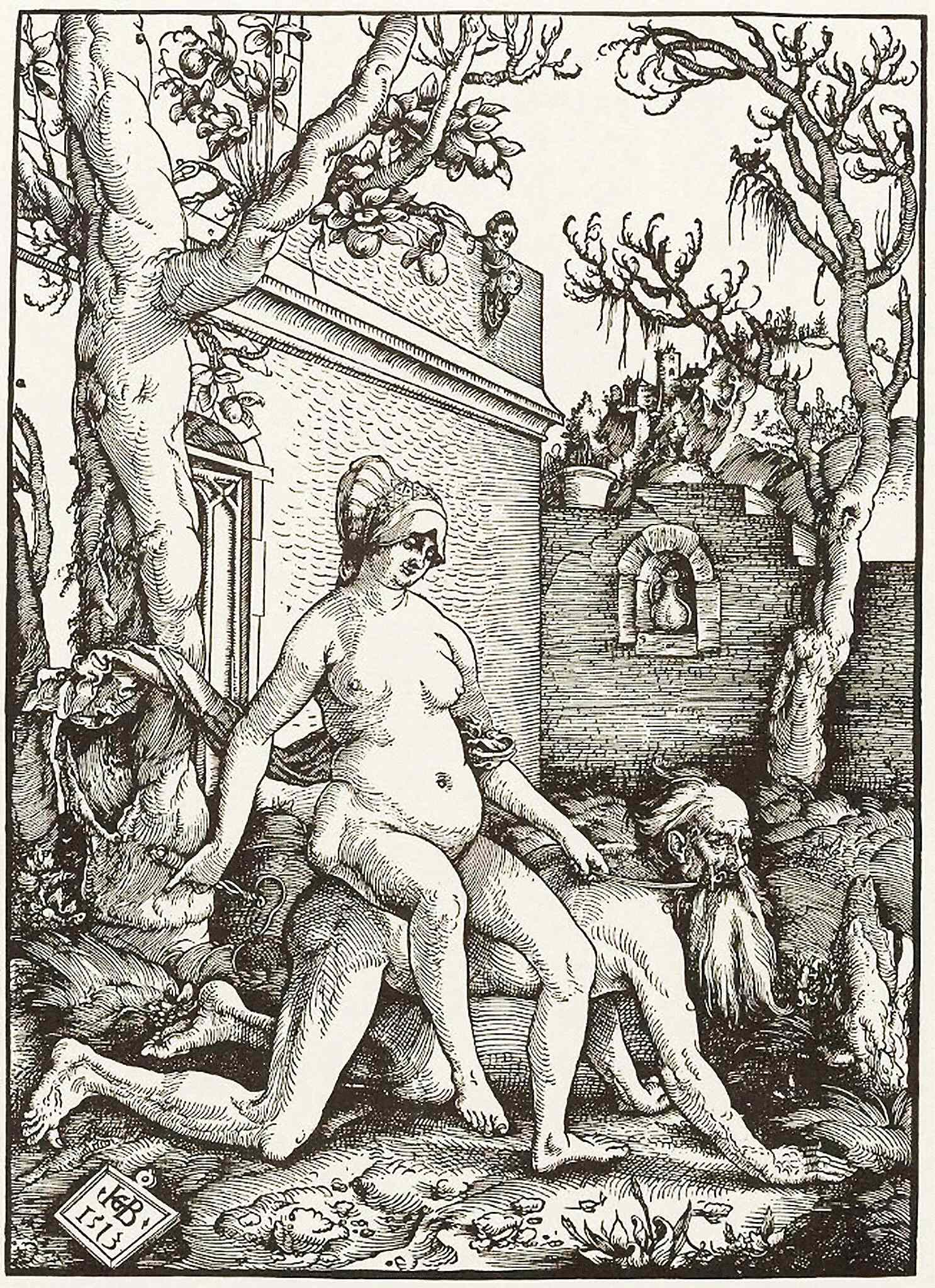
Woodcut of Aristotle ridden by Phyllis by Hans Baldung
“That [female] substance, even though it possesses all segments of the body in potential, actually exhibits none of them. For it contains those kinds of elements in potential by which the female is distinguished from the male. For just as it happens that at times deformed children come from deformed parents and at times they do not, so too in the same way sometimes female offspring come from females and sometimes they don’t, but males do instead. For the female is like a deformity of the male and menstrual discharge is like semen, but unclean.”
“These causes are also of the same. Some [offspring] are born similar to their parents while others are not. Some are similar to their father; others are like their mother, applying both to the body as a whole and to each part. Offspring are more like their parents than their ancestors and more like their ancestors than passersby.
Males are more similar to their father and females are more similar to their mother. But some are not like any of their relatives, but are still akin to human beings while others are like not at all like humans in their appearance, but rather like some monster. For whoever is not like his parents is in some way a monster because nature has in these cases wandered in some way from the essential character. The first beginning of this is when a female was born instead of a male.
But this is necessary by nature since a race of things divided by male and female must be preserved and since the male may at times not be in control because of age or youth or some other reason, it is necessary for species to have female offspring. Monstrosity is not necessary for any reason or specific ends, but it is necessary by probability of accident—since its origin must be considered as residing here.”
τέρας: can mean ‘monster’ (as translated here) or divine sign/omen. In cognates and parallel forms it is also associated with magic and the unnatural.
πηρόω (πεπηρωμένον) is a denominative verb from the noun πηρός, which means “infirm, invalid” (hence: “blind or lame”)
Thomson, Rosemarie Garland. 1997. Extraordinary Bodies: Figuring Physical Disability in American Culture and Literature. New York.
19: “Perhaps the founding association of femaleness with disability occurs in the fourth book of Generation of Animals, Aristotle’s discourse of the normal and the abnormal, in which he refines the Platonic concept of antinomies so that bodily variety translates into hierarchies of the typical and aberrant.”
20: “What this passage makes clearest, however, is that without the monstrous body to demarcate the borders of the generic, without the female body to distinguish the shape of the male, and without the pathological to give form to the normal, the taxonomies of bodily value that underlie political, social and economic arrangements would collapse.”
20: “This persistent intertwining of disability with femaleness in Western discourse provides a starting point for exploring the relationship of social identity to the body. As Aristotle’s pronouncement suggests, the social category of disability rests on the significance accorded bodily functioning and configuration.”
“Hence, what cannot be denied or put off must eventually be defended, whatever kind of case it is, or else just surrendered. We have demonstrated that there are two types of denial: either to say “this was not done” or to claim “what was done was not this.” Issues that cannot be defended or avoided must ultimately be denied and not only if there is some “redefinition” which might come to our aid, but also if there is nothing else but simple denial.
If there are witnesses, it is permitted to say much against them. If there is written proof, we can discredit the authenticity of the letter. Whatever the matter, there is nothing worse than a confession. The final option, when there is no room for defending or denying, is attacking the legality of the proceeding.”
Ergo quae neque negari neque transferri possunt utique defendenda sunt, qualiacumque sunt, aut causa cedendum. Negandi duplicem ostendimus formam, aut non esse factum aut non hoc esse quod factum sit. Quae neque defendi neque transferri possunt, utique neganda, nec solum si finitio potest esse pro nobis, sed etiam si nuda infitiatio superest. Testes erunt: multa in eos dicere licet; chirographum: de similitudine litterarum disserendum. Utique nihil erit peius quam confessio. Ultima est actionis controversia, cum defendendi negandive non est locus
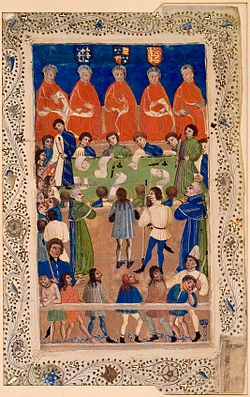
nitial N: King James I of Aragon Overseeing a Court of Law, unknown illuminator c. 1290 – 1310. Courtesy of Getty Images
Thanks to Dr. Rebecca Raphael for sharing this passage on the teleology of the human ass with me. This is mostly for distraction, but it also functions as a timely reminder of some of the absurd conclusions that can arise from teleological thinking.
Aristotle, Parts of Animals 689b
“A human being is has no tail, but does have buttocks although the quadruped does not. A human being also has legs which are fleshy in the thighs and calves, while all the rest of the animals have fleshless legs—and not only those animals which have live births, but as many of the other animals who have legs—and they are covered with sinew, are bony, and full of spines.
There is one explanation, you might say, for these differences and that is that humans are the only animal to stand upright. So, nature removed some of the fleshy parts from above and transferred the weight below in order to make the upper portions of human beings easier to bear. This is why nature made human butts fleshy along with their thighs and their calves. With the same act, it made the nature of the buttocks useful for taking a break.
For it is not a problem for the rest of the quadrupeds and they do not get tired from doing that continually. This is because they have four supports holding them up, it works the same as if they are lying down.But human beings do not easily remain standing upright: our bodies need rest and need to sit down.
This is why a human being has a fleshy butt and thighs and the same reason why we don’t have tails. All the nutrition which heads that way is spent on butts and thighs. The need and use of a tail, moreover, is negated by having butts and thighs. In quadrupeds and the rest of the animals, the situation is the opposite: because they are like dwarfs, all their weight is centered in their upper parts and it is separated from the lower section. For this reason, they have no butt and have hard legs.
“This has been said against the arguments; now I must speak against the witnesses. Euphorus’ authority need not be attacked with a great effort—he is a historian. Some of these types gain commendation by telling of incredible things and they excite a reader with something amazing when he would probably do something else if he were guided through more common events.”
Some historians believe anything; others overlook much. Some are unaware of a lie; but others find it pleasing. The first type do not avoid misinformation while the second seek it out. That’s enough about the whole nation of historians who do not think that their own work can be praised and achieve popularity unless they spice it up with lies. Indeed, Euphorus is not one of ‘religious’ fidelity. Often he is deceived, and often he deceives.”
Contra argumenta dictum est, contra testes dicendum est. Nec magna molitione detrahenda est auctoritas Ephoro: historicus est. Quidam incredibilium relatu commendationem parant et lectorem, aliud acturum si per cotidiana ducetur, miraculo excitant; quidam creduli, quidam neglegentes sunt; quibusdam mendacium obrepit, quibusdam placet; illi non evitant, hi appetunt. Haecin commune de tota natione, quae approbari opus suum et fieri populare non putat posse, nisi illud mendacio aspersit. Ephorus vero non est religiosissimae fidei; saepe decipitur, saepe decipit.
History of Classical Scholarship(trans. Alan Harris):
“John Tzetzes, that most unpleasant man, pretended to wider reading than he possessed and was a complete failure as a critic; but he had some advantages that we have not. The three princes of the church, Eustathius of Thessalonica, Michael Choniates of Athens and Gregory of Corinth (c. 1200), rank much higher. From Acominatus we learn that, apart from the Acropolis, the ancient monuments of Athens were already in his day as ruined, and her ancient traditions as forgotten, as when exploration began in the seventeenth century. The amount of material on Homer amassed by Eustathius is astounding, and his commentary, one of the first printed books, dominated Homeric studies for years; we possess it in the author’s own hand. At home it would not have found a public, even if the disastrous Fourth Crusade had not brought about a general decline and made havoc of the still ample heritage of ancient literature.
The damage was irreparable. Henceforth it was only small groups, mostly in monasteries, who exerted themselves to save the last remains.”
“This is the daily routine Severus used when there was peace. He was always doing something before dawn and after that you used to take a walk while talking and listening about the matters of the empire. Then he would have a judicial court, except when there was some festival or another. And he used to do this best of all—for he provided ample time for those who were arguing the case and he provided those of us who were advising him lots of time too. He used to make judgments until midday and then he would ride his horse as much as he was able. Then he would take a bath after engaging in some kind of exercise. Following this, he would have no meager lunch either on his own or with his children.
After lunch, he usually napped for a bit. When he rose, he turned to the rest of his affairs and then used to spend time engaged in both Greek and Latin debates while walking again. Near dusk, he would bathe again and then dine with those who were attending him—for he did not frequently have a guest for dinner and he would only sponsor expensive banquets on days when it was necessary. He lived for sixty-five years, plus eight months and twenty-five days. Even at the end, he demonstrated his eagerness for activity: as he was dying he said: “come here, give me whatever there is to do.”
“Kyrnos, this city is pregnant and I am afraid she will bear a man
Meant to correct our evil arrogance.
The citizens are still sane, but the leaders have changed
And have fallen into great evil.
Good people, Kyrnos, have never yet destroyed a city,
But whenever it pleases wicked men to commit outrage,
They corrupt the people and issue legal judgment in favor of the unjust,
For the sake of their own private profit and power.
Don’t expect this city to stay peaceful for very long
Even if it is not at a moment of great peace now,
When these deeds are dear to evil men,
As their profit accrues with public harm.
Civil conflicts and murder of kin comes from this,
And tyrants do too: may this never bring our city pleasure.”
“Still,” he said, “Cluvius told Lucius and Manilius he was not on sworn oath.” If he told them while sworn in, would you believe? What is the difference between a perjurer and a liar? A man who is accustomed to lying, can get used to committing perjury.
I can easily get a man to perjure himself once I am able to persuade him to lie. For once someone has departed from the truth, he is not in the habit of being constrained by greater belief from perjury than from lying. For what man who is not moved by the force of his own conscience is moved by invocation of the gods?
The reason for this is that the gods dispense the same penalty for the perjurer and the liar. The gods become enraged and punish a man not for the institution which frames the swearing of the words but because of the evil and the malice that these traps are set for another person.”
XVI. “Dicit enim,” inquit, “iniuratus Luscio et Manilio.” Si diceret iuratus, crederes? At quid interest inter periurum et mendacem? Qui mentiri solet, peierare consuevit. Quem ego, ut mentiatur, inducere possum, ut peieret, exorare facile potero. Nam qui semel a veritate deflexit, hic non maiore religione ad periurium quam ad mendacium perduci consuevit. Quis enim deprecatione deorum, non conscientiae fide commovetur? Propterea, quae poena ab dis immortalibus periuro, haec eadem mendaci constituta est; non enim ex pactione verborum, quibus ius iurandum comprehenditur, sed ex perfidia et malitia, per quam insidiae tenduntur alicui, di immortales hominibus irasci et suscensere consuerunt.
Sinon. Augustine, La Cit de Dieu, Books I-X. Paris, Ma tre Franois (illuminator); c. 1475-1480.



,_Winning_at_the_ancient_Games,_British_Museum_(7642744838).jpg)


