Racists Use This Fake Quote From Aristotle

“Tolerance and apathy are the last virtues of a dying society”

The character of this quotation is alien to Aristotle and ancient Greek ideas including using “tolerance” in this way and “dying society” (see the quora discussion). I poked around a bit through Aristotle, changing some of the ideas (an ancient Greek might think of “sick” or “corrupt” society”) but there is nothing close to this.

While searching, I found the variation “Tolerance is the last virtue of a depraved society” attributed to Dr. James Kennedy (an Evangelical preacher) and then Hutton Gibson (father of Mel Gibson and Holocaust Denier). Some of the mis-translations and fake translations can be found in quote books from the 19th century. This one does not appear in any books older than a decade or so and mostly in self-published racist texts whose titles and authors I will not print.

One need only a little familiarity with the discourse of modern politics to hear echoes of right-wing alarmism here. As a Reddit commenter notes, this one seems used to target multiculturalism and support a supremacist world view. And, as Curtis Dozier shows in Pharos, this fake-quotation is alive and well in modern xenophobia.

Don’t google this to see how people use it, because it will be upsetting. A reddit user did point to the Loeb translation of Politics:

“Also difference of race is a cause of faction, until harmony of spirit is reached; for just as any chance multitude of people does not form a state, so a state is not formed in any chance period of time. ” (Politics Book 5 section 1303a)

Aristotle, Politics 1303a27-30

“Not being of the same tribe is a cause of strife until they “breathe in sync” [breathe together? Sumpneusê], for just as a state does not develop from an accidental mob, so too it does not come together at an accidental time.”

στασιωτικὸν δὲ καὶ τὸ μὴ ὁμόφυλον, ἕως ἂν συμπνεύσῃ· ὥσπερ γὰρ οὐδ᾿ ἐκ τοῦ τυχόντος πλήθους πόλις γίγνεται, οὕτως οὐδ᾿ ἐν τῷ τυχόντι χρόνῳ. διὸ ὅσοι ἤδη συνοίκους ἐδέξαντο ἢ ἐποίκους οἱ πλεῖστοι ἐστασίασαν

It is easy to take this passage as supporting a racist point of view; I think that it probably is kind of racist, but it connects more with the Greek political idea of homophrosune or homonoia, that a unifying feature of a multiple people must be shared beliefs or aims. Also, rather than focusing on the first clause (the same tribe thing) note the trouble focus on “accident”: states cannot just happen. They need planning, work and a reason to be.

(Also, homonoia is not unproblematic, but at least it leaves open the idea that people who look different can join together in common cause. Maybe that is a pretty low bar, but it is as far from the texts using this fake quote as Olympos is from Tartaros.)

But, don’t fear, I am not going to defend Aristotle here. He can be plenty hateful. The point is, he did not say this stupid thing. And, further, there’s plenty of material he actually did say which is reprehensible. So, why be so lazy and recycle some nonsense from an American preacher?

LSJ Supneu


A Double Mind With a Single Tongue: Elegiac Advice on Vetting People

Theognis, Elegies

77-78

“A man you can trust, Kurnos, is equal to his weight in silver and gold
Kurnos, during a time of of painful civil strife.”

πιστὸς ἀνὴρ χρυσοῦ τε καὶ ἀργύρου ἀντερύσασθαι
ἄξιος ἐν χαλεπῇ, Κύρνε, διχοστασίῃ.

91-92

“Kurnos, whoever has a double mind with a single tongue is a
Terrible companion: a better enemy than a friend.”

ὃς δὲ μιῇ γλώσσῃ δίχ᾿ ἔχει νόον, οὗτος ἑταῖρος
δεινός, Κύρν᾿· ἐχθρὸς βέλτερος ἢ φίλος ὤν.

113-114

“Never make an evil man into a dear friend:
Avoid him always, like a bad harbor.”

μήποτε τὸν κακὸν ἄνδρα φίλον ποιεῖσθαι ἑταῖρον,
ἀλλ᾿ αἰεὶ φεύγειν ὥστε κακὸν λιμένα

117-118

“Nothing is harder than recognizing a counterfeit.
But, Kurnos, there is nothing more urgent than guarding against one.”

κιβδήλου δ᾿ ἀνδρὸς γνῶναι χαλεπώτερον οὐδέν,
Κύρν᾿, οὐδ᾿ εὐλαβίης ἐστὶ περὶ πλέονος.

161-164

“Many people have worthless minds but enjoy good luck
And what seems like misfortune ends up good.
And there are others with good plans who have wretched luck
and success never accompanies their deeds.”

Πολλοί τοι χρῶνται δειλαῖς φρεσί, δαίμονι δ’ ἐσθλῶι,
οἷς τὸ κακὸν δοκέον γίνεται εἰς ἀγαθόν.
εἰσὶν δ’ οἳ βουλῆι τ’ ἀγαθῆι καὶ δαίμονι δειλῶι
μοχθίζουσι, τέλος δ’ ἔργμασιν οὐχ ἕπεται.


Gemini. From the Hunterian Psalter, produced in England ca. 1170. Glasgow University Library MS Hunter 229, folio 3r.
University Library MS Hunter 229, folio 3r.

I Want to Have You Upon Demosthenes

[Letter from] John Adams to John Quincy Adams
Amsterdam May 29 1781

My dear Son

I am two Letters, I believe in your Debt, but I have been too busily engaged, to be able to write you.

I am pleased with the divisions of your time, which you tell your Brother you have lately made, which appears to be a judicious distribution of Study and Exercise, of Labour and Relaxation.

But I want to have you, upon some higher Authors than Phaedrus and Nepos. I want to have you upon Demosthenes. The plainer Authors you may learn yourself at any time. I absolutely insist upon it, that you begin upon Demosthenes, and Cicero. I will not be put by. You may learn Greek from Demosthenes and Homer as well as from Isocrates and Lucian—and Latin from Virgil and Cicero as well as Phaedrus and Nepos.

What should be the Cause of the Aversion to Demosthenes in the World I know not, unless it is because his sentiments are wise and grand, and he teaches no frivolities.

If there is no other Way, I will take you home, and teach you Demosthenes and Homer myself.

I am your affectionate Father,

John Adams

Image result for john adams

Theognis Starts With Some Swagger

Theognis, Elegies 19-26

“Kurnos, let a seal be placed on these words of mine
As I speak wisdom—they will not be stolen in secret,
And no one will take something worse in exchange
When something good is near, but every person will say this:
“Here are the words of Theognis of Megara, famous throughout all peoples.
But I am not yet able to please our fellow citizens.
This is nothing surprising, Polypaides—for not even Zeus
Pleases everyone when he rains or restrains himself.

Κύρνε, σοφιζομένῳ μὲν ἐμοὶ σφρηγὶς ἐπικείσθω
οῖσδ᾿ ἔπεσιν· λήσει δ᾿ οὔποτε κλεπτόμενα,
οὐδέ τις ἀλλάξει κάκιον τοὐσθλοῦ παρεόντος·
ὧδε δὲ πᾶς τις ἐρεῖ· ‘Θεύγνιδός ἐστιν ἔπη
τοῦ Μεγαρέως· πάντας δὲ κατ’ ἀνθρώπους ὀνομαστός.’
ἀστοῖσιν δ’ οὔπω πᾶσιν ἁδεῖν δύναμαι·
οὐδὲν θαυμαστόν, Πολυπαΐδη· οὐδὲ γὰρ ὁ Ζεύς
οὔθ’ ὕων πάντεσσ’ ἁνδάνει οὔτ’ ἀνέχων.


Related image

Buying Offices: Oligarchy and the Corruption of Elections

Aristotle, Politics 2.7 (1273a-1273b)

“If election based on wealth is oligarchic while election according to excellence is aristocratic, there can be a third system according to which a state is organized as the Carthaginian polity is constructed. For they choose their leaders looking at two issues, especially the most significant offices, that of kings and generals.

But it is right to think that this departure from aristocracy is an error by the lawmaker. For among the most critical issues to consider from the beginning is how the best citizens might be able to have the free time and to refrain from anything inappropriate, both in office and in their private life. If it is right to consider furnishing the means for free time [to rule], it is bad for the most significant positions to be for sale (the kingship and the generalship).

For this law makes wealth more important than virtue and makes the whole state structured around money. Whatever the power structure considers valuable, the opinion of the rest of the citizens will follow. Wherever virtue is not honored above all else, the constitution cannot be aristocratic. It is also likely that those who purchase their offices will make a profit from them when they rule after spending their own money. For, it would be strange if a respectable man who is poor will want to profit but a corrupt man who has spent his own money would be disinclined to do the same.”

εἴπερ οὖν τὸ μὲν αἱρεῖσθαι πλουτίνδην ὀλιγαρχικὸν τὸ δὲ κατ᾿ ἀρετὴν ἀριστοκρατικόν, αὕτη τις ἂν εἴη τάξις τρίτη καθ᾿ ἥνπερ συντέτακται καὶ τοῖς Καρχηδονίοις τὰ περὶ τὴν πολιτείαν· αἱροῦνται γὰρ εἰς δύο ταῦτα βλέποντες, καὶ μάλιστα τὰς μεγίστας, τούς τε βασιλεῖς καὶ τοὺς στρατηγούς. δεῖ δὲ νομίζειν ἁμάρτημα νομοθέτου6 τὴν παρέκβασιν εἶναι τῆς ἀριστοκρατίας ταύτην· ἐξ ἀρχῆς γὰρ τοῦθ᾿ ὁρᾶν ἐστὶ τῶν ἀναγκαιοτάτων, ὅπως οἱ βέλτιστοι δύνωνται σχολάζειν καὶ μηδὲν ἀσχημονεῖν, μὴ μόνον ἄρχοντες ἀλλὰ μηδ᾿ ἰδιωτεύοντες. εἰ δὲ δεῖ βλέπειν καὶ πρὸς εὐπορίαν χάριν σχολῆς, φαῦλον τὸ τὰς μεγίστας ὠνητὰς εἶναι τῶν ἀρχῶν, τήν τε βασιλείαν καὶ τὴν στρατηγίαν. ἔντιμον γὰρ ὁ νόμος οὗτος ποιεῖ τὸν πλοῦτον μᾶλλον τῆς ἀρετῆς καὶ τὴν πόλιν ὅλην φιλοχρήματον· ὅ τι δ᾿ ἂν ὑπολάβῃ τίμιον εἶναι τὸ κύριον, ἀνάγκη καὶ τὴν τῶν ἄλλων πολιτῶν δόξαν ἀκολουθεῖν τούτοις· ὅπου δὲ μὴ μάλιστα ἀρετὴ τιμᾶται, ταύτην οὐχ οἷόν τ᾿ εἶναι βεβαίως ἀριστοκρατικὴν πολιτείαν. ἐθίζεσθαι δ᾿ εὔλογον κερδαίνειν τοὺς ὠνουμένους, ὅταν δαπανήσαντες ἄρχωσιν· ἄτοπον γὰρ εἰ πένης μὲν ὢν ἐπιεικὴς δὲ βουλήσεται κερδαίνειν, φαυλότερος δ᾿ ὢν οὐ βουλήσεται δαπανήσας.


Image result for Medieval manuscript elections

Combating Barbarism, Reviving Knowledge

Ulrich von Wilamowitz-Moellendorff,

History of Classical Scholarship (trans. Alan Harris):

“In his Elegantiae Linguae Latinae Valla gave proof of the same historical sense in the linguistic sphere by showing how to distinguish the various periods and styles of Latin and waging war, not only on current barbarisms, but also on the practice of mixing words and phrases from entirely different departments of Latin literature – though of course adherence to the best models was bound to end in Ciceronianism, and the case for greater latitude, as advocated by Politian, had its points. Finally, Valla’s philosophical writings, in which he tried to do justice even to Epicurus, were equally bold and equally characteristic of the outstanding acuteness and independence of his mind. If we look deeper, we cannot avoid the conclusion that it was Valla’s contact with the Hellenic genius that lent wings to his soul, and that the advance from humanism to scholarship was entirely due to the influence of Greek literature, which alone could put new life into philosophy and natural science.”

Image result for lorenzo valla

Some Timely Advice on Judging People from Theognis

Theognis, 117-118

“Nothing is harder than recognizing a counterfeit.
But, Kurnos, there is nothing more urgent than guarding against one.”

κιβδήλου δ᾿ ἀνδρὸς γνῶναι χαλεπώτερον οὐδέν,
Κύρν᾿, οὐδ᾿ εὐλαβίης ἐστὶ περὶ πλέονος.

119-128

“One can survive the ruin from counterfeit silver and gold
Kurnos—and a wise person can easily uncover it.
But if a dear friend’s mind is hidden in his chest
When he is false and he has a deceptive heart,
Well, this the most counterfeit thing god has made for mortals
And it is the most painful thing of all to recognize.

For you cannot know the mind of a man or a woman
Before you investigate them, like an animal under a yoke—
And you cannot imagine what they are like at the right time
Since appearances often mislead your judgement.”

Χρυσοῦ κιβδήλοιο καὶ ἀργύρου ἀνσχετὸς ἄτη,
Κύρνε, καὶ ἐξευρεῖν ῥάιδιον ἀνδρὶ σοφῶι.
εἰ δὲ φίλου νόος ἀνδρὸς ἐνὶ στήθεσσι λελήθηι
ψυδρὸς ἐών, δόλιον δ’ ἐν φρεσὶν ἦτορ ἔχηι,
τοῦτο θεὸς κιβδηλότατον ποίησε βροτοῖσιν,
καὶ γνῶναι πάντων τοῦτ’ ἀνιηρότατον.
οὐδὲ γὰρ εἰδείης ἀνδρὸς νόον οὐδὲ γυναικός,
πρὶν πειρηθείης ὥσπερ ὑποζυγίου,
οὐδέ κεν εἰκάσσαις ὥσπερ ποτ’ ἐς ὥριον ἐλθών·
πολλάκι γὰρ γνώμην ἐξαπατῶσ’ ἰδέαι.

unoferswīðed
British Library, Royal 20 B XX, fol. 51v

No Regard for Future Punishment

Edward Gibbon, The Decline and Fall of the Roman Empire, Chp. XV:

“The writings of Cicero represent in the most lively colors the ignorance, the errors, and the uncertainty of the ancient philosophers with regard to the immortality of the soul. When they are desirous of arming their disciples against the fear of death, they inculcate, as an obvious, though melancholy position, that the fatal stroke of our dissolution releases us from the calamities of life; and that those can no longer suffer, who no longer exist. Yet there were a few sages of Greece and Rome who had conceived a more exalted, and, in some respects, a juster idea of human nature, though it must be confessed, that in the sublime inquiry, their reason had been often guided by their imagination, and that their imagination had been prompted by their vanity. When they viewed with complacency the extent of their own mental powers, when they exercised the various faculties of memory, of fancy, and of judgment, in the most profound speculations, or the most important labors, and when they reflected on the desire of fame, which transported them into future ages, far beyond the bounds of death and of the grave, they were unwilling to confound themselves with the beasts of the field, or to suppose that a being, for whose dignity they entertained the most sincere admiration, could be limited to a spot of earth, and to a few years of duration. With this favorable prepossession they summoned to their aid the science, or rather the language, of Metaphysics. They soon discovered, that as none of the properties of matter will apply to the operations of the mind, the human soul must consequently be a substance distinct from the body, pure, simple, and spiritual, incapable of dissolution, and susceptible of a much higher degree of virtue and happiness after the release from its corporeal prison. From these specious and noble principles, the philosophers who trod in the footsteps of Plato deduced a very unjustifiable conclusion, since they asserted, not only the future immortality, but the past eternity, of the human soul, which they were too apt to consider as a portion of the infinite and self-existing spirit, which pervades and sustains the universe. A doctrine thus removed beyond the senses and the experience of mankind, might serve to amuse the leisure of a philosophic mind; or, in the silence of solitude, it might sometimes impart a ray of comfort to desponding virtue; but the faint impression which had been received in the schools, was soon obliterated by the commerce and business of active life. We are sufficiently acquainted with the eminent persons who flourished in the age of Cicero, and of the first Caesars, with their actions, their characters, and their motives, to be assured that their conduct in this life was never regulated by any serious conviction of the rewards or punishments of a future state. At the bar and in the senate of Rome the ablest orators were not apprehensive of giving offence to their hearers, by exposing that doctrine as an idle and extravagant opinion, which was rejected with contempt by every man of a liberal education and understanding.”

“Feminine Fame”: Homer on Why We Disbelieve Women

After the suitor Amphimedon arrives in the underworld and tells the story of Penelope’s shroud and Odysseus’ return, Agamemnon responds:

Odyssey 24.192-202:

“Blessed child of Laertes, much-devising Odysseus,
You really secured a wife with magnificent virtue!
That’s how good the brains are for blameless Penelope,
Ikarios’ daughter, how well she remembered Odysseus,
Her wedded husband. The fame of her virtue will never perish,
And the gods will craft a pleasing song
Of mindful Penelope for mortals over the earth.
This is not the way for Tyndareos’ daughter.
She devised wicked deeds and since she killed
Her wedded husband, a hateful song
Will be hers among men, she will attract harsh rumor
To the race of women, even for those who are good.”

“ὄλβιε Λαέρταο πάϊ, πολυμήχαν’ ᾿Οδυσσεῦ,
ἦ ἄρα σὺν μεγάλῃ ἀρετῇ ἐκτήσω ἄκοιτιν·
ὡς ἀγαθαὶ φρένες ἦσαν ἀμύμονι Πηνελοπείῃ,
κούρῃ ᾿Ικαρίου, ὡς εὖ μέμνητ’ ᾿Οδυσῆος,
ἀνδρὸς κουριδίου. τῶ οἱ κλέος οὔ ποτ’ ὀλεῖται
ἧς ἀρετῆς, τεύξουσι δ’ ἐπιχθονίοισιν ἀοιδὴν
ἀθάνατοι χαρίεσσαν ἐχέφρονι Πηνελοπείῃ,
οὐχ ὡς Τυνδαρέου κούρη κακὰ μήσατο ἔργα,
κουρίδιον κτείνασα πόσιν, στυγερὴ δέ τ’ ἀοιδὴ
ἔσσετ’ ἐπ’ ἀνθρώπους, χαλεπὴν δέ τε φῆμιν ὀπάσσει
θηλυτέρῃσι γυναιξί, καὶ ἥ κ’ εὐεργὸς ἔῃσιν.”

More than half of this speech praises Penelope for being a loyal, ‘good’ wife (and that is another issue of its own). Of course, this makes Agamemnon think of Klytemnestra. There’s a lot to be said about how this passage sets up the end of the Odyssey, but Agamemnon’s words are striking because they reflect a sad reality not just about misogynistic thinking but about the operation of human thought.

Let’s start with the misogyny: Agamemnon says here, quite clearly, that because of the behavior of one woman (well, two if we hear ambiguity in the phrase “Tyndareos’ daughter” and think of Helen too) all women have bad fame, even if they are “good”? A simple response to this is to wonder whether the same applies to men (of course not…) Let’s pass over the fact that the murder of Agamemnon was probably well deserved.  I think this passage also reflects human cognition: the story of Klytemnestra is paradigmatic. We learn basic patterns about people and the world and apply these patterns (prejudices) as substitutions for deeper thought.

I am not sure whether this serves as a bit of an anticipatory apologetic on the part of epic–that the tale of Penelope cannot match up to negative messages about women. It probably stands as an acknowledgement of a “negative expectancy effect”–we are primed to hear negative tales and to believe negative things. I suspect that on Homer’s part this is probably less about women and more about anticipating the reception of this poem.

But, at the very least, this is a clear indication that Homer knows the way it goes: we live in a cultural system that discounts positive stories about women in favor of negative ones and which, accordingly, downgrades the authority of the stories they tell. In our responses to the testimonies of men and women, men have the privilege of being individuals whose lives might be ruined by rumor and false claims, while women are always already undermined. This is is an example of structural misogyny.

For discussions of this passage see: On the contrasting fame of Klytemnestra and Penelope, see Franco 2012, 60–61. For invocations of Klytemnestra as an example of how a woman can ruin a nostos, see Murnaghan 2011, chapter 4 and Nagy 1999, 36–39.

orestes
Classical myth deserves trigger warnings.

Franco, Cristina. 2012. “Women in Homer,” in Sharon L. James and Sheila Dillon, eds., A Companion to Women in the Ancient World. London. 55­–65.

Marquardt, Patricia. 1989. “Love’s Labor’s Lost: Women in the Odyssey,” in Robert Sutton, ed., Daidalikon: Studies in Honor of Raymond V. Schoder, S.J. Chicago. 239-248.

Murnaghan, Sheila. 2011. Disguise and Recognition in the Odyssey, Second Edition. Lanham.

Nagy, Gregory 1996. Poetry as Performance: Homer and Beyond. Cambridge

Cicero on Character Attacks

Cicero, De Inventione 2.33

“In every case, [the orator] should know the nature, the way of life, the interests or the fortune or any of those personal qualities which he might say were a cause for him to have committed the act he did or he should find fault with his character by reference to another kind of crime if there is no ability to bring up those of a similar crime.

If you are arguing that someone acted because of greed and you cannot show that the person you are accusing is greedy, you need to show that he has an affinity with other vices and, by implication, that it is not a surprise for someone who has acted either corruptly or greedily, or petulantly in other matters should have been wrong in this affair too. For every bit that detracts from a defendant’s honesty and authority diminishes the ease of his whole defense.”

Item in omni causa naturam aut victum aut studium aut fortunam aut aliquid eorum quae personis attributa sunt ad eam causam qua commotum peccasse dicet adiungere atque ex dispari quoque genere culparum, si ex pari sumendi facultas non erit, improbare animum adversari oportebit: si avaritia inductum arguas fecisse, et avarum eum quem accuses demonstrare non possis, aliis affinem vitiis esse doceas, et ex ea re non esse mirandum, qui in illa re turpis aut cupidus aut petulans fuerit, hac quoque in re eum deliquisse. Quantum enim de honestate et auctoritate eius qui arguitur detractum est, tantundem de facultate eius totius est defensionis deminutum.

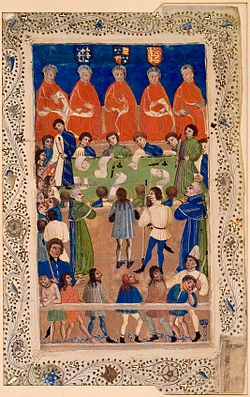
The Court of Kings Bench At Work