An Ocean's 11 style heist of the century film where a rogue's gallery of archaeologists and activists infiltrate the British Museum and repatriate the Parthenon sculptures.#creativeAct
They arrange to get all the marbles out of the country during the chaos of Brexit. The team is international and salty. Hilarity often ensues from their carping, mixing of university erudition with profanity and drinking, and a range of museum related students
Yup! And Horowitz made them the bad guys (boo!) Thankfully the UK doesn’t actually have a 14year old super spy so the ‘rogues gallery’ approach should work! We can file this under (more tweets that ensure I’ll never get a job in the BM)
“Wine does not usually freeze, it only gets numb with cold temperatures.”
vini natura non gelascit: alias ad frigus stupet tantum.
Ovid, Ex Ponto 4.85-90
“Is it that I lie, or does the Black sea turn hard at the cold
And ice overtakes many acres of its surface?
When he says these things, ask what reputation I have
Or seek in what way now I survive these hard times.
Here I meet no hatred; and I have not earned hatred either.
Nor has my mind changed at all with my fortune”
mentiar, an coëat duratus frigore Pontus,
et teneat glacies iugera multa freti.
haec ubi narrarit, quae sit mea fama require,
quoque modo peragam tempora dura roga.
nec sumus hic odio, nec scilicet esse meremur,
nec cum fortuna mens quoque versa mea est.
Aristotle, Generation of Animals 735a
“Watery things certainly freeze but semen does not freeze when it is given to frost in the open air…”
“When something freezes, which is the most extreme and most violent of the things that can happen to objects because of the cold, the effect is from water but the cause is the air. For water is a thing which is fluid and not solid and not cohesive. When it is pressed and strained by air in its cold state, it becomes compact.
“From there they were marching through massive amounts of snow and a for three miles and thirteen parasangs. The third part of it was especially hard: a northern wind was blowing directly against them, slamming everything and freezing the people.”
This toxic brew is one part myth, one part moral philosophy and at two parts misogyny mixed up with some delightful Xenophontic prose. It is as if Robert Frost wrote about the path less taken but in moralizing prose capitalizing on hateful stereotypes. Ok, so, it is not really like Robert Frost at all. Happy Tuesday!
Xenophon, Memorabilia 2.1.21-29
“Wise Prodikos in his composition on Herakles (which he performs for many people) also expresses similar views about virtue, he says this much, as far as I can remember. For he says:
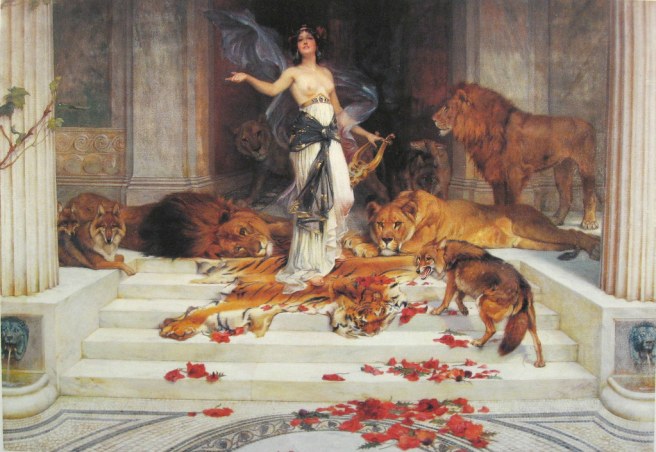
“Herakles, when he was moving from childhood into adolescence, that time when the young take control of their lives and demonstrate whether they will turn onto the path of virtue or vice, went out to sit down in a quiet place because he was uncertain which road to take.
While he was there, two giant women appeared and approached him. The first was fine to look at and naturally free—her body was dressed in purity, her eyes with shame, her bearing with wisdom, and her clothing was white.
The other woman was fed too much and was thick and soft; her skin was all decorated so that she seemed whiter and pinker than she really was, and her bearing made her look taller than she was naturally. Her eyes were opened-wide; her clothing showed off how everything was especially “in season”; and she was looking over herself all the time, trying to spot if anyone else was looking at her. She often was peeking at her own shadow.
When they approached Herakles, that first woman went in the manner which was mentioned, but the second ran up to Herakles because she was eager to to defeat her. She said. “Herakles, I see that you are unsure what path to follow in your life. If you make me your friend, I will take you on the most pleasing and easy journey. You will not miss out on any of life’s pleasures, and you will live without experience of sufferings.”
[…]
Then, after Herakles listened to this, he asked “Woman, what is your name”. And she said, “My friends call me Happiness, the haters call me Vice.”
“Meanwhile, the other woman approached and said, “I have also come to you, Herakles, someone who knows your parents and I have learned your nature as you were educated. This is why I hope that, if you choose the path I am offering, you will become a great doer of noble and solemn acts and that I will seem more honorable and famous for the good things I bring. I will not lie to you with an introduction of pleasures: I will tell you the truth, how the gods have made the world for you.”
“When I say, the translator of Homer should above all be penetrated by a sense of four qualities of his author: — that he is eminently rapid; that he is eminently plain and direct both in the evolution of his thought and in the expression of it, that is, both in his syntax and in his words; that he is eminently plain and direct in the substance of his thought, that is, in his matter and ideas; and, finally, that he is eminently noble; — I probably seem to be saying what is too general to be of much service to anybody. Yet it is strictly true that, for want of duly penetrating themselves with the first named quality of Homer, his rapidity, Cowper and Mr. Wright have failed in rendering him; that, for want of duly appreciating the second named quality, his plainness and directness of style and diction, Pope and Mr. Sotheby have failed in rendering him; that for want of appreciating the third, his plainness and directness of ideas, Chapman, has failed in rendering him; while for want of appreciating the fourth, his nobleness, Mr. Newman, who has clearly seen some of the faults of his predecessors, has yet failed more conspicuously than any of them.
Coleridge says, in his strange language, speaking of the union of the human soul with the divine essence, that this takes place,
Whene’er the mist, which stands ’twixt God and thee, Defæcates to a pure transparency;
and so, too, it may be said of that union of the translator with his original, which alone can produce a good translation, that it takes place when the mist which stands between them — the mist of alien modes of thinking, speaking, and feeling on the translator’s part — ‘defæcates to a pure transparency,’ and disappears. But between Cowper and Homer — (Mr. Wright repeats in the main Cowper’s manner, as Mr. Sotheby repeats Pope’s manner, and neither Mr. Wright’s translation nor Mr. Sotheby’s has, I must be forgiven for saying, any proper reason for existing) — between Cowper and Homer there is interposed the mist of Cowper’s elaborate Miltonic manner, entirely alien to the flowing rapidity of Homer; between Pope and Homer there is interposed the mist of Pope’s literary artificial manner, entirely alien to the plain naturalness of Homer’s manner; between Chapman and Homer there is interposed the mist of the fancifulness of the Elizabethan age, entirely alien to the plain directness of Homer’s thought and feeling; while between Mr. Newman and Homer is interposed a cloud of more than Ægyptian thickness — namely, a manner, in Mr. Newman’s version, eminently ignoble, while Homer’s manner is eminently noble.”
When I was applying to graduate school and asked what it was like, I remember my first Greek teacher telling me a story about his PhD qualifying exams. During the two-hour oral component, some eminent professor of distinguished achievement remained conspicuously silent. When he did speak up, he looked critically at the examinee (a Homerist) and asked a single question: “What is the name of Odysseus’ mother?” My teacher could not remember and it caused enough trauma that this was the story he used to characterize his experience in graduate school almost 30 years later.
When I was in a PhD program myself, this anecdote was the first thing that came to my mind as I looked over the returned draft of the first three chapters of my dissertation. Most dissertations leave behind them legacies of confusion, shame, and pain. Mine was not completely traumatizing, but that’s because, after struggling for six months to write over 100 pages of well-footnoted dreck, I had the audacity to throw everything away and start from scratch. During a feverish long-weekend in February 2006, I re-started from page 1 and ended up writing the first draft of a ‘chapter’ that, at over 100 pages, became the first three chapters of a messy, long, but ultimately ‘successful’ dissertation. (Spoiler: I passed).
When you submit chapters of your dissertation to advisors, the ensuing period of silence can be maddening. (And sometimes that long wait never ends.) When I did receive a marked-up version of my magnum opus, I scurried away from my advisor to start poring over his responses, hoping for some clue that I was on the right track, to divine some sign of my future. And inside: Corrected misspellings; Commas inserted and deleted; A Greek accent was repaired. The longest actual comment I could find was scrawled next to a footnote: the word “Phaeacia” was scratched out, next to it: “The Phaeacians live in Skheria.”
This was not the first warning I received in graduate school about the world into which I was seeking initiation. Any failure to translate adequately in seminars was met with sudden questions about obscure aorist stems. In casual conversation, I remember being corrected for calling someone “long-lifed”, when the right way of saying it is “long-lived”. But I am a blustery and confident sort. When I was asked in a seminar why I didn’t know the defective aorist of bainô, I responded, probably with a bit of acid, “because I am a student. I am here to learn.”
The first lesson I was taught in graduate school was either to shed the Socratic notion of owning up to my ignorance or be prepared for shame as a reward for my loyalty to Platonic dogma. The second lesson was really just the application of one I already knew: the best defense is a good offense. Know the nitty-gritty details; and, if you don’t, just put someone else on the spot first.
“It may be well, perhaps, to give one or two more instances to show the peculiar dignity possessed by all passages which thus limit their expression to the pure fact, and leave the hearer to gather what he can from it. Here is a notable one from the Iliad. Helen, looking from the Scæan gate of Troy over the Grecian host, and telling Priam the names of its captains, says at last: –
‘I see all the other dark-eyed Greeks; but two I cannot see, – Castor and Pollux, – whom one mother bore with me. Have they not followed from fair Lacedæmon, or have they indeed come in their sea-wandering ships, but now will not enter into the battle of men, fearing the shame and the scorn that is in Me?’
Then Homer: –
‘So she spoke. But them, already, the life-giving earth possessed, there in Lacedæmon, in the dear fatherland.’
Note, here, the high poetical truth carried to the extreme. The poet has to speak of the earth in sadness, but he will not let that sadness affect or change his thoughts of it. No; though Castor and Pollux be dead, yet the earth is our mother still, fruitful, life-giving. These are the facts of the thing. I see nothing else than these. Make what you will of them.”
Another text tentatively attributed to Caesar was discovered along with the fragments of the De Silvis and an appendix to De Bello Gallico. This is almost surely the lost Bellum Incivile.
C. Julius Caesar (?), Bellum Incivile. Edited by Dani Bostick
1.30 Although he had five draft deferments, did not pay taxes along with everyone else, had nothing to do with politics, and had no skill in public speaking, Manicula sought the consulship, but not out of a desire to serve the people nor out of enthusiasm for his political party.
For which reason his associates Michael Cohen, Ivanka, Don Jr., Paul Manafort, Michael Flynn, George Papadopoulus, Carter Page, Roger Stone, and Rick Gates, driven by the hope of influence and rewards, started communicating with Russians that Manicula had hoped for a long time to build opulent housing in their country and that he was seeking the enemy’s help so that he could be elected consul.
Manicula and his associates were completely incapable of reading Cicero’s orations, but they believed his words: “There are no plots more undetectable than those carried out under the guise of public duty or in the name of some sort of obligation. For you can easily avoid a known enemy by being cautious; to contrast, a hidden and deep-seated domestic threat not only exists, but actually crushes you before you can detect it and learn more about it.”* Because of this, they all thought they were able to avoid suspicion.
1.30 Manicula cum militiae quinque vacationes haberet neque tributa una cum reliquis penderet neque forum attingeret neque ullam dicendi facultatem haberet, tamen consulatum petivit, sed neque cupiditate serviendi populi neque studio partium adficiebatur.
Qua de causa eius comites M. Coenus et Ivanca et Donaldellus et P. Virfortus et M. Flinnus et G. Papadus et P. Cartus et R. Lapis et R. Porta spe auctoritatis atque munerum inducti cum legatis Sarmatiae loqui coeperant: Maniculam se aulam auream in Sarmatiae finibus aedificaturum diu speravisse et auxilium hostium quo consul nuntiaretur petere.
Manicula comitesque orationes Ciceronis legere haudquaquam poterant, sed crederunt eius verbis: “Nullae sunt occultiores insidiae quam eae quae latent in simulatione offici aut in aliquo necessitudinis nomine. Nam eum qui palam est adversarius facile cavendo vitare possis; hoc vero occultum intestinum ac domesticum malum non modo non exsistit, verum etiam opprimit antequam prospicere atque explorare potueris.” Ob eam causam omnes sese suspicionem vitare posse arbitrabantur.
“Fool, more foolish with each passing day,
Is this what we’ve come to? Ah, why not just be like
A little pigeon or a baby prince and insist on eating chopped up food
Or stop your mom from singing to you because you’re so angry?”
“o miser inque dies ultra miser, hucine rerum
venimus? a, cur non potius teneroque columbo
et similis regum pueris pappare minutum
poscis et iratus mammae lallare recusas?”
“Our fated nature is identified by Empedocles as the force behind this remaking, “wrapping [us] in a tunic of strange flesh” and transferring souls to a new place. Homer has called this circular revolution and the return of rebirth by the name Kirke, a child of Helios, the one who unites every destruction with birth and destruction again, binding it endlessly.
The Island Aiaia is that place which revives the person who dies, a place where the souls first step when they are wandering and feel like strangers to themselves as they mourn and cannot figure out which direction is west nor where the “sun which brings life to people over the land / descends again into the earth.”
These souls long for their habits of pleasure and their life in the flesh and the way they lived with their flesh and they fall again into that mixture where birth swirls together and truly stirs into one the immortal and moral, the material of thought and experience, elements of heaven and earth. The souls are enchanted but also weakened by the pleasures that pull them to birth again. At that time, souls require a great amount of good luck and much wisdom to find some way to resist and depart from their worst characters and become bound to their most base parts or passions and take up a terrible and beastly life.”
“She did not save him from Greek arms twice for that reason… (Aeneid 4.228)
Some say that ‘twice’ here was once, in his single combat with Diomedes, in which Aeneas was struck by a boulder which Diomedes threw. Juvenal has, ‘or with the mass by which Diomedes struck Aeneas’ hip’. And similarly, in the destruction scene, we read ‘I descend, and with a god leading me…’ and ‘this was my sweet mother.’
Others say that it is ‘twice’ because of the single combats of Diomedes and Achilles. But when he fought with Achilles, he was saved by Neptune. This can, nevertheless, be seen as stemming from Venus’ influence, for Juno this imputes the action to her, saying, ‘…and you were able to turn the nymphs into as many fleets.’ There can also be another sense: for Troy was once captured by Hercules, who was Greek, and we can understand that Aeneas was already alive at that time. Nor did much time pass before (as everyone agrees) power was handed over by Hercules to Priam.”
graivmque ideo bis vindicat armis alii dicunt ‘bis’ semel a Diomedis singulari certamine, in quo a Diomede percussus est saxo: Iuvenalis “vel quo Tydides percussit pondere coxam Aeneae” : et item in excidio, sicut legimus “descendo ac ducente deo” et “hoc erat alma parens”. alii dicunt propter Diomedis et Achillis certamina singularia. sed quando cum Achille dimicavit, a Neptuno liberatus est: potest tamen hoc pro Venere factum videri: sic enim Iuno imputat Veneri quod pro ea factum est dicens “et potes in totidem classes convertere nymphas”. potest etiam et alter sensus esse: nam Troia antea ab Hercule, qui et ipse Graecus fuit, capta est: ut intellegamus iam tunc Aeneam natum fuisse: nec enim multum tempus interfuit, cum constet Priamo tunc ab Hercule imperium traditum.