F**k My Critics

Jerome, Commentarius in Michaeam Prophetam

“We are always responding to the haters, because jealousy never leaves off, and the introductions of our books confute the shit-talk of our detractors, who commonly toss it about that I write certain trifles of sterile and empty speech, and claim that while I know not how to speak I am unable to be silent. So I pray you, Paula and Eustochius, shut your ears to barkings like this, and assisting my inability to speak with your payers, try to bring about an opening of my mouth from the apostle, so that it can be adapted to one speaking of the scriptures.

The lord will grant the word to those who evangelize with much virtue. I, however, warn the fat bulls, who have surrounded me, to be silent and to cease their maledictions, lest they come to learn their own wicked deeds. For when they say that I have plucked from the volumes of Origen and that it is improper for the writings of our predecessors to be contaminated, they think that it is an insult to me, but I count it as a great compliment, since I wish to imitate him, who, I have no doubt, pleases you and all wise people.

For if it is a crime to translate the things which Greeks have said well, then Ennius and Vergil, Plautus, Caecilius and Terence, Cicero, and other eloquent men should be brought to trial, since they not only translated some verses, but many chapters and even the longest books and complete plays.”

Image result for the critic

Semper invidis respondemus, quia non cessat invidia, et librorum nostrorum exordia aemulorum maledicta confutant, qui vulgo iactant, me sterilis ieiunique sermonis quasdam ineptias scribere, et cum loqui nesciam, tacere non posse. Itaque obsecro vos, o Paula et Eustochium, ut ad huiuscemodi latratus claudatis aures, et infantiam, ut dicunt, meam orationibus adiuvantes, impetretis mihi iuxta apostolum adapertionem oris mei, ut de scripturis loquenti adaptari possit: Dominus dabit verbum evangelizantibus virtute multa. Moneo autem tauros pingues, qui circumdederunt me, ut quiescant et desinant maledicere, malefacta ne noscant sua, quae proferentur post, si pergent laedere. Nam quod dicunt, Origenis me volumina compilare, et contaminari non decere veterum scripta, quod illi maledictum vehemens esse existimant, eandem laudem ego maximam duco, cum illum imitari volo, quem cunctis prudentibus, et vobis placere non dubito. Si enim criminis est Graecorum bene dicta transferre, accusentur Ennius et Maro, Plautus, Caecilius et Terentius, Tullius quoque et ceteri eloquentes viri, qui non solum versus, sed multa capita et longissimos libros ac fabulas integras transtulerunt.

Four Proverbs for Fools

Go here for more information about Ancient Greek collections of proverbs.

Arsenius, 5.29b

“A fool laughs even when nothing is funny.”

Γελᾷ δ’ ὁ μωρός, κἄν τι μὴ γέλοιον ᾖ.


Michael Apostolios 3.87

“You are considering ancient history.” A proverb applied to fools and simpletons.

᾿Αρχαϊκὰ φρονεῖς: ἐπὶ τῶν μωρῶν καὶ εὐηθῶν.


Michaelos Apostolios 11.92

“A fool can’t keep quiet”

Μωρὸς σιωπᾷν οὐ δύναται.

11.93

“He will blame instead of imitate”: a proverb applied to the uneducable and because it is easier to criticize than emulate.”

Μωμήσεται μᾶλλον ἢ μιμήσεται: ἐπὶ τῶν ἀπαιδεύτων, καὶ ὅτι τὸ ψέγειν τοῦ μιμεῖσθαι ῥᾳότερον.


Roman comments on fools.

Also: μωρολογία: properly, “stupid-talking” or “the talk of fools”. But why not: “the science of stupidity”?

Related image
Miniature from the Bute Psalter; c. 1270-80

A bonus anecdote for this evening;

Stobaeus 3.34.15

“Solon, after he was asked by Periander over drink—when the former happened to be quiet—whether he was silent because of a loss of words or foolishness, said “No fool could ever be quiet at a drinking party.”

Σόλων ἐρωτηθεὶς ὑπὸ Περιάνδρου παρὰ πότον, ἐπεὶ σιωπῶν ἐτύγχανε, πότερα διὰ λόγων σπάνιν ἢ διὰ μωρίαν σιωπᾷ, ‘ἀλλ’ οὐδεὶς ἄν’ εἶπε ‘μωρὸς σιωπᾶν ἐν συμποσίῳ δύναιτο’.

Half-Assing It: A Love Story

Aristokles, BNJ 831 F 3b (=Stobaios, Florides 4.20 b74)

“In the second book of his Wonders, Aristokles has this: A young man named Aristonymos, an Ephesian of a noble family, was Demostratos’ son, but in reality he was Ares’ son.

In the middle of the night, because he hated all women, he went to his father’s herd and had sex with a female donkey. She got pregnant and gave birth to the most beautiful girl, named Onoskelia, a nickname borrowed from the way she was born.”

᾽Αριστοκλέους ἐν β̄ Παραδόξων. <᾽Αριστώνυμος> ᾽Εφέσιος τῶι γένει, νεανίας τῶν ἐπισήμων, υἱὸς Δημοστράτου, ταῖς δ᾽ ἀληθείαις ῎Αρεως. οὗτος τὸ θῆλυ μισῶν γένος νυκτὸς βαθείας εἰς τοὺς πατρώιας ἔτρεχεν ἀγέλας, καὶ ὄνωι συνεγένετο θηλείαι· ἡ δὲ ἔγκυος γενομένη ἔτεκε κόρην εὐειδεστάτην ᾽Ονοσκελίαν τοὐνομα, τὴν προσηγορίαν λαβοῦσαν ἀπὸ τοῦ συμπτώματος.

Bodleian Library, MS. Bodley 764, Folio 44r

Knowing When to Stop

[The following passage is cited in John Barsby’s Commentary on Ovid’s Amores I as evidence of the claim, “According to Seneca the poets reckoned him among the rhetoricians, though the rhetoricians reckoned him among the poets.” It is difficult to see how one could read this passage from Seneca in that way unless one simply took the phrase “inter oratores Ovidium” entirely out of context.]

Seneca, Controversiae 9.5.17:

“Montanus has this fault: he ruins his sentences by repetition. Not being content to say one thing well once, he brings it about that he does not say it well. And on this account and for other reasons by which an orator may seem similar to a poet, Scaurus used to call Montanus ‘an Ovid among orators.’ For Ovid too did not know to leave off something which had ended well. Not to bring up too many examples, I will be content with this one instance of what Scaurus called Montaniana: when Polyxena had been abducted so that she could be sacrificed at the tomb of Achilles, Hecuba said,

The buried man’s ashes themselves fight against our race.

Montanus could have been content with this, but he added,

We feel the enemy even in the grave.

Not content with this, he added,

I was fertile for Achilles.

Scaurus had it right: it is no less an important virtue to know how to speak than to know when to stop.”

Image result for ovid amores woodcut

habet hoc Montanus vitium: sententias suas repetendo corrumpit. dum non est contentus unam rem semel bene dicere, efficit, ne bene dixerit. et propter hoc et propter alia, quibus orator potest poetae similis videri, solebat Scaurus Montanum ‘inter oratores Ovidium’ vocare; nam et Ovidius nescit quod bene cessit relinquere. ne multa referam, quae ‘Montaniana’ Scaurus vocabat, uno hoc contentus ero: cum Polyxene esset abducta, ut ad tumulum Achillis immolaretur, Hecuba dicit:

cinis ipse sepulti in genus hoc pugnat.

poterat hoc contentus esse; adiecit:

tumulo quoque sensimus hostem.

nec hoc contentus esse; adiecit:

Aeacidae fecunda fui.

aiebat autem Scaurus rem veram: non minus magnam virtutem esse scire dicere quam scire desinere.

The Tragedy of the Aeneid’s Dido As Told Through Buffy GIFs

Vergil, Aeneid 1.748–749

“Nor did unhappy Dido fail to drag out the night
With all kinds of talk as she was drinking deep of love.”

nec non et vario noctem sermone trahebat
infelix Dido longumque bibebat amorem,

Last year, Christian Lehmann (@buffyantiqua) told the story of Aeneas and Dido from Vergil’s Aeneid through GIFs from Buffy the Vampire Slayer. Here it is again, because, well, this is what we need.

This is not only genius which the world needs to witness for its own sake, but it also combines a few things I love: Homeric reception/myth and Buffy. (I tried to write about this once and partially failed.)

Image result for buffy season 6

I loved this so much that I wanted to share it with those who don’t use Twitter and Christian was kind enough to give his consent (see his work on “The 100 and Classical (Under)Worlds” too). This is a lively and fascinating retelling–it forces reconsiderations, I think, of both the Aeneid and BVTS. Also, Buffy and Spike > Buffy and Riley.

[below is my contribution: I learned this passage in high school where it was obligatory to understand that Dido was not dutiful enough and gave into passion, whereas Aeneas was oh so very pius.]

Vergil, Aeneid 4. 165-172

To the same cave came Dido and the Trojan captain
Earth first then nuptial Dido gave their sign
The lightning bolts were shining out and the Sky was a witness
to their bridal rites as the Nymphs sounded out on the mount’s highest peak
That day was the first cause of death; the first cause of evils.
For no longer was Dido cautioned by appearances or rumor
And no more was she harboring a secret love.
She calls it a marriage: with this name she cloaks her fault.

speluncam Dido dux et Troianus eandem
deveniunt. prima et Tellus et pronuba Iuno
dant signum; fulsere ignes et conscius Aether
conubiis, summoque ulularunt vertice Nymphae.
ille dies primus leti primusque malorum
causa fuit. neque enim specie famave movetur
nec iam furtivum Dido meditatur amorem;
coniugium vocat; hoc praetexit nomine culpam.

Romulus Says: “F**k the Senate!”

Dio Cassius, Roman History (Book 1):

Romulus became more harshly disposed toward the senate, and was inclined to act rather tyrannically toward it. He returned the hostages to the people of Veii of his own accord, and not with common consent, as was the common practice. When he perceived that they were irritated by this, he said a lot of harsh things, and finally told them, ‘O fathers, I did not select you so that you could rule over me, but so that I could command you.’

Plate 11, having given the laws, Romulus choses twelve bodyguards and a hundred men who wil become the senators, recorded by a scribe in the centre, from a series of 27 prints relating the story of Romulus and Remus. 1573-75  Etching

ὅτι ὁ ῾Ρωμύλος πρὸς τὴν γερουσίαν τραχύτερον διέκειτο καὶ τυραννικώτερον αὐτῇ προσεφέρετο, καὶ τοὺς ὁμήρους τοῖς Οὐηιένταις…… καθ’ ἑαυτὸν καὶ οὐκ ἀπὸ κοινῆς γνώμης, ὥσπερ τὰ πολλὰ ἐγίγνετο· ἀγανακτοῦντάς τε ἐπὶ τούτῳ αἰσθόμενος ἄλλα τε ἐπαχθῆ διελέχθη καὶ τέλος εἶπεν ὅτι “ἐγὼ ὑμᾶς, ὦ πατέρες, ἐξελεξάμην οὐχ ἵνα ὑμεῖς ἐμοῦ ἄρχητε, ἀλλ’ ἵνα ἐγὼ ὑμῖν ἐπιτάττοιμι.”

Where Do Snakes Come From? A Spine-Tingling Explanation

Past mid-October, it is about time things start to get a bit creepy…

Aelian, On the Nature of Animals 1.51

“People say that the spine of a human corpse turns into a snake as the marrow decomposes. As the beast slips out, so the most savage creature is born from the mildest. In this way the remains of men who were once fine and noble rest and they have peace as their prize just as the soul too does of these kinds of men according to what is sung and hymned by the wise.

But the spines of evil men bring forth these kinds of things after life too. Well, the truth is that the story is either completely a myth or if these things prove trustworthy, then it seems to me that the evil man’s corpse has earned this reward of becoming the serpent’s father.”

Ῥάχις ἀνθρώπου νεκροῦ φασιν ὑποσηπόμενον τὸν μυελὸν ἤδη τρέπει ἐς ὄφιν· καὶ ἐκπίπτει τὸ θηρίον, καὶ ἕρπει τὸἀγριώτατον ἐκ τοῦ ἡμερωτάτου· καὶ τῶν μὲν καλῶν καὶ ἀγαθῶν τὰ λείψανα ἀναπαύεται, καὶ ἔχει ἆθλον ἡσυχίαν, ὥσπερ οὖν καὶ ἡ ψυχὴ τῶν τοιούτων τὰ ᾀδόμενά τε καὶ ὑμνούμενα ἐκ τῶν σοφῶν· πονηρῶν δὲ ἀνθρώπων ῥάχεις τοιαῦτα τίκτουσι καὶ μετὰ τὸν βίον. ἢ τοίνυν τὸ πᾶν μῦθός ἐστιν, ἤ, εἰ ταῦτα οὑτωσὶπεπίστευται, πονηροῦ νεκρός, ὡς κρίνειν ἐμέ, ὄφεως γενέσθαι πατὴρ τοῦ τρόπου μισθὸν ἠνέγκατο.

Kongelige Bibliotek, Gl. kgl. S. 1633 4º, Folio 57r


“My Soul Tried to Cross Our Lips”: Platonic Love

Two love poems attributed to Plato

Diogenes Laertius Vita Phil 1.3 [Plato 31] and Athenaeus 589e

“I have a lover from Kolophôn named Arkheanassa—
Potent lust rests even on her wrinkles
Poor wretches who met her during the first sailing
Of her youth—what a conflagration you passed through!”

Ἀρχεάνασσαν ἔχω τὴν ἐκ Κολοφῶνος ἑταίραν,
ἧς καὶ ἐπὶ ῥυτίδων ἕζετο δριμὺς ἔρως.
ἆ δειλοὶ νεότητος ἀπαντήσαντες ἐκείνης
πρωτοπλόου, δι᾿ ὅσης ἤλθετε πυρκαϊῆς.

The Greek Anth. 7.217 attributes a slightly different version to Asclepiades

“I have Arkheanassa, a lover from Kolophôn—
Sweet lust rests even on her wrinkles
Oh lovers who harvested the fruit of her youth
At first bloom—what a conflagration you passed through!”

Ἀρχεάνασσαν ἔχω, τὰν ἐκ Κολοφῶνος ἑταίραν,
ἇς καὶ ἐπὶ ῥυτίδων ὁ γλυκὺς ἕζετ᾿ Ἔρως.
ἆ νέον ἥβης ἄνθος ἀποδρέψαντες ἐρασταὶ
πρωτοβόλου, δι᾿ ὅσης ἤλθετε πυρκαϊῆς.

D. L = Gr. Anth. 7.78

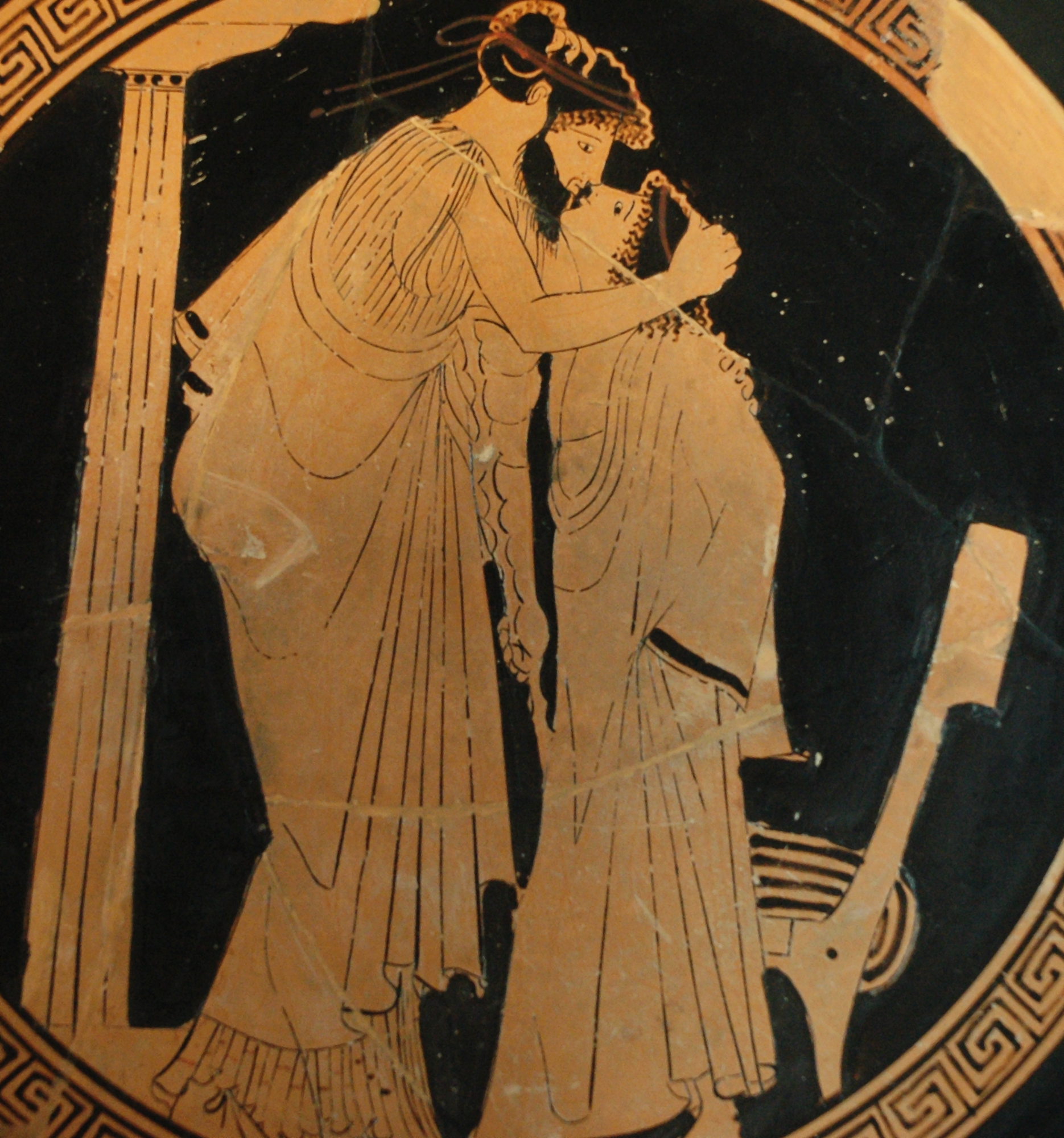
“When kissing Agathon I felt my soul at my lips.
The wretch—for she was trying to cross between us.”

τὴν ψυχὴν Ἀγάθωνα φιλῶν ἐπὶ χείλεσιν εἶχον·
ἦλθε γὰρ ἡ τλήμων ὡς διαβησομένη.

According to Aelian, Plato’s career as a poet was cut short (Varia Historia 2.30); but note, though there is mention of epic and tragedy, the anecdote makes no claims for lyric and elegy:

“Plato, the son of Ariston, at first pursued poetry and used to write heroic verse. But he soon burned it all because he despised it, since he reckoned that his poetry was far inferior when compared to Homer’s. He then tried tragedy and even completed a tetralogy, and he was about to enter the competition, even to the point of giving the verses to actors. But right before the Dionysia, he went and heard Socrates; and once he was seized by that Siren, he not only withdrew from the competition, but he also gave up the writing of tragedy for good to immerse himself in philosophy.”

Πλάτων ὁ ᾿Αρίστωνος τὰ πρῶτα ἐπὶ ποιητικὴν ὥρμησε, καὶ ἡρωϊκὰ ἔγραφε μέτρα• εἶτα αὐτὰ κατέπρησεν ὑπεριδὼν αὐτῶν, ἐπεὶ τοῖς ῾Ομήρου αὐτὰ ἀντικρίνων ἑώρα κατὰ πολὺ ἡττώμενα. ἐπέθετο οὖν τραγῳδίᾳ, καὶ δὴ καὶ τετραλογίαν εἰργάσατο, καὶ ἔμελλεν ἀγωνιεῖσθαι, δοὺς ἤδη τοῖς ὑποκριταῖς τὰ ποιήματα. πρὸ τῶν Διονυσίων δὲ παρελθὼν ἤκουσε Σωκράτους, καὶ ἅπαξ αἱρεθεὶς ὑπὸ τῆς ἐκείνου σειρῆνος, τοῦ ἀγωνίσματος οὐ μόνον ἀπέστη τότε, ἀλλὰ καὶ τελέως τὸ γράφειν τραγῳδίαν ἀπέρριψε, καὶ ἀπεδύσατο ἐπὶ φιλοσοφίαν.

Image result for ancient greek kissing vase
Louvre G 278 Attributed to Briseis Painter

Amoral Romans

Thomas de Quincey, Confessions of an English Opium Eater:

There is not (I believe) in human society, under whatever form of civilisation, any trust or delegated duty which has more often been negligently or even perfidiously administered. In the days of classical Greece and Rome, my own private impression, founded on the collation of many incidental notices, is – that this, beyond all other forms of domestic authority, furnished to wholesale rapine and peculation the very amplest arena. The relation of father and son, as was that of patron and client, was generally, in the practice of life, cherished with religious fidelity: whereas the solemn duties of the tutor (i.e. the guardian) to his ward, which had their very root and origin in the tenderest adjurations of a dying friend, though subsequently refreshed by the hourly spectacle of helpless orphanage playing round the margins of pitfalls hidden by flowers, spoke but seldom to the sensibilities of a Roman through any language of oracular power. Few indeed, if any, were the obligations, in a proper sense moral, which pressed upon the Roman.

AncientRome-4

Tawdry Tuesday: Raising the Dead

Greek Anthology 5.129 Automedon

“I praise the dancer from Asia, the one who moves
From the tips of her fingernails with devious positions,
Not because she shows every passion or because she throws
Her delicate hands delicately this way and that,
But because she knows how to dance around a worn out stump
And doesn’t try to flee its aging wrinkles.
She tongues it, kneads it, throws her hands around it–
And if she throws her leg over me, she raises my staff back from hell.”

129 ΑΥΤΟΜΕΔΟΝΤΟΣ
εἰς πόρνην ὀρχηστρίδα

Τὴν ἀπὸ τῆς Ἀσίης ὀρχηστρίδα, τὴν κακοτέχνοις
σχήμασιν ἐξ ἁπαλῶν κινυμένην ὀνύχων,
αἰνέω, οὐχ ὅτι πάντα παθαίνεται οὐδ᾽ ὅτι βάλλει
τὰς ἁπαλὰς ἁπαλῶς ὧδε καὶ ὧδε χέρας,
ἀλλ᾽ ὅτι καὶ τρίβακον περὶ πάσσαλον ὀρχήσασθαι
οἶδε καὶ οὐ φεύγει γηραλέας ῥυτίδας·
γλωττίζει, κνίζει, περιλαμβάνει· ἢν δ᾽ ἐπιρίψῃ
τὸ σκέλος, ἐξ ᾅδου τὴν κορύνην ἀνάγει.

 Detail from a Paestan red-figure skyphos, ca. 330-320 BC.