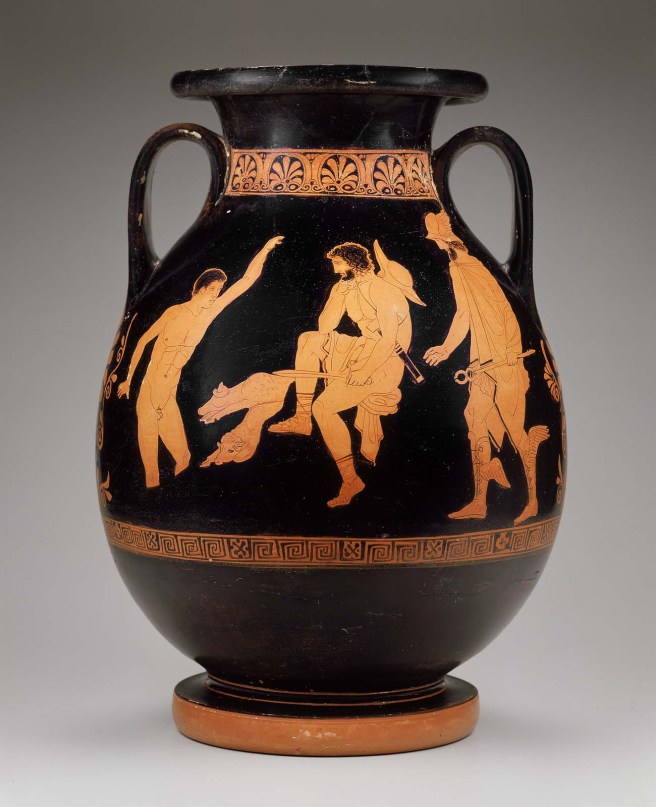
Meta-Classics Costume Idea: Paris as Menelaos

 In the Helen, Euripides pursues the version of events favored by Stesichorus and mentioned by Herodotus too: that Helen was replaced by a cloud-Helen (whom I call a Cylon). The fake-Helen went to Troy while the real one went to Egypt.

Apparently there was also a tradition that has Aphrodite pulling a Zeus-Amphitryon trick with Paris and Menelaos.

Nikias of Mallos, BNJ 60 F 2a [=Schol. V ad Od. 23.218]

“Priam’s child Alexander  left Asia and went to Sparta with the plan of abducting Helen while he was a guest there. But she, because of her noble and husband-loving character, was refusing him and saying that she would honor her marriage with the law and thought more of Menelaos. Because Paris was ineffective, the story is that Aphrodite devised this kind of a trick: she exchanged the appearance of Alexander for Menelaos’ character to persuade Helen in this way. For, because she believed that this was truly Menelaos, she was not reluctant to leave with him. After she went to the ship before him, he took her inside and left. This story is told in Nikias of Mallos’ first book”

᾽Αλέξανδρος ὁ Πριάμου παῖς ἀπὸ τῆς ᾽Ασίας κατάρας εἰς τὴν Λακεδαίμονα διενοεῖτο τὴν ῾Ελένην ξενιζόμενος ἁρπάσαι· ἡ δὲ γενναῖον ἧθος καὶ φίλανδρον ἔχουσα ἀπηγόρευε καὶ προτιμᾶν ἔλεγε τὸν μετὰ νόμου γάμον καὶ τὸν Μενέλαον περὶ πλείονος ἡγεῖσθαι. γενομένου δὲ τοῦ Πάριδος ἀπράκτου φασὶ τὴν ᾽Αφροδίτην ἐπιτεχνῆσαι τοιοῦτόν τι, ὥστε καὶ μεταβάλλειν τοῦ ᾽Αλεξάνδρου τὴν ἰδέαν εἰς τὸν τοῦ Μενελάου χαρακτῆρα, καὶ οὕτω τὴν ῾Ελένην παραλογίσασθαι· δόξασαν γὰρ εἶναι ταῖς ἀληθείαις τὸν Μενέλαον μὴ ὀκνῆσαι ἅμα αὐτῶι ἕπεσθαι, φθάσασαν δὲ αὐτὴν ἄχρι τῆς νεὼς ἐμβαλλόμενος ἀνήχθη. ἡ ἱστορία παρὰ Νικίαι †τῶι πρώτωι†.

Image result for Ancient Greek Vase Paris and Helen

This kind of doubling and uncertainty about identity is certainly at home in any discussion of Euripides’ Helen (well, at least the first third where no one knows who anybody is). But it is also apt for the Odyssey where Odysseus cryptically insists (16.204):

“No other Odysseus will ever come home to you”

οὐ μὲν γάρ τοι ἔτ’ ἄλλος ἐλεύσεται ἐνθάδ’ ᾿Οδυσσεύς,

Halloween is Next Week: Werewolf Week Returns

Last year, before Halloween, we got all excited about ancient Werewolves.  Last year, we also added some brain-eating in for good measure. This year, we are doing it all over again. We will talk about therapeutic treatments for lycanthropy, the ritual origins of some Greek beliefs, and a Roman ghost story from Petronius.  And, we have already mixed in some vampires (Lamia and Empousa) and a few posts on ghosts and fear.

But let’s start it all out with the oldest textual reference to werewolves in the western tradition:

Herodotus, Histories 4.105

“The Neuroi are Skythian culturally, but one generation before Darius’ invasion they were driven from their country by snakes. It happens that their land produces many snakes; and even more descended upon them from the deserted regions to the point that they were overwhelmed and left their own country to live with the Boudinoi.

These men may actually be wizards. For the Skythians and even the Greeks who have settled in Skythia report that once each year the Neurian men turn into wolves for a few days and then transform back into themselves again. People who say these things don’t persuade me, but they tell the tale still and swear to it when they do.”

Some Skythians were less civilized...
Some Skythians were less civilized…

Νευροὶ δὲ νόμοισι μὲν χρέωνται Σκυθικοῖσι. Γενεῇ δὲ μιῇ πρότερόν σφεας τῆς Δαρείου στρατηλασίης κατέλαβε ἐκλιπεῖν τὴν χώρην πᾶσαν ὑπὸ ὀφίων· ὄφις γάρ σφι πολλοὺς μὲν ἡ χώρη ἀνέφαινε, οἱ δὲ πλέονες ἄνωθέν σφι ἐκ τῶν ἐρήμων ἐπέπεσον, ἐς ὃ πιεζόμενοι οἴκησαν μετὰ  Βουδίνων τὴν ἑωυτῶν ἐκλιπόντες.

Κινδυνεύουσι δὲ οἱ ἄνθρωποι οὗτοι γόητες εἶναι. Λέγονται γὰρ ὑπὸ Σκυθέων καὶ ῾Ελλήνων τῶν ἐν τῇ Σκυθικῇ κατοικημένων ὡς ἔτεος ἑκάστου ἅπαξ τῶν Νευρῶν ἕκαστος λύκος γίνεται ἡμέρας ὀλίγας καὶ αὖτις ὀπίσω ἐς τὠυτὸ κατίσταται· ἐμὲ μέν νυν ταῦτα λέγοντες οὐ πείθουσι, λέγουσι δὲ οὐδὲν ἧσσον, καὶ ὀμνύουσι δὲ λέγοντες.

How and Wells’ Comment as follows on this passage (available on Perseus):

λύκος γίνεται. This earliest reference to the widespread superstition as to werewolves (cf. Tylor, P. C. i. 308 seq., and Frazer, Paus. iv. 189, for Greek parallels) is interesting, as the evidence is so emphatic. Others (e. g. Müllenhoff iii. 17) see in this story a reference to some festival like the Lupercalia.

Pumpkinception

My colleague Dr. Alex Ratzlaff and the Brandeis Techne Group at Autodesk carved this pumpkin, then 3D laser-scanned and rendered it with training from Ian Roy and the Brandeis MakerLab.

Talk about tekhne and partnerships! This is awesome and super meta. Also, it reminded me of Apocolocyntosis, Seneca’s neologism for “becoming a gourd” (Pumpkinification, his description for the apotheosis of poor Divus Claudius)

What would you call the digital apotheosis of a gourd?

Pumpkinification

Alex does really cool work and is going to start blogging about it. So, this is a preview. But, hey, it is also a season for pumpkins. (Werewolf week starts tomorrow.)

Seneca, Apocolocyntosis 4-5

“And he spat up his soul and then he seemed to stop living. He died, moreover, while he listened to comedians, so you understand that I do not fear them without reason. His final voice was heard among people as follows. When he emitted the greater sound with that part with which he spoke more easily, he said “Oh my, I shat myself I think”. Whether or not he did this, I do not know: but he certainly fouled up the place.

The things that were done next on earth are useless to report—for you certainly know it clearly. There is no risk that the memory left by public celebration will disappear—no one forgets his own joy. What was done in heaven, you should hear—the proof will come from the author!

It was announced to Jupiter that a man of certain good size had come, really grey. I don’t know what he was threatening, since he was constantly moving his head and dragging his right foot. When they asked what country he was from he responded with a confused sound and troubled voice—they could not understand his language. He was not Greek or Roman or of any other race.

Then Jupiter sent Hercules who had wandered over the whole earth and seemed to know every nation. He ordered him to go and explore what people this man was from. Then Hercules was a bit undone by the first sight because he had not yet feared all the monsters. As he gazed upon this new kind of a thing with its uncommon step, a voice belonging to no earth-bound beast but more like something coming out of a marine monster, coarse and wordless, he thought that he had arrived at a thirteenth labor. As he looked more closely, it seemed to him to be a man. Se he went up to him and said what comes easiest to a Greek tongue. “Who are you among men and from where? Where is your city and parents?”

Et ille quidem animam ebulliit, et ex eo desiit vivere videri. Exspiravit autem dum comoedos audit, ut scias me non sine causa illos timere. Ultima vox eius haec inter homines audita est, cum maiorem sonitum emisisset illa parte, qua facilius loquebatur: “vae me, puto, concacavi me.” Quod an fecerit, nescio: omnia certe concacavit.

Quae in terris postea sint acta, supervacuum est referre. Scitis enim optime, nec periculum est ne excidant memoriae quae gaudium publicum impresserit: nemo felicitatis suae obliviscitur. In caelo quae acta sint, audite: fides penes auctorem erit. Nuntiatur Iovi venisse quendam bonae staturae, bene canum; nescio quid illum minari, assidue enim caput movere; pedem dextrum trahere. Quaesisse se, cuius nationis esset: respondisse nescio quid perturbato sono et voce confusa; non intellegere se linguam eius, nec Graecum esse nec Romanum nec ullius gentis notae. Tum Iuppiter Herculem, qui totum orbem terrarum pererraverat et nosse videbatur omnes nationes, iubet ire et explorare, quorum hominum esset. Tum Hercules primo aspectu sane perturbatus est, ut qui etiam non omnia monstra timuerit. Ut vidit novi generis faciem, insolitum incessum, vocem nullius terrestris animalis sed qualis esse marinis beluis solet, raucam et implicatam, putavit sibi tertium decimum laborem venisse. Diligentius intuenti visus est quasi homo. Accessit itaque et quod facillimum fuit Graeculo, ait:

τίς πόθεν εἰς ἀνδρῶν, πόθι τοι πόλις ἠδὲ τοκῆες;

Give Me An Honest Review

Pico della Mirandola, Letter to Angelo Poliziano:

“Since I have arranged into five books my slender Muses, with which I joked about my loves while my age permitted, I am sending to you the first of them and will send the others too if I find in this one that you are a friend, not a yes-man. For they come to you on the understanding that they will be chastised, that they will be beaten, that they will be the penalty of their errors with fingernail and skewer. Present yourself to them, therefore, as a fair judge, not an iniquitous one – one who is severe, not indulgent. For, what greater injustice is there than to deceive a friend entrusting all of himself to you? I am not possessed of such a delicate mind that I would be worked up by some erasures made by a literate friend. Perhaps you, or anyone else for that matter, would not believe how little these poems please me, and even in the ones that I like a bit more, I fear that I might be (as that one guy says) a Suffenus. And so, I ask for you help in an honest and liberal undertaking, and I hope that you do not deny one who is your dearest friend.”


poliziano

Podcasting, Performance, and Pedagogy

Another great post from the wonderful Deborah Beck

“Imitation is innate to humans from childhood and they differ from other living creatures in this, that they are the most prone to imitation and their earliest learning comes about through imitation.”

τό τε γὰρ μιμεῖσθαι σύμφυτον τοῖς ἀνθρώποις ἐκ παίδων ἐστὶ καὶ τούτῳ διαφέρουσι τῶν ἄλλων ζῴων ὅτι μιμητικώτατόν ἐστι καὶ τὰς μαθήσεις ποιεῖται διὰ μιμήσεως τὰς πρώτας. Aristotle Poetics 1448b5

For the second year, my advanced Greek class at the University of Texas at Austin is creating a podcast series about our experiences reading and teaching ancient Greek. Last fall (2018), I piloted this idea in a course on Homer’s Iliad that satisfies university distributional requirements in writing and independent inquiry. I thought that a podcast would be a great way to work on both of these skills, while also giving all of us an opportunity to reach out to people beyond our own classroom who are interested in Greek literature.

Our series, “Musings from Greek 365,” was a great first effort – we all had a good time; the relatively small number of listeners who found our work enjoyed it (including Sententiae Antiquae); and I learned a lot, both about the Iliad and about how to create an effective podcast. So did the students. But it was clearly a first effort, and I ended the semester with a long list of what I wanted do differently next time. This fall, with the benefit of the experience and mistakes of last year, we’re off to a great start with our series Sophocles Antigone in 2019.

A podcast series uses a consistent structure for the series as a whole, within which every episode has a lot of leeway for individual creativity. Traditional storytelling in ancient Greece works the same way. In classical mythology, the broad parameters of a given myth are stable, but individual poets, artists, and writers can adjust the details as they see fit. So, each podcast episode in our series consists largely of close reading and interpretation of a particular section of the play that a given student has already taught to their colleagues during a regular class period, along with some reflection on their experience of teaching. But podcasting, like mythology, allows for and indeed thrives on individual choices.

I simply talked for all of my introductory episode, and some students have done that. Other students use music to enliven their episodes, while still others chose to discuss their material with fellow students. In Episode 5, Lyle discussed modern versions of ancient tragedy with a friend in the College of Business, with whom he had read the Antigone in high school. The various media, rhetorical styles, and modes of speaking that students use in their podcasts call to mind the range of meters, stylistic levels, and musical styles in Greek tragedy itself. But at the same time, our shared norms and interests as a class tie together the individual episodes, just as particular characters and themes crop up repeatedly in both the Antigone and students’ podcast episodes about the play.

Podcasting, in other words, reminds us that tragedy is a performance genre, something that can easily fall by the wayside as students struggle through the highly abstract and allusive Greek of a choral ode, or the compressed style of back-and-forth dialogue. Podcasting also makes a fruitful pairing with teaching, itself a kind of performance. In both teaching and podcasting, and for that matter in good writing, we have to decide what we really want to say about our material and how best to say that. If we try to say too many things, or we introduce details that we think are interesting but no one else cares about, we lose our audience.

Mosaic_of_the_theatrical_masks_-_Google_Art_Project_(crop_without_borders)

Furthermore, the manner in which we perform our material can play a huge role in how effectively it connects with an audience. In fact, I decided to go to graduate school to become a professor in part because I had been active in high school theater, and I thought (correctly) that I would enjoy the performance aspects of teaching. And the students enjoy it too. Although each of them has commented – either informally or in their podcasts, or both – that teaching is much more time consuming than they had expected, if you listen to our podcast, you will hear in their own words that they relish the experience and they learned a lot.

Different students, unsurprisingly, came away with different take-aways. In Episode 3, Cassie tells us that she enjoyed her experience as a taste of what having her own class might be like. Laura came to see Creon’s attitude in her passage not as humorous, as she had initially thought when she served as “Teacher of the Day,” but as a complex and even sympathetic character. Laura finished Episode 4 with this summing-up: “If I’ve learned anything from this assignment, it’s that the close reading and the thinking I had to do to teach this passage showed me both the complexity of the text, and the complexity of Creon’s character.”

What has the professor learned? Unfortunately, I failed to come up with a good name for our podcast. I am bad at catchy titles, and this podcast is no exception. I chose “Sophocles Antigone in 2019” to point to the enduring relevance of the Antigone for conversations about justice, law, and good government. This becomes a more cogent aspect of the play with every passing day, but it’s still a boring name.

I did, however, improve the assignment guidelines for how to create a podcast, which I am happy to share with anyone who would like to see them. These guidelines break down the process of producing a podcast episode into a series of concrete steps with specific due dates attached to each. As a result, students complete their podcasts in a timely fashion – a consistent problem last year – and our series releases new episodes on a regular basis throughout the fall semester. I wanted to make sure we had a regular release schedule in part to make the podcast more appealing to listeners.

Better publicity was, and is, at the top of my list of needed improvements. Last year, we had no publicity at all, except what was generated by traffic on Podomatic, our free podcasting platform. This did a real disservice to the terrific work of the students, and one of my main priorities for this year was to learn more about publicizing a podcast. So, we have a regular release schedule, we have some public domain artwork, and I am in the process of listing our podcast with iTunes and Google Play. So far, so good. When this course ends, I’ll doubtless have a fresh list of ways to do various things better next time.

Podcasting is a lot of work. It’s also really fun and everyone involved will learn a lot, often in unexpected ways. At the end of Episode 2, Dylan says, “I’m not just trying to translate the lines, but trying to understand their place in the text and how they serve the play as a whole. This came as a bit of a shock, because I think it’s easy for us to think at first that if one can translate the lines, they must already understand them. After this experience, I can certainly say that’s not true.”

If you listen to our series, drop us a note and tell us what you learned.

Manifest Guilt For The Blood He Spilt

Cicero, Pro Roscio (85-86):

That Lucius Cassius whom the Roman people thought the most honest and wisest judge used to ask over and over again in his cases, ‘To whom was this beneficial?’ Human life is so constituted that no one would attempt to approach any evil deed without some hope and some emolument. Those, to whom some danger was created because although he was a friend of truth, he was not by nature so much inclined to pity as given to severity, used to fear and flee from this inquisitor and judge.

For my part, although a man most boldly ranged against audacity and most merciful to the innocent is set at the head of the case, yet I would willingly suffer myself to speak for Sextus Roscius even with that most penetrating judge Cassius presiding, or even among the Cassian judges, whose name even those who must speak the case now still fear. When they see in this case that those men possessed the most ample fortunes while this man was stuck in the depth of poverty will not ask to whom was this beneficial?, but with that being clear enough already they will join the crime and the suspicion rather to the receipt of a reward than to the inheritance of poverty. What if it had happened had you previously been a slight person? What if you had been greedy, or audacious, or the greatest enemy to the man who was killed? Would we then need to ask what reason drew you on to such a crime? What part of this can be denied? The insignificance of such a person is such that it cannot be disguised, and it shines forth more obviously the more he attempts to hide it.

Image 10 of 11 for Officia, in German, translated by Johannes von Schwarzenberg and Johann Neuber.

Cassius ille quem populus Romanus verissimum et sapientissimum iudicem putabat identidem in causis quaerere solebat ‘cui bono’ fuisset. Sic vita hominum est ut ad maleficium nemo conetur sine spe atque emolumento accedere. Hunc quaesitorem ac iudicem fugiebant atque horrebant ei quibus periculum creabatur ideo quod, tametsi veritatis erat amicus, tamen natura non tam propensus ad misericordiam quam applicatus ad severitatem videbatur. Ego, quamquam praeest huic quaestioni vir et contra audaciam fortissimus et ab innocentia clementissimus, tamen facile me paterer vel illo ipso acerrimo iudice quaerente vel apud Cassianos iudices, quorum etiam nunc ei quibus causa dicenda est nomen ipsum reformidant, pro Sex. Roscio dicere. In hac enim causa cum viderent illos amplissimam pecuniam possidere, hunc in summa mendicitate esse, illud quidem non quaererent, cui bono fuisset, sed eo perspicuo crimen et suspicionem potius ad praedam adiungerent quam ad egestatem. Quid si accedit eodem ut tenuis antea fueris? quid si ut avarus? quid si ut audax? quid si ut illius qui occisus est inimicissimus? num quaerenda <causa> quae te ad tantum facinus adduxerit? Quid ergo horum negari potest? Tenuitas hominis eius modi est ut dissimulari non queat atque eo magis eluceat quo magis occultatur.

Dabbling in the Occult: Odysseus, Necromancer

It is the right time of the year for raising the dead. A student paper on the Elpenor Pelike at the MFA in Boston drew my attention to the following passage.

Servius ad Aen. 6.107

“For this reason the place is named without joy since, as people claim, it would not have been there but for necromancy or spell-craft. For, Aeneas completed these sacred rites when Misenus was killed and Ulysses did it with the death of Elpenor.

This very scene Homer himself presented falsely from the detail of its location which he specifies along with the length of time of the journey. For he claims that Ulysses sailed for one night and came to the place where he completed these sacrifices. For this reason it is abundantly clear that he doesn’t mean the ocean but Campania.”

sine gaudio autem ideo ille dicitur locus, quod necromantia vel sciomantia, ut dicunt, non nisi ibi poterat fieri: quae sine hominis occisione non fiebant; nam et Aeneas illic occiso Miseno sacra ista conplevit et Vlixes occiso Elpenore. quamquam fingatur in extrema Oceani parte Vlixes fuisse: quod et ipse Homerus falsum esse ostendit ex qualitate locorum, quae commemorat, et ex tempore navigationis; dicit enim eum a Circe unam noctem navigasse et ad locum venisse, in quo haec sacra perfecit: quod de Oceano non procedit, de Campania manifestissimum est.

The relevant passages from the Odyssey don’t give any hint that Elpenor was intentionally killed for black magic. When Odysseus actually does summon the dead, now that gets a little dark.

Odyssey, 10.552–560

“I could not even lead my companions unharmed from there.
The youngest of my companions was a certain Elpênor,
He was neither especially brave in battle or composed in his thoughts.
He separated himself from the companions in Kirkê’s holy home
Because he needed some air; then he fell asleep because he was drunk.
When he heard the noise and trouble of our companions moving out,
He got up immediately and it completely escaped his thoughts
To climb down again by the long ladder—
So he fell straight from the roof and his neck
Shattered along his spine; then his spirit flew down to Hades.”

οὐδὲ μὲν οὐδ’ ἔνθεν περ ἀπήμονας ἦγον ἑταίρους.
᾿Ελπήνωρ δέ τις ἔσκε νεώτατος, οὔτε τι λίην
ἄλκιμος ἐν πολέμῳ οὔτε φρεσὶν ᾗσιν ἀρηρώς,
ὅς μοι ἄνευθ’ ἑτάρων ἱεροῖσ’ ἐν δώμασι Κίρκης,
ψύχεος ἱμείρων, κατελέξατο οἰνοβαρείων·
κινυμένων δ’ ἑτάρων ὅμαδον καὶ δοῦπον ἀκούσας
ἐξαπίνης ἀνόρουσε καὶ ἐκλάθετο φρεσὶν ᾗσιν
ἄψορρον καταβῆναι ἰὼν ἐς κλίμακα μακρήν,
ἀλλὰ καταντικρὺ τέγεος πέσεν· ἐκ δέ οἱ αὐχὴν
ἀστραγάλων ἐάγη, ψυχὴ δ’ ῎Αϊδόσδε κατῆλθεν.

Elpênor appears twice more in the epic: 11.51–80 (Odysseus meets Elpênor’s ghost when he summons the dead); 12.9-15 (Odysseus buries Elpênor).

MFA Boston, Accession Number 34.79; Caskey-Beazley, Attic Vase Paintings (MFA), no. 111; Highlights: Classical Art (MFA), p. 070-071.

Nekuomanteia, glossed by Hesychius as nekromanteia (i.e. “necromancy”) is an alternate name for the Nekyuia, the parade of the dead in book 11 of the Odyssey. From the Greek Anthology: ᾿Εν τῷ Η ἡ τοῦ ᾿Οδυσσέως νεκυομαντεία· (3.8); Scholia to the Odyssey, Hypotheses: Λ. Νεκυομαντεία, ἢ, Νεκυία. Cf. Eustathius, Comm. Ad Od. 1.396.10

Latin Verses Versus Education

Charles Dickens, Bleak House (Chp. XIII):

I felt this to be true; though if I may venture to mention what I thought besides, I thought it much to be regretted that Richard’s education had not counteracted those influences or directed his character. He had been eight years at a public school and had learnt, I understood, to make Latin verses of several sorts in the most admirable manner. But I never heard that it had been anybody’s business to find out what his natural bent was, or where his failings lay, or to adapt any kind of knowledge to HIM. HE had been adapted to the verses and had learnt the art of making them to such perfection that if he had remained at school until he was of age, I suppose he could only have gone on making them over and over again unless he had enlarged his education by forgetting how to do it. Still, although I had no doubt that they were very beautiful, and very improving, and very sufficient for a great many purposes of life, and always remembered all through life, I did doubt whether Richard would not have profited by some one studying him a little, instead of his studying them quite so much.

To be sure, I knew nothing of the subject and do not even now know whether the young gentlemen of classic Rome or Greece made verses to the same extent—or whether the young gentlemen of any country ever did.

Image result for bleak house richard carstone

Worldly World Leader Wisdom

Suetonius, Divus Augustus (25):

Augustus thought that nothing was less appropriate to the perfect general than haste and temerity. He used all the time to toss about the saying,

Hasten slowly: a sure commander is better than a bold one.

And,

Whatever turns out well has been effected swiftly enough.

He also used to deny that one should ever undertake a battle or a war, except when greater hope of emolument than fear of loss was on offer. For, he used to say that those who pursued the slightest advantages at something more than the slightest risk were similar to those who went fishing with golden hooks, the loss of which could not be compensated for by any catch.

Roman mosaic from the Villa of the Nile, Leptis Magna, Libya (2nd century AD)

Nihil autem minus perfecto duci quam festinationem temeritatemque convenire arbitrabatur. Crebro itaque illa iactabat:

Σπευδε βραδέως. ἀσφαλὴς γάρ ἐστ’ ἀμείνων ἢ θρασὺς στρατηλάτης

Et: sat celeriter fieri quidquid fiat satis bene. Proelium quidem aut bellum suscipiendum omnino negabat, nisi cum maior emolumenti spes quam damni metus ostenderetur. Nam minima commoda non minimo sectantis discrimine similes aiebat esse aureo hamo piscantibus, cuius abrupti damnum nulla captura pensari posset.

Obscenity Watch: Walk Like an Egyptian

We are happy to have new contributions from the Fabulous Dr. Amy Coker. She shares a certain scatalogical interest, but brings considerable expertise to the matter.

This latest word is not to do with sex, but rather with another bodily action which is often a source of taboo words, excretion. More specifically, this post is about words I have been affectionately characterising as denoting ‘solid waste’ (or ‘poo’, ‘faeces’, etc.). One of the words in ancient Greek for the noun ‘poo’ is κόπρος (ko-pross), the word which gives us English scientific words beginning with ‘copro-‘ such as ‘coprolite’ – fossilised faeces – coined in the early nineteenth century.

Despite the unpleasantness of the substance κόπρος indicates, the word itself is not really ‘taboo’ or offensive, and is found in a range of Classical works from Homer’s epics to medical works in the Hippocratic corpus: κόπρος is milder in tone than the English four-letter word, ‘sh*t’. What sparked this post is an example in our ancient texts of a word similar to κόπρος – κόπριον (ko-pree-on). In technical parlance, this word is the stem κοπρ- plus the diminutive suffix -ιον (-ee-on): this last part is a segment which makes a word meaning the same thing as the stem, or a smaller version of it, or indicates affection from the speaker to the object (a bit like English ‘toe’, diminutive ‘toe-sie’).

The example of κόπριον we are interested in comes from a papyrus letter written in Egypt in the late 2nd or 3rd century AD, known as P.Oxy. 1761. Greek was the dominant language of Egypt for around a thousand years from the conquest of Alexander the Greek to the Arab conquest in the mid 7th century AD, so that fact that this letter is written in Greek in Egypt is not unusual. This letter is in other respects too typical of those written in vast numbers by individuals about everyday matters; these people are otherwise lost to history, but their correspondence by chance survives. (See picture for an example of what a papyrus letter looks like).

P.Oxy. 1672 Oxyrhynchus, Egypt, AD 37-41. Image courtesy of The Garstang Museum, University of Liverpool.
The first two lines read: Δημήτριος καὶ Παυσανίας Παυσαν[ί]αι | τῶι πατρὶ πλεῖστα χαίρειν καὶ ὑγι(αίνειν)- ‘Demetrius and Pausanias to their father Pausanias very many greetings and wishes for good health.’
It is lines 6-7 of P.Oxy. 1761 where the surprise lies: as Grenfell and Hunt put it in their edition in the early twentieth century, here ‘A very singular symptom of regret for an absent friend is specified’. Here is a full translation of the letter, as given by Montserrat’s Sex & Society in Graeco-Roman Egypt (1996, 8); the bold words are the ones which concerns us:

Callirhoë to her dear Sarapis, greetings. I say a prayer for you every day in the presence of the lord Sarapis. Since you have been away I go on the trail of your shit in my desire to see you. Greet Thermouthis and Helias and Ploution and Aphrodite and Nemesianus. Carabus and Harpocration greet you, and everyone at home. I pray for your health.

The Greek text which lies behind this ‘singular symptom of regret’ is: ἐπιζῃητοῦμέν σου τὰ κόπρια, literally, ‘I/we look for (or miss?) your κόπριον-s’ (κόπρια is the plural of κόπριον). There is no wandering about here, despite the impression the translation might give. A slightly more recent translation by Bagnall & Cribiore in their collection of women’s letters (2006, 392) renders these words as the striking ‘we are searching for your turds’.

Is Callirhoë really looking through the dunghill because she misses her friend? Even when we accept that ancient peoples did things differently, this seems a stretch. We could be tempted to think that this is an idiom peculiar to Egypt, perhaps stemming from a native expression, but there seems to be no obvious parallel (suggestions are welcome). I think rather the best explanation comes back to what κόπρος/κόπριον means.

Both these words are also used more broadly of ‘rubbish’, or things which can be taken away to be used as fertiliser: remember that most ancient waste was organic. κόπριον is found in this kind of sense in the Magical Papyri, an ancient collection of spells, where it is something picked up from the ground where a corpse has lain (PGM 4.1395-8, 4.1441-2). Dieter Betz translates this as ‘polluted dirt’, but the pollution comes only from the context of the spell.

I think here and in our letter we should rather take κόπρια as indicating ‘useless remains’ or ‘traces’, akin to English ‘crap’: note how ‘crap’ has just this double meaning of ‘excrement’ and ‘rubbish’ in contemporary UK English (e.g. ‘there is so much crap in my house’). The result is that Callirhoë is not looking for any particular bodily waste produced by her dear Sarapis, but rather for indications that she has been around: a rather loose translation of this sentiment might therefore be ‘I go through your crap wanting to find you there’.

Thanks to the Gartang Museum for use of the image of P.Oxy. 1672: follow the Museum’s blog at: http://garstangmuseum.wordpress.com.

Copyright © 2014/2019 Amy Coker. Not to be reproduced without permission.

Amy Coker has over the last decade held positions in Classics and Ancient History at the Universities of Manchester, Liverpool and Bristol in the UK. After undergraduate studies in Classics at Downing College, Cambridge, and an MA in Linguistics at the University of Manchester, she was awarded funding from the Arts & Humanities Research Council to support her doctoral work on gender variation in Ancient Greek (2007-2009, PhD Manchester 2010). She later secured a Leverhulme Trust Early Career Fellowship (2013-2016) for a project on Greek sexual and scatological vocabulary, and ancient offensive language. She was a Visiting Fellow at the Institute for Classical Studies, University of London (2017-2018), and is now an Honorary Research Fellow of the University of Bristol (2018-), and teacher of Classics at Cheltenham Ladies College (2018-).

She has published work in the fields of historical linguistics, pragmatics, and classics, and has pieces about to appear on the treatment of obscene language in the most well-known lexicon of Ancient Greek, Liddell and Scott, and on a filthy joke told by Cleopatra involving a ladle.

She is a keen supporter of outreach and public engagement, and has worked with the UK charity Classics for All running projects to bring Latin and Greek teaching to schools which have no tradition of teaching these subjects. She can be found on Twitter at @AECoker.