Aristotle Said Many Things, But He Did Not Say This One

Image result for character is made by many acts it may be lost by a single one Aristotle

A reader left a comment asking for an investigation of this one. Let’s not beat around the Athenian bush on this one: this is fake, like, really fake.

This seems only recently to have made the leap to Aristotle. It does not seem to be attributed to him in any books, but it appears in Great Thoughts from Master Minds. 1884/1907 by a certain Rev. Haigh.

character

The quotation is not attributed here, but it sounds like something that may be a summary of Aristotle’s comments on character or habit in the Nicomachean ethics. As far as my ranking of fake Aristotle quotes goes, this is Peisistratos Fake. A vesion that adds “unworthy” and “worthy” shows up in some religious literature in the mid-19th century. By guess is it makes the leap to internet inspirational work through quote texts like this 14000 Quips and Quotes for Speakers, Writers, Preachers, Editors, and Teachers.

Even though this seems like a rather anodyne statement, I think it is really un-Aristotelian and anti-ancient philosophy and general. The notion that you can be for the most part good, but your character is undermined by a single thing is about sin. This is totally Christian and completely not Aristotle.

Here’s some Nicomachaean Ethics as a cleanse 1105b

“It is therefore well said that a person becomes just by doing just things and prudent from practicing wisdom. And, no one could ever approach being good without doing these things. But many who do not practice them flee to argument and believe that they are practicing philosophy and that they will become serious men in this way. They act the way sick people do who listen to their doctors seriously and then do nothing of what they were prescribed. Just as these patients will not end up healthy from treating their body in this way, so most people won’t change their soul with such philosophy.”

εὖ οὖν λέγεται ὅτι ἐκ τοῦ τὰ δίκαια πράττειν ὁ δίκαιος γίνεται καὶ ἐκ τοῦ τὰ σώφρονα ὁ σώφρων· ἐκ δὲ τοῦ μὴ πράττειν ταῦτα οὐδεὶς ἂν οὐδὲ μελλήσειε γίνεσθαι ἀγαθός. ἀλλ’ οἱ πολλοὶ ταῦτα μὲν οὐ πράττουσιν, ἐπὶ δὲ τὸν λόγον καταφεύγοντες οἴονται φιλοσοφεῖν καὶ οὕτως ἔσεσθαι σπουδαῖοι, ὅμοιόν τι ποιοῦντες τοῖς κάμνουσιν, οἳ τῶν ἰατρῶν ἀκούουσι μὲν ἐπιμελῶς, ποιοῦσι δ’ οὐδὲν τῶν προσταττομένων. ὥσπερ οὖν οὐδ’ ἐκεῖνοι εὖ ἕξουσι τὸ σῶμα οὕτω θεραπευόμενοι, οὐδ’ οὗτοι τὴν ψυχὴν οὕτω φιλοσοφοῦντες.

Kurt Vonnegut, Mother Night

“We are what we pretend to be, so we must be careful about what we pretend to be.”


Excessive Expenditure: Aristotle on the Ethics of Gift-Giving

Aristotle, Nicomachean Ethics 4 (1121a-b)

“Most people who spend too much, as it is said, both take what is not right and are cheap because of that. They become greedy because they want to spend but cannot do this easily because their funds quickly escape them. They are therefore compelled to procure from elsewhere. In addition, because they don’t think at all about nobility of action, they take from everywhere. They desire to give and it makes no difference how or where to them. For this reason, their giving is not liberal. For the gifts are not noble or given for nobility’s sake, nor in the way that it correct. Sometimes they make those rich who ought to be poor and they will give nothing to those humble in character, but they provide much to their flatterers and those who please them.”

ἀλλ᾿ οἱ πολλοὶ τῶν ἀσώτων, καθάπερ εἴρηται, καὶ λαμβάνουσιν ὅθεν μὴ δεῖ, καὶ εἰσὶ κατὰ τοῦτο ἀνελεύθεροι. ληπτικοὶ δὲ γίνονται διὰ τὸ βούλεσθαι μὲν ἀναλίσκειν, εὐχερῶς δὲ τοῦτο ποιεῖν μὴ δύνασθαι, ταχὺ γὰρ ἐπιλείπει αὐτοὺς τὰ ὑπάρχοντα· ἀναγκάζονται οὖν ἑτέρωθεν πορίζειν. ἅμα δὲ καὶ διὰ τὸ μηθὲν τοῦ καλοῦ φροντίζειν ὀλιγώρως καὶ πάντοθεν λαμβάνουσιν· διδόναι γὰρ ἐπιθυμοῦσι, τὸ δὲ πῶς ἢ πόθεν οὐθὲν αὐτοῖς διαφέρει. διόπερ οὐδ᾿ ἐλευθέριοι αἱ δόσεις αὐτῶν εἰσίν· οὐ γὰρ καλαί, οὐδὲ τούτου ἕνεκα, οὐδὲ ὡς δεῖ· ἀλλ᾿ ἐνίοτε οὓς δεῖ πένεσθαι, τούτους πλουσίους ποιοῦσι, καὶ τοῖς μὲν μετρίοις τὰ ἤθη οὐδὲν ἂν δοῖεν, τοῖς δὲ κόλαξιν ἤ τιν᾿ ἄλλην ἡδονὴν πορίζουσι πολλά.


Image result for ancient greek gift giving

The Homeric Diet – ‘Equal Meals’

Athenaeus, Deipnosophistae 1.12.c -13.a:

“‘Greetings, Achilles – you will not be lacking an equal meal.’ (Iliad 9.225)

From these words, Zenodotus was persuaded that by an ‘equal meal’ (daita eisen) Homer meant a ‘good’ (agathen) one. He says that because nourishment was a necessary good (agathon) to humans, Homer stretched the word ‘eisen’ to his purposes. The earliest humans possessed no easy abundance of food, so as soon as it appeared they rushed upon it, stealing it by force and taking it away from those who had it, becoming murderers in the process of this frenzy. From this, it is likely that the word ‘impudent folly’ (atasthalia) is derived, because people first committed crimes against each other at festivals (thaliai). But, once they received a bountiful measure of Demeter’s gift, they apportioned out an equal (isen) portion to each person, and thus there came to be a certain sense of order to human meals. This is the source of the notion that bread and cakes should be apportioned equally (eis ison), and for drinking from goblets. These things occurred as people gradually moved toward equality (to ison). Thus, food is called a ‘meal’ (dais) from ‘divide into equal portions’ (daiesthai). Similarly so, the man who roasts the mean is called a daitros, because he would give an equal portion of meat to each person. The poet uses the word ‘meal’ (dais) only for human beings, and never for animals. Zenodotus, in his ignorance regarding the sense of this word, writes in his own edition of the Iliad,

‘…he made them a spoil for the dogs,

and a meal (daita) for the birds…’

thus signaling that they were food for vultures and other birds, even though it is humanity alone which has progressed toward equality from its primitive state of violence, on which account it is human food alone which can be called a ‘meal’ (dais).”

Image result for homer eating

χαῖρ’, ᾿Αχιλεῦ, δαιτὸς μὲν ἐίσης οὐκ ἐπιδευεῖς. ἐκ τούτων δ’ ἐπείσθη Ζηνόδοτος δαῖτα ἐίσην τὴν ἀγαθὴν λέγεσθαι. ἐπεὶ γὰρ ἡ τροφὴ τῷ ἀνθρώπῳ ἀγαθὸν ἀναγκαῖον ἦν, ἐπεκτείνας, φησίν, εἴρηκεν ἐίσην· ἐπεὶ οἱ πρῶτοι ἄνθρωποι, οἷς δὴ οὐ παρῆν ἄφθονος τροφή, ἄρτι φαινομένης ἀθρόον ἐπ’ αὐτὴν ἰόντες βίᾳ ἥρπαζον καὶ ἀφῃροῦντο τοὺς ἔχοντας, καὶ μετὰ τῆς ἀκοσμίας ἐγίνοντο καὶ φόνοι. ἐξ ὧν εἰκὸς λεχθῆναι καὶ τὴν ἀτασθαλίαν, ὅτι ἐν ταῖς θαλίαις τὰ πρῶτα ἐξημάρτανον οἱ ἄνθρωποι εἰς ἀλλήλους. ὡς δὲ παρεγένετο αὐτοῖς πολλὴ ἐκ τῆς Δήμητρος, διένεμον ἑκάστῳ ἴσην, καὶ οὕτως εἰς κόσμον ἦλθε τοῖς ἀνθρώποις τὰ δόρπα. διὸ ἄρτου τε ἐπίνοια πέμματός τε εἰς ἴσον διαμεμοιραμένου καὶ τοῖς διαπίνουσιν ἄλεισα· καὶ γὰρ ταῦτα εἰς <τὸ> ἴσον χωρούντων ἐγίνετο. ὥστε ἡ τροφὴ δαὶς ἐπὶ τῷ δαίεσθαι λέγεται, ὅ ἐστι διαμοιρᾶσθαι ἐπ’ ἴσης· καὶ ὁ τὰ κρέα ὀπτῶν δαιτρός, ἐπεὶ ἴσην ἑκάστῳ μοῖραν ἐδίδου. καὶ ἐπὶ μόνων ἀνθρώπων δαῖτα λέγει ὁ ποιητής, ἐπὶ δὲ θηρίων οὐκ ἔτι. ἀγνοῶν δὲ ταύτης τῆς φωνῆς τὴν δύναμιν Ζηνόδοτος ἐν τῇ κατ’ αὐτὸν ἐκδόσει γράφει (Α 4)·

αὐτοὺς δὲ ἑλώρια τεῦχε κύνεσσιν

οἰωνοῖσί τε δαῖτα,

τὴν τῶν γυπῶν καὶ τῶν ἄλλων οἰωνῶν τροφὴν οὕτω καλῶν, μόνου ἀνθρώπου χωροῦντος <εἰς> τὸ ἴσον ἐκ τῆς πρόσθεν βίας. διὸ καὶ μόνου τούτου ἡ τροφὴ δαίς· καὶ μοῖρα τὸ ἑκάστῳ διδόμενον.


Aiakos Built A Wall…And the Gods Paid for It

According to some authors Aiakos, who ends up as a judge of the dead in the underworld, was the son of Zeus and Europa. According to others (Pindar, Corinna) he was son of Zeus and Aegina (Or Poseidon and Aegina). When Poseidon and Apollo went to build the walls of Troy, they took Aiakos along to help them. A scholiast reports that it had to happen this way: since a mortal helped build the walls, they were not wholly invincible.

Pindar’s account of this emphasizes an omen that appeared at the completion of the walls. In his telling, Apollo interprets the omen as indicating that the descendants of Aiakos will be instrumental in the destruction of the city. Who are his descendants? Ajax, Achilles. Oh, Neoptolemos and Epeius the builder of the Trojan horse too!
(go here for the full Ode and a good commentary).

Pindar, Ol. 8.24-54

“For whatever weighs a great deal is hard
To judge with a fair mind at the right time.
But some law of the gods established this sea-protected land [Aegina]
As a sacred pillar
For every kind of stranger.
May rising time never tire
Of making this true
for this land tended by the Dorian people since Aiakos’ time.
It was Aiakos that Leto’s son and wide-ruling Apollo took
When they were going to build a wall around Troy. They summoned him
As a coworker for the wall. For it was fated that
When wars arose in the city-sacking battles,
That the wall would breathe out twisting smoke.
When the wall was just built, three dark serpents
Leapt up at it: two fell against it
and, stunned, lost their lives.
One rose up with cries of mourning.
Apollo interpreted this sign immediately and said:
“Pergamos will be sacked, hero, by your hands’ deeds:
So this sacred vision says to me
Sent by loud-thundering Zeus.
And it won’t be done without your sons: the city will be slaughtered by the first
And the third generations.*” So the god spoke clearly
And he rode Xanthus to the well-horsed Amazons and to the Danube.
The trident-bearer directed his swift-chariot.
To the sea by the Isthmus
Bearing Aiakos here
With golden horses,
Gazing upon the ridge of Corinth, famous for its feasts.
But nothing is equally pleasing among men.”

… ὅ τι γὰρ πολὺ καὶ πολλᾷ ῥέπῃ,
ὀρθᾷ διακρίνειν φρενὶ μὴ παρὰ καιρόν,
δυσπαλές: τεθμὸς δέ τις ἀθανάτων καὶ τάνδ᾽ ἁλιερκέα χώραν
παντοδαποῖσιν ὑπέστασε ξένοις
κίονα δαιμονίαν
ὁ δ᾽ ἐπαντέλλων χρόνος
τοῦτο πράσσων μὴ κάμοι
Δωριεῖ λαῷ ταμιευομέναν ἐξ Αἰακοῦ:
τὸν παῖς ὁ Λατοῦς εὐρυμέδων τε Ποσειδᾶν,
Ἰλίῳ μέλλοντες ἐπὶ στέφανον τεῦξαι, καλέσαντο συνεργὸν
τείχεος, ἦν ὅτι νιν πεπρωμένον
ὀρνυμένων πολέμων
πτολιπόρθοις ἐν μάχαις
λάβρον ἀμπνεῦσαι καπνόν.
γλαυκοὶ δὲ δράκοντες, ἐπεὶ κτίσθη νέον,
πύργον ἐσαλλόμενοι τρεῖς, οἱ δύο μὲν κάπετον,
αὖθι δ᾽ ἀτυζομένω ψυχὰς βάλον:
εἷς δ᾽ ἀνόρουσε βοάσαις.
ἔννεπε δ᾽ ἀντίον ὁρμαίνων τέρας εὐθὺς, Ἀπόλλων:
‘ Πέργαμος ἀμφὶ τεαῖς, ἥρως, χερὸς ἐργασίαι ἁλίσκεται:
ὣς ἐμοὶ φάσμα λέγει Κρονίδα
πεμφθὲν βαρυγδούπου Διός:
οὐκ ἄτερ παίδων σέθεν, ἀλλ᾽ ἅμα πρώτοις ῥάζεται
καὶ τερτάτοις.’ ὣς ἆρα θεὸς σάφα εἴπαις
Ξάνθον ἤπειγεν καὶ Ἀμαζόνας εὐίππους καὶ ἐς Ἴστρον ἐλαύνων.
Ὀρσοτρίαινα δ᾽ ἐπ᾽ Ἰσθμῷ ποντίᾳ
ἅρμα θοὸν τανύεν,
ἀποπέμπων Αἰακὸν
δεῦρ᾽ ἀν᾽ ἵπποις χρυσέαις,
καὶ Κορίνθου δειράδ᾽ ἐποψόμενος δαιτικλυτάν.
τερπνὸν δ᾽ ἐν ἀνθρώποις ἴσον ἔσσεται οὐδέν.

*First and Third generation: Aiakos had two sons (Telemon and Peleus) with Endeis and one with another woman (Phocus). Telemon and Peleus killed their half-brother; but the three sons fathered Ajax, Achilles and Panopeus (Phocus). The latter two grandsons fathered Neoptolemus and Epeios. Achilles’ son Neoptolemus helped take Troy; Epeios built the wooden horse.

Zeus – Aegina
|
Endeis – Aiakos – Psamathe
|                 |
Telamon Peleus                  Phocus
|                |                               |
Ajax       Achilles                  Panopeus
|                                  |
Neoptolemus                 Epeios

Image result for Medieval Manuscript walls of troy

Looking For A Good Game for Your Holiday Get-Togethers? Try Plutarch’s Questions

Plutarch’s “Table-talk” stands alongside Athenaeus’ Deipnosophists and Petronius Satyricon as presenting a wide variety of fragments and subjects discussed within a somewhat fragile narrative frame. When compared to the other works, Plutarch’s seems to offer even less of an effort to unite the various topics as “Table-talk”. Over nine books, Plutarch presents 90 topics for discussion by a rotating case of characters (often including himself).

Below I have excerpted all of the questions without any of the answers. For a dinner party or get-together with classical or philosophical themes, or just any gathering you might fear will lack good cheer and exciting conversation, I suggest putting each question on a card and distributing them randomly for hilarity.

[PS: if you do this, take notes or record it and share it with the world]

Plutarch Table Talk, [Moralia]

1.1 [612] “Is it right to practice philosophy while drinking?
Εἰ δεῖ φιλοσοφεῖν παρὰ πότον

1.2 [615] “Should the host assign seats to his guests or should they arrange themselves?”
Πότερον αὐτὸν δεῖ κατακλίνειν τοὺς ἑστιωμένους τὸν ὑποδεχόμενον ἢ ἐπ᾿ αὐτοῖς ἐκείνοις ποιεῖσθαι;

1.3 [619] “Why the position called the ‘consul’s’ gained honor?”
Διὰ τί τῶν τόπων ὁ καλούμενος ὑπατικὸς ἔσχε τιμήν

1.4 [620] “What sort of person should be in charge of drinking?”
Ποῖόν τινα δεῖ τὸν συμποσίαρχον εἶναι;

1.5 [622] “Why do people say that “Love teaches the poet”?
Πῶς εἴρηται τὸ “ποιητὴν δ᾿ ἄρα Ἔρως διδάσκει”;

1.6 [623] “On Alexander the Great’s excessive drinking”
Περὶ τῆς Ἀλεξάνδρου πολυποσίας;

1.7 [625] “On why old men like strong drinks”
Διὰ τί μᾶλλον ἀκράτῳ χαίρουσιν οἱ γέροντες;

1.8 [625] “Why do the elderly have to read words from farther away?”
Διὰ τί τὰ γράμματα πόρρωθεν οἱ πρεσβύτεροι μᾶλλον ἀναγιγνώσκουσιν

1.9 [626] “Why are clothes washed with fresh water instead of salt water?”
Διὰ τί τῷ ποτίμῳ μᾶλλον ἢ τῷ θαλαττίῳ πλύνεται τὰ ἱμάτια

1.10 [628] “Why is any representative of the trivbe of Ajas never judged last in Athens?”
Διὰ τί τῆς Αἰαντίδος φυλῆς Ἀθήνησιν οὐδέποτε τὸν χορὸν ἔκρινον ὕστατον;

2.1 [629] What are the matters about which Xenophon says that people are pleased to be questioned and mocked about while drinking?”
Τίν᾿ ἐστὶν ἃ Ξενοφῶν παρὰ πότον ἥδιον ἐρωτᾶσθαί φησι καὶ σκώπτεσθαι ἢ μή;

2.2 [635] “Why do people get hungrier in the fall?”
Διὰ τί βρωτικώτεροι γίγνονται περὶ τὸ μετόπωρον;

2.3 [635] “Which came first, the hen or the egg?”
Πότερον ἡ ὄρνις πρότερον1 ἢ τὸ ᾠὸν ἐγένετο;

2.4 [638] “Is wrestling really the oldest sport?”
Εἰ πρεσβύτατον ἡ πάλη τῶν ἀγωνισμάτων;

2.5 [639] “Why does Homer always put the boxing first, following by wrestling and ending with racing in the athletic contests?”
Διὰ τί τῶν ἀθλημάτων Ὅμηρος πρῶτον ἀεὶ τάττει τὴν πυγμὴν εἶτα τὴν πάλην καὶ τελευταῖον τὸν δρόμον;

2.6 [640] “Why are pine and firm and similar plants not grafted?”
Διὰ τί πεύκη καὶ πίτυς καὶ τὰ ὅμοια τούτοις οὐκ ἐνοφθαλμίζεται;

2.7 [641] “Concerning the sucking-fish?”
Περὶ τῆς ἐχενηίδος

2.8 [641] “Why people say that horses who are bitten by wolves are temperamental”
Διὰ τί τοὺς λυκοσπάδας ἵππους θυμοειδεῖς εἶναι λέγουσιν

2.9 [642] “Why do sheep which are wolf-bitten have meat which is sweeter but wool which is covered in lice?”
Διὰ τί τὰ λυκόβρωτα τῶν προβάτων τὸ κρέας μὲν γλυκύτερον τὸ δ᾿ ἔριον φθειροποιὸν ἴσχει;

2.10 [642] “Did people in ancient days do better with their individual portions than people of today who dine from a shared plate?”
Πότερον οἱ παλαιοὶ βέλτιον ἐποίουν πρὸς μερίδας ἢ οἱ νῦν ἐκ κοινοῦ δειπνοῦντες;

3.1 [646A] “Should flower-garlands be used at Drinking parties?
Εἰ χρηστέον ἀνθίνοις στεφάνοις παρὰ πότον;

3.2 [648] Is the nature of ivy hot or cold?”
Περὶ τοῦ κιττοῦ πότερον τῇ φύσει θερμὸς ἢ ψυχρός ἐστιν

3.3 [650] “Why women are hardest to get drunk but old men easiest?”
Διὰ τί γυναῖκες ἥκιστα μεθύσκονται τάχιστα δ᾿ οἱ γέροντες

3.4 [650]“Are women colder in their mettle than men or hotter?”
Πότερον ψυχρότεραι τῇ κράσει τῶν ἀνδρῶν ἢ θερμότεραί εἰσιν αἱ γυναῖκες

3.5 [651] “Is wine more cold in is strength?”
Εἰ ψυχρότερος τῇ δυνάμει ὁ οἶνος

3.6 [653] “When is the right time for sex?”
Περὶ καιροῦ συνουσίας

3.7 [655] “Why does sweet wine intoxicate the least?”
Διὰ τί τὸ γλεῦκος ἥκιστα μεθύσκει

3.8 [653] “Why are very drunk less crazy than the merely tipsy?”
Διὰ τί τῶν ἀκροθωράκων λεγομένων οἱ σφόδρα μεθύοντες ἧττον παρακινητικοί εἰσιν;

3.9 [657] “On the proposal to “drink five or three not four”
Περὶ τοῦ “ἢ πέντε πίνειν ἢ τρί᾿ μὴ τέσσαρα”

3.10 “Why does meat rot more under the moon than the sun?”
Διὰ τί τὰ κρέα σήπεται μᾶλλον ὑπὸ τὴν σελήνην ἢ τὸν ἥλιον;

4.1 [660] “Is a variety of food easier to digest than simple fare?”
Εἰ ἡ ποικίλη τροφὴ τῆς ἁπλῆς εὐπεπτοτέρα;

4.2 [664] “Why do truffles seem to be created by thunder and why do people think that lightning never strikes sleeping people?”
Διὰ τί τὰ ὕδνα δοκεῖ τῇ βροντῇ γίνεσθαι, καὶ διὰ τί τοὺς καθεύδοντας οἴονται μὴ κεραυνοῦσθαι;

4.2 [666] “Why do people invite as many as possible to wedding meals?”
Διὰ τί πλείστους ἐν γάμοις ἐπὶ δεῖπνον καλοῦσιν;

4.4 [667] “Is the sea more full of delicacies than the land?”
Εἰ ἡ θάλασσα τῆς γῆς εὐοψοτέρα;

4.5 [669] “Do Jews avoid the meat because they revere or despise pork?”
Πότερον οἱ Ἰουδαῖοι σεβόμενοι τὴν ὗν ἢ δυσχεραίνοντες ἀπέχονται τῶν κρεῶν;

4.6 [671] “Who is the Jews’ god?”
Τίς ὁ παρ᾿ Ἰουδαίοις θεός;

4.7 [672] “Why are days named for the planets arranged in an order different from the planets’ order? And, on the position of the sun?”
Διὰ τί τὰς ὁμωνύμους τοῖς πλάνησιν ἡμέρας οὐ κατὰ τὴν ἐκείνων τάξιν ἀλλ᾿ ἐνηλλαγμένως ἀριθμοῦσιν· ἐν ᾧ καὶ περὶ ἡλίου τάξεως

4.8 “Why do people carry seal rings on the finger next to the middle finger?”
Διὰ τί τῶν δακτύλων μάλιστα τῷ παραμέσῳ σφραγῖδας φοροῦσιν

4.9 “Is it more appropriate to wear images of gods or wise men on seal rings?”
Εἰ δεῖ θεῶν εἰκόνας ἐν ταῖς σφραγῖσιν ἢ σοφῶν ἀνδρῶν φορεῖν

4.10 “Why don’t women eat lettuce hearts?”
Διὰ τί τὸ μέσον τῆς θρίδακος αἱ γυναῖκες οὐ τρώγουσιν

5.1 [673] “Why do we feel pleasure hearing people act like they are angry and sad but displeasure when people are actually feeling these things?”
Διὰ τί τῶν μιμουμένων τοὺς ὀργιζομένους καὶ λυπουμένους ἡδέως ἀκούομεν, αὐτῶν δὲ τῶν ἐν τοῖς πάθεσιν ὄντων ἀηδῶς;

5.2 [674] “Was the poetic competition truly ancient?”
Ὅτι παλαιὸν ἦν ἀγώνισμα τὸ τῆς ποιητικῆς;

5.3 “For what reason was the pine considered sacred to Poseidon and Dionysus?
Τίς αἰτία δι᾿ ἣν ἡ πίτυς ἱερὰ Ποσειδῶνος ἐνομίσθη καὶ Διονύσου;

5.4 [677] “What do we think about the Homeric phrase “mix the wine stronger?”
Περὶ τοῦ “ζωρότερον δὲ κέραιε”;

5.5 [678]“What do we think of those who invite many to dinner?”
Περὶ τῶν πολλοὺς ἐπὶ δεῖπνον καλούντων;

5.6 [679] “What’s the reason there is not enough space for diners at the beginning of a meal but plenty later?”
Τίς αἰτία τῆς ἐν ἀρχῇ στενοχωρίας τῶν δειπνούντων εἶθ᾿ ὕστερον εὐρυχωρίας;

5.7 [680] “What do we think of those who cast a spell and have an evil eye?”
Περὶ τῶν καταβασκαίνειν λεγομένων καὶ βάσκανον ἔχειν ὀφθαλμὸν

5.8 [683] “Why does Homer call an apple tree “splendid in fruit while Empedocles calls apples hyperphloia?”
Διὰ τί τὴν μηλέαν “ἀγλαόκαρπον” ὁ ποιητὴς εἶπεν, Ἐμπεδοκλῆς δ᾿ “ὑπέρφλοια” τὰ μῆλα;

5.9 [684] “What’s the reason that the fig tree produces the sweetest fruit even though it is the most bitter tree?”
Τίς ἡ αἰτία, δι᾿ ἣν ἡ συκῆ δριμύτατον οὖσα δένδρον γλυκύτατον παρέχει τὸν καρπόν

5.10 [684] “Who are ‘salt and bean’ friends and, in connection, why does Homer call salt holy?”
Τίνες οἱ περὶ ἄλα καὶ κύαμον· ἐν ᾧ καὶ διὰ τί τὸν ἅλα “θεῖον” ὁ ποιητὴς εἶπεν;

6.1 [686] “What is the reason those who are fast are thirstier than they are hungry?”
Τίς ἡ αἰτία, δι᾿ ἣν οἱ νηστεύοντες διψῶσι μᾶλλον ἢ πεινῶσιν;

6.2 [687] “Are hunger and thirst caused by something missing or by a transformation of passages?”
Πότερον ἔνδεια ποιεῖ τὸ πεινῆν καὶ διψῆν ἢ πόρων μετασχηματισμός;

6.3 [689] “Why people stop being hungry if they drink but they get thirstier when they eat?”
Διὰ τί πεινῶντες μέν, ἐὰν πίωσι, παύονται, διψῶντες δ᾿, ἐὰν φάγωσιν, ἐπιτείνονται;

6.4 [689] “What is the reason that water which is drawn from awell gets cooler if remains in the air of the well over night?”
Διὰ τίν᾿ αἰτίαν τὸ φρεατιαῖον ὕδωρ ἀρυσθέν, ἐὰν ἐν αὐτῷ τῷ τοῦ φρέατος ἀέρι νυκτερεύσῃ, ψυχρότερον γίνεται

6.5 [690] “What is the reason that pebbles and bits of led thrown into water make it colder?”
Διὰ τίν᾿ αἰτίαν οἱ χάλικες καὶ αἱ μολιβδίδες ἐμβαλλόμεναι ψυχρότερον τὸ ὕδωρ ποιοῦσιν;

6.6 [691] “Why do people preserve snow with a covering of straw and cloths?”
Διὰ τίν᾿ αἰτίαν ἀχύροις καὶ ἱματίοις τὴν χιόνα διαφυλάττουσι;

6.7 [692] “Is it necessary to strain wine or not?”
Εἰ δεῖ τὸν οἶνον ἐνδιηθεῖν;

6.8 [693] “What is the cause of bulimia?”
Τίς αἰτία βουλίμου;

6.9 [694] “Why does Homer use particular epithets for other liquids while he only calls olive oil liquid?”
Διὰ τί ὁ ποιητὴς ἐπὶ μὲν τῶν ἄλλων ὑγρῶν τοῖς ἰδίοις ἐπιθέτοις χρῆται, μόνον δὲ τὸ ἔλαιον ὑγρὸν καλεῖ;

6.10 [696] “what is the reason that sacrificial meat becomes more tender when it is suspended on a fig tree?”
Τίς αἰτία, δι᾿ ἣν ψαθυρὰ γίνεται ταχὺ τὰ ἐκ συκῆς κρεμαννύμενα τῶν ἱερείων;

7.1 [698] “Against those who attack Plato because he says that drink goes through the lungs?”
Πρὸς τοὺς ἐγκαλοῦντας Πλάτωνι τὸ ποτὸν εἰπόντι διὰ τοῦ πλεύμονος ἐξιέναι;

7.2 [700] “Who is the “hornstruck” man according to Plato and why are seeds that fall on the horns of cattle harder?”
Τίς ὁ παρὰ τῷ Πλάτωνι κερασβόλος, καὶ διὰ τί τῶν σπερμάτων ἀτεράμονα γίγνεται τὰ προσπίπτοντα τοῖς κέρασι τῶν βοῶν;

7.3 [701] “What is the reason that the middle of wine is best, while olive oil is better at the top and honey is better near the bottom?”
Διὰ τί τοῦ μὲν οἴνου τὸ μέσον, τοῦ δ᾿ ἐλαίου τὸ ἐπάνω, τοῦ δὲ μέλιτος τὸ κάτω γίνεται βέλτιον;

7.4 [702] “Why did ancient Romans forbid that an empty table be removed or that a lamp be extinguished?”
Διὰ τί τοῖς πάλαι Ῥωμαίοις ἔθος ἦν μήτε τράπεζαν αἰρομένην περιορᾶν κενὴν μήτε λύχνον σβεννύμενον;

7.5 [703] “Is it the case that it is necessary to guard against the pleasures of degenerate music and how one must do it?”
Ὅτι δεῖ μάλιστα τὰς διὰ τῆς κακομουσίας ἡδονὰς φυλάττεσθαι, καὶ πῶς φυλακτέον;

7.6 [706] “A question about so-called “shadows” and if it is right to go to one person’s dinner at the invitation of others and when this is right and what kinds of hosts it is right for.”
Περὶ τῶν λεγομένων σκιῶν, καὶ εἰ δεῖ βαδίζειν καλούμενον πρὸς ἑτέρους ὑφ᾿ ἑτέρων ἐπὶ δεῖπνον, καὶ πότε, καὶ παρὰ τίνας;
7.7 [710] “is the music of flute girls right while drinking?
Εἰ δεῖ παρὰ πότον αὐλητρίσι χρῆσθαι;

7.8 [712] “What is the best entertainment at dinner?”
Τίσι μάλιστα χρηστέον ἀκροάμασι παρὰ δεῖπνον;

7.9 [714] “is it true that taking council on public affairs while drinking is no less Greek than Persian?”
Ὄτι βουλεύεσθαι παρὰ πότον οὐχ ἧττον ἦν Ἑλληνικὸν ἢ Περσικόν

7.10 [714] “Do those who deliberate while drinking do it well?”
Εἰ καλῶς ἐποίουν βουλευόμενοι παρὰ πότον;

8.1 [717] “About the days on which famous people were born and, in addition on births alleged from divine parents”
Περὶ ἡμερῶν ἐν αἷς γεγόνασί τινες τῶν ἐπιφανῶν· ἐν ᾧ καὶ περὶ τῆς λεγομένης ἐκ θεῶν γενέσεως

8.2 [718] “How did Plato mean that god was always doing geometry.”
Πῶς Πλάτων ἔλεγε τὸν θεὸν ἀεὶ γεωμετρεῖν;

8.3 [720] “Why is night more echoic than the day.”
Διὰ τί τῆς ἡμέρας ἠχωδεστέρα ἡ νύξ;

8.4 [724] “What’s the reason that different athletic competitions have different wreaths but all if them have the palm-frond. Also, why do people call large dates Nicolauses”
Διὰ τί τῶν ἱερῶν ἀγώνων ἄλλος ἄλλον ἔχει στέφανον, τὸν δὲ φοίνικα πάντες· ἐν ᾧ καὶ διὰ τί τὰς μεγάλας φοινικοβαλάνους Νικολάους καλοῦσιν;

8.5 [725] “Why do those who sail take water from the Nile before day?”
Διὰ τί πρὸ ἡμέρας ἐκ τοῦ Νείλου οἱ πλέοντες ὑδρεύονται;

8.6 [725] “Concerning people who come late to dinner. In addition, where the term akratisma [“breakfast”] and ariston [“lunch/breakfast”] and deipnon [“dinner”]
Περὶ τῶν ὀψὲ παραγινομένων ἐπὶ τὸ δεῖπνον· ἐν ᾧ καὶ πόθεν ἀκράτισμα καὶ ἄριστον καὶ δεῖπον ὠνομάσθη;

8.7 [727] “Concerning the Pythagorean injunction against inviting a swallow into the home and not to shake out the bedclothes right after rising.”
Περὶ συμβόλων Πυθαγορικῶν, ἐν οἷς παρεκελεύοντο χελιδόνα οἰκίᾳ. μὴ δέχεσθαι καὶ τὰ στρώματα συνταράττειν εὐθὺς ἀναστάντας

8.8 [728] “What’s the reason that Pythagoreans resist eating fish more than any other creature.”
Διὰ τί μάλιστα οἱ Πυθαγορικοὶ ἐμψύχων τοὺς ἰχθῦς παρῃτοῦντο;

8.9 [731] “Is it possible for new diseases to develop and what are their causes?”
Εἰ δυνατόν ἐστι συστῆναι νοσήματα καινὰ καὶ δι᾿ ἃς αἰτίας;

8.10 [734] “Why do we believe our dreams least in the autumn?”
Διὰ τί τοῖς φθινοπωρινοῖς ἐνυπνίοις ἥκιστα πιστεύομεν;

9.1 [736] “On timely and untimely quotations”
Περὶ στίχων εὐκαίρως ἀναπεφωνημένων καὶ ἀκαίρως;

9.2 [737] “Why is it that alpha is the first letter in the alphabet?”
Τίς αἰτία, δι᾿ ἣν τὸ ἄλφα προτέτακται τῶν στοιχείων;

9.3 [738] “What is the numerical relationship between vowels and semi-vowels?”
Κατὰ ποίαν ἀναλογίαν ὁ τῶν φωνηέντων καὶ ἡμιφώνων ἀριθμὸς συντέτακται;

9.4 [739] “Which of Aphrodite’s hands did Diomedes wound?”
Ποτέραν χεῖρα τῆς Ἀφροδίτης ἔτρωσεν ὁ Διομήδης;

9.5 “Why did Plato claim that Ajax’s soul was the twentieth to come to the drawing of lots?”
Διὰ τί Πλάτων εἰκοστὴν ἔφη τὴν Αἴαντος ψυχὴν ἐπὶ τὸν κλῆρον ἐκθεῖν;

9.6 [740] “What secret meaning does the tale of Poseidon’s defeat have? Also, why did the Athenians skip the second day of the month of Boedromion?”
Τί αἰνίττεται ὁ περὶ τῆς ἥττης τοῦ Ποσειδῶνος μῦθος; ἐν ᾧ καὶ διὰ τί τὴν δευτέραν Ἀθηναῖοι τοῦ Βοηδρομιῶνος ἐξαιροῦσιν;

9.7 [741] “What’s the cause for the division of melodies into a triad?”
Τίς αἰτία τῆς εἰς τριάδα διαιρέσεως τῶν μελῶν;

9.8 [741] “What difference is there between consonant and melodic intervals?”
Τίνι διαφέρει τὰ ἐμμελῆ διαστήματα τῶν συμφώνων;

9.9 [741] “What causes consonance? Also, why, when consonant notes are sounded, does the melody follow the one with lower pitch?”
Τίς αἰτία συμφωνήσεως; ἐν ᾧ καὶ διὰ τί, τῶν συμφώνων ὁμοῦκρουομένων, τοῦ βαρυτέρου γίνεται τὸ μέλος;

9.10 “What’s the reason that, when the sun and moon have equal ecliptic periods, the moon seems to enter into eclipse more often than the sun?”
Διὰ τί, τῶν ἐκλειπτικῶν περιόδων ἡλίου καὶ σελήνης ἰσαρίθμων οὐσῶν,3 ἡ σελήνη φαίνεται πλεονάκις ἐκλείπουσα τοῦ ἡλίου;

I swear, this idea could make me a million dollars.

“Dying is the Sweetest Thing”: The Gods Love Those Who Give The Most

This poem moves from praising the victory of Hiero’s horses at Olympos to the tale of Croesus’ reaction to the sacking of Sardis. In this version of the tale, he prepares to sacrifice his family on a pyre. The story is, well, a bit horrifying.

Bacchylides, Victory Odes 3.1-60

“Kleio, sweetness-giver, sing of Demeter
Who rules rich-grained Sicily, and also
Her purple-crowned daughter, and the swift
Olympic-racing horses of Hiero.

For they rushed with overwhelming Victory
And Glory alongside the broad-eddying
Alpheos where they made the blessed son of Deinomenes
A master of the crowns.

And the people shouted out:
“Oh, thrice-blessed man
Who obtained from Zeus
The widest-ruling power of all the Greeks
And knows not to hide his towered health
With black-cloaked shadow.

The temples overflow with sacrificial feasts
And the streets overflow with hospitality.
And god shines too in glancing light
From the tall-wrought tripods which were set up

In front of the temple where the Delphians
Take care of the greatest grove of Apollo
Alongside the waters of Kastalia—let someone
Glory in god, in god—this is the best of the blessings.

For once there was a time when
Even though the Sardians were sacked by the Persian army
Because Zeus had brought to an end
The judgment which was fated,
The leader of the horse-taming
Lydians, Kroisos, golden-sworded

Apollo protected. For Kroisos,
When he had come to that lamentable, unhoped for day
Was not about to wait for slavery any more. But he
Had a pyre built up in front of his bronze-walled yard.

There he climbed up with his dear wife
And his well-tressed daughters who were
Mourning uncontrollably. Then he raised his hands
Up to the high sky above

And he shouted: “Powerful god
Where is divine gratitude now?
Where is Leto’s son the lord?
Alyattes’ halls are falling down.
[what of the] myriad [gifts I gave you?]
[What trust can mortals give to gods?]

[Look now, the enemy has sacked my] city,
And the gold-eddying Paktôlos runs red
With blood and women are shamefully dragged away
From the well-built halls.

What was hated before is now dear. Dying is the sweetest thing.”
So much he said, and he ordered his light-stepping attendant
To Set fire to the wooden home. Then the girls were crying out
And they were throwing their hands to their

Mother. For mortals most hateful death
Is the one we see coming.
But as the shining strength
Of the terrible fire was leaping forth
Zeus sent over a dark-covering cloud
To extinguish the yellow flame.

Nothing is unbelievable when divine care
Makes it. Then Delian-born Apollo
Carried the old man to the Hyperboreans
And settled him there with his thin-ankled daughters

Because of his piety, because he sent to sacred Pytho
Gifts greatest of all the mortals.

᾿Αριστο[κ]άρπου Σικελίας κρέουσαν
Δ[ά]ματρα ἰοστέφανόν τε Κούραν
ὕμνει, γλυκύδωρε Κλεοῖ, θοάς τ’ ᾿Ο-
[λυμ]πιοδρόμους ῾Ιέρωνος ἵππ[ο]υς.

[Σεύον]το γὰρ σὺν ὑπερόχῳ τε Νίκᾳ
[σὺν ᾿Αγ]λαΐᾳ τε παρ’ εὐρυδίναν
[᾿Αλφεόν, τόθι] Δεινομένεος ἔθηκαν
ὄλβιον τ[έκος στεφάνω]ν κυρῆσαι·

θρόησε δὲ λ[αὸς ]
[] ἆ τρισευδαίμ[ων ἀνὴρ]
ὃς παρὰ Ζηνὸς λαχὼν πλείστ-
αρχον ῾Ελλάνων γέρας
οἶδε πυργωθέντα πλοῦτον μὴ μελαμ-
φαρέϊ κρύπτειν σκότῳ.

Βρύει μὲν ἱερὰ βουθύτοις ἑορταῖς,
βρύουσι φιλοξενίας ἀγυιαί·
λάμπει δ’ ὑπὸ μαρμαρυγαῖς ὁ χρυσός,
ὑψιδαιδάλτων τριπόδων σταθέντων

πάροιθε ναοῦ, τόθι μέγι[στ]ον ἄλσος
Φοίβου παρὰ Κασταλίας [ῥ]εέθροις
Δελφοὶ διέπουσι. Θεόν, θ[εό]ν τις
ἀγλαϊζέθὠ γὰρ ἄριστος [ὄ]λβων·

ἐπεί ποτε καὶ δαμασίπ-
[π]ου Λυδίας ἀρχαγέταν,
εὖτε τὰν πεπ[ρωμέναν] Ζη-
νὸς τελέ[σσαντος κρί]σιν
Σάρδιες Περσᾶ[ν ἁλίσκοντο στρ]ατῷ,
Κροῖσον ὁ χρυσά[ορος]

φύλαξ’ ᾿Απόλλων. [῾Ο δ’ ἐς] ἄελπτον ἆμαρ
μ[ο]λὼν πολυδ[άκρυο]ν οὐκ ἔμελλε
μίμνειν ἔτι δ[ουλοσύ]ναν, πυρὰν δὲ
χαλκ[ο]τειχέος π[ροπάροι]θεν αὐ[λᾶς]
ναήσατ’, ἔνθα σὺ[ν ἀλόχῳ] τε κεδ[νᾷ]
σὺν εὐπλοκάμοι[ς τ’] ἐπέβαιν’ ἄλα[στον]
[θ]υ[γ]ατράσι δυρομέναις· χέρας δ’ [ἐς]
[αἰ]πὺν αἰθέρα σ[φ]ετέρας ἀείρας

[γέ]γ[ω]νεν· «῾Υπέρ[βι]ε δαῖ-
μον, [πο]ῦ θεῶν ἐστι[ν] χάρις;
[πο]ῦ δὲ Λατοίδ[ας] ἄναξ; [ἔρ-]
[ρουσ]ιν ᾿Αλυά[τ]τα δόμοι

[] μυρίων
[]ν.
[]ν ἄστυ,
[ἐρεύθεται αἵματι χρυσο]δίνας
Πακτωλός, ἀ[ε]ικελίως γυνα[ῖ]κες
ἐξ ἐϋκτίτων μεγάρων ἄγονται·

τὰ πρόσθεν [ἐχ]θρὰ φίλα· θανεῖν γλύκιστον.»
Τόσ’ εἶπε, καὶ ἁβ[ρο]βάταν κ[έλε]υσεν
ἅπτειν ξύλινον δόμον. ῎Εκ[λα]γον δὲ
παρθένοι, φίλας τ’ ἀνὰ ματρὶ χεῖρας

ἔβαλλον· ὁ γὰρ προφανὴς
θνατοῖσιν ἔχθιστος φόνων·
ἀλλ’ ἐπεὶ δεινο[ῦ π]υρὸς λαμ-
πρὸν διάϊ[σσεν μέ]νος,
Ζεὺς ἐπιστάσας [μελαγκευ]θὲς νέφος
σβέννυεν ξανθὰ[ν φλόγα.]

῎Απιστον οὐδὲν ὅ τι θ[εῶν μέ]ριμνα
τεύχει· τότε Δαλογενὴ[ς ᾿Από]λλων
φέρων ἐς ῾Υπερβορέο[υς γ]έροντα
σὺν τανισφύροις κατ[έν]ασσε κούραις

δι’ εὐσέβειαν, ὅτι μέ[γιστα] θνατῶν
ἐς ἀγαθέαν <ἀν>έπεμψε Π[υθ]ώ.

Image result for Croesus king of lydia


Fragmentary Friday: A Poem of (Life’s) Mixed Evils

Archilochus, fr. 13

 “Neither citizen nor city, Perikles, will delight in the feast
And find fault in the pain of our mourning
For the waves of the much-resounding sea consumed
Such great men, and we have lungs swollen
With pain. But the gods, dear friend, have set
Powerful endurance as our medicine for untreatable
Evils. Different people have this at different times.
Now it has fallen to us and we lament a blooded wound,
But it will go to others in turn. Now, bear up quickly
Once you have pushed away womanly grief.”

κήδεα μὲν στονόεντα Περίκλεες οὔτέ τις ἀστῶν
μεμφόμενος θαλίηις τέρψεται οὐδὲ πόλις·
τοίους γὰρ κατὰ κῦμα πολυφλοίσβοιο θαλάσσης
ἔκλυσεν, οἰδαλέους δ’ ἀμφ’ ὀδύνηις ἔχομεν
πνεύμονας. ἀλλὰ θεοὶ γὰρ ἀνηκέστοισι κακοῖσιν
ὦ φίλ’ ἐπὶ κρατερὴν τλημοσύνην ἔθεσαν
φάρμακον. ἄλλοτε ἄλλος ἔχει τόδε· νῦν μὲν ἐς ἡμέας
ἐτράπεθ’, αἱματόεν δ’ ἕλκος ἀναστένομεν,
ἐξαῦτις δ’ ἑτέρους ἐπαμείψεται. ἀλλὰ τάχιστα
τλῆτε, γυναικεῖον πένθος ἀπωσάμενοι.


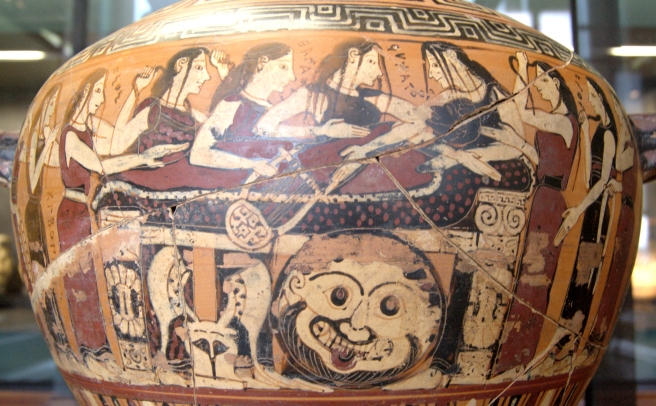
Image result for greek mourning vase
Corinthian Black Figure Hydra

Retreat or Resist? Seneca and Plutarch Disagree on Peace of Mind

How do we maintain equanimity in the midst of chaos? 

Seneca, Moral Epistle 94.68-69

“Don’t believe it is possible for anyone to be happy because of someone else’s unhappiness. These examples placed before our ears and ears, must be taken apart—we have to empty our hearts of the corrupting tales that fill them. Virtue must be introduced into the place they held—a virtue which can uproot these lies and contrafactual ideologies; a virtue which may separate us from the people whom we have trusted too much, to return us to sane beliefs.

This is wisdom, truly: to be returned to a prior state and to that place from where public sickness dislodged us. A great part of health is to have rejected the champions of madness and to have abandoned that union which was destructive for everyone involved.”

Non est quod credas quemquam fieri aliena infelicitate felicem. Omnia ista exempla, quae oculis atque auribus nostris ingeruntur, retexenda sunt et plenum malis sermonibus pectus exhauriendum. Inducenda in occupatum locum virtus, quae mendacia et contra verum placentia exstirpet, quae nos a populo, cui nimis credimus, separet ac sinceris opinionibus reddat. Hoc est enim sapientia, in naturam converti et eo restitui,unde publicus error expulerit. Magna pars sanitatis est hortatores insaniae reliquisse et ex isto coitu invicem noxio procul abisse.

Seneca seems to be unfamiliar with schadenfreude (probably because it was a Greek word). Or, perhaps he refuses to acknowledge it as real tranquility. Plutarch may have agreed that Seneca’s prescription was good for attaining ataraxia, but Plutarch does not see it as a efficacious for mental health. 

Plutarch, On the Tranquility of the Mind 465c-d

“The one who said that “it is necessary that someone who would be tranquil avoid doing much both in private and public” makes tranquility extremely pricey for us since its price is doing nothing. This would be like advising a sick man “Wretch, stay unmoving in your sheets” [Eur. Orestes 258.].

And certainly, depriving the body of experience is bad medicine for mental illness. The doctor of the mind is no better who would relieve it of trouble and pain through laziness, softness and the betrayal of friends, relatives and country. Therefore, it is also a lie that tranquility comes to those who don’t do much. For it would be necessary for women to be more tranquil than men since they do most everything at home….”

Ὁ μὲν οὖν εἰπὼν ὅτι “δεῖ τὸν εὐθυμεῖσθαι μέλλοντα μὴ πολλὰ πρήσσειν μήτε ἰδίῃ μήτε ξυνῇ,” πρῶτον μὲν ἡμῖν πολυτελῆ τὴν εὐθυμίαν καθίστησι, γινομένην ὤνιον ἀπραξίας· οἷον ἀρρώστῳ παραινῶν ἑκάστῳ
μέν᾿, ὦ ταλαίπωρ᾿, ἀτρέμα σοῖς ἐν δεμνίοις.
καίτοι κακὸν μὲν ἀναισθησία σώματος φάρμακον ἀπονοίας· οὐδὲν δὲ βελτίων ψυχῆς ἰατρὸς ὁ ῥᾳθυμίᾳ καὶ μαλακίᾳ καὶ προδοσίᾳ φίλων καὶ οἰκείων καὶ πατρίδος ἐξαιρῶν τὸ ταραχῶδες αὐτῆς καὶ λυπηρόν.
Ἔπειτα καὶ ψεῦδός ἐστι τὸ εὐθυμεῖν τοὺς μὴ πολλὰ πράσσοντας. ἔδει γὰρ εὐθυμοτέρας εἶναι γυναῖκας ἀνδρῶν οἰκουρίᾳ τὰ πολλὰ συνούσας·

Image result for Ancient Greek insanity

Simonides and Boris

It has recently been reported that Boris Johnson, current Prime Minister of the UK and Donald Trump bookend, is fond of reciting Simonides:

Johnson’s penchant for the Classics and his ability to recite Greek are often mentioned either to illustrate that he might actually be intelligent or to furnish some additional evidence for his winsome quirkiness. This quotation of Simonides is not only not impressive but it is entirely predictable and tiresome.

What is Simonides known for? Perhaps apocryphally, he is known for surviving a disaster and remembering where everyone was seated.  He is also said to have been saved from a sinking ship by a dream (everyone else died). Of equal interest, he is maligned or at least singled out in antiquity for being one of the first to make money from his poetry.

Sure, memorizing stuff isn’t easy, but it doesn’t mean you understand it or are noble at all. It means you come from a place of privilege where you were given the time and instruction to memorize it.

There’s a lot more to Simonides’ poetry than the muscular epigram in praise of Sparta little BoJo managed to keep in his head when he was failing to learn empathy and how to tell the truth. Memorizing a key bit about Thermopylae just shows you drank int he canon at Boarding school deep and full and you have been trading on shared delirium in your charlatan’s career.

Here are some of our favorites:

Fr. 14

“Weakness is the mortal’s lot,
nor yet does grief avail –
in such truncated time there’s naught
but toil heaped on travail.”

ἀνθρώπων ὀλίγον μὲν
κάρτος, ἄπρακτοι δὲ μεληδόνες,
αἰῶνι δ’ ἐν παύρωι πόνος ἀμφὶ πόνωι

Fr. 15 (definitely on Brexit plans)

“Human strength is meager
Our plains incomplete
Toil follows toil in our short lives.
Death looms inescapable for all—
Men who are good and bad draw
of that an equal portion.”

ἀνθρώπων ὀλίγον μὲν
κάρτος, ἄπρακτοι δὲ μεληδόνες,
αἰῶνι δ’ ἐν παύρωι πόνος ἀμφὶ πόνωι·
ὁ δ’ ἄφυκτος ὁμῶς ἐπικρέμαται θάνατος·
κείνου γὰρ ἴσον λάχον μέρος οἵ τ’ ἀγαθοὶ
ὅστις τε κακός.

Fr. 17 (on a No-deal Brexit?)

“Everything comes to a single, dreadful Charybis—
The great virtues and wealth the same.”

πάντα γὰρ μίαν ἱκνεῖται δασπλῆτα Χάρυβδιν,
αἱ μεγάλαι τ’ ἀρεταὶ καὶ ὁ πλοῦτος.

Fr. 16 (for some humility)

“Since you are human, never say what will come tomorrow.
Nor, if you see a fortunate man, how long it will last.
For not even the time of a tender-winged fly
goes as fast.”

ἄνθρωπος ἐὼν μή ποτε φάσηις ὅ τι γίνεται〚αὔριον〛,
μηδ’ ἄνδρα ἰδὼν ὄλβιον ὅσσον χρόνον ἔσσεται·
ὠκεῖα γὰρ οὐδὲ τανυπτερύγου μυίας
οὕτως ἁ μετάστασις.

Fr. 18

“Not even those who were long ago,
The half-divine sons of our lord gods,
Came to old age without finishing
A life of toil, pain and danger.”

†οὐδὲ γὰρ οἳ πρότερόν ποτ’ ἐπέλοντο,
θεῶν δ’ ἐξ ἀνάκτων ἐγένονθ’ υἷες ἡμίθεοι,
ἄπονον οὐδ’ ἄφθιτον οὐδ’ ἀκίνδυνον βίον
ἐς γῆρας ἐξίκοντο τελέσαντες.†


Fr. 525 (perhaps to explain people listing to BoJo)

“The gods easily make off with the minds of men”

ῥεῖα θεοὶ κλέπτουσιν ἀνθρώπων νόον


Fr. 524

“Death catches up with those who run from battle too.”

ὁ αὖ θάνατος κίχε καὶ τὸν φυγόμαχον

Fr. 37

“It is hard for a man to be truly good,
built evenly with hands,
feet and mind without blame.”

ἄνδρ’ ἀγαθὸν μὲν ἀλαθέως γενέσθαι
χαλεπὸν χερσίν τε καὶ ποσὶ καὶ νόωι
τετράγωνον ἄνευ ψόγου τετυγμένον·

https://twitter.com/SarahEBond/status/1179390489650499584?s=20

As Sarah Bond makes clear, there is more behind the choice of this Simonides: it is about claiming the ever so muscular Spartan mystique. This is all nonsense of course.

Myke Cole has talked about the lie of Sparta (“The Sparta Fetish is a Cultural Cancer”The New Republic). Bond published a piece for Eidolon  about the appropriation of Spartan iconography and values in the modern world (“This Is Not Sparta: Why the Modern Romance with Sparta is a Bad One”).  Neville Morely’s subsequent post on the use of Sparta by the far right is also a must-read. I have gathered some sources on this too.

Nuremberg chronicles f 60r 3.png

Hurt Me Too Deep: Millennia of ‘Marriage Story’

“What is love? Baby don’t hurt me…”

– Haddaway

Watching Marriage Story, I could not help but be reminded of that other, similarly-titled film with a narrow focus on the evolution of a relationship, Love Story. While the ending of Marriage Story is, in the strictest sense of the term, more tragic, I found myself far more devastated by the ending of Love Story, if for no reason than the fact that the inexorable workings of fate can still produce outcomes which are far more heartbreaking than the ways in which humans casually but steadily ruin their own lives.

A part of the dramatic backdrop for the relationship between Charlie and Nicole is their joint development of a modern adaptation of Electra, which is slated to move to Broadway as the couple begin their separation, with Nicole moving out to L.A. to resume her pursuit of a screen acting career. Electra serves as a potent precursor to the dramatic fallout between Charlie and Nicole, given that Electra (along with her brother Orestes) avenge their father Agamemnon’s murder at the hands of their mother, Clytemnestra. There, too, a once (apparently?) happy couple had been driven apart by distance and bad decisions on the part of a husband. While Nicole claims throughout the movie that Charlie had neglected her emotionally because he was too absorbed in his own work to take note of anyone else’s needs, so too one might see Agamemnon’s violent sacrifice of his daughter Iphigenia as the summit of professional self-absorption.

For a movie entirely separate from the horror genre, Marriage Story features two separate Halloweens – one near the middle of the film, and the other in the last scene. When we first see Nicole on the set of her new TV pilot, she is trying on different masks. The film is pressing us hard to see our individual characters as just that – masks or personae, mutable projections of who we are to an external audience whose love and adoration we seek. When, in the middle of the film, Henry opts to go as a ninja for Halloween rather than the Frankenstein costume which was custom made for him back in New York, he is not only asserting his nascent sense of autonomy in a new setting, but he is rejecting the persona which his father (a respected director) is offering him, one which would have him represented as the intentional creation of a mad genius.

We are inclined to think that love is a deeply genuine and authentic experience of penetrating behind the veil of fabricated social personae. America’s leading philosopher of relationships, Chris Rock, once said that marriage involved learning to love “the crust of that person.” One night stands and casual dating are dismissed as superficial lust or mere attraction, while the noun love is freighted with hefty emotional and spiritual baggage.

“Now I know what love is.”

nunc scio quid sit Amor

Vergil, Eclogues 8.43

It is, perhaps, for this reason that a contemporary reader of Roman love elegy finds it so perplexing. As a genre, elegy was built around a set of conventional tropes and expressions, many of which involved the most passionate effusions of romantic sentiment and devotion. And yet, the mistress of the Roman love elegist was either a fiction, or (if a real person), a persona or stylized version of that person placed in genre-appropriate situations and scenes. While the love poems of Catullus can on occasion appear to be sincere enough, he is not really an elegist. By the time that Ovid and Propertius are on the scene, we get the sense that they are keen enough on love, but perhaps even more keen on writing about it in novel ways. This requires not only that they fashion mistresses and fictional backdrops for their poems, but also that they contrive expressions of their own personae as lovers. Consider Propertius 1.8B as a parallel to a situation in Marriage Story. After she leaves for L.A., Charlie is eager for Nicole to return to New York, and a central point of their potential redemption as a couple in his mind is her return to this geographical center:

“Here she will be! Here she remains! Fuck the haters! We have won – she did not withstand our constant prayers.”

Hic erit! hic iurata manet! rumpantur iniqui!

    vicimus: assiduas non tulit illa preces.

Despite Charlie’s initial hope that their romance can be renewed, and later his hope that he can at least give his son Henry a New York life, the geographical decentering of his life in New York into a far-flung and sprawling L.A. existence serves as a metaphor for the gradual dissolution of his family’s bonds.

2020 golden globe nominations

While much of the love talk from poetic personae among the Roman poets may seem to us somewhat disingenuous (playing upon such grave emotion for artistic effect), Marriage Story presents us with a romance shot through the filter of hyperrealism. The film’s most believable and affecting scene begins as an attempt at reconciliation between Charlie and Nicole, who have realized that the lawyers involved in the process of divorce have complicated matters substantially. A series of small misunderstandings and frustrations lead this conversation into their most heated argument in the whole movie:

Nicole: You’re so merged with your own selfishness, you don’t even identify it as selfishness anymore! You’re such a dick!

Charlie: Every day I wake up and I hope you’re dead! Dead, like if I could guarantee Henry would be okay, I’d hope you’d get an illness, and then get hit by a car and die! Oh, God! I’m sorry.

Nicole: Me too.

One of the hardest parts of watching Marriage Story is trying to convince yourself that Scarlett Johansson and Adam Driver were ever a happy couple. But if you can suspend this initial disbelief, the movie is so captivating because it is so real, and this particular argument was one of the most believable lovers’ quarrels on film, because it ended not with violence or with one party storming away, but with an utterly pathetic Charlie on his knees, apologizing for the winged words which just escaped the bulwark of his teeth. Love, like death, wounds us so deeply because we cannot really understand it.

For the film starring Adam Driver and Scarlett Johansson, Jade  Healy used the couple's apartments to signify their breakup.

Old Sinatra sings,

Love and marriage, love and marriage

They go together like a horse and carriage

This I’ll tell you brother

You can’t have one without the other

We know, of course, that this is the kind of facile codswollop that people love in popular music, but it is manifestly untrue to experience, unless one takes the metaphor to suggest that love (the horse) is yoked to the institution of marriage (the carriage) until it has been so thoroughly worn out by dragging it that it collapses and dies. To be sure, I know some people whose marriages still seem imbued with a spirit of love and romance, but I know just as many who have settled into a kind of loveless cohabitation with the other parent of their child. (A friend of mine once said bluntly, “We definitely don’t love each other anymore – he’s kind of a jerk – but we’re like roommates with kids, and divorce is expensive.” Indeed, though the internet has managed to distort the narrative into some kind of Charlie vs. Nicole prize fight, it seems clear that the only villain in the story is the teeming mass of swamp monsters that make up the legal profession.)

Love is something which simply happens to you, but marriage is a project which must be made to work. English novels in the 19th century were wholly absorbed with the theme of marriage, yet somehow managed never to get around the central paradox of the marriage plot: all of the older married couples were insufferably meddling and obviously miserable, yet the highest happiness is held out to the young prospective couple if only they can get married. Why do we never see the central young couple of the 19th century grow to hate each other? Because the novel always ends when they get married! George Eliot reversed this trope in Middlemarch, with a conscious intention to write a story which begins, rather than ends, with the heroine’s marriage. This marriage, which begins as a wholly loveless but idealistic (for Dorothea) and practical (for Casaubon) business produces nothing but misery for the young Dorothea. But, as Aeschylus says, learning from suffering and all that, eh? Dorothea comes into her own as an unhappy bride, and then later as a widow. Only at the end of the book does she manage to fuse the concepts of love and marriage when she is betrothed to Will Ladislaw. (Of course, we never know how that goes in the end.) Moreover, despite its ostensible simplicity, Marriage Story is a rather complicated title, because the movie is not about marriage so much as divorce, i.e. the end of a marriage. Whereas most marriage-driven narratives work us toward the point of marriage as a goal of life, Marriage Story explores lives which have moved beyond marriage as something left behind.

Love is one of the oldest and most well-trodden paths in our literature, but no amount of analysis will ever resolve its mysteries. Marriage Story takes up in medias res, and presents us with a muddling mess of a life shared between two people who still love each other in some way. So much of our narrative focuses on the inception of love that Marriage Story can hold our attention almost by default, as something of a novelty – how often do you see such a genuine and honest movie about divorce? There is no real resolution in the end – just a final shot of a former couple who have begun to adjust to a different kind of relationship. Charlie and Nicole may not be Agamemnon and Clytemnestra, but they join the ranks of countless couples before them, whose lives outstripped their loves.

Murder of Agamemnon, Pierre-Narcisse Guérin

“Was never true love loved in vain,
For truest love is highest gain.
No art can make it: it must spring
Where elements are fostering.
So in heaven’s spot and hour
Springs the little native flower,
Downward root and upward eye,
Shapen by the earth and sky.”

-George Eliot, Middlemarch