Rome vs. Avignon (Or, “Avignon Sucks!”)

Petrarch, Against a Man Who Slandered Italy (6):

In order to finally put an end to these prefatory remarks, that advocate for France has, in the mode more of a preacher than a letter writer, taken up this piece of the Gospel as the foundation of his argument: “A certain person was going down from Jerusalem to Jericho,” and so on. Alas, what is this that I hear? Especially as it comes from the mouth of a literate person? By the faith of Heaven, what an inept and ugly beginning to his little tale! Has this arrived then to such a state of wretched madness that when a Christian, especially the pope, leaves Avignon to go to Rome, he is said to go down from Jerusalem to Jericho? Is it not better to say that he comes from the deepest sewer of all vice, indeed even from the Hell of the living, and goes up to Jerusalem? The matter has fallen so far that Avignon, that massive disgrace and most extreme rotting stench of all the world should be called Jerusalem, while Rome, the capital of the world, the queen of cities, the seat of empire, the citadel of Catholic faith, the fount of all memorable examples, should be called Jericho?

Giorgio Vasari, Return of Pope Gregory XI to Rome from Avignon

Ut vero iantandem his preludiis modus sit, prolocutor iste, non scribentis epystolam sed sermocinantis in morem, pro fundamento sui sermonis evangelicum illud assumit: “Homo quidam descendebat a Ierusalem in Ierico” et reliqua. Ei michi, quid est quod ego audio, ex ore presertim literati hominis? Pro superum fidem, o ineptum ac turpe principium fabelle! Eo ne igitur miseriarum ac vesanie ventum est, ut quicunque cristicola, maximeque Pontifex Romanus, Avinione digrediens Romam petat, a Ierusalem descendere dicatur in Ierico, et non potius e sentina profundissima vitiorum omnium, imo quidem ex inferno illo viventium, in Ierusalem dicatur ascendere? Huccine igitur res prolapsa est, ut Avinio, probrum ingens fetorque ultimus orbis terre, Ierusalem dicatur, Roma vero, mundi caput, urbium regina, sedes imperii, arx fidei catholice, fons omnium memorabilium exemplorum, Ierico nuncupetur?

War, Some Proverbs

Arsenius

“In war, iron is stronger for safety than gold;
But for living, reason is better than wealth.”

᾿Εν μὲν πολέμῳ πρὸς ἀσφάλειαν σίδηρος χρυσοῦ κρείττων,
ἐν δὲ τῷ ζῆν ὁ λόγος τοῦ πλούτου [Sophocles]

“You can’t fuck-up twice in a war
Οὐκ ἔστιν ἐν πολέμῳ δὶς ἁμαρτάνειν

Zenobius

“War is tear-free” A proverb applied to those who succeed easily through every danger and beyond expectations.”

῎Αδακρυς πόλεμος: ἐπὶ τῶν ἔξω κινδύνου παντὸς ῥᾷστα δὲ καὶ παρ’ ἐλπίδα τὰ πράγματα κατορθούντων.

Michael Apostolios

“Beginning of wars”: A proverb applied to those who try to do wrong
᾿Αρχὴ πολέμων: ἐπὶ τῶν ἀδικεῖν ἐπιχειρούντων.

“Endless War is Sweet”: A proverb applied to those who throw themselves into dangers because of inexperience

Γλυκὺς ἀπείρων πόλεμος: ἐπὶ τῶν ὑπ’ ἀπειρίας ἑαυτοὺς καθιέντων εἰς κινδύνους.

Bronze penteconter


Homeric Advice for Starting a Conversation at #AIASCS

Across the academy, conferences are famous for being hierarchical, expensive, humiliating, of questionable worth, and a general venue for all sorts of debauchery. (There are papers too.) This week, the world of Classics descends upon Washington D.C> Fortunately, Amy Pistone has generated some good advice for people attending conferences.

But professional conferences often require social engagement! Talking to new people can be hard. If you find yourself at a loss for words this conference season, why not try something new by using an old script?

Diomedes: Il. 6.123-129

“Bestie, who are you of mortal humans?
For I have never seen you before in this ennobling battle.
But now you stride out far ahead of everyone
In your daring—where you await my ash-wood spear.
Those who oppose my might are children of miserable parents!
But, if you are one of the immortals come down from the sky,
I don’t wish to fight with the sky-dwelling gods!”

τίς δὲ σύ ἐσσι φέριστε καταθνητῶν ἀνθρώπων;
οὐ μὲν γάρ ποτ’ ὄπωπα μάχῃ ἔνι κυδιανείρῃ
τὸ πρίν· ἀτὰρ μὲν νῦν γε πολὺ προβέβηκας ἁπάντων
σῷ θάρσει, ὅ τ’ ἐμὸν δολιχόσκιον ἔγχος ἔμεινας·
δυστήνων δέ τε παῖδες ἐμῷ μένει ἀντιόωσιν.
εἰ δέ τις ἀθανάτων γε κατ’ οὐρανοῦ εἰλήλουθας,
οὐκ ἂν ἔγωγε θεοῖσιν ἐπουρανίοισι μαχοίμην.

Glaukos, 6.145-151

“Oh, you great-hearted son of Tydeus, why are you asking about pedigree?
The generations of men are just like leaves on a tree:
The wind blows some to the ground and then the forest
Grows lush with others when spring comes again.
In this way, the race of men grows and then dies in turn.
But if you are willing, learn about these things so you may know
My lineage well—many are the men who know me.”

Τυδεΐδη μεγάθυμε τί ἢ γενεὴν ἐρεείνεις;
οἵη περ φύλλων γενεὴ τοίη δὲ καὶ ἀνδρῶν.
φύλλα τὰ μέν τ’ ἄνεμος χαμάδις χέει, ἄλλα δέ θ’ ὕλη
τηλεθόωσα φύει, ἔαρος δ’ ἐπιγίγνεται ὥρη·
ὣς ἀνδρῶν γενεὴ ἣ μὲν φύει ἣ δ’ ἀπολήγει.
εἰ δ’ ἐθέλεις καὶ ταῦτα δαήμεναι ὄφρ’ ἐὺ εἰδῇς
ἡμετέρην γενεήν, πολλοὶ δέ μιν ἄνδρες ἴσασιν

Then switch nametags!

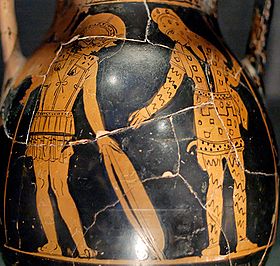
Image result for diomedes and glaucus

This post was inspired by the ever dynamic Rogue Classicist:

The conference equivalent of exchanging armor would probably be switching handouts with someone else and then giving a talk based on their handout. Aha! a new career goal!

If you are serious about getting to know new people (and there are always a lot of nice, interesting people at the annual meeting), Zeno has some great advice:

“We have two ears but one mouth so that we may listen more and talk less”

δύο ὦτα ἔχομεν, στόμα δὲ ἕν, ἵνα πλείω μὲν ἀκούωμεν, ἥττονα δὲ λέγωμεν

Who Is Your Janus and What Does He Do?

Ovid, Fasti 1.63-132

Behold, Germanicus, Janus is the first in my song, and he announces that the year will be favorable to you. Two-headed Janus, silent origin of the fleeting year, you alone of the gods see your own back. Favor our leaders, by whose labor both the fertile earth and the sea are at leisure. Favor, too, the senators and the people of Quirinus, and with your nod open the white temples. A prosperous light arises – favor our tongues and minds! Now good words are to be spoken on a good day.

Let all ears be free of strife, and let mad quarrels be gone straightaway. Angry tongue, hold off your work! You see how the ether shones with its odoriferous light, and hpw the Cilician saffron sounds on the illuminated altars? The flame strikes the gold of the temples with its own light and sprinkls its shaking radiance at the top of the building. It goes with untouched dress to the Tarpeian citadel, and the people shares its festive color. Now new fasces go forth, now new purple shines, and the notable ivory perceives its new burden. Young heiffers offer their necks, unskilled in burdens, to be struck; heiffers which the Faliscan grass nourished in its fields. When Jupiter looks out upon the whole world, he can see nothing which is not Roman.

Greetings, happy day! Come back better every time, worthy to be cultivated by a people powerful over the world.

“What god should I call you, twofold Janus? For Greece has no god equal to you. Tell me, too, the cause why you alone of the gods see what is behind and in front.” While I was working these things out in my mind on the tablets I had taken up, my house appeared brighter than before. Then holy Janus, marvelous in his twofold image, brought his two faces before my eyes. I felt afraid, and I sensed that my hair stood on end with fear, and my heart was chilled with sudden cold. He, holding his staff in his right hand and a key in the left, spoke first and said these things:

“Put aside your fear and learn, laboring poet of the days, what you seek, and mark my words in your mind. The ancients called me Chaos (for I was the first thing). Behold the deeds of a long age which I sing.

This clear air and the other three bodies – fire, water, and earth – were all one mass. As soon as this mass of things was separated by its strife and went to its new separate homes, the flame sought the heavens, and the next spot took the air, while the earth and sea sank onto the middle of the ground. Then I, who had been an orb, a mass without form, returned to my appearance and my body worthy of a god. Now too, the small notes of my once unformed figure, what is before me and behind me, are seen at the same tome.

Learn now what is the other cause of the form you ask about. Once you know this, you will understand my duty as well. Whatever you see anywhere – the sky, the sea, the clouds, the earth – are all closed and opened by my hand. The guardianship of the vast world is in my hands, and all the power of the turning pole is mine. When I’m in the mood to send Peace to placid homes, she walks freely about the streets without interruption; but the whole world will be mixed up with deadly gore, if my rigid bars do not hold back the wars ready to break out. I sit at the gates of heaven with the Hours: Jupiter comes and goes at the pleasure of my office. For that reason I am called Janus. When the priest offers me grain cake and spelt mixed with salt, you would laugh to hear my names; for I have been called now Patulcius and now Clusius by the priest’s mouth. Clearly, uncultured antiquity wished to signify the various changes by that name.

My power has already been narrated. Now learn the cause of my form, even though you already know it in part.

Image result for kindergarten cop who is your daddy

1. A K : IAN : F

Ecce tibi faustum, Germanice, nuntiat annum
inque meo primum carmine Ianus adest.
Iane biceps, anni tacite labentis origo,               65
solus de superis qui tua terga vides,
dexter ades ducibus, quorum secura labore
otia terra ferax, otia pontus habet:
dexter ades patribusque tuis populoque Quirini,
et resera nutu candida templa tuo.               70
prospera lux oritur: linguis animisque favete;
nunc dicenda bona sunt bona verba die.
lite vacent aures, insanaque protinus absint
iurgia: differ opus, livida turba, tuum.
cernis odoratis ut luceat ignibus aether,               75
et sonet accensis spica Cilissa focis?
flamma nitore suo templorum verberat aurum,
et tremulum summa spargit in aede iubar.
vestibus intactis Tarpeias itur in arces,
et populus festo concolor ipse suo est,               80
iamque novi praeeunt fasces, nova purpura fulget,
et nova conspicuum pondera sentit ebur.
colla rudes operum praebent ferienda iuvenci,
quos aluit campis herba Falisca suis.
Iuppiter arce sua totum cum spectet in orbem,               85
nil nisi Romanum quod tueatur habet.
salve, laeta dies, meliorque revertere semper,
a populo rerum digna potente coli.
Quem tamen esse deum te dicam, Iane biformis?
nam tibi par nullum Graecia numen habet.               90
ede simul causam, cur de caelestibus unus
sitque quod a tergo sitque quod ante vides.
haec ego cum sumptis agitarem mente tabellis,
lucidior visa est quam fuit ante domus.
tum sacer ancipiti mirandus imagine Ianus               95
bina repens oculis obtulit ora meis.
extimui sensique metu riguisse capillos,
et gelidum subito frigore pectus erat.
ille tenens baculum dextra clavemque sinistra
edidit hos nobis ore priore sonos:               100
‘disce metu posito, vates operose dierum,
quod petis, et voces percipe mente meas.
me Chaos antiqui (nam sum res prisca) vocabant:
aspice quam longi temporis acta canam.
lucidus hic aer et quae tria corpora restant,               105
ignis, aquae, tellus, unus acervus erat.
ut semel haec rerum secessit lite suarum
inque novas abiit massa soluta domos,
flamma petit altum, propior locus aera cepit,
sederunt medio terra fretumque solo.               110
tunc ego, qui fueram globus et sine imagine moles,
in faciem redii dignaque membra deo.
nunc quoque, confusae quondam nota parva figurae,
ante quod est in me postque videtur idem.
accipe quaesitae quae causa sit altera formae,               115
hanc simul ut noris officiumque meum.
quicquid ubique vides, caelum, mare, nubila, terras,
omnia sunt nostra clausa patentque manu.
me penes est unum vasti custodia mundi,
et ius vertendi cardinis omne meum est.               120
cum libuit Pacem placidis emittere tectis,
libera perpetuas ambulat illa vias:
sanguine letifero totus miscebitur orbis,
ni teneant rigidae condita Bella serae.
praesideo foribus caeli cum mitibus Horis               125
(it, redit officio Iuppiter ipse meo):
inde vocor Ianus; cui cum Ceriale sacerdos
imponit libum farraque mixta sale,
nomina ridebis: modo namque Patulcius idem
et modo sacrifico Clusius ore vocor.               130
scilicet alterno voluit rudis illa vetustas
nomine diversas significare vices.

Image result for janus

The Shoot That Rises from the Fire

Herodotus, Persian Wars Book 8.55

“I will now explain why I have told this story. There is in the Akropolis  an olive tree and a little salt pond inside the shrine of the one called the Earth-born Erekhtheus. The story among the Athenians is that after Poseidon and Athena struggled for the land they put these there as commemoration.

That olive tree was burned along with the temple by the barbarians. Yet, on the day after it burned, when some of the Athenians who were ordered to go there to sacrifice arrived at the temple, they saw a new shoot about as long as a cubit already growing from the trunk. They then told this story.”

Τοῦ δὲ εἵνεκεν τούτων ἐπεμνήσθην, φράσω. ἔστι ἐν τῇ ἀκροπόλι ταύτῃ Ἐρεχθέος τοῦ γηγενέος λεγομένου εἶναι νηός, ἐν τῷ ἐλαίη τε καὶ θάλασσα ἔνι, τὰ λόγος παρὰ Ἀθηναίων Ποσειδέωνά τε καὶ Ἀθηναίην ἐρίσαντας περὶ τῆς χώρης μαρτύρια θέσθαι. ταύτην ὦν τὴν ἐλαίην ἅμα τῷ ἄλλῳ ἱρῷ κατέλαβε ἐμπρησθῆναι ὑπὸ τῶν βαρβάρων· δευτέρῃ δὲ ἡμέρῃ ἀπὸ τῆς ἐμπρήσιος Ἀθηναίων οἱ θύειν ὑπὸ βασιλέος κελευόμενοι ὡς ἀνέβησαν ἐς τὸ ἱρόν, ὥρων βλαστὸν ἐκ τοῦ στελέχεος ὅσον τε πηχυαῖον ἀναδεδραμηκότα. οὗτοι μέν νυν ταῦτα ἔφρασαν.

As few years ago I posted this passage as wildfires burned through Attica. As with most non-US and non-Trump related disasters, these fires went under-reported). The recent coverage of the conflagration that is claiming Australia right now is even worse in the US. Part of it is our own myopia and narcissism; the rest is that we are in deep denial that we have crossed some pretty terrible lines. Our hearts are with our friends, colleagues, and everyone else affected by this.

Image result for australia fires

As Harper’s Magazine reports, severe fires are likely to be the rule rather than the exception thanks to our use of resources, lack of preparedness and global warming. This last year saw another season of devastation in the Western US, costing $163 million just to suppress. We can donate to help those affected, but in the long term we need to act to elect leaders who will acknowledge that we are hastening our own doom and we must hold accountable corporations that put short-term profit ahead of all else.

The passage above is from the part of Herodotus’ Histories after the Athenians have abandoned the city and retreated to Salamis to wage the war from the sea. This move is one of the most critical decisions of the Persian Wars, one that, arguably, is far more radical and important that the Spartan stand at Thermopylae. There is a simple beauty in the shoot growing from the burnt tree. But it is a beauty available only in hindsight and not to those who lost their lives before the story was told. The promise of new growth offers little solace to the dead and their bereaved families.

Image result for australia fires

The promise of new life from destruction is central to one of my favorite similes from Homer as well.

Homer, Odyssey 5.488-493

“Just as when someone hides a firebrand in black ash
On the farthest edge of the wilderness where there are no neighbors
And saves the seed of fire when there is no other way to kindle it,
Just so Odysseus covered himself in leaves. Then Athena
Poured sleep over his eyes so he might immediately rest
From his exhausting toil, once she closed his dear lashes.”

ὡς δ’ ὅτε τις δαλὸν σποδιῇ ἐνέκρυψε μελαίνῃ
ἀγροῦ ἐπ’ ἐσχατιῆς, ᾧ μὴ πάρα γείτονες ἄλλοι,
σπέρμα πυρὸς σῴζων, ἵνα μή ποθεν ἄλλοθεν αὕοι,
ὣς ᾿Οδυσεὺς φύλλοισι καλύψατο. τῷ δ’ ἄρ’ ᾿Αθήνη
ὕπνον ἐπ’ ὄμμασι χεῦ’, ἵνα μιν παύσειε τάχιστα
δυσπονέος καμάτοιο, φίλα βλέφαρ’ ἀμφικαλύψας.

The fire in this simile–that promise of life, the seed of the future–is a domesticated fire, one controlled and contingent on human relationships. It is a symbol for human potential to create and in its dormancy suppresses the urge to destroy. The promise of life and regrowth is contingent on the conditions that give life to begin with. We have the ability to make our lives together better or worse. We will never rid ourselves of all risk and disaster, but we can make the decision not to rush headlong into it. When I posted these passages a few years back, I was hopeful, somehow, that something might arise out of them. I am unsure that Herodotus’ historic view or Homer’s heroic vision can encapsulate what we’re facing at all: an unmaking of the world as we know it. This is primordial.

Hesiod Theogony 853-867

“When Zeus filled with strength and took his weapons,
That thunder, lightning, and the shining thunderbolt,
He leapt down from Olympos and attacked. He burned
All the divine heads of the terrible beast around him.
Once Zeus overcame him, slamming him down with his fists,
He fell, bent back, and the great Earth gasped beneath him.
Flame rose up from the thunder-beaten god
On the tops of the mountain ridges in the dry places
where he was struck and the great Earth burned beneath
because of the unbearable force and it melted there—
the way tin melts when fired with skill in the well-made channels
or the way iron—which is the strongest thing of all—
contracts when overcome by bright fire on mountain ridges
only to melt in the rich earth under Hephaistos’s hands—
that’s how the Earth melts in the glare of the burning fire”

Ζεὺς δ’ ἐπεὶ οὖν κόρθυνεν ἑὸν μένος, εἵλετο δ’ ὅπλα,
βροντήν τε στεροπήν τε καὶ αἰθαλόεντα κεραυνόν,
πλῆξεν ἀπ’ Οὐλύμποιο ἐπάλμενος· ἀμφὶ δὲ πάσας
ἔπρεσε θεσπεσίας κεφαλὰς δεινοῖο πελώρου.
αὐτὰρ ἐπεὶ δή μιν δάμασε πληγῇσιν ἱμάσσας,
ἤριπε γυιωθείς, στονάχιζε δὲ γαῖα πελώρη·
φλὸξ δὲ κεραυνωθέντος ἀπέσσυτο τοῖο ἄνακτος
οὔρεος ἐν βήσσῃσιν † ἀιδνῆς παιπαλοέσσης
πληγέντος, πολλὴ δὲ πελώρη καίετο γαῖα
αὐτμῇ θεσπεσίῃ, καὶ ἐτήκετο κασσίτερος ὣς
τέχνῃ ὑπ’ αἰζηῶν ἐν ἐυτρήτοις χοάνοισι
θαλφθείς, ἠὲ σίδηρος, ὅ περ κρατερώτατός ἐστιν,
οὔρεος ἐν βήσσῃσι δαμαζόμενος πυρὶ κηλέῳ
τήκεται ἐν χθονὶ δίῃ ὑφ’ ῾Ηφαίστου παλάμῃσιν·
ὣς ἄρα τήκετο γαῖα σέλαι πυρὸς αἰθομένοιο.

Here at the end of Hesiod’s Theogony, Zeus uses his overwhelming force and intelligence to face an existential challenge: the destructive potential of the universe contained within one figure, Typhoios (an elemental threat reflecting Zeus’ own surpassing power). Zeus brings order to the kosmos by subduing Typhoios and, in part thanks to this, gets to reign as king, father of gods and men. We don’t live in a poem of the gods; we can’t hope for myths to save our future. We need to do things now.

Or, we can just throw in with the reckless plutocrats and embrace that old Freudian death drive and keep on spending and burning until we’re all dead….

Anonymous, Greek Anthology, 7.704

“When I’m dead, the earth can be fucked by fire.
It means nothing to me since I’ll be totally fine.”

Ἐμοῦ θανόντος γαῖα μιχθήτω πυρί·
οὐδὲν μέλει μοι· τἀμὰ γὰρ καλῶς ἔχει.

This is the voice that says only the now matters, that this quarter’s profits are more important than sustainability and justice, that today’s ends justify any kinds of means. Unsurprisingly, it is attributed to the Roman Emperors Tiberius and Nero:

Suda tau 552 [cribbing Dio Cassius]

“And Tiberius uttered that ancient phrase, “when I am dead, the earth can be fucked with fire”, and he used to bless Priam because he died with his country and his palace.”

τοῦτο δὲ τὸ ἀρχαῖον ἐφθέγξατο· ἐμοῦ θανόντος γαῖα μιχθήτω πυρί. καὶ τὸν Πρίαμον ἐμακάριζεν, ὅτι μετὰ τῆς πατρίδος καὶ τῆς βασιλείας ἀπώλετο.

Frenemies Make for Awkward Conference Panels

Aelian, Varia Historia 3.19

“It is reported that the first difference between Plato and Aristotle developed for the following reasons. Plato was displeased with Aristotle’s life, and in the clothing he selected. See, Aristotle dressed in well-made clothes and shoes; he also had his haircut in a manner disliked by Plato; he also took pride in wearing many rings. His face, moreover, bore a certain aspect of derision; and within this face, an untimely talkativeness brought his character into question too. All these characteristics are obviously foreign to a philosopher. When Plato saw them, he was repelled by the man and preferred Xenocrates, Speusippos, Amykles, and others. These men received his respect and regular conversation.

When Xenocrates was out of town to visit his home, Aristotle set upon Plato and made a chorus of his companions around him with Mnason of Phocis and other similar men. Speusippus was ill and was incapable of walking with Plato who was already eighty years old. Thanks to his age, he had lost some parts of his memory. Aristotle plotted against him and set upon him: he questioned him rather aggressively and in the manner of refutation, which was clearly unjust and unsympathetic. Because of this, Plato stopped going for his walk outside; he walked inside with his friends.”

Λέγεται τὴν διαφορὰν ᾿Αριστοτέλους πρὸς Πλάτωνα τὴν πρώτην ἐκ τούτων γενέσθαι. οὐκ ἠρέσκετο τῷ βίῳ αὐτοῦ ὁ Πλάτων οὐδὲ τῇ κατασκευῇ τῇ περὶ τὸ σῶμα. καὶ γὰρ ἐσθῆτι ἐχρῆτο περιέργῳ ὁ ᾿Αριστοτέλης καὶ ὑποδέσει, καὶ κουρὰν δὲ ἐκείρετο καὶ ταύτην ἀήθη Πλάτωνι, καὶ δακτυλίους δὲ πολλοὺς φορῶν ἐκαλλύνετο ἐπὶ τούτῳ· καὶ μωκία δέ τις ἦν αὐτοῦ περὶ τὸ πρόσωπον, καὶ ἄκαιρος στωμυλία λαλοῦντος κατηγόρει καὶ αὕτη τὸν τρόπον αὐτοῦ. πάντα δὲ ταῦτα ὡς ἔστιν ἀλλότρια φιλοσόφου, δῆλον. ἅπερ οὖν ὁρῶν ὁ Πλάτων οὐ προσίετο τὸν ἄνδρα, προετίμα δὲ αὐτοῦ Ξενοκράτην καὶ Σπεύσιππον καὶ ᾿Αμύκλαν καὶ ἄλλους, τῇ τε λοιπῇ δεξιούμενος αὐτοὺς τιμῇ καὶ οὖν καὶ τῇ κοινωνίᾳ τῶν λόγων.

ἀποδημίας δὲ γενομένης ποτὲ τῷ Ξενοκράτει ἐς τὴν πατρίδα, ἐπέθετο τῷ Πλάτωνι ὁ ᾿Αριστοτέλης, χορόν τινα τῶν ὁμιλητῶν τῶν ἑαυτοῦ περιστησάμενος, ὧν ἦν Μνάσων τε ὁ Φωκεὺς καὶ ἄλλοι τοιοῦτοι. ἐνόσει δὲ τότε ὁ Σπεύσιππος, καὶ διὰ ταῦτα ἀδύνατος ἦν συμβαδίζειν τῷ Πλάτωνι. ὁ δὲ Πλάτων ὀγδοήκοντα ἔτη ἐγεγόνει, καὶ ὁμοῦ τι διὰ τὴν ἡλικίαν ἐπελελοίπει τὰ τῆς μνήμης αὐτόν. ἐπιθέμενος οὖν αὐτῷ καὶ ἐπιβουλεύων ὁ ᾿Αριστοτέλης, καὶ φιλοτίμως πάνυ τὰς ἐρωτήσεις ποιούμενος καὶ τρόπον τινὰ καὶ ἐλεγκτικῶς, ἀδικῶν ἅμα καὶ ἀγνωμονῶν ἦν δῆλος· καὶ διὰ ταῦτα ἀποστὰς ὁ Πλάτων τοῦ ἔξω περιπάτου, ἔνδον ἐβάδιζε σὺν τοῖς ἑταίροις.

Aelian, Varia Historia 4.9

“Plato used to call Aristotle Pôlos [the Foal]. What did he wish with that name? Everyone knows that a foal, when it has had its fill of baby’s milk, kicks its mother. Thus Plato was signaling a certain ingratitude on Aristotle’ part. Indeed, Aristotle received the greatest seeds of Philosophy from Plato and then, though he was filled to the brim with the best ideas, he broke with Plato rebelliously. He founded his own house, took his friends on Plato’s walk, and set himself up to be Plato’s rival.”

῾Ο Πλάτων τὸν ᾿Αριστοτέλη ἐκάλει Πῶλον. τί δὲ ἐβούλετο αὐτῷ τὸ ὄνομα ἐκεῖνο; δηλονότι ὡμολόγηται τὸν πῶλον, ὅταν κορεσθῇ τοῦ μητρῴου γάλακτος, λακτίζειν τὴν μητέρα. ᾐνίττετο οὖν καὶ ὁ Πλάτων ἀχαριστίαν τινὰ τοῦ ᾿Αριστοτέλους. καὶ γὰρ ἐκεῖνος μέγιστα ἐς φιλοσοφίαν παρὰ Πλάτωνος λαβὼν σπέρματα καὶ ἐφόδια, εἶτα ὑποπλησθεὶς τῶν ἀρίστων καὶ ἀφηνιάσας, ἀντῳκοδόμησεν αὐτῷ διατριβὴν καὶ ἀντιπαρεξήγαγεν ἐν τῷ περιπάτῳ ἑταίρους ἔχων καὶ ὁμιλητάς, καὶ ἐγλίχετο ἀντίπαλος εἶναι Πλάτωνι.

Image result for aristotle and plato

On the Anvil of Horatian Criticism

R.C. Jebb, Bentley (Chp. VIII):

Now, Horace was one of the most perilous subjects that Bentley could have chosen. Not so much because the text of Horace, as we have it, is particularly pure. There are many places in which corruption is certain, and conjecture is the only resource. But, owing to his peculiar cast of mind and style, Horace is one of the very last authors whose text should be touched without absolute necessity. In the Satires and Epistles his language is coloured by two main influences, subtly interfused, each of which is very difficult, often impossible, for a modern reader to seize. One is the colloquial idiom of Roman society. The other is literary association, derived from sources, old Italian or Greek, which in many cases are lost. In the Odes, the second of these two influences is naturally predominant; and in them the danger of tampering is more obvious, though perhaps not really greater, than in the Satires or Epistles. Now, Bentley’s tendency was to try Horace by the tests of clear syntax, strict logic, and normal usage. He was bent on making Horace ‘sound’ in a sense less fine, but even more rigorous, than that in which Pope is ‘correct.’

Thus, in the ‘Art of Poetry,’ Horace is speaking of a critic : — ‘If you told him, after two or three vain attempts, that you could not do better, he would bid you erase your work, and put your ill-turned verses on the anvil again‘ (et male tornatos incudi reddere versus). ‘Ill-turned ‘ — ‘anvil’! said Bentley : ‘what has a lathe to do with an anvil?’ And so, for male tornatos, he writes male ter natos, ‘thrice shaped amiss.’ Horace elsewhere speaks of verses as incultis . . .et male natis. To Bentley’s reading, however, it may be objected that the order of words required by the sense is ter male natos: for male ter natos ought to mean, either ‘unhappily thrice-born’ — like the soul of a Pythagorean, unfortunate in two migrations; or ‘barely thrice-born’ — as if, in some process which required three refinements, the third was scarcely completed. And then, if we are not satisfied with the simplest account of tornatos — viz., that Horace lapsed into a mixture of common metaphors — it admits of a strict defence. The verses have been put on the lathe, but have not been successfully rounded and polished. Then, says Horace’s critic, they must go back to the anvil, and be forged anew, passing again through that first process by which the rough material is brought into shape for the lathe. Yet Bentley was so sure of his ter natos that persons who doubted it seemed no better than ‘moles.’

Peter Paul Rubens, Hephaestus

Instruction vs. Art

Isidore of Seville, Etymologies 1.1:

Instruction (disciplina) received its name from learning (discendo): for this reason, it can also be called knowledge (scientia), because to know (scire) is derived from to learn (discere), because no one knows something if they have not learned it. Alternatively, it is called disciplina because it is learned in its fullness (discitur plena). Art however is so called because it consists of strict (artis) precepts and rules. Others say that this word is derived from the Greeks, from arete, that is, from virtue, which they called knowledge.

Plato and Aristotle wanted to establish this difference between art and instruction, saying that art (ars) consists of those things which can come about in an alternative way; but instruction (disciplina) deals with those things which cannot be otherwise than they are. For when something is discussed in true disputations, it is instruction; but when something similar to the truth and depending on conjecture is under discussion, it has the name of art.

Isidor von Sevilla.jpeg

DE DISCIPLINA ET ARTE. [1] De disciplina et arte. Disciplina a discendo nomen accepit: unde et scientia dici potest. Nam scire dictum a discere, quia nemo nostrum scit, nisi qui discit. Aliter dicta disciplina, quia discitur plena. [2] Ars vero dicta est, quod artis praeceptis regulisque consistat. Alii dicunt a Graecis hoc tractum esse vocabulum ἀπὸ τῆς ἀρετῆς, id est a virtute, quam scientiam vocaverunt. [3] Inter artem et disciplinam Plato et Aristoteles hanc differentiam esse voluerunt, dicentes artem esse in his quae se et aliter habere possunt; disciplina vero est, quae de his agit quae aliter evenire non possunt. Nam quando veris disputationibus aliquid disseritur, disciplina erit: quando aliquid verisimile atque opinabile tractatur, nomen artis habebit.

Don’t Let Questions Ruin Your Conference

In solidarity with friends traveling to the capitol this week….

Plato, Protagoras 338d-e

“But am willing to do this in such a way that you are eager for the conference and you will have some conversations. If Protagoras does not want to respond to questions, let him ask them instead, and I will answer and I will at the same time try to show him how I believe that someone should answer when he is asked something.

Whenever I answer however many questions he wants to ask, then let him promise to give me the same courtesy in return. If he does not seem enthusiastic about answering what he has been asked, then you and I can ask him in common—the very thing which you asked—that he not ruin our conference. It is not necessary to put one person in charge of this, but you can all watch over this together.”

ἀλλ᾿ οὑτωσὶ ἐθέλω ποιῆσαι, ἵν᾿ ὃ προθυμεῖσθε συνουσία τε καὶ διάλογοι ἡμῖν γίγνωνται· εἰ μὴ βούλεται Πρωταγόρας ἀποκρίνεσθαι, οὗτος μὲν ἐρωτάτω, ἐγὼ δὲ ἀποκρινοῦμαι, καὶ ἅμα πειράσομαι αὐτῷ δεῖξαι, ὡς ἐγώ φημι χρῆναι τὸν ἀποκρινόμενον ἀποκρίνεσθαι· ἐπειδὰν δὲ ἐγὼ ἀποκρίνωμαι ὁπόσ᾿ ἂν οὗτος βούληται ἐρωτᾷν, πάλιν οὗτος ἐμοὶ λόγον ὑποσχέτω ὁμοίως. ἐὰν οὖν μὴ δοκῇ πρόθυμος εἶναι πρὸς αὐτὸ τὸ ἐρωτώμενον ἀποκρίνεσθαι, καὶ ἐγὼ καὶ ὑμεῖς κοινῇ δεησόμεθα αὐτοῦ ἅπερ ὑμεῖς ἐμοῦ, μὴ διαφθείρειν τὴν συνουσίαν· καὶ οὐδὲν δεῖ τούτου ἕνεκα ἕνα ἐπιστάτην γενέσθαι, ἀλλὰ πάντες κοινῇ ἐπιστατήσετε.


Ammianus Marcellinus, History 21.4

“After Aquileia was surrounded by a double line of shields, when leaders conferred, it seemed best to try to persuade the defenders to surrender with a variety of threats and promises. Even though many words were intensively exchanged, their reluctance actually grew stronger and the conference was ended without a thing accomplished.”

Ordine itaque scutorum gemino Aquileia circumsaepta, concinentibus sententiis ducum, conveniens visum est ad deditionem allicere defensores, minacium blandorumque varietate sermonum: et multis ultro citroque dictitatis, in immensum obstinatione gliscente, ex colloquio re infecta disceditur.

One of the tapestries in the series The Hunt of the Unicorn: The Unicorn is Found, circa 1495-1505, The CloistersMetropolitan Museum of Art, New York City

Stoicism for a Shitty World

Edwyn Bevan, Stoics and Sceptics (1913, pp.32-33):

“If you are determined to limit yourself to what is called objective fact, you certainly diminish the chances of your making mistakes, but you also renounce all your chances of get- ting below the surface. What, for instance, is mainly interesting, to my mind, in the physical theories of Zeno, is not their detail, but the fact that he felt it necessary to enunciate a theory of Nature at all. We cannot under- stand what he was about unless we realize the necessity which was on him to give a complete answer to the enigma of the Universe, compact in all its parts, since nothing which left any room for doubt to get in could give a bewildered world security and guidance.

Stoicism, as it appears to me, was a system put to- gether hastily, violently, to meet a desperate emergency. Some ring-wall must be built against chaos. High over the place where Zeno talked could be descried the wall, built generations before, under the terror of a Persian attack, built in haste of the materials which lay to hand, the drums of columns fitted together, just as they were, with the more regular stones. That heroic wall still looks over the roofs of modern Athens. To Zeno it might have been a parable of his own teaching.

Even the passion of the Stoics for definition may in this way be regarded with human sympathy. It began with Zeno himself, who established numerous brief formulae as fixed and canonical definitions in the school tradition. Short definitions of this kind were well adapted to become current coin of all the philosophic schools and even of the market-place. As a matter of fact the Stoic definitions had a wide circulation in later antiquity. It is always the catch-words of a philosophical theory which lay hold of the general mind. Stoicism issued its own catch-words, one might say, with the official stamp. One of Zeno’s disciples, Sphaerus, seems to have shown a special aptitude for their manufacture. One is at first inclined to treat all this as a kind of dry philosophical pedantry. Perhaps with Chrysippus and the later Stoics such a vice of the mind was not altogether absent. But I think the motive behind it does take on another, and even a pathetic, aspect, when we consider the necessity to have a cut-and-dried answer ready to every question, if a coherent dogmatic system was to be fitted out such as the ordinary man could grasp, and consider also the bitter need for such a system which the world felt at that time.”