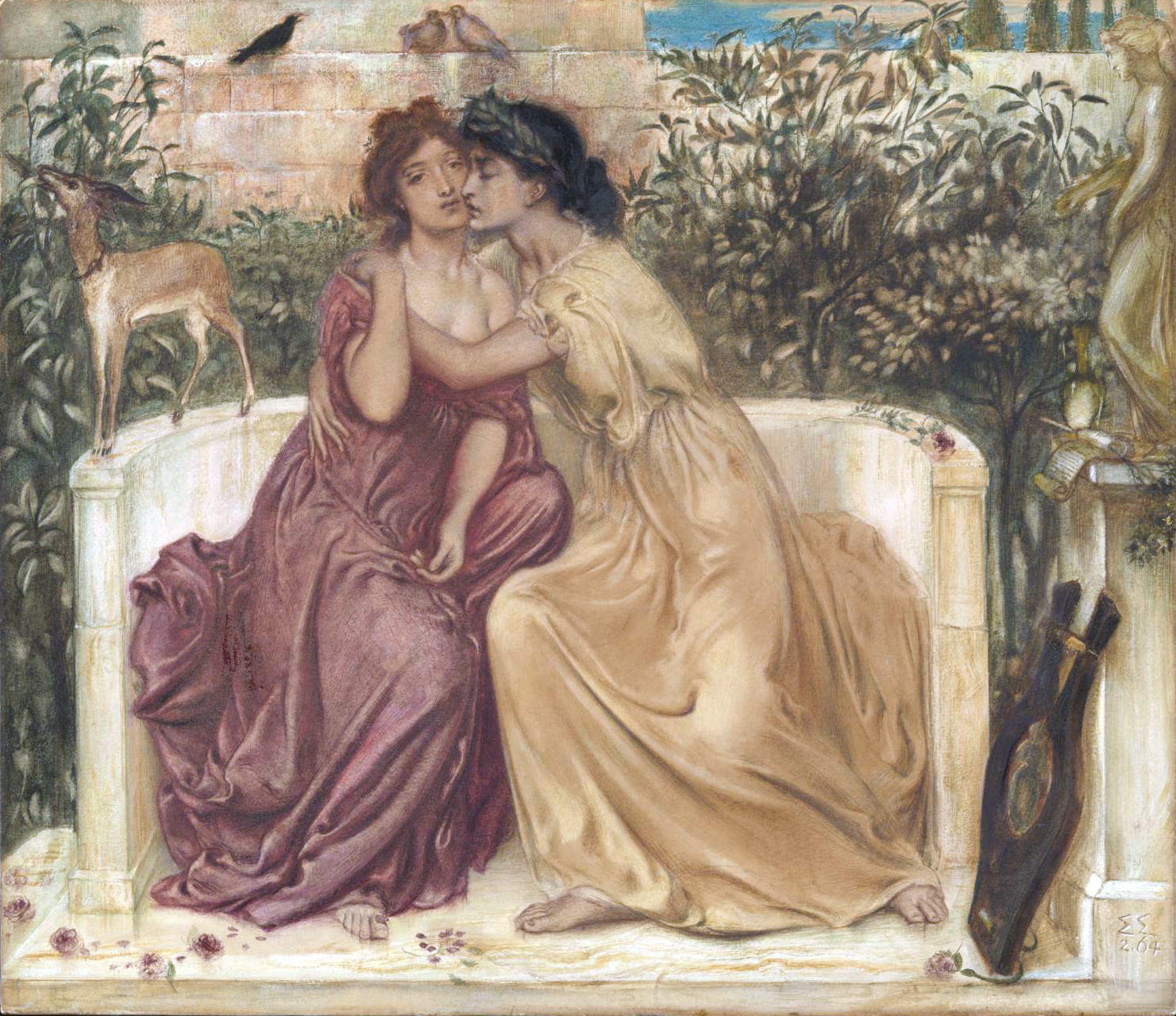
“Caesar left certain of his friends the impression that he did not want or desire to live longer because of his worsening health. This is why he ignored what the omens warned and what his friends revealed. Others believe that he dismissed the Spanish guards who accompanied him with swords because he was confident in the Senate’s recent decree and their sworn oath. Others report that he preferred to face the plots that threatened him at once rather than cower before them. There are those who assert that he used to say that his safety should be of more importance to the state than to himself: he had acquired an abundance of power and glory already, but the state, should anything happen to him, would have no rest and would suffer civil war in a worse condition than before.
The following is generally held to be the case, however: his manner of death was scarcely against his desire. For, when he read Xenophon’s account of how in the final days of illness Cyrus gave the plans for his own funeral, Caesar expressed disdain for so slow a death and wished that his own would be sudden and fast. And on the day before he died during dinner conversation at the home of Marcus Lepidus on the topic of the most agreeable end to life, Caesar said he preferred one that was sudden and unexpected.”
Suspicionem Caesar quibusdam suorum reliquit neque uoluisse se diutius uiuere neque curasse quod ualitudine minus prospera uteretur, ideoque et quae religiones monerent et quae renuntiarent amici neglexisse. sunt qui putent, confisum eum nouissimo illo senatus consulto ac iure iurando etiam custodias Hispanorum cum gladiis †adinspectantium se remouisse. [2] alii e diuerso opinantur insidias undique imminentis subire semel quam cauere … solitum ferunt: non tam sua quam rei publicae interesse, uti saluus esset: se iam pridem potentiae gloriaeque abunde adeptum; rem publicam, si quid sibi eueniret, neque quietam fore et aliquanto deteriore condicione ciuilia bella subituram.
illud plane inter omnes fere constitit, talem ei mortem paene ex sententia obtigisse. nam et quondam, cum apud Xenophontem legisset Cyrum ultima ualitudine mandasse quaedam de funere suo, aspernatus tam lentum mortis genus subitam sibi celeremque optauerat; et pridie quam occideretur, in sermone nato super cenam apud Marcum Lepidum, quisnam esset finis uitae commodissimus, repentinum inopinatumque praetulerat.
This is one of a few posts dedicatedto Iliad 22. As a reminder, these posts will remain free, but there is an option to be a financial supporter. All proceeds from the substack are donated to classics adjacent non-profits on a monthly basis.
The most memorable details of Iliad 22are probably Hektor running away from Achilles, then being tricked to facing him by Athena, and, finally, the mistreatment of his corpse before the book’s end. Before the antagonists face each other, however, Hektor has a remarkable speech where he chides himself for not taking advice to retreat within the walls earlier. He confesses that fear of shame—both for cowardice and for wasting so many Trojan lives—keeps him from returning to the city at this point.
In the final moments before he faces Achilles, when the narrative describes him as a coiled snake, Hektor imagines a different outcome. His dream-world can help us understand what happens in the rest of the book.
Iliad 22.111-128
“I wish I could put my embossed shield down Along with my mighty helmet, then lean my spear against the wall, And go face-to-face with blameless Achilles. I’d promise him Helen and the possessions along with her, Everything that Alexander took in his hollow ships When he went to Troy, the very beginning of our conflict, To give her back to the sons of Atreus and in addition To divide up all the things this city has kept safe. Then I would have an oath sworn among the Trojan elders Not to hide anything at all, but to divide up everything, Every possession the lovely city keeps inside. But why does my dear heart discuss these things? I can’t go forward and approach him—he wouldn’t pity me Nor feel any shame at all, but he will kill me even unarmed Just the way he would a woman, once I lay my weapons down. There’s no way at all from oak or stone To sweet-talk him, the way that a young woman and a young man or a young man and a young woman sweet talk one another.”
Hektor paints a vivid scene of disarming and meeting Achilles to make a truce. The language throughout is filled with references to pity and shame, those softer cultural correctives against the worst behavior. He also emphasizes redistributing goods, perhaps reaching back to the beginning of the epic when Achilles and Agamemnon fought over war spoils, but ultimately, Hektor knows neither his disarming nor the redistribution of goods is going to make a difference. Achilles is not merely upset, he is enraged. His loss of honor in book 1 led him to question and perhaps abandon the entire system of shame and esteem to which Hektor alludes. The death of Patroklos at Hektor’s hands, moreover, shook Achilles’ cosmic reality.
Schol. Ad Il. 22.126 bT
”There’s no way from oak or stone to sweet-talk him” to describe ridiculous ancient sayings: it is either from the generation of humans who were in the mountains, or it is because early people said they were ash-born or from the stones of Deukalion. Or it is about providing oracles, since Dodona is an oak and Pytho was a stone. Or it means to speak uselessly, coming from the leaves around trees and the waves around stones. Or it is not possible for him to describe the beginning of the human race.
When Hektor declares that “There’s no way at all from oak or stone…” to talk to Achilles, he uses a proverbial comment to tap into a cosmic/metaphysical assertion: Achilles is beyond shame and pity, he is beyond seeing anyone else in the world as more than an obstacle to his ends. But he still ruminates and fantasizes. In my first post on book 22, I suggest that we see Hektor as frozen in that moment of fight or flight for years, wrangling with the trauma of inaction and desperation. Fabian Horn, in an article from 2018, argues similarly that Hektor exhibits a combat stress reaction along with post-traumatic stress disorder—that he runs not from death but from a world lost in fear and out of his control
To add to these readings, I think we also need to think about what Hektor longs for, what he desires. Rachel Lesser considers Hektor and Achilles at some length in her recent book, Desire in the Iliad (2022, 208-214).In discussing lines 123-138, Lesser suggests that “When Hektor concludes, “he will kill me naked, just like a woman,” he acknowledges Achilleus’ unstoppable aggression and imagines himself as a vulnerable and passive victim” (209), emphasizing that Hektor imagines a equal relationship, one not of assault but of courtship (following Owen 1946’s observation that Hektor echoes his exchange with Andromache in that book—the language of intimate conversation Hektor uses here (e.g. ὀαρίζετον) appears there as well (cf. Il. 6.516). Such an image of romance, I think, dials back the story of the Iliad to the time before the beginning of the trouble. His repetition of youth and maiden, maiden and youth, shows him stumbling over the image, nearly trying to will it into being despite its impossibility.
Lesser argues that this erotic—in terms of courtly or romantic—language is operative throughout the faceoff between Achilles and Hektor, pervading the former’s eagerness and passion and helping us to understand the heightened language to describe Hektor and “[providing] a window into Achilleus’ psychology thatsupports the interpretation of Achilleus’ libidinal fixation on Hektor as an external displacement of his ambivalent longing for Patroklos. The final death blow to Hektor is a kind of “sexual consummation” as Achilles’ spear enters his enemy’s neck (211).
I really like the formulation of understanding Achilles’ “displacement” of his intensity for Patroklos onto the fire of his rage towards Hektor. There is a slippage that occurs in intense emotions we can observe here as Achilles identification with Patroklos moves from an acceptance of surrogacy in book 16 to a lamentation about what that surrogacy actual means in books 18 and 19 to redirecting it towards Hektor. Hektor becomes the reason Achilles lost part of himself but also a target for the emotional immensity so characteristic of Peleus’ only son. In addition to displacement, however I think there is also a kind of complementarity modeled by Hektor’s speech itself.
Achilles v. Hektor, c. 490 BCE. London, British Museum 1848,0801.1 Cat. Vases E 468
When Hektor imagines himself and Achilles as young lovers, he may make himself passive to Achilles’ agent, but he also positions them in a complementary stance to negotiate a different outcome to their conflict. Both in the repetition of identities near the end and in the overall scenario, Hektor imagines an egalitarian relationship where Achilles pursues him through speech, in a less aggressive and less destructive way than the actual outcome. For us as modern readers, however, it can be easy for us to misunderstand some of the assumptions attending marriage for Homeric audiences. One of the most well-known quotes about marriage from antiquity is the blessing Odysseus offers to Nausikaa in Odyssey 6 (6.180-185)
“May the gods grant as much as you desire in your thoughts, A husband and home, and may they give you fine likemindedness, For nothing is better and stronger than this When two people who are likeminded in their thoughts share a home, A man and a wife—this brings many pains for their enemies And joys to their friends. And the gods listen to them especially”
This passage is often viewed as a positive statement on marriage, while it also articulates a notion of justice (hurting friends/helping enemies) that is debated in Plato’s Republic as well. As James Redfield argues in his book The Locrian Maidens, the language of marriage and political stability overlap in emphasis in similarity of thought (more often homonoia). But as the story of the Odyssey shows, what this often means is the occluding of the desires and the interests of the passive/subordinate group by the values and interests of the group in power. Hektor gives up the possessions of Troy as something like a bridegift, yielding to Achilles what he wishes Achilles would desire in place of his blood and life.
There’s another angle to the moment that it took me a modern novel to see more clearly. Guy Gavriel Kay’s The Lions of Al-Rassan uses a medieval fantasy world to retell the story of Muslim Spain during the time of El Cid. Two of the primary characters, the cavalry captain Rodrigo Belmonte and the warrior/poet Ammar ibn Khairan end up on opposite sides of the war as the ‘foreigners’ are driven back across the sea. The two men start out as uneasy allies and are driven apart by diverging loyalties until they lead armies against each other.
One of the most remarkable scenes in a remarkable book comes near the end when Rodrigo and Ammar face each other on the field in single-combat. When the two approach that final moment, Kay leaves a silence to be filled by the audience: “No one escorted either man, so no one knew what it was that Rodrigo Belmonte and Ammar ibn Khairan said to each other when they stopped their horses a little distance apart, alone in the world.” Their former intimacy remains private, informing and anticipating the action to come.
The unfolding duel is watched by a woman named Jehane who loves them both. As she watches, the narrative moves and obscures their identities. One of the men thinks as the scene moves on:
It would have been pleasant, the thought came to him, to be able to lay down their weapons on the darkening grass. To walk away from this place, from what they were being made to do, past the ruins, along the river and into the woods beyond. To find a forest pool, wash their wounds and drink from the cool water and then sit beneath the trees, out of the wind, silent as the summer night came down.
As she observes this scene, Rodrigo’s wife, Miranda remembers, “But she had never, ever heard Rodrigo speak of another man—not even Raimundo, who had died so long ago—the way he’d talked about Ammar ibn Khairan during the long, waiting winter just past. The way the man sat a horse, handled a blade, a bow, devised strategies, jested, spoke of history, geography, the properties of good wine. Even the way he wrote poetry.”
Rodrigo and Ammar are different men in many ways, but they are united in their dedication to their people and their sense of duty. When Hektor briefly imagines chatting with Achilles and sharing a world outside of war with him, I imagine him, the breaker of horses, as occupying such a complementary space, where one fills the space left by another. Indeed, as Owen Lee argues, Hektor and Achilles are both versions of heroes who change the world, who bring a new reality into being. They mirror and refract, but do not perfectly overlap. As the duel continues in The Lions of Al-Rassan, it becomes difficult to trace who strikes and who defends and, in the final moments, it is left briefly unclear which warrior survives.
The interplay of love and death, of longing and fear, in the final moments between Rodrigo and Ammar has led me to see more of what Rachel Lesser sees in Hektor’s final moments. Achilles, Patroklos, and Hektor represent something of a trans-mortal triangle, as each represents life and/or death for the others and a series of replacement and displacement that alters the world they all briefly shared. The greatness of either hero is measured by the other—Hektor’s death matters in part because of Achilles’ life, their stories are entwined in the Iliad to the point that the differences are nearly obscured. As Kay writes of the duel in The Lions of Al-Rassan: “Most of the time, eyes narrowed against the sun, Jehane could tell them apart. Not always, though, as they overlapped and merged and broke apart. They were silhouettes now, no more than that, against the last red disk of light.”
The signal difference in Lions, however, is that dreadful balance between duty and rage. The heroes of Kay’s world are driven by the loyalties to face one another; Achilles and Hektor are driven by their roles into a series of choices that upends duty and common sense and leads them both to their deaths. But in Hektor’s speech we find a different desire that anticipates the very elision Kay describes: when he speaks contra-factually of Achilles’ ability to pity him or feel shame in his treatment, he echoes the very language Priam uses of Achilles in book 24 (503-504):
“But revere the gods, Achilles, and pity him, thinking of your own father. And I am more pitiable still…”
Priam, even if briefly, becomes for Achilles what rage makes impossible for Hektor: another human being whose love and brief light in the world reminds him of his own. The tragedy of Rodrigo and Ammar is that they find this in each other but then must leave it behind; Hektor and Achilles never have the time to find this in each other and Priam and Achilles are allowed only a brief glimpse before they return to their final days.
Hadjicosti, Ioanna L.. “Hesiod fr. 212B (MW): death at the Skaean gates.” Mnemosyne, Ser. 4, vol. 58, no. 4, 2005, pp. 547-554.
Horn, Fabian. “The psychology of aggression: Achilles’ wrath and Hector’s flight in Iliad 22.131-7.” Hermes, vol. 146, no. 3, 2018, pp. 277-289. Doi: 10.25162/hermes-2018-0023
Lee, M. Owen. “Achilles and Hector as Hegelian heroes.” Échos du monde classique = Classical views, vol. XXX, 1981, pp. 97-103.
Lesser, Rachel. 2022. Desire in the Iliad. Oxford.
Owen, E. T. 1946. The Story of the Iliad. Toronto.
Rabel, Robert J.. “The shield of Achilles and the death of Hector.” Eranos, vol. LXXXVII, 1989, pp. 81-90.
Redfield, James R. The Locrian Maidens: Love and Death in Italy. Princeton, 2004.
Vermeule, Emily D. Townsend. “The vengeance of Achilles. The dragging of Hektor at Troy.” Bulletin of the Museum of Fine Arts in Boston, vol. LXIII, 1965, pp. 34-52.
This post is a basic introduction to readingIliad 22. Here is a link to the overview of Iliad 21 and another to the plan in general. As a reminder, these posts will remain free, but there is an option to be a financial supporter. All proceeds from the substack are donated to classics adjacent non-profits on a monthly basis.
Book 22 has three basic parts, creating suspense before the final face-off between Achilles and Hektor; the faceoff itself followed by the mistreatment of Hektor’s body; and the first responses to Hektor’s death, culminating in Andromache’s first lament. In the first part, Hektor ignores pleas from his parents to return to the city and speaks to himself; the second part presents a famous and somewhat confusing (in terms of motivation) duel between Hektor and Achilles; and the third features some of the most emotional speeches in the epic.
Each of these narrative concerns adds something to the themes I have outlined in reading the Iliad: (1) Politics, (2) Heroism; (3) Gods and Humans; (4) Family & Friends; (5) Narrative Traditions. Among these, however, I think book 22 speaks most directly to heroism, gods and humans, and friends and family.
All of the segments in book 22 are deeply interdependent. Understanding Hektor’s behavior may be one of the most important interpretive challenges in approaching book 22. A simile before he speaks may help us start.
“As a serpent awaits a man in front of its home on the mountain, One who dined on ruinous plants [pharmaka], and a dread anger overtakes him As it coils back and glares terribly before his home. So Hektor in his unquenchable [asbestos] fury [menos] would not retreat, After he leaned his shining shield on the wall’s edge. He really glowered as he spoke to his own proud heart
As he stands before the walls of his city in book 22, Hektor is compared to a snake, coiled to strike an intruder. This moment of anticipation of violence is prolonged as Hektor turns away from the pleas of his family not to face Achilles. In a moment marked by the repeated speech introduction “ (ὀχθήσας δ᾽ ἄρα εἶπε πρὸς ὃν μεγαλήτορα θυμόν), Hektor ruminates, and worries despite what the opening simile anticipates. He resolves to face Achilles, but then immediately changes his mind: “When Hektor noticed Achilles, a tremor overtook him and he could not bear to wait for him / but he left the gates behind and left in flight” Ἕκτορα δ᾽, ὡς ἐνόησεν, ἕλε τρόμος: οὐδ᾽ ἄρ᾽ ἔτ᾽ ἔτλη / αὖθι μένειν, ὀπίσω δὲ πύλας λίπε, βῆ δὲ φοβηθείς).
What happens between the end of Hektor’s speech and his choice to run from Achilles? Very few people who read or write about the Iliad can make great sense of Hektor. His traditional character is part of James Redfield’s widely cited The Tragedy of Hektor (1975) and his strange engagement with his advisor Polydamas–with whom he argues on three separate occasions–is seen as a function of the limits of Trojan politics but rarely as evidence of the emotional response of an actual human being.
Indeed, throughout the Iliad, Hektor’s behavior can be hard to parse, and so much harder to defend. He is harsh to his brother, but within limits; his kindness to Helen and joy in his son seems ill-fit to his rejection of Andromache’s advice. In war, he seems relentless, speaking repeatedly of glory and the alternating chance of war, while pursuing an offensive onslaught that seems either wholly irrational or an artificial hastening of the war’s ultimate plot. Sure, we see the man-killing Hektor in all his unquenchable fury, but there are questions: he barely fights Ajax to a draw in book 7; he needs the help of another man and a god to slay Patroklos in book 16; he must be tricked to face Achilles when the final conflict awaits him.
During the COVID-19 pandemic, I started to think of Hektor as someone marked by prolonged uncertainty and torturous anticipation. In a way, we have lived in our own kind of siege over the past year: often unable to leave our homes, afraid of what days and weeks would bring, and plagued beyond all else by uncertainties that undermined many things we held to be true, even sacred. I started to think of Hektor and the Trojans as living this way not for one year, but for nine, hearing of the deaths or abductions of family members in other cities, seeing no way to break out. Before the beginning of the epic we know, Hektor spent nine years pacing the walls of his city, unable to fight off his enemies yet unable to flee. Until, of course, the Iliad’s action lets him break free.
The Grief and Recriminations of Andromache over the Body of Hector Her Husband (1783) by Jacques-Louis David
In the third edition of his The Body Bears the Burden: Trauma, Dissociation, and Disease (2014), Robert Scaer looks at the cycle of arousal and rest that characterizes the function of our nervous system in response to crisis or danger. In simple terms, we can think of the fight or flight response which triggers different neurotransmitters to prepare for rapid response: in a resting state, our bodies are prepared for and more efficient at digesting and storing nutrients and also at processing and storing knowledge of facts and events (13). The fight/flight response puts us in a high-energy nervous state, raising blood-pressure and moving blood into our muscular system.
Such a shifting of biological resources is an essential survival tool. But when we experience prolonged arousal without release or resolution we can become locked in or frozen, establishing an unstable state that may look immobile but may actually be “rapid and exaggerated sympathetic/parasympathetic oscillation (15). To put it in other words: when we face a crisis situation we can neither fight nor flee, our “freeze” reaction is a parafunctional cycling through the same fight/flight and resting process over and over again. In this state, our minds can become “numb and dissociated” and our vascular and digestive systems suffer.
As Scaer outlines (15-16), Animals often show remarkable responses to this freeze (a “discharge”) that can include convulsions and more in an instinctive attempt to restore “autonomic homeostasis” (16), that is, stability. Human beings, however, rarely show such ‘rests’ to discharge the trauma and reset the body. Such an inability to resolve the freeze moment, it seems, compounds the long term dangers of physical responses to trauma and the likelihood that memories of the events will incite similar physical responses, a return to a traumatized state. Scaer argues that many chronic diseases may be rooted in the reshaping of our brains by trauma and the inability of our conscious minds to distinguish between now and traumatizing events.
Hector’s last visit with his wife, Andromache, and infant son Astyanax, startled by his father’s helmet (Apulian red-figure vase, 370–360 BC)
Reading Hektor’s Trauma
When we see Hektor before the walls of Troy, he is “coiled” like a snake (elissomenos) and he wouldn’t retreat because of his unquenchable heart. Note that I translate that participle clause ἄσβεστον ἔχων μένος causally. This is, of course, a significant choice, but I think a well-motivated one. This is the only time in Greek epic when menos—one’s energy, life force—is described as asbestos, “inextinguishable, unsatisfiable”. The adjective appears to mark extreme or powerful expressions of emotion as in describing the laughter of the gods at Hephaistos (1.599) or war cries of groups as they engage in battle (11.500, 11.530; 13.169; 13.450; 16.267). In the Odyssey, asbeston twice modifies kleos (4.584; 7.133). This word seems to describe extreme moments of pitch, or aggression with a sense of duration. But as Lorenzo Garcia argues in his Homeric Durability, asbestosmarks things that ultimately cannot endure: what the sound of a laugh or a war-cry share in common with Hektor’s menos is an unsustainable intensity. In addition, the adjective marks something that is public, shared, or heard by others. Here, the asbeston menos is something private, a massive, unsustainable thing somehow contained within a single person.
The simile compares Hektor to an animal coiled for attack; in describing his refusal to retreat, the narrative uniquely describes the energy driving him; the speech introduction that follows places him in a motif of deliberation over fighting or fleeing. Speeches introduced by the formula “He really glowered as he spoke to his own proud heart” (ὀχθήσας δ᾽ἄρα εἶπε πρὸς ὃν μεγαλήτορα θυμόν) are dramatic representations of deliberation—moments that happen in an instant but are unfolded in the time of performance to allow audiences to consider the inner workings of heroic minds. The simile of the serpent creates extra space and invites audiences to consider the space between the image of the coiled snake and Hektor’s actions: it is as much about how Hektor is the snake and how he is not.
For mortals, the moment of deliberation seems to be that very freeze before the selection of fight or flight: at 11.404-410, Odysseus, caught alone in battle worries about being overcome as the battle rages around him. At 17.90, Menelaos pauses in the defense of Patroklos’ body, afraid to face Hektor alone. At 18.5, Achilles is paralyzed by fear that something has happened to Patroklos and later at 20.143, Achilles finds himself perplexed at the sudden disappearance of Aeneas who has been rescued by the gods. At 21.552, Agenor the son of Antenor pauses mid-battle to decide to run or face Achilles.
The participle characterizing the speech, okhthêsas, moreover, expresses anger or resentment and may be an iterative of ekhthomai, that same root that gives us Greek words for hostility and enmity. Especially when combined with the asseverative particle ἄρα, this verb communicates an inward wrath at a choice with no good options. It is the coiling of anticipation, of loss, and of a loss of control. It is, I think, a formulaic marker for the process of navigating between fight and flight. In its pairing with the opening simile, it marks Hektor in that same moment, in an extended freeze. His resolution, however, contrasts with the other scenes: Hektor ends up acting contrary to his choice to stand.
Hektor’s menos, his anger, is a reflex of his loss of control and of his longing for something to be different. Andromache anticipates this when she speaks to him in book (6.407-409):
“Divine one, your menos will destroy you and you do not pity Your infant child and my wretched fate, the one who will soon Be your widow. For the Achaeans are on their way to kill you…”
Hektor’s drive to protect those he cares for most is the very thing that separates him from them, that unites them only in loss and longing. This calls to my mind the work of my friend, Emily Austin, who has written a book foregrounding the thematic importance of loss and longing (pothos) in the Iliad: it is the sudden absence that motivates Achilles’ menis. I think it is also the unconquerable fire that keeps Hektor from ever truly being still.
Thinking about the fight/flight/freeze complex as described by Scaer helps us confirm the poetic function of a Homeric formula: it also serves to invite audiences into a mind navigating a moment of crisis, of choice or judgment (hence Greek krisis) over running away or facing danger. In combination with a striking simile and a strange description of Hektor’s menos, this pattern also helps us see what can happen when the deliberation fails, when the freeze prolongs. Hektor’s menos is overloaded, it is too thoroughly interiorized, coiled inside him, breaking him from within.
Andromache looking down from the walls of Troy at Achilles dragging Hector’s corpse behind his chariot. Limestone, fragment of a sarcophagus, late 2nd century CE.
Hektor, Fighting and Fleeing
Almost 15 years ago, Elton Barker and I wrote an article about debates over fight or flight in the New Archilochus Poem and Homer. In it, we argued that both Homer and Archilochus were engaged in a tradition of poetic debate about the merits of fight or flight, transcending our narrow concepts of genre and operating ahierarchically, that is, prioritizing neither Homer nor Archilochus, but providing evidence of debate and reflection over time. I don’t think we’re wrong, still; but I do think that this debate is about more than drama and poets: it is about representing human emotion and cognition.
Broadly speaking, Scaer’s framework and my own experience makes me think that we need to rethink Hektor’s behavior throughout the epic and the depiction of Trojan responses to the war in general, allowing more richness to the emotive and cognitive content. There are thematic ties that tell a story of their own.
When Hektor speaks to Andromache in book 6, he anticipates the shame he worries about in book 22 and considers his wife’s suffering after his death. He expresses a characteristic fatalism when he dismisses Andromache to her weaving, saying, “I claim that there is no one who has escaped his fate, / whether a good person or a bad one, after they are born” (μοῖραν δ’ οὔ τινά φημι πεφυγμένον ἔμμεναι ἀνδρῶν, /οὐ κακὸν οὐδὲ μὲν ἐσθλόν, ἐπὴν τὰ πρῶτα γένηται, 6.488-489).
Perhaps it is too much to read into this passage to say that Hektor thinks flight is impossible (he does…), but it certainly helps explain his subsequent actions: keeping the Trojan army out on the field at night in book 8, breaking through the Greek fortifications despite a bad omen in book 12, and refusing to return to the defense of the city in book 18. When Polydamas calls for them to retreat, Hektor continues to insist Zeus is on their side and declares, “I will not flee him from the ill-sounding battle, but I will stand / against Achilles either to win great strength or to be taken myself. War is common ground and the one who kills is killed” (…οὔ μιν ἔγωγε / φεύξομαι ἐκ πολέμοιο δυσηχέος, ἀλλὰ μάλ’ ἄντην /στήσομαι, ἤ κε φέρῃσι μέγα κράτος, ἦ κε φεροίμην / ξυνὸς ᾿Ενυάλιος, καί τε κτανέοντα κατέκτα, 18.306-309).
When Hektor freezes in the choice to fight or flee in book 22, he knows there is no other option. In his speech, he often surprises modern audiences with a wish that he and Achilles could exchange pledges like young lovers and wishes neither would have to die even as he admits that shame would prevent him from retreat. It is as if Hektor has a handful of cards and is repeatedly flipping through them, looking for one that will change a fate he knows cannot be changed. He goes back through his own stories, perhaps stopping at his conversation with Andromache and thinking about what he loses, what he needs, and the absence of choices remaining to him. At the end, he returns to that deceptive idea, that fate alternates and he just might win the day (εἴδομεν ὁπποτέρῳ κεν Ὀλύμπιος εὖχος ὀρέξῃ, 130).
“Andromaque”, 1883 painting that can be seen in Rouen’s fine art museum in France.
The Trojans in Trauma
Of course, there’s not a single way to think about this moment. David Morris in his 2015 The Evil Hours notes that Freud theorized that war neuroses came from an internal conflict between self preservation and responsibility to honor and comrades (15). As Jonathan Shay adds in his Achilles in Vietnam, trauma undermines “the cohesion of consciousness” (1995,188). And this fragmentation has been born out by neurobiological studies since.
The additional thing to think about for Hektor and for us, is that the impact of trauma can be increased by duration. What if we think of the Trojan leader as coiled for nine years, as representing a people besieged, constantly poised between the need to fight and the desire for an impossible flight. The repeated suppression of the fight or flight choice, the prolonged freeze would be traumatizing neurobiologically. It would change the way Hektor’s mind and body worked.
I do want to be careful to say that I am not saying the Greeks would have seen it this way precisely, but rather that there is clearly a traditional marker through the collocation of simile, deliberative introduction, and the invitation to the audience to linger with Hektor for a moment (the freeze) that modern observers have seen as having both psychological and neurobiological components. Ancient audiences would have seen their own peers shaped and reshaped by similar traumas and their poems show evidence of understanding the long term impact experiences like isolation, betrayal, and helplessness can have on the working of human minds (think of Philoktetes, Ajax, Odysseus, and others like Klytemnestra and Medea in tragedy).
So, this is not a positivistic reading saying “this thing is definitely that” but more that our modern scientific discourse has outlined a space of behavior that traditional poetics found meaningful too and that the correlation between these observations may help us understand something about Hektor others have missed. But I think this is bigger than Hektor: it may be about the Trojans, a people besieged, as a whole.
In the traditional story of the Trojan War, the story of the horse seems all but ridiculous (ok, it is ridiculous). But what if we considered the Trojan willingness to accept a clear trap, to engage in such extreme denial, as a function of their collective trauma? We are no strangers to large parts of our population refusing to accept what others see as fact, in engaging in clearly self-destructive behavior because it adheres so much more closely to what they want to be true and reality causes them so much pain.
In Greek myth, trouble tends to run in families and cities, traveling from father to son and grandson until the whole line is used up. This too resounds with what we have learned over the past century. We know trauma can be passed down three generations. Large-scale studies of oppressed populations show greater evidence of trauma related behaviors (depression, suicide, drug use) in the grand-children of those who suffered abuse and displacement than their peers. And these responses may be about more than the power of discourse and socialization. There’s growing evidence for the reshaping of DNA as a result of trauma. Our ancestors’ experiences may impact those parts of our DNA that inform our mental health and shape our responses to traumatic events in our lives.
Trauma impacts our physical health; it impedes learning and new memories; it alters how we respond to crisis; untreated, it deprives us of even instinctual advantages. The Iliad’s story of the Trojan War gives its audiences traumatized warriors and families on both sides. It shows people fraying then unraveling under the pressures of long term conflict. And it provides us with vignettes of men and women trying to make sense of the world as everything they know breaks down. When Hektor tries to face his death, but then runs, the traditional language and its images unfold a human mind at its most intense moment of crisis.
Over the past few years, I have often found myself arguing about what the humanities are, about what they are good for. A poem like the Iliad is not some timeless relic, a perfect object to be worshipped for the unmixed good it can bring. But it is a deeply complex inheritance, a poem that gives us the opportunity to move between what we know and see now and what others experienced thousands of years ago. By tracing out the story of Hektor’s mind and his body’s burden, we may find just a little help in learning how to carry our own.
n.b this is not an exhaustive bibliography. If you’d like anything else included, please let me know. Follow-up posts will address kleos and Trojan politics
Horn, Fabian. “The psychology of aggression: Achilles’ wrath and Hector’s flight in Iliad 22.131-7.” Hermes, vol. 146, no. 3, 2018, pp. 277-289. Doi: 10.25162/hermes-2018-0023
Lynn Kozak, Experiencing Hektor: Character in the Iliad. Bloomsbury Classical Studies Monographs. London; New York: Bloomsbury Academic, 2016. xiv, 307.
Hillary Mackie. Talking Trojan: Speech and Community in the Iliad . Lanham, MD: Rowman and Littlefield, 1996.
Van der Mije, Sebastiaan Reinier. “Bad herbs: the snake simile in Iliad 22.” Mnemosyne, Ser. 4, vol. 64, no. 3, 2011, pp. 359-382. Doi: 10.1163/156852511X505079
W. R. Nethercut. “Hektor at the Abyss.” Classical Bulletin 49 (1972) 7-9.
Oele, Marjolein. “Priam’s despair and courage: an Aristotelian reading of fear, hope, and suffering in Homer’s « Iliad ».” Logoi and muthoi : further essays in Greek philosophy and literature. Ed. Wians, William. SUNY Series in Ancient Greek Philosophy. Albany (N. Y.): State University of New York Pr., 2019. 297-317.
Pantelia, Maria C. “Helen and the Last Song for Hector.” Transactions of the American Philological Association (1974-) 132, no. 1/2 (2002): 21–27. http://www.jstor.org/stable/20054056.
Pucci, Pietro. “Divine protagonists in the « Iliad »: Hector’s death in book 22.” Yearbook of Ancient Greek Epic, vol. 1, 2017, pp. 175-205.
Ready, Jonathan L.. “Iliad 22.123-128 and the erotics of supplication.” The Classical Bulletin, vol. 81, no. 2, 2005, pp. 145-164.
James Redfield. Nature and Culture in the Iliad: The Tragedy of Hektor. Chicago: University of Chicago Press, 1975.
This is one of a few posts dedicatedto Iliad 21. As a reminder, these posts will remain free, but there is an option to be a financial supporter. All proceeds from the substack are donated to classics adjacent non-profits on a monthly basis.
In the last post on Iliad 21, I suggested that the supernatural violence of the book from when Achilles starts to fight the river Scamander to the realization of theomachy within the Iliad has the effect of overwhelming audiences, if inducing in them a ‘fog of war’ sensation as the events described get bigger, louder, more chaotic. The increase in intensity is both a function of Achilles’ rage and a narrative crescendo to help emphasize what comes next (the final meeting of Hektor and Achilles). As the noise quiets and the chaos simplifies, the narrative creates space for the speeches and encounters of book 22.
But the violence of 21 is about more still than building up the plot. It also dramatizes the danger intrinsic to a hero like Achilles and the cosmic disorder inherent to a world that mixes gods and mortals. One of the broader themes of the Iliad and the Odyssey together is the movement of the history of the divine world toward a settlement closer to the lives of Homer’s audiences. One metaphysical question attending Greek epic is why there are no demigods in their world.
As Barbara Graziosi and Johannes Haubold argue in their Homer: The Resonance of Epic, the Iliad and the Odyssey work in concert with other ‘Homeric’ poems (the Hymns) and the works of Hesiod to tell the story of the development of the cosmos up to the point of the basic perspective of the Archaic age in Greece. This process takes us from the creation of the world in Hesiod’s Theogony to the life of work and human intrigue described in the Works and Days. The Homeric narratives provide dramatic vignettes from steps along the way: The Hymns detail how individual gods came to occupy their sphere of influence and the epics tell about the end of the generation of heroes.
As Elton Barker and I discuss (probably too much) in Homer’s Thebes, Hesiod positions the end of the race of heroes as happening in the wars around Thebes and Troy. And, as I mentioned in a post on Zeus’ “plan”, a fragment from the lost epic, the Kypria confirms that this is all part of the cosmic order.
From left to right: Poseidon, Dionysos, Zeus. Black figured neck-amphora, 540 BC. National Museum of Denmark, Copenhagen
Hesiod, Works and Days, 161 165
Evil war and dread battle destroyed them (tous men), some at seven-gated Thebes in the land of Cadmus, when they fought for the flocks of Oedipus, and others (tous de) when it had led them in their ships over the great deep sea to Troy for lovely-haired Helen.
“Some have claimed that Homer is riffing on another story. For people say that the earth was weighed down by an overpopulation of human beings, and since there was no sense of reverence among them, she asked Zeus to lighten her burden. First, Zeus arranged the Theban War right away. He used that to kill a lot of them, and then in turn he caused the Trojan War, because he listened to Momos’ advice. This is what Homer calls the plan of Zeus, since he was capable of destroying them all with lightning or floods (kataklysm). Momos prevented this, offering instead two plans: first, Thetis’ marriage to a mortal and then the birth of a beautiful girl. From these two events there would be a war between Greeks and barbarians which would result in unburdening the earth because so many were killed.
This story is told in the Kypria composed by Stasinus who says as follows (Cypria fr. 1) There was a time when the countless mortal clans Constantly weighed down the broad chest of the trampled earth. When Zeus noticed, he felt pity and in his complex thoughts Devised to unburden the all nourishing land of human beings. He sowed the seeds of the great conflict around Ilion To lighten that weight through death. And so at Troy The heroes were dying and Zeus’ plan was being fulfilled.
I think that one helpful way to imagine book 21 is to see it as a rapid re-progression from the creation of the Universe and its potential theomachies to an explanation for why the gods are less involved in human affairs in ‘real life’ than in epic poetry. At the same time, the exploration of Achilles’ excess in his choosing of sacrificial victims, his refusal of a suppliant, and his onslaught against the river, emphasizes just how much suffering has been caused by a ‘hero’. The exchange of Poseidon and Apollo in the later half of the book emphasizes some of these themes.
Then the powerful shaker of the earth addressed Apollo: Phoibos: Why indeed do the two of us stand apart? It isn’t right Now that the rest have begun. No, it would be more shameful If we returned to the bronze-threshold of Zeus on Olympos without fighting. Start, since you are the younger by birth. It isn’t right for me Since I was born earlier and know more. Fool, you have a thoughtless heart. You don’t remember How many evils we two suffered over Ilion, Alone of the goods, when we had to serve Arrogant Laomedon for a year thanks to Zeus For some promised pay. He ordered us around, telling us what to do! I myself built the wall around the city for the Trojans, I made it broad and very fine, so the city would be unbreakable. And you, Phoibos, herded their ambling cattle In the glens of forested and hilly Ida. But when the year’s seasons produces the end of our contract, Then that monster of a man cheated the two of us Of all of our wages. And he sent us away with a threat. He promised he would tie our feet and hands up And sell us to islands far afield. Then he threatened to cut both our ears off with bronze! The two of us went back again with angry hearts Enraged over the money he promised us but didn’t pay. Now you are currying favor with his people and you don’t try Along with us to make sure that the arrogant Trojans die out Completely and horribly with their children and wives.”
Far-shooting Apollo then answered him in turn: “Earth-shaker, you would not describe me as wise If I made war with you, at least, over the mortals, Those unlucky creatures who grow like leaves At one time flourishing into life, eating the fruit of the fields, But then they shrink and wither. Come, let’s stop our fighting As fast as we can. Let them fight on their own.”
So he turned him back by speaking like this. For he was ashamed To engage in violence with his father’s brother.”
Laomedon Refusing Payment to Poseidon and Apollo [Debated attribution, 17th Century)
One of the striking things about this passage is the repeated language of evaluation or judgment: Poseidon (and then the narrator) are concerned with shame and propriety. It may seem strange that Poseidon spends so much time describing their mistreatment at the hands of Laomedon, but it works thematically well for this section. First, it shows how the Trojans failed a test of theoxeny (when gods go in disguise to test people); second, it demonstrates that gods themselves suffer pain from human beings; and, third, I think it also implies that humans suffer from these exchanges as well. Imagine how much less suffering there would be if the Trojans’ did not possess a wall built by Poseidon!
While Poseidon focuses on the insolence of the Trojans, extending the behavior of the long-gone forefather to the entire city, Apollo steps quickly away. He does not emphasize their shame, but his own prudence, or imprudence were he to fight Apollo for the sake of mortals. In a way, Apollo echoes Glaukos in book 6 of the Iliad when he compares human generations to the leaves. (Note the similar battlefield context and the use of the image of brevity if not futility to disengage from a fight through speech.) But this also echoes Sarpedon’s speech to Glaukos in book 12 when he says they must fight and die because they are mortal. The general argument of the Iliad—and I think a theological/metaphysical theme for the epic world—is that humans receive glory because they sacrifice what they have in short supply. Human life can have morality, shame, duty, and meaning because there are consequences that cannot be surmounted by time.
For the gods, whose lives cannot change because the cosmos is fixed in place by Zeus’ order, there’s no advantage from fighting with or about mortals any more. The gods, from the Homeric perspective, can gain no honor; they can not actually change. The only thing they receive any longer from mingling with human beings is pain—the loss of honor, as in Poseidon’s shaming by Laomedon; the physical pain Aphrodite feels when Diomedes wounds her in book 5; and, most of all, the emotional pain of loss Zeus feels for the death of Sarpedon alongside the terrible grief Thetis faces in empathizing with her son and anticipating his death.
Apollo, the god who started the divine actions in the Iliad, is shown here declaring he has had enough. And while the speech is short, Poseidon agrees. They leave the battle to let the mortals work it out for themselves as the gods watch from the distance in lives of eternal ease.
Paolo Fiammingo, “Apollo and Poseidon Punishing Troy“
A W. H. Adkins. ”Homeric Gods and the Values of Homeric Society.” JHS 92 (1972) 1-19.
W. Allan. “Divine Justice and Cosmic Order in Early Greek Epic” JHS 126 (2006) 1–35.
Burkert, Walter.1986. Greek Religion. 119-125.
G. M. Calhoun. “Homer’s Gods: Prolegomena”. TAPA 68 (1937) 24-25.
Barbara Graziosi and Johannes Haubold. Homer: The Resonance of Epic. London: Duckworth, 2005.
Jenny Strauss Clay. The Wrath of Athena: Gods and Men in the Odyssey. Princeton: Princeton University Press, 1983.
—,—. The Politics of Olympus: Form and Meaning in the Major Homeric Hymns. Princeton: Princeton University Press, 1989.
—,—. Hesiod’s Cosmos. Cambridge: Cambridge University Press, 2003
Erwin Cook. The Odyssey in Athens: Myths of Cultural Origins. Ithaca: Cornell University Press, 1995.
E. R. Dodds. The Greeks and the Irrational. Berkeley, 1951.
Erbse, Hartmut (1986). Untersuchungen zur Funktion der Götter im homerischen Epos. Berlin: de Gruyter
Barbara Graziosi and Johannes Haubold. Homer: The Resonance of Epic. London: Duckworth, 2005.
Christopher Gill. Personality in Greek Epic, Tragedy and Philosophy: The Self in Dialogue. Oxford: Oxford University Press, 1996.
Jasper Griffin. Homer on Life and Death. Oxford: Oxford University Press, 1980.
Heiden, Bruce 2002. “Structures of Progression in the Plot of the Iliad.” Arethusa 35 (2002) 237-54.
Emily Kearns. “The Gods in the Homeric Epics.” In Robert Fowler (ed.). The Cambridge Companion to Homer. Cambridge: Cambridge University Press, 2004, 59-73.
Lamberton, Robert. 1986. Homer the Theologian: Neoplatonist Allegorical reading and the Growth of the Epic Tradition. Berkeley and Los Angeles.
N. J. Lowe. The Classical Plot and the Invention of Western Literature. Cambridge: Cambridge University Press, 2000.
W. F. Otto. 1954. The Homeric Gods The Spiritual Significance of Greek Religion. Trans. M, Hadas.
Pietro Pucci. “Theology and Poetics in the Iliad.” Arethusa 35 (2002) 17-34.
Naoko Yamagata. Homeric Morality. Leiden: E. J. Brill, 1994.
In our annual tradition, we are re-posting this list with more names and updated links. Most of the evidence for these authors has been collected only in Wikipedia. I have added new translations and new names over the past few years (especially among the philosophers). Always happy to have new names and links suggested.
I originally received a link to the core list in an email from my undergraduate poetry teacher, the amazing poet and translator Olga Broumas. The post is on tumblr on a page by DiasporaChic, bit the original author is Terpsikeraunos.
Women in ancient Greece and Rome with surviving works or fragments
PHILOSOPHY
Here is a list of Women philosophers with testimonia and fragments (with French translations and commentary).
Aesara of Lucania: “Only a fragment survives of Aesara of Lucania’s Book on Human Nature, but it provides a key to understanding the philosophies of Phintys, Perictione, and Theano II as well. Aesara presents a familiar and intuitive natural law theory. She says that through the activity of introspection into our own nature – specifically the nature of a human soul – we can discover not only the natural philosophic foundation for all of human law, but we can also discern the technical structure of morality, positive law, and, it may be inferred, the laws of moral psychology and of physical medicine. Aesara’s natural law theory concerns laws governing three applications of moral law: individual or private morality, laws governing the moral basis of the institution of the family, and, laws governing the moral foundations of social institutions. By analyzing the nature of the soul, Aesara says, we will understand the nature of law and of justice at the individual, familial, and social levels.” – A History of Women Philosophers: Volume I: Ancient Women Philosophers, 600 B.C.-500 A.D., by M.E. Waith
Melissa: “Melissa (3rd century BC)[1][2] was a Pythagorean philosopher…Nothing is known about her life. She is known only from a letter written to another woman named Cleareta (or Clearete). The letter is written in a Doric Greek dialect dated to around the 3rd century BC.[2] The letter discusses the need for a wife to be modest and virtuous, and stresses that she should obey her husband.[2] The content has led to the suggestion that it was written pseudonymously by a man.[2] On the other hand, the author of the letter does not suggest that a woman is naturally inferior or weak, or that she needs a man’s rule to be virtuous.[1]” –Wikipedia
Perictione (I and II): “Two works attributed to Perictione have survived in fragments: On the Harmony of Women and On Wisdom. Differences in language suggest that they were written by two different people. Allen and Waithe identify them as Perictione I and Perictione II. Plato’s mother was named Perictione, and Waithe argues that she should be identified as the earlier Perictione, suggesting that similarities between Plato’s Republic and On the Harmony of Women may not be the result of Perictione reading Plato, but the opposite–the son learning philosophy from his mother. On the Harmony of Women, however, is written in Ionic prose with occasional Doric forms. This mixed dialect dates the work to the late fourth or third centuries BC. The reference in On the Harmony of Women to women ruling suggests the Hellenistic monarchies of the third century BC or later. On Wisdom is written in Doric and is partly identical with a work by Archytas of the same name. This work should be dated later, to the third or second centuries BC. Both the dates of the works and their dialects mean Perictione as the mother of Plato could not have written them. We then have two Pythagorean texts, attributed to otherwise unknown women named Perictione who should be dated perhaps one hundred years apart.” –Women Writers of Ancient Greece and Rome: An Anthology, by I.M. Plant
*N.B. This account leaves out the the basic narrative from Diogenes Laertius, that Plato’s father Ariston raped his mother Perictione.
Phintys: “Phintys (or Phyntis, Greek: Φίντυς; 4th or 3rd century BC) was a Pythagorean philosopher. Nothing is known about her life, nor where she came from. She wrote a work on the correct behavior of women, two extracts of which are preserved by Stobaeus.” –Wikipedia
*Note, Stobaeus (4.32.61a) calls her the daughter of Kallikrates the Pythagorean (Φιντύος τᾶς Καλλικράτεος θυγατρὸς Πυθαγορείας). Here are some of her fragments on the prudence befitting women: part 1 and part 2.
Ptolemais of Cyrene: “Ptolemais is known to us through reference to her work by Porphyry in his Commentary on the Harmonics of Ptolemy. He tells us that she came from Cyrene and gives the title of her work, The Pythagorean Principles of Music, which he quotes. She is the only known female musical theorist from antiquity. Her dates cannot be known for sure. She clearly preceded Porphyry, who was born about AD 232; Didymus, who is also quoted by Porphyry, knew Ptolemais’ work and may even have been Porphyry’s source for it. This Didymus is probably the one who lived in the time of Nero, giving us a date for Ptolemais of the first century AD or earlier…One of the problems in dealing with this text is that it is in quotation. Porphyry does not clearly distinguish between the text he quotes from Ptolemais and his own discussion of the issues raised…A second issue is the problem of the accuracy of the quotation. Porphyry says in the introduction to fragment 4 that he has altered a few things in the quotation for the sake of brevity. We should not assume that this is the only quotation to have suffered from editing. On the other hand, where he quotes the same passage twice (fragment 3 is repeated almost verbatim in fragment 4) his consistency is encouraging. Ptolemais’ extant work is a catechism, written as a series of questions and answers. She discusses different schools of thought on harmonic theory, distinguishing between the degree to which they gave importance to theory and perception. Her text prefers the approach of Aristoxenus to that of the Pythagoreans, thus she should not be thought a Pythagorean, despite the title of her work.” –Women Writers of Ancient Greece and Rome: An Anthology, by I.M. Plant
This is one of a few posts dedicatedto Iliad 21. As a reminder, these posts will remain free, but there is an option to be a financial supporter. All proceeds from the substack are donated to classics adjacent non-profits on a monthly basis.
Book 21 of the Iliad is like one of those extended fight scenes in a Transformers or Marvel movie: superpowered giants smashing against one another in a dizzying array of violence that leaves almost any audience reeling with confusion, immersed in a battlefield but uncertain how things are going. The effect can be to lose the thread of the narrative, to sit with the action itself and feel wearied, bewildered. An adventurous modernist reading might suggest that this is the very point, to bring the fog of war to an audience reclining on their couches or seated near friends.
The Iliad (and those CGI-filled modern movies) is doing more than this, however. The violence itself is somewhat formulaic, alluding to other fight scenes, to other narrative traditions that help us understand the one we are witnessing. And the mayhem sets up new emphasis in performance for when the bloodletting pauses: brief exchanges in the eye of the battlefield’s storm are charged. In Iliad 21 there are two moments that always stick out for me: the exchange between Achilles and Lykaon near the beginning of the book and the even briefer conversation between Poseidon and Apollo near its end. Both reflect on the brevity of human life; both engage with the Iliad’s narrative arc on mortality, violence, and heroism’s brittle promises.
After Achilles has captured and passed on twelve Trojan youths to slaughter over Patroklos’ funeral pyre, he encounters the son of Priam, Lykaon, whom we learn he had captured earlier in the war and ransomed back to his family. When Lykaon sees Achilles, he rushes to him to grab his knees “and he was deeply desiring in his heart / to flee terrible death and dark fate” (περὶ δ’ ἤθελε θυμῷ ἐκφυγέειν θάνατόν τε κακὸν καὶ κῆρα μέλαιναν, 21.65-66). Achilles pushes him back and gives one of the most memorable speeches from the Iliad.
Nike (left) pours a libation to Trojan hero Lykaon (centre) about to depart to war while his father (right) watches. Side A from an Attic red-figured amphora, ca. 440. From Nola, Campania.
Iliad 21.103-10
“So the glorious son of Priam addressed him, Begging with words, but he heard a cruel voice ‘Fool, don’t mention ransom to me nor address me in public. Before the fateful day took Patroklos away Then is was dearer to my thoughts to spare Trojans, And I took many of them alive and then sold them back. But now there is no one who will avoid death, no one whom the god, at least, puts in my hands in front of Troy, no one of all the Trojans, and especially the sons of Priam. So friend, die too. Why do you mourn like this? Even Patroklos died and he was much better than you. Do you not see what kind of man I am, how fine and large? I come from a noble father and a divine mother bore me, but strong fate and death await me too. There will come a time at dawn, in the afternoon, or at midday When some Ares rips the life from even me Either by striking me with a spear or from a bowstring.”
This scene should remind readers of discussion between Agamemnon and Menelaos in book 6 when the former tells his brother not to spare a suppliant Trojan. That moment follows the theomachy-resonant chaos of book 5 and extends the transgression against reciprocity in the ransom denied in book 1 (when Agamemnon refuses to give Chryseis back) to the battlefield. The Iliad’s war has no rules or boundaries and the sequence in book 21, starting with the ransom-denied followed by a second (or third or fourth?) theomachy creates a reminder and a narrative ring. All of the tension of battle, all of the extremity of war is loaded into Achilles’ fury.
This speech is marked out as different, moreover, before it even begins. To my knowledge, this is one of the only examples in Greek epic of a speech introduction that emphasizes the recipient’s position rather than the speaker. The transition “begging with words, but he heard a cruel voice” makes Achilles somewhat more distance from the external audience (us) and may have the effect of drawing our perspective closer to Lykaon’s than Achilles.
If we were to cluster together a few of Achilles’ speeches after the death of Patroklos, it would be easy to see how much he continues the motif of surrogacy, mourning over the fact that Patroklos took his place in war when he imagined instead that Patroklos would take his own place in life when he was gone. Patroklos has become for Achilles a “transitional object”, through him he is seeing himself and others differently. Many readers have made thematic connections between this plot and the story of the Gilgamesh poems, where it is through the death and loss of Enkidu that the god-king of Uruk realizes his own mortality, transitioning his narrative from one of adventure to a journey for eternal life.
I am agnostic about any literal connection between the Gilgamesh poems and Homer (I think we make the connections and have no idea if ancient audiences could have). But I think there is also a significant difference between the two situations. Losing Patroklos does not make Achilles value his life more or desire to extend it. Instead, it induces in him a murderous nihilism: first, he laments that he didn’t die instead (rather than mourning for the portion of life denied to his friend), then becomes an instrument of death himself (instead of a vessel seeking for more life). (At least I put it somewhat this way when I wrote among some other of my juvenalia “Achilles internalises and then generalises Patroklos’ death: these two passages reveal his acceptance of his own death but here he goes further. In denying the obligations of suppliancy, he himself becomes the instrument of death’s inevitability” (2009, 191)
Early 18th-century French school Achilles in front of the river Scamandre after killing Lycaon (Iliad, Canto XXI) Oil on canvas. 42 x 55 cm
Achilles’ “identification” with Patroklos through death emerges as a kind of jejune narcissism, a philosophizing or catastrophizing adolescent first imagining that the universe ceases to be with his own death and then in some way seeking to make it happen. Note the rapid movement in that second part from Lykaon, to Patroklos, to Achilles himself. If I am right that there is a thematic movement in Achilles’ grief that helps him see others as real again, then this speech should be seen as a negative turn from his lament in book 19. He acknowledges Lykaon as another person, but considers him less than himself and insofar as people he loved have died, everyone is due to die too.
There’s a lot of interesting language in this section about beauty and the body. From the grasping at the knees to Achilles’ spearing of Lykaon after this speech where he points to his own body, the language here may flirt with the erotic as Achilles projects his loss—his lack of the rest of himself—on the world around him. In her recent book, Rachel Lesser suggests (following Vermeule 1979) “Here Achilleus’ spear metonymically, expresses the hero’s own frustrated desire, and its phallic shape suggests the similarity between aggressive and sexual urges” (2022, 206). Read in an intrageneric context of song—where lyric and elegy exist alongside epic and we understand Achilles as mourning his lost companion—this scene has a sense of displaced desire.
In addition to providing insight into the tension of desire that can never be fulfilled, Achilles’ language in this passage also speaks to the symbolism of the heroic body. As I discuss in an article on disability studies and Homeric epic “Homeric poetry presents a system in which to have a beautiful body signals an authoritative place in a community and a monstrous or disabled body de-authorizes or dehumanizes a figure” (2022). Frequently observations on body size and shape are used to confirm membership in a particular class. When Athena sees Telemachus in the Odyssey, she says “I see that you are really big and noble, and brave” μάλα γάρ σ’ ὁρόω καλόν τε μέγαν τε, 1.302: = 3.199 (Nestor addressing Telemachus). Cf. 4.141–47 where Helen recognizes Telemachus because he looks like his father and Menelaos responds “I was just now thinking this too, wife, as you note the similarity: / these are the kinds of feet and hands / the eye glances, and head and hair belonging to that man” (οὕτω νῦν καὶ ἐγὼ νοέω, γύναι, ὡς σὺ ἐΐσκεις· / κείνου γὰρ τοιοίδε πόδες τοιαίδε τε χεῖρες / ὀφθαλμῶν τε βολαὶ κεφαλή τ’ ἐφύπερθέ τε χαῖται, 4.148–50).
By using similar language, Achilles acknowledges the physiognomic assumptions of heroic bodies, but insists that they are still subject to the rules of mortality. In the broader context of heroic myth, Achilles is emphasizing that heroes do in fact die and that their perfect bodies are not proof against human decay and weakness. He articulates this for himself when he more or less correctly predicts his own death (“by a spear or an arrow”).
As a final note, the tone of Achilles’ opening address to Lykaon as “friend” has been read as biting or sarcastic. But if we reconsider the etymology of philos as indicating something that is part or akin to you, Achilles’ address to Lykaon may signal a transfer of identity or a sharing of class. When Achilles calls Lykaon “friend”, then, he performs a kind of identification that obscures the boundaries between the two of them and his lost companion.
Achilles and Ajax playing a board game. Attic black-figure amphora, ca. 500 BC
Christensen, Joel P. 2009. “Universality or Priority? The Rhetoric of Death in the Gilgamesh Poems and the Iliad.”In Quaderni del Dipartimento di Scienze dell’Antichità e del Vicino Oriente dell’Università Ca’ Foscari, 4. E. Cingano and L. Milano (eds.), 179–202.
Christensen, Joel. P. 2021. “Beautiful Bodies, Beautiful Minds: Some Applications of Disability Studies to Homer.” Classical World 114.4: 365–393.
Danek, Georg. “Troilos und Lykaon : ein Beitrag zur Intertextualität Homers.” Geistes-, Sozial- und Kulturwissenschaftlicher Anzeiger, vol. 151, no. 1, 2016, pp. 5-54.
Fisher, Nick. “The friendships of Achilles and the killing of Lykaon.” Ethics in ancient Greek literature: aspects of ethical reasoning from Homer to Aristotle and beyond : studies in honour of Ioannis N. Perysinakis. Ed. Liatsi, Maria. Trends in Classics. Supplementary Volumes; 102. Berlin ; Boston (Mass.): De Gruyter, 2020. 31-57. Doi: 10.1515/9783110699616-003
Karp, Andrew. “The harmony of eleos and aidôs in the moral universe of the Iliad.” New England classical newsletter & journal, vol. 21, 1993-1994, pp. 106-110.
Lesser, Rachel. 2022. Desire in the Iliad. Oxford.
MUELLNER, L. Metonymy, Metaphor, Patroklos, Achilles. Classica: Revista Brasileira de Estudos Clássicos, [s. l.], v. 32, n. 2, p. 139–155, 2019. DOI 10.24277/classica.v32i2.884
Homer Iliad, 21.103-10 [for a longer discussion of this passage, go here.]
“So the glorious son of Priam addressed him,
Begging with words, but he heard a cruel voice
‘Fool, don’t mention ransom to me nor address me in public.
Before the fateful day took Patroklos away
Then is was dearer to my thoughts to spare Trojans,
And I took many of them alive and then sold them back.
But now there is no one who will avoid death, no one
whom the god, at least, puts in my hands in front of Troy,
no one of all the Trojans, and especially the sons of Priam.
So friend, die too. Why do you mourn like this?
Even Patroklos died and he was much better than you.
Do you not see what kind of man I am, how fine and large?
I come from a noble father and a divine mother bore me,
but strong fate and death await me too.
There will come a time at dawn, in the afternoon, or at midday
When some Ares rips the life from even me
Either by striking me with a spear or from a bowstring.”
French School, 18th Century Early 18th-century French school Achilles in front of the river Scamandre after killing Lycaon (Iliad, Canto XXI) Oil on canvas. 42 x 55 cm
This post is a basic introduction to readingIliad 21. Here is a link to the overview of Iliad 20 and another to the plan in general. As a reminder, these posts will remain free, but there is an option to be a financial supporter. All proceeds from the substack are donated to classics adjacent non-profits on a monthly basis.
Book 21 follows book 20 as Achilles rampages over the battlefield in search of Hektor. As mentioned in discussing book 20, the two movements together serve both to delay the anticipated clash between Achilles and Hektor and also to depict the extremes to which Achilles’ rage will take him. Where book 20 features the hero facing another son of a goddess (Aeneas) and engages the Iliad with other heroic traditions, book 21 takes the violence to a cosmic scale. Achilles goes from slaughtering nameless young men to refusing to spare a suppliant, to fighting with gods.
If Achilles has superhuman strength and his mênis has the potential to destabilize the universe, then book 21 dramatizes just how dangerous he is by invoking narrative themes of theomachy. His onslaught brings him into conflict with an anthropomorphized river (Skamandros) which he begins to lose, resulting in another appeal to the gods. When Hephaistos enters the fray to counter the river, it nearly breaks apart the fabric of the narrative, eliciting a battle between Athena and Ares. In this back and forth, the epic not only echoes motifs from tales of gigantomachy and titanomachy, but it uses language and imagery that may have reminded some audiences of the tales of Herakles.
At the same time, the events of book 21 recall earlier moments in the Iliad, from Achilles’ initial pleas in book 1 through the near theomachy of book 6, centered around the actions of Diomedes. Here, the gods eventually decide not to continue the fighting. When Poseidon and Apollo decline to battle one another, they confirm that there will be no proxy succession battle and there will be no cosmic disorder. The threat of Achilles is ultimately contained to the mortal realm, affirming the Iliad’s part in a narrative tradition that enacts and justifies the separation between the worlds of gods and humans.
Each of these narrative concerns adds something to the themes I have outlined in reading the Iliad: (1) Politics, (2) Heroism; (3) Gods and Humans; (4) Family & Friends; (5) Narrative Traditions. Among these, however, I think book 21 speaks most directly to narrative traditions, Gods and humans, and heroism.
Achilles kills Penthesileia
Judging Achilles
One of the chief challenges of the Iliad’s second half—if not of the entire epic—is establishing just what we are supposed to think of Achilles. There are no simple answers at any point in the epic as he moves from frustratingly reactive in book 1 to almost persuasively reflective in book 9 to concerned but recalcitrant in books 11 and 16 and finally a force like nothing else but a god once he returns to the battlefield. Book 20 showed that even the best of the mortals—a demigod!—is no match for Thetis’ son. Book 21 takes it one step further.
“Then godly Achilles left his spear there on the bank, Leaning on the tamarisks and he leapt into the river, Holding only his sword as he devised wicked deeds in his thoughts. And he was striking constantly. An unseemly groan rose up From the people he killed with the sword. And the water grew red with blood. As when other fish fill the hollows of a safe harbor When they are fleeing in front of a great-jawed dolphin Out of fear, since it eats up whatever it catches, So too did the Trojans cower in the currents of the terrible river Right beneath the banks. But when he tired out his hands in the killing, Achilles took twelve young men out of the river alive As payback for the death of Menoitios’ son Patroklos. He let them out and they were stunned like fawns. He bound their hands behind them with the well-twisted belts They were carrying themselves to cinch their tunics. He handed them over to his attendants to take to the hollow ships. Then he sprang back into action again, eager to murder some more.”
The simile here is memorable, but it may strike modern readers as a little odd. We don’t often think of dolphins as bloody murderers. One scholion, however, expands on the comparison’s aptness based on its location.
Schol. bT Ad Hom. Il. 21.22-24
“The [elements] of the comparison work really well. On the one hand, the pursuer is on land, but those who are fleeing are pressed together into the river. The poem previously compared him to a fire and them to locusts [21.12-140]. But when the pursuer and the pursued are in the water, it harmonizes them to the newly established space.”
Ok, so the first scholion seems to show no interest in dolphins whatsoever. But it is interested in how the local space of the narrative corresponds to the frame of the simile. Such a ‘harmony’ between form and content directs me to think about what we can think about the correspondence between the actions Achilles undertakes and their narrative framing.
This scene, where Achilles captures the twelve Trojan youths he will sacrifice on Patroklos’ grave later on in the epic, is nearly understated compared to what happens later on in book 21. But it stands for me in the same notional space as the murder of the suitors in the Odyssey and the hanging of the enslaved women. One of my concerns for all of these scenes is how we as modern readers should receive the Homeric drama: are these scenes exploration of excessive violence, of transgressive action, or are they merely vivid depictions of the kinds of actions heroes commit in the heat of battle. To put it differently, how do we understand the Homeric narrator’s tone here. Often, when discussing the Odyssey, scholars couch Odysseus’ vengeance against the suitors and his son’s treatment of the enslaved women as justified as part of the epic’s homecoming narrative. I think this kind of reading is both insensitive to the language of Homeric poetry and naive concerning the complexity of its capacity to convey ‘traditional’ actions in a negative light.
Achilles doodt Hector (Léonce Legendre, circa 1831 – circa 1893); collection: Musea Brugge – Groeningemuseum
I am certain that Odysseus’ homecoming vengeance was understood as going to far and initiating a potential endless cycle of violence. Similarly, I think that Achilles’ violence in books 21-23 is marked as going way too far, both to characterize the absolute ruin caused by his raise and also to implicitly frame the danger represented by a figure possessing so much power that he cannot be restrained by other mortals and amounts to a threat even to the gods. The story of the Iliad is not about the excellence of heroes; it is about the danger they represent and the damage they cause.
When we talk about excessive violence in the Iliad, we sometimes miss out on how the epic itself marks some of it as exceptional or transgressive. Achilles’ capture of the Trojan youths is prefaced by the narratives seemingly blithe “then he was devising wicked deeds”. The combination kaka erga implies some judgment on the part of the narrative, but kakon can at times mark a deed as merely base or ignoble. The combination with the verb mêdeto seems to invoke a pattern in the Iliad around Achilles’ actions in particular. In book 22, when Achilles is about to pierce Hektor’s ankles and drag his body around the city, he is described as “devising unseemly deeds against shining Hektor” (῏Η ῥα, καὶ ῞Εκτορα δῖον ἀεικέα μήδετο ἔργα, 22.395=23.24) and then, again, in book 23, before he actually sacrifices the twelve Trojan youths, the same phrase as in 21 appears, marking the sacrifice in particular as transgressive (…κακὰ δὲ φρεσὶ μήδετο ἔργα, 23. 176).
While the adjective modifying erga changes, there’s something in the verb in that penultimate position that marks supernatural agency. In the Odyssey, mêdeto appears in this position when ascribing the responsibility for actions to a generic god or to Zeus. In the Iliad, only Zeus (x2) and Achilles (x4) are subjects of this verb in this position and for it is localized to his sacrifice of the Trojan youths and his mistreatment of Hektor’s corpse. For Zeus, it marks Agamemnon’s ignorance about Zeus’ actual plans in book 2 (νήπιος, οὐδὲ τὰ ᾔδη ἅ ῥα Ζεὺς μήδετο ἔργα, 2.38) and Zeus’ preparations for the return to war in book 7 (παννύχιος δέ σφιν κακὰ μήδετο μητίετα Ζεὺς, 7.478).
The Iliadic use of this phrasal shape, then, makes a connection between Zeus’ prosecution of his plan within the Iliad and Achilles’ superhuman destruction. While narrative judgment in each case may be subject to some debate, it seems clear to me that the cumulative effect is to acknowledge the particular cruelty of the events of the Iliad (as requested by Achilles) and the excess of heroic action. The Homeric narrative does not clearly state that Achilles criminal acts of horror, but I cannot imagine how any attentive audience would not hear such an implication.
One scholion—and I am not sure I have understood it completely—seems to say that these scenes are motivated in part by a need to do something different, now that the Iliad has done everything it could with fighting on the plain, around the walls, and among the ships. It also adds that there’s no way “barbarians” would be worthy of fighting him, so that it makes sense to pit Achilles against gods instead.
Schol. bT ad Hom. Il. 21.18a ex
“Once he went through every kind of battle in the plain, around the fortification, and among the ships, now [the poet] has devised something new in Achilles’ onslaught in the battle along the river, not only in emphasizing the single idea, but adding new/strange compositions to the poetry. For he contrived this fourth kind of battle for the closing of his poem, since he does not see barbarians as worthy of fighting Achilles; and it ends the poem in a strange incompleteness, and he introduces the battle of the gods and the river, taking as a convenient starting point the constraint [imposed on the river] by the corpses”
Another makes it clear that at least some ancient readers saw the behavior as excessive.
Schol. bT ad Hom Il. 21. 27
This passage is here because he is going to introduce later the sacrifice called the dôdecad. The poem presents a great excess through this, showing that he selects the prisoners of a certain kind and number and that he binds these men together into one group, tying up their hands as if slaves captured in war.”
“Then godly Achilles left his spear there on the bank,
Leaning on the tamarisks and he leapt into the river,
Holding only his sword as he devised wicked deeds in his thoughts.
And he was striking constantly. An unseemly groan rose up
From the people he killed with the sword. And the water grew red with blood.
As when other fish fill the hollows of a safe harbor
When they are fleeing in front of a great-jawed dolphin
Out of fear, since it eats up whatever it catches,
So too did the Trojans cower in the currents of the terrible river
Right beneath the banks. But when he tired out his hands in the killing,
Achilles took twelve young men out of the river alive
As payback for the death of Menoitios’ son Patroklos.
He let them out and they were stunned like fawns.
He bound their hands behind them with the well-twisted belts
They were carrying themselves to cinch their tunics.
He handed them over to his attendants to take to the hollow ships.
Then he sprang back into action again, eager to murder some more.”
“The [elements] of the comparison work really well. On the one hand, the pursuer is on land, but those who are fleeing are pressed together into the river. The poem previously compared him to a fire and them to locusts [21.12-140]. But when the pursuer and the pursued are in the water, it harmonizes them to the newly established space.”
Sosias (potter, signed). Painting attributed to the Sosias Painter (name piece for Beazley, overriding attribution) or the Kleophrades Painter (Robertson) or Euthymides (Ohly-Dumm)
This is one of a few posts dedicatedto Iliad 20. As a reminder, these posts will remain free, but there is an option to be a financial supporter. All proceeds from the substack are donated to classics adjacent non-profits on a monthly basis.
Schol. T Ad Hom. Il. 20.307-8
“Some people say that [the children of Aeneas live on] through the Romans, which the poet knew from the oracles of the Sibyl, while others claim that the Aiolians expelled the descendants of Aeneas. But those who claim that Aphrodite devised the Trojan War because she knew this are wrong”
The greater portion of book 20 is dedicated to the faceoff between Achilles and Aeneas, one I have described earlier as a kind of heroic Superman vs. Batman. (And, yes, I think this Aeneas is more Ben Affleck Batman than a Michael Keaton….). Books 20 and 21 together work to delay the inevitable meeting of Hektor and Achilles, but they also provide something of a deliberate tour through different kinds of heroism. In book 21, Achilles challenges divine beings and wrestles a river, turning into his most Heraklean self. In book 20, he faces Aeneas, a hero of a different shape altogether.
As I discuss in the earlier post, Aeneas and Achilles engage in heroic flyting that is more or less an elaborate ‘meta-flyting’. Metapoetic moments in literature invite audiences to think about the rhetorical content of the forms that are entertaining them, both in a critical way and in one that invites enjoyment from those who recognize play and engagement with other traditions. Meta-moments, when they are successful, work on different levels, responding to audience capacity to catch references to other narratives or to understand comparisons in motif, trope, and genre.
When Achilles and Aeneas meet, the audience is invited to a series of meta-motifs: the heroic boast, followed by shifts in type scenes, and hints that there is a world larger than the already very large one contained within the Iliad. For the Iliad, such moments allow it to appropriate from other traditions without becoming them, by subordinating them to its own story. (The Odyssey does this constantly too!) But the act of appropriation itself is adaptive and integrative: it always carries within it the potential for recursive doubling of meaning, for multiple, even contradictory ideological frames to coexist, in tension, producing meaning only when the audience resolves the tension by leaning toward one or the other.
When Achilles and Aeneas meet, there is a problem: Achilles is on a murderous rampage and gets to kill everyone he wants. Aeneas is the son of a goddess who is supposed to live. What in the world is the epic to do?!
ca. 500 BCE MET Accession Number: 56.171.26
Homer, Iliad 20.288-308
Then Aeneas would have struck [Achilles] as he rushed at him With a stone in the helmet or shield, which would have projected him from ruin, But Peleus’s son would have robbed him of his life with his sword near at hand— If Poseidon the earth-shaker had not sharply noticed it all. Immediately, he spoke this speak among the immortal gods: “Shit! Truly, I have grief for great-hearted Aeneas Who soon will go to Hades overcome by Peleus’ son, All because he listened to the words of far-shooting Apollo, The fool, that god will not be of any use against harsh ruin. But why should this guy who isn’t at fault suffer grief now Without any reason because of other people’s pain when he always Gave cherished gifts to the gods who hold the wide sky. But come on, let’s lead him away from death So that Kronos’ son won’t get enraged somehow if Achilles Kills him. It is his fate to escape So that the race of Dardanos won’t go seedless and erased, Dardanos whom the son of Kronos loved beyond all his children Who were born to him from mortal women. Kronos’ son has already turned against Priam’s offspring. Now, mighty Aeneas will be lord over the Trojans Along with the children of his children who will be born later on.”
This passage is interesting because of the way it plays upon so many different Homeric motifs. To start, the battle scene is upended: an outcome of the fight is predicted but then denied, twice, as each hero’s next moves are anticipated, but denied. The denial proceeds through a somewhat regular motif in Homeric epic that goes by various names such as “if not-situations” (de Jong 2004, 68-71), “reversal passages” (Morrison 1992) and “pivotal contrafactuals” (Louden 1993, 181). Mabel Lang was one of the first to focus on these ‘unreal conditionals’ that provide the Homeric narrator and characters alike to express what would (or could) have happened, had events turned out different. Like English, Greek grammar marks unreal conditionals—in this case, contrary to fact—with clear signs, such as the use of specific particles in conjunction with particular verb forms (in this case, the aorist indicative in each clause with the Greek modal particle (a short word indicating that the situation is unreal) κε and introductory “if then not/unless” (εἰ μὴ).
It is one thing to describe the grammatical and semantic nature of a construction like this, however, and a wholly different thing to outline the use of a construction in a particular narrative. Unreal conditinoals in Homer seem in particular to create a space wherein Homeric epic flirts with deviating from the external constraints. Morrison, for example, argues that these scenes constitute moments where the traditional story or plot is nearly upended as Homer challenges and distinguishes himself from the tradition.
Morrison divides “reversal passages” into three types: (a) violations of the sack of Troy motif; (b) violations of the Iliad’s plot; and (c) minor variations during battle and in the funeral games (61). Lorenzo Garcia agrees that “in such instances Homer appears to challenge the very tradition in which he is working—which we may think of as a kind of “destiny” for the narrative in its own right…and asserts his own authority for the direction the narrative takes. Such events, As Gregory Nagy puts it, would be “untraditional”. Bruce Louden, however, suggests that commentators have overemphasized the tendency for this device to raise violations of the tradition. Across the 33 instances of this construction in the Iliad, 15 are “corrected” by divine intervention; 15 are addressed by mortals.
I think an undervalued aspect of the construction is its ability to draw attention to an event as contrary to patterns and expectations. It indicates a breaking of suspense and invites audiences to view this event as a course correction. In this way, a small measure of chaos is admitted into an ordered text, acknowledging the instability of narrative even as exerting control over it. This is an appropriate structure, then, for pointing to the potentially tradition-rattling encounter of Achilles and Aeneas.
MET 41.162.171, mid 6th Century BCE: Aeneas Carrying Anchises
Such tension intrigues me with this case in particular because we have pretty good evidence for extra-Iliadic traditions of Aeneas surviving the fall of Troy from archaeological and iconographic evidence. There are black figure vases from the sixth century BCE that depict Aeneas carrying his father Anchises from Troy. The Homeric Hymn to Aphrodite, which centers Anchises, appears to be one of the ‘older’ hymnic tradition; yet in this speech, Poseidon focuses on the future and omits such a reference to the past. The iconography and this speech both point to Aeneas’ survival as a basic fact of the narrative universe, but other than that there is no good reason to imagine these passages as in any way responding to each other, unless we imagine the Homeric epic as leaning away from such a common image, doing the very Homeric thing of making its own space and meaning in between the immutable lines of the larger tradition. As I usually emphasize, there’s no good reason to insist that the images and text are engaging directly with each other or existing in some sort of a temporal—therefore interpretive—hierarchy rather than to understand them as both variations on a shared narrative theme. Instead, it is interesting to go through the process in multiple directions, leaving space as well for the stories we have lost in between.
Divine interest in supporting fate—if we can call it that rather than the narrative instrumentalization of divinity to allow the story to both diverge and converge with what is known—leads me to some final observations on this speech. The presence and the absence of the gods are both felt keenly here. For example, a scholiast asks why Aphrodite isn’t the one to save him and answers it is because she is afraid of Athena ( ἡ ᾿Αφροδίτη τὸν υἱὸν οὐ σῴζει; δέδιεν ᾿Αθηνᾶν, Schol. T ad Il. 20.291a1). When Poseidon worries about the impact of Apollo’s words on Aeneas, I wonder if we can imagine a general anxiety about how the ‘words of Apollo (prophecy and poetry especially) may lead people to ruin.
British Museum: Black Figure Amphora, c. 490 BCE
There may also be wordplay as well around the name Achilles or at least the importance of ‘grief’ for the plot. Poseidon notes that akhos (“grief, woe”), a word often associated with etymologies of Achilles (e.g akhos + laos, “woe for the people”) comes over him when he hears about Aeneas and that Aeneas is suffering because of “other peoples akhos”. I may be so bold as to suggest that Poseidon feels the very same reaction that audiences might be feeling at this moment but also in response to the events of the Iliad. At the same time, he is extending the impact of the same emotion on ‘players’ in the epic itself: akhos drives the plot of the Trojan War, but it also reshapes the plot of the Iliad even as it flirts with diverging from that larger narrative structure.
But we are not yet done with emotional responses to these. In discussing the earlier passage in book 20 where Zeus claims that he is going to sit apart taking pleasure in watching the unfolding events, I suggested that king of gods and men derived this feeling from the sense that the narrative was moving toward a particular end, to a closure he had anticipated, if not arranged. Here, Poseidon notes Zeus’ potential displeasure at a particular outcome’s failure: Zeus will “be angry”( κεχολώσεται) if Achilles should kill Aeneas. Kholos, as I discuss in other posts, drawing on Thomas Walsh’s work, is anger that is socially motivated, among peers. It is an operative word in the conflict between Achilles and Agamemnon in book 1, strife among the gods in books 13-15, and during the funeral games in book 23. (It contrasts, in a complementary way, with menis, which tends to signal rage at cosmic disorder, as Lenny Muellner argues). Indeed, to connect this back to the introductory form, the “pivotal contrafactual”, Tyler Flatt has argued that this structure appears in moments where we may be expected to consider the overlap between the need to mourn and the need to hear further narrative. Poseidon’s concern for Zeus’ emotions foreground the affective nature of narratives that go where we don’t want them to go.
It is almost as if Zeus is presented as both audience and author of the narrative unfolding and, while we could imagine him as indicating the swings of the poem’s external audience, we could also frame this theologically. Zeus is something like an especially keen game master (or DM, dungeon master for the older crowd). He knows where he wants the story to go: he takes pleasure in the players finding their way there, and gets angry when they try to change his plans.
A Short bibliography
BECK, DEBORAH. “EMOTIONAL AND THEMATIC MEANINGS IN A REPEATING HOMERIC MOTIF: A CASE STUDY.” The Journal of Hellenic Studies 138 (2018): 150–72. https://www.jstor.org/stable/26575923.
Bouxsein, Hilary. “That Would Have Been Better: Counterfactual Conditions in Homeric Character Speech.” Mnemosyne 73, no. 3 (2020): 353–76. https://www.jstor.org/stable/26989141.
De Jong, Irene J. F. Narrators and Focalizers: The Presentation of the Story in the Iliad. 2nd Edition. London: Bristol, 2004.
Garcia, Lorenzo F., Jr. 2013. Homeric Durability: Telling Time in the Iliad. Hellenic Studies Series 58. Washington, DC: Center for Hellenic Studies.
Lang, Mabel L.. “Unreal conditions in Homeric narrative.” Greek, Roman and Byzantine Studies, vol. XXX, 1989, pp. 5-26.
Bruce Louden. “Pivotal Contrafactuals in Homeric Epic.” Classical Antiquity 12 (1993) 181-98.
James V. Morrison. Homeric Misdirection: False Predictions in the Iliad. Ann Arbor: The University of Michigan Press, 1992.
—,—. “Alternatives to the Epic Tradition: Homer’s Challenges in the Iliad.” Transactions and Proceedings of the American Philological Association 122 (1992) 61-71.
Muellner, Leonard. 1996. The Anger of Achilles: Mênis in Greek Epic. Cornell.
Nagy, Gregory. The Best of the Achaeans: Concepts of the Hero in Archaic Greek Poetry. Revised ed. Baltimore. Orig. pub. 1979. 1999
SAUSSY, HAUN. “WRITING IN THE ‘ODYSSEY’: EURYKLEIA, PARRY, JOUSSE, AND THE OPENING OF A LETTER FROM HOMER.” Arethusa 29, no. 3 (1996): 299–338. http://www.jstor.org/stable/26309735.
Walsh, Thomas. Feuding Words, Fighting Words: Anger in the Homeric Poems. Washington, D. C.: Center for Hellenic Studies. 2005