Hipparchia and His Wealth

Diogenes Laertes 6. 96-98 Hipparkhia

“Hipparkhia, Metrokles’s sister, was also attracted to their theories. They were both from Marôneia. She fell in love with Kratês’s words and his life and paid no attention to any of her suitors, ignoring their wealth, nobility, and beauty. No, Kratês was everything to her. She even used to threatened her parents, in fact, that she would kill herself if she were not married to him.

So, when Kratês was summoned her her parents to discourage the girl, he was trying everything and when he finally could not persuade her, he stood up and stripped off his clothes and said, “Look, this is the bridegroom; this is his wealth; you are choosing these things. You will not be my partner unless you share these practices.”

The girl made the choice and once she took up the same dress she used to travel with her husband and appeared in public and went to meals with him. Once when she went to Lysimakhos’ home for a symposium, she insulted Theodoros, nicknamed the Atheist, by applying the following witticism: “If whatever Theodoros does is not called unjust then it would not be unjust if Hipparkhia did it. But if Theodoros hit himself, it would not be called wrong, nor would it be wrong if Hipparkhia hit him.”

He had nothing to say in response to this, but he started to take away Hipparkhia’s cloak. But Hipparkhia was neither surprised nor troubled in the way a woman typically is. Instead, when he said, ““Who is this who is abandoning the shuttle at the loom?” She replied, “It’s me, Theodorus—do I seem to have made a mess of my life if, instead of wasting the time to come at the loom, I have used it for education?” There are tons of other tales like this about the lady-philosopher.

Ἐθηράθη δὲ τοῖς λόγοις καὶ ἡ ἀδελφὴ τοῦ Μητροκλέους Ἱππαρχία. Μαρωνεῖται δ’ ἦσαν ἀμφότεροι.

Καὶ ἤρα τοῦ Κράτητος καὶ τῶν λόγων καὶ τοῦ βίου, οὐδενὸς τῶν μνηστευομένων ἐπιστρεφομένη, οὐ πλούτου, οὐκ εὐγενείας, οὐ κάλλους· ἀλλὰ πάντ’ ἦν Κράτης αὐτῇ. καὶ δὴ καὶ ἠπείλει τοῖς γονεῦσιν ἀναιρήσειν αὑτήν, εἰ μὴ τούτῳ δοθείη. Κράτης μὲν οὖν παρακαλούμενος ὑπὸ τῶν γονέων αὐτῆς ἀποτρέψαι τὴν παῖδα, πάντ’ ἐποίει, καὶ τέλος μὴ πείθων, ἀναστὰς καὶ ἀποθέμενος τὴν ἑαυτοῦ σκευὴν ἀντικρὺ αὐτῆς ἔφη, “ὁ μὲν νυμφίος οὗτος, ἡ δὲ κτῆσις αὕτη, πρὸς ταῦτα βουλεύου· οὐδὲ γὰρ ἔσεσθαι κοινωνός, εἰ μὴ καὶ τῶν αὐτῶν ἐπιτηδευμάτων γενηθείης.”

Εἵλετο ἡ παῖς καὶ ταὐτὸν ἀναλαβοῦσα σχῆμα συμπεριῄει τἀνδρὶ καὶ ἐν τῷ φανερῷ συνεγίνετο καὶ ἐπὶ τὰ δεῖπνα ἀπῄει. ὅτε καὶ πρὸς Λυσίμαχον εἰς τὸ συμπόσιον ἦλθεν, ἔνθα Θεόδωρον τὸν ἐπίκλην Ἄθεον ἐπήλεγξε, σόφισμα προτείνασα τοιοῦτον· ὃ ποιῶν Θεόδωρος οὐκ ἂν ἀδικεῖν λέγοιτο, οὐδ’ Ἱππαρχία ποιοῦσα τοῦτο ἀδικεῖν λέγοιτ’ ἄν· Θεόδωρος δὲ τύπτων ἑαυτὸν οὐκ ἀδικεῖ, οὐδ’ ἄρα Ἱππαρχία Θεόδωρον τύπτουσα ἀδικεῖ. ὁ δὲ πρὸς μὲν τὸ λεχθὲν οὐδὲν ἀπήντησεν, ἀνέσυρε δ’ αὐτῆς θοἰμάτιον· ἀλλ’ οὔτε κατεπλάγη Ἱππαρχία οὔτε διεταράχθη ὡς γυνή. ἀλλὰ καὶ εἰπόντος αὐτῇ,

“αὕτη ἐστὶν / ἡ τὰς παρ’ ἱστοῖς ἐκλιποῦσα κερκίδας;”, “ἐγώ,” φησίν, “εἰμί, Θεόδωρε· ἀλλὰ μὴ κακῶς σοι δοκῶ βεβουλεῦσθαι περὶ αὑτῆς, εἰ, τὸν χρόνον ὃν ἔμελλον ἱστοῖς προσαναλώσειν, τοῦτον εἰς παιδείαν κατεχρησάμην;” καὶ ταῦτα μὲν καὶ ἄλλα μυρία τῆς φιλοσόφου.

File:Crates and Hipparchia Villa Farnesina.jpg
Crates and Hipparchia at the Villa Farnesina

Wise and Insightful Deino

Iamblichus V.P. 132, p. 96 Nauck 

“In addition there was Deinô, the wife of Brontinos, one of the Pythagorians, whose mind was wise and insightful and whose beautiful and intelligent saying was “It is right that a woman make a sacrifice every time she rises from her husband’s side”. Some people attribute this to Theano, but she in fact called the women of Kroton together as a group to convince their husbands to persuade Pythagoras to talk to them about wisdom…”

πρὸς Δεινὼ γὰρ τὴν Βροντίνου γυναῖκα, τῶν Πυθαγορείων ἑνός, οὖσαν σοφήν τε καὶ περιττὴν τὴν ψυχήν, ἧς ἐστι καὶ τὸ καλὸν καὶ περιβόητον ῥῆμα τὸ “τὴν γυναῖκα δεῖν θύειν αὐθημερὸν ἀνισταμένην ἀπὸ τοῦ ἑαυτῆς ἀνδρός”, ὅ τινες εἰς Θεανὼ ἀναφέρουσι, πρὸς δὴ ταύτην παρελθούσας τὰς τῶν Κροτωνιατῶν γυναῖκας παρακαλέσαι περὶ τοῦ συμπεῖσαι τὸν Πυθαγόραν διαλεχθῆναι περὶ τῆς πρὸς αὐτὰς σωφροσύνης τοῖς ἀνδράσιν αὐτῶν …

An Iliad of Troubles

Erasmus, Adagia 226:

Ἰλιὰς κακῶν, that is, an Iliad of troubles; used when speaking of the greatest and most numerous calamities, because in Homer’s Iliad there is no type of problem which isn’t covered. For this reason, the learned think that the premises of tragedies were taken from it, just as the plots of comedies were taken from the Odyssey. It is, however, a rather wordy work, hardly finished in twenty-four volumes. Thus, they call any speech which is a little more prolix than necessary ‘longer than the Iliad,’ as Aeschines, against Demosthenes wrote, ‘Ταῦτα δὲ εἰπὼν δίδωσιν ἀναγνῶναι ψήφισμα τῷ γραμματεῖ, μακρότερον μὲν τῆς Ἰλιάδος, κενώτερον δὲ τῶν λόγων οὓς εἴωθε λέγειν’ that is, ‘with these words he gave the decision to the scribe to be read, more long-winded than the Iliad, but more empty than the words with which he usually speaks.’

Eustathius inverts the saying thus: ‘Καὶ παροιμία μέντοι κακῶν Ἰλιάδα φησίν, αὕτη δὲ καλοῦ παντὸς Ἰλιάς,’ that is, ‘the proverb says an Iliad of troubles, but this is an Iliad of everything good.’ Synesius writes in a letter to his brother, Καὶ ὅλως κακῶν ἂν Ἰλιάς περιέστη τὴν πόλιν ἡμῶν, that is, ‘in sum, an Iliad of troubles has surrounded our city.’ Plutarch, in his Conjugal Precepts, writes, ‘Ὁ δὲ ἐκείνων Ἰλιάδα κακῶν Ἕλλησι καὶ βαρβάροις ἐποίησεν,’ that is, ‘but their marriage rites brought a whole Iliad of troubles upon the Greeks and the barbarians.’ For he is talking about the wedding of Paris and Helen, which was the cause of inestimable troubles. Cicero, too, uses this expression in his letters to Atticus: ‘such a great Iliad of troubles hangs over us.’

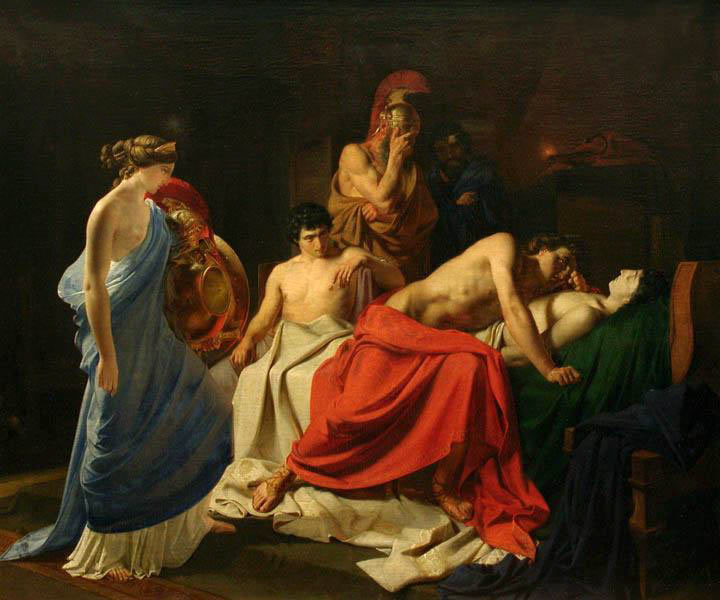
Achilles Lamenting the Death of Patroclus, by Nikolay Ge

Ἰλιὰς κακῶν, id est Ilias malorum. De calamitatibus maximis simul et plurimis. Propterea quod in Iliade Homerica nullum mali genus non recensetur. Vnde ex hac docti putant tragoediarum argumenta fuisse sumpta, sicut ex Odyssea comoediarum. Est autem opus verbosum, viginti quatuor voluminibus vix absolutum. Vnde et quamuis orationem plus satis prolixam Iliade longiorem vocant, vt Aeschines aduersus Demosthenem. Ταῦτα δὲ εἰπὼν δίδωσιν ἀναγνῶναι ψήφισμα τῷ γραμματεῖ, μακρότερον μὲν τῆς Ἰλιάδος, κενώτερον δὲ τῶν λόγων οὓς εἴωθε λέγειν, id est His dictis decretum scribae legendum tradit, prolixius quidem lliade, vanius autem verbis iis quae dicere consueuit.

Eustathius inuertit adagionem ad hunc modum: Καὶ παροιμία μέντοι κακῶν Ἰλιάδα φησίν, αὕτη δὲ καλοῦ παντὸς Ἰλιάς, id est Iliadem malorum prouerbium ait, at haec omnium bonorum llias. Synesius in epistola quadam ad fratrem: Καὶ ὅλως κακῶν ἂν Ἰλιάς περιέστη τὴν πόλιν ἡμῶν, id est In summa,  malorum Ilias circunstetit vrbem nostram. Plutarchus in Praeceptis coniugalibus: Ὁ δὲ ἐκείνων Ἰλιάδα κακῶν Ἕλλησι καὶ βαρβάροις ἐποίησεν, id est At illorum nuptiae Iliada malorum Graecis ac barbaris inuexerunt. Loquitur enim de coniugio Paridis et Helenae, quod inaestimabilium malorum fuit causa. Vtitur et M. Tullius in Epistolis ad Atticum: Tanta malorum impendet Ilias.

Pilfered Poetry

Jean Dorat, Poematia:

Orpheus, Musaeus, and even Homer were all thieves; Hesiod was a thief for thieving the shield of Achilles. What is the shield of Hercules was once the shield of Achilles. Both Hesiod and Homer steal from the Sibyls, and each one decks himself out with the Sibylline verses. But don’t think, just because Greece is always deceuitful, that the Greeks are greater thieves than the Latin poets. Father Ennius himself pilfers from Homer, and for that reason he seemed to himself to be a second Homer.

Image result for jean dorat

Orphaeus, Musaeus, fur et Homerus erant:

Fur erat Hesiodus, clypeum furatus Achillis:

Herculis est, olim tegmen Achillis erat.

Ipsas quinetiam furatur uterque Sibyllas,

Seque Sibyllinis ornat uterque modis,

Neve putes, mendax quia semper Graecia, Graecos

Furaces Latiis vatibus esse magis.

Ennius ipse pater magnum furatur Homerum,

Maeonides alter visus et inde sibi est.

A Reminder: Medical and Philosophical Traditions Consider Women Not Fully Human

Aristotle, Generation of Animals Book 2, 737a

“That [female] substance, even though it possesses all segments of the body in potential, actually exhibits none of them. For it contains those kinds of elements in potential by which the female is distinguished from the male. For just as it happens that at times deformed children come from deformed parents and at times they do not, so too in the same way sometimes female offspring come from females and sometimes they don’t, but males do instead. For the female is like a deformity of the male and menstrual discharge is like semen, but unclean.”

καὶ γὰρ ἐκεῖνο περίττωμα, καὶ πάντα τὰ μόρια ἔχει δυνάμει, ἐνεργείᾳ δ᾿ οὐθέν. καὶ γὰρ τὰ τοιαῦτ᾿ ἔχει μόρια δυνάμει, ᾗ διαφέρει τὸ θῆλυ τοῦ ἄρρενος. ὥσπερ γὰρ καὶ ἐκ πεπηρωμένων ὁτὲ μὲν γίνεται πεπηρωμένα ὁτὲ δ᾿οὔ, οὕτω καὶ ἐκ θήλεος ὁτὲ μὲν θῆλυ ὁτὲ δ᾿ οὔ, ἀλλ᾿ ἄρρεν. τὸ γὰρ θῆλυ ὥσπερ ἄρρεν ἐστὶ πεπηρωμένον, καὶ τὰ καταμήνια σπέρμα, οὐ καθαρὸν δέ

Generation of Animals, Book 4, 767b

“These causes are also of the same. Some [offspring] are born similar to their parents while others are not. Some are similar to their father; others are like their mother, applying both to the body as a whole and to each part. Offspring are more like their parents than their ancestors and more like their ancestors than passersby.

Males are more similar to their father and females are more similar to their mother. But some are not like any of their relatives, but are still akin to human beings while others are like not at all like humans in their appearance, but rather like some monster. For whoever is not like his parents is in some way a monster because nature has in these cases wandered in some way from the essential character. The first beginning of this is when a female was born instead of a male.

But this is necessary by nature since a race of things divided by male and female must be preserved and since the male may at times not be in control because of age or youth or some other reason, it is necessary for species to have female offspring. Monstrosity is not necessary for any reason or specific ends, but it is necessary by probability of accident—since its origin must be considered as residing here.”

Αἱ δ᾿ αὐταὶ αἰτίαι καὶ τοῦ τὰ μὲν ἐοικότα γίνεσθαι τοῖς τεκνώσασι τὰ δὲ μὴ ἐοικότα, καὶ τὰ μὲν πατρὶ τὰ δὲ μητρί, κατά τε ὅλον τὸ σῶμα καὶ κατὰ μόριον ἕκαστον, καὶ μᾶλλον αὐτοῖς ἢ τοῖς προγόνοις, καὶ τούτοις ἢ τοῖς τυχοῦσι, καὶ τὰ μὲν ἄρρενα μᾶλλον τῷ πατρὶ τὰ δὲ θήλεα τῇ μητρί, τὰ δ᾿ οὐδενὶ τῶν συγγενῶν, ὅμως δ᾿ ἀνθρώπῳ γέ τινι, τὰ δ᾿ οὐδ᾿ ἀνθρώπῳ τὴν ἰδέαν ἀλλ᾿ ἤδη τέρατι. καὶ γὰρ ὁ μὴ ἐοικὼς τοῖς γονεῦσιν ἤδη τρόπον τινὰ τέρας ἐστίν· παρεκβέβηκε γὰρ ἡ φύσις ἐν τούτοις ἐκ τοῦ γένους τρόπον τινά. ἀρχὴ δὲ πρώτη τὸ θῆλυ γίνεσθαι καὶ μὴ ἄρρεν. ἀλλ᾿ αὕτη μὲν ἀναγκαία τῇ φύσει, δεῖ γὰρ σώζεσθαι τὸ γένος τῶν κεχωρισμένων κατὰ τὸ θῆλυ καὶ τὸ ἄρρεν· ἐνδεχομένου δὲ μὴ κρατεῖν ποτὲ τὸ ἄρρεν ἢ διὰ νεότητα ἢ γῆρας ἢ δι᾿ ἄλλην τινὰ αἰτίαν τοιαύτην, ἀνάγκη γίνεσθαι θηλυτοκίαν ἐν τοῖς ζῴοις. τὸ δὲ τέρας οὐκ ἀναγκαῖον πρὸς τὴν ἕνεκά του καὶ τὴν τοῦ τέλους αἰτίαν, ἀλλὰ κατὰ συμβεβηκὸς ἀναγκαῖον, ἐπεὶ τήν γ᾿ ἀρχὴν ἐντεῦθεν δεῖ λαμβάνειν.

τέρας: can mean ‘monster’ (as translated here) or divine sign/omen. In cognates and parallel forms it is also associated with magic and the unnatural.

πηρόω (πεπηρωμένον) is a denominative verb from the noun πηρός, which means “infirm, invalid” (hence: “blind or lame”)

Thomson, Rosemarie Garland. 1997. Extraordinary Bodies: Figuring Physical Disability in American Culture and Literature. New York.

19: “Perhaps the founding association of femaleness with disability occurs in the fourth book of Generation of Animals, Aristotle’s discourse of the normal and the abnormal, in which he refines the Platonic concept of antinomies so that bodily variety translates into hierarchies of the typical and aberrant.”

20: “What this passage makes clearest, however, is that without the monstrous body to demarcate the borders of the generic, without the female body to distinguish the shape of the male, and without the pathological to give form to the normal, the taxonomies of bodily value that underlie political, social and economic arrangements would collapse.”

20: “This persistent intertwining of disability with femaleness in Western discourse provides a starting point for exploring the relationship of social identity to the body. As Aristotle’s pronouncement suggests, the social category of disability rests on the significance accorded bodily functioning and configuration.”

Image result for ancient greek women
Ivory Sculpture from the MET


The Pythagorean Women

Diogenes Laertius, Lives of the Philosophers 8.41

“For [Hermippos] says that when Pythagoras was in Italy he built a little home in the ground and told his mother to write down on a tablet what happened and the time and then to send it down to him until he came up again. His mother did that.

Later, when Pythagoras finally came up again he was shriveled and almost a skeleton. After he came to the assembly, he was saying that he came from Hades. Then he read aloud to them what had happened. And they were overwhelmed by what he said, crying and weeping and believing that Pythagoras was divine. They believed it so much that they gave him their wives so that they might learn some of his philosophy from him. They were called Pythagorean Women. Well, that’s what Hermippos says…”

λέγει γὰρ ὡς γενόμενος ἐν Ἰταλίᾳ κατὰ γῆς οἰκίσκον ποιήσαι καὶ τῇ μητρὶ ἐντείλαιτο τὰ γινόμενα εἰς δέλτον γράφειν σημειουμένην καὶ τὸν χρόνον, ἔπειτα καθιέναι αὐτῷ ἔστ’ ἂν ἀνέλθῃ. τοῦτο ποιῆσαι τὴν μητέρα. τὸν δὲ Πυθαγόραν μετὰ χρόνον ἀνελθεῖν ἰσχνὸν καὶ κατεσκελετευμένον· εἰσελθόντα τε εἰς τὴν ἐκκλησίαν φάσκειν ὡς ἀφῖκται ἐξ Ἅιδου· καὶ δὴ καὶ ἀνεγίνωσκεν αὐτοῖς τὰ συμβεβηκότα. οἱ δὲ σαινόμενοι τοῖς λεγομένοις ἐδάκρυόν τε καὶ ᾤμωζον καὶ ἐπίστευον εἶναι τὸν Πυθαγόραν θεῖόν τινα, ὥστε καὶ τὰς γυναῖκας αὐτῷ παραδοῦναι, ὡς καὶ μαθησομένας τι τῶν αὐτοῦ· ἃς καὶ Πυθαγορικὰς κληθῆναι. καὶ ταῦτα μὲν ὁ Ἕρμιππος…


There is another version of this in the Scholia to Sophocles’ Elektra 62-64

“Pythagoras confined himself in an underground hole and told his mother to tell people that he had died. When he reappeared, he told a lot of marvelous tales about resurrection and the things which happen in the underworld, and, to the living he related a full account of all the companions he happened to meet in the underworld; from this arose the belief that he was Aithalides son of Hermes before the Trojan War, then Euphorbus, then Hermotimus, then Pyrrhus the Delian, and then finally Pythagoras. Sophocles seems to be hinting at this story. Some assert, though unpersuasively, that the lines are aimed at Odysseus. But this is unconvincing, because Odysseus never did anything of the sort.”

ἤδη γὰρ εἶδον πολλάκις Πυθαγόρας καθείρξας ἑαυτὸν ἐν ὑπογείῳ λογοποιεῖν ἐκέλευσε τὴν μητέρα ὡς ἄρα τεθνηκὼς εἴη καὶ μετὰ ταῦτα ἐπιφανεὶς περὶ παλιγγενεσίας καὶ τῶν καθ’ ῞Αιδου τινὰ ἐτερατεύετο διηγούμενος πρὸς τοὺς ζῶντας περὶ τῶν οἰκείων οἷς ἐν ῞Αιδου συντετυχηκέναι ἔλεγεν ἐξ ὧν τοιαύτην ἑαυτῷ δόξαν περιέθηκεν ὡς πρὸ μὲν τῶν Τρωικῶν Αἰθαλίδης ὢν ὁ ῾Ερμοῦ, εἶτα Εὔφορβος, εἶτα ῾Ερμότιμος, εἶτα Πύρρος ὁ Δήλιος, εἶτα ἐπὶ πᾶσι Πυθαγόρας· εἰς τοῦτο  οὖν ἔοικεν ἀποτείνεσθαι ὁ Σοφοκλῆς· ἔνιοι δὲ οἴονται ἀπιθάνως εἰς ᾿Οδυσσέα ἀποτείνεσθαι· οὐ γὰρ πέπρακταί τι τοιοῦτον ᾿Οδυσσεῖ·

Diogenes Laertes, Pythagoras 29

“The most famous women Pythagoreans were: Timukha, the wife of Mullias of Kroton, Philtus, the daughter of Theophoris of Kroton amd sister of Bundakos, Okellô and Ekkelô, the sisters of Okkelos and Okkilos of Leukania, Kheilonis, the daughter of the Spartan Kheilôn, Kratêsikleia, a Spartan and wife of Kkleanôr the Spartan, Theano, the wife of Brotinus of Metapontos, Muia, the wife of Milo of Kroton, Lastheneia from Arcadia, Habroteleia the daughter of Habrotelos the Tarentinian, Ekhekrateia from Phlius, Tyrsênis of Sybaris, Pesirrodê of Tarantum, Theadousa the Spartan, Boiô the Argive, Babeluka the Argive, and Kleaikhma the sister of Autokharidas of Laconia. There are seventeen in total.”

[29] Πυθαγορίδες δὲ γυναῖκες αἱ ἐπιφανέσταται· Τιμύχα γυνὴ Μυλλία τοῦ Κροτωνιάτου, Φιλτὺς θυγάτηρ Θεόφριος τοῦ Κροτωνιάτου, Βυνδάκου ἀδελφὴ, Ὀκελλὼ καὶ Ἐκκελὼ <ἀδελφαὶ Ὀκκέλω καὶ Ὀκκίλω>1 τῶν Λευκανῶν, Χειλωνίς θυγάτηρ Χείλωνος τοῦ Λακεδαιμονίου, Κρατησίκλεια Λάκαινα γυνὴ Κλεάνορος τοῦ Λακεδαιμονίου, Θεανὼ γυνὴ τοῦ Μεταποντίνου Βροτίνου, Μυῖα γυνὴ Μίλωνος τοῦ Κροτωνιάτου, Λασθένεια Ἀρκάδισσα, Ἁβροτέλεια Ἁβροτέλους θυγάτηρ τοῦ Ταραντίνου, Ἐχεκράτεια Φλιασία, Τυρσηνὶς Συβαρῖτις, Πεισιρρόδη Ταραντινίς, Θεάδουσα Λάκαινα, Βοιὼ Ἀργεία, Βαβέλυκα Ἀργεία, Κλεαίχμα ἀδελφὴ Αὐτοχαρίδα τοῦ Λάκωνος.

αἱ πᾶσαι ιζʹ.

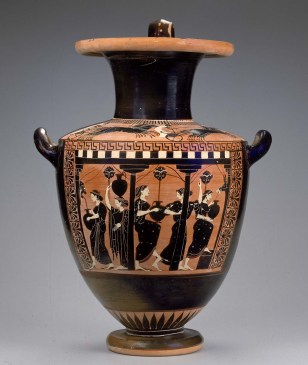
Hydria with Women at a Fountain (MFA Boston)

Odysseus’s Sister and Names for In-Laws

We have posted before about Odysseus’ sister Ktimene. She is mentioned by the swineherd Eumaios but never by Odysseus. The scholia connect her to one of Odysseus’ companions. The evidence for this seems to be the fact that Ktimene was sent to Same for marriage (where Eurylochus is from) and a kinship term used for him by Odysseus. Also of interest, according to the scholion, Odysseus may have had more sisters.

Homer, Odyssey 15.364-41

Strong Ktimenê, the youngest of the children she bore.
I was raised with her, and she honored me little less.
But when we both made it to much-praised youth,
They gave her to Samê and received much in return
But she gave me a cloak, tunic and clothing
Dressing me finely and give me sandals for my feet
And sent me to the field. But she loved me more in her heart.

οὕνεκά μ’ αὐτὴ θρέψεν ἅμα Κτιμένῃ τανυπέπλῳ
θυγατέρ’ ἰφθίμῃ, τὴν ὁπλοτάτην τέκε παίδων·
τῇ ὁμοῦ ἐτρεφόμην, ὀλίγον δέ τί μ’ ἧσσον ἐτίμα.
αὐτὰρ ἐπεί ῥ’ ἥβην πολυήρατον ἱκόμεθ’ ἄμφω,
τὴν μὲν ἔπειτα Σάμηνδ’ ἔδοσαν καὶ μυρί’ ἕλοντο,
αὐτὰρ ἐμὲ χλαῖνάν τε χιτῶνά τε εἵματ’ ἐκείνη
καλὰ μάλ’ ἀμφιέσασα ποσίν θ’ ὑποδήματα δοῦσα
ἀγρόνδε προΐαλλε· φίλει δέ με κηρόθι μᾶλλον.

Schol. BW ad Od. 15.364 ex

“Ktimenê is the proper name of Odysseus’ sister, whom Eurylochus is supposed to have married.”

Κτιμένη] Κτιμένη κυρίως ἐκαλεῖτο ἡ ᾿Οδυσσέως ἀδελφὴ, ἧς
ὁ Εὐρύλοχος ὑπονοεῖται ἀνήρ. λέγει γὰρ “καὶ πηῷ περ ἐόντι μάλα
σχεδόν” (κ, 441.). B.Q.

“She bore the youngest of the children”: [this means] of the female children. For his father only had Odysseus [for a son]. There were more sisters of Odysseus.”

ὁπλοτάτην τέκε παίδων] θηλειῶν γοῦν. μόνον δ’ αὖτ’ ᾿Οδυσσέα πατὴρ τέκε (π, 119.). καὶ πλείους οὖν αἱ ᾿Οδυσσέως ἀδελφαί. Q.

Homer, Odyssey 10.438-442

“So he spoke, and I was turning over in my thoughts
As I began to draw the sharp-edged sword next to my thick thigh,
Whether I should cut off his head and drive him to the ground
Even though he really was my relative. But our companions
Were restraining me with gentle words from all sides.”

ὣς ἔφατ’, αὐτὰρ ἐγώ γε μετὰ φρεσὶ μερμήριξα,
σπασσάμενος τανύηκες ἄορ παχέος παρὰ μηροῦ,
τῷ οἱ ἀποτμήξας κεφαλὴν οὖδάσδε πελάσσαι,
καὶ πηῷ περ ἐόντι μάλα σχεδόν· ἀλλά μ’ ἑταῖροι
μειλιχίοισ’ ἐπέεσσιν ἐρήτυον ἄλλοθεν ἄλλος·

Schol. QVB ad Od 10.441 ex

Q “Instead of the genitive here, “even though he was an in-law”.

V. “Relative”

QV For he married Odysseus’ sister Ktimene.
B “even though he was my brother-in-law by my sister Ktimenê.”

καὶ πηῷ] ἀντὶ τοῦ, καὶ πηοῦ περ ἐόντος. Q. συγγενεῖ. V.
Κτιμένην γὰρ γεγαμήκει τὴν ᾿Οδυσσέως ἀδελφήν. Q.V. γαμβρῷ
μοι ὄντι ἐπὶ τῇ ἀδελφῇ Κτιμένῃ. B.

Suda

“Pêos: A relative by marriage. In-law. Also, “in-lawness” [Pêosunê], relation-by-marriage. There is also Pêôn [genitive plural], for “of relatives-by-marriage. Homer has: “relatives and friends” [Il. 3.163]

Πηός: ὁ κατ’ ἐπιγαμίαν συγγενής. καὶ Πηοσύνη, ἡ συγγαμβρία.
καὶ Πηῶν, τῶν συγγενῶν. ῞Ομηρος· πηούς τε φίλους τε.

Etymologicum Gudianum

“…There is a difference between in-law and friend. People who have no connection to you by birth are friends. In-laws are related to you through marriage.”

διαφέρει δὲ πηὸς φίλου· φίλοι μὲν λέγονται οἱ μηδὲν τῷ γένει προσήκοντες·  πηοὶ δὲ οἱ κατ’ ἐπιγαμίαν συγγενεῖς.

peos

For a beautiful narrative re-imagining of the life of Ktimene, see Mary Ebbot’s “Seeking Odysseus’ Sister”

A Tip on Translating

Aulus Gellius, Attic Nights 9.9:

When remarkable expressions are to be translated or imitated from the Greek, we must not strive to turn all of the words entirely into the mode in which they have been expressed. They quite often lose their grace if they are translated as if against their will or refusing the process. Vergil, therefore, acted knowingly and shrewdly when, working up some passages of Homer or Apollonius or Parthenius or Callimachus or Theocritus or some other poets, he abandoned some part of the work and expressing another. Thus, quite recently at table when the bucolic poems of both Theocritus and Vergil were being read at the same time, we noticed that Vergil abandoned some of the expressions which, although they were marvelously charming in the Greek, neither should nor could have been translated into Latin.

Virgil Reading the Aeneid to Augustus, Octavia, and Livia by Jean-Baptiste Wicar

Quando ex poematis Graecis vertendae imitandaeque sunt insignes sententiae, non semper aiunt enitendum, ut omnia omnino verba in eum, in quem dicta sunt, modum vertamus. Perdunt enim gratiam pleraque, si quasi invita et recusantia violentius transferantur. Scite ergo et considerate Vergilius, cum aut Homeri aut Hesiodi aut Apollonii aut Parthenii aut Callimachi aut Theocriti aut quorundam aliorum locos effingeret, partem reliquit, alia expressit. Sicuti nuperrime aput mensam cum legerentur utraque simul Bucolica Theocriti et Vergilii, animadvertimus reliquisse Vergilium, quod Graecum quidem mire quam suave est, verti autem neque debuit neque potuit.

A Physician’s Notes on the Lives and Deaths of Women

Hippocrates, Epidemics 5.101

 “A woman in Abdera developed cancer on her chest, and bloody plasma leaked out through her nipple. Once the flowing stopped, she died.”

Γυναικί, ἐν Ἀβδήροισι καρκίνωμα ἐγένετο περὶ στῆθος, διὰ τῆς θηλῆς ἔρρει ἰχὼρ ὕφαιμος· ἐπιληφθείσης δὲ τῆς ῥύσιος ἔθανεν.

There is an earlier account of breast cancer in Herodotus:

Herodotus, 3.133

“A little while later following these events, some other things happened. Cyrus’ daughter and Dareios’ wife, Atossa, developed a swelling in her breast. It burst out and expanded. As long as it was rather small, she hid it and told no one because she was ashamed. But when it became worse, she summoned Democedes and showed him. He told her that he could make her  healthy again but had her swear to him that she would reward him with whatever he asked from her, but that he would request nothing which would bring shame on her.”

ἐν χρόνῳ δὲ ὀλίγῳ μετὰ ταῦτα τάδε ἄλλα συνήνεικε γενέσθαι. Ἀτόσσῃ τῇ Κύρου μὲν θυγατρὶ Δαρείου δὲ γυναικὶ ἐπὶ τοῦ μαστοῦ ἔφυ φῦμα, μετὰ δὲ ἐκραγὲν ἐνέμετο πρόσω. ὅσον μὲν δὴ χρόνον ἦν ἔλασσον, ἣ δὲ κρύπτουσα καὶ αἰσχυνομένη ἔφραζε οὐδενί: ἐπείτε δὲ ἐν κακῷ ἦν, μετεπέμψατο τὸν Δημοκήδεα καί οἱ ἐπέδεξε. ὁ δὲ φὰς ὑγιέα ποιήσειν ἐξορκοῖ μιν ἦ μέν οἱ ἀντυπουργήσειν ἐκείνην τοῦτο τὸ ἂν αὐτῆς δεηθῇ: δεήσεσθαι δὲ οὐδενὸς τῶν ὅσα ἐς αἰσχύνην ἐστὶ φέροντα.

This has been called the “earliest account of inflammatory mastitis

Hippocrates of Cos Epidemics 5.25

“In Larissa, Dyseris’ servant, when she was still young, experienced severe pain whenever she had intercourse. But she was without pain otherwise. She was never pregnant. When she was sixty, she started feeling pan at midday as if she were in severe labor pains. Before midday, she had eaten many leeks and when the pain overcame her and was the strongest of all, she rose up and felt something rough-edged near the entrance to her womb. Then, because she had already fainted, another woman inserted her hand and withdrew a stone which was as big as a spindle top and very rough. After that she was immediately healthy.”

Ἐν Λαρίσῃ ἀμφίπολος Δυσήριδος, νέη ἐοῦσα ὁκότε λαγνεύοιτο περιωδύνει ἰσχυρῶς, ἄλλως δὲ ἀνώδυνος ἦν. ἐκύησε δὲ οὐδέποτε. ἑξηκονταέτης γενομένη ὠδυνᾶτο ἀπὸ μέσου ἡμέρης, ὡς ὠδίνουσα ἰσχυρῶς· πρὸ δὲ μέσου ἡμέρης αὕτη πράσα τρώγουσα πολλά, ἐπειδὴ ὀδύνη αὐτὴν ἔλαβεν ἰσχυροτάτη τῶν πρόσθεν, ἀναστᾶσα ἐπέψαυσέ τινος τρηχέος ἐν τῷ στόματι τῆς μήτρης. ἔπειτα, ἤδη λειποψυχούσης αὐτῆς, ἑτέρη γυνὴ καθεῖσα τὴν χεῖρα ἐξεπίεσε λίθον ὅσον σπόνδυλον ἀτράκτου, τρηχύν· καὶ ὑγιὴς τότε αὐτίκα καὶ ἔπειτα ἦν.

5.50

“Nerios’ beautiful virgin daughter was twenty years old when she was struck on the forehead by a flat hand when she was playing with a young woman friend. When it happened, she became blind and out of breath; when she went home, a fever came over her right away. Her head hurt; she was flushed all over her face. By the seventh day, a bad-smelling pus flowed out of her right ear—it was red colored and there was more than a fifth of a cup of it. She seemed to feel better and was relieved. But she was stretched out again later because of a fever. She was feeling badly and was speechless. The right part of her face was contracted and she breathed with difficulty. She also had spasms of trembling. Her tongue stopped working. Her eye was affected. She died on the ninth day.”

Ἡ παρθένος ἡ καλὴ ἡ τοῦ Νερίου ἦν μὲν εἰκοσαέτης, ὑπὸ δὲ γυναίου φίλης παιζούσης πλατέῃ τῇ χειρὶ ἐπλήγη κατὰ τὸ βρέγμα. καὶ τότε μὲν ἐσκοτώθη καὶ ἄπνοος ἐγένετο, καὶ ὅτε ἐς οἶκον ἦλθεν αὐτίκα τὸ πῦρ εἶχε, καὶ ἤλγει τὴν κεφαλήν, καὶ ἔρευθος ἀμφὶ τὸ πρόσωπον ἦν. ἑβδόμῃ ἐούσῃ, ἀμφὶ τὸ οὖς τὸ δεξιὸν πύον ἐχώρησε δυσῶδες, ὑπέρυθρον, πλεῖον κυάθου, καὶ ἔδοξεν ἄμεινον ἔχειν, καὶ ἐκουφίσθη. πάλιν ἐπετείνετο τῷ πυρετῷ, καὶ κατεφέρετο, καὶ ἄναυδος ἦν, καὶ τοῦ προσώπου τὸ δεξιὸν μέρος εἵλκετο, καὶ δύσπνοος ἦν, καὶ σπασμὸς τρομώδης ἦν. καὶ γλῶσσα εἴχετο, ὀφθαλμὸς καταπλήξ· ἐνάτῃ ἔθανεν.

Image result for medieval manuscript medicine women
Wellcome Library, London, MS 49, Apocalypse

Achilles’ (Missing) Sister

Reading over Merkelbach and West’s Fragmenta Hesiodea often reminds me of many things I have forgotten. I am too young to blame this forgetfulness on senility; and yet too old to blame it on youthful ignorance.

Today’s particular disturbance comes from fragment 213 which tells us that Achilles, like Odysseus, has a sister (fragment included within the scholia below).

At first, I thought that this was some sort of Lykophrontic fantasy. But, alas, upon looking into the details, she is actually mentioned in the Iliad!

Iliad, 16.173-178

“Menestheus of the dancing-breastplate led one contingent,
son of the swift-flowing river Sperkheios
whom the daughter of Peleus, beautiful Poludôrê bore
when she shared the bed with the indomitable river-god, Sperkheios
although by reputation he was the son of Boros, the son of Periêrês
who wooed her openly by offering countless gifts.”

τῆς μὲν ἰῆς στιχὸς ἦρχε Μενέσθιος αἰολοθώρηξ
υἱὸς Σπερχειοῖο διιπετέος ποταμοῖο·
ὃν τέκε Πηλῆος θυγάτηρ καλὴ Πολυδώρη
Σπερχειῷ ἀκάμαντι γυνὴ θεῷ εὐνηθεῖσα,
αὐτὰρ ἐπίκλησιν Βώρῳ Περιήρεος υἷι,
ὅς ῥ’ ἀναφανδὸν ὄπυιε πορὼν ἀπερείσια ἕδνα.

The confusion, shock and horror of this detail—which I presume the vast majority of Homer’s audiences have overlooked or forgotten as with the sad fate of Odysseus’ sister—can be felt as well in the various reactions of the Scholia where we encounter (a) denial—it was a different Peleus!; (b) sophomoric prevarication—why doesn’t Achilles talk about her, hmmm?; (c) conditional acceptance through anachronistic assumptions—she’s suppressed because it is shameful that she is a bastard; (d) and, finally, citation of hoary authorities to insist upon a ‘truth’ unambiguous in the poem.

I have translated the major scholia below. Note that we can see where the ‘fragments’ of several authors come from here (hint: they’re just talked about by the scholiasts). We can also learn a bit about the pluralistic and contradictory voices to be found in the Homeric scholia. The bastard child bit is my favorite part.


Schol A. ad Il. 16.175

“Pherecydes says that Polydora was the sister of Achilles. There is no way that this has been established in Homer. It is more credible that this is just the same name, as in other situations, since [the poet] would have added some sign of kinship with Achilles.”

ὃν τέκε Πηλῆος θυγάτηρ: ὅτι Φερεκύδης (Fr. 61-62) τὴν Πολυδώραν φησὶν ἀδελφὴν ᾿Αχιλλέως. οὐκ ἔστι δὲ καθ’ ῞Ομηρον διαβεβαιώσασθαι. πιθανώτερον οὖν ὁμωνυμίαν εἶναι, ὥσπερ καὶ ἐπ’ ἄλλων, ἐπεὶ προσέθηκεν ἂν τεκμήριον τῆς πρὸς ᾿Αχιλλέα συγγενείας.


Schol T. ad Il. 16.175

”  “Daughter of Peleus”: A different Peleus, for if he were a nephew of Achilles, this would be mentioned in Hades when they speak about his father and son or in the allegory of the Litai when he says “a great spirit compelled me there” or “my possessions and serving women” he might mention the pleasure of having a sister. The poet does not recognize that Peleus encountered some other woman. Neoteles says that Achilles’ cousin leads the first contingent and gives evidence of knowledge of war. And he gave countless gifts to marry the sister of Achilles. Should he not mentioned her in Hades? Odysseus does not mention Ktimene [his sister].

Pherecydes says that [Polydore] was born from Antigonê, the daughter of Eurytion; the Suda says her mother was Laodameia the daughter of Alkmaion; Staphulos says she was Eurudikê the daughter of Aktôr. Zenodotos says the daughter’s name was Kleodôrê; Hesiod and everyone else calls her Poludôrê.”

ex. Πηλῆος θυγάτηρ: ἑτέρου Πηλέως· εἰ γὰρ ἦν ἀδελφιδοῦς ᾿Αχιλλέως, καὶ ἐμνήσθη αὐτοῦ ἐν τῷ ῞Αιδῃ περὶ τοῦ πατρὸς καὶ τοῦ υἱοῦ ἐρωτῶν (cf. λ 494—537), καὶ ἐν ταῖς Λιταῖς, φάσκων „ἔνθα δέ μοι μάλα <πολλὸν> ἐπέσσυτο θυμός” (Ι 398), „κτῆσιν ἐμὴν δμῶάς τε” (Τ 333), ἔφασκεν ἂν καὶ τῆς ἀδελφῆς ἀπόλαυσιν. Πηλέα τε οὐκ οἶδεν ὁ ποιητὴς ἑτέρᾳ γυναικὶ συνελθόντα. Νεοτέλης δὲ ὡς ἀδελφιδοῦν᾿Αχιλλέως φησὶ τῆς πρώτης τάξεως ἡγεῖσθαι, ὡς καὶ μαρτυρεῖ ἐπιστήμην πολέμου· †ὡς ἀχιλλέως τε ἀδελφὴν γαμεῖν† ἀπερείσια δίδωσιν ἕδνα (cf. Π 178). εἰ δὲ μὴ ἐμνήσθη αὐτῆς ἐν ῞Αιδου· οὐδὲ γὰρ ᾿Οδυσσεὺς Κτιμένης (cf. ο 363 cum λ 174—9). Φερεκύδης (FGrHist 3, 61 b) δὲ ἐξ ᾿Αντιγόνης τῆς Εὐρυτίωνος, Σουίδας (FGrHist 602, 8) ἐκ Λαοδαμείας τῆς ᾿Αλκμαίωνος, Στάφυλος (FGrHist 269,5) ἐξ Εὐρυδίκης τῆς῎Ακτορος. Ζηνόδοτος (FGrHist 19,5) δὲ Κλεοδώρην φησίν, ῾Ησιόδου (fr. 213 M.—W.) καὶ τῶν ἄλλων Πολυδώρην αὐτὴν καλούντων.

Schol. BCE ad Il. 16.175

“They say that she is from another Peleus. For if he were a nephew of Achilles wouldn’t this be mentioned or wouldn’t he ask about his sister in Hades along with his father and son? At the same time, the poet does not know that Peleus encountered some other women. More recent poets say that Menestheus is his nephew and that this is the reason he leads the first contingent and shows knowledge of war and that ‘he gave countless gifts to marry the sister of Achilles’. But if he does not mention it, it is not necessarily foreign to him. For the poet is rather sensitive to certain proprieties.”

ἑτέρου, φασί, Πηλέως· εἰ γὰρ ἦν ἀδελφιδοῦς ᾿Αχιλλέως, πῶς οὐκ ἐμνήσθη αὐτοῦ ἢ τῆς ἀδελφῆς ἐν τῷ ῞Αιδῃ περὶ τοῦ πατρὸς ἐρωτῶν καὶ τοῦ υἱοῦ; ἅμα τε οὐκ οἶδεν ὁ ποιητὴς Πηλέα ἑτέρᾳ συνελθόντα γυναικί. οἱ δὲ νεώτεροι ἀδελφιδοῦν αὐτοῦ λέγουσιν· ὅθεν καὶ τῆς πρώτης τάξεως ἡγεῖται καὶ πολέμων ἐπιστήμων μαρτυρεῖται, καὶ ὡς †ἀχιλλέως ἀδελφὴν γαμῶν ἀπερείσια δίδωσιν. εἰ δὲ μὴ ἐμνήσθη αὐτῆς ἢ τούτου, οὐ ξένον· περὶ γὰρ τῶν καιριωτέρων αὐτῷ ἡ φροντίς.

Schol. b ad Il. 16.175

“Since, otherwise, if Polydora were his sister, she would be a bastard and he would not want to mention her. Or, maybe it is because she has already died.”

ἄλλως τε ἐπειδὴ νόθη ἦν ἡ Πολυδώρη αὐτοῦ ἀδελφή, τάχα οὐδὲ μνημονεύειν αὐτῆς ἐβουλήθη. ἢ ὅτι καὶ αὐτὴ ἤδη τετελευτηκυῖα ἦν.

Schol D ad Il. 16.175

“Did Peleus have a daughter Polydôrê from another? Staphulos says in the third book of his Thessalika that she was born from Eurydike the daughter of Aktôr. Pherecydes says it was the daughter of Eurytion; others says Laodameia, the daughter of Alkmaion.”

ἐκ τίνος Πηλεὺς Πολυδώρην ἔσχεν; ὡς μὲν Στάφυλός φησιν ἐν τῇ τρίτῃ Θεσσαλικῶν, ἐξ Εὐρυδίκης τῆς ῎Ακτορος θυγατρός. Φερεκύδης δὲ ἐξ ᾿Αντιγόνης τῆς Εὐρυτίωνος, ἄλλοι δὲ ἐκ Λαοδαμείας τῆς ᾿Αλκμαίωνος.

What happened to Peleus’ first wife—if they were married? According to John Tzetzes (see Fowler 2013, 444) Peleus accidentally killed his father-in-law during the Kalydonian Boar Hunt, so he had to go abroad and in Iolkos the king’s wife tried to seduce him and told Antigone that Peleus would abandon her. Antigone killed herself, leaving Peleus free to marry Thetis. (But who took care of their daughter?).

It can get more confusing: some traditions (Apollodorus, 3.163 and 168) make a Polymele the daughter of Peleus and Patroklos’ mother whereas Polydora is Peleus’ wife in between Antigone and Thetis. Whatever the case, we can do our own scholiastic justification for Achilles not talking about his sister without creating a second Peleus. She must have been a bit older than Achilles since by all accounts Peleus fathered her before (1) the Kalydonian Boar Hunt, (2) the sacking of Iolkos and (3) the Voyage of the Argo. She would likely have been raised in a separate household from Achilles and married off before he went to study with the centaur Cheiron!

(More importantly: In the poetic world of Homer, sisters just don’t matter. Brothers do. Helen does not mention missing her sisters. Hektor talks to multiple brothers, but where are his sisters? In the Odyssey, Achilles asks about his father and son because Odysseus is interested in fathers and sons. This may make it more, not less, appropriate that Achilles says nothing of his sister: Odysseus just doesn’t care about sisters. Nor, it seems, does Homer.)

Works Consulted (apart from the Greek Texts).

Timothy Gantz. Early Greek Myth. Baltimore, 1993.
Robert Fowler. Early Greek Mythography. Vol. 2:Commentary, 2013.

Image result for ancient greek achilles