Bolt and bar the shutter,
For the foul winds blow:
Our minds are at their best this night,
And I seem to know
That everything outside us is
Mad as the mist and snow.
Horace there by Homer stands,
Plato stands below,
And here is Tully’s open page.
How many years ago
Were you and I unlettered lads
Mad as the mist and snow?
You ask what makes me sigh, old friend,
What makes me shudder so?
I shudder and I sigh to think
That even Cicero
And many-minded Homer were
Mad as the mist and snow.
Dionysius of Halicarnassus, Roman Antiquities (1.36)
There is another story told by the inhabitants, that before the reign of Zeus, Kronos ruled in that land, and the period of life named after him was fruitful in all of the things which the seasons produce, and that it was fruitful for no one more than themselves. If anyone wished to take away the mythical part of this story and examine closely the excellence of the land, from which the race of humans has harvested so much of the greatest happiness born immediately either (as the old story has it) from the earth or otherwise, they would not find any land more suitable than this.
For, to compare one land with another as great in size, not only in Europe but in all the world, it seems to me that Italy is the greatest of all. Indeed, it does not escape me that I might seem to relate some things which are incredible to many people, when they set their spirits on Egypt, Libya, Babylon, and any other lands which may be blessed in their way. But I do not place the wealth of the earth in one type of produce, nor am I possessed of a desire for a life in which there are only fertile fields but little or nothing of other useful things; rather, I consider as the best the land which is most self-sufficient and for the most part in little need of imported goods, and I am persuaded that Italy is the land beyond all other lands in its abundant fertility and beneficence.
“It is also necessary for a woman to take to heart that she will find no kind of purifying remedy for this mistake [adultery], something that would allow her to approach the temples and altars of the gods as a chaste and god-loved woman. This is because in this crime especially the divine spirit is most unforgiving. The most beautiful achievement of a free woman and the foremost glory is to provide as testimony to her prudence toward her husband her children, if they do in fact bear the imprint of similarity to the father who sowed them. That seems to me to be enough regarding marriage.
The following seems to be right to me when it comes to the management of the body. A woman should wear white, but be dressed simply and without decoration. This style of dressing is achieved without transparent or decorated robes or robes which are made from silk; instead a woman should wear modest and white clothing. She preferably also avoids luxury and ostentation and will not cause vile jealousy in other women. She should also not put on gold or emeralds at all—this behavior would make her seem wealthy and haughty to common women.
It is necessary that the well-governed city which is ordered completely with a view to its whole should be one of common experiences and likemindedness. And it should keep out the craftspeople who create these sorts of baubles from its territory. A prudent woman should not embellish her appearance with foreign decoration and makeup but should use the native beauty of the body—she should decorate her body by washing it in water rather than bringing it shame. For this brings honor to herself and the man she lives with.
Women need to make processions from their homes to make sacrifices to the leading-god of the city for themselves, their husbands, and their households. They must make their expedition to the theater or to the market for household goods, however, not when the evening star is rising nor when it is dark but whenever it is still light, accompanied by a single servant or, at most, two as is proper.
In addition, a prudent woman must also perform sacrificial rites for the gods as is permitted to her, but must abstain from the occult rites and rituals of the Great Mother at home. For the common law prohibits women from performing these rituals, since, in addition to other things, these practices make them drunk and insane. The woman of the home needs to be temperate and uncontaminated by everything, even when she is governing the home.”
Galen, Commentary on Hippocrates’ Epidemics (3.2):
“Here is a small example of what Ptolemy Euergetes did to the Athenians, showing how eager he was for the acquisition of ancient books. He gave them a security of fifteen talents of silver in exchange for borrowing the official copies of Sophocles, Euripides, and Aeschylus for the sake of making copies of them and returning them intact to the Athenians. He had copies worked up in exceedingly fine fashion on the most beautiful papyrus, and then kept the copies which the Athenians had sent him, while sending to them the finely-wrought copies and saying that they could keep the fifteen talents and take the new copies in exchange for the old ones. Even if Ptolemy had not sent them the new books, the Athenians could do nothing since they had taken the silver on the understanding that they could keep it if Ptolemy did not return the books. And so, they took the new copies and held on to the silver.”
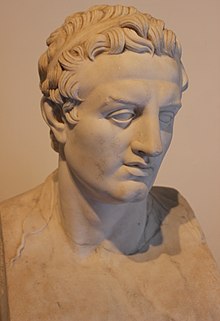
Bust of Ptolemy III Euergetes from Museo Archeologico Nazionale, Naples
“There are those who accumulate books not from eagerness to use them, but from the desire to have them, and they possess them not as a bulwark to their minds, but as an ornament for their bedrooms. And so, passing over the others, Julius Caesar and Augustus both concerned themselves with a Roman library. For such an important task, one of them put Marcus Varro in charge of the library, and this is with all respect to Demetrius of Phalerum, who had the greatest name among the Egyptians for his librarianship; but Varro is in no way inferior to Demetrius – in fact, he is far superior. Pompeius Macer, himself an eminently learned man, was put in charge of the library by the other. Asinius Pollio, the most illustrious orator, burned with enthusiasm for a library of Greek and Latin literature, and is said to have opened the first one for the public in Rome.
But those are private things. Cato’s appetite for books was insatiable, a fact of which Cicero is a witness, and even Cicero was possessed of an ardor for purchasing books, which is attested by many of his letters to Atticus, on whom he imposed the task of purchasing them, driving him on with the greatest insistence and all the power of entreaty, as I now do to you. Indeed, if a rich reader is permitted to beg for patronage in the way of books, what do you think is permitted to the poor reader?”
Sunt enim qui libros, ut cetera, non utendi studio cumulent, sed habendi libidine, neque tam ut ingenii presidium, quam ut thalami ornamentum. Atque, ut reliquos sileam, fuit romane bibliothece cura divis imperatoribus Iulio Cesari et Cesari Augusto; tanteque rei prefectus ab altero — pace Demetrii Phalerii dixerim, qui in hac re clarum apud Egiptios nomen habet — nichil inferior, ne dicam longe superior, Marcus Varro; ab altero Pompeius Macer, vir et ipse doctissimus. Summo quoque grece latineque bibliothece studio flagravit Asinius Pollio orator clarissimus, qui primus hanc Rome publicasse traditur.
Illa enim privata sunt: Catonis insatiabilis librorum fames, cuius Cicero testis est, ipsiusque Ciceronis ardor ad inquirendos libros, quem multe testantur epystole ad Athicum, cui eam curam non segnius imponit, agens summa instantia multaque precum vi, quam ego nunc tibi. Quodsi opulentissimo ingenio permittitur librorum patrocinia mendicare, quid putas licere inopi?
“You write to me that Cicero is amazed that I say nothing about his deeds. Since you are hassling me, I will write you what I think thanks to your coaxing.
I know that Cicero has done everything with the best intention. What could be more proved to me than his love for the republic? But certain things seem to me, what can I say, that the most prudent man has acted as if inexperienced or ambitiously, this man who was not reluctant to take on Antony as an enemy when he was strongest?
I don’t know what to write to you except a single thing: the boy’s desire and weakness have been increased rather than repressed by Cicero and that he grinds on so far in his indulgence that he does not refrain from invectives that rebound in two ways. For he too has killed many and he must admit that he is an assassin before what he objects to Casca—in which case he acts the part of Bestia to Casca—
Or because we are not tossing about every hour the Ides of March the way he always has the Nones of December in his mouth, will Cicero find fault in the most noble deed from a better vantage point than Bestia and Clodius were accustomed to insult his consulship?
Our toga-clad friend Cicero brags that he has stood up to Antony’s war. How does it profit me if the cost of Antony defeated is the resumption of Antony’s place? Or if our avenger of this evil has turned out to be the author of another—an evil which has a foundation and deeper roots, even if we concede <whether it is true or not> those things which he does come from the fact that he either fears tyranny or Antony as a tyrant?
But I don’t have gratitude for anyone who does not protest the situation itself provided only that he serves one who is not raging at him. Triumphs, stipends, encouragement with every kind of degree so that it does not shame him to desire the fortune of the man whose name he has taken—is that a mark of a Consular man, of a Cicero?
1Scribis mihi mirari Ciceronem quod nihil significem umquam de suis actis; quoniam me flagitas, coactu tuo scribam quae sentio.
Omnia fecisse Ciceronem optimo animo scio. quid enim mihi exploratius esse potest quam illius animus in rem publicam? sed quaedam mihi videtur—quid dicam? imperite vir omnium prudentissimus an ambitiose fecisse, qui valentissimum Antonium suscipere pro re publica non dubitarit inimicum? nescio quid scribam tibi nisi unum: pueri et cupiditatem et licentiam potius esse irritatam quam repressam a Cicerone, tantumque eum tribuere huic indulgentiae ut se maledictis non abstineat iis quidem quae in ipsum dupliciter recidunt, quod et pluris occidit uno seque prius oportet fateatur sicarium quam obiciat Cascae quod obicit et imitetur in Casca Bestiam. an quia non omnibus horis iactamus Idus Martias similiter atque ille Nonas Decembris suas in ore habet, eo meliore condicione Cicero pulcherrimum factum vituperabit quam Bestia et Clodius reprehendere illius consulatum soliti sunt?
Sustinuisse mihi gloriatur bellum Antoni togatus Cicero noster. quid hoc mihi prodest, si merces Antoni oppressi poscitur in Antoni locum successio et si vindex illius mali auctor exstitit alterius fundamentum et radices habituri altiores, si patiamur, ut iam <dubium sit utrum>ista quae facit dominationem an dominum [an] Antonium timentis sint? ego autem gratiam non habeo si quis, dum ne irato serviat, rem ipsam non deprecatur. immo triumphus et stipendium et omnibus decretis hortatio ne eius pudeat concupiscere fortunam cuius nomen susceperit, consularis aut Ciceronis est?
“How I wish that you had invited me to that most sumptuous feast on the Ides of March! We would now have no little scraps if you had. But now you have with them such difficulty in preventing that divine benefit which you bestowed upon the Republic from exciting some complaint. But, though it is hardly right, I am on occasion angry with you, because it was by you – a noble man indeed – it was by you and by your good service that this pest [Marc Antony] was led away and still lives. Now you have left behind more trouble for me alone than for everyone else.”
Quam vellem ad illas pulcherrimas epulas me Idibus Martiis invitasses! reliquiarum nihil haberemus. at nunc cum iis tantum negoti est ut vestrum illud divinum <in> rem publicam beneficium non nullam habeat querelam. quod vero a te, viro optimo, seductus est tuoque beneficio adhuc vivit haec pestis, interdum, quod mihi vix fas est, tibi subirascor; mihi enim negoti plus reliquisti uni quam praeter me omnibus.
“But should all these things befall us, the Ides of March may console. Our heroes too accomplished most gloriously and magnificently everything it was in their power to do. For the rest, we need money and troops, neither of which we have.”
Sed omnia licet concurrant, Idus Martiae consolantur. nostri autem ἥρωες quod per ipsos confici potuit gloriosissime et magnificentissime confecerunt; reliquae res opes et copias desiderant, quas nullas habemus
Cicero, Letters to Brutus I.15 (23) 14 July 43
“Therefore, come here, by the gods, as fast as possible; Convince yourself that it would do your country no greater good if you come quickly than you did on the Ides of March when you freed your fellow citizens from slavery.”
subveni igitur, per deos, idque quam primum, tibique persuade non te Idibus Martiis, quibus servitutem a tuis civibus depulisti, plus profuisse patriae quam, si mature veneris, profuturum.
Cicero, Letters to Brutus, 1.15 (23) July 43
“After the death of Caesar and your unforgettable Ides of March, Brutus, you will not have lost sight of the the fact that I said that one thing was overlooked by you—how much a storm loomed over the Republic. The greatest disease was warded off thanks to you—a great blight was cleansed from the Roman people—and you won immortal fame for your part. But the mechanism of monarchy fell then to Lepidus and Antonius—one of whom is more erratic, while the other is rather unclean—both fearing peace and ill-fit to idle time.”
Post interitum Caesaris et vestras memorabilis Idus Martias, Brute, quid ego praetermissum a vobis quantamque impendere rei publicae tempestatem dixerim non es oblitus. magna pestis erat depulsa per vos, magna populi Romani macula deleta, vobis vero parta divina gloria, sed instrumentum regni delatum ad Lepidum et Antonium, quorum alter inconstantior, alter impurior, uterque pacem metuens, inimicus otio.
The death of Julius Caesar in the Roman Senate by Vincenzo Camuccini
Dionysius of Halicarnassus, Roman Antiquities 1.20:
They made a treaty with the Pelasgians and, separating their lands, gave to them the areas around the sacred lake, in which most of the area was marsh, and which are now called in accordance with the old turn of dialect is called Velia. It was the custom among the ancient Greeks in many cases to place the syllable ‘ou’, written in one letter, before words which began with vowels. This was like a gamma with two horizontal lines yoked onto one upright one, as in Ϝελένη, Ϝάναξ, Ϝοῖκος, Ϝαὴρ and many other words of this sort.