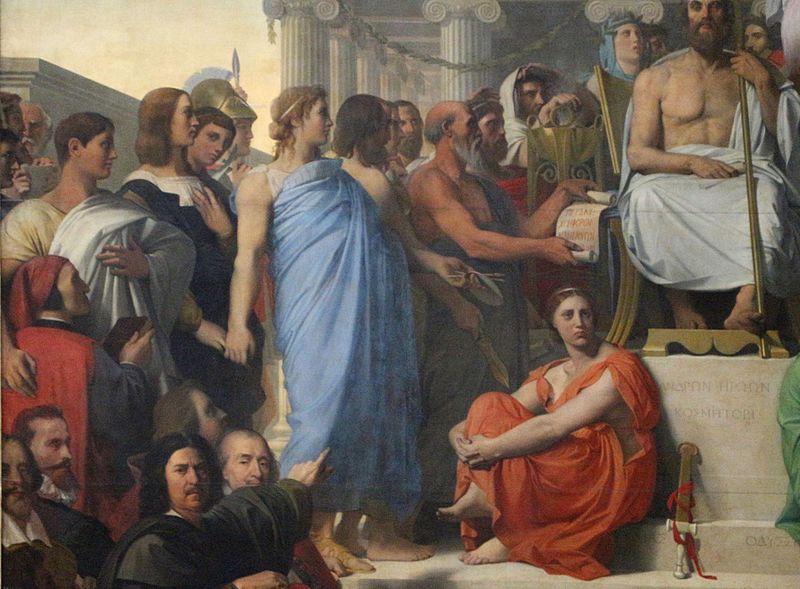
Scott and Liddell had been appointed by the Dean to the post of Sub-Librarian, and had thus access to the splendid collection of books, pictures, and engravings contained in the College Library. In making the appointment Gaisford advised Liddell to make himself well acquainted with the contents of the Library, referring with gusto to the motto which he had seen over Bishop Cosin’s library at Durham: Nosse bonos libros non minima pars est bonae eruditionis.* This phrase Liddell used in after-days to quote when himself appointing students to the same honourable post.
* (To know good books is not the least part of sound erudition.)
“We would not rightly say that an ox or a horse or any other animal is happy. For it is not possible for any of these to have a common share of ennobling work. This is the reason a child is not happy—they are not yet capable of ennobling actions because of their age. When children are called this, they are being blessed because of their hope for future nobility. There is a need yet, as we said, for complete excellence and a full lifetime.
There are certainly many changes and fortunes of every sort throughout life. It is possible for someone who is extremely fortunate to meet great troubles in old age, just as the story is told about Priam in the heroic epics. No one considers someone who faces these kinds of misfortunes and then dies terribly happy.
But if we then believe that no human being should be considered happy while they live, according to that Solonic saying, “look to the end”—if indeed it must mean this—is it really the case that a person is happy when they’re dead? Well, that would be really strange, right, for us to say others size that this is a kind of obvious happiness? Unless we mean that that dead person is happy, not in the way that Solon wants, but that someone can only say that someone is happy safely when he is out of the way of evils and misfortune.
Even this interpretation has some controversy. For then evil and good seem to be possible for the dead, even as it is for the living even when they do not perceive it, as in the case of honors, and dishonors or the noble or ignoble deeds of children and all of their descendants.
These things are a problem too. For it is possible that someone has lived a rather blessed life up to old age and died in the same way, he could still experience many troubles because of his descendants—some of whom are good and received a life worthy of this, and others who were opposite. It is clear that it is possible for them to be different in every way from their forebears. It would be strange if the dead man would change along with them and become wretched when he was blessed before. But it would also be strange if the affairs of descendants had no impact on their ancestors at all.”
Each week we select scenes from a play, actors and experts from around the world, and put them all together for 90 minutes or so to see what will happen. This process is therapeutic for us; and it helps us think about how tragedy may have had similar functions in the ancient world as well
Euripides, Trojan Women, 95-98
“Any mortal fool enough to sack cites,
Their temples, shrines and the graves of those they killed,
Dies later on in self-made isolation.”
For obvious reasons of context, then, Euripides’ Trojan Women is often read as a response to the same forces arguing that might makes right in Thucydides’ famous Melian dialogue. For me, the outcome of the Melian decision, that a democratic people voted to destroy an allied city, kill all the men, and enslave all the women and children for the crime of resisting their power, stands with Odysseus’ hanging of the enslaved women in the Odyssey and Achilles’ sacrifice of Trojan youths over Patroclus’ funeral pyre as horrors transmitted by the ancient world that we have all too often minimized or ignored altogether in our reception of the past.
“Listen how it is with Hektor’s mournful tale:
He died, leaving a reputation as the best man.
The coming of the Greeks made this happen.
If they had stayed home, his value would have stayed hidden.”
Upcoming Readings (Wednesdays at 3PM EDT, Unless otherwise noted; the project page))
Sophocles, Ajax, May 29th
Euripides, Andromache, June 3rd
Sophocles, Oedipus Tyrannos, June 10th
Euripides, Ion, June 17th[10 AM EDT/3PM GMT]
Euripides, Hecuba, June 24th
Aeschylus, Prometheus Bound, July 1st
1203-1206
“Any mortal is a fool who takes some pleasure
From imagining their good luck is safe: in its turns
Fortune’s like a crazed person leaping this way one day
And then another, no one ever keeps the same good luck.”
“Creep, who looks upon Latin words with sad eyes,
Read by Augustus Caesar these six dirty lines:*
‘Because Antony fucks Glaphyra, Fulvia has assigned
This penality as mine: I need to fuck Fulvia too.
I should fuck Fulvia? What if Manius would beg
That I sodomize him? Would I? Probably not, if I were wise.
“But fuck, or let us fight” she says. But what—is my life
dearer than my dick?** Let the war-trumpets sound.’
Augustus, you endorse these charming little books for me
Since you know how to speak with such Roman honesty.”
Caesaris Augusti lascivos, livide, versus
sex lege, qui tristis verba Latina legis:
‘quod futuit Glaphyran Antonius, hanc mihi poenam
Fulvia constituit, se quoque uti futuam.
Fulviam ego ut futuam? quid si me Manius oret
pedicem? faciam? non puto, si sapiam.
“aut futue; aut pugnemus” ait. quid quod mihi vita
carior est ipsa mentula? signa canant!’
absolvis lepidos nimirum, Auguste, libellos,
qui scis Romana simplicitate loqui.
*There is doubt whether or not Augustus composed these lines. If he did, then, as the speculation goes, someone published them in a collection of Principis Epigrammata.
**I reversed the Latin sense of vita (in the ablative) and mentula (nominative) for what feels to me like a more natural expression in English.
While we are on (a) topic, here are some useful principal parts in Latin and Greek.
“I have many other reasons to hope for the outcome if you are willing not to grow your empire by warring more and not to add dangers of your own choosing. For I am much more afraid of our own mistakes than our enemies’ plans.
But these are topics which will be explained in another speech on those matters. For now, let use send them away with these answers, that we will allow the Megarians to use our marketplace and harbors provided that the Spartans do not continue their foreign actions against us or our allies—for nothing stops this action or that one in the treaties we have. In addition, we will leave cities independent if they were independent when we came into contact with them and when those cities did not give in to them, they should be independent too, as each of them desires.
Add as well that we are willing to submit to judgments according to the treaties and we will not begin the war, although we will defend against those who do start it. These answers are just and proper answers for the city. You need to understand that we must go to war—but if we welcome it willingly, we will have less enthusiastic opponents.
Remember also that the greatest honors come both in private and public from the greatest dangers. Didn’t our fathers stand up against the Medes even though they started from so unequal a position? And when they left everything they had behind, they fought off the barbarian with greater intelligence than luck and greater daring than power and raised our state to what it is today. For this reason, we must not fall back, but we must defend against our enemies in every way and strive to give to our descendants a state no weaker at all.”
Do you see how in Homer, Nestor talks about his own virtues all the time? He was looking upon his third generation of people, and he did not need to fear, in speaking the truth about himself, that he would seem either insolent or garrulous. Indeed, as Homer says, from his lips the speech flowed sweeter than honey, for which sweetness he was in need of no bodily strength. That famous king of Greece at no point wished to have ten men similar to Ajax, but he did wish for ten like Nestor; and he did not doubt that if he got them, Troy would fall to ruin in a brief space.
Videtisne, ut apud Homerum saepissime Nestor de virtutibus suis praedicet? Tertiam iam enim aetatem hominum videbat, nec erat ei verendum ne vera praedicans de se nimis videretur aut insolens aut loquax. Etenim, ut ait Homerus, ‘ex eius lingua melle dulcior fluebat oratio,’ quam ad suavitatem nullis egebat corporis viribus. Et tamen dux ille Graeciae nusquam optat, ut Aiacis similes habeat decem, sed ut Nestoris; quod si sibi acciderit, non dubitat, quin brevi sit Troia peritura.
In honor of the correct outcome, here’s how they all died, according to tradition.
Valerius Maximus, Memorable Words and Deeds 9.12
“Aeschylus did not meet a willing death, but it is worth mentioning because of its novelty. As he was leaving the walls where he was staying in Italy, he stopped in a sunny spot. An eagle who was flying above him carrying a tortoise was tricked by his shining skull—for he had no hair—and it dropped it on him as if he were a stone so that it might eat the flesh from the broken shell. By that strike, the origin and font of a better type of tragedy was extinct.”
[….]
“But Euripides’ death was a bit more savage. As he was returning from dinner with Archelaus to the place where he was staying in Macedonia, he died, lacerated by the bites of dogs. Such a genius did not merit this cruel fate.”
[…]
“When Sophocles was extremely old, and he had entered a tragedy competition, he was agitated for too long over the uncertain outcome of the vote, but when he was the winner by a single vote, his joy was the cause of his death.”
Aeschyli vero poetae excessus quem ad modum non voluntarius sic propter novitatem casus referendus. in Sicilia moenibus urbis, in qua morabatur, egressus aprico in loco resedit. super quem aquila testudinem ferens elusa splendore capitis—erat enim capillis vacuum—perinde atque lapidi eam illisit, ut fractae carne vesceretur, eoque ictu origo et principium <per>fectioris tragoediae exstinctum est.
Sed atrocius aliquanto Euripides finitus est: ab Archelai enim regis cena in Macedonia domum hospitalem repetens, canum morsibus laniatus obiit: crudelitas fati tanto ingenio non debita.
Sophocles ultimae iam senectutis, cum in certamen tragoediam demisisset, ancipiti sententiarum eventu diu sollicitus, aliquando tamen una sententia victor causam mortis gaudium habuit.
Some lines from the Gnomologium Vaticanum
404
“When Menander was asked what the difference was between Sophokles and Euripides he said that Sophokles makes people feel pleasure while Euripides makes his audience feel anger.”
“When he was asked why he made people with noble characters and Euripides made those of base ones, Sophokles answered “Because I make people how they should be and he makes people as they are.”
“Celsus Albinovanus: Hello! I hope this finds you well.
Muse, take this message to Nero’s friend and secretary,
Should he ask how I’m doing, tell him that even though I threatened
Many fine things, I don’t live rightly or pleasantly.
And this isn’t because hail ruined my vines or heat shrank my olives
Or because my flock is getting sick in a far-away field.
No, it’s that my mind is less well than any part of my body.
I don’t want to listen or learn about anything that relieves the disease.
I start fights with doctors; I fly into a rage with friends
Over why they want to get me out of this deadly funk.
I keep stalking what hurt me, I avoid anything I suspect will help.
I flit back and forth, wanting the Tibur in Rome and in Rome the Tibur.
After that, ask him if he’s well, how he and his stuff are,
How his standing is with the young man and his crew.
If he says “well”, first, rejoice! But then
Leave this reminder in his little ears:
“As you bear fortune, Celsus, we’ll bear you.”
Celso gaudere et bene rem gerere Albinovano
Musa rogata refer, comiti scribaeque Neronis.
si quaeret quid agam, dic multa et pulchra minantem
vivere nec recte nec suaviter; haud quia grando
contuderit vitis oleamque momorderit aestus,
nec quia longinquis armentum aegrotet in agris;
sed quia mente minus validus quam corpore toto
nil audire velim, nil discere, quod levet aegrum;
fidis offendar medicis, irascar amicis,
cur me funesto properent arcere veterno;
quae nocuere sequar, fugiam quae profore credam;
Romae Tibur amem ventosus, Tibure Romam.
Post haec, ut valeat, quo pacto rem gerat et se,
ut placeat iuveni percontare utque cohorti.
si dicet, “recte,” primum gaudere, subinde
praeceptum auriculis hoc instillare memento:
“ut tu fortunam, sic nos te, Celse, feremus.”
Recently, my dearest Marrasio, when among some of the most distinguished youths dedicated to humanistic study, I praised Homer in the highest terms and said that it was not only in his great works (which usually offer a field for even the mediocre orator or poet), but even in the war of the frogs and mice which he devised as a young man, he showed how much power of intellect he possessed, they entreated me with prayers and force to translate the Batrachomyomachia into Latin and – if it was not possible in verse – to at least render it into prose. And so, since I could in no way resist their pleading, I set about translating it free from all metrical concern. But when I had translated only a few verses, the speech seemed to me so rough and poorly composed that none of it appeared to be sweet or elegant or even to sound like Homer. And so I changed my plan and called upon the Muses to give me a little bit of inspiration and to sprinkle my lips, if not with the sacred waters of Parnassus, at least with the drops of that fountain of Gaius, about which you recently wrote so many delightful elegies. And if suddenly, I would become a poet from a crow (as he said), I promised a whole hecatomb to them.
On the next night, I dreamt that I was taken up on the Muses’ lap and then submerged in the fountain of Gaius, and for that reason when I woke up a little later, I rushed with swiftness of mind to writing and I rendered this little work into our own language. If anything seems elegant in it, attribute it to Homer, the most excellent of all poets, especially in those waves with which you say that your own poems are drenched. But if you come upon anything inept, you can be sure that it was mine.
But I joke too much. It does not escape me that Plutarch thought that these things did not seem to be the work of Homer, because he thought that it would redound to the praise of this most renowned poet if nothing were ascribed to his authorship but those two outstanding poems, of in one of which he sang about the Trojan War, and in the other of which he sand the wanderings of Ulysses. And for that reason, he denied that the Margites was composed by Homer. He made no mention of the Hymns, but I do not see why the opinion of those who ascribe these poems to Homer cannot be true. For if our own Vergil wrote the Culex, the Copa, and some other things for the sake of exercising his talent so that he could finally sing about pastors, fields, and horrid wars, what wonder is it that Homer played around with this kind of work before the Trojan War, especially since the elegance of the language seems hardly discordant with the tone of that noble work. For although it seems laudable to write great things, it is hardly absurd to exercise oneself in small matters, and indeed, ‘I am not doubtful in my mind to say in words how great it is and to add honor to small things.’ For, as the most excellent poet writes, ‘in a small thing, there is labor but no small glory.’
But this should hardly seem amazing to us, if we consider what kind of controversy about this work there is among the learned, since we see that there are so many different opinions about the birth, life, and country of Homer himself. If you consult Ephorus about his fatherland, he says he was Cumaean; if you look to Pindar, the prince of the lyric poets, he will say he’s Smyrnaean now and Chian another time; if you ask Antimachus and Nicander, they will think that he comes from Colophon; if you go to Aristarchys and Dionysius Thrax, they will hardly hesitate to say that he is Athenian; and though Simonides says he’s from Chios, and Aristotle says the same, there are those who grant that he may be from Cyrpus, Salamis, or Argos. Similarly, there are just as many different opinions about when he was born or who his parents were, that it would be more to the point to affirm nothing about Homer than to offer any opinions about him.
“Was this the ride that began the crab-claw clips?”
Nuper, suavissime Marrasi, quom apud quosdam praestantissimos iuvenes studiis humanitatis mirifice deditos Homerum summopere laudassem dixissemque eum non solum in rebus magnis, quae mediocri oratori vel poetae maximum orationis campum praestare solent, verum etiam in eo bello quod adolescens de ranis muribusque finxit quantum iam ingenio valeret ostendisse, et precibus et vi a me exegerunt ut id in Latinum converterem ac, si non valerem versu, saltem id, quoquo modo possem, soluta oratione transferrem. Itaque, cum eorum studiis nullo pacto obsistere quirem, liber omni pede id traducere aggressus sum; sed, cum perpaucos transtulissem versus, ita ea oratio incondita et incomposita mihi visa est, ut nihil suave, nihil elegans, nihil denique Homericum resonare videretur. Itaque mutato consilio, Musas invocavi, ut mihi aliquantulum aspirarent meaque labra si non Parnasi sacris undis, saltem lymphis illius Gaii fontis, de quo nuper quam plures suavissimos elegos edidisti, aspergerent. Ac si repente ex corvo (ut inquit ille) poeta prodirem, eis hecatombem pollicitus sum. Proxima deinde nocte in somnis mihi visum est Musarum gremio sublatum in Gaio fonte esse demersum, quamobrem paulo post experrectus, alacri animo ad scribendum accessi et hoc opusculum in nostram linguam transtuli. In quo si quid elegans visum fuerit, tum Homero, omnium poetarum praestantissimo, tuo maxime illis undis, quibus tua carmina uda esse dicis, attribuito; sin autem aliquid ineptum offenderis, id a me editum esse credas. Sed iam diu tecum iocor. Non tamen me latet videri Plutarcho haec Homero non esse tribuenda, putavit enim, ut arbitror, hanc clarissimi poetae summam fore laudem, si nihil illius nomine inscriberetur praeter illa duo egregia poemata, quorum altero bellum Troianum, altero Ulixis varios errores cecinit. Itaque et hoc et Margitem Homeri esse negavit; de Hymnis vero nullam fecit mentionem, sed non video cur sententia eorum qui haec Homero ascribunt vera esse non possit. Nam si noster Maro Culicem, Copam nonnullaque alia exercendi ingenii gratia scripsit, ut tandem pastores, agros horrendaque bella caneret, quid mirum Homerum hoc opere bello Troiano praelusisse, praesertim quom verborum elegantia ab illo praeclaro opere minime dissentire videatur? Quamvis enim laudabile sit res magnas scribere,in parvis tamen aliquando se exercere haud absurdum est, et enim “non sum animi dubius verbis ea dicere magnum / quam sit et angustis hunc addere rebus honorem”. Nam, ut inquit praestantissimus poeta, “in tenui labor at tenuis non gloria”. Sed minime mirum nobis videri debet, si de hoc opere inter doctos aliquod certamen sit, quom de genere, de vita, de patria denique ipsius Homeri tam varias sententias esse videamus. Nam si ab Ephoro patriam quaeras, Cumaeum esse dicet; si a Pindaro omnium liricorum principe, tum Smyrnaeum tum Chium asseverabit; si ab Antimacho et Nicandro, Colophonium censebunt; sin autem ab Aristarcho et Dionysio Thracio, haud dubitabunt Atheniesem dicere; demum quom Simonides Chium, Aristoteles item fuisse scribat, non desunt qui eum ex Cypro, Salaminium aut Argivum esse concedant, qua item tempestate quibusve parentibus fuerit, tam variae sententiae sunt, ut satius sit de eo nihil affirmare quam tam diversas de eo opiniones proferre.
In her introduction to the Penelopiad, Margaret Atwood notes that two lingering questions from the Odyssey inspired her– (1) the ancient question of what Penelope was up to (during Odysseus’ absence and in the Odyssey itself where many have seen her toying with the suitors, recognizing Odysseus ahead of time, etc. and (2) the brutal savagery of the slaughter of the handmaids who allegedly gave comfort to the suitors. The epic implies, I think, that Odysseus is tyrannical with his mutilation of Melanthios, but its presentation of the hanging of the maids is far more ambiguous and challenging to explain/defend/contextualize for students (or for myself). In preparation for a lecture on the Odyssey and the Penelopiad, I revisit this passage.
Homer Odyssey, 22.446-73
“So he spoke and all the women came in close together,
Wailing terribly, shedding growing tears.
First, they were carrying out the corpses of the dead men,
and they put them out under the portico of the walled courtyard
stacking them against one another. Odysseus himself commanded
as he oversaw them—they carried out the bodies under force too.
Then, they cleaned off the chairs and the preciously beautiful trays
With water and much-worn sponges.
Meanwhile Telemachus, the cowherd and the swineherd
were scraping up the close-fit floors of the home
with hoes—the maids were carrying the remnants to the ground outside.
Then, when they had restored the whole house to order,
They led the women out of the well-roofed hall,
Halfway between the roof and the courtyard’s perfect wall,
Closing them in a narrow space were there was no escape.
Among them, learned Telemachus began to speak.
“May I not rip the life away from these women with a clean death,
These women who poured insults on my head and my mother
These women who were stretching out next to the suitors”
So he spoke. After attaching a ship’s cable to a pillar he bound it around
The dome of the house and stretched it up high
so that no one could be able to touch the ground with feet.
Just as when either thin-winged thrushes or doves
step into a snare which has been set in a thicket,
as they look for a resting place, a hateful bed receives them—
Just so the women held their heads in a line, and nooses
fell around every neck so that they would die most pitiably.
They were gasping, struggling with their feet a little bit, but not for very long.”
“It is clear from the words uttered that the father ordered one thing but the son ordered another. For since it seems that a clean death is from a sword, and an unclean one is hanging, as is clear from the Nekyia, he thought it was right that unclean women should not have a clean death, since they were not clean themselves nor did they leave their masters clean of insults.”