Skylla and Charybdis? An Easy Choice

A few months back I ran the following poll. The results surprised me.

I had imagined that Simonides made things clear:

Simonides, fr. 356

“Everything comes to a single, dreadful Charybdis—
The great virtues and wealth the same.”

πάντα γὰρ μίαν ἱκνεῖται δασπλῆτα Χάρυβδιν,
αἱ μεγάλαι τ’ ἀρεταὶ καὶ ὁ πλοῦτος.

No? Ok. Here’s a proverb and an explanation

Michael Apostolios, Collectio Paroemiarum 16.49

“Avoid Kharybdis and come close to Skyla.” This is similar to the saying, “I avoided it by finding a better evil”

They say about Skyla that she was a Tyrrhenian woman, something if a beast, who was a woman down to the navel but she grew dog heads beneath that point. The rest of her body was a serpent. This kind of a cerature is very silly to imagine. But here is the truth. There were the islands of the Tyrrenians, which used to raid the coasts of Sicily and the Ionian bay. There was a trirereme which had the named Skyla. That trireme used to overtake other ships often and use their food and there was many a story about it. Odysseus fled that ship. trusting a strong and favorable wind and he told this story in Corcyra to Alkinoos, how he was pursued and how he fled and what the shape of the ship was. From these stories, the myth was formed.”

Τὴν Χάρυβδιν ἐκφυγὼν, τῇ Σκύλῃ περιέπεσον:
ὁμοία τῇ· ῎Εφυγον κακὸν εὗρον ἄμεινον

Λέγουσι περὶ Σκύλης ὡς ἦν Τυῤῥηνία, θηρίον τι, γυνὴ  μὲν μέχρι τοῦ ὀμφαλοῦ, κυνῶν δὲ ἐντεῦθεν αὐτῇ προσπεφύκασι κεφαλαί· τὸ δ’ ἄλλο σῶμα ὄφεως. τοιαύτην δὲ φύσιν ἐννοεῖν πολὺ εὔηθες· ἡ δὲ ἀλήθεια αὕτη· Τυῤῥηνίων νῆσοι ἦσαν, αἳ ἐληΐζοντο τὰ περίχωρα τῆς Σικελίας καὶ τὸν ᾿Ιόνιον κόλπον· ἦν δὲ ναῦς τριήρης ταχεῖα τό τε ὄνομα Σκύλα· αὕτη ἡ τριήρης τὰ λοιπὰ τῶν πλοίων συλλαμβάνουσα πολλάκις εἰργάζετο βρῶμα, καὶ λόγος ἦν περὶ αὐτῆς πολύς· ταύτην τὴν ναῦν ᾿Οδυσσεὺς σφοδρῷ καὶ λαύρῳ πνεύματι χρησάμενος διέφυγε, διηγήσατο δὲ ἐν Κερκύρᾳ τῷ ᾿Αλκινόῳ, πῶς ἐδιώχθη καὶ πῶς ἐξέφυγε, καὶ τὴν ἰδέαν τοῦ πλοίου· ἀφ’ ὧν προσανεπλάσθη ὁ μῦθος.

Ok. Maybe that wasn’t clear.

Heraclitus, Homeric Problems 70

“Charybdis is an obvious name for luxury and endless drinking. Homer has allegorized manifold shamelessness in Skylla, which is why she would logically have a belt of dogs, guardians for her rapacity, daring, and pugnacity. “

Καὶ Χάρυβδις μὲν ἡ δάπανος ἀσωτία καὶ περὶ πότους ἄπληστος  εὐλόγως ὠνόμασται·  Σκύλλαν δὲ τὴν πολύμορφον ἀναίδειαν ἠλληγόρησε, διὸ δὴ κύνας οὐκ ἀλόγως ὑπέζωσται προτομαῖς ἁρπαγῇ, τόλμῃ καὶ πλεονεξίᾳ πεφραγμέναις·

Yeah, that doesn’t help matters. How about this?

Philo, On Dreams, 70

“But you, go away from “the smoke and the wave” and depart the ridiculous concerns of mortal life as from that fearsome Charybdis without touching it at all, don’t even, as the people say, brush it with your littlest toe.”

ἀλλὰ σύ γε τοῦ μὲν “καπνοῦ καὶ κύματος ἐκτὸς” βαῖνε καὶ τὰς καταγελάστους τοῦ θνητοῦ βίου σπουδὰς ὡς τὴν φοβερὰν ἐκείνην χάρυβδιν ἀποδίδρασκε καὶ μηδὲ ἄκρῳ, τὸ τοῦ λόγου τοῦτο, ποδὸς δακτύλῳ ψαύσῃς.

Plutarch, with an assist

Plutarch, Fr. 178, Stobaeus 4.52 from his On the Soul [Plutarch uses the same image elsewhere]

“For satiety seems to be becoming worn out in pleasures from the soul suffering in some way with the body, since the soul does not shirk from its pleasures. But when it is interwoven, as it is said, with the body, it suffers the same things as Odysseus, just as he was held, clinging to the fig tree, not because he desired it or delighted in it, but because he feared Charybdis lurking below him. The soul clings to the body and embraces it in this way not because of goodwill or gratitude but because it fears the uncertainty of death.

As wise Hesiod says, “the gods keep life concealed from human beings.” They have not tied the soul to the body with fleshly bonds, but they have devised and bound around the mind one cell and one guard, our uncertainty and distrust about our end. If a soul had faith in these things—“however so many await men when they die”, to quote Heraclitus—nothing would restrain it at all.”

 καὶ γὰρ ὁ κόρος κόπος ἐν ἡδοναῖς ἔοικεν εἶναι τῷ μετὰ σώματός τι τὴν ψυχὴν πάσχειν, ἐπεὶ πρός γε τὰς αὑτῆς ἡδονὰς οὐκ ἀπαγορεύει. συμπεπλεγμένη δέ, ὥσπερ εἴρηται, τῷ σώματι ταὐτὰ τῷ Ὀδυσσεῖ πέπονθεν· ὡς γὰρ ἐκεῖνος τῷ ἐρινεῷ προσφὺς εἴχετο καὶ περιέπτυσσεν οὐ ποθῶν οὐδ᾿ ἀγαπῶν ἐκεῖνον, ἀλλὰ δεδιὼς ὑποκειμένην τὴν Χάρυβδιν, οὕτως ἔοικεν ἡ ψυχὴ τοῦ σώματος ἔχεσθαι καὶ περιπεπλέχθαι δι᾿ εὔνοιαν οὐδεμίαν αὐτοῦ καὶ χάριν, ἀλλ᾿ ὀρρωδοῦσα τοῦ θανάτου τὴν ἀδηλότητα.

κρύψαντες γὰρ ἔχουσι θεοὶ βίον ἀνθρώποισι

κατὰ τὸν σοφὸν Ἡσίοδον, οὐ σαρκίνοις τισὶ δεσμοῖς πρὸς τὸ σῶμα τὴν ψυχὴν κατατείναντες, ἀλλ᾿ ἕνα δεσμὸν αὐτῇ καὶ μίαν φυλακὴν μηχανησάμενοι καὶ περιβαλόντες, τὴν ἀδηλότητα καὶ ἀπιστίαν τῶν μετὰ τὴν τελευτήν· ἐπεὶ τήν γε πεισθεῖσαν, ὅσα ἀνθρώπους περιμένει τελευτήσαντας καθ᾿ Ἡράκλειτον, οὐδὲν ἂν κατάσχοι.”

So, to be clear:  Charybdis=death. 
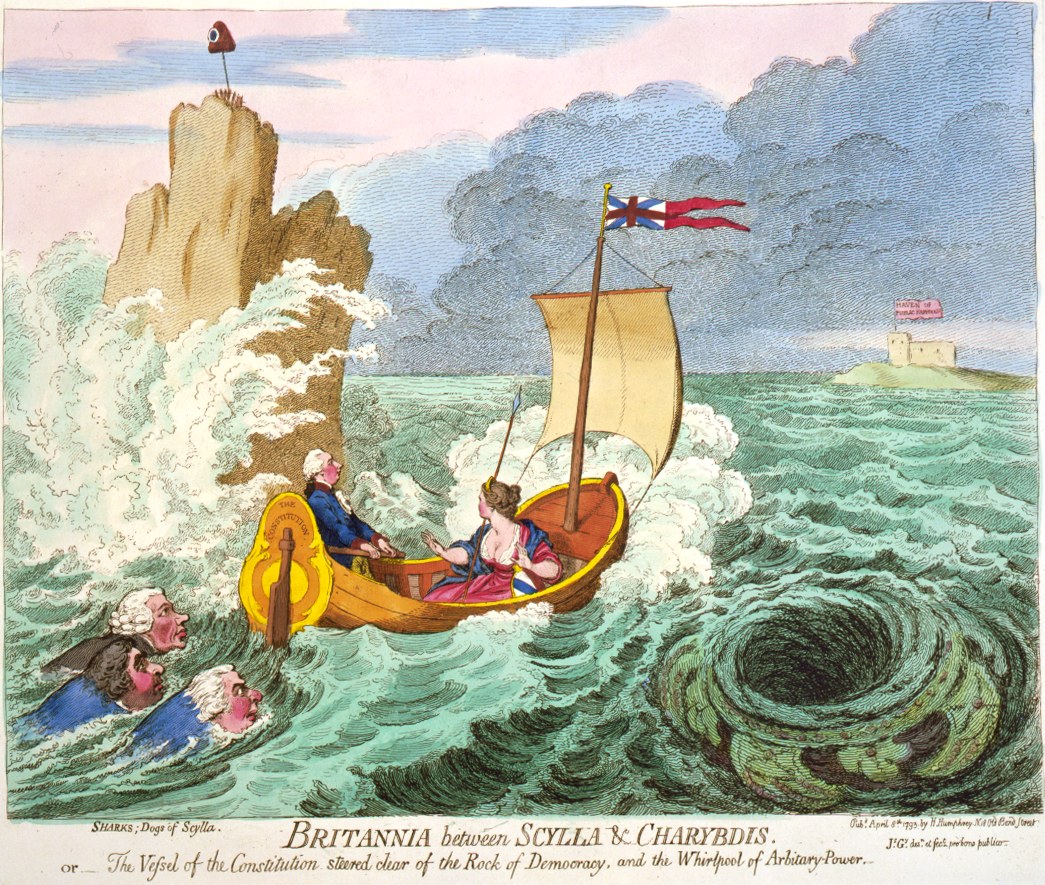
 

Britannia between Scylla & Charybdis. or— The Vessel of the Constitution steered clear of the Rock of Democracy, and the Whirlpool of Arbitrary-Power. James Gilray, 1793


Martial’s Guide to Happiness

Martial, Epigrams 10.47:

These are the things, my dearest Martial, which make life happier: possessions not gotten from labor, but left to you; a not ungrateful field, a fireplace always warm; never any strife, rarely putting on the toga, a quiet mind; inborn strength, a healthy body; wise simplicity and equal friends; easy dining, and a simple table; sober nights, but still free of cares; a bed that isn’t sad, but still with its share of modesty; sleep to make the shadows short; to wish to be what you are, and to desire nothing else; not to fear your final day, nor yet to wish for it.

Here is the same epigram translated more poetically by Henry Howard:

My friend, the things that do attain
The happy life be these, I find:
The riches left, not got with pain,
The fruitful ground; the quiet mind;
The equal friend; no grudge, no strife;
No charge of rule nor governance;
Without disease the healthy life;
The household of continuance;
The mean diet, no dainty fare;
True wisdom joined with simpleness;
The night discharged of all care,
Where wine the wit may not oppress;
The faithful wife, without debate;
Such sleeps as may beguile the night:
Content thyself with thine estate,
Neither wish death, nor fear his might.
Henry Howard Earl of Surrey 1546.jpg

Vitam quae faciant beatiorem,
Iucundissime Martialis, haec sunt:
Res non parta labore, sed relicta;
Non ingratus ager, focus perennis;
Lis numquam, toga rara, mens quieta;                            5
Vires ingenuae, salubre corpus;
Prudens simplicitas, pares amici;
Convictus facilis, sine arte mensa;
Nox non ebria, sed soluta curis;
Non tristis torus, et tamen pudicus;                            10
Somnus, qui faciat breves tenebras:
Quod sis, esse velis nihilque malis;
Summum nec metuas diem nec optes.

NANAIHB Day 3: Meriones vs. Ajax

This is the thirdday of the Non-Atreid, Non-Achilles Iliadic Hero Bracket tournament to once and for all establish the second best of the Achaeans. 

A brief recap from yesterday’s match which pitted the hero-king of Crete, Idomeneus, against one of the Epigonoi, Sthenelos the sacker of Thebes.

Idomeneus stepped away from his corner where Nestor was still giving him instructions he had not heard and stood still, waiting for Sthenelos. Sthenelos, was talking heatedly with Phoinix, and the only words any word heard sound like “father”, “better”, and “destruction of Thebes”. Sthenelos turned around and said, “Hail, descendant of Minos, Lord of Crete,King of one hundred cities, the Son of Capaneus will bring you down like the city of seven-gated Thebes!”

Idomeneus waited. Sthenelos hurled his first spear, and missed. The second lodged in Idomeneus’ shield without piercing it. Sthenelos drew his sword and charged, dropping it after he struck Idomeneus’ shield with all his force. Idomeneus was about to draw his sword when Diomedes caught his eye. The Cretan shrugged, raised his shield, and thwamped Sthenelos on the head. The light left the eyes of the Argive prince as he knelt to the ground. Unconscious, but still breathing.

As Idomeneus hefted his shield again, Epeios chuckled to Eurypulos, “ἴδε οἱ μένος!*

*ide hoi menos: “look at his strength!” a play on the name Idomeneus

NANAIHB Day 2

Today’s contest pits the Cretan Charioteer, Meriones, against the Salaminian Tower of Strength, Ajax. The winner will face Idomeneus in the next round, which will be super awkward if it is Meriones.

NANAIHB Day 2 (2)

Meriones: In the first version of this bracket, Meriones had slipped out. But there was a roar from justice as people clamored to have him back in. So, who is he? He is the half-brother of Idomeneus, often called his charioteer and he has at least seven kills in the Iliad, where he is first named as “equal to man-slaying Enyalios” (Μηριόνης τ’ ἀτάλαντος ᾿Ενυαλίῳ ἀνδρειφόντῃ, 2.651). In book 7, he is one of the 9 who stands to face Hektor in a dual and he volunteers to join Diomedes on his night raid in book 10. In each case he is second only to the more famous Ajax and Odysseus. Perhaps his most humorous moment is when he rushes out of the battle in book 13 and meets Idomeneus, saying “I am going to see if there are any spears left / in our dwellings for I have just now broken the one I was holding / when I threw it at the spear of that super-manly Deiphobos” (ἔρχομαι εἴ τί τοι ἔγχος ἐνὶ κλισίῃσι λέλειπται / οἰσόμενος· τό νυ γὰρ κατεάξαμεν ὃ πρὶν ἔχεσκον / ἀσπίδα Δηϊφόβοιο βαλὼν ὑπερηνορέοντος, 13.256-258). He stands with Idomeneus in book 13 to rally again the Trojan attack. He’s fast, he’s good with the bow too.

Ajax: What is there to say about Ajax? Outside the Iliad he is most famous for losing to Odysseus in the judgment of Achilles’ arms. He is a son of Telamon, which by most accounts makes him Achilles’ cousin (Peleus and Telamon were brothers). He came to Troy from Salamis with 12 ships and was central in later traditions for arguing the ‘ownership’ of Salamis. He is by far the best man after Achilles and Helen describes him as the “monstrous tower of the Achaeans” (οὗτος δ’ Αἴας ἐστὶ πελώριος ἕρκος ᾿Αχαιῶν, 3.229) since both he and Idomeneus standout from afar. He tears battle lines apart singlehandedly! He carries a shield as large as a tower (Αἴας δ’ ἐγγύθεν ἦλθε φέρων σάκος ἠΰτε πύργον, 7.219). When he runs out of spears, well he’s hero enough to toss boulders at people. He duels Hektor (and then later Odysseus) to a draw. But for all these he seems pretty even-headed. IN book 9, he’s the one who breaks Achilles down a bit (Iliad 9.632-638):

“You are relentless: someone might even accept payment
for the murder of a brother or the death of his own child.
and after making great restitution, the killer remains in his country,
and though bereft, the other restrains his heart and mighty anger
once he has accepted the price. But the gods put an untouchable
and wicked rage in your heart over only a girl…”

νηλής· καὶ μέν τίς τε κασιγνήτοιο φονῆος
ποινὴν ἢ οὗ παιδὸς ἐδέξατο τεθνηῶτος·
καί ῥ’ ὃ μὲν ἐν δήμῳ μένει αὐτοῦ πόλλ’ ἀποτίσας,
τοῦ δέ τ’ ἐρητύεται κραδίη καὶ θυμὸς ἀγήνωρ
ποινὴν δεξαμένῳ· σοὶ δ’ ἄληκτόν τε κακόν τε
θυμὸν ἐνὶ στήθεσσι θεοὶ θέσαν εἵνεκα κούρης
οἴης…

The Dreamer and Majority Opinion: Some Passages and Words

Philo, On Dreams, 1.1

“The first dream proper to this category is the one which appeared to the dreamer on the stairway to heaven.”

 ὄναρ δ᾿ ἐστὶ πρῶτον οἰκεῖον εἴδει τῷ σημαινομένῳ τὸ φανὲν ἐπὶ τῆς οὐρανοῦ κλίμακος τόδε. [the dream he discusses is Gen. xxviii. 12–15]

107

“And I, when I am just a little free of my drunkenness, I am so allied with those men that I share the same enemy and friend. And even now I reject and hate the dreamer no less because those people hate him. No one who is reasonable can fault me for this because the opinions and the votes of the majority always prevail.”

ἐγὼ δ᾿ ἐκείνοις, ὅταν μικρὸν ἀνεθῶ τῆς μέθης, οὕτως εἰμὶ ἔνσπονδος, ὡς τὸν αὐτὸν ἐχθρὸν καὶ φίλον εἶναι νομίζειν. καὶ νῦν οὐδὲν ἧττον τὸν ἐνυπνιαστήν, ὅτι γε καὶ ἐκεῖνοι, προβαλοῦμαι καὶ στυγήσω· καὶ οὐδεὶς εὖ φρονῶν ἐπὶ τούτῳ μέμψαιτ᾿ ἄν με τῷ τὰς πλειόνων γνώμας τε καὶ ψήφους ἀεὶνικᾶν.

Some Words

ὕπαρ, τὸ: “day-dream”

ἐνύπιον, τὸ: “dream”

ἐνυπνιαστής: “dreamer”

ὄναρ, τὸ: “dream”

ὄνειρος, ὁ: “dream”

ὀνείρειος: “dreamy”

ὀνειρογενής: “dream-producing”

ὀνειροδάτις: “dream-giving”

ὀνειροκρίτης: “dream-judge”

ὀνειρόπληκτος: “dream-struck” (“frightened by dreams”)

ὀνειροπόλος: “dreamer, dream interpreter”

ὀνειρόσοφος: “wise in dreams”

ὀνειροφαντασία: “dream illusion”

Image result for Ancient Greek dream
From the Piraeus Archaeological Museum

Note ancient Greek does not have:

ὀνειροφόνος: “dream slayer”

ὀνειροκτόνος: “dream killer”


Aelian, Varia Historia 3.1

“The Peripatetics say that at day the soul is a slave encased by the body and it is not able to see the truth clearly. At night, it is freed from its service and, after takes the shape of a sphere in the area around the chest, it becomes somewhat prophetic: this is where dreams come from.”

Οἱ περιπατητικοί φασι μεθ’ ἡμέραν θητεύουσαν τὴν ψυχὴν τῷ σώματι περιπλέκεσθαι καὶ μὴ δύνασθαι καθαρῶς τὴν ἀλήθειαν θεωρεῖν• νύκτωρ δὲ διαλυθεῖσαν τῆς περὶ τοῦτο λειτουργίας καὶ σφαιρωθεῖσαν ἐν τῷ περὶ τὸν θώρακα τόπῳ μαντικωτέραν γίνεσθαι, ἐξ ὧν τὰ ἐνύπνια.

Arsenius, 17.66

“Windblown dreams and shadows of glory”: A proverb applied to those hoping for things in vain.

῾Υπηνέμια ὀνείρατα καὶ ἐπαίνων σκιαί: ἐπὶ τῶν μάτην ἐλπιζόντων.

Image result for medieval manuscript dream
Dream of Astyages Speculum humanae salvationis, France 1470-1480 Marseille, Bibliothèque municipale, ms. 89, fol. 4v

Covering Up Our Evils: Reading Euripides’ “Andromache Online”

Euripides, Andromache 368-9 (Full text on Scaife Viewer)

“Understand this well: whatever thing someone happens to desire
That becomes for them a greater thing than taking Troy.”

εὖ δ᾿ ἴσθ᾿, ὅτου τις τυγχάνει χρείαν ἔχων,
τοῦτ᾿ ἔσθ᾿ ἑκάστῳ μεῖζον ἢ Τροίαν ἑλεῖν.

RGTO Andromache

Euripides, Andromache 368-9

“Before, even though I was buried in sorrows
Hope always led me to this child who, if saved
Might provide some kind of defense or aid.
But once my husband married that Spartan Hermione
He has spurned my slave’s bed and I
Have been battered down by her evil tortures.”

καὶ πρὶν μὲν ἐν κακοῖσι κειμένην ὅμως
ἐλπίς μ᾿ ἀεὶ προσῆγε σωθέντος τέκνου
ἀλκήν τιν᾿ εὑρεῖν κἀπικούρησιν κακῶν·
ἐπεὶ δὲ τὴν Λάκαιναν Ἑρμιόνην γαμεῖ
τοὐμὸν παρώσας δεσπότης δοῦλον λέχος,
κακοῖς πρὸς αὐτῆς σχετλίοις ἐλαύνομαι.

The Center for Hellenic Studies , the Kosmos Society and Out of Chaos Theatre has been presenting scenes from Greek tragedy on the ‘small screen’ with discussion and interpretation during our time of isolation and social distancing. As Paul O’Mahony, whose idea this whole thing was said in an earlier blog post, Since we are “unable to explore the outside world, we have no option but to explore further the inner one.

Each week we select scenes from a play, actors and experts from around the world, and put them all together for 90 minutes or so to see what will happen. This process is therapeutic for us; and it helps us think about how tragedy may have had similar functions in the ancient world as well.

Euripides, Andromache 954-6

“You’ve laid into your kindred with your tongue too much!
Such things are forgivable for you now, but still
Women must work to cover up women’s afflictions!”

ἄγαν ἐφῆκας γλῶσσαν ἐς τὸ σύμφυτον.
συγγνωστὰ μέν νυν σοὶ τάδ᾿, ἀλλ᾿ ὅμως χρεὼν
κοσμεῖν γυναῖκας τὰς γυναικείας νόσους.

This week we turn to Euripides’ Andromache, a play that returns us to the experiences of the enslaved women of Priam’s household, like his Hecuba and Trojan Women. In this play, we witness the dual sufferings of Andromache and Menelaos’ daughter Hermione. The former is the enslaved concubine of Achilles’ son, Neoptolemos and the latter is his wife. Hermione, however, is barren while Andromache has borne a son. This play returns us to themes of child killing revenge, legitimacy and the sufferings of women.

It may also have deep political resonance: This play’s date of performance is unknown, with scholars placing it as early as 428 at the end of the Periklean plague or as late as 417 BCE. Its treatment of women, children, and the offspring of slaves may reflect on the use of Athenian power during its empire and, perhaps, may comment on the Mytilenean revolt: when an Allied city tried to rebel from Athenian power and was voted to have all its men executed and women and children enslaved after its surrender. While this decision was reversed, it bared the nature of Athenian rule and foreshadows the demise of Melos 10 years later.

Euripides, Andromache 263-267

“Ah, you give me a bitter lottery and choice
For my life. Should I win, I am ruined
And if I lose I am unluckier still.”

οἴμοι, πικρὰν κλήρωσιν αἵρεσίν τέ μοι
βίου καθίστης· καὶ λαχοῦσά γ᾿ ἀθλία
καὶ μὴ λαχοῦσα δυστυχὴς καθίσταμαι.

Scenes (from the this translation)

1-55: Andromache

147-273: Andromache, Hermione, Chorus

545-765: Peleus, Menelaus, Andromache, Chorus

891-953: Orestes, Hermione, Chorus

1166-1283: Chorus, Peleus, Thetis


Euripides, Andromache 846-850

“Oh, my fate!
Where is fire’s flame dear to me?
Where can I throw myself from rocks
Either into the see or a mountain’s forest,
So I can die and the dead can care for me?”

οἴμοι πότμου.
ποῦ μοι πυρὸς φίλα φλόξ
ποῦ δ᾿ ἐκ πέτρας ἀερθῶ,
<ἢ> κατὰ πόντον ἢ καθ᾿ ὕλαν ὀρέων,
ἵνα θανοῦσα νερτέροισιν μέλω;

Cast and Crew

Andromache – Tamieka Chavis

Peleus – Michael Lumsden

Hermione – Evelyn Miller

Menelaus – Brian Nelson Jr

Orestes – Paul O’Mahony

Chorus – Sara Valentine

Thetis – Noree Victoria

Special Guest:Katerina Ladianou

Dramaturgical assistance: Emma Pauly

Direction: Paul O’Mahony

Posters: John Koelle

Technical, Moral, Administrative Support: Lanah Koelle, Allie Mabry, Janet Ozsolak, Helene Emeriaud, Sarah Scott, Keith DeStone

Upcoming Readings (Go here for the project page)

Aristophanes, Clouds, July 15

Euripides, Alcestis, July 22

The Chorus, July 29th [Special 10 AM time]

Euripides, Andromache 413-420

“Child, I who bore you go to Hades now
So that you may not die. If you outrun this fate,
Remember your mother, all I suffered and how I died.

Go to your father and through kisses
Tell him what I died while shedding tears
And throwing your arms around him.

Children are the soul of all humankind—
Whoever has no children mocks them and
While they may feel less pain, feel sadder happiness too.”

ὦ τέκνον, ἡ τεκοῦσά σ᾿, ὡς σὺ μὴ θάνῃς,
στείχω πρὸς Ἅιδην· ἢν δ᾿ ὑπεκδράμῃς μόρον,
μέμνησο μητρός, οἷα τλᾶσ᾿ ἀπωλόμην,
καὶ πατρὶ τῷ σῷ διὰ φιλημάτων ἰὼν
δάκρυά τε λείβων καὶ περιπτύσσων χέρας
λέγ᾿ οἷ᾿ ἔπραξα. πᾶσι δ᾿ ἀνθρώποις ἄρ᾿ ἦν
ψυχὴ τέκν᾿· ὅστις δ᾿ αὔτ᾿ ἄπειρος ὢν ψέγει,
ἧσσον μὲν ἀλγεῖ, δυστυχῶν δ᾿ εὐδαιμονεῖ.

Videos of Earlier Sessions (Go here for the project page)
Euripides’ Helen, March 25th
Sophocles’ Philoktetes, April 1st
Euripides’ Herakles, April 8th
Euripides’ Bacchae, April 15th
Euripides’ Iphigenia , April 22nd
Sophocles, Trachinian Women, April 29th
Euripides, Orestes May 6th
Aeschylus, Persians, May 13th
Euripides, Trojan Women May 20th
Sophocles’ Ajax, May 27th
Sophocles, Oedipus Tyrannos, June 10th

Euripides, Ion,  June 17th

Euripides, Hecuba June 24th

Aeschylus, Prometheus Bound June 30th

Euripides, Andromache 744-746

“I just let your words roll off of me:
You’re just a walking shadow who has a voice,
Incapable of doing anything other than speaking alone.”

τοὺς σοὺς δὲ μύθους ῥᾳδίως ἐγὼ φέρω·
σκιὰ γὰρ ἀντίστοιχος ὣς φωνὴν ἔχεις,
ἀδύνατος οὐδὲν ἄλλο πλὴν λέγειν μόνον.

Take it and Read!

Augustine, Confessions 8.12.29

I was saying these things and weeping in the most bitter contrition of my heart. Then suddenly, I heard a voice from a nearby house of someone, perhaps a boy or girl, I don’t know, singing and repeating, ‘Pick it up and read. Pick it up and read.’ Immediately, my expression changed, and I began to think most intently whether children were accustomed to sing anything like that in the form of some game. It did not occur to me that I had ever heard anything like it, and so I suppressed the first motion of my tears and got up, understanding that I was divinely ordered to do none other than open my book and read the first chapter which I came upon.

I had heard of Antony that he was advised by reading from what he had come upon by chance in the New Testament, as if what he read was spoken to him: ‘Go, sell all that you have and give it to the poor, and you will have a treasure in heaven; and come, follow me.‘ Oh Lord, it was by such an oracle that he was immediately converted to you. And so, struck by what I heard, I returned to the place where Alypius was sitting, for it was there that I had placed the book of the apostle when I had gotten up. I grabbed it, opened it, and read in silence the first chapter on which my eyes fell: ‘Not in eating and drunkenness, not in fornication and shamefulness, not in strife and jealousy, but cloak yourself in the lord Jesus Christ and don’t concern yourself with the flesh in the midst of all your lust.

I did not want to read more, nor was it necessary. Indeed, immediately upon reaching the end of this sentence, as if with the light of security poured into my heart, all of the shadows of doubt fled away.

Library Exhibits :: About St. Augustine

dicebam haec et flebam amarissima contritione cordis mei. et ecce audio vocem de vicina domo cum cantu dicentis et crebro repetentis, quasi pueri an puellae, nescio: ‘tolle lege, tolle lege.’ statimque mutato vultu intentissimus cogitare coepi utrumnam solerent pueri in aliquo genere ludendi cantitare tale aliquid. nec occurrebat omnino audisse me uspiam, repressoque impetu lacrimarum surrexi, nihil aliud interpretans divinitus mihi iuberi nisi ut aperirem codicem et legerem quod primum caput invenissem. audieram enim de Antonio quod ex evangelica lectione cui forte supervenerat admonitus fuerit, tamquam sibi diceretur quod legebatur: ‘vade, vende omnia quae habes, et da pauperibus et habebis thesaurum in caelis; et veni, sequere me,’ et tali oraculo confestim ad te esse conversum. itaque concitus redii in eum locum ubi sedebat Alypius: ibi enim posueram codicem apostoli cum inde surrexeram. arripui, aperui, et legi in silentio capitulum quo primum coniecti sunt oculi mei: ‘non in comessationibus et ebrietatibus, non in cubilibus et impudicitiis, non in contentione et aemulatione, sed induite dominum Iesum Christum et carnis providentiam ne feceritis in concupiscentiis.’ nec ultra volui legere nec opus erat. statim quippe cum fine huiusce sententiae quasi luce securitatis infusa cordi meo omnes dubitationis tenebrae diffugerunt.

Bart Simpson GIF - Find & Share on GIPHY


NANAIHB Day 2: Idomeneus vs. Sthenelos

This is the second day of the Non-Atreid, Non-Achilles Iliadic Hero Bracket tournament to once and for all establish the second best of the Achaeans. 

Before we get to today’s match, here’s a brief recap from yesterday’s inaugural competition which saw the Pseudo-Rhodian Tlepolemos face off against the other son of Telamon, the Archer Teucer. Nestor stood as the corner man for the son of Herakles and Phoinix stood beside Telamon’s son.

Teucer 1 Tweet

Tlepolemos started out the contest by brandishing two spears in his massive right hand and mocking Teucer, saying “Bastard son of Telamon, smallest of the Achaeans, coward who hides behind brother’s shields! How do you expect to beat me, standing here alone, a lesser son of a lesser man against the massive scion of Herakles? I am going to….”

Tlepolemos was cut off mid-threat by an arrow piercing his throat. Teucer had turned and walked into the watching crowd before the arrow  landed, muttering without a hint of a smile, “οὐ δὴ τλῆ τὸν πόλεμον”*

*ou dê tlê ton polemon: “he didn’t endure this war”. A play on Tle-polemos’ name.

NANAIHBDay1

Today’s contest pits the Hero-King of Crete, Idomeneus against Sthenelos, Sacker of Thebes.

Idomeneus is a member of the council of elders, a grandson of Minos, and friend to Ajax. Meriones is his second in command. He is listed as one of the leaders Agamemnon might despoil instead of Achilles (along with Odysseus and Ajax) and heralded by the narrator as one of the best of the Pan-Achaeans (γέροντας ἀριστῆας Παναχαιῶν, along with Nestor, both Ajaxes, Odysseus, Diomedes, and Menelaos, 2.404-408). He came to Troy from Crete of 100 cities (2.649; the Odyssey gives him only 90 cities) with 80 ships. (For comparison, Agamemnon led 100 ships and Odysseus brought 12).

Idomeneus is central to the defense of the ships in book 13 and made it out of Troy alive. In the Odyssey, he may still be ruler of Crete (although some traditions have a harsher homecoming). It is not hard to imagine narrative traditions that center this Cretan hero more: he is blamed for unfairly distributed spoils (given as an etiology for “Cretan” meaning a “liar”) and is responsible elsewhere for Odysseus’ successful homecoming. If you were drafting a heroic lineup and you wanted Ajax-level performance for a much lower price, Idomeneus would be your man.

Sthenelos: This son of Kapaneus may not be a household name, but he’s the Robin to Diomedes’ Batman and they go everywhere and destroy everything together. The pair came fro Aros and Tiryns leading 80 ships between them with Euryalos as their third (Il. 2559-568)! Diomedes is so confident with his little buddy by his side that he declares “Run away with your ships to your darling fatherland! / We two–Sthenelos and I–will fight until we find /  the end of Ilion–for we have come here with god on our side!” (φευγόντων σὺν νηυσὶ φίλην ἐς πατρίδα γαῖαν· / νῶϊ δ’ ἐγὼ Σθένελός τε μαχησόμεθ’ εἰς ὅ κε τέκμωρ / ᾿Ιλίου εὕρωμεν· σὺν γὰρ θεῷ εἰλήλουθμεν, 9.47-49). This kind of confidence is infectious. Sthenelos rejects Agamemnon’s attempt to rally them in Iliad 4, declaring (4.404–410):

“Son of Atreus, don’t lie when you know how to speak clearly.
We say we are better than our fathers:
we sacked foundation of seven-gated Thebes
even though we led a smaller army before bigger walls
because we were relying on the signs of the gods and Zeus’ help.
Those men perished because of their own recklessness.
Don’t put our fathers in the same honor.”

“Ἀτρεΐδη, μὴ ψεύδε’ ἐπιστάμενος σάφα εἰπεῖν·
ἡμεῖς τοι πατέρων μέγ’ ἀμείνονες εὐχόμεθ᾿ εἶναι·
ἡμεῖς καὶ Θήβης ἕδος εἵλομεν ἑπταπύλοιο
παυρότερον λαὸν ἀγαγόνθ’ ὑπὸ τεῖχος ἄρειον,
πειθόμενοι τεράεσσι θεῶν καὶ Ζηνὸς ἀρωγῇ·
κεῖνοι δὲ σφετέρῃσιν ἀτασθαλίῃσιν ὄλοντο·
τὼ μή μοι πατέρας ποθ’ ὁμοίῃ ἔνθεο τιμῇ.”

His name means strength. He’s got a big voice and a bigger resume.

Argive vs. Cretan. Captain vs. Lieutenant. Who’s it gonna be?

NANAIHBDay1 (2)

Between Mouth and Morsel

Aulus Gellius, Attic Nights 13.18:

What, in Marcus Cato’s work, the words ‘between the mouth and the morsel’ mean.

There is a speech of Marcus Cato the Censor On Aediles Wrongly Created. These are the words from the speech: ‘Now they say that the grain is good in the fields and plains. Don’t get too excited on that account. For I have often heard that many things can happen between the mouth and the morsel; and indeed, between the morsel and the grain itself, there is a long gap.’

Erucius Clarus, who was city prefect and twice consul, a most enthusiastic admirer of ancient customs and literature, wrote to Sulpicius Apollinaris, the most learned man in our memory, that he asked and begged Apollinaris to write back and tell him what the hell that expression meant.

Then in my presence (for at that time, I was a young man following him in Rome for the sake of education) wrote back to Clarus in brief, seeing that he was a learned man, that the ancient proverb ‘between the mouth and the morsel’ meant the same as those proverbial Greek verses:

There is a lot between the cup and the edge of the lip.

Food and dining in the Roman Empire - Wikipedia

Quid aput M. Catonem significent verba haec “inter os atque offam”. I. Oratio est M. Catonis Censorii de aedilibus vitio creatis. Ex ea oratione verba haec sunt: “Nunc ita aiunt in segetibus, in herbis bona frumenta esse. Nolite ibi nimiam spem habere. Saepe audivi inter os atque offam multa intervenire posse; verumvero inter offam atque herbam ibi vero longum intervallum est”. II. Erucius Clarus, qui praefectus urbi et bis consul fuit, vir morum et litterarum veterum studiosissimus, ad Sulpicium Apollinarem scripsit, hominem memoriae nostrae doctissimum, quaerere sese et petere, uti sibi rescriberet, quaenam esset eorum verborum sententia. III. Tum Apollinaris nobis praesentibus – nam id temporis ego adulescens Romae sectabar eum discendi gratia – rescripsit Claro ut viro erudito brevissime vetus esse proverbium “inter os et offam” idem significans, quod Graecus ille paroimiodes versus:

 πολλὰ μεταξὺ πέλει κύλικος καὶ χείλεος ἄκρου.

All That They Pretend to Teach

Edward Gibbon, Memoirs of My Life and Writings:

“Our seminaries of learning do not exactly correspond with the precept of a Spartan king, ‘that the child should be instructed in the arts, which will be useful to the man;’ since a finished scholar may emerge from the head of Westminster or Eton, in total ignorance of the business and conversation of English gentlemen in the latter end of the eighteenth century. But these schools may assume the merit of teaching all that they pretend to teach, the Latin and Greek languages: they deposit in the hands of a disciple the keys of two valuable chests; nor can he complain, if they are afterwards lost or neglected by his own fault. The necessity of leading in equal ranks so many unequal powers of capacity and application, will prolong to eight or ten years the juvenile studies, which might be despatched in half that time by the skilful master of a single pupil. Yet even the repetition of exercise and discipline contributes to fix in a vacant mind the verbal science of grammar and prosody: and the private or voluntary student, who possesses the sense and spirit of the classics, may offend, by a false quantity, the scrupulous ear of a well-flogged critic. For myself, I must be content with a very small share of the civil and literary fruits of a public school. In the space of two years (1749, 1750), interrupted by danger and debility, I painfully climbed into the third form; and my riper age was left to acquire the beauties of the Latin, and the rudiments of the Greek tongue. Instead of audaciously mingling in the sports, the quarrels, and the connections of our little world, I was still cherished at home under the maternal wing of my aunt; and my removal from Westminster long preceded the approach of manhood.”

How to Unfriend with Lysias

Lysias, Accusation of Calumny 180

“These were the excuses you clearly made up about me and my relationship with Thrasymachos. And now that these excuses have escaped you, you stop at nothing to abuse me rather freely. I should have known then that it was my luck to endure these things, when you were shit-talking me to your associates. And then I have told you everything about Polykles, a man you are helping. Why didn’t I guard my words more carefully? I was a bit simple-minded, I guess. I believed that since I was your friend I wouldn’t be maligned by you because you were slandering everyone else to me! I thought I had some kind of contract from you in your terrible insults about each other.

Well, I am happily quitting your friendship, since, by the gods, I can’t see how I’ll suffer by not associating with you when I won nothing by being your friend.”

τοιαύτας προφάσεις προφασιζόμενοι τότε μὲν ἐκ τῆς ἐμῆς καὶ Θρασυμάχου συνουσίας ἐστὲ φανεροί, νῦν δὲ ἐπειδὴ ἐκλελοίπασιν ὑμᾶς αἱ προφάσεις, ἐλευθεριώτερόν με κακῶσαι λείπετε ἤδη οὐδέν. χρῆν μὲν οὖν τότε με γιγνώσκειν ὀφειλόμενόν μοι ταῦτα παθεῖν, ὅτε καὶ πρὸς ἐμὲ περὶ ὑμῶν αὐτῶν ἐλέγετε κακῶς· ἔπειτα καὶ περὶ Πολυκλέους, ᾧ νυνὶ βοηθεῖτε, πάντ᾿ εἴρηκα πρὸς ὑμᾶς. κατὰ τί δὴ ταῦτα <οὐκ> ἐφυλαττόμην; εὔηθές τι ἔπαθον. ᾤμην γὰρ ἀπόθετος ὑμῖν εἶναι φίλος τοῦ μηδὲν ἀκοῦσαι κακὸν δι᾿ αὐτὸ τοῦτο, διότι πρὸς ἐμὲ τοὺς ἄλλους ἐλέγετε κακῶς, παρακαταθήκην ἔχων ὑμῶν παρ᾿ ἑκάστου λόγους πονηροὺς περὶ ἀλλήλων.

Ἐγὼ τοίνυν ἑκὼν ὑμῖν ἐξίσταμαι τῆς φιλίας, ἐπεί τοι μὰ τοὺς θεοὺς οὐκ οἶδ᾿ ὅ τι ζημιωθήσομαι μὴ ξυνὼν ὑμῖν·

Unfriend (2)