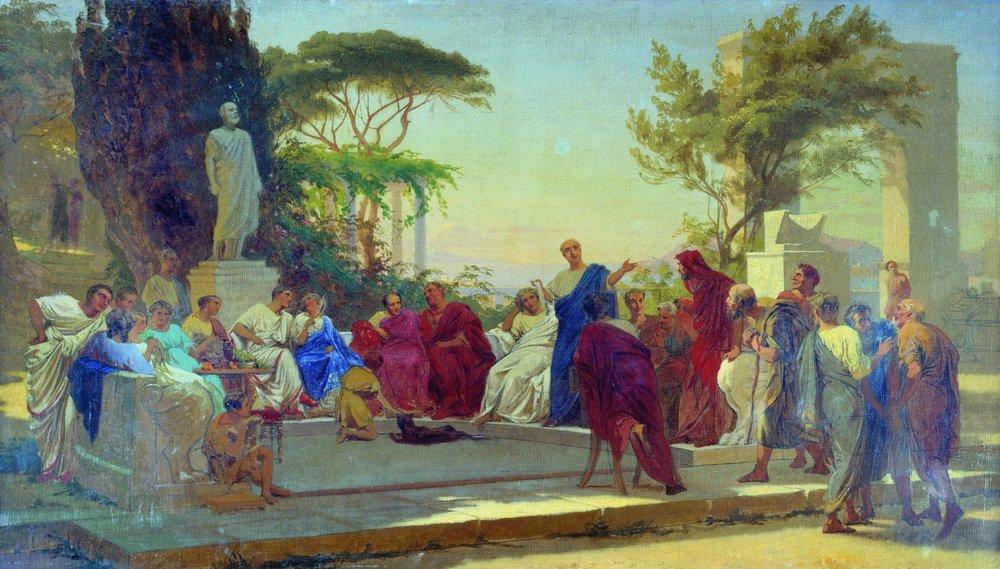
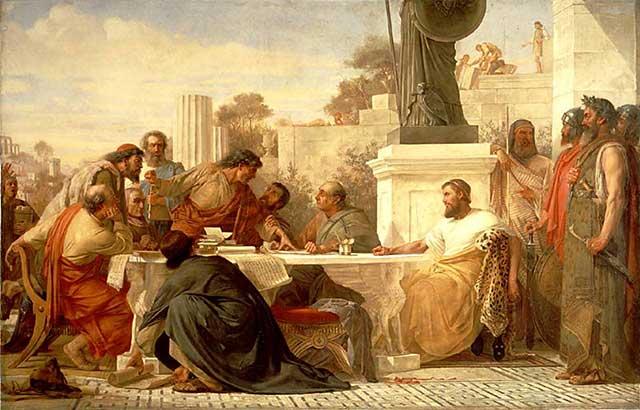
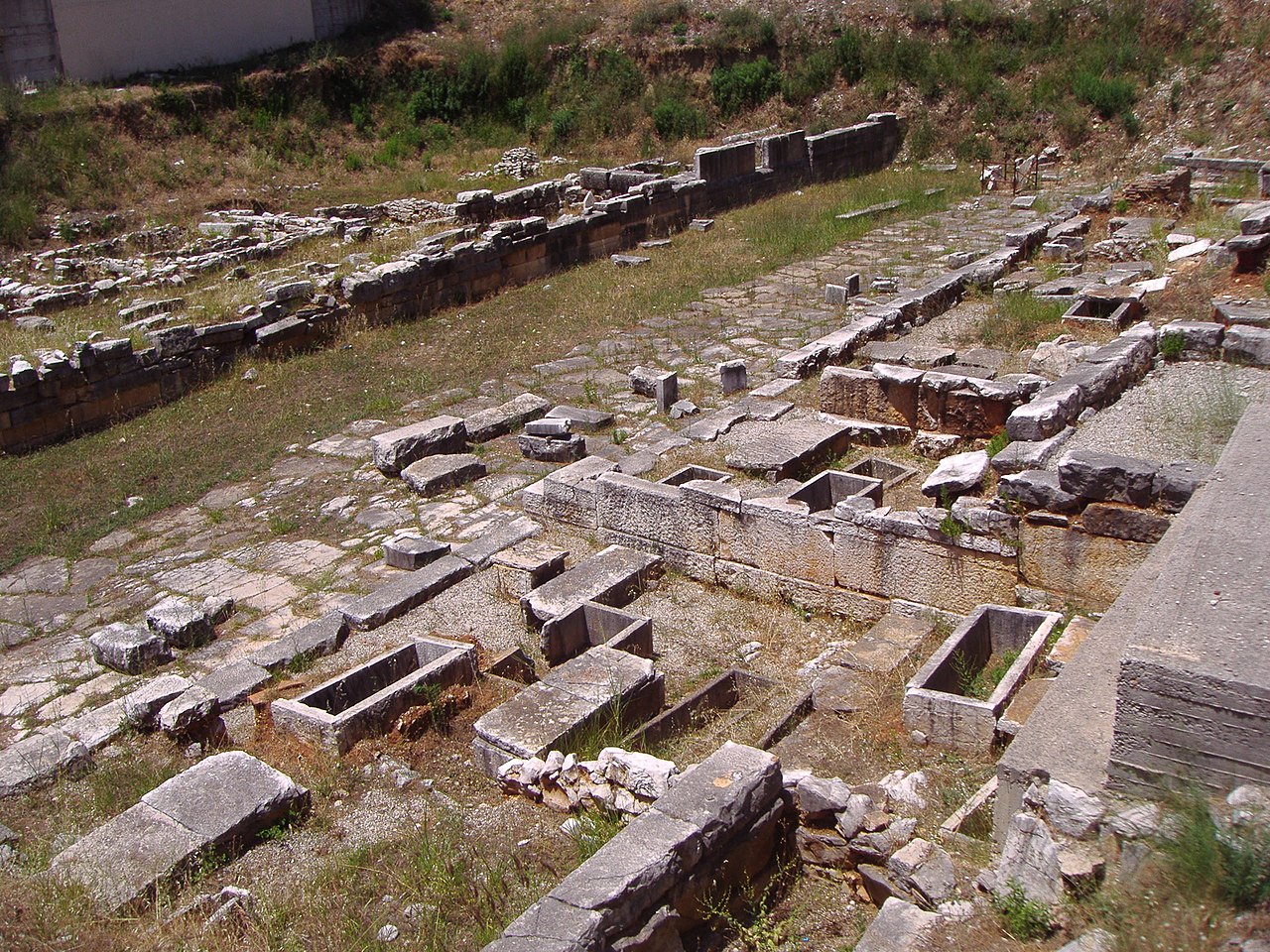
There is the noted tyrannicide who, though his work was incomplete, was captured and when he was tortured to inform upon his fellow conspirators, named the friends of the tyrant standing around, to whom he knew the life of the tyrant was actually very dear. And when Hippias ordered them to be killed one by one as they were named, he asked whether anyone remained. The tyrannicide responded, ‘Only you – for I have left out no one else to whom you were dear.’ Anger brought it about that the tyrant accommodated his hands to the tyrannicide, and killed his guard with his very own hand.
Notus est ille tyrannicida qui, inperfecto opere comprehensus et ab Hippia tortus ut conscios indicaret, circumstantes amicos tyranni nominauit quibusque maxime caram salutem eius sciebat. Et cum ille singulos, ut nominati erant, occidi iussisset, interrogauit ecquis superesset: ‘tu’ inquit ‘solus; neminem enim alium cui carus esses reliqui.’ Effecit ira ut tyrannus tyrannicidae manus accommodaret et praesidia sua gladio suo caederet.
“This mistake, this minor madness, still possesses
This many advantages—consider them. The poet is
Not one with a greedy heart. He loves his lines, and desires
This alone. He mocks lost money, the flight of slaves and fires
There’s no thought of fraud against his friend or his ward
He lives as well as thin gruel and dry bread can afford.
Although he’s slow and a bad soldier, he’s still of use,
If you believe this: that grand affairs are helped by small matters too.
Hic error tamen et levis haec insania quantas
virtutes habeat, sic collige. vatis avarus
non temere est animus; versus amat, hoc studet unum;
detrimenta, fugas servorum, incendia ridet;
non fraudem socio puerove incogitat ullam
pupillo; vivit siliquis et pane secundo;
militiae quamquam piger et malus, utilis urbi,
si das hoc, parvis quoque rebus magna iuvari.
Welcome to the second round of the #NANAIHB (the Non-Atreid, Non-Achilles Iliadic hero Bracket), the definitive tournament to decide who really is the second best of the Achaeans. The first round saw six contests, most of which were blowouts. The second round introduces heroes who received first-round byes: Odysseus, Ajax,and Diomedes.
#NANAIHB Round 2, Match 3: Patroklos vs. Antilokhos.
If there was something like a buzz in the air as Patroklos readied himself to face Nestor’s son Antilokhos, it came from the grumbles of assembled Achaeans who were hustled, bustled, and knocked to the side as Achilles paced along the sideline. He repeatedly muttered about how long this was taking as Phoinix readied Patroklos and Nestor tended to his son.
Agamemnon called the battle to begin and both younger heroes threw their first spear: Achilles watched as each approached its apex and they brushed each other mid-air and flew off course, scattering the crowd on either side. Patroklos looked at Achilles, who nodded, and then dropped his second spear and drew his sword. He rushed screaming and swinging with such force that the surprised younger hero stepped back, driven one, two, and then a dozen feet into the crowd all while doing everything he could not to stop Patroklos’ sword with his face.
Under the weight of the relentless blows, Antilochus’ shield arm was quickly tiring and he made a quick feint with his sword only to have his opponent’s blade crash into his forearm. As Antilokhos fell to his knees and Patroklos raised his sword again, Nestor raised his mighty voice, shouting, “Stop son of Menoitios, what tale will your father hear?*”
Patroklos withdrew as Antilokhos yielded. Achilles walked away with him as the crowd dispersed.
*Παῦε, Μενοιτιου υἵε, τὶ κλέος Πατήρ τεὸς ἀκούσει; A pointed punning, since Nestor uses the two elements of Patroklos name: Pater [father] and story/fame [kleos]
Today’s match: Thersites vs. Diomedes. Thersites is coming off a surprise victory over Ajax the lesser. This is Diomedes’ first appearance in the tournament. Does momentum matter?
Today’s match sets up Diomedes, a victorious sacker of Thebes, against Thersites, who is, um, Thersites. There’s a bit of a family drama to the affair. Diomedes was born in Argos be ause his father was in exile after being deposed from Calydon by Agrios. Thersites and his brothers overthrew their uncle Oeneus to put their father Agrios on the throne. According to later traditions, Diomedes arrived there and killed Thersites’ brothers to install Oeneus as king again.
(Thersites was either not there or dead at Achilles’ hands.)
So, just in case it is unclear:. Agrios and Oeneus were brothers. Their sons Tydeus and Thersites were cousins. So, that makes this a battle between Diomedes and his father’s cousin. To say there is bad blood here would be an understatement. Diomedes is one of the greatest warriors in Greek epic and he has Athena on his side. Thersites is, um, Thersites.
Julian, To the Cynic Heracleios, Oration 7 (215d-216b)
“I should now say a little bit about the divisions or tools of philosophy. For it is no big deal whether someone applies logic with practical or natural philosophy, for it is similarly necessary in both cases. But these three divisions can each be split into three others. Natural philosophy has theology, mathematics and as a third the examination of things that develop and perish and those that are unseen and which concerns what their essence is and existence entails for each one.
Practical philosophy, because it concerns a single man, has ethics, economics—when it pertains to a household—and politics—when it concerns the state. Logic in turn is demonstrative through truths, but rather violent when dealing with opinions or polemical when concerned with beliefs that merely appear to be true.
These are the subdisciplines of philosophy unless something has escaped me. Indeed, it would not be shocking were some mere soldier incapable of precisely describing or managing these kinds of definitions, since they come not from book learning but from observation and some experience. You can be my witnesses for this to, if you consider how many days there were because the lecture we recently heard and today and in addition the number of matters which have taken my attention. But, the thing I was saying, if I missed anything, and I really don’t think I did, if someone else can finish it, he won’t be my enemy but my friend.”
Welcome to the second round of the #NANAIHB (the Non-Atreid, Non-Achilles Iliadic hero Bracket), the definitive tournament to decide who really is the second best of the Achaeans. The first round saw six contests, most of which were blowouts. The second round introduces heroes who received first-round byes: Odysseus, Ajax,and Diomedes.
As the two massive warriors stood impassive on each side of the agora, Idomeneus raised up his voice, “Ajax, son of Telamon, you massive tower of a man. Come, let us put away our spears and bows and fight like men!” Ajax, smiling, gave no other answer then to pick up his castle-sized shield and draw his sword as he moved forward.
The clashing of these two giants set a flutter even into the hearts of the gods who watched them. As Zeus gazed on the clanging of sword to sword and the pounding of shield to shield, he said, “Ah, my children, I see you on the earth, thundering in power like my thunder, but flashing as brief as lightning. I have not heard such sound since the giants tried to mount Olympos or the hundred-handers locked the Titans in their dusky home. Hermes, come, let’s save Idomeneus who is fated to fall to Ajax this very day.” Maia’s son, the divine Argeiphontes, disappeared, moving faster than the eyes of the father of gods and men.
The Achaeans watched eagerly as Ajax bashed Idomeneus down to his knees, alternating with shield and sword as the Cretan king could barely fend off his blows. Finally, they could see a tear in the covering of the shield and hear the crack of its frame breaking. Then Ajax dropped his sword and gripped his shield in both hands, bringing it down like a thunderstrike on Idomeneus’ head. But as it fell, his form swirled away like smoke, leaving nothing there, save the shattered wreck of his broken shield.
Ajax stood, blinking. His chest heaved. He looked around the crowd and his eyes fell, burning, on Odysseus. The clever son of Laertes shrugged. Ajax stomped toward his ships.
Today’s match: Patroklos vs. Antilokhos.
In the first round, Antilokhos handled the Aitolian Thoas in what turned out to be the second closest competition of the round. At the end, the greater speed and Nestor’s advice made a difference. Patroklos faced Makhaon, and made pretty fast work of the field medic who slipped into the competition to begin with.
There is a little intrigue this time: who will get Achilles’ favor? We all know that Patroklos and Achilles have a relationship so deep that the latter’s death provokes his rage to new levels in the Iliad. But Antilokhos’ death in the lost Aethiopis inspires Achilles to go on a rampage that ends in his death too.
So, who’s it going to be this time? The new boy, or the old? The wrathful son of Menoetius or Nestor’s precocious charioteer? Neither of them gets Achilles’ armor: can both of them have his love?
Each week we select scenes from a play, actors and experts from around the world, and put them all together for 90 minutes or so to see what will happen. This process is therapeutic for us; and it helps us think about how tragedy may have had similar functions in the ancient world as well.
Aristophanes, Clouds 88-89
“Turn your life around ASAP
Go and learn what I am suggesting.”
This week we are taking a break from tragedy and turning to Aristophanes for some much needed comic relief. His Clouds, however, is not just funny: it is serious intellectual history in the way his other plays are serious political commentary and literary theory. Ok, that might be a step too far, but Aristophanes provides a cutting and fun critique of sophists like Socrates who attracted followers for their dynamic style of argumentation, their investigation into natural sciences, and their willingness to question religious and ritual convention. And this critique seems to have made some impact, since Plato has Socrates bring it up 20 years later.
Plato, Apology of Socrates 19c5
“You have witness these things yourself in the comedy of Aristophanes where some Socrates is carried around saying “I walk on the are” and spouting much other nonsense I don’t know anything serious or small about.”
This week we are trying something different and will be performing the whole play (a bit a abridged) from beginning to end using this translation by Ian Johnston.
Aristophanes, Clouds 94-99
“That is the thinkery of wise minds.
Inside there are men who are very convincing
when they argue that the sky is a grill cover
and that it covers over us because we are coals.
These people teach anyone who gives them money
how to kill in debates, whether they’re just or not.”
Socrates – Tony Jayawardena
Strepsaides – René Thornton Jr.
Pheidippides – Patrick Walshe McBride
Main Chorus – T. Lynn Mikeska, Valoneecia Tolbert
Main Student. -James Callás Ball
Good Argument – Judd Farris
Worse Argument – Richard Neale
Special Guest: Joel Alden Schlosser
Dramaturgical assistance: Emma Pauly
Direction: Beth Burns with production assistance by Paul O’Mahony
Posters: John Koelle
Technical, Moral, Administrative Support: Lanah Koelle, Allie Mabry, Janet Ozsolak, Helene Emeriaud, Sarah Scott, Keith DeStone
Aristophanes, Clouds 101-103
“Gross, those bums! I know them. They’re con-men,
those lilywhite, shoeless scoundrels you’re talking about–
that haunted Socrates and his Khairophon.
“Think a bit and bear down heard,
turn yourself in every direction,
cogitating, contemplating. Quick! if you get lost,
leap to some other part of your mind.
Keep sweet-tempered sleep far from your eyes!”
Whenever reactionary pundits see action in the streets, they dust off their abridged copies of Gibbon or Spengler and cue up the collapse of civilization narrative. To the privileged mind which can fight all of its battles in ink, the notion that anyone might, in defense of their rights, have to do anything not already currently being discussed by the commentariat is entirely perplexing. From bland neoliberals to Rand conservatives, consensus politics is the only politics, and despite their apparent ideological differences, their worldview is predicated upon the idea that the system always works in the end. But to everyone who doesn’t have their hands on the levers of power, or at least an entry permit to the control room, the political system (whatever system it happens to be) represents little more than the promise of failed promises.
From Occupy Wall Street to Black Lives Matter, any organized action to demand fundamental political change strikes fear into the heart of the reactionary, who is never in short supply of golden ages to hearken back to or of collapsed civilizations to warn of. The creation of street art is vandalism, and its erasure a triumph of law and order; the erection of a hateful statue is history, and its removal a testament to ignorance and decadence. Apparently it was only equestrian statues cast in bronze that held barbarism at bay; once they come down, you can assume that Odoacer has breached the walls. So, at least, goes the story.
This story takes for granted the idea that periods of violent political upheaval are inimical to true civilization, and ignores that great art and great literature, much of which has helped edge civilization down the promenade of progress, were not always created in times of bland and peaceful civic passivity. Of all the Italian cities which shone as beacons for ‘civilization’ in the Renaissance, none shone more brightly than Florence.
In the 15th century, that charming little town on the Arno possessed an importance to the history of European civilization well out of proportion to the scale of the city itself. But despite its cultural and intellectual dominance in the that century, Florence was riven with violent political factionalism and perpetually menaced by the threat of war with other Italian cities and, near the end of that century, by invasion from France. When politicians and pundits talk about how nasty politics is today, they pretend to have forgotten (or perhaps never knew) that even ostensibly republican politics of the past was a potentially deadly business.
For much of the 15th century, Florence was run by the Medici. Just as in any other free and fair political system, one man could not amass for himself the power to tyrannize over his fellow citizens, unless of course he first amassed a fortune with which to do it. Cosimo de’ Medici understood the golden rule – that he who has the gold makes the rules. And so, he used his wealth as Florence’s chief banker and financier for those who did hold political office, and contented himself to possess real power instead of its illusory trappings. Following Cosimo’s death, this state of affairs was largely upheld by his son Piero, but by the time the Medici bank was bequeathed to Cosimo’s grandson, Lorenzo de’ Medici, it was a little less amply stocked than it had been in Cosimo’s day, so Lorenzo thought it time for the Medici family to break into the business of openly running the state by holding political office.
Though Lorenzo was often spoken of in glowing terms by many of the Renaissance humanists to whom he sent a florin now and then, it seems that his compatriots entertained a less cheerful view of his heavy-handed tactics. In particular, the Pazzi family (the chief rivals to the Medici) resented the Medici supremacy as only someone in second place can. In 1478, the Pazzi attempted to kill Lorenzo and his brother Giuliano, but only Giuliano died. As invariably happens in such cases when a powerful man survives an assassination attempt, the conspiracy convinced him to consolidate his power. Enlisting the help of Naples, Lorenzo returned to the city and permanently banished all the members of the Pazzi family, who stayed banished until Lorenzo’s son, Piero, was himself banished from the city in 1494.
In the interest of brevity and tidiness, I have minimized the appearance of knives driven into bodies and bodies thrown into the Arno in the above narrative, but you can be sure that there was plenty of all of that. Florence in the 15th century was a violent place, where violent men did violent things to get hold of more power with which to do violence. People witnessed public executions in the streets; people witnessed extrajudicial murder in the alleys; people rioted, tore down monuments, stormed palaces, supported factions, opposed other factions, and made their feelings known in forceful ways as the mood struck them. But for all of this apparent chaos, there was in that very town, at that very time, an intellectual ferment which produced scholarship to strain the mind, political theory to chill the spine, and art so beautiful that only a heart of flint could maintain its pace when seeing it up close. Angelo Poliziano, one of the foremost Latinists of his day, is the man who wrote the primary contemporary account of the Pazzi conspiracy; he called Florence home. Marsilio Ficino was there. So was Leonardo da Vinci. Botticelli completed his Birth of Venus in 1480. Unrest may have prevailed in the streets, but the life of the mind was still pretty active inside.
The Florentine situation is not unparalleled. The height of Athenian cultural achievement occurred during the period largely marked out by the Persian Wars and the Peloponnesian War, which also saw a not insubstantial amount of internal factionalism. The Persians may have wrecked the city, but the Athenians just built it better the second time around. Perhaps if they had not spent so much time watching all those wonderful tragedies, they may have been more keen on preventing their own.
Similarly, Rome’s cultural zenith juts out from the 1st century BCE, at a time when the Romans had done such a thorough job spilling their neighbors’ blood that they had to take a turn spilling their own for a while. A few military and imperialist ventures punctuated the apparently endless series of civil wars, but for a better part of the century, it was Roman vs. Roman. It seems that the flow of blood materially improved the flow of ink, because no century contributed more to Latin literature than the one which began with the birth of Caesar and ended with the birth of Christ.
The literary machine was allowed to coast, and great stuff continued to be written until the reign of Nero, who thought that the best way to ensure his own literary reputation was to kill all the writers who might be worthy of one on their own. He killed a lot of writers, but as Seneca observed, no matter how many people the tyrant kills, his successor will always be one of the ones he didn’t kill. So there were plenty of later emperors, but great authors were in short supply. This time, the bloodshed made the inkwell run dry, and though some good writers now and then show up on the scene, Latin literature just wasn’t what it used to be. Roman civilization didn’t collapse when people rioted in the streets. In truth, it also didn’t collapse when Odoacer took the city in 476. It was, by then, just an old city with yet another new government, but all of the old civilization had fled when an endless succession of tyrants and military rulers made it clear that it was no longer safe to canvas for change when the inexorable logic of a broken system promised nothing more than to crush you under the newest set of purple shoes.
These are lessons to bear in mind when conservative commentators begin to decry the barbarians at the gates and ring the death knell for civilization simply because they see monuments to barbarism being taken down and people demanding the justice supposedly characteristic of that civilization. That stodgy old commentariat will try to scare people with dates like 476 and 1789, but will never ask themselves whose stubborn refusal to correct a broken system led to the events conjured up by those dates. Put simply, the equation of protest in the street and statues on their sides with the collapse of civilization is one developed by blockheads for dupes. They are wrong, and fail to consider that the agitation which they witness among their fellow citizens may not be the signs of incipient collapse or decadence, but may represent instead the first rumblings of a cultural ferment which will set us on the path to that ‘civilized’ society we so often hear of.
Kragaleus: Nikander reports this in his Metamorphoses as Athanadas does in his Ambrakian Issues. Kragaleus the son of Dryops inhabited Dryopis near the Baths of Herakles, springs which the stories claim Herakles created when he clubbed the side of the moountain. Kragaleus was already old and judged to be just and far by his neighbors. When he was grazing his cattle, Apollo, Artemis, and Herakles came to him for a judgment about Ambrakia in Epiros.
Apollo was insisting that the city was his because his son Melaneus, the king of the Dryopes, had conquered all of Epiros and then had two children himself, Eurutos and Ambrakia, where the city got its name. Besides, he had done a lot of great things for the city. For the Sisyphidai, commanded by him, went to the city to correct the Ambrakians for the war they had waged against the Epirotes and Gorgon, the brother of Kupselos took a colony army against Ambrakia from Korinth to follow his own oracle. In addition, also in accordance with his oracle, the Abrakians had revolted against the tyrant Phalaikos and, thanks to this, the masses destroyed him. Altogether, Apollo was often the one who brought an end to civil way, strife, and conflict and he promoted fair laws, order, and justice instead, which is why to this day he is respected as the Pythian Savior at feasts and festivals.
Artemis was stopping the quarrel with Apollo because she believed that she held Ambrakia with his blessing. She claimed the city according this argument. When Phalaikos was the tyrant of the city and no one could get rid of him because of fear, she had a lion cub appear to him when he was hunting. He accepted the cub into his hands and its mother jumped out of the woods, leapt upon him, and ripped his chest wide open. In this way, The Ambrakians escaped slavery and were hailed Artemis Leader. They had a bronze statue of the Huntress made and placed the animal beside it.
But the Herakles was demonstrating that Ambrakia belonged to him along with all of Epiros. For when the Kelts, Khaones, Thesprotians, and all the Epirotes attacked him, he overpowered them at the time when they joined him in the plot to steal Geryon’s cattle. At a later time, a group came from Korinth to found a colony and once they uprooted the earlier inhabitants took up the settlement of Ambrakia. All the Korinthians come from Herakles.
Once Kragaleus listened thoroughly to all these arguments, he decided that the city was Herakles’. Apollo touched him with his hand out of anger and turned him to a rock where he stood. So the Ambrakians sacrifice to Apollo the Savior, but they judge that their city belongs to Herakles and his descendants and they offer sacrificial rites to Kragaleus the hero even today, following a festival to Herakles.”
The Disturbing ‘Veil’ and “Double-Vision” of the Naïve White Liberal Anti-Racist Gaze
In the Odyssey, ancient Odysseus and his men accomplished yet another great feat of survival, blinding the one-eyed Cyclops to escape from his cave. One wonders today about the blinded single-eye of the good-natured, white liberal democrat: a view that sees itself as rabidly pro-justice, freedom, democracy, and the rest of the ideals that descend from the Western Enlightenment (made by and for white European men in the 18th century).
And, yet, this strange creature has a split double vision from its one eye. It ‘feels’ the dual threat of both Trumpian, right-wing, anti-democratic authoritarianismand the diverse social movements and protests against anti-Black racism leading to the tearing down of statues and what the right and left alike calls ‘cancel culture’ or the right asserts as the ‘indoctrination of the left.’
Is it fated for someone in a position of power to feel threatened at all times? If we turn to W. E. B. Du Bois’s ingenious insights on the ‘veil’ and ‘double-consciousness’ of being Black in America, one can think of another, inverted ‘veil’ and ‘double-consciousness’ of this blinded white liberal view today. The blinding strike of our historical present has led to a split within a single vision that lies beneath a kind of veil.
One can say the white liberal, democratic, maybe even progressive socialist and leftist view sees the world from within a veil that is not lifted. On the one hand, they see themselves through the eyes of two other groups: they claim how horrifying and vile white nationalism, supremacy, neo-Nazis, anti-Semites, and mostly anti-Black and other anti-Indigenous and POC, for example hatred of Latinx and Asians, are. They say in a silent voice of rage and hatred, a mixture of shame, guilt, and revulsion, that ‘we cannot be one of them,’ and that ‘the legacy of slavery and colonialism is not ours,’ as the philosopher Shannon Sullivan noted in her trenchant critique of white liberalism. The good-natured ones call those evil barbarians who espouse biological racism today the abhorrent ‘other,’ while reserving for themselves some sense of decency in claiming ‘we are different.’
But then, on the other hand, they see the other group of BIPOC facing multi-generational and daily humiliation, violence, and death: torrents of waves where past, present, and future co-mingle, at once stemming from both systematic and systemic racism that derive from and transcend white nationalists, the KKK, and Neo-Nazis. For this oppression permeates every institution and aspect of American society. Why not? Does it not come down to a fascination with ‘whiteness’ for those who live it and critique it? To them, the white liberal says, ‘I cannot possibly understand what it’s like to endure that racial oppression of non-whites,’ and ‘I want to speak out from within my silence but words escape me, and I relapse back into the silence I inhabit within the veil.’ Therefore, ‘I am in this world but not of it’ to quote the Gospel.
What can we learn from this split vision of positing and negating when it comes to two other groups that the white liberal tries to see and understand apart from itself? White supremacy is decried but also distanced so far to the point of paralyzing inaction while BIPOC suffer and die everywhere. They suffer at the hands of everyday white civilians, the militarized police, the heartless state, and the avarice corporations and their environmentally damaging atrocities, the terror continues. BIPOC, as the ‘other’, witness their suffering pornographically fetishized in white liberal discourse, but only to have this suffering doubled when the old discourse of the ‘free exchange of ideas,’ ‘tolerance of differing perspectives in a civil manner’ kicks in again. That old stalwart thinking quickly returns to diagnose the evil disease of ‘cancellation culture’ and ‘indoctrination of dogmatic intolerance’ in the ‘new religion’ of anti-racism, for example BLM.
What are we to make of this twenty-first century wounded Cyclops? The creature retains privilege as in the original myth since everything was provided for them, and they don’t have to work for what they have inherited. And that is called the utter, unfathomable, historical accident of either being born ‘white’ or ‘white enough to pass’ as such. If Marx analyzed the commodity, no one to this day has comparably or sufficiently analyzed ‘whiteness’ or ‘white passing.’
The self-denying person who says they are not reduced to biological ‘whiteness’ is the ultimate white liberal, democrat anti-racist. And this occurs across generations in our historical present, across the different generations who think they inhabit one single time-line. Here we find white supremacy and white privilege in a blind coexistence as it relates to the problem of time and therefore historical time. No whiteness exists apart from white supremacy. Color-blindness is privilege. So the blinded, fractured Cyclops does not see that problem.
They must consume everything that crosses their path in this split, double-vision, not even a double consciousness that is forever ‘irreconcilable’ for Black people as Du Bois said nearly 120 years ago and one can attribute to other POC today, albeit in intersectional terms. But this ruptured one-eyed giant called ‘white anti-racist liberalism’ doesn’t live in a cave, because there is no inside or outside distinction in the world of an eternal racism.
In some respect the veil – -as an illusion of real self-consciousness because one is always seeing oneself in relation to and different from the other — is itself the ultimate blind spot: the veil doesn’t exist at all. Rather, white supremacy becomes the mirror’s taint called ‘white liberalism’ and the objects that appear in the mirror are dialectically exchanged in the stasis of a perpetual motion: the white liberal must say I am not a ‘white supremacist’ while also failing to see the impossibility of pure connection with BIPOC because white liberals have the privilege of whiteness, and hence an-other type of ‘supremacy’ we are trying to name here.
This schizophrenic four-fold vision of identity and difference in the self-consciousness of the white liberal needs a new name: to be the same and different from white supremacy and same and different from BIPOC oppressed groups means one is never fully synthesized in two different ways. One can say that the ultimate giant, whose ideas shaped the white modern world to an extent like no other of his time, namely the imperialist Hegel, knew this well and suffered from it in the phantasm of truth called his ‘system and philosophy of world history.’
The dead bodies and skeletons slayed by systemic racism over colonialist centuries doom us to atrophy and entropy. At some point, this wounded creature will also perish on the lands they neither built nor own, and hopefully leaving a new world created not by the privileged gods but by a diverse, more humble humanity. We can call it the world after ‘Floyd.’
Rajesh Sampath is currently Associate Professor of the Philosophy of Justice, Rights, and Social Change at the Heller School for Social Policy and Management at Brandeis University. He completed his PhD at the University of California, Irvine in the humanities with a concentration in modern continental European philosophies of history and critical theory at the Critical Theory Institute. He studied under the French philosopher, Jacques Derrida, the founder of deconstruction. His areas of specialization center on the philosophy of history, historical time, and epochal shifts.
Welcome to the second round of the #NANAIHB (the Non-Atreid, Non-Achilles Iliadic hero Bracket), the definitive tournament to decide who really is the second best of the Achaeans. The first round saw six contests, most of which were blowouts. The second round introduces four heroes who received first-round byes: Odysseus, Ajax, Patroklos, and Diomedes.
Round 2, Match 1: Odysseus vs. Teucer.
The Achaeans gathered and noticed that Odysseus was already seated in the competition grounds, looking off into the distance. When Teucer arrived, Odysseus stood up and said, “Welcome son of Telamon, pride of Salaminian land! I hail you as a friend and offer you my own bow as a sign of our guest-friendship.” Teucer squinted at the Ithakan king and said, “Odysseus, that would be a sign of enmity through theft, not friendship—your bow is much better than mine.” He stood to his side and spoke a few words to Ajax while Odysseus continued to stare.
When Nestor announced the contest’s beginning, Odysseus picked up his shield and a single spear. Teucer raised his bow and nocked an arrow. As he drew it back, the string broke, twanging off tune like a lyre string recoiling. Odysseus darted forward and slashed Teucer on the left army lightly, saying “Teucer, what should be done? The gods have made you unlucky!*”
Odysseus’ brother-in-law, Eurylochus, yelled, “Odysseus, that’s pretty harsh, even for you!” And Odysseus responded, winking at Ajax who was looming near Teucer, “Some ships are rowed without all their oars.” Teucer yielded.
* Odysseus toyed with Teucer’s name, saying, Ὤ Τεύκρε, τὶ τευκτόν εστί; οἱ σε θεοί δυστυχέα τεῦξαν! [ôh Teukre, ti teukton? Hoi se Theoi dustukhea teuksan!]
Today’s match, Idomeneus against Ajax.
Homer, Iliad 3.230-231
“That there is the monstrous bulwark of the Achaeans, Ajax.
Idomeneus stands on the other side like a god among the Cretans.”
Telamonian Ajax is reportedly the “best of men while Achilles was raging” (ἀνδρῶν αὖ μέγ’ ἄριστος ἔην Τελαμώνιος Αἴας ὄφρ’ ᾿Αχιλεὺς μήνιεν, 2.768-769) and it would be fascinating to fully understand the difference between being “best of men” and “best of the Acheans”. He is the son of Telamon: in most accounts Peleus, Achilles’ father, and Telamon are brothers. Broader myth puts these cousins together frequently: there is a much repeated image of the two playing a game in armor; Ajax is frequently credited with carrying Achilles’ body out of the battle (as he does with Patroklos); and Ajax’s emotional appeal to Achilles in book nine is often seen as instrumental in keeping him from returning to Phthia.
Ajax came to Troy with 12 ships from Salamis and—according to the text of the Iliad we possess—lined them up with the Athenians (Αἴας δ’ ἐκ Σαλαμῖνος ἄγεν δυοκαίδεκα νῆας / στῆσε δ’ ἄγων ἵν’ ᾿Αθηναίων ἵσταντο φάλαγγες, 2.557-558; Carolyn Higbie has a great article about how this text may have been manipulated in antiquity). But he is known for his own bad self, and not his people. He is the monstrous bulwark of the Achaeans (οὗτος δ’ Αἴας ἐστὶ πελώριος ἕρκος ᾿Αχαιῶν, 3.239)
When Priam sees him from the gates, he describes him as “that other big and noble man / head and shoulders above the rest of the Argives.”τίς τὰρ ὅδ’ ἄλλος ᾿Αχαιὸς ἀνὴρ ἠΰς τε μέγας τε / ἔξοχος ᾿Αργείων κεφαλήν τε καὶ εὐρέας ὤμους; (3.226-227). His shield is as big as a tower! (Αἴας δ’ ἐγγύθεν ἦλθε φέρων σάκος ἠΰτε πύργον, 7.219). He’s brave (ἄλκιμος Αἴας), he’s shiny (φαίδιμος Αἴας), he’s really big (Τελαμώνιος Αἴας) and he walks big too (Αἴας…μάκρα βιβάσθων· 18.809).
Idomeneus is also huge—if he weren’t Cretan and if Ajax weren’t there, this son of Minos just might be the second best of the Danaans. He devastated Sthenelos in round 1. He has held battalions of Trojans at bay.
How does he match up against Ajax? Helen places them right next to each other. And who is a better judge of a man than her?