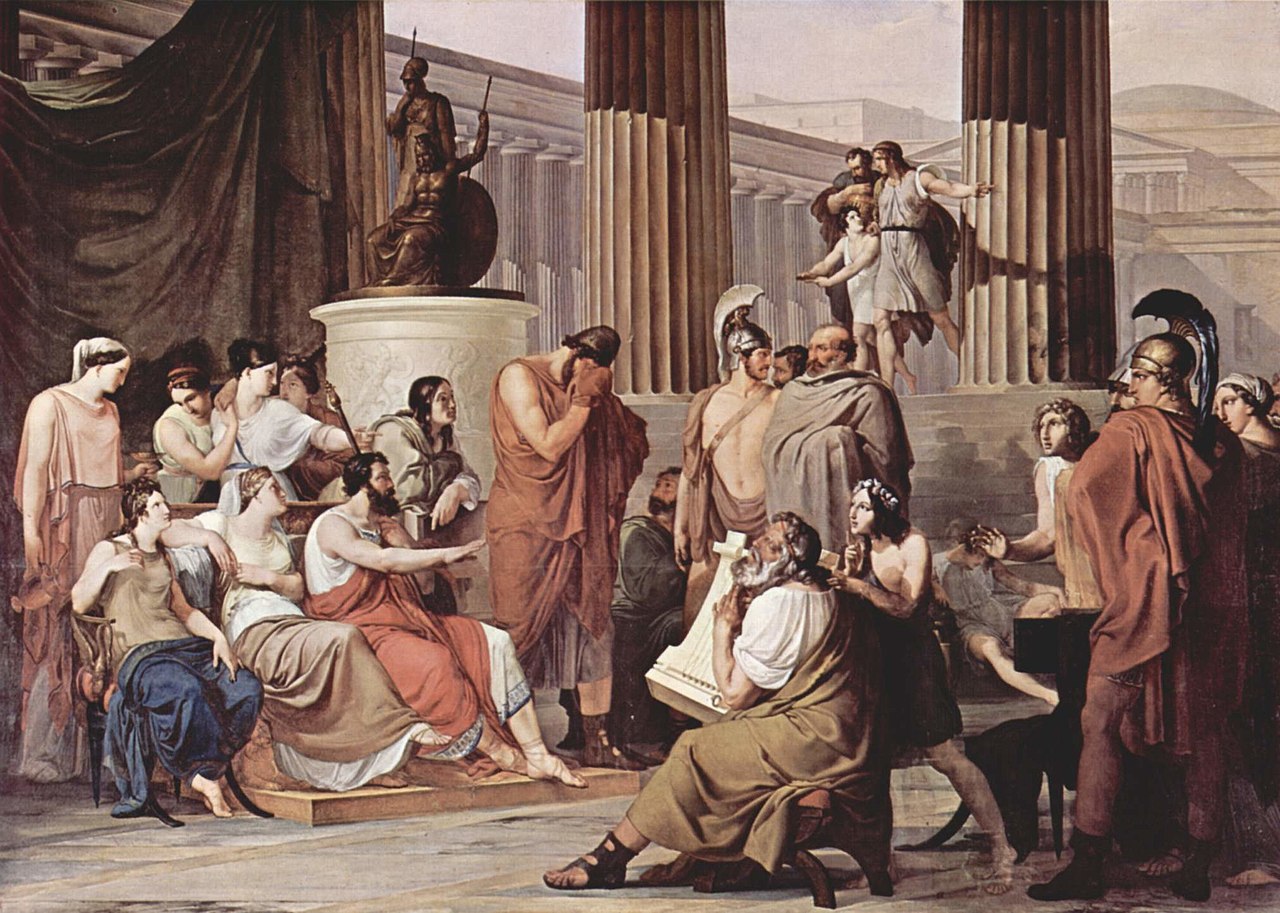
“At that time, poets spent their time among kings, and even earlier Anacreon found himself at the court of Polycrates of Samos, and both Aeschylus and Simonides went to Syracuse to visit Hiero. Philoxenus spent time with Dionysius, who was later tyrant in Sicily, while both Antagoras of Rhodes and Aratus of Soli kept company with Antigonus when he ruled the Macedonians. Either Hesiod and Homer happened not to chance upon any kings, or they willingly despised them; Hesiod would have done so from his innate rusticity and aversion to traveling, while Homer spent a lot of time abroad and set the aid accruing to him from the wealth of the powerful at less than the good opinion from the people, since we find even among Homer that Demodocus spent time in the court of Alcinous, and Agamemnon left behind a poet with his wife. There is a grave not far from the gates, on which there is a depiction of a soldier standing next to a horse: I don’t know who it is, but Praxiteles carved both the horse and the soldier.”
Francesco Hayez, Odysseus at the Court of Alcinous
“The evils of the civil war seemed to have ended when they were rekindled by Sulla’s cruelty. Once he was made dictator—and this honor had been avoided for a hundred and twenty years since the last time it had been used was one year after Hannibal quit Italy—and it is obvious that the fear which prompted the Roman people to want a dictator was less than how much they feared his power. As dictator, Sulla applied the power which earlier dictators had used only to save the country from the greatest dangers with unmeasured degrees of savagery.
He was the first—and I wish he had been the last—to discover the model of proscription with the result that in the same state in which legal recourse is available to an actor booed from the stage, in that state a price was set for the murder of a Roman citizen: he would have the most who killed the most! The reward for the killing of an enemy would be no greater than for the murder of a citizen.
In essence, each man was valued for the price of his own death. Such savagery was applied not only to those who had carried arms against them, but against many innocents too. In addition to this, the goods of the proscribed were offered for sale: children already deprived of their father’s goods were also prohibited from the right of seeking public office and, the most unjust thing of all, they had to maintain the standards of their social rank without recourse to the rights.”
Videbantur finita belli civilis mala, cum Sullae crudelitate aucta sunt. Quippe dictator creatus (cuius honoris usurpatio per annos centum et viginti intermissa; nam proximus post annum quam Hannibal Italia excesserat, uti adpareat populum Romanum usum dictatoris haud metu desiderasse tali quo timuisset potestatem) imperio, quo priores ad vindicandam maximis periculis rem publicam olim usi erant, eo in inmodicae crudelitatis licentiam usus est.3 Primus ille, et utinam ultimus, exemplum proscriptionis invenit, ut in qua civitate petularitis convicii iudicium histrioni ex albo redditur, in ea iugulati civis Romani publice constitueretur auctoramentum, plurimumque haberet, qui plurimos interemisset, neque occisi hostis quam civis uberius foret praemium Geretque quisque merces mortis suae.4 Nec tantum in eos, qui contra arma tulerant, sed in multos insontis saevitum. Adiectum etiam, ut bona proscriptorum venirent exclusique paternis opibus liberi etiam petendorum honorum iure prohiberentur simulque, quod indignissimum est, senatorum filii et onera ordinis sustinerent et iura perderent.
“Kyrnos, this city is pregnant and I am afraid she will bear a man
Meant to correct our evil arrogance.
The citizens are still sane, but the leaders have changed
And have fallen into great evil.
Good people, Kyrnos, have never yet destroyed a city,
But whenever it pleases wicked men to commit outrage,
They corrupt the people and issue legal judgment in favor of the unjust,
For the sake of their own private profit and power.
Don’t expect this city to stay peaceful for very long
Even if it is not at a moment of great peace now,
When these deeds are dear to evil men,
As their profit accrues with public harm.
Civil conflicts and murder of kin comes from this,
And tyrants do too: may this never bring our city pleasure.”
“I had great wealth and I was ruling my home.
I would have had noble children some day
And she would only give birth to half-slave bastards for them.
But never and I say it over and over, never
Should anyone who has any sense at all and a wife
Allow other women to come to visit them!
These women are instructors of evils.
One ruins a marriage because she hopes to gain something,
While another who’s afflicted wants someone to be sick with.
Many more act because of native vice—and this is how
The homes of men grow diseased.”
“You’ve laid into your kindred with your tongue too much!
Such things are forgivable for you now, but still
Women must work to cover up women’s afflictions!”
“Theophrastus, in the book I already discussed, addresses the same matter which Cicero does, but more extensively and more pointedly. But he too does not make his opinion clear concerning distinguishing about a solitary and separate action—he does not use clearly established examples, but discusses classes of action in summary in close to the following:
“A small and rather thin shame or bad reputation ought to be endured if it is possible through it to be of great advantage to a friend. Certainly, the loss from a compromised sense of honor is repaid and repaired by some greater or weightier service to a friend and that momentary slip, or in a way, your damaged reputation is made whole again with the fine material of usefulness to a friend.”
21 Theophrastus autem in eo, quo dixi, libro inquisitius quidem super hac ipsa re et exactius pressiusque quam Cicero disserit. 22 Set is quoque in docendo non de unoquoque facto singillatim existimat neque certis exemplorum documentis, set generibus rerum summatim universimque utitur ad hunc ferme modum: 23 “Parva” inquit “et tenuis vel turpitudo vel infamia subeunda est, si ea re magna utilitas amico quaeri potest. Rependitur quippe et compensatur leve damnum delibatae honestatis maiore alia gravioreque in adiuvando amico honestate, minimaque illa labes et quasi lacuna famae munimentis partarum amico utilitatium solidatur.
“Tell them that their home is already plagued,
and that the strife among their children
is no longer balanced out
by the fact that they all love life.”
“Do not send me from this land in dishonor,
but as a master of my wealth and the captain of my house.
I have said enough now. Old man, it is your task
to go and safeguard this need.
And the two of us will go: for it is the perfect moment
and the perfect moment is man’s greatest guide in every deed.”
Each week we select scenes from a play, actors and experts from around the world, and put them all together for 90 minutes or so to see what will happen. This process is therapeutic for us; and it helps us think about how tragedy may have had similar functions in the ancient world as well.
Sophocles, Elektra 91-95
“This hateful bed in our painful house
shares the pains of all my nights
how much I mourn for my wretched father…”
This week we turn to the first of many plays set around the House of Atreus, Sophokles’ Elektra. This story follows Orestes’ return home to murder his mother (and her lover Aegisthus) for the killing of his father Agamemnon. For fans of tragedy, the tale is famous from our only full trilogy from ancient Athens, Aeschylus’ Oresteia. But it was legendary—and perhaps even paradigmatic—Homer’s Odyssey as well, where Orestes is held up repeatedly as a model of youthful initiative to Telemachus and Clytemnestra’s betrayal of her husband appears as a constant threat to Odysseus’ homecoming.
The story of Orestes is, like the end of the Odyssey, about the cycle of vengeance and the dangerous narrative pull of the call to revenge. In Aeschylus’ Eumenides, Orestes ends up in Athens where he is judged by a jury for his mother’s murder: his story pits the orders of one god (Apollo) against he claims of others (the Furies) and the loyalty of a son to mother or father. The story of the Elektra is a prolonged rumination on the choices made before that crises. This version of the tale is often dated to the end of Sophocles’ life, during the middle of the Peloponnesian War. It features Orestes returning with Pylades in disguise to announce his death. The title character, Electra, has been mourning her father’s murder and longing for her brother’s return. Once she finds out about Orestes’ true identity, the play turns to the murder, but prior to that ever delayed moment of recognition, the audiences witnesses Orestes’ hesitation and Electra’s sorrow.
“No noble person wants
to ruin their good reputation by living badly
namelessly, my child.
So you have accepted for yourself
a life of fame and constant sorrow,
making a weapon from a noble cure–
with one strike you win two prizes
to be called a child excellent and wise.”
Electra – Evelyn Miller
Chrysothemis – Tabatha Gayle
Chorus – Sara Valentine
Orestes – Tim Delap
Clytemnestra – Eunice Roberts
Aegisthus – René Thornton Jr.
Special Guests, Amy. R. Cohen
Artistic Director: Paul O’Mahony (Out of Chaos Theatre) Associate Director: Liz Fisher Director of Outreach: Amy Pistone (Gonzaga University) Dramaturg: Emma Pauly Executive Producer: Lanah Koelle (Center for Hellenic Studies) Producers: Keith DeStone (Center for Hellenic Studies), Hélène Emeriaud, Janet Ozsolak, and Sarah Scott (Kosmos Society) Poster Artist: John Koelle Poster Designer: Allie Marbry (Center for Hellenic Studies)
Sophocles, Elektra 1282-1287
“My love–I am hearing a voice
I never hoped to hear,
but still I kept my eagerness quiet.
I heard with no cry in response.
But now, I have you. You are clear as day,
holding the dearest vision before me,
something I never could forget in any troubles.”
“What the greatest mob of fools and senseless wastes!
Don’t you care at all about your life
Or are you incapable of any thought at all,
When you cannot recognize that you aren’t just close,
but You’re in the middle of the worst shit there is?”
The saddest adage among Latin authors is Ὗς τὴν Ἀθηνᾶν, that is, ‘A pig…Minerva’, where ‘advises’ or ‘teaches’ must be understood as the verb. It is typically said whenever someone uneducated or lacking in wit tries to teach someone from whom they should rather be taught. To use the words of Pompeius Festus, it is when someone teaches another that of which they themselves are ignorant. This is because the guardianship of the arts and the intellect is attributed to Minerva by the poets, as we have said. Further, there is no other animal more brutish or filthy than the big, either because it takes immeasurable delight in shit, which comes about because of the size of its liver, which is the seat of lust and desire, or because of the thickness of its nose and its blunt sense of smell, from which it occurs that it is not offended by the filth. Further, it is so prone and given to food that if by chance it is compelled to look upward, it suddenly falls into a stuporous silence because of the novelty, as Alexander Aphrodiseus tells us. Nor is there anything less capable of instruction, and seems not to be of any use (as some other animals are), but rather to have been given to us by nature simply for feasts. Pliny, in Book VIII Chapter 51 of his Natural History, attests to this when he says, Of all the animals, the pig is especially brutish and is thought, not unwittily, to have received a soul as salt. Varro, in the second book of On Agricultural Affairs says the same thing: They say that the swinish herd was given by nature for feasting. And so, they were given souls in place of salt, to preserve the meat. Indeed, in the fifth book of On the Ends of Good and Evil, Cicero explains what these words mean:
For of all things, which nature creates and guards, which are either lacking mind or not far from it, the highest good lies in their body, as it seems not unwisely said of the pig that a mind was given to that flock in place of salt, so that it would not rot. There are however beasts in which there is something similar to virtue, as for example in lions, in dogs, in horses, in which we see not only some motions in their bodies (as is the case in pigs), but even in some part of their minds.
Aristotle, in his Physiognomics, writes that people with a small forehead are incapable of instruction and unsuited for learning, and seem to belong to their own race, as if they were the farthest removed of all from docility and human arts. For the rest seem full of docility, from which now too we are accustomed commonly to call those who are lacking intelligence and born as if for their guts and stomachs alone ‘pigs’.
Nay, even Suetonius in his catalogue of illustrious grammarians relates that Palaemon was endowed with such arrogance that he called Marcus Varro a pig, and said that his letters were born with and would die with him. Further, if we wish to signify anything uneducated or illiterate, we say that it came from the pig sty, as Cicero says in Against Piso: Brought forth from the sty, not from the school. From this, then, comes the adage a pig Minerva. Luciius Caesar in Cicero’s second book of The Orator says, Thus I, as Crassus listens, will speak first about jokes and I the pig will teach him, the oratorof whom, when Catulus had recently heard him, said that the rest might as well eat hay. Cicero also says in the first book of his Academic Questions: For even if it is not a case of the pig teaching Minerva, as they say, nevertheless whoever ineptly teaches Minerva…
Jerome says, in Against Rufinus: I pass over the Greeks, the knowledge of whom you toss about, and while you run after foreign things, you have almost entirely forgotten your speech, lest according to the old adage a pig seems to teach Minerva. Jerome also uses this phrase with different wording in a letter to Marcella, the beginning of which is Charity does not have measure.
Marcus Varro and Euhemerus refer the saying to fables, which can be conjectured from the words of Pompeius Festus, who says, They preferred to involve this thing, placed in the middle, with inept stories rather than relating it simply. The joke of Demosthenes is celebrated; when Demades was crying out to him Δημοσθένης ἐμὲ βούλεται διορθοῦν, ἡ ὗς τὴν Ἀθηνᾶν, that is, Demosthenes wants to correct me, like a pig correcting Minerva, Demosthenes responded, Αὕτη μέντοι πέρυσιν ἡ Ἀθηνᾶ μοιχεύουσα εἰλήφθη, that is, And indeed, this Minerva was recently caught out in adultery. The saying alluded to Minerva the virgin.
SVS MINERVAM
Tritissimum apud Latinos autores adagium Ὗς τὴν Ἀθηνᾶν, id est Sus Mineruam, subaudiendum ‘docet’ aut ‘monet’, dici solitum, quoties indoctus quispiam atque insulsus eum docere conatur, a quo sit ipse magis docendus aut, vt Festi Pompeii verbis vtar, cum quis id docet alterum, cuius ipse est inscius. Propterea quod Mineruae artium et ingeniorum, vt diximus, tutela tribuitur a poetis. Porro sue nullum aliud animal magis brutum magisque sordidum, vt quod stercoribus impense gaudeat vel ob iecoris magnitudinem, quae sedes est concupiscentiae ac libidinis, vel ob narium crassitudinem et olfactum hebetem, vnde fit vt non offendatur foetore; tum adeo pronum ciboque deditum, vt si forte sursum aspicere cogatur, protinus stupore sileat ob insolentiam, vt tradit Alexander Aphrodiseus. Nec est aliud magis indocile, proinde non ad vsum aliquem, quemadmodum pecudes nonnullae, sed ad epulas duntaxat a natura donatum videtur. Cui rei testis est Plinius lib. viii., cap. li. Animalium, inquit, hoc maxime brutum animamque ei pro sale datam, non illepide existimabatur. Idem affirmat Varro libro De re rustica secundo, Suillum, inquit, pecus donatum a natura dicunt ad epulandum. Itaque his animam datam pro sale, quae seruaret carnem. Atque haec quidem verba quid sibi velint, explicat M. Tullius libro De finibus bonorum quinto,
Etenim omnium rerum, inquit, quas et creat natura et tuetur, quae aut sine animo sunt aut non multo secus, eorum summum bonum in corpore est, vt non inscite illud dictum videatur in suem, animum illi pecudi datum pro sale, ne putresceret. Sunt autem bestiae, in quibus inest aliquid simile virtutis vt in leonibus, vt in canibus, vt in equis, in quibus non corporum solum vt in suibus, sed etiam animorum aliqua ex parte motus aliquos videmus.
Aristoteles in Physiognomicis scribit exigua fronte homines indociles et ad disciplinas ineptos videri atque ad suum genus pertinere, tanquam a docilitate humanisque artibus longe omnium alienissimum. Nam reliqua ferme docilitatis esse capacia, vnde nunc quoque vulgo insipidos istos et quasi ventri atque abdomini natos sues appellare consueuimus.
Quin et Suetonius in catalogo illustrium grammaticorum refert Palaemonem arrogantia tanta fuisse, vt M. Varronem porcum appellaret, secum et natas et morituras literas. Praeterea si quid indoctum atque illiteratum significare volumus, id ex hara profectum dicimus. Quemadmodum M. Tullius in
Pisonem: Ex hara productae, non schola. Hinc igitur natum adagium Sus Mineruam. L. Caesar apud Ciceronem libro De oratore secundo, Sic ego, inquit, Crasso audiente primum loquar de facetiis et docebo sus, vt aiunt, oratorem eum, quem cum Catulus nuper audisset, foenum alios aiebat esse oportere. Idem Cicero libro de
Academicis quaestionibus primo: Nam etsi non sus Mineruam, vt aiunt, tamen inepte quisquis Mineruam docet.
Hieronymus in Rufinum: Praetermitto Graecos, quorum tu iactas scientiam, et dum peregrina sectaris, pene tui sermonis oblitus es, ne vetere prouerbio sus Mineruam docere videatur. Vsurpat idem verbis commutatis in epistola ad Marcellam, cuius initium Mensuram charitas non habet.
Varro et Euemerus adagium ad fabulas retulerunt, id quod ex Pompeii verbis licet coniicere. Quam rem, inquit, in medio, quod aiunt, positam ineptis μύθους inuoluere maluerunt, quam simpliciter referre. Celebratur a multis Demosthenis scomma, qui cum Demades vociferaretur in eum: Δημοσθένης ἐμὲ βούλεται διορθοῦν, ἡ ὗς τὴν Ἀθηνᾶν, id est Demosthenes vult me corrigere, sus Mineruam, respondit: Αὕτη μέντοι πέρυσιν ἡ Ἀθηνᾶ μοιχεύουσα εἰλήφθη, id est Atqui nuper haec Minerua in adulterio fuit deprehensa. Dictum allusit ad Mineruam virginem.
“After they captured Troy, the Greeks pitied the fate of the captured people and they announced this altogether Greek thing: that each of the free men could select and take one of his possessions. Aeneas selected and was carrying his ancestral gods, after dismissing everything else. Impressed by the righteousness of this man, the Greeks conceded that he may take a second possession away.
Then, Aeneas placed his father—who was extremely old—on his shoulders and walked off. Because they were so amazed, they granted him all of his own possessions, attesting to the fact that men who are enemies by nature become mild when faced with righteous men who revere the gods and their parents.”
“For me, this was frightening to see,
And for you to hear. Know well that my child
Would be wondrous to behold if he did well but,
He’s not beholden to the state:
he will rule the land if he merely survives.”
Porph. On Abstaining from Animal Food (de abst. 2. 18(p. 148 Nauck))
“People say that when the Delphians asked Aeschylus to write a paean for the god he said that Tynnichus had already composed the best one. His would be no better when compared to it than modern statues set alongside ancient ones.”
“We have frequently noted more than a few words or expressions which we cannot say in a few words, as in Greek, and which, even if we use as many words as possible to say them, cannot be articulated as clearly or pointedly in Latin as the Greeks can convey in a few words. For recently, when a book of Plutarch came my way and I was reading the title, which was “Peri polypragmosunes”, a man who didn’t know Greek asked me whose book it was and what it was written about. I spoke the name of the writer immediately, but the subject of the book was something I hesitated on.
At first, since I did not believe that it would be an elegant translation if I said that the book was De Negotiositate (about busyness), I began to search my mind for some other description which, as the saying goes, would express it “word for word”. But there was nothing which I could remember that I read nor anything I could invent that would not in some way be harsh or silly—if I made a new word out of multitude and negotium, in the same way we say “multifaceted” or “multicolored” or “multiform”. But it would be said no less awkwardly than if one were to translate into a single world polyphilia (having many friends), polytropia (of many ways) or polysarkia (with much flesh). Therefore, after I spent a while thinking silently, I responded that it did not seem possible to me to communicate the subject in a single word and that, as a result, I was considering how to convey the meaning of that Greek word with a phrase.”
“Therefore, beginning many affairs and working on all of them is called in Greek polypragmosunê” I said, “and the label communicates that this book is written about this matter.” Then, that unrefined man, misled by my incomplete and unclear words and thinking that polypragmonê is a virtue, said “Certainly, then, this man Plutarch, whoever he is, exhorts us to engage in business, and that very many endeavors should be pursued with dedication and speed, and he has written the name of this virtue, about which he plans to speak, on the book itself, just as you say, with propriety.” I answered “Not at all, in truth. For that is in no way a virtue, that subject which is anticipated by the Greek name on the book. And Plutarch does not do what you believe—and I did not mean to say that. Indeed, he dissuades us in this book as much as he is able from too varied and frequent and unnecessary planning or seeking of too many types of obligations. But” I added, “I do see that the root of your mistake is in my lack of eloquence, the way that I could not express in many words and with clarity what a single Greek word indicates completely and plainly.”
Adiecimus saepe animum ad vocabula rerum non paucissima, quae neque singulis verbis, ut a Graecis, neque, si maxime pluribus eas res verbis dicamus, tam dilucide tamque apte demonstrari Latina oratione possunt, quam Graeci ea dicunt privis vocibus. 2 Nuper etiam cum adlatus esset ad nos Plutarchi liber et eius libri indicem legissemus, qui erat peri polypragmosynes, percontanti cuipiam, qui et litterarum et vocum Graecarum expers fuit, cuiusnam liber et qua de re scriptus esset, nomen quidem scriptoris statim diximus, rem, de qua scriptum fuit, dicturi haesimus. 3 Ac tum quidem primo, quia non satis commode opinabar interpretaturum me esse, si dicerem librum scriptum “de negotiositate”, aliud institui aput me exquirere, quod, ut dicitur, verbum de verbo expressum esset. 4 Nihil erat prorsus, quod aut meminissem legere me aut, si etiam vellem fingere, quod non insigniter asperum absurdumque esset, si ex multitudine et negotio verbum unum compingerem, sicuti “multiiuga” dicimus et “multicolora” et “multiformia”. 5 Sed non minus inlepide ita diceretur, quam si interpretari voce una velis polyphilian aut polytropian aut polysarkian. Quamobrem, cum diutule tacitus in cogitando fuissem, respondi tandem non videri mihi significari eam rem posse uno nomine et idcirco iuncta oratione, quid ucliet Graecum id verbum, pararam dicere.
“Ad multas igitur res adgressio earumque omnium rerum actio polypragmosyne” inquam “Graece dicitur, de qua hunc librum conpositum esse inscriptio ista indicat”. VII. Tum ille opicus verbis meis inchoatis et inconditis adductus virtutemque esse polypragmosynen ratus: “hortatur” inquit “nos profecto nescio quis hic Plutarchus ad negotia capessenda et ad res obeundas plurimas cum industria et celeritate nomenque ipsius virtutis, de qua locuturus esset, libro ipsi, sicuti dicis, non incommode praescripsit”. VIII. “Minime” inquam “vero; neque enim ista omnino virtus est, cuius Graeco nomine argumentum hoc libri demonstratur, neque id, quod tu opinare, aut ego me dicere sentio aut Plutarchus facit. Deterret enim nos hoc quidem in libro, quam potest maxime, a varia promiscaque et non necessaria rerum cuiuscemodi plurimarum et cogitatione et petitione. Sed huius” inquam “tui erroris culpam esse intellego in mea scilicet infacundia, qui ne pluribus quidem verbis potuerim non obscurissime dicere, quod a Graecis perfectissime verbo uno et planissime dicitur”.