Vergerio, de ingenuis moribus et liberalibus adulescentiae studiis, LIV:
“There is indeed good reason to gather together those times which others tend to neglect, as when we read at dinner or awaits sleep (or avoids it) by reading. Yet, the doctors tell us that these practices are bad for our sight and eyes; this is true if we read too much, that is to say, either too intently or after an excessive meal. But it will also be to our advantage if we set up, in our libraries and right before our eyes, those instruments which are used to measure the hours and times more generally, so that we may see time as it flows and slips away from us. It would also be useful if we were to use those places for nothing else than what they were established, allowing there no external business or thought.”
Bonae etenim rationis est ea quoque bona colligere quae solent neglegere ceteri, ut si quis super cenam legat et somnum quidem inter libros exspectet aut certe per libros fugiat. Quamquam physici obesse ea visui luminibusque contendunt; quod et verum est, si modo praeter modum, id est, aut intentione nimia aut super multam saturitatem id fiat. Sed et illud quoque proderit nonnihil, si intra bibliothecas nostras coram atque in oculis instrumenta haec constituamus, quibus horas ac tempora metiri solent, ut quasi tempus ipsum fluere labique videamus, et si eis ipsis locis ad nihil aliud quam ad quod instituta sunt utamur, nullam ibi aut occupationem aut cogitationem extremam admittentes.
This week, we turn to the most tragic of epics (according to Aristotle, at least), Homer’s Iliad
As everyone knows, the Iliad begins with the rage of Achilles. As many of us forget, it ends not with the Trojan Horse or the death of Achilles, but instead with the burial of horse-taming Hektor. I think it is probably dangerous to ask a Homerist to tell you about the Iliad, because so often we don’t know where to start, whether it should be in thinking about its relationship with the Odyssey or about what it means to say the word “Homer”. True Story: many years ago, while patronizing a drinking establishment in Queens, my wife asked me to tell her what the Iliad was about. After about 45 minutes, she asked how much more there was to it. I had not even finished book 1 yet…
Ancient performers of the epics didn’t have these challenges because audiences grew up hearing stories about most of the events and characters they would be singing about and because the performance contexts didn’t expect them to tell the whole story. We don’t know a lot about the actual performance contexts and practices of Homeric poetry in the ancient world (see the work of José Gonzalez on rhapsodes, Casey Dué’s work on multiformity, Egbert Bakker’s From Formula to Poetics or any of Gregory Nagy’s Poetry as Performanceor Plato’s Rhapsogy and Homer’s Music), but it seems likely that the stories were performed in episodes at various occasions and at times in monumental performances at festivals. How these performances were prepared is another issue: some think they were memorized from a script, others think they were composed in performance. I tend towards the latter belief with the acknowledgement that even when something is composed in performance, there are various degress of fixity from one performance to another and one singer to another…
And, here again, I have started to trail off. Often people talk about performance of song within Homer to start us thinking about epic performance (the songs of Demodokos and Phemios in the Odyssey; Achilles singing to his lyre in the Iliad) but there’s some evidence outside the poems too. One passage comes from Plato’s Ion:
Plato, Ion 535d-e
Ion: Now this proof is super clear to me, Socrates! I’ll tell you without hiding anything: whenever I say something pitiable, my eyes fill with tears. Whenever I say something frightening, my hair stands straight up in fear and my heart leaps!
Socrates: What is this then, Ion? Should we say that a person is in their right mind when they are all dressed up in decorated finery and gold crowns at the sacrifices or the banquests and then, even though they haven’t lost anything, they are afraid still even though they stand among twenty thousand friendly people and there is no one attacking him or doing him wrong?
Ion: Well, by Zeus, not at all, Socrates, TBH.
Socrates: So you understand that you rhapsodes produce the same effects on most of your audiences?
Ion: Oh, yes I do! For I look down on them from the stage at each moment to see them crying and making terrible expressions, awestruck by what is said. I need to pay special attention to them since if I make them cry, then I get to laugh when I receive their money. But if I make them laugh, then I’ll cry over the money I’ve lost!”
Note in this passage that Plato’s Socrates assumes that Ion is faithfull performing a ‘text’ ascribed to Homer and that they both identify as salient features of the performance the context (“sacrifices” and “festivals”) the emotional affect (crying and carrying on, channeling the emotive content of the scenes) and the impact on the audience (making them cry too) all while emphasizing the material benefit accruing to a rhapsode who pleases his audiences.
When I think about Homeric performance, I think a lot about how little we know about the audiences and their responses and how crucial this was to the shape of the poems we have. I too often forget that the performers were an important part of this process in shaping the reception through their use of intonation, voice, gesture, and tune. So, in our readings from the Iliad today, I will be thinking about the parts, and not the whole, and how performance creates a new text of its own.
We’ve selected some passages today for performance from different parts of the epic to give an idea of the power of the whole and to provide a range of characters for our actors. We will get some of the debate in book 1, some family scenes in Troy, and a whole range of lament and regret. What more could one ask for a Wednesday?
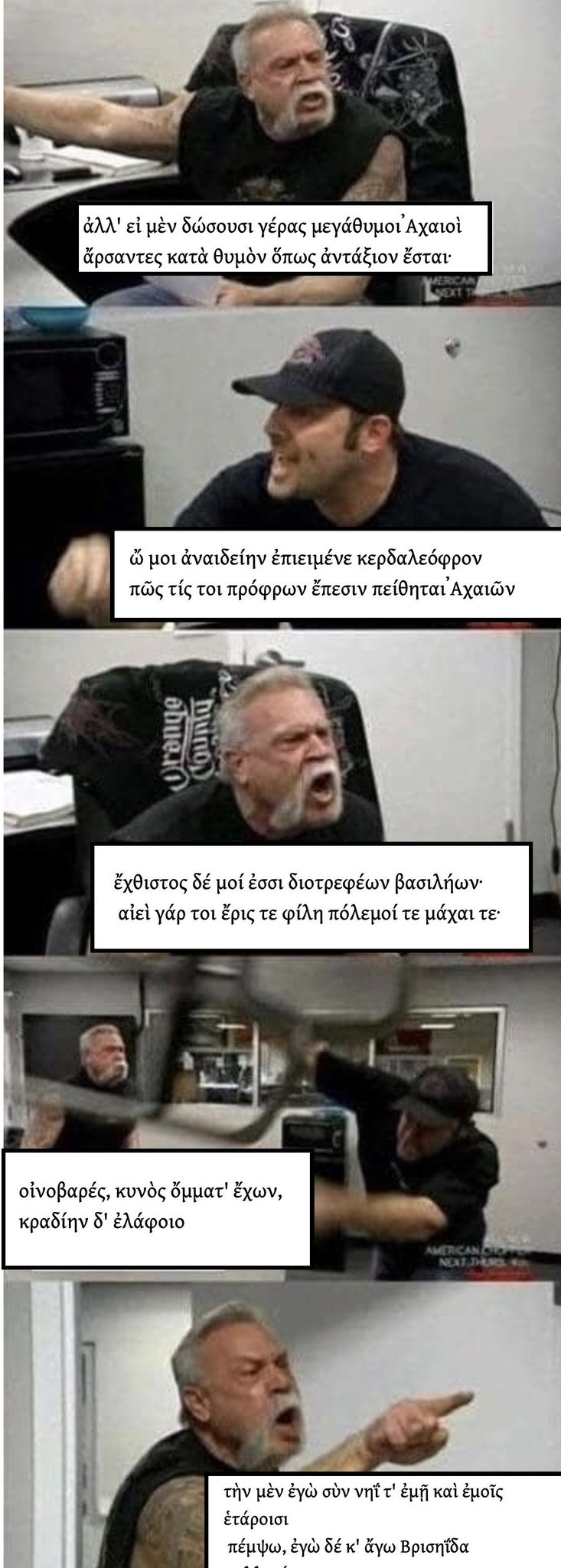
“But, you great shamepot, we follow you so that you feel joy, As we collect honor for Menelaos and you, dog-face, From the Trojans—you don’t shudder at this, you don’t care.”
Selected Passages (Using the Stanley Lombardo translation with permission from Hackett)
Iliad 1 Agamemnon and Achilles’ argument
Iliad 6 Hector and Andromache
Iliad 19 Agamemnon and Achilles reconcile – may be cut for time
Iliad 22 Andromache’s first lament for Hector
Iliad 24 Achilles and Priam
Iliad 24 Priam, Hecuba, Andromache and Helen laments for Hector
Iliad 1.224–228 [Achilles Addressing Agamemnon]
“Wine-sod! Dog-eyes! You have the heart of a deer! You never suffer to arm yourself to enter battle with the army Nor to set an ambush with the best of the Achaeans. That seems like death itself to you!”
“After a while, Diomedes good-at-the warcry, addressed them: “I will fight with you first because you are being foolish, son of Atreus, Which is right, Lord, in the assembly. So don’t get angry at all.”
Artistic Director: Paul O’Mahony (Out of Chaos Theatre) Associate Director: Liz Fisher Director of Outreach: Amy Pistone (Gonzaga University) Dramaturg: Emma Pauly Executive Producer: Lanah Koelle (Center for Hellenic Studies) Producers: Keith DeStone (Center for Hellenic Studies), Hélène Emeriaud, Janet Ozsolak, and Sarah Scott (Kosmos Society) Poster Artist: John Koelle Poster Designer: Allie Marbry (Center for Hellenic Studies)
Iliad 21.461-465
“Then lord Apollo the far-shooter answered, “Earthshaker, you would not think that I would be prudent If indeed I fought with you over mortals, Wretched men who are like the leaves now flourish Until they grow full, eat the fruit of fields, And then they diminish until they die…”
October 14 Rhesus, Euripides with Mary Ebbott (College of the Holy Cross)
Saturday, October 17 Assemblywomen, Aristophanes with Francisco Barrenechea (University of Maryland, College Park)
October 21 Agamemnon, Aeschylus with Fiona Macintosh (University of Oxford)
Iliad 24.503-6
“Achilles, respect the gods and take pity, Once you think of your own father. I am even more pitiable, Since I endure what no other mortal person ever has, To reach my hands to the lips of the man who slaughtered my child.”
“You, child, will also either follow me Where you will toil completing the wretched works Of a cruel master or some Achaean will grab you And throw you from the wall to your evil destruction Because he still feels anger at Hektor killing his brother Or father or son, since many a man of the Achaeans dined On the endless earth under Hektor’s hands.”
“After heaping up the mound [sêma] they returned. Then Once they were well gathered they shared a fine feast In the halls of the god-nourished king, Priam. Thus they were completing the burial of horse-taming Hektor.”
“Come, let us build walls now,
A speaking, intricate, construction of words”
εἶα τειχίζωμεν ἤδη ποικίλον
κόσμον αὐδάεντα λόγων
Dio Chrysostom, Diogenes, Or On Tyranny (6.37)
“And still when he was awake, he would pray to be asleep to forget his fears. But when he was asleep, he jumped up as soon as possible because he believed he was being killed by his dreams, that the golden-plane tree, all the mansions of Semiramis, and the walls of Babylon were useless to him”
“[Antisthenes used to say] “rational thought is the mightiest wall. It never falls apart or betrays you. We must build walls in our own unconquerable calculations.”
“Value nothing which compels you to break your promise, to abandon your honor, to hate, suspect or curse anyone, to be a hypocrite, or to lust after anything which needs walls or decorations.”
“Imagine that a set of people inhabit the same place, what should make us believe that they inhabit a single state? For, it could not be walls since it would certainly be possible to build a wall around all of the Peloponnese.”
“But you will give us a home there, or how will we be able to survive the cold? You have many homes in your walls left empty. One of them is enough for us.”
“Don’t you think that we should know what affects our homes—what is happening and what occurs in a home which is not bounded by our walls but is instead the whole world, the dwelling and homeland the gods gave us to share, since, especially, if we are ignorant of these things, we must be ignorant of many other weighty matters too?”
An tu ad domos nostras non censes pertinere scire, quid agatur et quid fiat domi, quae non ea est, quam parietes nostri cingunt, sed mundus hic totus, quod domicilium quamque patriam di nobis communem secum dederunt, cum praesertim, si haec ignoremus, multa nobis et magna ignoranda sint?
[for the the theme of being a citizen of the world, see this post]
Seneca, De Tranquillitate Animi 4-5
“We do not shut ourselves up in the walls of a single city as proof of our great souls, but instead we enter into exchange with the whole world and claim the world as our homeland so that we are allowed to give our virtue a wider field.”
Ideo magno animo nos non unius urbis moenibus clusimus, sed in totius orbis commercium emisimus patriamque nobis mundum professi sumus, ut liceret latiorem virtuti campum dare.
“Did they not hear from you, when they were children,
What kind of a man Odysseus was among your parents,
He did nothing unfair nor said anything [unfair]
Among the people? This is the right of divine kings—
They can hate some people and love another.”
“this is the way of kings, to hate one person but love another. Etc. This line is presented gnomically about kings, because they hate some people but love another. This is not strictly applicable to Odysseus. Therefore line must be taken for use in this particular situation.”
“A new era begins with the name of Friedrich August Wolf 1824). His father was the schoolmaster and organist of the little village of Hamrode near Nordhausen, south of the Harz, and it was to his mother that he owed the awakening of his intellectual life. Before he had attained the age of two, he knew a large number of Latin words, and, before he was eight, had acquired the rudiments of Greek and French, and could read an easy Latin author. His memory was as remarkable as that of Porson, who was born in the same year. His parents soon removed to Nordhausen, where, by the age of twelve, he had learned all that his instructors could teach him. At his new home, the first of his three head-masters was Johann Andreas Fabricius (1696 1769), the author of a History of Learning. Towards the end of his school-days he became his own teacher. Starting once more with the declensions, he ‘read with new eyes the Latin and Greek Classics, some carefully, others more cursorily; learnt by heart several books of Homer, and large portions of the Tragedians and Cicero, and went through Scapula’s Lexicon and Faber’s Thesaurus’. During this time of strenuous study, ‘he would sit up the whole night in a room without a stove, his feet in a pan of cold water, and one of his eyes bound up to rest the other’. Happily this severe ordeal ended with his removal to the university of Gottingen.”
Consider this how this could turn out on many ships or even just one: there is a captain of some size and strength beyond the rest of the men in the ship, but he is deaf and similarly limited at seeing, and he knows as much about sailing as these qualities might imply. So, the sailors are struggling with one another about steering the ship, because each one believes that he should be in charge, even though he has learned nothing of the craft nor can indicate who his teacher was nor when he had the time to learn. Some of them are even saying that it is not teachable, and that they are ready to cut down the man who says it can be taught.
They are always hanging all over the captain asking him and making a big deal of the fact that he should entrust the rudder to them. There are times when some of them do not persuade him, and some of them kill others or kick them off the ship, and once they have overcome the noble captain through a mandrake, or drugs, or something else and run the ship, using up its contents drinking, and partying, and sailing just as such sort of men might. In addition to this, they praise as a fit sailor, and call a captain and knowledgeable at shipcraft the man who is cunning at convincing or forcing the captain that they should be in charge. And they rebuke as useless anyone who is not like this.
Such men are unaware what a true helmsman is like, that he must be concerned about the time of year, the seasons, the sky, the stars, the wind and everything that is appropriate to the art, if he is going to be a leader of a ship in reality, how he might steer the ship even if some desire it or not, when they believe that it is not possible to obtain art or practice about how to do this, something like an art of ship-steering. When these types of conflicts are occurring on a ship, don’t you think the one who is a true helmsman would be called a star-gazer, a blabber, or useless to them by the sailors in the ships organized in this way?
“In his sexual relationships with boyfriends, much more even than those activities for having children, a tyrant falls short of happiness. Certainly, we all understand that sexual pleasures are much increased under the influence of desire. But desire is certainly least willing to arise in a tyrant.
For lust does not take pleasure in aiming for things ready at hand, but instead for those things that are only hoped for. For this reason, a man who knows nothing of thirst gets no pleasure from drinking; and the man untested by desire is inexperienced of the sweetest sexual delights”
“It is understandable that he brought a prejudice on the highest offices in the land, which would no longer allow people to return the characters they started with, but instead could make them mean, boastful, and inhumane. Whether this is a movement or a change of nature because of chance or it is an unmasking of the truth when there is evil in authority, some other investigation will discover.”
“The Attic sex-worker, once the torturer was finally worn out, chewed threw her own tongue and spat it out at the face of the angry tyrant—that is, she spat out her voice too so that she would not be able to expose her conspirators if she was overcome…”
Attica meretrix carnifice iam fatigato postremo linguam suam comesam in faciem tyranni saevientis exspuit, ut exspueret et vocem, ne coniuratos confiteri posset, si etiam victa voluisset.
Plutarch, Moralia 1088b
“Metrodoros says ‘I have often spat on the pleasures of the flesh.’ ”
“One of them came right up to him and spat at him.”
εἷς δὲ καὶ προσέπτυσεν ἐξεναντίας προσελθών.
Beekes 2010
Select Papyri, P Gurob. 2
“Woman, you were at that place with Kallipos…and you were insulting me, claiming that I had said to certain people that…When I was insulting you in turn, you spat on me….and took my collar…so I am suing you for assault for 200 drachmae.”
“When someone was criticizing him for spending too much on meals, he said “Wouldn’t you have purchased the same for three obols?” When the man said he would, Aristippos said, “Ok, I am not a hedonist; you are a money-grubber.”
At a different time, Simos, who was Dionysius’ steward, a Phrygian and a nasty fellow too, was showing him expensive houses with fine tile work. When Aristippos coughed and spat in his face and he resented it, the man replied, “I didn’t have any more appropriate a place.”
“He never forgot the slight. After the king’s death when Anaxarchus was sailing and was forced to land on Cyprus, Nicocreon had him arrested and placed him on a mortar, ordering that he be pounded to death with iron pestles.
But he, not giving a shit about the punishment, uttered that famous saying, “You pound the bag of Anaxarchus but you do not pound Anaxarchus.” When Nicocreon ordered his tongue to be cut off, the story is that he bit it off and spat it at him.”
On the Advantages and Disadvantages of Literature (Part I):
“Lorenzo Alberti, our father, a man who was in his time easily the best in many things, including in the education of his family (as you yourself know, Carolus), was accustomed to wish us so educated as to appear both at home and outside never to be entirely idle. Having been educated and imbued with this ingenuous and shining discipline of our father, you have always been involved either in the management of business or in the study of literature; I, however, who have applied myself entirely to literature by setting other things at naught, can probably do anything in the world more willingly than to pass a day without either reading or composing something.
For that reason, I am glad that we have brought it about that we can in some part bear moderately, and in some part prudently avoid the adversity and sufferings which have long pressed upon us by resorting to the consultation of literature. Indeed, it seems to me that we should strive with our studies not only to render them beneficial to ourselves, but even more so to make them satisfy the expectation of our friends. Every day all of our friends, to whom my dignity and reputation are dear, beg me to draw forth some fruit of my late nights, so that they can be sure that I have actually achieved something in the labor and assiduity of my studies.”
Laurentius Albertus parens noster, vir cum multis in rebus, tum in educanda familia temporibus suis facile nostrorum omnium princeps, ut meministi, Carole, solitus erat nos ita instructos velle et domi et foris videri, ut nunquam essemus otiosi. Qua quidem ingenua et preclara patris nostri disciplina instituti atque imbuti, tu semper aut gerendis negotiis aut in litterarum cognitione versaris; ego autem, qui me totum tradidi litteris, ceteris posthabitis rebus, omnia posse libentius debeo quam diem aliquam nihil aut lectitando aut commentando preterire.
Qua ex re illud quidem nos assecutos gaudeo, ut adversas quibus diutius premimur erumnas partim ferre moderate, partim vitare prudenter licuerit documentis litterarum. Ac mihi quidem studiis nostris non modo ut nobis tantum prosint, sed magis etiam ut amicorum expectationi satisfaciant enitendum videtur. Namque in dies nostri, quibus et dignitas mea cara est et fama, omnes exposcunt ut fructum aliquem depromam vigiliarum mearum, quo intelligant me meo studiorum labore et assiduitate aliquid profecisse.








.jpg)