“The more clearly a tyrant is afraid, the more people conspire against him because they despise his cowardice. He lives like a person isolated in a small cage where swords are hanging above his head, pointing at him from every direction, some just grazing his skin.
They are fixed this close not just to his body but to the tyrant’s soul too, so much that Tantalos in Hades has an easier plight, the one they say: “fears the rock swinging over his head.” Tantalos, at least, doesn’t have to fear death any more, while the tyrant suffers alive what people say only happens to a corpse.”
Letter From Thomas Jefferson to Francis Eppes, 6 October 1820:
“Your letter of the 28th came to hand yesterday, and, as I suppose you are now about leaving Richmond for Columbia, this letter will be addressed to the latter place. I consider you as having made such proficiency in Latin & Greek that on your arrival at Columbia you may at once commence the study of the sciences: and as you may well attend two professors at once, I advise you to enter immediately with those of Mathematics & Chemistry. after these go on to Astronomy, Natl philosophy, Natl history & Botany. I say nothing of Mineralogy or Geology, because I presume they will be comprehended in the Chemical course. nor shall I say any thing of other branches of science, but that you should lose no time on them until the accomplishment of those above named, before which time we shall have opportunities of further advising together. I hope you will be permitted to enter at once into a course of mathematics, which will itself take up all that is useful in Euclid, and that you will not be required to go formally thro’ the usual books of that Geometer. that would be a waste of time which you have not to spare, and if you cannot enter the Mathematical school without it, do not enter it at all, but engage in the others sciences above mentioned. Your Latin & Greek should be kept up assiduously by reading at spare hours: and, discontinuing the desultory reading of the schools. I would advise you to undertake a regular course of history & poetry in both languages, in Greek, go first thro’ the Cyropaedia, and then read Herodotus, Thucydides, Xenophon’s Hellenies & Anabasis, Arrian’s Alexander, & Plutarch’s lives,, for prose reading: Homer’s Iliad & Odyssey, Euripides, Sophocles in poetry, & Demosthenes in Oratory; alternating prose & verse as most agreeable to yourself. in Latin read Livy, Caesar, Sallust Tacitus, Cicero’s Philosophies, and some of his Orations, in prose; and Virgil, Ovid’s Metamorphoses, Horace, Terence & Juvenal for poetry. After all these, you will find still many of secondary grade to employ future years, and especially those of old age and retirement.”
“Whoever trusts a dishonest man to keep him safe,
Discovers ruin where he thought he would find aid.
When the doves were often fleeing from the kite
And were avoiding death by wings’ rapid flight
The kite turned his plans toward deceit
And tricked the silly race with this conceit:
“Why do you live a live with so much worrying,
When with a simple oath, you could make me king?
I would keep you safe from every harm?”
Believing him, they put their safety in his arms.
Once he gained the realm he ate them one by one
And exercised his power with the harshest talons.
Then one of the remaining doves reflected,
“We deserve this: we gave our life to a criminal we selected.”
I.31 Milvus et Columbae
Qui se committit homini tutandum improbo,
auxilia dum requirit, exitium invenit.
Columbae saepe cum fugissent milvum,
et celeritate pinnae vitassent necem,
consilium raptor vertit ad fallaciam,
et genus inerme tali decepit dolo:
“Quare sollicitum potius aevum ducitis
quam regem me creatis icto foedere,
qui vos ab omni tutas praestem iniuria?”
Illae credentes tradunt sese milvo.
Qui regnum adeptus coepit vesci singulas,
et exercere imperium saevis unguibus.
Tunc de reliquis una “Merito plectimur,
huic spiritum praedoni quae commisimus”.
“It is not impossible for however so many people become tyrants of a city or small country to escape their regime and live somewhere else in hiding. Yet no one loves a tyrant, instead people hate them, are suspicious of them, and easily give them up to those they wronged.
But those who rule over many cities, peoples, and endless land, as the Persian king does, cannot ever escape, not even if they come to understand their troubles when some god frees them of their ignorance. A tyrant could never live safely, not even if he turned into bronze or iron, because even then he’d die, broken into pieces and melted down.”
“It was necessary that those who readily accept the wealth that sees should give up the senseless wealth to those who still are lacking in perception. The Greeks sing the praises of Anaxagoras and Democritus because they were so struck by philosophy that they allowed their fields to be ground down by sheep.
I do admire those men myself because they showed that they were stronger than wealth—but how much better would it have been if they had not given up their possessions to feed beasts but instead used them for the needs of people, their friends and family, transforming their loss of interest into wealth for someone else.
That first action is negligent—it would be considered nuts if Greece did not admire those people—while the second is sober, something carefully thought out.”
Plutarch’s “To the Uneducated Ruler” has no relevance today, at all (780a-c)...
“The majority of kings and rulers are stupid–they imitate those artless sculptors who believe that their over-sized figures seem large and solid if they make them with a wide stance, flexing their muscles, mouths gaped open. For these types of rulers seem merely to be imitating the impressiveness and seriousness of leadership with their deep voice, severe glance, bitter manners and their separate way of living: but they are not really any different from the sculpted colossus which is heroic and godly on the outside, but filled with dirt, stone or lead within.
The real difference is that the weight of the statue keeps it standing straight, never leaning; these untaught generals and leaders often wobble and overturn because of their native ignorance. For, because they have built their homes on a crooked foundation, they lean and slide with it. Just as a carpenter’s square, if it is straight and solid, straightens out everything else that is measured according to it, so too a leader must first master himself and correct his own character and only then try to guide his people. For one who is falling cannot lift others; one who is ignorant cannot teach; one who is simple cannot manage complicated affairs; one who is disordered cannot create order; and one who does not rule himself cannot rule.”
“Among the weak, base and private citizens, ignorance when combined with a lack of power yields little wrongdoing, as in nightmares some trouble upsets the mind, making it incapable of responding to its desires. But when power has been combined with wickedness it adds energy to latent passions. And so that saying of Dionysus is true—for he used to say that he loved his power most when he could do what he wanted quickly. It is truly a great danger when one who wants what is wrong has the power to do what he wants to do.
As Homer puts it “When the plan was made, then the deed was done.” When wickedness has an open course because of its power, it compels every passion to emerge, producing rage, murder, lust, adultery, and greedy acquisition of public wealth.”
“It is not possible to hide wickedness in power. But, as when someone with vertigo* might go up in a high place and move around, only to become dizzy and uncertain, thus revealing their suffering, so fortune amplifies the untaught and ignorant a little with some wealth, reputation or offices and, once they have risen up, it shows them falling. Or rather, it is the same as when you cannot tell which of some containers is solid and which is cracked but when you pour water into them, the culprit leak is clear: rotten minds cannot manage power, but they ooze out random desires, rages, improprieties, and base manners.”
“Against those in power, no one has enough defense
If a wicked advisor also enters the scene
His power and malice ruins their opposition.
An eagle carried a tortoise on high,
When he pulled his body in his armored home to hide,
And rested hidden untouched by any attack,
A crow came on a breeze flying near them:
“You have well seized a precious prize with you talons,
But, if I don’t show what you need to do,
It will pointlessly wear you out with its heavy weight.”
Promised a portion, the crow instructs the eagle to drop
The hard shell from the stars upon a cliff’s rock.
It would be easy to feed on the broken flesh!
The eagle followed up these wicked instructions
And also split the feast with her teacher.
Just so, the tortoise who was safe by nature’s gift.
Was ill-matched to those two and died a sad death.”
Contra potentes nemo est munitus satis;
si vero accessit consiliator maleficus,
vis et nequitia quicquid oppugnant, ruit.
Aquila in sublime sustulit testudinem:
quae cum abdidisset cornea corpus domo,
nec ullo pacto laedi posset condita,
venit per auras cornix, et propter volans
“Opimam sane praedam rapuisti unguibus;
sed, nisi monstraro quid sit faciendum tibi,
gravi nequiquam te lassabit pondere.”
promissa parte suadet ut scopulum super
altis ab astris duram inlidat corticem,
qua comminuta facile vescatur cibo.
inducta vafris aquila monitis paruit,
simul et magistrae large divisit dapem.
sic tuta quae naturae fuerat munere,
impar duabus, occidit tristi nece.
“You’re going so slow: why don’t you want to go faster”
Be careful or I will sink my sting in your neck!”
The mule answered, “Your words are not my master;
I fear this fool who sits at the front of my cart:
He holds me back with flicking whip
And pulls at my face with dripping reins as I start!
So screw off with your arrogant show!
I know where I need to dawdle and when I need to run.”
With this story it is therefore right to mock,
Whoever without action offers empty talk.
Musca in temone sedit et mulam increpans
“Quam tarde es” inquit “non vis citius progredi?
Vide ne dolone collum conpungam tibi.”
Respondit illa: “Verbis non moveor tuis;
sed istum timeo sella qui prima sedens
cursum flagello temperat lento meum,
et ora frenis continet spumantibus.
quapropter aufer frivolam insolentiam;
nam et ubi tricandum et ubi sit currendum scio.”
Hac derideri fabula merito potest
qui sine virtute vanas exercet minas.
Vergerio, de ingenuis moribus et liberalibus adulescentiae studiis, LIV:
“There is indeed good reason to gather together those times which others tend to neglect, as when we read at dinner or awaits sleep (or avoids it) by reading. Yet, the doctors tell us that these practices are bad for our sight and eyes; this is true if we read too much, that is to say, either too intently or after an excessive meal. But it will also be to our advantage if we set up, in our libraries and right before our eyes, those instruments which are used to measure the hours and times more generally, so that we may see time as it flows and slips away from us. It would also be useful if we were to use those places for nothing else than what they were established, allowing there no external business or thought.”
Bonae etenim rationis est ea quoque bona colligere quae solent neglegere ceteri, ut si quis super cenam legat et somnum quidem inter libros exspectet aut certe per libros fugiat. Quamquam physici obesse ea visui luminibusque contendunt; quod et verum est, si modo praeter modum, id est, aut intentione nimia aut super multam saturitatem id fiat. Sed et illud quoque proderit nonnihil, si intra bibliothecas nostras coram atque in oculis instrumenta haec constituamus, quibus horas ac tempora metiri solent, ut quasi tempus ipsum fluere labique videamus, et si eis ipsis locis ad nihil aliud quam ad quod instituta sunt utamur, nullam ibi aut occupationem aut cogitationem extremam admittentes.
This week, we turn to the most tragic of epics (according to Aristotle, at least), Homer’s Iliad
As everyone knows, the Iliad begins with the rage of Achilles. As many of us forget, it ends not with the Trojan Horse or the death of Achilles, but instead with the burial of horse-taming Hektor. I think it is probably dangerous to ask a Homerist to tell you about the Iliad, because so often we don’t know where to start, whether it should be in thinking about its relationship with the Odyssey or about what it means to say the word “Homer”. True Story: many years ago, while patronizing a drinking establishment in Queens, my wife asked me to tell her what the Iliad was about. After about 45 minutes, she asked how much more there was to it. I had not even finished book 1 yet…
Ancient performers of the epics didn’t have these challenges because audiences grew up hearing stories about most of the events and characters they would be singing about and because the performance contexts didn’t expect them to tell the whole story. We don’t know a lot about the actual performance contexts and practices of Homeric poetry in the ancient world (see the work of José Gonzalez on rhapsodes, Casey Dué’s work on multiformity, Egbert Bakker’s From Formula to Poetics or any of Gregory Nagy’s Poetry as Performanceor Plato’s Rhapsogy and Homer’s Music), but it seems likely that the stories were performed in episodes at various occasions and at times in monumental performances at festivals. How these performances were prepared is another issue: some think they were memorized from a script, others think they were composed in performance. I tend towards the latter belief with the acknowledgement that even when something is composed in performance, there are various degress of fixity from one performance to another and one singer to another…
And, here again, I have started to trail off. Often people talk about performance of song within Homer to start us thinking about epic performance (the songs of Demodokos and Phemios in the Odyssey; Achilles singing to his lyre in the Iliad) but there’s some evidence outside the poems too. One passage comes from Plato’s Ion:
Plato, Ion 535d-e
Ion: Now this proof is super clear to me, Socrates! I’ll tell you without hiding anything: whenever I say something pitiable, my eyes fill with tears. Whenever I say something frightening, my hair stands straight up in fear and my heart leaps!
Socrates: What is this then, Ion? Should we say that a person is in their right mind when they are all dressed up in decorated finery and gold crowns at the sacrifices or the banquests and then, even though they haven’t lost anything, they are afraid still even though they stand among twenty thousand friendly people and there is no one attacking him or doing him wrong?
Ion: Well, by Zeus, not at all, Socrates, TBH.
Socrates: So you understand that you rhapsodes produce the same effects on most of your audiences?
Ion: Oh, yes I do! For I look down on them from the stage at each moment to see them crying and making terrible expressions, awestruck by what is said. I need to pay special attention to them since if I make them cry, then I get to laugh when I receive their money. But if I make them laugh, then I’ll cry over the money I’ve lost!”
Note in this passage that Plato’s Socrates assumes that Ion is faithfull performing a ‘text’ ascribed to Homer and that they both identify as salient features of the performance the context (“sacrifices” and “festivals”) the emotional affect (crying and carrying on, channeling the emotive content of the scenes) and the impact on the audience (making them cry too) all while emphasizing the material benefit accruing to a rhapsode who pleases his audiences.
When I think about Homeric performance, I think a lot about how little we know about the audiences and their responses and how crucial this was to the shape of the poems we have. I too often forget that the performers were an important part of this process in shaping the reception through their use of intonation, voice, gesture, and tune. So, in our readings from the Iliad today, I will be thinking about the parts, and not the whole, and how performance creates a new text of its own.
We’ve selected some passages today for performance from different parts of the epic to give an idea of the power of the whole and to provide a range of characters for our actors. We will get some of the debate in book 1, some family scenes in Troy, and a whole range of lament and regret. What more could one ask for a Wednesday?
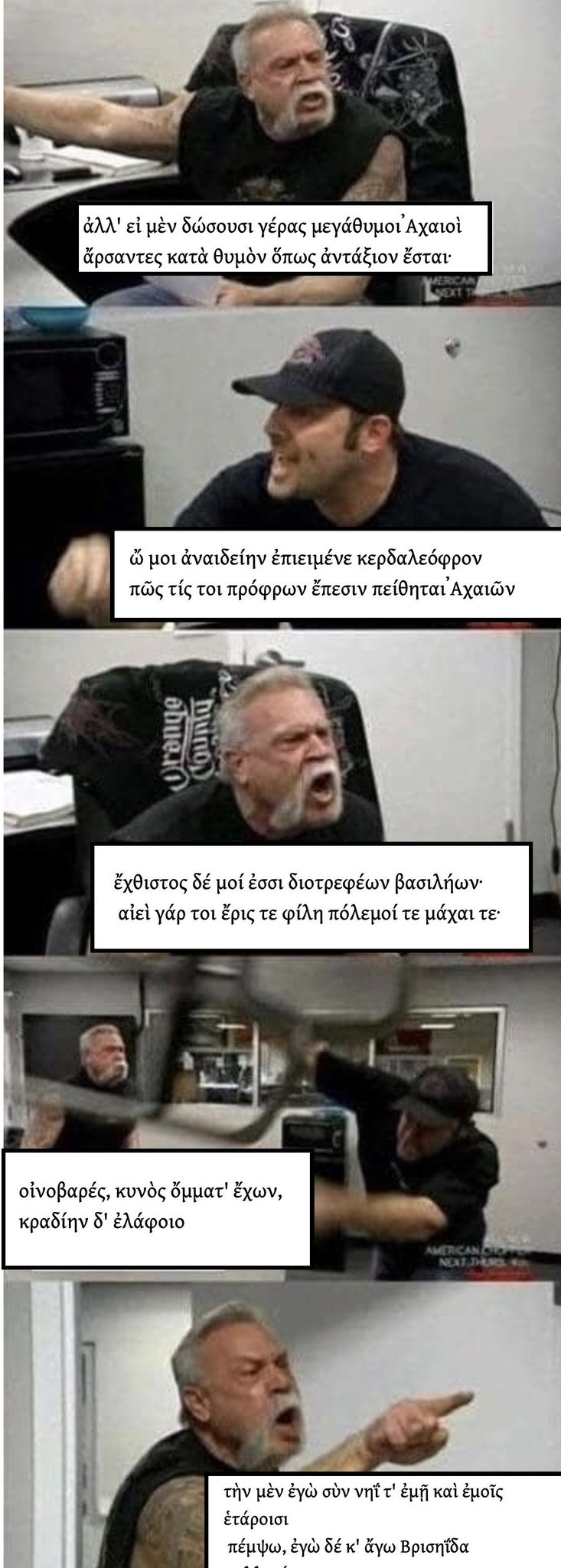
“But, you great shamepot, we follow you so that you feel joy, As we collect honor for Menelaos and you, dog-face, From the Trojans—you don’t shudder at this, you don’t care.”
Selected Passages (Using the Stanley Lombardo translation with permission from Hackett)
Iliad 1 Agamemnon and Achilles’ argument
Iliad 6 Hector and Andromache
Iliad 19 Agamemnon and Achilles reconcile – may be cut for time
Iliad 22 Andromache’s first lament for Hector
Iliad 24 Achilles and Priam
Iliad 24 Priam, Hecuba, Andromache and Helen laments for Hector
Iliad 1.224–228 [Achilles Addressing Agamemnon]
“Wine-sod! Dog-eyes! You have the heart of a deer! You never suffer to arm yourself to enter battle with the army Nor to set an ambush with the best of the Achaeans. That seems like death itself to you!”
“After a while, Diomedes good-at-the warcry, addressed them: “I will fight with you first because you are being foolish, son of Atreus, Which is right, Lord, in the assembly. So don’t get angry at all.”
Artistic Director: Paul O’Mahony (Out of Chaos Theatre) Associate Director: Liz Fisher Director of Outreach: Amy Pistone (Gonzaga University) Dramaturg: Emma Pauly Executive Producer: Lanah Koelle (Center for Hellenic Studies) Producers: Keith DeStone (Center for Hellenic Studies), Hélène Emeriaud, Janet Ozsolak, and Sarah Scott (Kosmos Society) Poster Artist: John Koelle Poster Designer: Allie Marbry (Center for Hellenic Studies)
Iliad 21.461-465
“Then lord Apollo the far-shooter answered, “Earthshaker, you would not think that I would be prudent If indeed I fought with you over mortals, Wretched men who are like the leaves now flourish Until they grow full, eat the fruit of fields, And then they diminish until they die…”
October 14 Rhesus, Euripides with Mary Ebbott (College of the Holy Cross)
Saturday, October 17 Assemblywomen, Aristophanes with Francisco Barrenechea (University of Maryland, College Park)
October 21 Agamemnon, Aeschylus with Fiona Macintosh (University of Oxford)
Iliad 24.503-6
“Achilles, respect the gods and take pity, Once you think of your own father. I am even more pitiable, Since I endure what no other mortal person ever has, To reach my hands to the lips of the man who slaughtered my child.”
“You, child, will also either follow me Where you will toil completing the wretched works Of a cruel master or some Achaean will grab you And throw you from the wall to your evil destruction Because he still feels anger at Hektor killing his brother Or father or son, since many a man of the Achaeans dined On the endless earth under Hektor’s hands.”
“After heaping up the mound [sêma] they returned. Then Once they were well gathered they shared a fine feast In the halls of the god-nourished king, Priam. Thus they were completing the burial of horse-taming Hektor.”





_-_The_Guerilla%27s_Departure_-_RCIN_405092_-_Royal_Collection.jpg)