“The Law of the Twelve Tables commands that anyone who has conspired with an enemy against the state or handed a citizen to a public enemy, should suffer capital punishment.”
Marcianus, ap. Dig., XLVIII, 4, 3: Lex XII Tabularum iubet eum qui hostem concitaverit quive civem hosti tradiderit capite puniri.
“[Cases concerning] death and citizenship must not be pursued except before the greatest assembly and those whom the censors have recorded in the rolls of the citizens.”
de capite civis nisi per maximum comitiatum ollosque, quos censores in partibus populi locasint, ne ferunto.
The death penalty is not the enactment of justice, it is the execution of vengeance when justice is impossible or not actually desired. It does not function as a deterrent. It is meted out disproportionately to people without financial and social capital, which in the United States means that people of color face capital charges and are executed at far higher rates. The moral peril is compounded by the imperfection of our criminal system where at least 1 in 25 people on death row are actually innocent. The death penalty is not part of a justice system, it is part of a vengeance system.
Note the connection in several passages between the sanctity of the state, the power to end a life, and citizenship.
“These opponents have not said that I am guilty of any of the actions for which the established penalty is death–robbing a temple, theft, enslaving someone, betraying the state…”
“Whoever raises a human being into power and thus enslaves the laws, whoever makes the state subordinate to his petty faction and transgresses what is right by doing all of this violently and stirring up civil strife, he should be considered the most inimical to the whole state.
And the kind of person who does not share these actions, but does occupy some of the most important offices of the state and either fails to observe them or does not fail but will not avenge his country because of cowardice, he should be considered as a citizen at a second degree of evil.
Let each person whose worth is small bear witness to the officers of the state by bringing this person to court for his plotting violent and unconstitutional revolution. Give them the same charges we have for temple robbery and run the trial as it is in those cases where the death penalty comes by majority vote.”
“It is right that punishments for other crimes come after them, but punishment for treason should precede the dissolution of the state. If you miss that opportune moment when those men are about to do something treacherous against their state, it is not possible for you to obtain justice from the men who did wrong: for they become stronger than the punishment possible from those who have been wronged.”
“Death is not the most extreme penalty–there are those described in Hades for offenses like this which are beyond death and are truly described, but they are useless in deterring some kinds of minds from their crimes.”
From Brill’s New Pauly on the death penalty in Greece and Rome by Gottfriend Schiemann:
“In Athens not only premeditated killing (phónos) and sedition and high treason (katálysis toû dḗmoû, prodosía ) resulted in the death penalty, but also religious offences such as desecration of the temple (hierosylía) and (cf. in particular the case against Socrates [2], 399 BC) publicly taught godlessness (asébeia). In a similar way, in Rome there was provision for the state death penalty for sedition and high treason (perduellio) by beheading (decollatio , in Greece apokephalízein) with an axe, later a sword. In the Roman Imperial period this was the typical death penalty for honestiores , but now sometimes also for homicide.”
Jacob van Maerlant, (The traitor Ganelon drawn and quartered)., Spieghel Historiael, West Flanders, c. 1325-1335
In the second century CE, Pausanias composed ten books on the sights and wonders of ancient Greece. His text provides some of the only accounts of architecture, art and culture that have been lost in intervening centuries. In his eighth book, he turns to Arcadia and starts by discussing the rituals performed in honor of Lykian Zeus.
The story, mentioned by Plato too, is one of those ‘original sin’ tales from Greek myth–like the story of Tantalos and Pelops, it hearkens back to a golden age when gods and men hung out together. Its details about werewolves are similar to those offered by Pliny (especially the 9-10 year period as a wolf).
“Cecrops was the first to declare Zeus the Highest god and he thought it wrong to sacrifice anything that breathed, so he burned on the altar the local cakes which the Athenians call pelanoi even today. But Lykaon brought a human infant to the altar of Lykaian Zeus, sacrificed it, spread its blood on the altar, and then, according to the tale, turned immediately from a man into a wolf.
This tale convinces me for the following reasons: it has circulated among the Arcadians since antiquity and it also seems probable. For in those days men were guests and tablemates of the gods because of their just behavior and reverence. Those who were good received honor openly from the gods; divine rage fell upon the unjust—then, truly, gods were created from men, gods who have rites even today such as Aristaios, Britomartis the Cretan, Herakles the son of Alkmene, Amphiaros the son of Oicles and, finally, Kastor and Polydeukes.
For this reason we should entertain that Lykaon was turned into a beast and that Niobe became a stone. In our time, when wickedness has swelled to its greatest size and looms over every land and city, no god can come from men, except in the blandishment offered to rulers. Today, divine rage lies in wait for the wicked when they leave for the lower world.
In every age many ancient events—and even those that are current—end up disbelieved because of those who create lies by using the truth. Men report that since the time of Lykaon a man always transforms from a human into a wolf at the sacrifice of Lykaian Zeus, but that he doesn’t remain a wolf his whole life. Whenever someone turns into a wolf, if he refrains from human flesh, people say he can become a man again ten years later. But if he does taste it, he will always remain a beast.”
They did not know whether this was usual at other schools, but certainly it had never been done at Tercanbury. The results were curious. Mr. Turner, who was the first victim, broke the news to his form that the headmaster would take them for Latin that day, and on the pretence that they might like to ask him a question or two so that they should not make perfect fools of themselves, spent the last quarter of an hour of the history lesson in construing for them the passage of Livy which had been set for the day; but when he rejoined his class and looked at the paper on which Mr. Perkins had written the marks, a surprise awaited him; for the two boys at the top of the form seemed to have done very ill, while others who had never distinguished themselves before were given full marks. When he asked Eldridge, his cleverest boy, what was the meaning of this the answer came sullenly :
” Mr. Perkins never gave us any construing to do. He asked me what I knew about General Gordon.”
Mr. Turner looked at him in astonishment. The boys evidently felt they had been hardly used, and he could not help agreeing with their silent dissatisfaction. He could not see either what General Gordon had to do with Livy. He hazarded an enquiry afterwards.
” Eldridge was dreadfully put out because you asked him what he knew about General Gordon,” he said to the headmaster, with an attempt at a chuckle.
Mr. Perkins laughed.
” I saw they’d got to the agrarian laws of Caius Gracchus, and I wondered if they knew anything about the agrarian troubles in Ireland. But all they knew about Ireland was that Dublin was on the Liffey. So I wondered if they’d ever heard of General Gordon.”
Then the horrid fact was disclosed that the new head had a mania for general information. He had doubts about the utility of examinations on subjects which had been crammed for the occasion. He wanted common sense.
The Death of Gaius Gracchus, by François Topino-Lebrun
Ἰλιὰς κακῶν, that is, an Iliad of troubles; used when speaking of the greatest and most numerous calamities, because in Homer’s Iliad there is no type of problem which isn’t covered. For this reason, the learned think that the premises of tragedies were taken from it, just as the plots of comedies were taken from the Odyssey. It is, however, a rather wordy work, hardly finished in twenty-four volumes. Thus, they call any speech which is a little more prolix than necessary ‘longer than the Iliad,’ as Aeschines, against Demosthenes wrote, ‘Ταῦτα δὲ εἰπὼν δίδωσιν ἀναγνῶναι ψήφισμα τῷ γραμματεῖ, μακρότερον μὲν τῆς Ἰλιάδος, κενώτερον δὲ τῶν λόγων οὓς εἴωθε λέγειν’ that is, ‘with these words he gave the decision to the scribe to be read, more long-winded than the Iliad, but more empty than the words with which he usually speaks.’
Eustathius inverts the saying thus: ‘Καὶ παροιμία μέντοι κακῶν Ἰλιάδα φησίν, αὕτη δὲ καλοῦ παντὸς Ἰλιάς,’ that is, ‘the proverb says an Iliad of troubles, but this is an Iliad of everything good.’ Synesius writes in a letter to his brother, Καὶ ὅλως κακῶν ἂν Ἰλιάς περιέστη τὴν πόλιν ἡμῶν, that is, ‘in sum, an Iliad of troubles has surrounded our city.’ Plutarch, in his Conjugal Precepts, writes, ‘Ὁ δὲ ἐκείνων Ἰλιάδα κακῶν Ἕλλησι καὶ βαρβάροις ἐποίησεν,’ that is, ‘but their marriage rites brought a whole Iliad of troubles upon the Greeks and the barbarians.’ For he is talking about the wedding of Paris and Helen, which was the cause of inestimable troubles. Cicero, too, uses this expression in his letters to Atticus: ‘such a great Iliad of troubles hangs over us.’
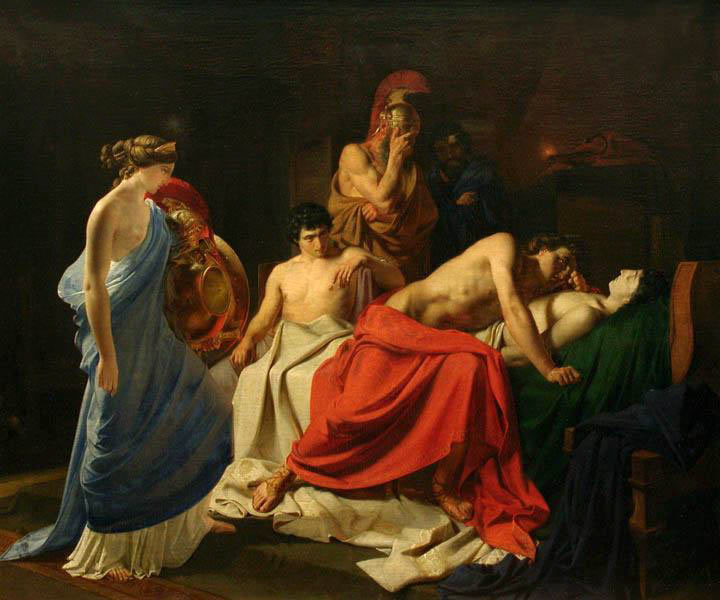
Achilles Lamenting the Death of Patroclus, by Nikolay Ge
Ἰλιὰς κακῶν, id est Ilias malorum. De calamitatibus maximis simul et plurimis. Propterea quod in Iliade Homerica nullum mali genus non recensetur. Vnde ex hac docti putant tragoediarum argumenta fuisse sumpta, sicut ex Odyssea comoediarum. Est autem opus verbosum, viginti quatuor voluminibus vix absolutum. Vnde et quamuis orationem plus satis prolixam Iliade longiorem vocant, vt Aeschines aduersus Demosthenem. Ταῦτα δὲ εἰπὼν δίδωσιν ἀναγνῶναι ψήφισμα τῷ γραμματεῖ, μακρότερον μὲν τῆς Ἰλιάδος, κενώτερον δὲ τῶν λόγων οὓς εἴωθε λέγειν, id est His dictis decretum scribae legendum tradit, prolixius quidem lliade, vanius autem verbis iis quae dicere consueuit.
Eustathius inuertit adagionem ad hunc modum: Καὶ παροιμία μέντοι κακῶν Ἰλιάδα φησίν, αὕτη δὲ καλοῦ παντὸς Ἰλιάς, id est Iliadem malorum prouerbium ait, at haec omnium bonorum llias. Synesius in epistola quadam ad fratrem: Καὶ ὅλως κακῶν ἂν Ἰλιάς περιέστη τὴν πόλιν ἡμῶν, id est In summa, malorum Ilias circunstetit vrbem nostram. Plutarchus in Praeceptis coniugalibus: Ὁ δὲ ἐκείνων Ἰλιάδα κακῶν Ἕλλησι καὶ βαρβάροις ἐποίησεν, id est At illorum nuptiae Iliada malorum Graecis ac barbaris inuexerunt. Loquitur enim de coniugio Paridis et Helenae, quod inaestimabilium malorum fuit causa. Vtitur et M. Tullius in Epistolis ad Atticum: Tanta malorum impendet Ilias.
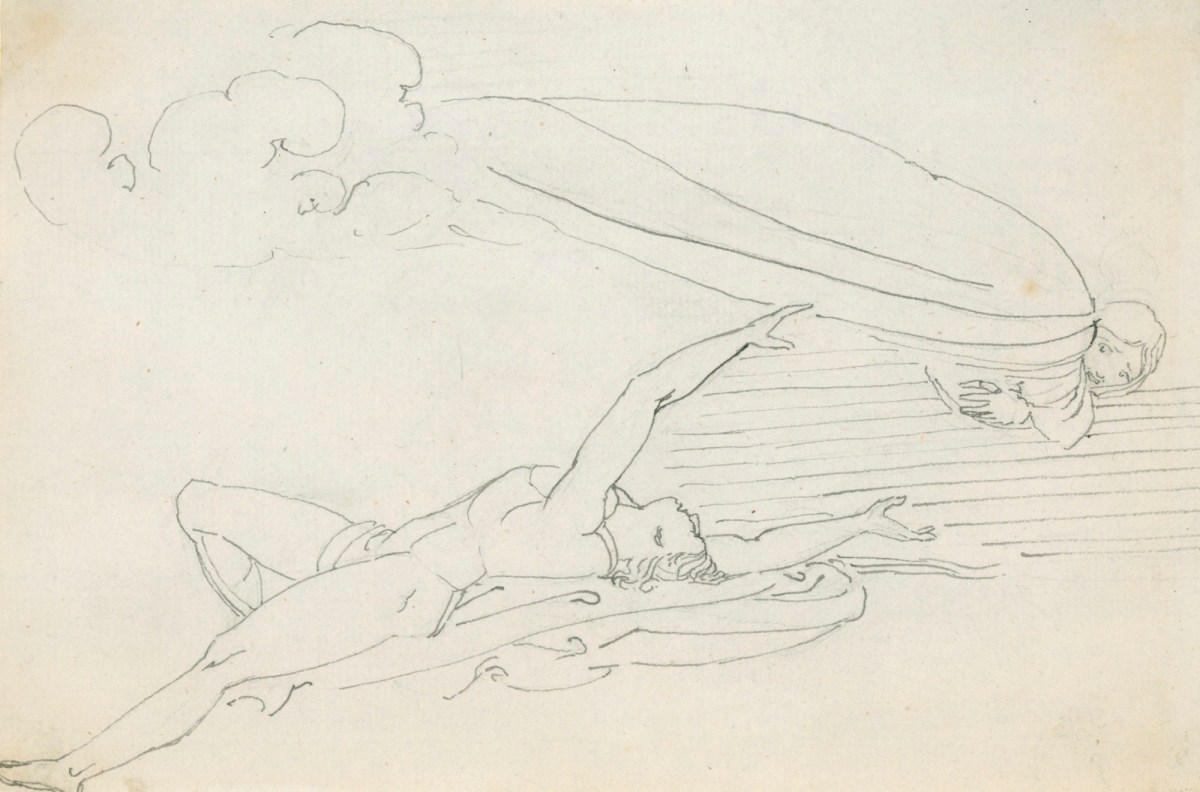
John Flaxman; The Ghost of Patroclus Appearing to Achilles; 1792-3 (c) Royal Academy of Arts
Homer, Iliad 23.65-76
And there appeared to him the ghost of poor Patroclus all in his likeness for stature, and the lovely eyes, and voice, and wore such clothing as Patroclus had worn on his body. The ghost came and stood over his head and spoke a word to him: You sleep, Achilles; you have forgotten me; but you were not careless of me when I lived, but only in death. Bury me as quickly as may be, let me pass through the gates of Hades. The souls, the images of dead men, hold me at a distance, and will not let me cross the river and mingle among them, but I wander as I am by Hades’ house of the wide gates. And I call upon you in sorrow, give me your hand; no longer shall I come back from death, once you give me my rite of burning.
Ghosts, apparitions, miracles, supernatural events, to what extent do we believe in them? And if they were to be real, how much would they differ from each other? At first we need to begin by establishing what we understand by supernatural. If we refer to occurrences that fall outside the laws of nature, then the scope of these events has immediately enlarged, considering that we do not live in nature, but in a world – a human product. Nowadays many things have gone missing from that world; people, places, events. And these disappearances, through quarantine, incarceration or simply prolonged absence, are a kind of supernatural event in reverse – a sudden dis-apparition. But the missing haven’t been abandoned, instead, they lie in a state of abeyance, without being immediately present. With the irresistible and ceaseless flow of time — paraphrasing here Anna Komnene — we begin to question their reality.
Have these things and persons in abeyance then become ghostly presences or apparitions? I like Derrida’s idea that ghosts today are but the return or persistence of elements from the past, because it instantly complicates matters around ghostliness: Since elements from the past are always around us, can we really talk about absence or ghosts? Would it be correct to identify all absences as ghostly? Not sure here what it is exactly that returns or reappears.
We need to turn to dictionaries now, but they aren’t of much help. The only antonyms of ghostly (what is the opposite of a ghost?) that I could find, were the terms ‘natural’ and ‘angelic’, both of which do little in reference to the world, so that there’s not an exact territory of coincidence between ghosts and death. A dictionary of classical literature, on the other hand, tells us that ghosts are difficult to distinguish from supernatural entities or delusions, and yet the really striking part of the definition is that while ghosts seem generally ‘powerless and ineffectual’, they are persistent. I am fascinated by this combination of both persistence and powerlessness in the ghost, because of what it has to say to us about contemporary political narratives.
An example of this persistence comes down to us from the Iliad: Without a proper burial, the ghost of Patroclus, Achilles’ companion, is condemned to wander around the house of Hades for eternity. It would be hard to overstate how important burials were for antiquity (and continue to be so for us, for no clear reason, accounting for the shock at the mass graves of Bergamo and Hart Island during the pandemic) but I don’t want this commonplace trope to distract us from the mysterious apparition. It is one of the strangest dreams in classical literature and the only ghost to appear in the Iliad: Breaking away from the pattern of Homeric dreams, which generally involve divinities that bring knowledge of the future (following a structure of apparition at night when the person has retired, speech, departure, reaction and then dawn), dead Patroclus’ apparition in book XXIII makes no real sense, and it doesn’t bring any new information or steer the narrative in any direction.
The strangeness begins earlier, when Achilles himself performs two unusual tasks one after another (18.316-317): First, he attempts to summon Patroclus back to life by the uncommon gesture of placing his hand on the chest of the dead body as if it were alive and then he greets Patroclus with the formal χαῖρέ (hail!), establishing a distance between himself and Patroclus, implying a separation between them that is hard for Achilles to grasp — is he alive or dead? This attention to detail might seem pesky but given that the repertory of epic is so limited, any deviation in patterns of speech and behavior is telling us something; an innovation is taking place. After the funeral feast, Achilles slumbers into sleep by the seashore, and Patroclus appears to him ‘all in his likeness’ (23.66) with a puzzling request to be buried as soon as possible, given that Achilles had already decided to bury him the next day.
Gregory Buchakjian, photograph of Istanbul’s Tarlabaşı neighborhood that was due to be demolished. May 2013, a few weeks before the Gezi Park demonstrations started. Courtesy of the artist.
Patroclus is dead (at the hand of Hector, who was in turn subsequently slain by Achilles — the heart of the epic) but he hasn’t entered Hades yet. He finds himself in an in-between space, a uniquely hybrid dream/underworld scene where, far from heroic convention, this meeting about memory and the past, is still possible. And yet Patroclus asks Achilles to give him his hand for the last time for he’s nevermore to return from Hades after his burial (23.75). In spite of the immense affection between them, when Achilles tries to embrace him, the shadow suddenly turns into nothingness and dissolves into air (23.99-101), ‘with a shrill cry’. This extraordinary moment of tenderness, apparently innocuous, happens at a pivotal moment in the epic, when the death of Achilles is near – this was no news. Achilles himself is too baffled, and speaks with sadness about Patroclus’ weeping and wailing (23.106), before lighting the funeral pyre, followed by the long funeral games, a series of competitions held in honor of Patroclus and that take up most of the book.
The ghost appears thrice in the book, however on the last appearance (23.221-225), there’s a heartbreaking scene: a distraught Achilles is said to call upon Patroclus’ ghost for a last time, ‘as a father mourns the bones of a son, who was married only now, and died to grieve his unhappy parents’ and ‘[Achilles] dragged himself by the fire in close lamentation’. It seems as if the span of the apparition has come to an end, yet something is about to occur that makes the brief encounter with Patroclus gain immense depth. In book XXIV, Achilles is still agonizingly mourning Patroclus and abusing Hector’s body, dragging it around his friend’s tomb – Hector’s mother Hecuba remarks that even that did not bring Patroclus back to life (24.755-57). The apparition of Patroclus in fact restored Achilles’ humanity which had been buried in his anger and pain. A moment of reckoning arrives here: now he begins to see all the desolation that his anger has caused and there’s a final encounter with mortality in which Achilles accepts Patroclus’ death and also his own.
Commentary on the Iliad is long and intricate – it is a song about war and its disastrous consequences, but also one about political foundations and origins. But I want to dwell on the neglected figure of the ghost. Homeric terminology for the ghost is complex and “Psyché” encompasses meanings as diverse as both life and departed life, and is also used indistinguishably with other terms for soul and mind. As we had earlier seen, the status of the ghost is undefinable, and therefore it stands outside of and sometimes in opposition to the order of memory that establishes a polis upon return to the homeland from the battlefield. In the world of epic, commemoration of great deeds from the past is caught between two temporal modes: Remembering the life of a hero who has already died (remembrance of Achilles from a future standpoint) and preserving that memory as something not forgotten (the lasting permanence of the past), therefore the appearance of the ghost of Patroclus breaks down here the collective recollections of victory and turns inwards, towards remembrance of the past together with Achilles but not collectively with others (23.78).
Though we speak a lot about memory-narratives in the present, collective memory is a function of the regime of history, where things and events have already consolidated into a foundation (or against foundations). Whether the permanence of the memory that founded the body politic in the first place undergoes change, the substance of the space of the polis goes back to a single source. What I want to propose here is an idea of ghosts as communities of memory, distinct from but parallel to political foundations. What if it were possible for memory to become fragmented into different filaments of remembrance of things past and future articulated around the present and stemming from different sources?
A notion of ghosts as communities of memory came from recent work by Turkish sociologists Cihan Erdal (a young scholar now imprisoned in Turkey alongside thousands of other students on bogus charges of political activities) and Derya Fırat, on ‘presentism’ and the temporality of Gezi, the popular uprising that took place in Turkey in 2013 and after which the political landscape of the country has significantly deteriorated into authoritarian rule. Erdal and Fırat question the defeatism of the Western and Turkish Left in regard to utopian moments and whether something remains from them? Has the defeat of Gezi in anyway affected our sense of temporality?
Gezi Park protests graffiti, “The solution is Gandalf, what’s up Derrida?”, Istanbul, June 2013, photograph by the author
On a close reading of Enzo Traverso’s work on the melancholy of the Left, and his assertion that utopias have become a historical form of the past, they speak about the presentism after 1989 that absorbs the past and the future through the opening up of a self-dissolving, sparse present tense, so that this present-timeism builds a thick wall between the present and the past, putting an end to the transference of experience […] particularly in the absence of an alternative model of society. Following from that, their central argument is that the Gezi Park protests attempted to establish a new radical imagination of time (moving simultaneously between past and present, memory and expectation) that disrupted the current neoliberal presentism, and that they did so by imagining utopias both past and future – as a dialogue between different moments of mourning and memory, and between different ghosts that return and persist.
A few words on presentism would help to clarify the extent to which the Iliad as a foundational narrative is able to time-travel in order to tell us something about the present: Admittedly there’s no concept of linear time in Homer, in the same way that our fractured temporality — the temporariness of life under presentist authoritarian regimes, we’ve been ejected from time — attempts to grasp the past in order to imagine other possibilities: The subject of the Iliad is time itself and the durability of memory that withstands the withering flow of this ever-present time. Achilles’ most famously referred description as κλέος ἄφθιτον (of unwithering glory) expresses this desire as an action yet to be completed (9.410-416) simultaneously in the past and future. Time might be abstract but it is also a force that produces change, and this is what presentism (in Homer as the returning cycles of nature and in our times as the capitalist eternity of markets and the internet) is attempting to erase by collapsing the future-orientation of utopia or memory into an obsolete historical form, predicated on the ends of history: This is the best of all possible worlds.
While it’s been constantly argued that memory and mourning is the way out of the amnesia of presentism (why are we so shocked about Bergamo and Hart Island but not so much about the mass graves of wars elsewhere within the same time period?), the politics of ghosts proposed by Erdal and Fırat reframes this work of memory beyond both static remembrance of the past and restoration of past utopias. Remembrance becomes here a different orientation, which created means of communication between different historical moments and social movements, preventing the present or the past from exercising authority over each other. Ghosts from the past are speaking to each other in the here-and-now, expressing not only the”no longer” that has passed, but a sense of continuity anchored in “not yet” and “would be” referred towards the future — a typology of Iliadic time.
The ghosts that we are dealing with in here are moments of upheaval, uprising and utopia that have been deeply buried in the collective imagination but that have the power to return any time – the function of latency – without destroying the fabric of time by attempting futile restorations. These ghosts are not only moments of political action, but also catalysts thereof, such as commemorations of events and memories of violence. In the context of Gezi, for example, Erdal and Fırat mention that when Taksim Square was banned for workers in 1979, the symbols of the left factions were hung on Konak Square in the city of Izmir, a gesture that was repeated in 2013 on the facade of the Atatürk Cultural Center in Istanbul. As a checkpoint in political memory, the building was subsequently demolished, and yet this doesn’t guarantee that these ghosts will not return again and again: Apparently, the trade-free shopping between ghosts continues. Within the world of the Iliad, physical objects, decaying structures — of ships and tombs, and moments lost in time provide a record of the past that continues to exert force upon the present.
The fundamental problem that Erdal and Fırat see with with the work of mourning (over utopian pasts) is that it requires a dead body and a burial, but how can something be buried if it is absent or has never been completed? For Derrida, the ghost cannot even be called a being, because it doesn’t exist – it is both present and non-existent, and therefore one cannot enter into mourning with ghosts, because ghosts never die, they always keep coming back. The recognition of the presence of the ghost in its unburied state, is also a call for practical justice and therefore, a reinscription of experience within time, rather than against it: This proposal is also a formulation of justice so that time out of joint can be rectified. It is one that will provide an exit from the present in crisis and will bring us to justice by building this new relationship with both past and future. It is a politics of ghosts that, on the one hand, aims to put an end to the violence of the present against the past, and on the other hand, it will overcome the possibility of the past and future to dominate / erode the present.
Atatürk Cultural Center, Gezi Park protests, Istanbul, June 2013, photograph by the author
In a time of global upheaval, although we are still trapped in the presentism of catastrophe and disaster which is one of the most common narratives of capitalism — the emergency, the possibility of closing the distance between the present and a horizon of expectation about the future has not been completely closed. The future is still a latent possibility that might awake again at some undefined point. Is this future coming from the past? There’s no assurance, sometimes the future arises out of itself, but the cancellation of movement inside historical planes is not a viable solution when the present alone is too fragile to hold institutions and moral reflexions. In a world replete with ghosts – paraphrasing Derrida – the supernatural is no longer an extraordinary occurrence, but the nature of all political action. Insofar as all human action remains unpredictable, in both motive and intended goal, it is always miraculous and supernatural in the sense that it is highly improbable and yet actual.
But if all worldly existence and political life is invaded by ghosts, how to distinguish then between the ghost and reality? We think that memory should be reconstructed today and considered as a radical invitation to democratize the relationship between generations in political space. Political space is always a term that brings us back to the Iliad again: This isn’t only a concept of memory, since physical spaces as the containers of memory, are replete with debris that functions as “clocks” measuring time through both deterioration and durability. The constant apparitions of the past in these spaces remind us that although encounters with ghosts are ephemeral, they can serve as markers of the short distance between no longer and not yet, as expressed in the “now” emphasis in the words of Menelaus in the Iliad, while remembering Patroclus in such a way that this now, although stemming from the present, becomes a memory for a would-be future:
Homer, Iliad 17.670-672
Now let each one of you remember poor Patroclus who was gentle, and understood how to be kindly toward all men while he lived. Now death and fate have closed in upon him.
Here the conversation about ghosts and the supernatural is also a conversation about very long spans of memory across time: While all politics is grounded in human action and all human action is supernatural, our standard liberal model of society attempts to dovetail action and do away with politics by reducing it to bureaucratic administration and the satisfaction of human needs in nature, therefore its alleged emphasis on the social and economic question. But it was at the very beginning of our tradition of politics, in the Iliad, when the ability to change the flow of time in any direction, was considered the benchmark of rising above the cycles of nature, and therefore making action and speech identical with freedom. Anthropologists David Graeber and David Weingrow speak about freedoms that were common to many early human societies in the past and that we have abandoned: The freedom to refuse orders, to move away and to create entirely new social orders or move between different ones. This ability for new beginnings is at the heart of the Iliad‘s struggle against the destructive influence of time.
Little did they know (they couldn’t), Cihan Erdal and Derya Fırat, at the time their work was published in the end of 2019, that the politics of ghosts would become a mainstay of political life only a few months later when we would temporarily lose the world, and become entirely surrounded by ghosts. But interestingly enough, they do mention at the end of their essay the songs of Victor Jara rising from the squares and balconies in the capital Santiago in Chile or the yellow vests in the streets of Paris as a part of the conversation between ghosts. Only a few days ago, a referendum in Chile overthrew the constitution from the Pinochet dictatorship, even as many other uprisings are taking place and failing elsewhere. The ghost dialogue about new beginnings continues…
‘Being here, today, is accepting to live with our ghosts, to long for them, to feed them’ said Lebanese artists Joana Hadjithomas and Khalil Joreige years ago (I know the quote is real, but I cannot locate its source, therefore it remains itself a ghost), speaking about incomplete mourning: these ghosts are present among us, and the spaces they occupy are irredeemable – a gap that cannot be closed, but they can suddenly break out of the present by throwing us back into the future, a future that can be remembered and over which it is also possible to act. In a fragment from the Myrmidons, a lost play of Aeschylus, recounting aspects of the story of Achilles and Patroclus, unknown or too obvious to the Iliad, Achilles scolds his comrade Antilochus, reversing the nature of mourning over his companion Patroclus – we are not in mourning over the missing, but over ourselves:
Scholia to Aristophanes
Antilochus, bewail me, the living, rather than him, the dead; for I have lost my all.
᾿Αντίλοχ’, ἀποίμωξόν με τοῦ τεθνηκότος τὸν ζῶντα μᾶλλον.
[Fragments in italics, from Cihan Erdal and Derya Fırat, “Toplumsal Hareketler ve Bellek İlişkisi: Yas ve Anmadan Hayaletler Siyasetine” (The Relationship Between Social Movements and Memory: From Mourning and Remembrance to the Politics of Ghosts) Birikim, December 2019, translated and paraphrased by the author]
Cihan Erdal, courtesy of Omer Ongun
On September 25, 2020, Cihan Erdal, a 32-years-old PhD researcher in the Department of Sociology and Anthropology at Carleton University in Canada, was arrested in Istanbul. The charges stem from events back in 2014, which are being used to continue persecuting members of the leftist HDP political party. Erdal and 81 others have been targeted because they are all signatories to a letter calling for the government to protect a Kurdish town under ISIS attacks. He was placed in solitary confinement in Ankara until October 23, 2020. No indictment and no hearing date has been announced yet. If convicted, he might be facing a potential life sentence. Some 2500 academics worldwide have signed a petition for his release. As an LGBT person, he is at risk of additional persecution over his sexuality. Cihan has been based in Canada since 2017 and his research is largely focused on youth-led social movements in Europe, including Turkey. Learn more about the case at https://freecihanerdal.wordpress.com/
Send letters to Cihan Erdal:
Cihan Erdal adına Sincan 2 Nolu F Tipi Yüksek Güvenlikli Kapalı Ceza İnfaz Kurumu 06930 Yenikent/Sincan-ANKARA
Acknowledgements: Gregory Buchakjian & Joana Hadjithomas in Beirut for (almost) a decade of conversations, both present and absent, about ghosts, our own and others’. Dedicated to Cihan Erdal, for your prompt liberation.
Demolition of Atatürk Cultural Center, Istanbul, May 2018, photograph by the author
Arie Amaya-Akkermans is a writer and art critic based in Istanbul. He’s also tweeting about Classics, continental philosophy, contemporary art and Turkey/Greece.
Bibliography:
Arie Amaya-Akkermans, “Revolution or Redemption? The Middle East” in Revolutions: Finished and Unfinished, from Primal to Final, ed. P. Caringella, W. Cristaudo & G. Hughes, Cambridge Scholars Publishing, 2012, pp 329-249
Hannah Arendt, “Introduction to Politics” in The Promise of Politics, Schocken Books, 2005, pp 93-200
Hannah Arendt, “What is Freedom?” in Between Past and Future, Penguin Classics, 2006, pp 142-169
Hannah Čulík-Baird, “The Fragment as Form”, UT Austin Lecture, 25th September 2020, online.
Cihan Erdal & Derya Fırat, “Toplumsal Hareketler ve Bellek İlişkisi: Yas ve Anmadan Hayaletler Siyasetine” (The Relationship Between Social Movements and Memory: From Mourning and Remembrance to the Politics of Ghosts) in Birikim, 368, December 2019, 35-43
R.K. Fischer, “The Concept of Miracle in Homer”, Antichthon, 29 (1995), pp 1-14
Lorenzo F. Garcia, Homeric Durability: Telling Time in the Iliad, Hellenic Studies Series 58, Center for Hellenic Studies, 2013, online.
George Alexander Gazis, Homer and the Poetics of Hades, Oxford University Press, 2018
David Graeber, Debt: The First 5000 Years, Melville House, 2012
Agnes Heller, A Philosophy of History in Fragments, Wiley-Blackwell, 1993
Nat Muller, “What Was Lost: Joana Hadjithomas and Khalil Joreige in conversation with Nat Muller” Ibraaz, 2012, online.
W.B. Stanford, “Ghosts and Apparitions in Homer, Aeschylus and Shakespeare” in Hermathena, No. 56 (November, 1940), pp 84-92
David Wengrow, What Makes Civilization: The Ancient Near East and the Future of the West, Oxford University Press, 2018
“There’s a story of the tyrant of Troezen. Because he wanted to get rid of any plots and conspiracies against him, he ordered that no one could talk to anyone else in public or private. This was an impossible and harsh matter. But the people circumvented the tyrant’s command: they were nodding to each other and using hand gestures too. They also used angry, calm, or bright facial expressions. Each person was clear to all in his emotions, showing the suffering in his spirit on his face by grimacing at bad news or implacable conditions.
These actions caused the tyrant annoyance too—for he was believing that even silence accompanied by plentiful gestures was contriving something bad for him. So, he stopped this too.
One of those who was burdened and troubled by this absurdity was longing to end the monarchy. A group rose up with him and stood together sharing their tears. A report came to the tyrant that no one was using gestures any longer, because, instead, they were trafficking in tears. Because he was eager to stop this, he was proclaiming not only slavery of the tongue and gestures, but he was even trying to ban the freedom of the eyes we get from nature. So he went there without delay with his bodyguards to stop the tears. But as soon as the people saw him they took away his bodyguards’ weapons and killed the tyrant.”
There once was a tyrant from Troizen Who banned speech in public and said then If they grimace and fuss Or shed tears thus I'll send in my thugs to despoil 'em
“Then there was a younger daughter, Jane, still at home, who passed her life between her mother’s work-table and her father’s Greek, mending linen and learning to scan iambics,—for Mr. Crawley in his early days had been a ripe scholar.”
[…]
“But beneath the hands of Mr. Crawley it always stood open; and with the exception of the small space at which he wrote, was covered with dog’s-eared books, from nearly all of which the covers had disappeared. There were there two odd volumes of Euripides, a Greek Testament, an Odyssey, a duodecimo Pindar, and a miniature Anacreon. There was half a Horace,—the two first books of the Odes at the beginning, and the De Arte Poetica at the end having disappeared. There was a little bit of a volume of Cicero, and there were Cæsar’s Commentaries, in two volumes, so stoutly bound that they had defied the combined ill-usage of time and the Crawley family. All these were piled upon the secretary, with many others,—odd volumes of sermons and the like; but the Greek and Latin lay at the top, and showed signs of most frequent use.”
[…]
“And he had Greek at his fingers’ ends,—as his daughter knew very well. And even to this day he would sometimes recite to them English poetry, lines after lines, stanzas upon stanzas, in a sweet low melancholy voice, on long winter evenings when occasionally the burden of his troubles would be lighter to him than was usual. Books in Latin and in French he read with as much ease as in English, and took delight in such as came to him, when he would condescend to accept such loans from the deanery. And there was at times a lightness of heart about the man. In the course of the last winter he had translated into Greek irregular verse the very noble ballad of Lord Bateman, maintaining the rhythm and the rhyme, and had repeated it with uncouth glee till his daughter knew it all by heart. And when there had come to him a five-pound note from some admiring magazine editor as the price of the same,—still through the dean’s hands,—he had brightened up his heart and had thought for an hour or two that even yet the world would smile upon him. His wife knew well that he was not mad; but yet she knew that there were dark moments with him, in which his mind was so much astray that he could not justly be called to account as to what he might remember and what he might forget. How would it be possible to explain all this to a judge and jury, so that they might neither say that he was dishonest, nor yet that he was mad?”
[…]
“Early on the following morning she contrived to let him know that she was about to send a neighbour’s son over with a note to Mr. Walker, fearing to urge him further to change his mind; but hoping that he might express his purpose of doing so when he heard that the letter was to be sent; but he took no notice whatever of her words. At this moment he was reading Greek with his daughter, or rather rebuking her because she could not be induced to read Greek.”
Past mid-October, it is about time things start to get a bit creepy…
Aelian, On the Nature of Animals 1.51
“People say that the spine of a human corpse turns into a snake as the marrow decomposes. As the beast slips out, so the most savage creature is born from the mildest. In this way the remains of men who were once fine and noble rest and they have peace as their prize just as the soul too does of these kinds of men according to what is sung and hymned by the wise.
But the spines of evil men bring forth these kinds of things after life too. Well, the truth is that the story is either completely a myth or if these things prove trustworthy, then it seems to me that the evil man’s corpse has earned this reward of becoming the serpent’s father.”
Tully, in the fourth of his Tusculans, distinguishes these terrors which arise from the apprehension of some terrible object heard or seen, from other fears, and so doth Patritius lib. 5. Tit. 4. de regis institut. Of all fears they are most pernicious and violent, and so suddenly alter the whole temperature of the body, move the soul and spirits, strike such a deep impression, that the parties can never be recovered, causing more grievous and fiercer melancholy, as Felix Plater, c. 3. de mentis alienat. speaks out of his experience, than any inward cause whatsoever: and imprints itself so forcibly in the spirits, brain, humours, that if all the mass of blood were let out of the body, it could hardly be extracted. This horrible kind of melancholy (for so he terms it) had been often brought before him, and troubles and affrights commonly men and women, young and old of all sorts. Hercules de Saxonia calls this kind of melancholy (ab agitatione spirituum) by a peculiar name, it comes from the agitation, motion, contraction, dilatation of spirits, not from any distemperature of humours, and produceth strong effects. This terror is most usually caused, as Plutarch will have, from some imminent danger, when a terrible object is at hand, heard, seen, or conceived, truly appearing, or in a dream: and many times the more sudden the accident, it is the more violent.
Stat terror animis, et cor attonitum salit,
Pavidumque trepidis palpitat venis jecur.
Their soul’s affright, their heart amazed quakes,
The trembling liver pants i’ th’ veins, and aches.
Artemidorus the grammarian lost his wits by the unexpected sight of a crocodile, Laurentius 7. de melan. The massacre at Lyons, 1572, in the reign of Charles IX., was so terrible and fearful, that many ran mad, some died, great-bellied women were brought to bed before their time, generally all affrighted aghast. Many lose their wits by the sudden sight of some spectrum or devil, a thing very common in all ages, saith Lavater part 1. cap. 9. as Orestes did at the sight of the Furies, which appeared to him in black (as Pausanias records). The Greeks call them μορμολύχεια, which so terrify their souls, or if they be but affrighted by some counterfeit devils in jest,
———ut pueri trepidant, atque omnia caecis
In tenebris metuunt———
as children in the dark conceive hobgoblins, and are so afraid,
they are the worse for it all their lives. Some by sudden fires, earthquakes, inundations, or any such dismal objects: Themiscon the physician fell into a hydrophobia, by seeing one sick of that disease: (Dioscorides l. 6. c. 33.) or by the sight of a monster, a carcase, they are disquieted many months following, and cannot endure the room where a corpse hath been, for a world would not be alone with a dead man, or lie in that bed many years after in which a man hath died.
At Basil many little children in the springtime went to gather flowers in a meadow at the town’s end, where a malefactor hung in gibbets; all gazing at it, one by chance flung a stone, and made it stir, by which accident, the children affrighted ran away; one slower than the rest, looking back, and seeing the stirred carcase wag towards her, cried out it came after, and was so terribly affrighted, that for many days she could not rest, eat, or sleep, she could not be pacified, but melancholy, died. In the same town another child, beyond the Rhine, saw a grave opened, and upon the sight of a carcase, was so troubled in mind that she could not be comforted, but a little after departed, and was buried by it. Platerus observat. l. 1, a gentlewoman of the same city saw a fat hog cut up, when the entrails were opened, and a noisome savour offended her nose, she much misliked, and would not longer abide: a physician in presence, told her, as that hog, so was she, full of filthy excrements, and aggravated the matter by some other loathsome instances, insomuch, this nice gentlewoman apprehended it so deeply, that she fell forthwith a-vomiting, was so mightily distempered in mind and body, that with all his art and persuasions, for some months after, he could not restore her to herself again, she could not forget it, or remove the object out of her sight, Idem.
Many cannot endure to see a wound opened, but they are offended: a man executed, or labour of any fearful disease, as possession, apoplexies, one bewitched; or if they read by chance of some terrible thing, the symptoms alone of such a disease, or that which they dislike, they are instantly troubled in mind, aghast, ready to apply it to themselves, they are as much disquieted as if they had seen it, or were so affected themselves. Hecatas sibi videntur somniare, they dream and continually think of it.
“When you see me you, fail to recognize me
But when you glanced at this lock of hair
Or followed along the shape of my feet,
You took flight and imagined me there!”
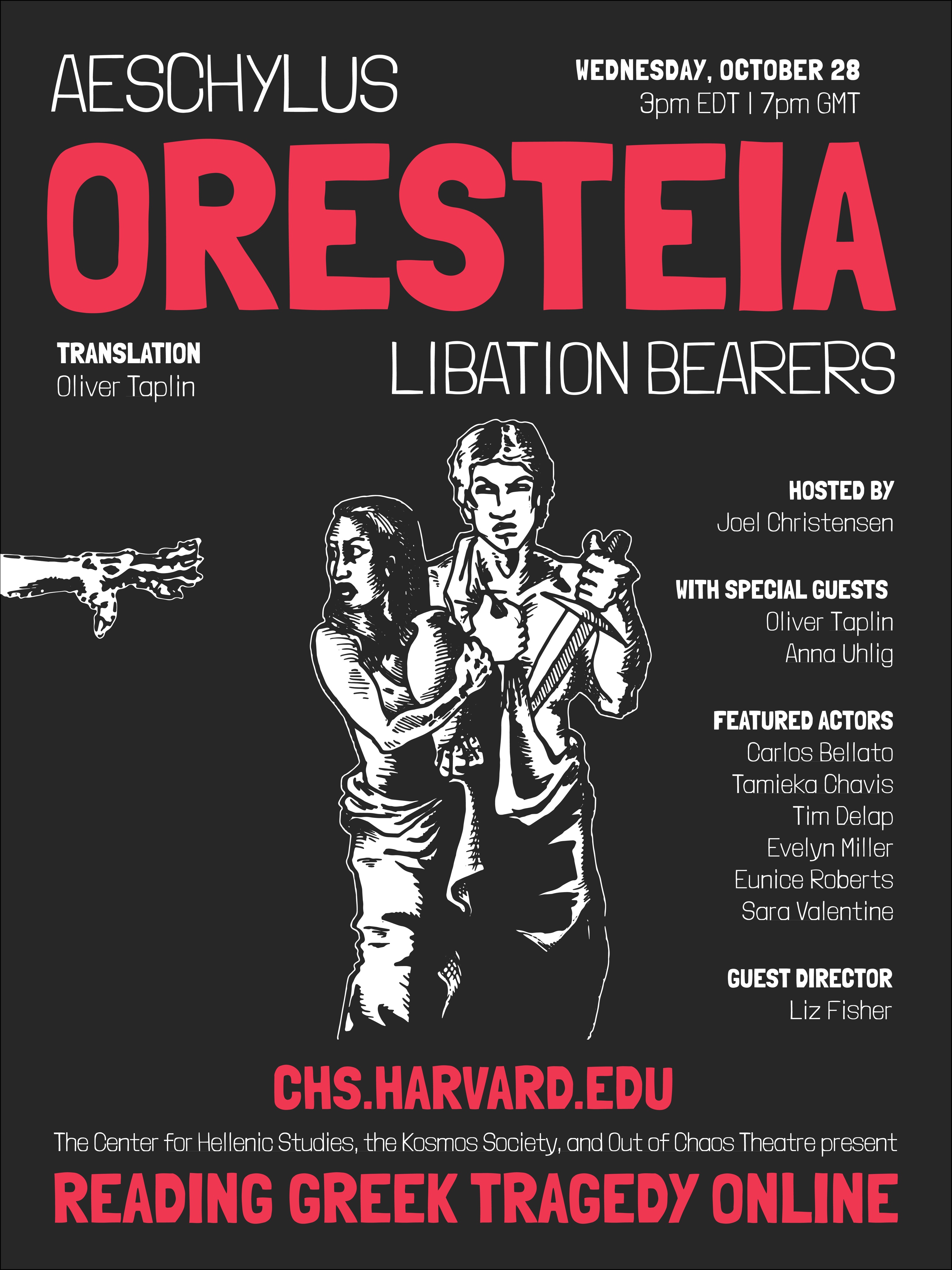
Today we come to the second play of the Oresteia, the Libation-Bearers, which follows the death of Agamemnon some time later with the return of his son Orestes. Motifs from this play remained well-known enough that audiences of the later Elektras by Sophocles and Euripides could be relied upon to recall its moments of recognition and the tension between the expectations placed on Euripides and his hesitation when finally facing the deed.
Along with the rest of the trilogy, the Libation-Bearers earned first prize at the City Dionysia in 458 BCE. But what was it about these plays that charmed the judges and audiences? This play certainly does not present the heroic narrative one might expect from the Homeric Odyssey, where Orestes is repeated hailed as a returning avenger and a model for Telemachus. This Orestes reunites joyously with his sister and joins her in a shared song of lament that takes up the central portion of the play. When the time to act arrives, pushed on by Apollo’s prophecies, Orestes hesitates before taking his mother’s life. And then he is cursed by the furies, pushing him into the exile resolved in the Eumenides.
The story of Agamemnon and Orestes hinges on the balance of justice and vengeance. The horrible logic of the later faces up to the demands of the former and comes up short. In the distance between the two, humankind continues to suffer.
Aeschylus, Libation-Bearers 387-394
“May I sing a song of victory
Over a slaughtered man
And a woman as she dies—
Why should I hide
The kind of plan floating in my mind?
Before my heart’s prow
A driving anger blows,
Hatred’s rage.”
Chorus – Carlos Bellato, Tamieka Chavis, and Sara Valentine
Slave – Sara Valentine
Special Guests: Anna Uhlig and Oliver Taplin
Special Director: Liz Fisher
Aeschylus, Libation-Bearers 585-95
“The earth feeds many things,
Terrible griefs of fear,
And the folds of the sea
Are full with similar monsters.
Lights burning between
Sky and earth cause harm
To creatures on wing and on foot.
You might even mention the wind-borne rage of hurricanes.
But who can speak of the arrogant
Mind of a man or the all-daring
Lusts in a woman’s thoughts,
The joined paths of mortal ruin?”
Artistic Director: Paul O’Mahony (Out of Chaos Theatre) Associate Director: Liz Fisher Director of Outreach: Amy Pistone (Gonzaga University) Dramaturg: Emma Pauly Executive Producer: Lanah Koelle (Center for Hellenic Studies) Producers: Keith DeStone (Center for Hellenic Studies), Hélène Emeriaud, Janet Ozsolak, and Sarah Scott (Kosmos Society) Poster Artist: John Koelle Poster Designer: Allie Marbry (Center for Hellenic Studies)
Aeschylus, Libation-Bearers 434-438
“You speak of complete dishonor!
She will payback the dishonoring of my father
With willing gods
With my willing hands.
When I have cut her out, may I die too.”
October 28 Libation Bearers, Aeschylus; translation by O. Taplin
November 4 Eumenides, Aeschylus
with Ellen McLaughlin (Barnard College) and Andrew Simpson (Catholic Univeristy of America); translation by O. Taplin
November 11 Medea, Euripides
with Fiona Macintosh (University of Oxford)
Pieter Lastman – De offerstrijd tussen Orestes en Pylades
Aeschylus, Libation-Bearers 548-550
“It is right—because she raised a terrible monster—
For her to die violently. Once transformed into a snake,
I kill her. That’s what this dream is telling us.”