Let’s Talk About Sweat, Baby

sweating profusely” sudans multum, Fronto

“much sweat was pouring down” πολὺς δ’ ἐξέρρεεν ἱδρὼς, Quintus Smyrnaeus

Aristotle, Problems 2, 866b10 (Problems Concerning Sweat) Selections

“Why does head sweat not stink or at least stink less than that from the body? Is it because the top of the head is well aired?”

Διὰ τί ὁ ἱδρὼς ἐκ τῆς κεφαλῆς ἢ οὐκ ὄζει ἢ ἧττον | τοῦ ἐκ τοῦ σώματος; ἢ ὅτι εὔπνους ὁ τῆς κεφαλῆς τόπος

“Why does the face sweat most of all?”

Διὰ τί ἱδροῦσι μάλιστα τὰ πρόσωπα;

“Why do our backs sweat more than our fronts?”

Διὰ τί ἱδροῦμεν τὸν νῶτον μᾶλλον ἢ τὰ πρόσθεν;

“Why do we sweat less while we are toiling than when we stop?”

Διὰ τί ἧττον ἱδροῦσιν ἐν αὐτῷ τῷ πονεῖν ἢ ἀνέντες;

Hippocrates, Prorrhetic 1.39 (Full Greek text on the Scaife Viewer)

“To sweat acutely, especially with an unpleasant perspiration over the head, is bad; even more so if it comes with dark urine. Difficult breathing in these patients is bad” 
 
Οἱ ἐφιδρῶντες καὶ μάλιστα κεφαλὴν ἐν ὀξέσιν ὑποδύσφοροι, κακόν, ἄλλως τε καὶ ἐπ᾿ οὔροισι μέλασι, καὶ τὸ θολερὸν πνεῦμα ἐν τούτοισι κακόν.
 
Hippocrates, Coan Prenotions 561 (Full Greek text on the Scaife Viewer)
 
“The best sweat is one that breaks a fever on the necessary day, but one that brings relief is also useful. A cold sweat developing only around the head and neck is not good and also indicates limited time and danger.”
 
Ἱδρὼς ἄριστος μὲν ὁ λύων τὸν πυρετὸν ἐν ἡμέρῃ κρισίμῳ, χρήσιμος δὲ καὶ ὁ κουφίζων· ὁ δὲ ψυχρὸς καὶ μοῦνον περὶ κεφαλὴν καὶ τράχηλον γινόμενος, φλαῦρος, καὶ γὰρ χρόνον καὶ κίνδυνον σημαίνει.
 

Ancient Greek Abstract Art

The title of this post will most likely strike the reader as nonsensical. The canon of Graeco-Roman art, populated with statues of athletes, friezes of battles, a Pompeian fresco or two of dancing fauns, seems to leave no space for abstraction. Most of us think of classical art as uniformly figurative, and we perceive this mimetic tradition as unbroken until the nineteenth century, when experimental figures like J. M. W. Turner begin to display an ever-lesser interest in the minute reproduction of the visually perceptible world.

The likes of Wassily Kandinsky and Kazimir Malevich, it is commonly thought, deal the final blow to the formerly unchallenged tradition of representational art as they start to paint pure abstractions, art bearing no trace of reference to anything recognizable. This straightforward narrative of linear development is challenged in a striking story told by Pliny in his Natural History. In a fascinating anecdote, surprisingly little-known given the extraordinary evidence it presents, Pliny introduces us to the world’s first abstract painting, composed by the celebrated painters Apelles and Protogenes in the fourth century BC.

The story goes as follows. Apelles, the most accomplished painter of all time according to Pliny, once visited the studio of the likewise respected Protogenes, curious to see the works he had so far only heard rumors of. He found nobody there except an old slave and an empty canvas ready for painting. Instead of telling the slave to inform Protogenes of his arrival, Apelles simply drew an exquisitely fine line on the empty canvas and left. When Protogenes returned and examined the line, he instantly knew that Apelles had been there, as only he could have drawn something that perfect.

In reply, Protogenes drew an even finer line in different color upon the previous one and went out again. Soon, Apelles returned and found himself surpassed in Protogenes’ reply. He took up another color and drew an even finer, barely discernible line upon the previous two, leaving no space for anything more delicate to be executed, and left. At this point, Protogenes conceded defeat and went out in search of Apelles to finally make his acquaintance. Left behind in the studio was a piece of abstract art.

Sharing the fate of the vast majority of classical art, not a single painting by either Apelles or Protogenes has survived until the present day. Some believe that we can catch a glimpse of Apelles’ work in the Pompeian Venus Rising from the Sea, speculating that it is a copy of the artist’s renowned version of the motif.

So far, there is nothing exceptional in this story. The Natural History is full of such more or less believable anecdotes of artistic dexterity. Pliny, marvelling at the extraordinary verisimilitude in the finest examples of realist painting, relates how horses would neigh when confronted with Apelles’ painting of a horse, and how birds would peck at Zeuxis’ likeness of grapes. Apelles’ Pollock-like technique of throwing a wet sponge at his canvas to create the effect of foam sounds more unorthodox, yet ultimately results in a meticulously realistic reproduction of the recognizable world as well.

Apelles’ and Protogenes’ painting makes no such attempt at mimesis. This would still be nothing surprising in a mere display of artistic skill, and so far the story has not suggested that the painters perceived their competition as anything more. But in a tantalizing twist at the end, Pliny recounts how Apelles and Protogenes thought it appropriate to treat this exercise as a finished work of art, and how it was displayed to an admiring and appreciative public, even only recently at the Imperial palace on the Palatine:

Among the most elaborate works it had all the appearance of a blank space; and yet by that very fact it attracted the notice of everyone, and was held in higher estimation than any other painting there.

audio … [tabulam] spatiose nihil aliud continentem quam lineas visum effugientes, inter egregia multorum opera inani similem et eo ipso allicientem omnique opere nobiliorem.
Naturalis Historia 35.36.83

(Full Latin text available on the Scaife Viewer)

Although the fame of the artists and the virtuosity manifest in the minuteness of the lines must have contributed to the painting’s charm, these features were not of most interest to the ancient audience according to Pliny. It was rather the very emptiness of the painting that was admired, and it was its very blankness that earned it the estimation as the finest piece of art in the exquisite Imperial collection. The abstract composition was clearly perceived as art. The three solitary lines were weighed with reference to the surrounding figurative pieces and chosen as the finest among them. The spectators perceived the abstract, non-representational piece as capable of giving the same kind of aesthetic pleasure as the figurative art they were used to, and they even found the pleasure derived from contemplating this absence of presence in some way superior. For a modern reader, this anecdote conjures up the extraordinary image of ancient Romans crowding around and admiring a minimalist abstract painting, oblivious of the surrounding portraits of gods and goddesses.

The simplicity of The Magic of Color (Joan Miró, 1930), showing three circles of different size and color on a vast empty surface, is a modern parallel to the almost bare canvas once exhibited on the Palatine.

Unsurprisingly, the story of Apelles and Protogenes’ experiment did not gain particular traction with early modern artists. Its oddity and simplicity provided little opportunity for opulent classicising compositions and were for a long time overshadowed by tales such as Apelles’ painting and falling in love with Alexander’s mistress Campaspe, subject of numerous renaissance and baroque nudes. One may expect a sudden surge of interest in the anecdote to appear with the emergence of abstract art, yet it does not seem to have resonated with early avantgardists except Guillaume Apollinaire.

In a short 1912 article, Apollinaire writes on the elusiveness of the subject in cubist art and calls this absence of representation ‘pure painting’, providing admirers with ‘artistic sensations due exclusively to the harmony of lights and shades and independent of the subject depicted in the picture’. He finds a precedent of such practice in the piece by Apelles and Protogenes, yet nevertheless calls cubism ‘an entirely new plastic art’, apparently uninterested in tracing continuities and eager to portray the avantgarde as a revolutionary breakthrough.

Apollinaire was right in not ascribing too much weight to Pliny’s story and treating it as nothing more than a fascinating curiosity. The painting by Apelles and Protogenes was an isolated case rather than an example of a flourishing abstract tradition in ancient Greek art. The fame of the artists and the ancient admiration of finesse must have been pivotal in enabling this extraordinary, one-off abstract exhibition.

Yet this does not mean that we should not take the story seriously. Rather, it can serve as a reminder that simplistic, traditionalist narratives often overlook the most fascinating details, in the case of art history negating the variety and diversity of artistic expression. Western artbooks skimp over the striking impressionism of Song Dynasty splashed-ink paintings, preceding Turner’s first works by over half a millennium. Women like Georgiana Houghton and Hilma af Klint painted pure abstractions before Kandinsky and Malevich but still gain little recognition for their work. Just so, visitors to the Imperial palace were capable of enjoying ‘artistic sensations due exclusively to the harmony of lights and shades’ long before the first cubist exhibition.

Hilma af Klint’s The Ten Biggest No 7 (1907) predates abstract attempts by Kandinsky, Picabia and others.

Alex Tadel is a recent graduate from an MSt in Greek and Latin Languages and Literature at the University of Oxford. Stationed in Ljubljana, Slovenia, she is taking a short break from academia and working as a freelance writer, researcher and tutor.

Feeling Sad? Just Think of All the Famous Dead People

Marcus Aurelius, Meditations 6.47

“Always keep in mind that all sorts of people from all kinds of occupations and from every country on earth have died. And take this thought to Philistion and Phoibos and Origanion. Turn to the rest of the peoples on earth too.

We have to cross over to the same place where all those clever speakers and so many serious philosophers have gone—Heraclitus, Pythagoras, Socrates—and where those great heroes of old, the brave generals and tyrants have gone too. Among them are Eudoxos, Hipparchus, Archimedes,  and other sharp natures, big minds, tireless men, bold men, and those who mock the temporary and disposable nature of life itself, like Menippus and the rest.

Think about all these people, that they have been dead for a long time. Why is this terrible for them? Why worry about those who are no longer named? This one thing is worth much: to keep on living with truth and justice and in good will even among liars and unjust men.”

Ἐννόει συνεχῶς παντοίους ἀνθρώπους καὶ παντοίων μὲν ἐπιτηδευμάτων, παντοδαπῶν δὲ ἐθνῶν, τεθνεῶτας· ὥστε κατιέναι τοῦτο μέχρι Φιλιστίωνος καὶ Φοίβου καὶ Ὀριγανίωνος. μέτιθι νῦν ἐπὶ τὰ ἄλλα φῦλα. ἐκεῖ δὴ μεταβαλεῖν ἡμᾶς δεῖ, ὅπου τοσοῦτοι μὲν δεινοὶ ῥήτορες, τοσοῦτοι δὲ σεμνοὶ φιλόσοφοι, Ἡράκλειτος, Πυθαγόρας, Σωκράτης· τοσοῦτοι δὲ ἥρωες πρότερον, τοσοῦτοι δὲ ὕστερον στρατηγοί, τύραννοι· ἐπὶ τούτοις δὲ Εὔδοξος, Ἵππαρχος, Ἀρχιμήδης, ἄλλαι φύσεις ὀξεῖαι, μεγαλόφρονες, φιλόπονοι, πανοῦργοι, αὐθάδεις, αὐτῆς τῆς ἐπικήρου καὶ ἐφημέρου τῶν ἀνθρώπων ζωῆς χλευασταί, οἶον Μένιππος καὶ ὅσοι τοιοῦτοι. περὶ πάντων τούτων ἐννόει, ὅτι πάλαι κεῖνται. τί οὖν τοῦτο δεινὸν αὐτοῖς; τί δαὶ τοῖς μηδ᾿ ὀνομαζομένοις ὅλως; Ἓν ὧδε πολλοῦ ἄξιον, τὸ μετ᾿ ἀληθείας καὶ δικαιοσύνης εὐμενῆ τοῖς ψεύσταις καὶ ἀδίκοις διαβιοῦν.

File:David - The Death of Socrates.jpg

Jacques-Louis David, The Death of Socrates 1787

Hated By the People, Plotted Against by Friends

Diodorus Siculus, The Library of History 37.22a (Full text available on LacusCurtius)

“Sertorius, when he noticed that the uprising among the indigenous people was overwhelming, turned nasty to his allies: he accused some and had them killed; others he threw into prison; but he liquidated the wealth of the richest men. Even though he acquired a great deal of gold and silver this way, he did not put any of it into the public treasury for the war effort, instead he hoarded it for himself. He didn’t use it to pay the soldiers either or even share some of it with his commanders.

When it came to capital cases, he did not consult the council or advisers, but had hearings in private and gave judgments after serving as the solitary judge. He did not consider his commanders worthy of invitations to his banquets and demonstrated no beneficence to his friends. As he was generally driven mad by the worsening state of his own rule, he acted tyrannically toward everyone: he was hated by the people and conspired against by his friends.”

Ὅτι ὁ Σερτώριος θεωρῶν ἀκατάσχετον οὖσαν τὴν ὁρμὴν τῶν ἐγχωρίων πικρῶς προσεφέρετο τοῖς συμμάχοις, καὶ τοὺς μὲν καταιτιώμενος ἀπέκτεινεν, τοὺς δὲ εἰς φυλακὴν παρεδίδου, τῶν δὲ εὐπορωτάτων ἐδήμευε τὰς οὐσίας. πολὺν δὲ ἄργυρον καὶ χρυσὸν ἀθροίσας οὐκ εἰς τὸ κοινὸν τοῦ πολέμου ταμιεῖον κατετίθετο, ἀλλ᾿ ἰδίᾳ ἐθησαύριζεν· οὔτε τοῖς στρατιώταις ἐχορήγει τὰς μισθοφορίας, οὔτε τοῖς ἡγεμόσι μετεδίδου τούτων, οὔτε τὰς κεφαλικὰς κρίσεις μετὰ συνεδρίου καὶ συμβούλων ἐποιεῖτο, διακούων δὲ ἰδίᾳ καὶ μόνον κριτὴν ἑαυτὸν ἀποδείξας ἐποιεῖτο τὰς ἀποφάσεις· εἴς τε τὰ σύνδειπνα τοὺς ἡγεμόνας οὐκ ἠξίου παραλαμβάνειν, οὐδὲ φιλανθρωπίας οὐδεμιᾶς μετεδίδου τοῖς φίλοις. καθόλου δὲ διὰ τὴν ἐπὶ τὸ χεῖρον ἐπίδοσιν τῆς περὶ αὐτὸν ἐξουσίας ἀποθηριωθεὶς τυραννικῶς ἅπασιν προσεφέρετο. καὶ ἐμισήθη μὲν ὑπὸ τοῦ πλήθους, ἐπεβουλεύθη δὲ ὑπὸ τῶν φίλων.

Quintus Sertorius by Gerard van der Kuijl

“Where Bad People Flee”: Reading Euripides’ “Heracleidae” Online

Euripides, Heracleidae 179-180 (Full text on the Scaife Viewer)

“Who could judge or recognize a speech as just,
Before clearly understanding the issue from both sides?”

τίς ἂν δίκην κρίνειεν ἢ γνοίη λόγον,
πρὶν ἂν παρ᾿ ἀμφοῖν μῦθον ἐκμάθῃ σαφῶς;

https://www.youtube.com/watch?v=bSG78-fp5Mo&feature=youtu.be

Euripides, Heracleidae 26-27

“I share my exile with these children who are in exile,
And I share in their sufferings as they suffer too.”

ἐγὼ δὲ σὺν φεύγουσι συμφεύγω τέκνοις
καὶ σὺν κακῶς πράσσουσι συμπράσσω κακῶς,

Euripides, Heracleidae 418-419

“…If I do these things,
A civil war will break out.”

εἰ δὲ δὴ δράσω τόδε,
οἰκεῖος ἤδη πόλεμος ἐξαρτύεται.

Euripides’ Heracleidae, the “Children of Herakles”, was performed around 430 BCE, just as the Athenians were beginning their 3 decade war against the Spartans. It may not be Euripides’ most famous play, but it has just about everything you’d ask for in a tragedy: theme of Xenia, suppliancy, noble bloodlines, battle, human sacrifice, gender, a war scene described in a messenger speech, revenge.

Like any good tragedy, it focuses on the choices human beings make outside of their fate and divine meddling. But its end is troubling, perhaps reflecting the world outside of the play, where violence is far from distant and death for many is certain. For while this is the year that Athens repels a Spartan invasion and attacks the Peloponnese, it is also the first year of the famous plague. This play, so focused on the descendants of Herakles and the end of feuds, seems so precariously set at the beginnings of things.

Euripides, Heracleidae 427-430

 “Children, we are like sailors who have fled
A savage storm’s blows to touch the land
With their hand only to be pounded back
From the shore to the sea by the winds again.”

ὦ τέκν᾿, ἔοιγμεν ναυτίλοισιν οἵτινες
χειμῶνος ἐκφυγόντες ἄγριον μένος
ἐς χεῖρα γῇ συνῆψαν, εἶτα χερσόθεν
πνοαῖσιν ἠλάθησαν ἐς πόντον πάλιν.

Scenes (George Theodorids’ translation)

69-287: Iolaus, Kopreas, Chorus, Demophon
473-595: Makaria, Iolaos, Demophon
708-799: Chorus, Alcmene, Iolaos, Servant
960-end: Chorus, Alcmene, Eurystheus

Performers

Kopreus/Servant – Aldo Bringas
Makaria – Evelyn Miller
Alcmene – Maria Goycoolea
Chorus – Paul O’Mahony
Demophon/Eurystheus – Rhys Rusbatch
Iolaus – Tim Delap
Special Guest: Helene Foley

Euripides, Heracleidae, Medea 863-866

“…with his current fortune
He announces for all mortals a clear thing to learn,
Do not envy someone who seems to be lucky
Before you see them die. For each day is its own fortune.”

…τῇ δὲ νῦν τύχῃ
βροτοῖς ἅπασι λαμπρὰ κηρύσσει μαθεῖν,
τὸν εὐτυχεῖν δοκοῦντα μὴ ζηλοῦν πρὶν ἂν
θανόντ᾿ ἴδῃ τις· ὡς ἐφήμεροι τύχαι.

Artistic Director: Paul O’Mahony (Out of Chaos Theatre)
Associate Director: Liz Fisher
Director of Outreach: Amy Pistone (Gonzaga University)
Dramaturg: Emma Pauly
Executive Producer: Lanah Koelle (Center for Hellenic Studies)
Producers: Keith DeStone (Center for Hellenic Studies), Hélène Emeriaud, Janet Ozsolak, and Sarah Scott (Kosmos Society)
Poster Artist: John Koelle
Poster Designer: Allie Marbry (Center for Hellenic Studies)

Euripides, Heracleidae 1016-1017

“Although I don’t long for death,
I wouldn’t be annoyed at leaving life behind.”

….θανεῖν μὲν οὐ
χρῄζω, λιπὼν δ᾿ ἂν οὐδὲν ἀχθοίμην βίον.

Upcoming Episodes (Go to CHS Project Page for more information)

November 25 Special Edition: Tragic Fragments
with Melissa Funke (University of Winnipeg) and Charlotte Parkyn (University of Notre Dame)

December 2 Oedipus at Colonus, Sophocles – 3:30pm EST
with Laura Slatkin (New York University)

Euripides, Heracleidae 1-6

“For a long time now this has been my belief
One man is born just those near him
While another’s heart lusts after profit
And he is useless to the city, a heavy burden to bear,
The ‘best’ to himself…”

Πάλαι ποτ᾿ ἐστὶ τοῦτ᾿ ἐμοὶ δεδογμένον·
ὁ μὲν δίκαιος τοῖς πέλας πέφυκ᾿ ἀνήρ,
ὁ δ᾿ ἐς τὸ κέρδος λῆμ᾿ ἔχων ἀνειμένον
πόλει τ᾿ ἄχρηστος· καὶ συναλλάσσειν βαρύς,
αὑτῷ δ᾿ ἄριστος·…

Tawdry Tuesday: Failing to Rise to the Occasion

Greek Anthology, 5.47 Rufinus

To Thaleia, his escort

“I often yearn to take you at night, Thaleia,
And fill my heart with your warm lust-madness.
But now when you are naked next to me with sweet limbs,
I am spent, and my limb is worn with sleepy exhaustion.
Cowardly heart, what have you suffered? Rise up, don’t be weary!
Someday you will seek such excessive good luck again.”

εἰς Θάλειαν, τὴν ἑαυτοῦ ἑταίραν
Πολλάκις ἠρασάμην σε λαβὼν ἐν νυκτί, Θάλεια,
πληρῶσαι θαλερῇ θυμὸν ἐρωμανίῃ·
νῦν δ᾽, ὅτε 〈μοι〉 γυμνὴ γλυκεροῖς μελέεσσι πέπλησαι,
ἔκλυτος ὑπναλέῳ γυῖα κέκμηκα κόπῳ.
θυμὲ τάλαν, τί πέπονθας; ἀνέγρεο μηδ᾽ ἀπόκαμνε·
ζητήσεις ταύτην τὴν ὑπερευτυχίην.

C. 490 BCE Red Figure attributed to Euphronius Painter, British Museum

Learning Something for Old Age

Euripides Suppliants, 187-189 (Full Greek text on the Scaife Viewer)

“Sparta is savage and duplicitous.
The rest of the states are small and weak.
Only your city could take up this task.”

Σπάρτη μὲν ὠμὴ καὶ πεποίκιλται τρόπους,
τὰ δ᾿ ἄλλα μικρὰ κἀσθενῆ· πόλις δὲ σὴ
μόνη δύναιτ᾿ ἂν τόνδ᾿ ὑποστῆναι πόνον·

Euripides Suppliants, 846-852

“I will not ask about one thing, to avoid being a joke,
Whom each of these men stood to oppose in battle
Or from which enemy’s lance he received his wound.
For these words are hollow to those who hear them
And those who repeat them: who can stand in a battle
And then report truly who was brave or not
As the lance went passing before his eyes?”

ἓν δ᾿ οὐκ ἐρήσομαί σε, μὴ γέλωτ᾿ ὄφλω,
ὅτῳ ξυνέστη τῶνδ᾿ ἕκαστος ἐν μάχῃ
ἢ τραῦμα λόγχης πολεμίων ἐδέξατο.
κενοὶ γὰρ οὗτοι τῶν τ᾿ ἀκουόντων λόγοι
καὶ τοῦ λέγοντος, ὅστις ἐν μάχῃ βεβὼς
λόγχης ἰούσης πρόσθεν ὀμμάτων πυκνῆς
σαφῶς ἀπήγγειλ᾿ ὅστις ἐστὶν ἁγαθός.

Euripides Suppliants, 916-917

“Whatever someone learns, they are careful to preserve
Into old age. For this reason, teach your children well.”

ἃ δ᾿ ἂν μάθῃ τις, ταῦτα σῴζεσθαι φιλεῖ
ἐς γῆρας. οὕτω παῖδας εὖ παιδεύετε.

Euripides Suppliants, 1108-1113

“Old age, hard to wrangle, how much I hate you!
And I hate all those people who try to lengthen life
By feeding it with foοd and drink and medicine,
Turning aside the force so they might not die.
It is better—since they don’t help the world at all—
For them to die and go away, making space for the young.”

ὦ δυσπάλαιστον γῆρας, ὡς μισῶ σ᾿ ἔχων,
μισῶ δ᾿ ὅσοι χρῄζουσιν ἐκτείνειν βίον,
βρωτοῖσι καὶ ποτοῖσι καὶ μαγεύμασιν
παρεκτρέποντες ὀχετὸν ὥστε μὴ θανεῖν·
οὓς χρῆν, ἐπειδὰν μηδὲν ὠφελῶσι γῆν,
θανόντας ἔρρειν κἀκποδὼν εἶναι νέοις.

Heracles and Geras, son of Nyx and the personification of old age. Attic  red-figure pelike, ca. 480–470 BC. | Middle eastern art, Eastern art,  Ancient romans
Herakles, beating Old Age

Cicero had a Reason to Lament, You Don’t

Martial, Epigrams 9.70 (Full Latin text on the Scaife Viewer)

“Cicero once said “What customs, what times!”
As Cataline laid out his sinful designs
And when a son and father-in-law met with dread arms
And dyed the ground red with civil blood.
But why do you repeat “What Customs, What times” now
What can displease you now? Caecilianus, what is it?
We have no clash of kings or insanity of sword.
Our customs don’t make you hate your own times,
but your own do, Caecilianus.”

Dixerat ‘O mores! O tempora!’ Tullius olim,
sacrilegum strueret cum Catilina nefas,
cum gener atque socer diris concurreret armis
maestaque civili caede maderet humus.
cur nunc ‘O mores!’ cur nunc ‘O tempora!’ dicis? 5
quod tibi non placeat, Caeciliane, quid est?
nulla ducum feritas, nulla est insania ferri;
pace frui certa laetitiaque licet.
Non nostri faciunt tibi quod tua tempora sordent,
sed faciunt mores, Caeciliane, tui.

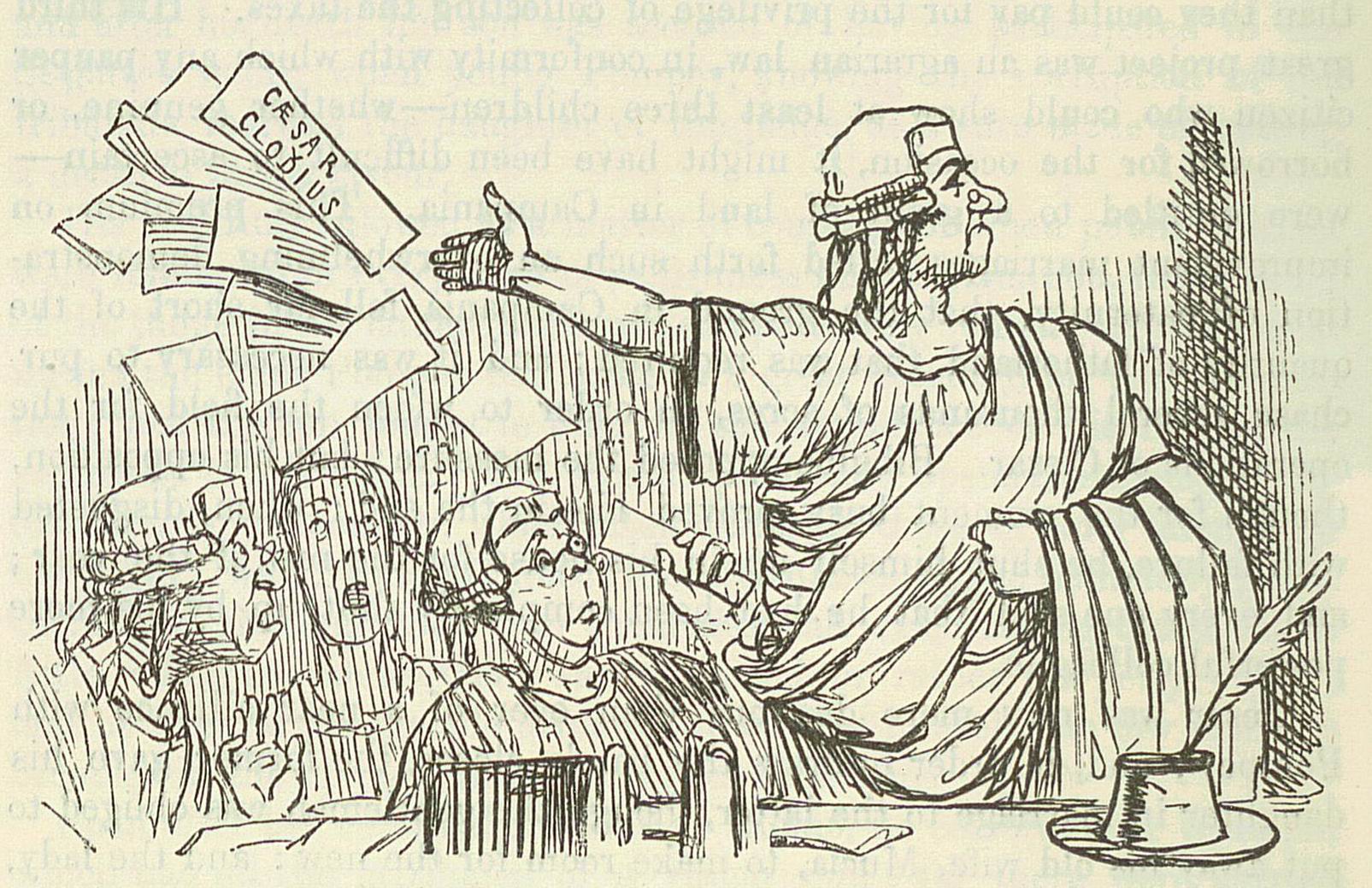
Cicero throws up his Brief like a Gentleman (from The Comic History of Rome, c. 1850)

Pliny, With an Epistolary Guilt-Trip

Pliny, Letters 3.17 (Full Latin text on the Scaife Viewer)

 “Is the reason your letters have not come for so long because everything is going well? Or, is everything good but you are really busy? Or are you not that busy but just have barely any time for writing?

Please take this worry away from me, I can’t handle it! Do it even if you have to send a courier. I will pay the cost and top him too as long as he tells me what I want.

I am well, if to be well is to live in suspense and worry, expecting all day long and fearing that anything which can hurt a person as happened to my dearest friend.”

Plinius Iulio Serviano Suo S.

1Rectene omnia, quod iam pridem epistulae tuae cessant? an omnia recte, sed occupatus es tu? an tu non occupatus, sed occasio scribendi vel rara vel nulla? Exime hunc mihi scrupulum, cui par esse non possum, exime autem vel data opera tabellario misso. Ego viaticum, ego etiam praemium dabo, nuntiet modo quod opto. Ipse valeo, si valere est suspensum et anxium vivere, exspectantem in horas timentemque pro capite amicissimo, quidquid accidere homini potest. Vale.

Tuscum des Plinius Schninkel AA2.jpg
Pliny’s Villa at Tuscum

From American Cato to American Carnage

It is a truth universally acknowledged, that an interesting book in possession of a good topic, must be in want of a title. The title of Thomas Ricks’ new book, ‘First Principles,’ is less than ideally informative, and it is perhaps some indication of the author’s consciousness of this fact that he appends such a lengthy subtitle to it. Ricks got the title from his returning to “first principles” following the most terrifying moment in modern American history, the improbable and to this day still literally incredible election of Donald Trump. While many of us idly fumbled about in rage or reached for the distilled consolations of the bottle, Ricks went to the library and cracked open a copy of Aristotle’s Politics. Perusing Aristotle impressed him with the Classical influences upon this country’s founding generation, and he wrote this book as a meditation upon American political history in an era which has delegitimized both politics and history. This is a much more general treatment of the history of the period than Carl J. Richards’ The Founders and the Classics, which dealt more comprehensively with the subject of classical education and influence, but was perhaps far less suitable for the general reader with a broad interest in both the founders and the classics. Ricks’ new book is a fun, engaging, and accessible, and though a few regrettable errors (particularly on the classical end of things) seem to suggest that the book was rushed to meet a publication date coinciding with post-election fervor, some of those may be easily glossed over in light of the satisfaction afforded by reading these reflections on the American experiment so shortly after Donald Trump received the old boot from the ballot box.

First Principles presents a portrait of America’s first four presidents (Washington, Adams, Jefferson, and Madison) with special emphasis on the way in which they drew upon Classical Greek/Roman history in their political lives, and how this shaped the nascent republic. Ricks’ reason for not proceeding beyond the apparently arbitrary limit of Madison becomes clear somewhat later in the book, when he suggests that Classical learning simply did not have the same currency in politics by the 1820s as it did in the latter half of the 18th century. While James Monroe and John Quincy Adams of course had their Classical educations, there was a growing impatience with the use of all the old Caesars and Catos and Catilines in public debate, and the ascendancy of a cruel and illiterate barbarian (Jackson) followed by the cynical party-machining technocrat (Martin Van Buren) effectively ended the golden age of Classical politics in a country which had long shown marked anti-intellectual tendencies anyway.

Because he is a military historian, Ricks steers a large portion of the book onto terrain with which he is intimately familiar. The large early section on Washington focuses on his military experience. Ricks writes about Washington’s early setbacks in the French and Indian War as a counterpoint to the traditional education enjoyed by Adams, Jefferson, and Madison. Later in the book, Ricks will emphasize Washington’s various Classical roles enacted in the theater of life: Cato, Fabius, and Cincinnatus. But the portrait of Washington as educated in the camp and not the college makes him the American Marius. As Sallust presents it, Marius was proud of having attended the school of hard knocks on the battlefield and avoided the enervating effects of book learning:

My words are not artfully chosen. I don’t give a shit about that. Virtue shows herself without any help. Only those who want to hide their shameful conduct with rhetoric have need of artifice. I also didn’t learn Greek literature: I had no desire to learn that, since it apparently never did anything to enhance the virtue of its teachers. Instead, I learned all about the things which do the best for the Republic: to assault the enemy, to move the defenses, to fear nothing except a bad reputation, to suffer summer blazes and winter frosts equally, to sleep on the ground, and to tolerate neediness and labor at the same time. I will exhort my soldiers with these precepts, but I will not coddle them with art, and I will make myself, not my glory, their work. This is useful, this is civic power. For, when you conduct the army safely through idle softness and drive it on with punishment, that is to be a master, not a general.

Yet, at the same time, this entire exercise may itself suggest the absurdity of insisting too firmly upon Classical parallels for contemporary figures. In so doing, we are far more apt to mold the historical figure to fit the contemporary point of comparison than we are to seize upon genuinely significant parallels, and so it is likely that we will in this way simply distort our understanding of history, rather than illuminating either present or past by the comparison. Perhaps Plutarch is to blame for this enthusiasm for comparison.

Apart from the pitfalls of comparison, though, sometimes we simply learn the wrong lesson from classical figures. Ricks cites Cato’s possession of wealth and his rejection of luxury as an admirable example of public virtus, but surely it is a form of villainy to possess substantial wealth which you have no real intention of using? I am always struck by the adulation given to Warren Buffett for living such a simple and frugal lifestyle despite his possession of billions of dollars. One is reminded of the story of Herodes Atticus, who professed to Trajan that he had no idea how to use a fantastic financial windfall, and was urged to abuse it then instead. If Warren Buffett neither needs to use that wealth nor wants to abuse it, is it not a more villainous and miserly form of avarice than the hyper wealthy who at least seem bent on blowing through a good chunk of their fortunes?

George Washington is supposed to be the American Cato (because of his stern patrician virtue), but Ricks notes that he had an early enthusiasm for Cato’s worst enemy, a certain Julius Caesar. This view was shared by Alexander Hamilton, who once claimed that Julius Caesar was the greatest man ever to have lived. If we were to insist too much on the adequacy of classical parallels, we might feel some discomfort at trying to square Washington the Caesarian with Washington the Catonian (especially given that Caesar is a purely villainous force in Washington’s favorite play, Addison’s Cato), but luckily we have progressed to that enlightened point in the progress of this review where we have learned to abandon strict classical parallelism.

Washington gets several classical roles, but for Adams is reserved the role of the American Cicero. This comparison is actually fairly apt, given the tendency of both men to feel a kind of petty sense of offended dignity and petty grievance which could easily sprout rhetorical wings and take a flight of fancy. Unlike the patrician Virginians Washington, Jefferson, and Madison, John Adams was indeed a “new man” like Cicero, and had to work his way from the agrarian middle class into the upper echelons of power. But, just as Cicero did, he was eager to identify himself with the ruling elite once he was there, and hardened into a kind of anti-democratic and anti-populist conservative once he had his first real experience with the heady vapors of power.

Ricks gives us the familiar portrait of Adams: the upward striver who originally hated his studies, but found a corrective in the hard ditch labor which his dad once forced upon him. As with many of the founders, Adams seems to have gotten much of his early classical knowledge from secondary sources like Rollin’s Ancient History and Dodsley’s Preceptor. If it ever seems that there is a universal frame of classical reference among the founding generation, it is for just this reason: many of them internalized a framework of classical knowledge from these pre-digested sources before they applied themselves much to reading authors in the original. Edward Gibbon confesses to doing this in his youth, and compared the speed with which he could internalize whole quires of translated history to the plodding pace of parsing Greek verbs all day to work through one speech. Indeed, as I have written here before, it seems that many of the men of the late 18th century kept up just enough of their classical languages to quote some approved tags, but preferred for the most part to read for reference either in translation or digest form. On the other side of the Atlantic from John Adams, James Boswell was filling his diaries with constant exhortations to get back to his Greek studies, but found the temptations of conversation and prostitutes too alluring. Ricks quotes Adams’ diary from January 1759 to the same effect:

Let no trifling Diversion or amuzement or Company decoy you from your Books, i.e. let no Girl, no Gun, no Cards, no flutes, no Violins, no Dress, no Tobacco, no Laziness, decoy you from your Books.

There was a deep anxiety in the souls of late 18th century men of letters for drawing up plans of reading, and one gets the sense that study was something that they really had to force themselves to.

The most novel and interesting part of First Principles is Ricks’ focus on the Scottish Enlightenment as a driving force in the development of the American intellectual character. In particular, the connections between enterprising Scottish bankers (who experimented with establishing branch offices in the colonies) and the tobacco trade led to an influx of Scotsmen to the southern states. At the time, Edinburgh offered a more robust education than could be obtained at Oxford, and it seems that Jefferson and Madison owed their comparative ease and fluency with Greek culture and history to the fact that they each had Scottish tutors early in life.

Jefferson doesn’t receive the strict classical parallel treatment, but we understand that he is steeped in classical learning thanks to this Scottish influence. We also get a portrait of Jefferson as the dedicated Epicurean. Ricks seems to suggest that Jefferson’s lax style of Epicureanism can help to account for his contradictions – a champion of liberty who owned slaves, who did nothing to fight for liberty but rather ignominiously retreated in the face of danger. That is to say, some of Jefferson’s perceived detachment and desire to be above the fray of real politics may be owing to the traditional Epicurean injunction against real political involvement. This has its parallel in the modern Stoic movement, which in its own way counsels a kind of passivity in the face of injustice, and serves as a useful shield for the willful amorality of powerful figures in the tech and finance sectors. It was all very well for a famous Stoic like Seneca to recommend poverty and powerlessness when he was himself rich and powerful. What was hypocrisy then is still hypocrisy now. Nothing good can come from the anachronistic adoption of ancient life philosophy. Indeed, there is something fundamentally childish about pretending to subscribe to the teachings of a long defunct philosophical school in a world which they could not have foreseen. While there is no deep absurdity in approving of individual doctrines of Epicureanism or Stoicism, any kind of wholesale acceptance of one of these philosophical programs amounts to intellectual indolence and moral cowardice. Jefferson was most corrupted by power when he pretended not to have any.

Ricks is on solid footing when he assails the tendency of Jefferson’s prose to grow Latinate and otiose when writing for any audience other than the general public. (Indeed, throughout the book, it becomes clear that Jefferson and Adams are the vain and irascible fops of the early presidency, while Washington and Madison serve as the steady bookends of virtue and intellectualism which counterbalance them.) Much the same could be said about Milton’s poetry, or Samuel Johnson’s fondness for ridiculous Anglo-Latin coinages. Ricks penetrates through the thick fog of Jeffersonian mythopoiesis when he writes, “Contrary to his image, Jefferson was not really a literary man.” One of Jefferson’s blunders in literary judgment was being taken in by the impostures of James MacPherson, whose publication of the works of the fake poet “Ossian” did indeed dupe many people at the time. For some reason, Ricks defends Jefferson by noting that Napoleon, too, was taken in, but it is not clear why he is cited as a paragon of literary judgment.

Throughout the book, Ricks makes much of the fact that Washington was the least classically educated and yet the most “Roman” of all the founding fathers, but the central conceit of this apparent paradox is the idea that the Roman heroes (from whom we distill the notion of “Romanness” that is applied to Washington) were themselves educated in any meaningful sense of the term. This could hardly be more misleading. What was Cincinnatus but an illiterate farmer? Marius boasted of his lack of education. Cato the elder flaunted his ignorance of Greek before condescending to learn it in old age, and the younger Cato was not exactly an egghead. Washington was the closest to the mythico-propagandistic projection of the idealized Roman yeoman who lives a simple life, does some glorious military service, and does not covet power. Education is antithetical to this stock character type. And yet, the highly polished Romans of the Late Republic – the ones with fancy “classical” educations in the Greek poets – seemed to have been entirely covetous of power. Cicero was positively drunk on it. If the Roman spirit were really so noble, patriotic, and averse to the seizure of individual power, the Republic would not have been destroyed by a series of bloody civil wars conducted by megalomaniacs and finally culminating in an autocratic imperial system. To buy the Roman propaganda and argue that the Sullas, Caesars, and Octavians weren’t exemplars of the true Roman spirit is just as silly as to believe Joe Biden when he looks into the camera and reminds America, “This isn’t who we are.” Sorry Joe – it looks like it is. To be sure, Washington is the closest of the founding fathers to the mythic Roman heroes, but they are so much less real than the Ciceros and Caesars who tore the state apart for their own petty grievances.

In that respect, the identification of Adams with Cicero seems particularly apt, given his petulant temper, his inflated sense of self-importance, and his strikingly reactionary impulses in the midst of revolution. The Adams of the Alien and Sedition Acts is paradoxically ranged against the very thing – free speech – which lifted him from poverty and obscurity, and made him a public figure. But could anyone really doubt that Cicero would have employed the strong arm of state suppression to silence his enemies if he could have done it?

Each of these men appears to be marred by their classical molding, with the exception of James Madison, who seems to have approached the classics with scholarly detachment and not imitative zeal. Washington, Adams, and Jefferson each took the classical exemplar theory too far, and turned themselves into theatrical productions of ancient figures, as though the American Revolution really were a continuation of or parallel to the ancient struggled which they read about in their favorite books. James Madison benefited from the educational influence of the Scottish Enlightenment, and a deep engagement with Greek history and literature, as opposed to the shallow and almost exclusively Roman preoccupations of the other founders. Yet, this fascination with Greek history posed its own dangers to the nascent republic, and Madison’s ancient reading lives to tyrannize over us today. Ricks notes that the outsized power of states like Wyoming (allotted the same number of senators as California) can be traced to the inspiration which Madison drew from the Amphictyonic League. This is enough to make one resent Madison’s library, and the entire study of Greek history.

Despite the fact that much of the American experiment succeeded, we should not lose sight of the fact that the founders had a remarkable knack for taking some of the worst lessons away from their ancient studies: a distrust of democracy, the valorization of ostentatious public virtue (what was Cato if not the inventor of virtue signaling?), and a tendency to favor deeply reactionary conservatism dressed in the language of revolutionary liberation. The Romans themselves expelled kings from their politics in 509 BCE, but this “revolution” did not usher in an unprecedented turn to democratic power. In fact, the story goes that some people grumbled that they had merely exchanged one king for two in the form of the consuls. The Tarquins were gone, but Rome’s wealthy patricians were still the ones running the show. When George III was given the old heave-ho from the colonies, the lion’s share of real governing power still lay with the wealthy patricians of the new Rome who were running things even when the king still held nominal sway on this side of the Atlantic.

When historians make the obligatory comparisons between the 18th century’s two main revolutions – the American and the French – they often express wonder at the comparative stability of the American. But when set against the French Revolution, the American hardly appears to be a Revolution at all. Really, it looks more like a change in administrative bookkeeping. France experienced genuine upheaval, and a total overturning (revolution) of the ruling order. Society itself was being restructured. Ricks notes that John Adams felt uneasy with the growing power of the common people in America at the beginning of the 19th century, and this gives the whole game away. Just as in Rome, the ruling class was jealous of its own freedom from an individual tyrant, but was content to leave the great mass of people largely disenfranchised. The revolutionary fervor of Brutus’ sic semper tyrannis was quickly morphed into a staid preservation of the mos maiorum for the good of the Republic.

We all do it, but asking questions like “What would George Washington think about Donald Trump?” is a frivolous rhetorical exercise of the sort mocked by Petronius and Seneca. One may as well ask what he would make of quantum computing, instant access to an infinite sea of pornography, or AI-guided nuclear weapons. We would like to think of Trump as just a do-nothing demagogue, a kind of stock type universal character recognizable in antiquity, but how do you make sense of him without the full and frightening context of the 21st century: the acceleration and provocation of global capitalism, the horror of infinite war elided with the society of spectacle, the reversal of Puritan decorum into a prizing of personal scandal as a new mode of American celebrity? Would the Washington who understood the war of posts be able to comprehend shock and awe, or the way that entire media empires were built upon showing the American public live feeds of bombs exploding over ancient cities? The founders simply did not possess the capacity for horror which we now do. We have seen death camps, carpet bombing, and nuclear holocaust. They could rail on about Catilines and Caesars subverting the republic, but Aaron Burr never had an atomic arsenal. The founders never had to worry that one man could provoke an international incident which, with “fire and fury” could end human civilization itself. No host of delatores can compare to the NSA.

In short, the founders had neither the experience nor the intellectual framework for understanding our American monster. Even today, we who have lived through the nightmare from which we struggle in vain to wake cannot make sense of this man or this moment. While we should certainly study the founding generation and their intellectual influences to understand how we got here, we must cease to ask ourselves what they would think of this moment, because it is no longer their country. In his discussion of Americans’ growing impatience with classical exempla, Ricks cites Benjamin Randall: “The quoting of ancient history was no more to the purpose than to tell how our forefathers dug clams at Plymouth.” Let the Pilgrims dig their clams, and let the founders lie in their tombs. This is a country for the living, and we must cease to ask what the dead might think if we are ever to wash away the miasma of this American carnage.