“If you put down a rotten foundation, already falling apart, not even a little shack can be built upon it, and the greater and more forceful thing you build upon it, the faster it will fall to the ground.
So you are depriving this dear person of life without any reason, a citizen of the very same state, both the larger one and the local one. Then, as you commit an act of murder and destroy another human being who did no wrong, you claim that “you have to stick to what was decided!” If it ever occurred to you to kill me, would you have to stick to your decisions then?
That kind of a person is scarcely persuaded to change his mind. But it is impossible to transform others today. So, now, I think I understand that proverb that used to confuse me, that “you can’t persuade or break a fool!”
May I never have a wise fool as a friend, there’s nothing harder to deal with. He says, “I have decided.” Well, people who are out of their minds decided too. But just as much as they believe that what isn’t true is solid, that’s how much hellebore they need to drink.”
Phlegon of Trailes, On Amazing Things: Multiple Births 28-32
“Antigonos also records that in Alexandria one woman gave birth to twenty children in four labors and that she raised most of them
Another woman in the same city produced five children in a single birth; three were male and two were female. The emperor Trajan ordered for them to be raised on his own funds.
Another woman gave birth to three different children in one year.
Hippostratos says in his work On Minos, that Aiguptos fathered fifty sons from Eururroê, the daughter of the Nile.
Similarly, Danaus had fifty daughters from one wife, Eurôpê, the daughter of the Nile.
Krateros, the brother of Antigonos that king, says that he knew of a certain person who in a seven year period was a child, an adolescent, a man and an old man and that he died after getting married and having children.
Megasthenes claims that the women who live in Padaia give birth when they are seven years old.”
“These things seem quite entertaining to me, but they are not true. I have also heard another reason for the bit, much more credible. I am happy with what is said by those who generally agree in Greece, who believe that the goddess is Hera and the work was made by Dionysus. For Dionysus went into Syria on the road that goes to Ethiopia. There are many signs left by Dionysus in the Shrine, among them are foreign clothing and Indian stones and Elephant horns which Dionysus brought from Ethiopia. There are also two really big phalluses that stand up at the entrance gates. This epigram has been inscribed upon them. ‘Dionysus dedicated these phalluses to Hera, his stepmother.’
This remains enough for me, but I will tell you of another oddity in the temple of Dionysus. The Greeks bear phalloi in honor of Dionysus, and they carry something in front of it, a little man carved out of wood which has huge genitals. These are called puppets. There is also one of these in the temple. On the right side of the temple, there is a small bronze man that has giant genitals.”
According to the Greek Anthology there was a temple to Apollônis, the mother of Attalos and Eumenes, at Cyzicos. The temple had at least nineteen epigrams inscribed on columns with accompanying relief images. All of the epigrams have mothers from myth and poetry as their subjects. The Eighth Epigram is on Odysseus’ mother Antikleia.
On the eighth tablet is the underworld visit of Odysseus. He addressed is own mother and asked her for news of his home (Greek Anthology 3.8)
“Wise-minded mother of Odysseus, Antikleia
You didn’t welcome your son home to Ithaka while alive.
Instead, he is shocked when his glance falls upon his sweet mother
Now wandering along the banks of Akheron.”
Of course, this scene plays upon book 11 of the Odyssey doubly: the image recalls Odysseus describing his mother in the Odyssey and it also plays upon the Odyssey’s catalogue of heroic mothers motif, which it in turn shares with the fragmentary Hesiodic Catalogue Of Women.
11.84-89
“Then came the spirit of my mother who had passed away,
The daughter of great-hearted Autolykos, Antikleia
Whom I left alive when I went to sacred Troy.
When I saw her I cried and pitied her in my heart,
But I could not allow her to come forward to touch
The blood before I had learned from Teiresias.”
Attalos, Eumenes and Apollônis? These were members of the Attalid clan who ruled from Pergamon during the Hellenistic period (after 241 BCE). Attalus I married Apollônis who was from Cyzicos.
Here are two Roman authors talking about writing and publication.
Seneca, De Tranquillitate Animi 13-14
“Why do we need to compose work that will endure for generations? Why not stop driving to make sure posterity won’t be quiet about you? You have been born mortal—a silent funeral is less annoying! So, for the sake of passing time, write something for your use in a simple style not for publication. There is less need to work for those who study just for today.”
Quid opus est saeculis duratura componere? Vis tu non id agere, ne te posteri taceant? Morti natus es, minus molestiarum habet funus tacitum! Itaque occupandi temporis causa, in usum tuum, non in praeconium aliquid simplici stilo scribe; minore labore opus est studentibus in diem.
Pliny the Younger, Letters 10 To Octavius Rufus
“For the meantime, do as you wish regarding publication too. Recite it from time to time, then you may feel more eager to publish and then you may experience the joy I have long been predicting for you, and not without reason. I imagine what crowds, what admiration, what clamor then silence awaits you. (For myself, I like this as much as applause when I speak or read, as long as it shows a desire to hear me speaking). There is a great reward ready for you! Stop undermining your work with endless delay! When even this is excessive, we need to be wary of hearing the name of idleness, laziness, or even fear. Farewell!”
Et de editione quidem interim ut voles: recita saltem quo magis libeat emittere, utque tandem percipias gaudium, quod ego olim pro te non temere praesumo. Imaginor enim qui concursus quae admiratio te, qui clamor quod etiam silentium maneat; quo ego, cum dico vel recito, non minus quam clamore delector, sit modo silentium acre et intentum, et cupidum ulteriora audiendi. Hoc fructu tanto tam parato desine studia tua infinita ista cunctatione fraudare; quae cum modum excedit, verendum est ne inertiae et desidiae vel etiam timiditatis nomen accipiat. Vale.
“Clearly, something must be published – ah, it would be best if I could just publish what I have already finished! (You may hear in this the wish of laziness.)
Est enim plane aliquid edendum — atque utinam hoc potissimum quod paratum est! Audis desidiae votum
“May the gods grant as much as you desire in your thoughts,
A husband and home, and may they give you fine likemindness,
For nothing is better and stronger than this
When two people who are likeminded in their thoughts share a home,
A man and a wife—this brings many pains for their enemies
And joys to their friends. And the gods listen to them especially”
“A woman has two days which are the sweetest:
When someone marries her and when someone carries her out dead.”
δύ᾿ ἡμέραι γυναικός εἰσιν ἥδισται,
ὅταν γαμῇ τις κἀκφέρῃ τεθνηκυῖαν.
Babrius, Fable 24: Frogs at the Sun’s Wedding
“It was the time of the wedding of the summer Sun
And the animals held charming revels for the god.
Even the frogs were putting on choruses in their pond.
But a toad stopped and said to them, “this is no time
For our hymns of praise! This is for worry and grief.
For the sun nearly dries up every pool when he is alone—
What kind of evils we will suffer if, once he’s married,
He fathers a child who is something like himself?
Many people, thanks to an excess of empty-headedness
Delight at things which in the future they will not love, to the extreme.”
“The strongest marriage for a wise man
Is to take a woman of noble character—
This dowry alone safeguards a home.
[But whoever takes a fancy woman home…]
The wise man has a partner instead of a mistress
A woman with a good mind, reliable for a lifetime.”
Suetonius, Lives of Illustrious Men (On Rhetoricians)
28 Marcus Epidius, famous for blackmailing people, started a school of elocution and among others he taught Marcus Antonius and Augustus. When these two were once mocking Tiverous Cannutius because he aligned himself with the powerful faction of the the ex-consul Isauricus, Cannutius responded that he would prefer to be a student of Isaurius instead of a slanderer like Epidius.
This Epidius maintained that he was descended from Gaius Epidius from Nucerina. People claim that he jumped into the headwaters of the Sarnus river and came out soon after with golden horns on his head. Immediately he vanished and was counted in the number of the gods.”
Epidius, calumnia notatus, ludum dicendi aperuit docuitque inter ceteros M. Antonium et Augustum; quibus quondam Ti. Cannutius, obicientibus sibi quod in re p. administranda potissimum consularis Isaurici sectam sequeretur, malle respondit Isaurici esse discipulum quam Epidi calumniatoris. Hic Epidius ortum se a C. Epidio Nucerino praedicabat, quem ferunt olim praecipitatum in fontem fluminis Sarni, paulo post cum cornibus aureis exstitisse, ac statim non comparuisse in numeroque deorum habitum.
Alciphron (ca. 170-220 CE) wrote fictional prose letters depicting scenes from the lives of ordinary people. Like the epigrams on which they were modeled, the letters offer snapshots of experience, portraits of vivid emotions. They are pictures rather than meditations.
I’ve paired Alciphron’s letter about a rural youth’s desire to travel to the city with a letter from an 18th century epistolary novel about an urban youth’s move to the country. Alciphron’s letter is a portrait of naive yearning; and Goethe’s, a portrait of sober reflection.
Alciphron: Letter 2.28
From Philocomus to Astyllus
Since I’ve never yet gone into town, I don’t know what this thing called “a city” is. I so want to see the fresh spectacle of people living close together, as if in a web; and I want to learn the many other ways city and country life differ. If you should have occasion to go into town, do go, and take me along this time. I’ll surely experience to the full what it has to offer. After all, my first beard is coming out! And really, is there anyone more qualified to introduce me to the multitude of city things than you, one who wanders about inside its gates?
Goethe: The Sorrows of Young Werther June 21
Dear Wilhelm,
I have thought over all kinds of things: about man’s desire to spread himself, make new discoveries, wander about. And then also about his inner impulse to willingly surrender himself to his limitations, to continue on with the same habits, and not to worry about what’s to his left or right . . . O, distance is like the future! Something enormous and dark rises before our soul, our emotions become blurred, and our eyes too . . . And alas! When we hurry to it, when the “there” becomes “here,” everything is just as before, and we stand there in our poverty, in our limitation, and our soul thirsts for an elusive balm.
Lieber Wilhelm, ich habe allerlei nachgedacht, über die Begier im Menschen, sich auszubreiten, neue Entdeckungen zu machen, herumzuschweifen; und dann wieder über den inneren Trieb, sich der Einschränkung willig zu ergeben, in dem Gleise der Gewohnheit so hinzufahren und sich weder um Rechts noch um Links zu bekümmern . . . O es ist mit der Ferne wie mit der Zukunft! Ein großes dämmerndes Ganze ruht vor unserer Seele, unsere Empfindung verschwimmt darin wie unser Auge . . . und ach! Wenn wir hinzueilen, wenn das Dort nun Hier wird, ist alles vor wie nach, und wir stehen in unserer Armut, in unserer Eingeschränktheit, und unsere Seele lechzt nach entschlüpftem Labsale.
The Acropolis and surrounding area, Athens. Neil Beer/Getty Images
From Heraclitus the Paradoxographer, 7 Concerning Pasiphae
“People claim that [Pasiphae] lusted after the Bull, not, as many believe, for an animal in a herd—for it would be ridiculous for a queen to desire such uncommon intercourse—instead she lusted for a certain local man whose name was Tauro [the bull]. She used as an accomplice for her desire Daidalos and she was impregnated. Then she gave birth to a son whom many used to call “Minos” but they would compare him to Tauro because of his similarity to him. So, he was nicknamed Mino-tauros from the combination.”
From Heraclitus the Paradoxographer 15 On the Chimaera
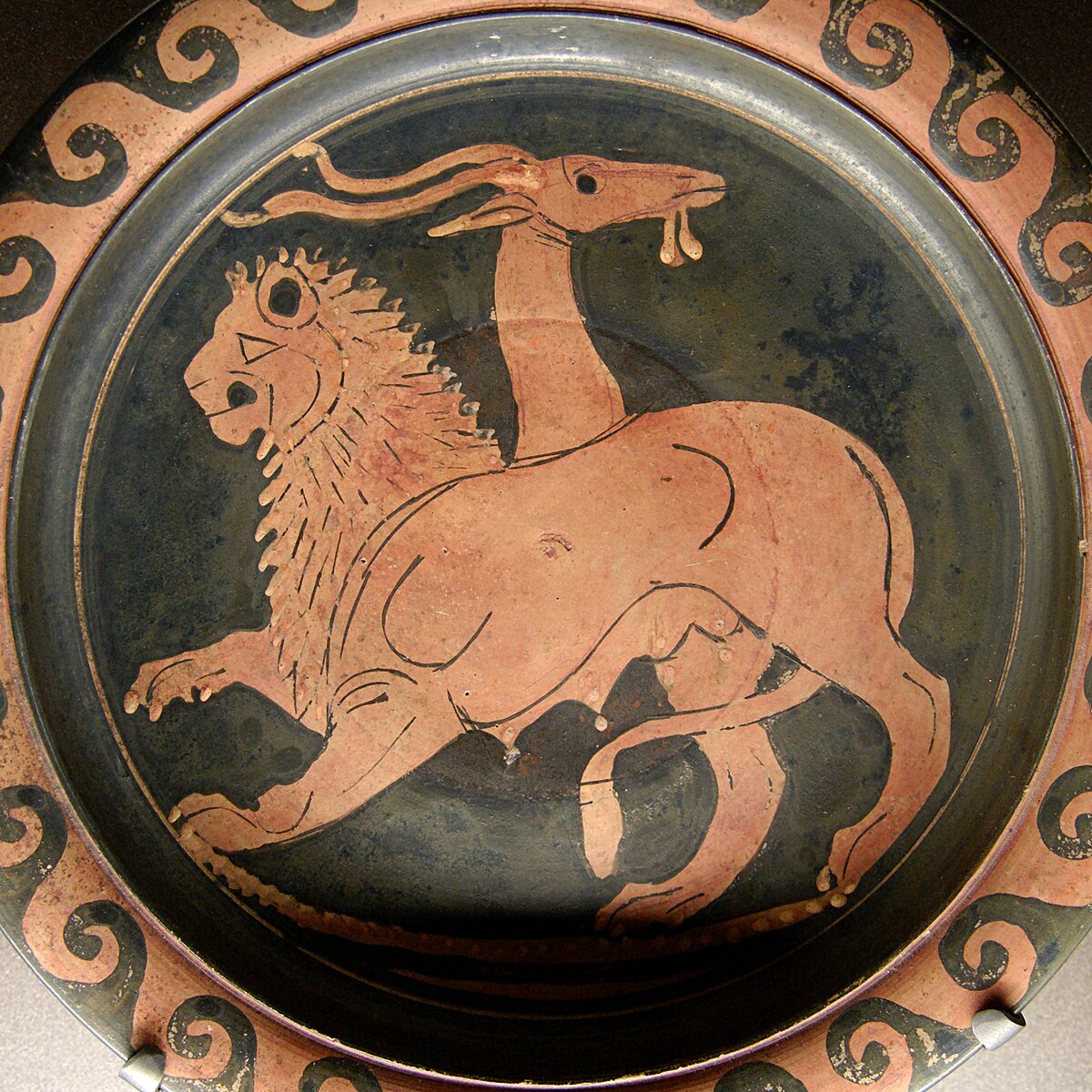
“Homer provides an image of the Khimaira when he says that in the front she was a lion, in the rear a serpent and in the middle a goat. This sort of thing could be the truth. A woman who ruled over those places had two brothers who helped her named Leo and Drako. Because she was an oath-breaker and guest-killer, she was killed by Bellerophon.”
From Heraclitus the Paradoxographer 16 Concerning Circe
“Myth has handed down the idea that Kirkê transformed people with a drink. But she was a prostitute and by charming guests at first with every kind of delight she would mold them towards good will, and once they were in a state of passion, she would keep them there by means of their desires as long as they were carried away with pleasures. Odysseus bested even her.”
14 “Similarly, near Kosê there is a spring which, if you place a container filled with wine in it until it covers the mouth, then it becomes more bitter than vinegar right away according to the same author.”
7 “In Naxos Aglaosthenês says that wine bubbles up on its own for the earth and when it goes into rivers it does not mix with water. The person who tastes it goes crazy”
Some passages for the end of another strange semester
Solon, fr. 18
“I grow old, always learning many things.”
γηράσκω δ’ αἰεὶ πολλὰ διδασκόμενος·
Kim Stanley Robinson The Years of Rice and Salt (2003: 758)
“Over time, Bao came to understand that teaching too was a kind of reincarnation, in that years passed and students came and went, new young people all the time, but always the same age, taking the same class; the class under the oak trees, reincarnated. He began to enjoy that aspect of it. He would start the first class by saying, “Look, here we are again.” They never knew what to make of it; same response, every time.
He learned, among other things, that teaching was the most rigorous form of learning. He learned to learn more from his students than they did from him; like so many other things, it was the reverse from what it seemed to be, and colleges existed to bring together groups of young people to teach some chosen few of their elders the things that they knew about life, that the old teachers had been in danger of forgetting.”
Seneca, Moral Epistles 76.3-5
“People of every age enter this classroom. “Do we grow old only to follow the young?” When I go into the theater as an old man and I am drawn to the racetrack and no fight is finished without me, shall I be embarrassed to go to a philosopher?
You must learn as long as you are ignorant—if we may trust the proverb, as long as you live. And nothing is more fit to the present than this: as long as you live you must learn how to live. Nevertheless, there is still something which I teach there. You ask, what may I teach? That an old man must learn too.”
Omnis aetatis homines haec schola admittit. “In hoc senescamus, ut iuvenes sequamur?” In theatrum senex ibo et in circum deferar et nullum par sine me depugnabit ad philosophum ire erubescam?
Tamdiu discendum est, quamdiu nescias; si proverbio credimus, quamdiu vivas. Nec ulli hoc rei magis convenit quam huic: tamdiu discendum est, quemadmodum vivas, quamdiu vivas. Ego tamen illic aliquid et doceo. Quaeris, quid doceam? Etiam seni esse discendum.







_(5485650566).jpg)

