“It was then that our state first seemed to have become more learned with a certain foreign type of education. For it was no little stream which flowed from Greece into this city, but the most powerful river of those disciplines and arts. Some people tell the tale that Demaratus—a Corinthian exceptional in his own city for his respect, wealth, and authority—who was not able to endure the tyrant Cypselos at Corinth, fled with his money and took up residence in Tarquinii, the most elegant city of Etruria at the time.
Once he heard that Cypselos’ power was complete, the man of freedom and bravery officially became an exile and re-established his home and roots here. When he had two sons with the Tarquinian mother of his family, he had them educated in every art of the Greek system…”
XIX. Sed hoc loco primum videtur insitiva quadam disciplina doctior facta esse civitas. influxit enim non tenuis quidam e Graecia rivulus in hanc urbem, sed abundantissimus amnis illarum disciplinarum et artium. fuisse enim quendam ferunt Demaratum Corinthium et honore et auctoritate et fortunis facile civitatis suae principem; qui cum Corinthiorum tyrannum Cypselum ferre non potuisset, fugisse cum magna pecunia dicitur ac se contulisse Tarquinios, in urbem Etruriae florentissimam. cumque audiret dominationem Cypseli confirmari, defugit patriam vir liber ac fortis et adscitus est civis a Tarquiniensibus atque in ea civitate domicilium et sedes collocavit. ubi cum de matre familias Tarquiniensi duo filios procreavisset, omnibus eos artibus ad Graecorum disciplinam erudiit. . .
The following is a spurious letter from the wild Historia Augusta. This is filled with religious confusion, some hate, and an odd detail about cups.
Historia Augusta, 29.7
“Hadrianus Augustus greets Servianus the Consul.
Dearest Servianus, that Egypt you were praising to me is completely light of learning, volatile, and swinging toward every little rumor. The people there who follow Serapis are Christians and those who claim to be followers of Christ are actually worshipers of Serapis. There’s no one in charge of the synagogue of the Jews, there’s no Samaritans, no Christian presbyter who is not also an astrologer, a psychic or some baptist. Even the Patriarch, when he has come to Egypt, is made to worship Serapis by some and Christ by others.
These people are the most traitorous, the most vain, most likely to injure while their state is wealthy, showy, fertile and a place where no one is without work. Some people blow glass; paper is made by others; everyone weaves some kind of linen or are part of some kind of craft. The lame have things they do; eunuchs have things they do as do the blind and even those with crippled hands are not without work among them.
Money is their only god—Christians, Jews, every people and race worship him. I wish that this place had a better nature, for it is truly worthy because of its size and richness to be the chief place of all Egypt. I conceded everything to it; I returned its ancient rights and added new ones so that the people thanked me while I was there. But, then, the moment I left, they said many things against my son Verus and I believe that you have learned what they said about Antinoos.
I wish nothing for them except that they live on their own chickens which they raise in a way that is shameful to speak. I am sending you some cups which are decorated with changing colors and were given to me by the priest of a temple but are now dedicated to you and my sister. I want you to use them on feast days. Be careful that our companion Africanus does not use them as he wants.”
VIII. “Hadrianus Augustus Serviano consuli salutem. Aegyptum, quam mihi laudabas, Serviane carissime, totam didici levem, pendulam et ad omnia famae momenta volitantem. illic3 qui Serapem colunt Christiani sunt, et devoti sunt Serapi qui se Christi episcopos dicunt. nemo illic archisynagogus Iudaeorum, nemo Samarites, nemo Christianorum presbyter non mathematicus, non haruspex, non aliptes. ipse ille patriarcha cum Aegyptum venerit, ab aliis Serapidem adorare, ab aliis cogitur Christum. genus hominum seditiosissimum, vanissimum, iniuriosissimum; civitas opulenta, dives, fecunda, in qua nemo vivat otiosus. alii vitrum conflant, aliis charta conficitur, omnes certe linyphiones aut cuiuscumque artis esse videntur; et habent podagrosi quod agant, habent praecisi quod agant, habent caeci quod faciant, ne chiragrici quidem apud eos otiosi vivunt. unus illis deus nummus est. hunc Christiani, hunc Iudaei, hunc omnes venerantur et gentes. et utinam melius esset morata civitas, digna profecto quae pro sui fecunditate, quae pro sui magnitudine totius Aegypti teneat principatum. huic ego cuncta concessi, vetera privilegia reddidi, nova sic addidi ut praesenti gratias agerent. denique ut primum inde discessi, et in filium meum Verum multa dixerunt, et de Antinoo quae dixerint comperisse te credo. nihil illis opto, nisi ut suis pullis alantur, quos quemadmodum fecundant, pudet dicere. calices tibi allassontes versicolores transmisi, quos mihi sacerdos templi obtulit, tibi et sorori meae specialiter dedicatos; quos tu velim festis diebus conviviis adhibeas. caveas tamen ne his Africanus noster indulgenter utatur.”
“Whoever understands the limits of life knows that it is extremely easy to take away the pain of want and to make all of life fulfilled. Then he lacks nothing which is acquired through conflicts.”
“Some of our desires are natural and necessary. Others are natural and not necessary. Some more are neither natural nor necessary, but they develop thanks to meaningless beliefs.”
We have posted about the strange story of Erikhthonios before, but this account not only contains an aetiological myth for the absence of crows but also has some strange details, like Athena trying to bring a mountain to Athens. Antigonus of Carystus allegedly compiled his collections of wonders in the 3rd Century BCE.
Antigonus Paradoxographus, Historiae Mirabiles 12
“Amelêsagoras the Athenian, author of the Atthis, claims that the crow does not fly to the Akropolis and that no one can say he has seen it happen. He provides the cause of this as a myth.
For he says that when Athena was given to Hephaestos that she disappeared right after she laid down with him and Hephaistos ejaculated his seed on the ground. The earth later produced for Hephaestos Erikhthonios whom Athena cared for but then closed in a basket and handed over to the daughters of Kekrops, Agraulos, Pandrosos, and Hersê. She told them not to open the basket until she returned.
When she left for Pellênê to bring back a mountain in order to make a defensive barrier before the city, two of Kekrops’ daughters—Agraulos and Pandrosos—opened the basket and saw two snakes around Erikhthonios.
[Amelêsagoras] claims that a crow went to Athena as she was carrying the mountain which is now called Lykabettos and told her that Erikhthonios was in the open. When she heard this, she threw the mountain to where it is now, said tat it would no longer right for the crow to go to the Akropolis because of his evil message.”
“For this reason we must examine whether or not it is possible for the study of the philosophers to bring us [happiness].”
Quare hoc videndum est, possitne nobis hoc ratio philosophorum dare.
Aristotle, Eudemian Ethics, 2.1 (1219a25)
“Let the work of the mind be the performance of life—and what this means is using life and being awake (for sleep is some kind of a rest and cessation of life). As a result, since the work of the mind and its virtue are identical, then the work of virtue is an earnest life.
This, then, is the complete good, which is itself happiness. For it is clear from what we have argued—as we said that happiness was the best thing; the goals and the greatest of the goods are in the mind, but aspects of the mind are either a state of being or an action—it is clear that, since an action is better than a state and the best action is better than the best state, that the performance of virtue is the greatest good of the mind. Happiness, then, is the action of a good mind.”
ψυχή: can be translated into English as “spirit” or “soul” instead of “mind”. I avoided the former to sidestep the implication that Aristotle is making some kind of a mystical argument; I avoided the latter because it has such strong religious associations in English.
Seneca De Beneficiis 22
“A just reason for happiness is seeing that a friend is happy—even better, is to make a friend happy.”
iusta enim causa laetitiae est laetum amicum videre, iustior fecisse
“This is how he increases attention by creating expectation, which is a device one might use in a proem. For it is necessary that he acquire the goodwill of his audience for himself and attention for his speech so that they might welcome him as he speaks and they might internalize the things he says of the deeds and they might learn in what way Odysseus handled [everything] in general as he both praises himself but also demonstrates the number and strangeness of his experiences—this clarifies his purpose, from where he was present, and what he wants. This is why he begins the material of the longer narrative with “bringing me from Troy….”
“He always rushes to the action and steals
His audience to the story as if it is already known…”
semper ad eventum festinat et in medias res
non secus ac notas auditorem rapit
Dio Chrysostom, Oration 11.25-26
“For once he tried to describe the war which happened between the Achaians and Greeks, he did not begin from the beginning, but from wherever he chanced. This is what nearly all liars do, as they embellish and re-weave their tales, never wishing to speak in the order of events.
For, they are less than clear in this way; otherwise, they would be shown false by the tale itself. This can be seen happening now in the courts of law and other places where men lie with skill. But people who wish to show what has happened, as each thing occurred, report in this way: first thing first, second thing second and everything else in order.
This is one explanation for why Homer does not begin his poem naturally; another is that he wished to obscure the beginning and the end the most and to obtain the opposite belief about these things. This is why he does not dare to narrate the beginning and the end clearly, nor does he promise to say anything about them. If he does mention them at all it is in passing and brief and it his clear he is mixing it all up. For he does not dare nor was he able to address these things readily.
This is what happens with liars especially, when someone is saying many different things about a matter and going on about them, because they want to hide some part of it the most, they don’t speak in an organized way or appeal to their audience by ordering things in the same place but where they are most deceptive. This is because they are ashamed to lie and hesitate to proceed, especially when it is about something serious. For this reason, liars do not speak in a loud voice when they come to this moment. Some people stutter and speak unclearly; others act as if they don’t know the truth but heard this from others.
Whoever speaks something true does it fearing nothing. Nor then has Homer spoken about the abduction of Helen or even about the sack of the city simply or in a free manner. Instead, as I was saying, even though he was so very bold, he stumbled and swooned because he knew he was speaking the opposite to the truth and was lying about the very substance of his affair.”
In 1923 Rainer Maria Rilke published Sonnets to Orpheus, a sequence of poems dedicated to the mythical father of song. The poems are as beautiful and subtle as they are challenging.
A Platonic concept animates the third sonnet: namely, song’s audial aspect (I treat the word as interchangeable with “music”) should direct us to the art’s higher, pure form. In fact, it should move us beyond the world of appearances and reconcile us with fundamental reality.
And so Socrates says of song: “certainly it is useful in the search for the beautiful and the good” [Republic 531c]. Like geometry and astronomy, song should “compel contemplation of being itself” [Republic 526e].
With these lofty claims in mind, enjoy Rilke:
Sonnets to Orpheus: III
A god is able. But tell me, how could
a man follow him through the narrow lyre?
Man’s mind is conflict. At the meeting of two
heart-paths there is no temple to Apollo.
Song, as you teach it, is not desire,
not an instrument for reaching a goal.
Song is being. For a god, a simple thing.
But when will we be? When will he turn
the earth and the stars toward our being?
Song’s not there, youth, for when you fall in love,
though your voice forces your mouth open. Learn
to forget you sang that way. It will pass.
True singing is breath of another kind:
A breath about nothing. A flutter in the god. A wind.
Ein Gott vermags. Wie aber, sag mir, soll
ein Mann ihm folgen durch die schmale Leier?
Sein Sinn ist Zwiespalt. An der Kreuzung zweier
Herzwege steht kein Tempel für Apoll.
Gesang, wie du ihn lehrst, ist nicht Begehr,
nicht Werbung um ein endlich noch Erreichtes ;
Gesang ist Dasein. Für den Gott ein Leichtes.
Wann aber sind wir? Und wann wendet er
an unser Sein die Erde und die Sterne?
Dies ists nicht, Jüngling, daß du liebst, wenn auch
die Stimme dann den Mund dir aufstößt, – lerne
vergessen, daß du aufsangst. Das verrinnt.
In Wahrheit singen, ist ein andrer Hauch.
Ein Hauch um nichts. Ein Wehn im Gott. Ein Wind.
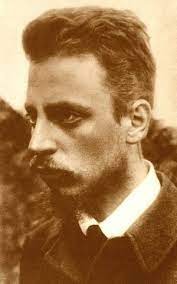
Rilke at 25 bore some resemblance to young Stalin.
“Against those in power, no one has enough defense
If a wicked adviser also enters the scene
His power and malice ruins their opposition.
An eagle carried a tortoise on high,
When he pulled his body in his armored home to hide,
And rested hidden untouched by any attack,
A crow came on a breeze flying near them:
“You have well seized a precious prize with your talons,
But, if I don’t show what you need to do,
It will pointlessly wear you out with its heavy weight.”
Promised a portion, the crow instructs the eagle to drop
The hard shell from the stars upon a cliff’s rock.
It would be easy to feed on the broken flesh!
The eagle followed up these wicked instructions
And also split the feast with her teacher.
Just so, the tortoise who was safe by nature’s gift.
Was ill-matched to those two and died a sad death.”
Contra potentes nemo est munitus satis;
si vero accessit consiliator maleficus,
vis et nequitia quicquid oppugnant, ruit.
Aquila in sublime sustulit testudinem:
quae cum abdidisset cornea corpus domo,
nec ullo pacto laedi posset condita,
venit per auras cornix, et propter volans
“Opimam sane praedam rapuisti unguibus;
sed, nisi monstraro quid sit faciendum tibi,
gravi nequiquam te lassabit pondere.”
promissa parte suadet ut scopulum super
altis ab astris duram inlidat corticem,
qua comminuta facile vescatur cibo.
inducta vafris aquila monitis paruit,
simul et magistrae large divisit dapem.
sic tuta quae naturae fuerat munere,
impar duabus, occidit tristi nece.
Here is the second half of the Paradoxographus Palatinus: Admiranda.This collection is extremely difficult to date and may hail from Byzantine Greece. As with some of the other paradoxographoi these are new translations, so corrections or questions are welcome.
11 “Artemidoros says that among the Liparitanoi fish are found by digging and that the people there use the dug fish unsparingly for snacking.”
12 “Andronikos says that in Hispania in some place pebbles are found strewn about with many angles, grown on their own—some are white and others are wax-colored; they give birth to pebbles like them.
I also used to have one of these for testing which was produced at my home which showed that the story was not a lie. He also says that there is a certain spring in Hispania which has water which is sweet and potable. If someone puts his hands in the water and holds them their for a short time he will find white salt embedded around his hands.”
14 “In Selasphoros an herb is found which when people use it in the spring there they rid themselves of yellow bile, but in the spring black bile, and phlegm if they use it in the winter. It leads out the portion of those which is unmixed of every other. [?]”
15 “Kallimachus says that in Thrace there are two rivers named Keron and Neleus. He adds that flocks who are there for grazing turn white from the Neleus, but those who take from both waters become multi-colored.”
18 “Athenaios says that there is a tree among the Persians which bears some kind of deadly fruit, which the Persians, when Kambyses led his army against Egypt, took to Egypt and planted in many places so that the Egyptians died when they encountered the fruit. The tree transforms the earth to endure the fruit unharmed and they call it Persaia because it was planted by the Persians”
19 “Theopompos says that in the land of the Agrioi of Thrace there is a river called Pontos which carries burning stones. When these are lit they do not burn as they are turned under the rapids but when they appear from under the water they reignite. Nothing that moves can endure the smell of these stones.”
20 “Antigonos says [of sheep intestines] that those of rams are voiceless, but those from females can sing. This fact has not escaped the poet, for he says “He stretching the seven strings from female sheep.”
The following two passages are from the Mirabilia ofApollonius the Paradoxographer (usually dated to the 2nd Century BCE, making him one of the earliest extant paradoxographers).
This plant makes you bigger [=BNJ 81 F17]
“Phularkhos writes in the eighth book of his Histories that near the Arabian Gulf there is a spring of water from which if anyone ever anoints their feet what transpires miraculously is that their penis becomes enormously erect. For some it never contracts completely, while others are put back in shape with great suffering and medical attention.”
“Phularkhos in book 20 of the Histories says that there is a white root imported from India which when [people] cut it and smear it over their feet with water, those who are smeared with it experience forgetfulness of sex and become similar to Eunuchs. For this reason still some apply it before they are fully adults and are not aroused for the rest of their life.”
“Phularkhos says that Sandrokottos, the king of the Indians, sent along with other gifts to Seleukos some drugs with erectile powers, the kind of which, when they are applied beneath feet of those who are going to have sex, give the the urge like birds, while some people lose their ability [for sex].”
“To be able to fuck a lot: mix fifty [pine nuts] with two measures of honey and seeds of pepper and drink it. To have an erection whenever you want: mix pepper with honey and rub it on your thing.”