What Hephaestus Really Wanted from Thetis

Schol. to Pin. Nemian Odes, 4.81

“Phylarkhos claims that Thetis went to Hephaistos on Olympos so that he might create weapons for Achilles and that he did it. But, because Hephaistos was lusting after Thetis, he said he would not give them to her unless she had sex with him. She promised him that she would, but that she only wanted to try on the weapons first, so she could see if the gear he had made was fit for Achilles. She was actually the same size as him.

Once Hephaistos agreed on this, Thetis armed herself and fled. Because he was incapable of grabbing her, he took a hammer and hit Thetis in the ankle. Injured in this way, she went to Thessaly and healed in the city that is called Thetideion after her.”

Φύλαρχός φησι Θέτιν πρὸς ῞Ηφαιστον ἐλθεῖν εἰς τὸν ῎Ολυμπον, ὅπως ᾽Αχιλλεῖ ὅπλα κατασκευάσηι, τὸν δὲ ποιῆσαι. ἐρωτικῶς δὲ ἔχοντα τὸν ῞Ηφαιστον τῆς Θέτιδος, οὐ φάναι ἂν δώσειν αὐτῆι, εἰ μὴ αὐτῶι προσομιλήσαι. τὴν δὲ αὐτῶι ὑποσχέσθαι, θέλειν μέντοι ὁπλίζεσθαι, ὅπως ἴδηι εἰ ἁρμόζει ἃ ἐπεποιήκει ὅπλα τῶι ᾽Αχιλλεῖ· ἴσην γὰρ αὐτὴν ἐκείνωι εἶναι. τοῦ δὲ παραχωρήσαντος ὁπλισαμένην τὴν Θέτιν φυγεῖν, τὸν δὲ οὐ δυνάμενον καταλαβεῖν σφύραν λαβεῖν καὶ πατάξαι εἰς τὸ σφυρὸν τὴν Θέτιν· τὴν δὲ κακῶς διατεθεῖσαν ἐλθεῖν εἰς Θετταλίαν καὶ ἰαθῆναι ἐν τῆι πόλει ταύτηι τῆι ἀπ᾽ αὐτῆς Θετιδείωι καλουμένηι.

Image result for Thetis Berlin F2294
Hephaistos Thetis Kylix by the Foundry Painter Antikensammlung Berlin F2294

Informers, Flatterers, and Figs: On Sycophants

From the Suda

“To be a sykophant: To rub sexually. That’s how Plato and Menander use it.”

Συκοφαντεῖν: κνίζειν ἐρωτικῶς. οὕτως Πλάτων καὶ Μένανδρος.

Browse the Suda on the Scaife Viewer. Or, check out translation and commentary on the Suda Online

More from the Suda

“To be a sykophant: to falsely accuse someone. They the Athenians called it this at the time when a fig-plant was first discovered and they were stopping the export of figs for this reason. Those people who reported that figs were being exported were called “sykophants” [lit. “fig speakers”]. Over time, anyone who accused people in a super annoying manner were named in this way.

Aristophanes writes “these things are small and indigenous” since being a sykophant is a native characteristic of Athenians. Aelian adds “he alleged [sukophantei] that he god was negligent. For these reasons plagues and famine over came the Himerians’ city.”

Συκοφαντεῖν: τὸ ψευδῶς τινος κατηγορεῖν. κεκλῆσθαι δέ φασι τοῦτο παρ’ ᾿Αθηναίοις πρῶτον εὑρεθέντος τοῦ φυτοῦ τῆς συκῆς καὶ διὰ τοῦτο κωλυόντων ἐξάγειν τὰ σῦκα. τῶν δὲ φαινόντων τοὺς ἐξάγοντας συκοφαντῶν κληθέντων, συνέβη καὶ τοὺς ὁπωσοῦν κατηγοροῦντας τινῶν φιλαπεχθημόνως οὕτω προσαγορευθῆναι. ᾿Αριστοφάνης· καὶ ταῦτα μὲν δὴ σμικρὰ κἀπιχώρια. ἴδιον γὰρ ᾿Αθηναίων τὸ συκοφαντεῖν. Αἰλιανός· ὁ δὲ ἐσυκοφάντει τὸν θεὸν ὀλιγωρίας. ἐκ δὴ τούτων νόσοι καὶ τροφῶν ἀπορίαι τὴν ῾Ιμεραίων κατέσχον.

Even more from the Suda

“Sykophant: When there was a famine in Attica, some people were gathering figs in secrete which had been promised to the gods. After this, when times were good again. Some people were prosecuting these men. This is where the term developed. Look at the term “fig squeezer” too.

Συκοφάντης: λιμοῦ γενομένου ἐν τῇ ᾿Αττικῇ, τινὲς λάθρα τὰς συκᾶς τὰς ἀφιερωμένας τοῖς θεοῖς ἐκαρποῦντο· μετὰ δὲ ταῦτα εὐθηνίας γενομένης, κατηγόρουν τούτων τινές. ἐκεῖθεν οὖν συκοφάντης λέγεται. ζήτει ἐν τῷ ἀποσυκάζεις.

“Sykophant: The devil. For he made a false accusation of god, claimed that he prevented [humans] from having a share of the tree [of knowledge]. He also spoke slanderously against Job: “Does Job worship god with no return?”

Consider also sykophantia, which means false prosecution.

Συκοφάντης: ὁ διάβολος· τὸν γὰρ θεὸν ἐσυκοφάντησε, φήσας κεκωλυκέναι τοῦ ξύλου τὴν μετάληψιν· καὶ κατὰ τοῦ ᾿Ιώβ· μὴ δωρεὰν σέβεται ᾿Ιὼβ τὸν θεόν; καὶ Συκοφαντία, ἡ ψευδὴς κατηγορία.

For the story of Solon and the sycophants, see Plutarch’s Life of Solon on the Scaife Viewer. The sense of flatterer or parasite is somewhat present in the ancient Greek but becomes more prominent in English usage. The negative use can be seen in the fragment from Alexis’ The Poet (fr. 187) preserved in Athenaeus:

The name of sykophant is not rightly
Given to corrupted men.
For it should have been right for any man
Who was good and sweet to have figs
Attached to him to reveal his character.
But it fills us with confusion on why something sweet
Has been attached to someone bad.

ὁ συκοφάντης οὐ δικαίως τοὔνομα |
ἐν τοῖσι μοχθηροῖσίν ἐστι κείμενον.
ἔδει γάρ, ὅστις χρηστὸς ἦν ἡδύς τ᾿ ἀνήρ,
τὰ σῦκα προστεθέντα δηλοῦν τὸν τρόπον·
νυνὶ δὲ πρὸς μοχθηρὸν ἡδὺ προστεθὲν
ἀπορεῖν πεπόηκε διὰ τί τοῦθ᾿ οὕτως ἔχει.

Syc OED


Yes to Vergil, No to Lucan

J.E. Sandys, Harvard Lectures on the Revival of Learning:

“Cicero and Virgil became the principal text-books of the Revival of Learning. Petrarch describes them in one of his poems as the ‘two eyes’ of his discourse. In his very boyhood he had been smitten with the charm of Virgil, and, even in his old age, he was still haunted by the mediaeval tradition of the allegorical significance of the Aeneid. But, unlike the mediaeval admirers of Virgil, he does not regard the Latin poet as a mysteriously distant and supernatural being; he finds in him a friend, and he is even candid enough to criticise him. Under his influence the Aeneid was accepted as the sole model that was worthy of imitation by the epic poets of the succeeding age. A German critic regards this result with regret, a regret that few, if any, will share; nor is it easy to believe that any scholar would really have preferred seeing Petrarch throw the weight of his example on to the side of any other Latin epic poet, such as Lucan.”

Image result for petrarch

Dishonoring the Gods

Sophocles, Antigone 280–288

“Stop speaking before you fill me with rage!
And you’re revealed as a fool as well as an old man.

You speak of unendurable things, claiming that the gods
Have some plan for this corpse.
Did they do it to honor him so greatly for his fine work,
Concealing him, the man who came here
To burn their temples and their statutes,
To ruin their land and their laws?
Do you see the gods honoring evil people?”

παῦσαι, πρὶν ὀργῆς καί με μεστῶσαι λέγων,
μὴ ᾿φευρεθῇς ἄνους τε καὶ γέρων ἅμα.
λέγεις γὰρ οὐκ ἀνεκτὰ δαίμονας λέγων
πρόνοιαν ἴσχειν τοῦδε τοῦ νεκροῦ πέρι.
πότερον ὑπερτιμῶντες ὡς εὐεργέτην
285ἔκρυπτον αὐτόν, ὅστις ἀμφικίονας
ναοὺς πυρώσων ἦλθε κἀναθήματα
καὶ γῆν ἐκείνων καὶ νόμους διασκεδῶν;
ἢ τοὺς κακοὺς τιμῶντας εἰσορᾷς θεούς;

 Sophocles, Antigone 72–77

“It is noble for me to do this and then die.
I will lie with him because I belong to him, with him,
Once I have completed my sacred crimes. There’s more time
When I must please those below than those here,
Since I will lie there forever. You? Go head,
Dishonor what the gods honor if it seems right.”

… καλόν μοι τοῦτο ποιούσῃ θανεῖν.
φίλη μετ᾿ αὐτοῦ κείσομαι, φίλου μέτα,
ὅσια πανουργήσασ᾿· ἐπεὶ πλείων χρόνος
ὃν δεῖ μ᾿ ἀρέσκειν τοῖς κάτω τῶν ἐνθάδε·
ἐκεῖ γὰρ αἰεὶ κείσομαι. σὺ δ᾿ εἰ δοκεῖ
τὰ τῶν θεῶν ἔντιμ᾿ ἀτιμάσασ᾿ ἔχε.

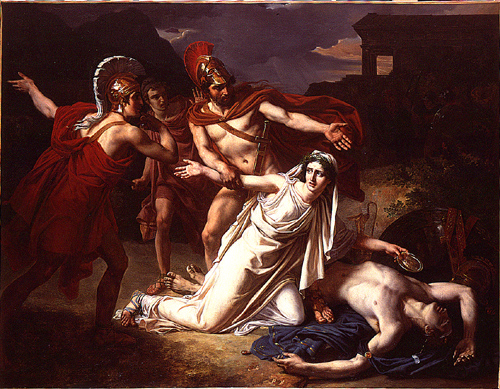
Sébastien Norblin, Antigone donnant la sépulture à Polynice

Further Lyric Inducements to Drink

PMG 900

“Ah, but I wish I were a large bit of gold
And a beautiful lady would wear me with a pure mind.”

εἴθ᾿ ἄπυρον καλὸν γενοίμην μέγα χρυσίον |
dκαί με καλὴ γυνὴ φοροίη καθαρὸν θεμένη νόον

PMG 901

“Drink with me. Be Young with me. Love with Me. Wear crowns with me.”

σύν μοι πῖνε, συνήβα, συνέρα, συστεφανηφόρει

PMG 902

“Be crazy with me when I’m crazy
Be sensible when I have sense.”

σύν μοι μαινομένῳ μαίνεο, σὺν σώφρονι
σωφρόνει.

Greek Anthology, 7.415 [=Callimachus 37]

“You are walking over the grave of a man who knew how to sing,
Callimachus, who also could laugh at the right time with a drink.”

Βαττιάδεω παρὰ σῆμα φέρεις πόδας, εὖ μὲν ἀοιδὴν
εἰδότος, εὖ δ᾿ οἴνῳ καίρια συγγελάσαι.

Alcaeus, Fr. 38A (P. Oxy. 1233 fr. 1)

“Drink and get drunk with me, Melanippos.
Why would you say that once you cross the great eddying
River of Acheron you will see the pure light of the sun again?

πῶνε [καὶ μέθυ᾿ ὦ] Μελάνιππ᾿ ἄμ᾿ ἔμοι· τί [φαῖς †
ὄταμε[. . . .]διννάεντ᾿ † Ἀχέροντα μέγ[αν πόρον
ζάβαι[ς ἀ]ελίω κόθαρον φάος [ἄψερον

Anacreon, fr. 412

“I’m drunk, won’t you let me go home?”

οὐ δηὖτέ μ᾿ ἐάσεις μεθύοντ᾿ οἴκαδ᾿ ἀπελθεῖν;

From medievalists.net

Rhetoric is for Losers

Montaigne, Essays The Vanity of Words (1.51)

The republics which maintained themselves in a well-ordered and civilized state, like the Cretans or the Spartans, did not make great account of orators. Ariston sagely defined rhetoric as ‘the science of persuading the people.’ Socrates and Plato described it as ‘the art of tricking and flattering.’ Those who deny it in genera description nevertheless confirm it in all of their precepts. Muslims prohibit its teaching to children on account of its uselessness. And the Athenians, perceiving how dangerous its use, which held total sway in their city, actually was, ordered that its principal part, which is to stir the emotions, be taken away, along with exordia and perorations. It is a tool invented for handling and agitating a crowd and an unruly community; and, as with medicine, this tool isn’t used except when people are in bad states.

In those states where the mob, or the ignorant, or indeed everyone possesses all the power, as in Athens, or Rhodes, or Rome, and where affairs are in a perpetual storm – there it is where orators have flooded in. In truth, there are few people in these republics who are driven to great credit without recourse to eloquence. Pompey, Caesar, Crassus, Lucullus, Lentulus, Metellus, took from eloquence their great support on which they launched themselves to the great authority at which they finally arrived, and they were aided by it more than by arms, contrary to the opinion of better times. For Lucius Volumnius, speaking publicly in favor of the election to the consulship of Quintus Fabius and Publius Decius, said, ‘They are of a type born for war, great men in their actions; they are uneducated in the combat of idle babbling; their minds are truly consular; the subtle, the eloquent, the brilliant – they are good for the city, praetors for administering justice. Eloquence flourished in Rome more when their affairs were in a sadder state, when the storm of civil wars was stirring.

Des républiques qui se sont maintenues en un état réglé et bien policé, comme la crètoise ou lacédémonienne, elles n’ont pas fait grand compte d’orateurs. Ariston définit sagement la rhétorique, « Science à persuader le peuple : » Socrate, Platon, « art de tromper et de flatter. » Et ceux qui le nient en la générale description le vérifient par tout en leurs préceptes. Les mahométans en défendent l’instruction à leurs enfants, pour son inutilité ; et les Athéniens, s’apercevant combien son usage, qui avait tout crédit en leur ville, était pernicieux, ordonnèrent que sa principale partie, qui est émouvoir les affections, fût ôtée, ensemble les exordes et péroraisons. C’est un outil inventé pour manier et agiter une tourbe et une commune déréglée ; et cet outil ne s’emploie qu’aux états malades, comme la médecine. En ceux où le vulgaire, où les ignorants, où tous ont tout pu, comme celui d’Athènes, de Rhodes et de Rome, et où les choses ont été en perpétuelle tempête, là ont afflué les orateurs. Et, à la vérité, il se voit peu de personnages en ces républiques là qui se soient poussés en grand crédit sans le secours de l’éloquence. Pompée, César, Crassus, Luciillus, Lentulus, Metellus, ont pris de là leur grand appui à se monter à cette grandeur d’autorité où ils sont enfin arrivés, et s’en sont aidés plus que des armes, contre l’opinion des meilleurs temps ; car L. Volumnius, parlant en public en faveur de l’élection au consulat faite des personnes de Q. Fabius et P. Decius : « Ce sont gens nés à la guerre, grands aux effets ; au combat du babil, rudes ; esprits vraiment consulaires : les subtils, éloquents et savants sont bons pour la ville, prêteurs à faire justice, » dit il. L’éloquence à fleuri le plus à Rome lorsque les affaires ont été en plus mauvais état et que l’orage des guerres civiles les agitait…

Chief Minister of Bullsh*t

Cicero, Letters to Atticus 92 (4.18) October or November 54

You may ask me “how are you handling these things?” By god, pretty damn well and I love myself for doing so. My friend, we have not only lost the marrow and blood of a just state, but we’ve lost its decoration and facade too.

There is no Republic where I might find happiness or comfort. You may ask, “Can you really take this well?” Yes. That’s it. I recall how well the state thrived when I was governing it and the gratitude it gave me. No grief touches me at all at seeing one person capable of everything. Those who were upset that I had any power are wrecked by it.

No, I have many things to bring me solace. But I do not move from where I am, instead I return to that way of life which is most natural, to my books and my research.”

Dices ‘tu ergo haec quo modo fers?’ belle mehercule et in eo me valde amo. amisimus, mi Pomponi, omnem non modo sucum ac sanguinem sed etiam colorem et speciem pristinae civitatis. nulla est res publica quae delectet, in qua acquiescam. ‘idne igitur’ inquies ‘facile fers?’ id ipsum. recordor enim quam bella paulisper nobis gubernantibus civitas fuerit, quae mihi gratia relata sit. nullus dolor me angit unum omnia posse; dirumpuntur ii qui me aliquid posse doluerunt. multa mihi dant solacia, nec tamen ego de meo statu demigro, quaeque vita maxime est ad naturam, ad eam me refero, ad litteras et studia nostra.

Carved bust of Cicero 

This Unforgetting Stone (Another Epitaph)

Iscr. di Cos (Fun.) EF 518  From Kos, 2nd/1st Century BCE

“Previously Homeric grooves [arrows] were sounding out
The master-loving habit of Eumaios on golden tablets,
But now this stone, repeating the unforgetting word,
Will sing your wise wit even into Hades, Inakhos.

Philoskos, who reveres your home, will always increase
The fine gifts and honor you both among the living and the dead—
Along with your wife who honors your son who is weeping,
A young child who draws deep from the spring of her breasts.

O, inescapable Hades, why do you hoard this kind of blessing,
Taking away the famous son of Kleumakhis?”

1 π̣ρὶν μ̣ὲν Ὁμήρειο[ι γλυφί]δες φιλ[οδέσποτ]ο̣ν̣ ἦ̣θ̣[ο]ς
Εὐμαίου χρ̣υσέαις̣ ἔ̣κλαγον ἐν σ̣ε̣λίσ̣ι̣ν̣·
σεῦ δὲ καὶ εἰν Ἀΐδαο σαόφρονα μῆτιν ἀείσει
Ἴν̣αχ̣’ ἀείμνηστον γ̣ρ̣άμ̣μ̣α λαλεῦσ̣α̣ πέ̣τρ̣η·
5 καί σε πρὸς εὐσεβέ̣ων δ̣όμ̣ον ἄξ̣ε̣ται ἐσθλὰ Φ̣ιλίσκος̣
δῶρα καὶ ἐν ζῳοῖς κἂμ φθιμένοισι τίνων·
σήν τ̣’ ἄλοχ̣ον κλείουντ’ αὐτόν σοι παῖδα τίο̣υσαν
π̣ηγῆς ἧς μασ̣τ̣ῶν ε̣ἴ̣λ̣κυ̣σ̣ε νηπίαχο̣ς̣.
[ὦ] δυσάλικτ’ Ἀΐδα, τὶ τὸ τηλίκον ἔσχ̣ες ὄνειαρ̣,
10 κλεινὸν Κλευμαχίδο̣ς̣ κοῦρον ἀειρ̣ά̣μενο̣ς̣;

Image result for ancient greek arrows

Anger, Insult, and Wounds

Seneca, De Ira, 28

“Anger hobbles many, it makes many disabled even when it finds ready material. Add to this the fact that nothing is born so submissive that it will pass on without any threat for its destroyer. Pain and danger make some of the weak equal to the strongest. What, don’t most of the things we get angry about insult us more than they wound?

Indeed, there is a great difference whether someone resists my will, steals it from me, or does not agree with it. But we attach equal value to each, whether someone takes something or denies it, whether he crushes our hope or puts it off, whether he acts against us or for himself, and whether because of love or out of hate.”

Multos iracundia mancos, multos debiles fecit, etiam ubi patientem est nancta materiam. Adice nunc quod nihil tam imbecille natum est, ut sine elidentis periculo pereat; imbecillos valentissimis alias dolor, alias casus exaequat. Quid, quod pleraque eorum, propter quae irascimur, offendunt nos magis quam laedunt? Multum autem interest, utrum aliquis voluntati meae obstet an desit, eripiat an non det. Atqui in aequo ponimus, utrum aliquis auferat an neget, utrum spem nostram praecidat an differat, utrum contra nos faciat an pro se, amore alterius an odio nostri. Quidam vero non tantum iustas causas standi contra nos, sed etiam honestas habent.

Image result for medieval manuscript anger
Angry Fish The Hague, KA 16, 14th c.


Cicero’s Cool – Aristotle Sucks

Montesquieu, Diverse Thoughts:

Cicero, in my opinion, is one of the greatest minds who have ever lived: his soul was always beautiful when it wasn’t weak.

Two masterpieces: the death of Caesar in Plutarch, and that of Nero in Suetonius. In one, we begin to feel for the conspirators whom we see in danger, and then for Caesar, whom we see killed. In the death of Nero, one is astonished to see him obliged by degrees to kill himself, without any cause to restrict him, and yet in a way that he cannot avoid.

Vergil, inferior to Homer in variety and grandeur of his characters, is equally admirable for his invention, and for the beauty of his poetry.

A nice phrase of Seneca: Enjoy present pleasures in a way that doesn’t ruin future ones.

The same error of the Greeks saturates all of their philosophy: bad physics, bad morals, bad metaphysics. They don’t perceive the difference which exists between positive and relatives qualities. Aristotle fooled himself with his dry, his humid, his warm, his cold. Plato and Socrates fooled themselves with their beautiful, their good, their wise. It was a grand discovery that there was no positive quality.

The terms the beautiful, the good, the noble, the grand, the perfect, these are all attributes of objects, and are relative to the beings who consider them. One must set this principle firmly in one’s head. It is the sponge of nearly every prejudice. It is the scourge of ancient philosophy, of Aristotle’s physics, of Plato’s metaphysics. And if you read the dialogues of that philosopher, you would find that they are nothing but a tissue of sophisms made from ignorance of this principle. Malebranche was done in with a thousand sophisms for his ignorance of it.

Cicéron, selon moi, est un des plus grands esprits qui aient jamais été : l’âme toujours belle lorsqu’elle n’était pas faible.

Deux chefs-d’œuvre : la mort de César dans Plutarque, et celle de Néron dans Suétone. Dans l’une, on commence par avoir pitié des conjurés qu’on voit en péril, et ensuite de César qu’on voit assassiné. Dans celle de Néron, on est étonné de le voir obligé par degrés de se tuer, sans aucune cause qui l’y contraigne, et cependant de façon à ne pouvoir l’éviter.

Virgile, inférieur à Homère par la grandeur et la variété des caractères, par l’invention admirable, l’égale par la beauté de la poésie.

Belle parole de Sénèque : Sic prœsentibus utaris voluptatibus, ut futuris non noceas.

La même erreur des Grecs inondait toute leur philosophie : mauvaise physique, mauvaise morale, mauvaise métaphysique. C’est qu’ils ne sentaient pas la différence qu’il y a entre les qualités positives et les qualités relatives. Comme Aristote s’est trompé avec son sec, son humide, son chaud, son froid, Platon et Socrate se sont trompés avec leur beau, leur bon, leur sage : grande découverte qu’il n’y avait pas de qualité positive.

Les termes de beau, de bon, de noble, de grand, de parfait, sont des attributs des objets, lesquels sont relatifs aux êtres qui les considèrent. Il faut bien se mettre ce principe dans la tête ; il est l’éponge de presque tous les préjugés ; c’est le fléau de la philosophie ancienne, de la physique d’Aristote, de la métaphysique de Platon ; et si on lit les dialogues de ce philosophe, on trouvera qu’ils ne sont qu’un tissu de sophismes faits par l’ignorance de ce principe. Malebranche est tombé dans mille sophismes pour l’avoir ignoré