Senators, Do Not Fail the Republic!

Cicero Philippic 3.14

“For this reason, Senators—by the gods almighty—take this opportunity offered to you and finally remember that you are the leaders of the most powerful council in the world. Give a sign to the Roman people that your response will not fail the Republic since they do insist that their own dedication will not fail you. You don’t need my warning!

No person is so foolish that they don’t understand that if we remain asleep at this moment we will have to live through a rule that is not only cruel and arrogant but ignoble and disgraceful too. You know this man’s arrogance, his friends, and his whole household. To serve shameful lusts, bullies, disgusting and irreverent thieves, those drunkards—well, that is the worst suffering married to the greatest dishonor.

But if—and the gods forbid this—if the final story of our Republic is being told, may we face it like noble gladiators when they fall with honor. Let us who were the leaders of the whole world and model for every people act so that we die with dignity rather than serve in disgrace. Nothing is more hateful than dishonor; nothing is more despicable than servitude. We were born into honor and freedom: let us keep them or die with dignity.

For too long we have hidden our thoughts. Now it is out in the open. Everyone is making what they think, what they want for each side clear. There are traitorous citizens—too many given the value of our Republic—but they are a mere few in comparison to those who know what’s right…”

14] Hanc igitur occasionem oblatam tenete, per deos immortalis, patres conscripti, et amplissimi orbis terrae consili principes vos esse aliquando recordamini! Signum date populo Romano consilium vestrum non deesse rei publicae, quoniam ille virtutem suam non defuturam esse profitetur. Nihil est quod moneam vos.

Nemo est tam stultus qui non intellegat, si indormierimus huic tempori, non modo crudelem superbamque dominationem nobis sed ignominiosam etiam et flagitiosam ferendam. Nostis insolentiam Antoni, nostis amicos, nostis totam domum. Libidinosis, petulantibus, impuris, impudicis, aleatoribus, ebriis servire, ea summa miseria est summo dedecore coniuncta.

Quod si iam—quod di omen avertant!—fatum extremum rei publicae venit, quod gladiatores nobiles faciunt, ut honeste decumbant, faciamus nos, principes orbis terrarum gentiumque omnium, ut cum dignitate potius cadamus quam cum ignominia serviamus. Nihil est detestabilius dedecore, nihil foedius servitute. Ad decus et ad libertatem nati sumus: aut haec teneamus aut cum dignitate moriamur.

Nimium diu teximus quid sentiremus; nunc iam apertum est. Omnes patefaciunt in utramque partem quid sentiant, quid velint. Sunt impii cives—pro caritate rei publicae nimium multi, sed contra multitudinem bene sentientium admodum pauci…

Oil painting on canvas, An Ideal Classical Landscape with Cicero and Friends, by Jacob More (Edinburgh 1740 ? Rome 1793), signed and dated: Rome, 1780.

Lingering Winter Cold? Here’s A Spice for the Elimination of Hardened Phlegm

Galen, De Simplicium Medicament. 12.55

Maker is an inner tree bark which comes from India, in regarding its flavor it is sufficiently sour, fragrant as well with a brief bitterness. But it also has a sweet smell similar to most Indian fragrances. The substance itself seems to come from a mixture, which is mostly of cold earth but a little bit of something warm and course—this is why it dries rather powerfully and gets sour and because of that mixes with the intestinal and dysenteric forces: it is in the third order of medicines which dry but it produces no different effect along the range of heat and cold*”

     [α′. Περὶ μάκερος.] Μάκερ φλοιός ἐστιν ἐκ τῆς ᾿Ινδικῆς κομιζόμενος, ἐν μὲν τῷ γεύεσθαι στρυφνὸς ἱκανῶς, μετά τινος βραχείας δριμύτητος ἀρωματιζούσης· ὀσμώμενος δὲ ἡδὺς ὁμοίως τοῖς πλείστοις ἀρώμασι τοῖς ᾿Ινδικοῖς. ἔοικεν οὖν καὶ αὐτὸς ἐκ μικτῆς οὐσίας συνεστάναι, τῆς πλείστης μὲν γεώδους ψυχρᾶς, ὀλίγης δέ τινος θερμῆς τε καὶ λεπτομεροῦς, ὅθεν ἰσχυρῶς ξηραίνει καὶ στύφει καὶ διὰ τοῦτο κοιλιακαῖς τε καὶ δυσεντερικαῖς μίγνυται δυνάμεσιν, ἐν μὲν τῇ τρίτῃ τάξει τῶν ξηραινόντων ὑπάρχων, ἐν δὲ τῇ κατὰ θερμότητα καὶ ψυχρότητα διαφορᾷ μηδέτερον ἐπιφανῶς ἐργαζόμενος.

*special thanks to the first comment for useful suggestions and addressing some of my very deep ignorance about Galen


Paulus 7.3.12

“Maker is a bark which comes from India, when dry in the third stage, it is in the middle of hot and cold. It is harsh and coarse. For this reason it works into the intestinal and dysenteric [regions].”

     Μάκερ φλοιόϲ ἐϲτιν ἐκ τῆϲ ᾿Ινδικῆϲ κομιζόμενοϲ, ξηραίνων μὲν κατὰ τὴν τρίτην τάξιν, μέϲοϲ δὲ κατὰ θερμότητα καὶ ψῦξιν· ἔϲτι δὲ καὶ ϲτυπτικὸϲ λεπτομερήϲ· ὅθεν κοιλιακοῖϲ τε καὶ δυϲεντερικοῖϲ ἁρμόττει.

Is this Walidda? Cf. Pliny the Elder Nat. Hist. 12.18

Aetius, 8.47.42

“These are [medicines] for the wealthy: “costos, amômos, and the one called maker, which is sufficiently hot with a sour taste. The Kurêneaic juice is useful for the elimination of hardened phlegm or something of the substances which accompany this, just like lasar is.”

ἔϲτι δὲ καὶ ταῦτα ἐπὶ μὲν τῶν πλουϲίων κόϲτοϲ καὶ ἄμωμον καὶ τὸ καλούμενον μάκερ, θερμαῖνον ἱκανῶϲ μετὰ  ϲτύψεωϲ καὶ ὁ Κυρηναικὸϲ δὲ ὀπὸϲ εἰϲ διαφόρηϲιν τῶν ϲκληρυνομένων φλεγμονῶν ἐπιτήδειοϲ ἤ τι τῶν μετ’ αὐτῶν, οἷόν ἐϲτι τὸ λάϲαρ.

Flower-01-KayEss-1.jpeg

Soul. Cold.

ψυχή, ἡ: soul, life

ψύχωσις: life-giving/generating

ψυχοανακάλυπτος: soul-baring, revealing

ψυχοκλέπτης: soul-thief

ψυχοκτόνος:soul-killing

ψυχοπλανής: soul-wandering

ψυχοπότης: soul drinker (drinking of life, i.e. blood)


ψῦχος, τό: cold

ψυχρία: cold

ψυχοκρασία: growing cold

ψυχολογία: frigid talking

ψυχροποιός: making cold

ψυχροπότης: cold drinker (one who drinks cold water)

ψυχρόσαρκος: with cold flesh

soulCOld1

cold 2

Snowy Mountain

Sorry But Aristotle Did Not Say This Thing about Snowflakes

The following quote has recently been attributed to Aristotle. As anyone who has read even a little bit by Aristotle can attest, this is about as far away from an Aristotelian sentiment as you can get.

Oh, Town and Country magazine, you fell for it. I get it. The quotation sounds kind of cool. It is inspiring in that insipid, soul-numbing way motivational posters start out as ‘neat’ and end up as part of a fevered nightmare.

As recently as 2012, this quotation was attributed anonymous (and this appears frequently). So, this one must have jumped attribution quite recently. Please, contact your local office of common sense and decency and let them know we cannot stand for this.

Here’s a real Aristotle quotation about snow:

Aristotle, Prior Analytics, 12b

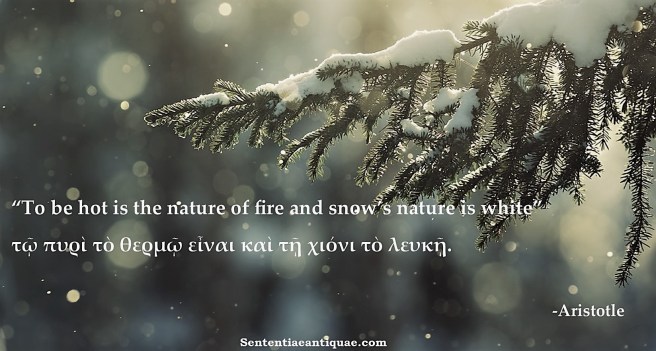
“To be hot is the nature of fire and snow’s nature is white”

τῷ πυρὶ τὸ θερμῷ εἶναι καὶ τῇ χιόνι τὸ λευκῇ.


And here is a Pinterest version for you:

Snow istotle

Thick on A Winter’s Day

Homer, Iliad 12.277–289

So those two yelled out to encourage the Greeks to fight
And just as waves of snowfall thick on a winter’s day
When Zeus the master of all urges it to snow
On human beings, showing them what his weapons are like—
And he reins in the winds to pour it constantly
So that he covers the high mountains and the jutting cliffs
As well as the flowering meadows and men’s rich fields,
Snowing onto the harbors and the promontories of the gray sea,
Even as the wave resists it when it strikes. But everything else
Is covered beneath it whenever Zeus’ storm drives it on.
That’s how the stones fell thick from both sides,
Some falling against the Trojans, others from the Trojans
against the Greeks and a great din overwhelmed the whole wall.”

῝Ως τώ γε προβοῶντε μάχην ὄτρυνον ᾿Αχαιῶν.
τῶν δ’, ὥς τε νιφάδες χιόνος πίπτωσι θαμειαὶ
ἤματι χειμερίῳ, ὅτε τ’ ὤρετο μητίετα Ζεὺς
νιφέμεν ἀνθρώποισι πιφαυσκόμενος τὰ ἃ κῆλα·
κοιμήσας δ’ ἀνέμους χέει ἔμπεδον, ὄφρα καλύψῃ
ὑψηλῶν ὀρέων κορυφὰς καὶ πρώονας ἄκρους
καὶ πεδία λωτοῦντα καὶ ἀνδρῶν πίονα ἔργα,
καί τ’ ἐφ’ ἁλὸς πολιῆς κέχυται λιμέσιν τε καὶ ἀκταῖς,
κῦμα δέ μιν προσπλάζον ἐρύκεται· ἄλλά τε πάντα
εἴλυται καθύπερθ’, ὅτ’ ἐπιβρίσῃ Διὸς ὄμβρος·
ὣς τῶν ἀμφοτέρωσε λίθοι πωτῶντο θαμειαί,
αἱ μὲν ἄρ’ ἐς Τρῶας, αἱ δ’ ἐκ Τρώων ἐς ᾿Αχαιούς,
βαλλομένων· τὸ δὲ τεῖχος ὕπερ πᾶν δοῦπος ὀρώρει.

Schol. bT ad Il. 12. 279

“[The Poet] immediately specifies a winter day—for there is snow in the Spring too, but it isn’t deep.”

εὐθὺς χειμέριον παρέλαβε τὴν ἡμέραν· γίνονται μὲν γὰρ καὶ ἐν ἔαρι νιφάδες, ἀλλ’ οὐ πυκναί

Last Snowfall by Sophia Moran [from Wikimedia Commons]

Platonic Despotism

John Addington Symonds,

Renaissance in Italy: The Age of the Despots (Chp. 3)

What I have said about Italian despotism is no mere fancy picture. The actual details of Milanese history, the innumerable tragedies of Lombardy, Romagna, and the Marches of Ancona, during the ascendency of despotic families, are far more terrible than any fiction; nor would it be easy for the imagination to invent so perplexing a mixture of savage barbarism with modern refinement. Savonarola’s denunciations and Villani’s descriptions of a despot read like passages from Plato’s Republic, like the most pregnant of Aristotle’s criticisms upon tyranny. The prologue to the sixth book of Matteo Villani’s Chronicle may be cited as a fair specimen of the judgment passed by contemporary Italian thinkers upon their princes (Libro Sesto, cap. i.): ‘The crimes of despots always hinder and often neutralize the virtues of good men. Their pleasures are at variance with morality. By them the riches of their subjects are swallowed up. They are foes to men who grow in wisdom and in greatness of soul in their dominions. They diminish by their imposts the wealth of the peoples ruled by them. Their unbridled lust is never satiated, but their subjects have to suffer such outrages and insults as their fancy may from time to time suggest. But inasmuch as the violence of tyranny is manifested to all eyes by these and many other atrocities, we need not enumerate them afresh. It is enough to select one feature, strange in appearance but familiar in fact; for what can be more extraordinary than to see princes of ancient and illustrious lineage bowing to the service of despots, men of high descent and time-honored nobility frequenting their tables and accepting their bounties? Yet if we consider the end of all this, the glory of tyrants often turns to misery and ruin. Who can exaggerate their wretchedness? They know not where to place their confidence; and their courtiers are always on the lookout for the despot’s fall, gladly lending their influence and best endeavors to undo him in spite of previous servility. This does not happen to hereditary kings, because their conduct toward their subjects, as well as their good qualities and all their circumstances, are of a nature contrary to that of tyrants. Therefore the very causes which produce and fortify and augment tyrannies, conceal and nourish in themselves the sources of their overthrow and ruin. This indeed is the greatest wretchedness of tyrants.’

Anger and Masks of Injury

Seneca, De Ira 5-8

“Some one will be said to have spoken badly of you: think whether you did this first; think of how many people you talk about. Let us think, I say, that some are not offending us, but repaying us; that some are doing good for us, that others are forced to act, and some are just ignorant. There are those who do what they do willingly and with full understanding who attach us not for the injury itself: one is either seduced by the sweetness of his wit; other does it not to move against us but because he cannot pursue his own aims unless he moves through us.

Often praise, although it flatters, offends. Whoever reminds himself of how many times he has encountered false suspicion or how many good services fortune has disguised with masks of injury, or how many people he learned to love after hating them, he will not anger quickly. As you are offended each time, say to yourself quietly: “I have done this myself.”

And where would you encounter a judge this just? The one who desires everyone’s wife and believes that it is just enough a reason to love her that someone else has her refuses to have his own wife seen. The traitor has the harshest demands on loyalty and the perjurer is obsessed with lies himself. The devious lawyer despises any charge made against him and the man who thinks nothing of his own shame will not abide the temptation of others. We keep everyone else’s vices in clear view, but own own behind our backs.”

Dicetur aliquis male de te locutus; cogita an prior feceris, cogita de quam multis loquaris. Cogitemus, inquam, alios non facere iniuriam sed reponere, alios pro nobis facere, alios coactos facere, alios ignorantes, etiam eos, qui volentes scientesque faciunt, ex iniuria nostra non ipsam iniuriam petere; aut dulcedine urbanitatis prolapsus est, aut fecit aliquid, non ut nobis obesset, sed quia consequi ipse non poterat, nisi nos repulisset; saepe adulatio, dum blanditur, offendit. Quisquis ad se rettulerit, quotiens ipse in suspicionem falsam inciderit, quam multis officiis suis fortuna speciem iniuriae induerit, quam multos post odium amare coeperit, poterit non statim irasci, utique si sibi tacitus ad singula quibus offenditur dixerit: “Hoc et ipse commisi.” Sed ubi tam aequum iudicem invenies? Is qui nullius non uxorem concupiscit et satis iustas causas putat amandi, quod aliena est, idem uxorem suam aspici non vult; et fidei acerrimus exactor est perfidus, et mendacia persequitur ipse periurus, et litem sibi inferri aegerrime calumniator patitur; pudicitiam servulorum suorum adtemptari non vult qui non pepercit suae. Aliena vitia in oculis habemus, a tergo nostra sunt.


File:Bronze Cavalry Sports Mask Roman 2nd century CE.jpg
Roman Calvary Sports Mask, MET

Turtle-eaters and Their Homes

Strabo 16

“The Khelônophagoi live underneath turtle shells that are big enough to sail in too. Some of them, because a lot of seaweed is cast onto the shore and makes piles as high as hills, dig into them and live inside. They dispose of corpses as food for fish by allowing them to be drawn away in the high tides.

Three islands are situated in a row: they are named Turtle Island, Seal Island, and Hawk Island. The whole shoreline has palm-trees, olive trees, and laurels and this is not just in the straits but on the outside too. There is a certain Philip’s island, facing which, above the coastline, is a hunting preserve for elephants which is called Pythangelos’ Hunting Ground.

Next to this is Arsinoê which has a city and harbor and beyond these, to Deirê above which is another hunting preserve for elephants. The land right above Deirê is rich in aromatics: the first part part produces myrrh—and it is the land of the Fish-Eaters and Meat-Eaters—and it also produces persea and the Egyptian sykamin. Beyond this land is Likha, another hunting ground for elephants. Frequently there are pools of rain water in the region and when these dry, the elephants dig with their tusks and teeth and uncover water.

On that coast, there are two enormous lakes extending up as far as the Pytholaian headland. One of them has salt water and they call it a sea; the other is fresh and contains both hippopotamuses and crocodiles. It also has papyrus on its shores. People also find the Ibis around this lake. Starting near the Pytholaus, the people who live there have unblemished bodies….”

  1. Οἱ δὲ Χελωνοφάγοι τοῖς ὀστράκοις αὐτῶν σκεπάζονται μεγάλοις οὖσιν, ὥστε καὶ πλεῖσθαι ἐν αὐτοῖς· ἔνιοι δὲ τοῦ φύκους ἀποβεβλημένου πολλοῦ καὶ θῖνας ὑψηλὰς καὶ λοφώδεις ποιοῦντος, ὑπορύττοντες ταύτας ὑποικοῦσι. τοὺς δὲ νεκροὺς ῥίπτουσι τροφὴν τοῖς ἰχθύσιν, ἀναλαμβανομένους ὑπὸ τῶν πλημμυρίδων. τῶν δὲ νήσων τινὲς τρεῖς ἐφεξῆς κεῖνται, ἡ μὲν Χελωνῶν, ἡ δὲ Φωκῶν, ἡ δ᾿ Ἱεράκων λεγομένη· πᾶσα δ᾿ ἡ παραλία φοίνικάς τε ἔχει καὶ ἐλαιῶνας καὶ δαφνῶνας, οὐχ ἡ ἐντὸς τῶν στενῶν μόνον, ἀλλὰ καὶ τῆς ἐκτὸς πολλή. ἔστι δέ τις καὶ Φιλίππου νῆσος, καθ᾿ ἣν ὑπέρκειται τὸ Πυθαγγέλου καλούμενον τῶν ἐλεφάντων κυνήγιον· εἶτ᾿ Ἀρσινόη πόλις καὶ λιμήν, καὶ μετὰ ταῦτα ἡ Δειρή· καὶ τούτων ὑπέρκειται θήρα τῶν ἐλεφάντων. ἀπὸ δὲ τῆς Δειρῆς ἡ ἐφεξῆς ἐστιν ἀρωματοφόρος, πρώτη μὲν ἡ τὴν σμύρναν φέρουσα (καὶ αὕτη μὲν Ἰχθυοφάγων καὶ Κρεοφάγων), φύει δὲ καὶ περσέαν καὶ συκάμινον Αἰγύπτιον· ὑπέρκειται δὲ ἡ Λίχα θήρα τῶν ἐλεφάντων· πολλαχοῦ δ᾿ εἰσὶ συστάδες τῶν ὀμβρίων ὑδάτων, ὧν ἀναξηρανθεισῶν οἱ ἐλέφαντες ταῖς προβοσκίσι καὶ τοῖς ὀδοῦσι φρεωρυχοῦσι καὶ ἀνευρίσκουσιν ὕδωρ. ἐν δὲ τῇ παραλίᾳ ταύτῃ μέχρι τοῦ Πυθολάου ἀκρωτηρίου δύο λίμναι εἰσὶν εὐμεγέθεις· ἡ μὲν ἁλμυροῦ ὕδατος, ἣν καλοῦσι θάλατταν, ἡ δὲ γλυκέος, ἣ τρέφει καὶ ἵππους ποταμίους καὶ κροκοδείλους, περὶ τὰ χείλη δὲ πάπυρον· ὁρῶνται δὲ καὶ ἴβεις περὶ τὸν τόπον. ἤδη δὲ καὶ οἱ πλησίον τῆς ἄκρας τῆς Πυθολάουτὰ σώματα ὁλόκληροί
Related image
Silver Turtle Stater from Aigina

Actually, The Destruction of Melos Only Seems Bad…

Isocrates engages in thoroughly familiar apologetics in response to criticism of the Athenian empire. (Yes, this does seem to be in reference to the Melos of the Melian Dialogue)

Isocrates, Panegyricus 100-102

“Before these things, I think that everyone would agree that our city was responsible for the most good things and that we held our empire justly. But after that, some people start to criticize us, that once we obtained power over the sea, we were responsible for many evils for the Greeks and they offer as evidence in their speeches our enslavement of the Melians and the slaughter of the Skiônians.

I am of the opinion, first, that it is no indication of our ruling badly if some of those who were fighting against us appear to have been punished severely, but it is a much greater sign that we were running our allies’ affairs well that none of the states who were still subject to us faced these kinds of disasters.

As a second point, if other states had managed similar affairs more gently, then we could be criticized fairly. But since this did not happen and it is not possible to rule a group of so many states unless you punish those who insult you, how would it not be right to praise us when we actually were able to maintain our empire for so long all while being harsh in the fewest number of cases?”

Μέχρι μὲν οὖν τούτων οἶδ᾿ ὅτι πάντες ἂν ὁμολογήσειαν πλείστων ἀγαθῶν τὴν πόλιν τὴν ἡμετέραν αἰτίαν γεγενῆσθαι, καὶ δικαίως ἂν αὐτῆς τὴν ἡγεμονίαν εἶναι· μετὰ δὲ ταῦτ᾿ ἤδη τινὲς ἡμῶν κατηγοροῦσιν, ὡς ἐπειδὴ τὴν ἀρχὴν τῆς θαλάττης παρελάβομεν, πολλῶν κακῶν αἴτιοι τοῖς Ἕλλησι κατέστημεν, καὶ τόν τε Μηλίων ἀνδραποδισμὸν καὶ τὸν Σκιωναίων ὄλεθρον ἐν τούτοις τοῖς λόγοις ἡμῖν προφέρουσιν. ἐγὼ δ᾿ ἡγοῦμαι πρῶτον μὲν οὐδὲν εἶναι τοῦτο σημεῖον ὡς κακῶς ἤρχομεν, εἴ τινες τῶν πολεμησάντων ἡμῖν σφόδρα φαίνονται κολασθέντες, ἀλλὰ πολὺ τόδε μεῖζον τεκμήριον ὡς καλῶς διῳκοῦμεν τὰ τῶν συμμάχων, ὅτι τῶν πόλεων τῶν ὑφ᾿ ἡμῖν οὐσῶν οὐδεμία ταύταις ταῖς συμφοραῖς περιέπεσεν. ἔπειτ᾿ εἰ μὲν ἄλλοι τινὲς τῶν αὐτῶν πραγμάτων πραότερον ἐπεμελήθησαν, εἰκότως ἂν ἡμῖν ἐπιτιμῷεν· εἰ δὲ μήτε τοῦτο γέγονε μήθ᾿ οἷόντ᾿ ἐστὶ τοσούτων πόλεων τὸ πλῆθος κρατεῖν, ἢν μή τις κολάζῃ τοὺς ἐξαμαρτάνοντας, πῶς οὐκ ἤδη δίκαιόν ἐστιν ἡμᾶς ἐπαινεῖν, οἵ τινες ἐλαχίστοις χαλεπήναντες πλεῖστον χρόνον τὴν ἀρχὴν κατασχεῖν ἠδυνήθημεν;


A Melian Stater

Solon Says: Sue Bad Leaders of State

Aeschines, Against Timarchus

“[Solon] believed that someone who managed their own personal affairs badly would manage matters of state similarly. It did not seem likely to the lawgiver that that the same person who was a scoundrel in private would be a useful citizen in public. He also did not think right that a person should come to speak in public before being prepared for it, not just for words but in life.

And he also thought that advice from a good and noble person, however poorly and simply it was framed, is beneficial to those who hear it, while the words of a person who has no shame, who has made a mockery of his own body and who has shamefully managed his inheritance—well, these words he believed would never help the people who heard them, not even if they were delivered well.

This is why he keeps these kinds of people from the platform, why he forbids them from addressing the public. If someone speaks, then, not merely against these precepts but also for the sack of bribery and criminality, and if the state can no longer endure such a person, he adds “Let any citizens who desires it, and who is able, sue him…”

τὸν γὰρ τὴν ἰδίαν οἰκίαν κακῶς οἰκήσαντα, καὶ τὰ κοινὰ τῆς πόλεως παραπλησίως ἡγήσατο διαθήσειν, καὶ οὐκ ἐδόκει οἷόν τ᾿ εἶναι τῷ νομοθέτῃ τὸν αὐτὸν ἄνθρωπον ἰδίᾳ μὲν εἶναι πονηρόν, δημοσίᾳ δὲ χρηστόν, οὐδ᾿ ᾤετο δεῖν τὸν ῥήτορα ἥκειν ἐπὶ τὸ βῆμα τῶν λόγων ἐπιμεληθέντα πρότερον, ἀλλ᾿ οὐ τοῦ βίου. καὶ παρὰ μὲν ἀνδρὸς καλοῦ καὶ ἀγαθοῦ, κἂν πάνυ κακῶς καὶ ἁπλῶς ῥηθῇ, χρήσιμα τὰ λεγόμενα ἡγήσατο εἶναι τοῖς ἀκούουσι· παρὰ δὲ ἀνθρώπου βδελυροῦ, καὶ καταγελάστως μὲν κεχρημένου τῷ ἑαυτοῦ σώματι, αἰσχρῶς δὲ τὴν πατρῴαν οὐσίαν κατεδηδοκότος, οὐδ᾿ ἂν εὖ πάνυ λεχθῇ συνοίσειν ἡγήσατο τοῖς ἀκούουσι. τούτους οὖν ἐξείργει ἀπὸ τοῦ βήματος, τούτους ἀπαγορεύει μὴ δημηγορεῖν. ἐὰν δέ τις παρὰ ταῦτα μὴ μόνον λέγῃ, ἀλλὰ καὶ συκοφαντῇ καὶ ἀσελγαίνῃ, καὶ μηκέτι τὸν τοιοῦτον ἄνθρωπον δύνηται φέρειν ἡ πόλις, “Δοκιμασίαν μέν,” φησίν, “ἐπαγγειλάτω Ἀθηναίων ὁ βουλόμενος, οἷς ἔξεστιν,” ὑμᾶς δ᾿ ἤδη κελεύει

File:Portrait bust of Sophocles on Herm (known as Solon)-Uffizi.jpg
Bust Labeled “Solon” but Probably actually Sophocles. Sue Me.

Suda, Sigma 289

“Seisakhtheia: Shaking off burdens. The abolition of public and private debts which Solon introduced. Its name comes from the Athenian habit of having the poor work with their bodies for their creditors. When they finished the debt it was like “shaking [aposeisasthai] off the burden” [akhthos]. For this situation, as Philokhoros sees it, the burden was really “voted off”.

Σεισάχθεια: χρεωκοπία δημοσίων καὶ ἰδιωτικῶν, ἣν εἰσηγήσατο Σόλων. εἴρηται δέ, παρ’ ὅσον ἔθος ἦν ᾿Αθήνησι τοὺς ὀφείλοντας τῶν πενήτων σώματι ἐργάζεσθαι τοῖς χρήσταις· ἀποδόντας δὲ οἱονεὶ τὸ ἄχθος ἀποσείσασθαι· ὡς Φιλοχόρῳ δὲ δοκεῖ, ἀποψηφισθῆναι τὸ ἄχθος.

Suda, Sigma 779

“Solon the law-giver of the Athenians, persuaded by friends who were in debt, introduced the cancellation of debts.”

Σόλων: ὅτι Σόλων ὁ νομοθέτης Ἀθηναίων, φίλων ἡττώμενος ὀφειλόντων, χρεῶν εἰσηγήσατο ἀποκοπάς.

Diogenes Laertius, Lives of the Eminent Philosophers 1.2. 45

“Solon the son of Exekestides, born at Salamis, was the first to introduce the Abolition of Debts for the Athenians. This was a release of bodies and property. For people used to borrow money with their bodies as collateral and many were compelled to work as servants because of poverty. Indeed, he rejected a debt of seven talents due to him because of his father and advised the rest to do what he did. The law is called shaking-off-the-burden for obvious reasons.

Σόλων Ἐξηκεστίδου Σαλαμίνιος πρῶτον μὲν τὴν σεισάχθειαν εἰσηγήσατο Ἀθηναίοις· τὸ δὲ ἦν λύτρωσις σωμάτων τε καὶ κτημάτων. καὶ γὰρ ἐπὶ σώμασιν ἐδανείζοντο καὶ πολλοὶ δι᾿ ἀπορίαν ἐθήτευον. ἑπτὰ δὴ ταλάντων ὀφειλομένων αὐτῷ πατρῴων συνεχώρησε πρῶτος καὶ τοὺς λοιποὺς τὸ ὅμοιον προὔτρεψε πρᾶξαι. καὶ οὗτος ὁ νόμος ἐκλήθη σεισάχθεια· φανερὸν δὲ διὰ τί.

Solon, Fr. 13. 1–8

“Glorious children of Olympian Zeus and Memory
Pierian Muses, hear me as I pray.
Grant me happiness from the blessed gods and possession
Of a good reputation among all people forever.
In this may I be sweet to my friends and bitter to my enemies,
Revered by the former and terrible for the latter to see.
I long to have money, but I do not want to obtain it
Unjustly—punishment inevitably comes later.

Μνημοσύνης καὶ Ζηνὸς ᾿Ολυμπίου ἀγλαὰ τέκνα,
Μοῦσαι Πιερίδες, κλῦτέ μοι εὐχομένωι·
ὄλβον μοι πρὸς θεῶν μακάρων δότε, καὶ πρὸς ἁπάντων
ἀνθρώπων αἰεὶ δόξαν ἔχειν ἀγαθήν·
εἶναι δὲ γλυκὺν ὧδε φίλοις, ἐχθροῖσι δὲ πικρόν,
τοῖσι μὲν αἰδοῖον, τοῖσι δὲ δεινὸν ἰδεῖν.
χρήματα δ’ ἱμείρω μὲν ἔχειν, ἀδίκως δὲ πεπᾶσθαι
οὐκ ἐθέλω· πάντως ὕστερον ἦλθε δίκη.